


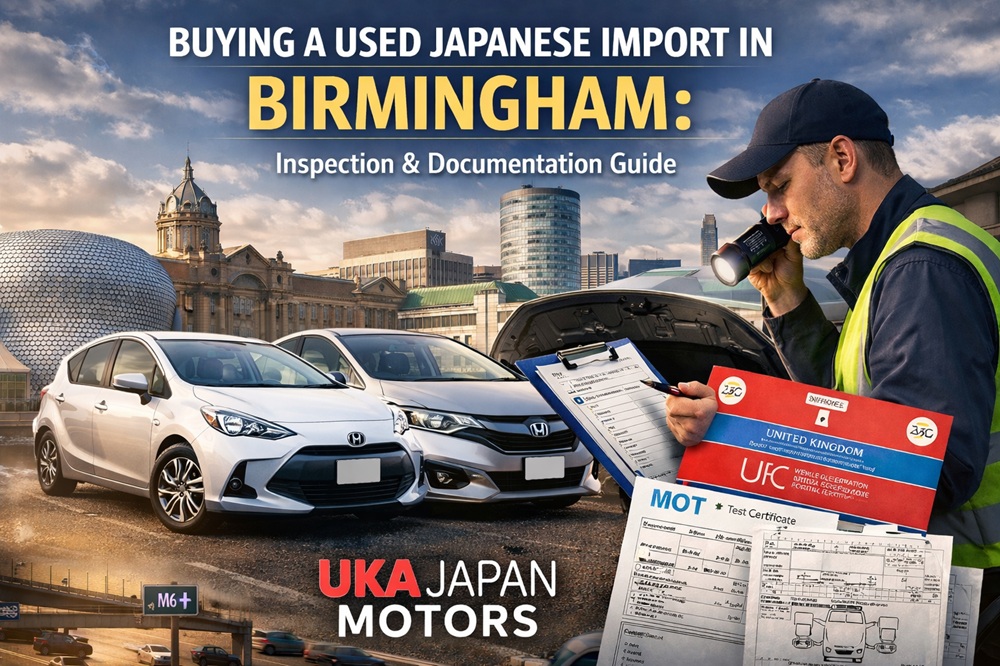
Japanese imports have become a familiar sight across Birmingham’s roads — from the city centre’s stop-start traffic to the steady motorway runs along the M6 and M42. Their reliability, build quality, and specification levels attract drivers across the West Midlands.
However, buying a used Japanese import in Birmingham requires more than a standard vehicle check. Inspection standards, compliance requirements, and documentation processes differ from buying a UK-supplied vehicle.
This guide explains:
- What a Japanese import is
- Why inspection is critical in Birmingham conditions
- What documentation must be verified
- How compliance works in England
- When imports are suitable — and when they may not be
It is written to help buyers make informed, inspection-focused decisions.
What Is a Used Japanese Import?
A Japanese import is a vehicle originally manufactured for the Japanese domestic market (JDM) and later brought into the UK.
Some are nearly new; others may have several years of use in Japan before arriving in England. Many feature:
- Higher factory specifications
- Advanced safety features
- Efficient petrol or hybrid drivetrains
- Automatic transmissions
Common examples seen in Birmingham include:
- Toyota Aqua
- Nissan Note
- Toyota Voxy
- Honda Fit
While these vehicles often arrive in excellent condition, they were not originally built for UK roads or regulations — which makes inspection and documentation review essential.
Why Inspection Matters Specifically in Birmingham
Birmingham’s driving environment places specific demands on vehicles:
- Congested city centre traffic
- Frequent short journeys
- Speed bumps and uneven residential roads
- Motorway commuting via the M6, M5 and M42
- Wet winters and salted roads
A Japanese import must be assessed not only for its condition on arrival but also for how well it will perform long-term in these local conditions.
Urban Stop-Start Driving
Hybrids such as the Toyota Aqua perform efficiently in traffic, but the hybrid battery system should be inspected carefully to confirm:
- Smooth transition between electric and petrol power
- No warning lights
- Stable charge behaviour
Motorway Stability
Vehicles originally designed for Japanese roads may have slightly different suspension tuning. On UK motorways, stability at higher speeds must be evaluated through:
- Steering alignment checks
- Suspension condition
- Brake responsiveness
Direct Answer: What Must Be Checked Before Buying?
Before purchasing a used Japanese import in Birmingham, you should verify:
- UK registration and V5C logbook
- MOT status and history
- Speedometer conversion (if applicable)
- Rear fog light compliance
- Tyre specifications suitable for UK roads
- Service records (Japanese and UK)
- Auction grading reports (if available)
- Signs of corrosion after UK winters
Failure to review these elements can lead to compliance issues or long-term ownership complications.
Inspection Checklist: Mechanical & Structural
1. Engine & Transmission
Japanese engines are known for reliability, but inspection should confirm:
- No fluid leaks
- Clean cold start
- Smooth gear transitions
- No hesitation under acceleration
Hybrids should be scanned electronically for stored fault codes.
2. Underbody & Corrosion
Japanese vehicles often arrive rust-free. However, Birmingham’s salted winter roads can accelerate corrosion if underbody protection is not adequate.
Inspect:
- Subframe
- Suspension mounting points
- Brake lines
- Exhaust system
Compare with a UK-supplied vehicle of similar age. Imports may initially have less corrosion — but only if protected correctly after arrival.
3. Suspension & Steering
Road surfaces across parts of Birmingham can be uneven. Check:
- Shock absorbers
- Bushings
- Steering rack response
- Wheel alignment
4. Brake System
Stop-start city traffic increases brake wear. Ensure:
- Even disc wear
- Smooth braking without vibration
- No ABS warning lights
Documentation Guide: What Must Be Verified
Documentation is where many buyers overlook critical details.
1. V5C Registration Certificate
The vehicle must be properly registered with the DVLA. The V5C should:
- Match the vehicle identification number (VIN)
- Show correct engine capacity
- Display accurate fuel type
Any mismatch must be clarified before purchase.
2. MOT History
Check:
- Previous advisories
- Repeated failures
- Brake or suspension trends
An import with consistent MOT results demonstrates stable UK adaptation.
3. Import Approval & Compliance
Depending on age and import route, vehicles may have required:
- Individual Vehicle Approval (IVA), or
- Mutual Recognition process
Ensure compliance modifications were properly completed, including:
- Rear fog light installation
- Speedometer reading in mph
- Headlight alignment suitable for UK traffic flow
4. Japanese Auction Sheet (If Available)
Many imports originate from Japanese auctions. Auction sheets provide:
- Structural grade
- Interior condition rating
- Accident history notation
This document can be extremely valuable when available.
Comparison: Japanese Import vs UK-Supplied Vehicle
| Aspect | Japanese Import | UK-Supplied Vehicle |
|---|---|---|
| Specification Level | Often higher | Varies |
| Service History Format | May begin in Japanese | UK-based |
| Corrosion at Arrival | Usually minimal | Varies |
| Compliance Checks Required | Yes | No |
| Resale Understanding | Requires buyer awareness | Widely familiar |
For Birmingham buyers, the key difference lies in documentation complexity and compliance history.
Insurance & Ownership Considerations in Birmingham
While many imports are insured without issue, some models may require additional documentation verification.
Before purchase:
- Confirm insurer acceptance
- Verify exact model code
- Ensure vehicle classification is accurate
Long-term ownership considerations include:
- Availability of parts
- Hybrid battery longevity
- Specialist diagnostic access
In most cases, common models like the Nissan Note or Honda Fit do not present major servicing challenges in Birmingham.
When a Japanese Import Makes Sense in Birmingham
A used Japanese import may be suitable if:
- You prioritise reliability
- You want higher factory specification
- You mainly drive urban routes
- You value efficient petrol or hybrid systems
When It May Not Be Suitable
It may not be ideal if:
- You prefer fully UK-documented lifetime service history
- You are uncomfortable verifying compliance paperwork
- You require certain UK-specific trim configurations
Practical Inspection Approach Before Purchase
- Conduct a full mechanical inspection
- Scan for diagnostic codes
- Verify underbody condition
- Review documentation line by line
- Check MOT advisories carefully
- Confirm registration accuracy
- Compare VIN on vehicle and paperwork
- Test drive in both city and motorway conditions
This structured approach reduces uncertainty.
Frequently Asked Questions
1. Are Japanese imports legal to drive in Birmingham?
Yes, provided they are properly registered, compliant with UK regulations, and hold a valid MOT certificate.
2. Do Japanese imports require special servicing?
Most mainstream models can be serviced using standard UK equipment, particularly widely available brands.
3. Is rust a concern?
Initially less common on arrival, but long-term corrosion depends on UK road exposure and underbody protection.
4. How do I verify auction history?
Auction sheets, when available, should match the vehicle’s VIN and grading details.
5. Are hybrid imports reliable in city driving?
Hybrid systems generally perform well in Birmingham’s traffic conditions if battery health is confirmed.
6. Does the speedometer need modification?
Yes, it must display miles per hour to meet UK standards.
7. Can MOT history reveal past issues?
Yes, repeated advisories often highlight recurring maintenance concerns.
8. Is documentation more complex than UK cars?
Yes. Imports require additional compliance verification compared to UK-supplied vehicles.
UKA Japan Motors: Inspection-Focused Approach in Birmingham
At UKA Japan Motors, the focus is placed on:
- Detailed mechanical inspection
- Compliance verification
- Documentation transparency
- Clear explanation of import history
- Long-term suitability for Birmingham driving conditions
The aim is not simply vehicle availability, but ensuring that each car aligns with UK regulatory requirements and practical ownership expectations.
Conclusion
Buying a used Japanese import in Birmingham can be a sound decision when inspection and documentation are treated with seriousness.
The vehicle’s mechanical condition, compliance modifications, registration accuracy, and MOT history all play essential roles in protecting long-term ownership confidence.
Japanese imports often provide strong engineering quality and specification advantages — but only when properly verified.
In Birmingham’s demanding urban and motorway environment, a careful, structured inspection process makes the difference between a confident purchase and avoidable complications.
Contact UKA Japan Motors for availability and inspection guidance.