


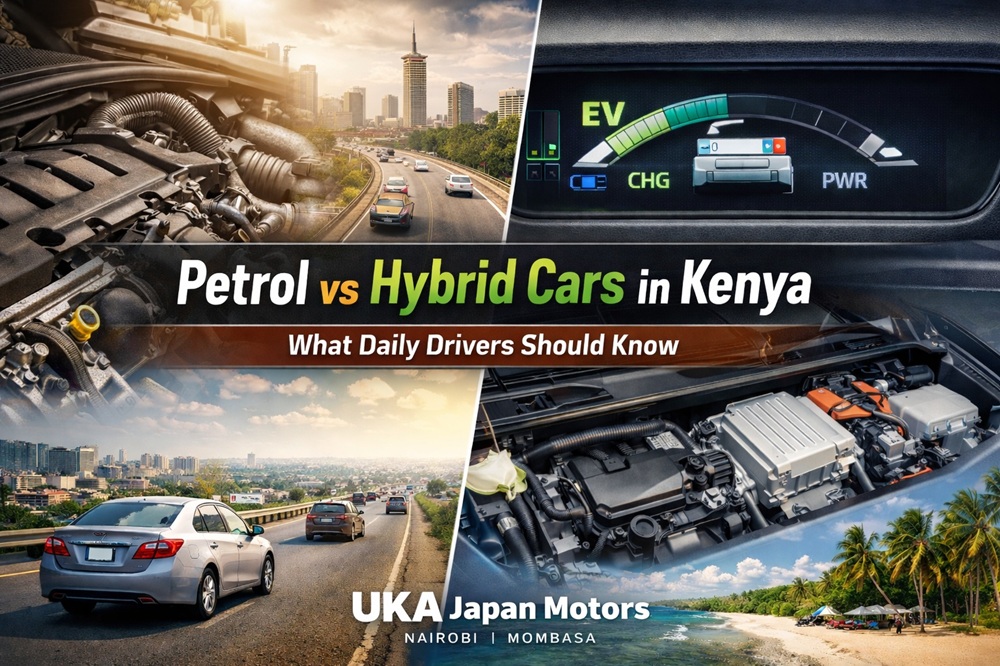
The choice between a petrol and a hybrid car in Kenya is no longer theoretical. It directly affects daily driving experience in Nairobi’s traffic congestion, long-distance highway travel between counties, and even vehicle durability in Mombasa’s coastal humidity.
This article explains:
- What petrol and hybrid vehicles are
- How they function under Kenyan driving conditions
- Maintenance and inspection realities
- Long-term ownership considerations
- Which type suits different driver profiles
The goal is not to promote one over the other, but to clarify how each works within Kenya’s real-world environment.
Direct Answer: Petrol vs Hybrid in Kenya
Petrol cars rely entirely on an internal combustion engine. They are mechanically simpler and widely supported by workshops across the country.
Hybrid cars combine a petrol engine with an electric motor and battery. They behave differently in stop-and-go traffic, especially in urban areas like Nairobi.
For heavy city traffic, hybrids operate differently. For long highway routes or rural use, petrol vehicles remain straightforward and dependable.
The best option depends on how and where the vehicle will be used daily.
Understanding Petrol Cars in the Kenyan Context
A petrol vehicle uses fuel combustion to generate all driving power. There is no traction battery or electric drive motor assisting the engine.
Common petrol configurations in Kenya include models such as the Toyota Premio, Toyota Fielder, and Nissan Note in their standard petrol versions.
Why Petrol Cars Remain Common in Kenya
- Mechanical familiarity – Most garages in Nairobi, Mombasa, and upcountry towns understand petrol engines well.
- Parts availability – Replacement parts are widely accessible.
- Rural suitability – In counties outside major cities, petrol vehicles are easier to maintain.
- Less electronic dependency – No high-voltage battery or inverter system.
However, petrol engines continue running while stationary in traffic, which affects daily operation in congested areas.
Understanding Hybrid Cars in Kenya
Hybrid vehicles combine:
- A petrol engine
- An electric motor
- A high-voltage battery
- A control system that switches between power sources
Well-known hybrid models on Kenyan roads include the Toyota Prius, Toyota Aqua, Toyota Fielder Hybrid, and Honda Fit Hybrid.
How Hybrid Systems Work in Daily Driving
At low speeds, the electric motor may power the vehicle alone. During braking, the system captures energy (regenerative braking) and stores it in the battery. The petrol engine activates when needed for higher speeds or additional power.
In Nairobi’s stop-and-go traffic, this switching behavior becomes noticeable.
Nairobi Traffic: A Major Consideration
Daily commuting in Nairobi often includes:
- Long idle periods
- Congested roundabouts
- Slow-moving traffic corridors
- Short urban trips
Petrol in Nairobi Traffic
- Engine remains running while stationary
- Fuel combustion continues during idling
- Brake components wear normally
Hybrid in Nairobi Traffic
- Engine may switch off at low speeds
- Electric drive assists in slow movement
- Regenerative braking reduces reliance on traditional brakes
For drivers commuting within areas such as Westlands, Kilimani, Upper Hill, or the CBD, hybrid systems behave differently than petrol systems during heavy congestion.
Mombasa’s Coastal Climate: What Changes?
Mombasa introduces environmental factors such as:
- Humidity
- Salt exposure
- Coastal air corrosion
Petrol Vehicles in Coastal Areas
- Exhaust systems require monitoring
- Underbody corrosion inspections are important
- Cooling systems must be maintained properly
Hybrid Vehicles in Coastal Areas
- Same corrosion concerns as petrol
- Additional attention to battery cooling systems
- Inspection of electrical connectors and wiring
Humidity does not automatically damage hybrid batteries, but proper inspection and maintenance become more important in coastal conditions.
Maintenance Differences in Kenya
Petrol Vehicle Maintenance
Routine servicing includes:
- Engine oil changes
- Spark plugs
- Air and fuel filters
- Cooling system checks
- Transmission servicing
Most workshops across Kenya can handle these procedures without specialized equipment.
Hybrid Vehicle Maintenance
In addition to standard engine servicing:
- Hybrid battery health diagnostics
- Inverter system inspection
- Battery cooling system cleaning
- High-voltage system checks
Hybrid servicing is not complicated, but it requires appropriate diagnostic tools and trained technicians, which are more commonly available in Nairobi than in smaller towns.
Long-Distance and Highway Use
For drivers regularly traveling between counties — for example Nairobi to Kisumu or Mombasa to Nairobi — petrol engines perform consistently over extended highway distances.
Hybrid vehicles still function normally on highways, but electric assistance is more limited at higher steady speeds. The petrol engine becomes the primary power source during sustained highway driving.
If most driving is highway-based rather than urban, the operational difference between petrol and hybrid may feel smaller.
Inspection Before Purchase or Import
Inspection quality matters more than engine type.
For Petrol Vehicles
- Confirm service history
- Inspect engine condition
- Check for oil leaks
- Verify mileage accuracy
- Assess underbody corrosion
For Hybrid Vehicles
All petrol checks, plus:
- Hybrid battery health verification
- Diagnostic scan for system errors
- Inverter and cooling system inspection
- Confirmation of no warning lights
Hybrid battery condition is especially important before import or purchase. Documentation and inspection reports provide clarity about system health.
Long-Term Ownership Considerations
Petrol Ownership Over Time
- Predictable servicing schedule
- Mechanical wear follows standard patterns
- No traction battery to monitor
Hybrid Ownership Over Time
- Battery health monitoring becomes relevant
- Cooling system cleanliness matters
- Electronic diagnostics occasionally required
Hybrid batteries are designed for durability, but condition depends on usage history and maintenance quality.
Environmental and Urban Impact
In dense urban areas like Nairobi:
- Hybrid vehicles reduce engine idling
- Emissions during low-speed driving are lower
- Urban air quality impact differs compared to continuous combustion
Petrol engines emit continuously while running, including when stationary.
For daily urban commuting, this operational difference is noticeable in real-world conditions.
When Petrol May Be More Suitable
Petrol vehicles may suit drivers who:
- Live in rural or remote counties
- Rely on smaller local garages
- Drive long highway distances frequently
- Prefer mechanical simplicity
When Hybrid May Be More Suitable
Hybrid vehicles may suit drivers who:
- Commute daily within Nairobi
- Spend significant time in traffic
- Prefer smoother low-speed operation
- Have access to hybrid diagnostic servicing
Frequently Asked Questions (FAQs)
1. Do hybrid cars need external charging in Kenya?
No. Standard hybrids charge automatically through regenerative braking and engine operation.
2. Is hybrid battery replacement common?
Not routinely. Battery condition depends on maintenance history and inspection.
3. Are petrol vehicles easier to repair outside major cities?
Yes. Most general mechanics are comfortable with petrol engines.
4. Do hybrids perform well on highways?
Yes. They operate normally, but electric assistance is less active at higher steady speeds.
5. Does Nairobi traffic favor hybrids?
Hybrids operate differently in stop-and-go traffic due to electric assistance and engine shut-off capability.
6. Does Mombasa’s climate damage hybrid batteries?
Humidity does not automatically damage batteries, but proper cooling system maintenance is important.
7. Are hybrid vehicles more complex?
They include additional electronic systems, which require diagnostic tools during servicing.
8. Which lasts longer — petrol or hybrid?
Longevity depends on maintenance, inspection history, and driving habits rather than fuel type alone.
The Importance of Inspection and Documentation
In Kenya, vehicle condition depends heavily on:
- Pre-shipment inspection
- Auction sheet verification
- Accurate mileage records
- Mechanical and electronic diagnostics
Whether petrol or hybrid, thorough inspection before purchase determines long-term reliability more than the engine type itself.
UKA Japan Motors’ Role in Guidance
With branches in Nairobi and Mombasa, UKA Japan Motors focuses on:
- Verified auction documentation
- Transparent inspection processes
- Compliance awareness
- Clear vehicle condition assessment
Hybrid vehicles require battery health review. Petrol vehicles require mechanical condition verification. Both require proper documentation before purchase or import.
The objective is informed decision-making based on inspection clarity, not trends.
Conclusion
Petrol and hybrid cars both operate effectively in Kenya, but their strengths differ depending on driving patterns.
In Nairobi’s congestion, hybrid systems behave differently due to electric assistance. On long highway routes and in rural areas, petrol vehicles remain mechanically straightforward and widely serviceable.
Climate, workshop access, driving habits, and inspection quality should guide the decision.
Understanding how each system functions under Kenyan conditions allows daily drivers to choose responsibly.
Contact UKA Japan Motors for availability and inspection guidance.