


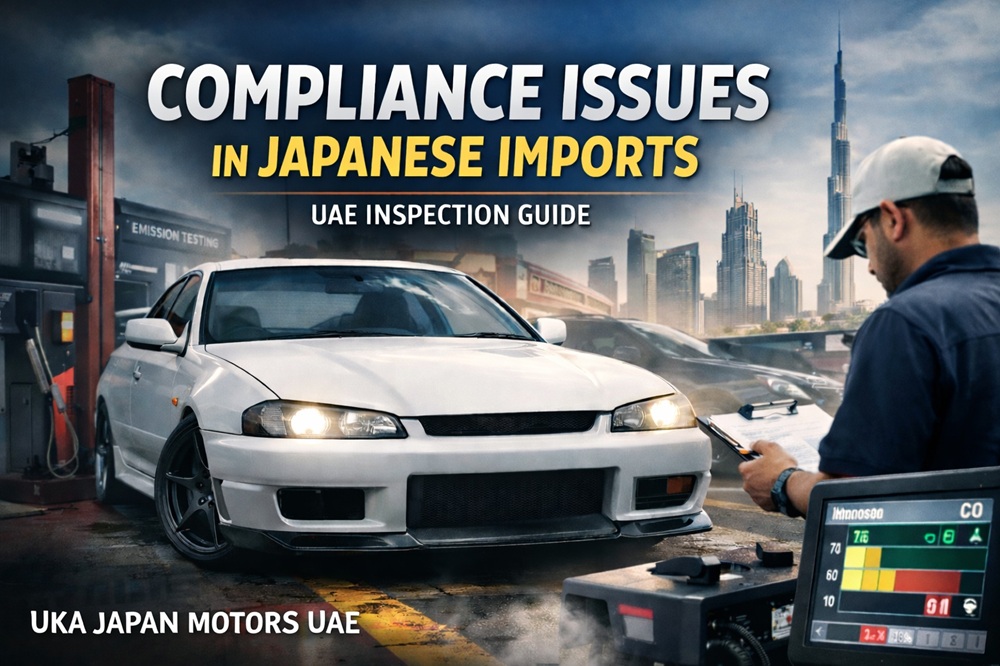
Quick answer
Japanese imports often fail initial UAE inspection due to lighting mismatches, undocumented modifications, emissions non-compliance, structural repairs, and missing safety or conformity documentation. These issues are usually fixable—but only if they’re identified before registration or resale timelines are affected.
This matters in the UAE because inspection standards are regulation-driven, climate-aware, and safety-focused, not cosmetic. What passes in Japan does not automatically pass in Dubai, Abu Dhabi, or Sharjah.
Why Japanese Imports Face Compliance Challenges in the UAE
Japanese vehicles are popular across the UAE for good reason: disciplined maintenance culture, low mileage, and strong mechanical reliability. But Japan’s domestic regulations (JDM standards) are fundamentally different from UAE inspection criteria.
Key differences that trigger inspection issues:
- Japan drives on the left-hand side (affects lighting and mirrors)
- Domestic Japanese regulations allow modifications not permitted in UAE
- Japan’s road, climate, and emissions environment differ sharply from the UAE
- Export paperwork often prioritizes shipping—not UAE registration readiness
UAE inspection centers—such as those governed by Roads and Transport Authority in Dubai and equivalent authorities in other emirates—inspect vehicles based on road safety, environmental compliance, and structural integrity, not market popularity.
1. Headlight & Lighting Configuration Failures
The most common inspection failure
Japanese imports frequently fail inspection due to incorrect beam pattern.
Why this happens
- Japanese vehicles are designed for left-side driving
- Headlights often dip the wrong direction, causing glare to oncoming traffic in the UAE
Typical inspection findings
- Beam cutoff incorrect for right-side driving
- JDM headlights without UAE-acceptable markings
- Aftermarket HID/LED conversions without proper leveling or certification
UAE compliance expectation
- Correct beam orientation
- Proper alignment and intensity
- Secure installation with no exposed wiring
This is not a cosmetic issue—it’s treated as a road safety violation.
2. Undocumented or Non-Compliant Modifications
Modifications are inspected more strictly than many buyers expect
Japanese imports often arrive with:
- Lowered suspension
- Non-stock exhaust systems
- Engine swaps or tuning
- Aftermarket steering wheels or seats
Why inspections fail
- Modifications not declared in import documentation
- Parts lacking UAE conformity certification
- Changes affecting emissions, noise levels, or structural safety
High-risk modifications
| Modification Type | Inspection Risk |
|---|---|
| Lowered suspension | Ride height & underbody clearance |
| Performance exhaust | Noise & emissions |
| Engine swaps | VIN/engine mismatch |
| Aftermarket lighting | Electrical & glare issues |
UAE inspectors prioritize traceability: if a modification exists, it must be explainable, documented, and safe.
3. Emissions & Exhaust Compliance Issues
Japan-passing emissions ≠ UAE-passing emissions
Even well-maintained Japanese vehicles can fail UAE emissions tests.
Common causes
- Catalytic converters removed or altered
- ECU tuning optimized for performance, not emissions
- Exhaust systems not designed for UAE testing thresholds
UAE inspection focus
- Functional catalytic converter
- Acceptable CO and HC levels
- No exhaust leaks or bypass systems
Hot climate conditions amplify emissions issues—what passes in cooler Japanese weather may fail in UAE heat.
4. Structural Repairs & Accident History Detection
Japanese auction grading is not enough for UAE inspectors
Some imports arrive with prior accident repairs that were:
- Acceptable for resale in Japan
- Undetectable without deep inspection
- Structurally altered but visually clean
Inspection red flags
- Weld marks on chassis rails
- Uneven panel alignment
- Repainted structural areas
- Airbag system inconsistencies
UAE inspection centers are trained to identify structural integrity risks, not just surface-level damage.
5. VIN, Chassis & Documentation Mismatches
Paperwork errors can stop registration entirely
This issue is more common than many buyers realize.
Typical problems
- Chassis number formatting differences
- Engine number not matching documents
- Japanese export certificate inconsistencies
- Missing or unclear import declarations
Why it matters
UAE registration systems require clear identity verification. Any mismatch—even if accidental—can delay or block approval.
6. Safety System Non-Compliance
Safety checks go beyond warning lights
UAE inspections test:
- Airbag system integrity
- ABS functionality
- Seatbelt condition and operation
- Warning indicators behaving correctly
Common failure causes
- Airbags deployed and replaced improperly
- Warning lights disabled rather than repaired
- JDM-specific safety configurations not recognized by UAE scanners
7. Cooling System & Climate Readiness Issues
UAE climate exposes weaknesses fast
Japanese vehicles are not always prepared for:
- Extended high-temperature idling
- Desert driving conditions
- Heavy AC usage
Inspection-related findings
- Cooling fans not engaging properly
- Radiators partially clogged
- AC systems underperforming or leaking
While not always an instant failure, these issues often surface during inspection or shortly after registration.
8. Tires, Wheels & Fitment Problems
Fitment is a compliance issue, not a style choice
Japanese imports often arrive with:
- Oversized wheels
- Incorrect load ratings
- Stretched tires
- Non-standard offsets
UAE inspectors assess:
- Tire load and speed ratings
- Clearance and steering lock safety
- Wheel security and alignment
Comparison: Issues by Risk Level
| Compliance Area | Inspection Risk Level |
|---|---|
| Headlights & lighting | Very High |
| Undocumented modifications | Very High |
| Emissions & exhaust | High |
| Structural repairs | High |
| Documentation mismatches | High |
| Safety systems | Medium–High |
| Cooling & climate readiness | Medium |
| Tires & wheels | Medium |
Who Is Most Affected by These Issues?
- First-time Japanese import buyers
- Buyers purchasing auction vehicles without UAE-focused inspection
- Enthusiasts importing modified JDM models
- Dealers sourcing vehicles without pre-compliance checks
How These Issues Can Be Avoided
The key is inspection before registration, not after.
Best practices:
- Conduct UAE-standard inspection before shipment or immediately upon arrival
- Verify lighting, emissions, and documentation early
- Treat modifications as compliance risks, not upgrades
- Use inspection professionals familiar with UAE authority standards, including requirements aligned with Ministry of Industry and Advanced Technology
Ownership & Long-Term Use Considerations in the UAE
A vehicle that barely passes inspection today may:
- Struggle at renewal inspection
- Require repeated compliance fixes
- Suffer accelerated wear in UAE climate
Compliance-ready vehicles are typically:
- Easier to insure
- Easier to resell
- Less stressful to own long-term
Frequently Asked Questions
1. Do all Japanese imports face inspection issues in the UAE?
No, but many face at least one compliance adjustment due to regulatory differences.
2. Are JDM headlights always rejected?
If beam pattern or certification is incorrect, yes—adjustment or replacement is required.
3. Are modifications automatically illegal?
No, but undocumented or unsafe modifications often fail inspection.
4. Can emissions failures be fixed?
In many cases, yes—once the root cause is identified.
5. Is auction grading enough to ensure compliance?
No. Auction grades focus on condition, not UAE regulations.
6. Do different emirates apply different standards?
Inspection procedures vary slightly, but core compliance expectations are consistent across the UAE.
7. Can paperwork issues delay registration?
Yes. Documentation mismatches are a common cause of delays.
8. Should inspection be done before or after shipping?
Ideally before purchase decision or immediately upon arrival to avoid compounding issues.
Why Inspection-Focused Importers Matter
An inspection-first approach:
- Reduces registration delays
- Prevents unexpected compliance costs
- Protects long-term ownership experience
This is especially critical for Japanese imports, where market appeal does not equal regulatory readiness.
Neutral Takeaway
Japanese imports remain a strong option in the UAE—but only when compliance is treated as a technical process, not an afterthought. Most inspection issues are predictable, preventable, and manageable when identified early.
Ignoring them simply shifts risk from the inspection bay to the owner.
Contact UKA Japan Motors for availability and inspection guidance.