


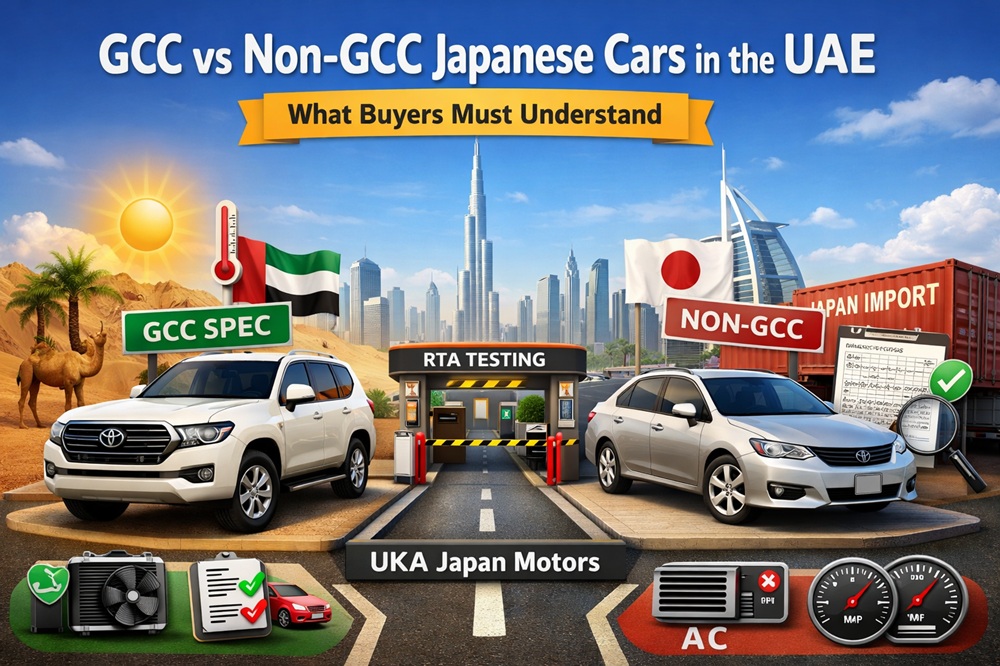
Buying a vehicle in the UAE often comes with one major question:
Should you choose a GCC-spec vehicle or a non-GCC Japanese import?
The terms are widely used in Dubai, Sharjah, Abu Dhabi, and across the Emirates — yet many buyers do not fully understand what they actually mean. Misunderstanding this difference can lead to incorrect assumptions about cooling systems, inspection results, registration requirements, and long-term ownership experience.
This guide explains:
- What GCC specification truly means
- What defines a non-GCC Japanese vehicle
- How both perform in UAE heat and traffic
- Inspection and RTA testing realities
- Insurance and documentation considerations
- Who each type suits — and when it may not be suitable
This is not about which option is “better.” It is about making an informed decision based on how you plan to use the vehicle in the UAE.
What Does “GCC Specification” Actually Mean?
GCC stands for Gulf Cooperation Council — the regional regulatory framework that includes the United Arab Emirates.
A GCC-spec vehicle is manufactured and distributed by the brand’s official regional dealer network specifically for Gulf markets.
For example:
- Al-Futtaim Motors distributes Toyota vehicles in the UAE
- Arabian Automobiles Company distributes Nissan vehicles in the Northern Emirates
These vehicles are built according to specifications required for Gulf climate, fuel standards, and regulatory compliance.
What Is a Non-GCC Japanese Vehicle?
A non-GCC Japanese vehicle typically refers to:
- A vehicle manufactured for the Japanese domestic market (JDM)
- Imported into the UAE independently
- Not originally distributed through the official UAE dealer network
These vehicles often arrive through ports such as Jebel Ali in Dubai or Sharjah Port, and are later tested and registered locally.
It is important to understand:
Non-GCC does not mean illegal or non-compliant.
It simply means the vehicle was not originally built for Gulf distribution.
Immediate Answer: Are Non-GCC Japanese Cars Suitable for the UAE?
Yes — if properly inspected, verified, and maintained.
However, suitability depends on:
- Cooling system condition
- AC system performance
- Accident history
- Compliance with UAE testing standards
- Proper documentation
A poorly inspected vehicle — whether GCC or non-GCC — can cause ownership problems.
The key factor is verification, not origin label.
Climate Considerations: The UAE Heat Factor
The UAE climate is one of the most demanding in the world.
Summer temperatures regularly exceed 45°C. Vehicles operate in:
- Long traffic queues
- High-speed highways
- Heavy AC usage
- Sand exposure
- Stop-and-go urban driving
Let’s compare how GCC and non-GCC vehicles handle this.
1. Cooling System Differences
GCC vehicles are often configured with:
- Larger radiators
- Heavy-duty cooling fans
- High-temperature coolant specifications
- Optimized AC condensers
Japanese domestic vehicles are engineered for a milder climate.
However, modern Japanese cars — especially post-2010 models — are generally robust enough for UAE conditions if the cooling system is healthy.
What matters more than origin:
- Radiator cleanliness
- Thermostat condition
- Water pump health
- Proper coolant type
- AC compressor performance
An older GCC vehicle with neglected cooling maintenance can overheat faster than a properly maintained Japanese import.
2. Air Conditioning Performance
In the UAE, AC performance is not a luxury — it is essential.
GCC vehicles are typically calibrated for stronger cooling performance.
Japanese imports may:
- Require AC servicing upon arrival
- Need refrigerant recharge
- Show reduced performance if neglected
Before purchasing, always test:
- Idle cooling performance
- Highway cooling performance
- AC at full load in peak daytime heat
RTA Testing and Registration in Dubai
All vehicles — GCC and non-GCC — must pass inspection before registration.
In Dubai, this is handled through the Roads and Transport Authority (RTA).
RTA inspection includes:
- Brake efficiency testing
- Suspension check
- Chassis/VIN verification
- Emissions testing
- Structural integrity check
- Headlight alignment
- Tire condition
Common Myths
Myth: Non-GCC vehicles automatically fail RTA.
Reality: Failure depends on condition, not origin.
Common failure reasons:
- Accident repair issues
- Incorrect headlight alignment
- Modified exhaust systems
- Chassis damage
- Warning lights active
A properly inspected Japanese import can pass without difficulty.
Insurance Considerations in the UAE
Insurance companies may classify vehicles differently based on origin.
Key considerations:
- Vehicle valuation method
- Accident history transparency
- Import documentation clarity
Proper documentation should include:
- Export certificate
- Auction sheet (if applicable)
- Customs clearance documents
- UAE inspection certificate
Clear paperwork reduces insurance complications.
Speedometer and Instrument Differences
Japanese domestic vehicles sometimes have:
- Speedometer primarily in km/h (which is fine for UAE)
- Navigation systems in Japanese
- Infotainment systems requiring language change
Most of these are minor usability adjustments, not compliance problems.
Resale Perception in the UAE
Market perception plays a role.
Some buyers prefer GCC vehicles because:
- They associate them with dealer history
- They believe cooling systems are stronger
- They assume resale will be easier
However, resale value depends heavily on:
- Mileage accuracy
- Accident-free status
- Service records
- Clean inspection history
A verified Japanese import with clean documentation can maintain strong resale demand.
Ownership Reality: Which One Suits You?
GCC Vehicle May Suit You If:
- You prefer official dealer-distributed vehicles
- You value local service familiarity
- You want a vehicle originally built for Gulf distribution
Non-GCC Japanese Vehicle May Suit You If:
- You want access to Japan-only trims
- You value detailed auction grading transparency
- You prefer direct import history visibility
When a Non-GCC Vehicle May Not Be Suitable
- If accident history cannot be verified
- If cooling system condition is unknown
- If documentation is incomplete
- If the vehicle has been heavily modified
Verification is essential.
Inspection Matters More Than Label
A crucial truth in the UAE automotive market:
Origin label does not guarantee reliability.
Condition, documentation, and inspection history determine long-term ownership success.
A neglected GCC vehicle can cause more issues than a carefully verified Japanese import.
Practical Inspection Checklist Before Buying
Whether GCC or non-GCC, check:
- VIN consistency across chassis and documents
- Underbody corrosion or repair marks
- AC cooling under high temperature
- Cooling fan operation
- Radiator leaks
- Transmission smoothness
- Brake vibration
- Suspension noise
- OBD diagnostic scan results
Long-Term Ownership Considerations in the UAE
- Regular coolant maintenance is critical
- AC servicing before summer is essential
- Avoid overheating situations
- Keep service documentation organized
- Re-test after major repairs
Dubai traffic and UAE climate reward preventive maintenance.
Frequently Asked Questions (FAQ)
1. Can non-GCC Japanese cars be registered in Dubai?
Yes, if they pass RTA inspection and have complete import documentation.
2. Do non-GCC cars overheat in UAE summers?
Not if the cooling system is properly maintained.
3. Are GCC cars always more reliable?
Reliability depends on maintenance history, not specification label alone.
4. Does insurance cost differ between GCC and non-GCC?
Insurance terms may vary based on documentation clarity and valuation method.
5. Are spare parts available for Japanese imports?
Yes. Many parts are compatible with regional models.
6. Do Japanese imports pass emissions tests?
If properly maintained and unmodified, they can meet UAE requirements.
7. Is resale harder for non-GCC vehicles?
Resale depends on condition, mileage verification, and documentation.
8. Should I avoid non-GCC vehicles completely?
Avoid poorly documented vehicles — not necessarily non-GCC ones.
The Role of Professional Verification
At UKA Japan Motors, every vehicle is evaluated with focus on:
- Structural integrity
- Cooling system health
- Auction grade transparency
- Documentation completeness
- Compliance with UAE testing standards
Our approach prioritizes condition verification over origin labeling.
Conclusion
GCC and non-GCC Japanese vehicles both operate successfully in the UAE — when properly inspected and maintained.
The difference lies not in the badge, but in:
- Documentation
- Condition
- Transparency
- Compliance readiness
A well-verified vehicle — regardless of origin — can provide reliable performance in Dubai’s demanding climate and traffic conditions.
The key is informed decision-making.
Contact UKA Japan Motors for availability and inspection guidance.