


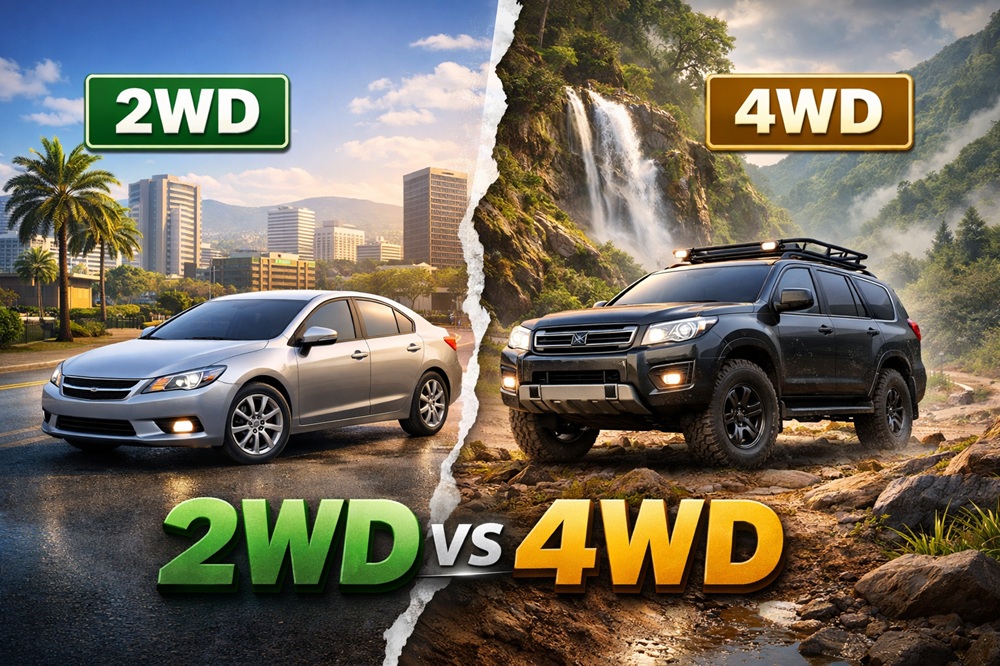
Choosing between a 2WD (Two-Wheel Drive) and 4WD (Four-Wheel Drive) vehicle is one of the most important decisions Jamaican drivers make when importing or purchasing a used vehicle. While the difference may seem technical, it directly affects how your vehicle performs in Kingston traffic, hillside communities, coastal areas, and rural roads.
In Jamaica, driving conditions vary significantly. Urban commuting in Kingston involves stop-and-go traffic and tight parking spaces. In contrast, rural parishes may include steep inclines, uneven surfaces, and roads affected by heavy rainfall. Because of this variation, the drivetrain type matters more than many buyers initially realize.
This article explains:
- What 2WD and 4WD actually mean
- How each system works
- Which suits different Jamaican driving conditions
- Inspection considerations before import and registration
- Long-term ownership implications
- When one option may not be suitable
By the end, you will understand which drivetrain aligns with your daily driving needs.
Direct Answer: Which One Should You Choose?
In Jamaica:
- 2WD vehicles are generally suitable for city driving, regular highway use, and drivers who primarily commute within Kingston or other urban areas.
- 4WD vehicles are better suited for hilly terrain, rural districts, construction zones, farming areas, and locations where roads may become slippery during heavy rainfall.
The correct choice depends on where and how you drive, not simply on preference.
What Is 2WD (Two-Wheel Drive)?
A 2WD vehicle delivers engine power to only two wheels. These wheels can either be:
- Front wheels (FWD – Front-Wheel Drive)
- Rear wheels (RWD – Rear-Wheel Drive)
Most passenger cars imported into Jamaica, including compact sedans and small crossovers, are front-wheel drive.
How 2WD Works
In a 2WD system:
- The engine sends power through the transmission.
- Power is transferred to either the front or rear axle.
- Only two wheels are responsible for moving the vehicle.
This design is mechanically simpler than 4WD.
Why 2WD Is Common in Kingston
Kingston’s primary roads are paved and maintained. Daily commuting typically includes:
- Traffic congestion
- Short-distance travel
- Urban intersections
- Moderate highway speeds
For these conditions, a 2WD system performs efficiently and reliably.
What Is 4WD (Four-Wheel Drive)?
A 4WD vehicle sends power to all four wheels. This improves traction and control in challenging conditions.
Most 4WD systems are found in:
- SUVs
- Pickup trucks
- Larger crossovers
- Off-road capable vehicles
How 4WD Works
In addition to the transmission, a 4WD system includes:
- A transfer case
- Front and rear differentials
- Additional driveshaft components
Power is distributed to both axles, allowing all four wheels to contribute to movement.
Some systems are:
- Part-time 4WD (driver manually engages 4WD)
- Full-time 4WD (all wheels powered continuously)
- Automatic systems (engage when traction loss is detected)
Comparing 2WD and 4WD for Jamaican Driving Conditions
1. City Driving in Kingston
For drivers commuting between areas such as Half-Way-Tree, New Kingston, and Portmore:
2WD Advantages:
- Simpler drivetrain
- Efficient in stop-and-go traffic
- Lower mechanical complexity
- Smoother steering feel in tight parking
4WD in the City:
- Provides no significant advantage on dry paved roads
- Slightly heavier drivetrain
- More components requiring inspection
For purely urban use, 2WD is generally sufficient.
2. Hillside Communities
In areas with steep gradients:
- Red Hills
- Stony Hill
- Rural Clarendon
- Hilly sections of St. Andrew
4WD provides better traction when:
- Starting on steep inclines
- Driving during heavy rainfall
- Navigating uneven road surfaces
A 2WD vehicle can manage hills, but traction may be reduced if road surfaces are slippery.
3. Rainy Season Performance
Jamaica experiences periods of intense rainfall. During these times:
- Roads can become slick
- Flood-prone areas may accumulate standing water
- Rural dirt roads may soften
4WD offers improved grip under low-traction conditions. However, it does not eliminate the need for proper tires and careful driving.
It is important to understand:
4WD improves traction, not braking distance.
4. Rural and Farming Use
For agricultural, construction, or remote-area driving:
- Gravel roads
- Muddy surfaces
- Uneven terrain
4WD vehicles provide clear functional advantages.
2WD vehicles in these conditions may:
- Lose traction
- Struggle on loose surfaces
- Experience higher tire wear
Inspection Considerations Before Importing
When importing a used vehicle into Jamaica, drivetrain condition must be carefully evaluated.
2WD Inspection Points
- Front or rear axle condition
- CV joints (for front-wheel drive)
- Transmission smoothness
- Differential noise (if rear-wheel drive)
These systems are generally straightforward to inspect.
4WD Inspection Points
A 4WD vehicle requires additional evaluation:
- Transfer case operation
- Front differential function
- Rear differential condition
- Drive shaft integrity
- Engagement mechanism (if selectable 4WD)
Because of increased mechanical complexity, inspection must be thorough before shipment and registration.
Maintenance Differences Over Time
2WD Maintenance
- Fewer moving components
- Lower drivetrain complexity
- Fewer lubrication points
This makes long-term servicing simpler.
4WD Maintenance
- Additional differential fluids
- Transfer case servicing
- More drivetrain joints and seals
In Jamaica’s humid and coastal climate, proper maintenance is critical to prevent corrosion and seal deterioration.
Fuel Efficiency Considerations
While this article does not focus on cost, drivetrain design affects fuel consumption patterns.
2WD vehicles are generally:
- Lighter
- Less mechanically resistant
- More efficient in standard road conditions
4WD systems add weight and mechanical drag, which may slightly affect fuel usage in daily city driving.
When 2WD May Not Suit You
2WD may not be ideal if:
- You frequently drive in rural parishes
- Your home is located on steep terrain
- You operate in construction or agricultural environments
- You encounter muddy or loose surfaces regularly
In these situations, traction becomes a priority.
When 4WD May Not Suit You
4WD may not be necessary if:
- You drive primarily within Kingston
- Your travel is mostly highway commuting
- You rarely encounter unpaved roads
- You prioritize mechanical simplicity
Choosing 4WD without needing it adds complexity without clear benefit.
Registration and Documentation in Jamaica
When importing either drivetrain type:
- The vehicle must meet age and compliance requirements.
- Engine and chassis numbers must match documentation.
- Drivetrain configuration must align with registration records.
For 4WD vehicles, inspection may include confirmation that the drivetrain system operates correctly, particularly if the vehicle includes selectable modes.
Accurate documentation prevents delays in processing and registration.
Ownership Patterns in Jamaica
In Kingston, most daily drivers choose 2WD sedans and compact crossovers.
In rural parishes and hillside communities, 4WD SUVs and pickup trucks are more common due to terrain demands.
Choosing the correct drivetrain should reflect your long-term lifestyle and typical road exposure.
Practical Example Comparison
| Condition | 2WD Performance | 4WD Performance |
|---|---|---|
| Kingston Traffic | Fully adequate | No added benefit |
| Highway Driving | Smooth and stable | Smooth but heavier |
| Steep Hills | May struggle in rain | Strong traction |
| Mud/Gravel | Limited grip | Improved control |
| Maintenance Simplicity | Higher | Moderate complexity |
Long-Term Reliability Considerations
Both systems can be reliable when properly maintained.
However:
- 2WD systems have fewer wear points.
- 4WD systems require regular servicing of multiple drivetrain components.
In Jamaica’s climate, rust protection and fluid maintenance are essential for both.
Frequently Asked Questions (FAQ)
1. Is 4WD safer than 2WD?
4WD improves traction in low-grip conditions but does not automatically improve braking performance. Safe driving habits remain essential.
2. Can a 2WD SUV handle Jamaican hills?
Yes, in most cases. However, traction may decrease on steep wet surfaces.
3. Is 4WD necessary for Kingston driving?
For purely urban driving, it is generally not necessary.
4. Does 4WD mean better control in rain?
It improves traction during acceleration, but careful driving is still required.
5. Are 4WD vehicles harder to inspect before import?
They require more detailed drivetrain checks due to additional components.
6. Do 2WD vehicles consume less fuel?
They are typically lighter and mechanically simpler, which may improve efficiency in city driving.
7. Can 4WD systems fail if not used?
Selectable 4WD systems should be engaged periodically to maintain proper operation.
8. Is maintenance more complex for 4WD?
Yes, due to extra differentials and transfer case servicing requirements.
How UKA Japan Motors Supports the Process
Selecting between 2WD and 4WD requires understanding not only terrain but also inspection history and drivetrain condition.
UKA Japan Motors focuses on:
- Verifying drivetrain type before shipment
- Reviewing auction and inspection records
- Checking mechanical integrity of differentials and transfer systems
- Ensuring documentation aligns with registration requirements
Proper verification reduces uncertainty and ensures the vehicle suits Jamaican driving conditions.
Conclusion
The difference between 2WD and 4WD is not about preference—it is about suitability.
For Kingston commuters and standard highway driving, 2WD offers simplicity and practicality. For drivers navigating steep hills, rural terrain, or challenging road conditions, 4WD provides enhanced traction and confidence.
Understanding your driving environment is the key factor. Choose the drivetrain that matches your daily reality, not just appearance or assumption.
Contact UKA Japan Motors for availability and inspection guidance.