


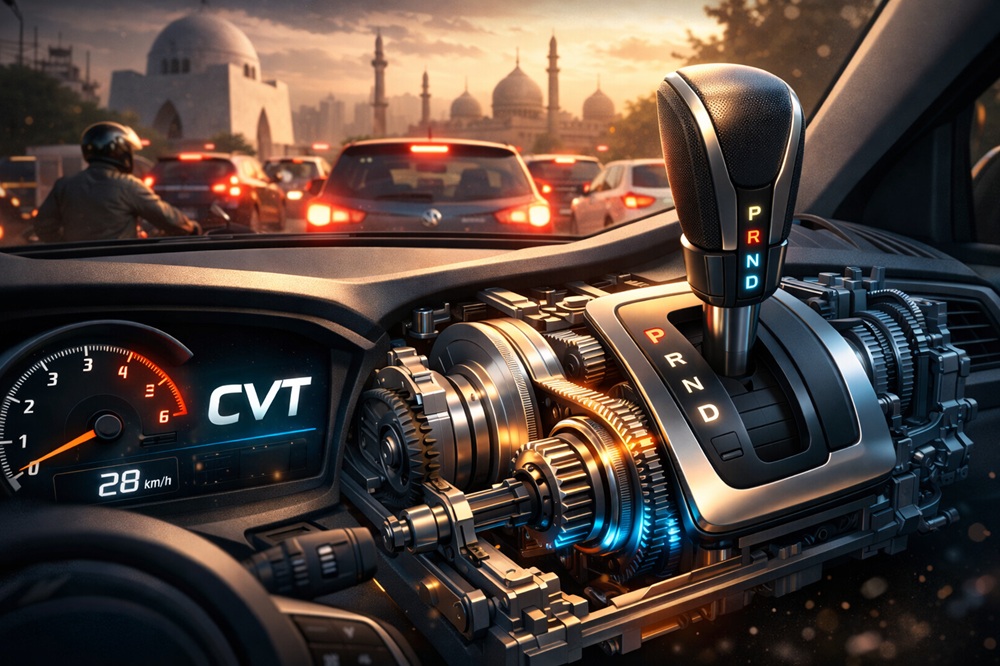
Urban driving places very specific demands on a vehicle’s transmission system. In cities such as Karachi and Lahore, drivers frequently encounter long stretches of slow-moving traffic, repeated stop-and-go conditions, crowded intersections, and daily commutes that involve constant speed adjustments.
These conditions affect how a transmission operates, how efficiently it delivers power, and how quickly components experience wear. Over the past decade, many imported Japanese vehicles entering Pakistan have been equipped with Continuously Variable Transmissions (CVT) rather than conventional automatic gearboxes.
While CVT technology offers smooth power delivery and efficient engine operation, its behaviour in dense city traffic often surprises drivers who are more familiar with traditional automatic transmissions. The absence of fixed gear shifts, the way engine speed rises during acceleration, and the unique feel during slow driving can create confusion about whether the transmission is functioning correctly.
Understanding how CVT systems operate in daily urban conditions helps drivers interpret normal behaviour, recognize early warning signs of potential issues, and maintain the transmission properly over long periods of use.
Quick Answer: How CVT Transmissions Behave in City Traffic
A CVT transmission adjusts engine speed continuously rather than shifting between fixed gears. In heavy urban traffic, this means:
-
Acceleration often feels smooth without noticeable gear shifts
-
Engine RPM may rise steadily before vehicle speed increases
-
Low-speed crawling feels gradual rather than stepped
-
Frequent speed changes are handled without gear changes
This behaviour is normal and reflects how the CVT manages power delivery during slow and variable driving conditions.
However, city driving also places unique demands on the transmission due to constant throttle adjustments, frequent braking, and prolonged low-speed operation.
How a CVT Transmission Works
A CVT operates differently from both manual and conventional automatic transmissions. Instead of shifting between fixed gears, it uses a belt-and-pulley system that changes ratios continuously.
The system typically includes:
-
A primary pulley connected to the engine
-
A secondary pulley connected to the wheels
-
A metal belt or chain connecting both pulleys
-
Hydraulic or electronic controls adjusting pulley width
As pulley diameters change, the transmission adjusts the effective gear ratio. This allows the engine to operate within an efficient speed range while vehicle speed varies.
Unlike traditional gearboxes where the driver feels gear changes, a CVT maintains smooth and uninterrupted power delivery.
Why CVT Transmissions Feel Different in Stop-and-Go Traffic
Drivers accustomed to traditional automatic transmissions often notice several behavioural differences when driving a CVT-equipped vehicle in urban traffic.
Lack of Gear Shifts
Traditional automatics shift between discrete gears. Each shift produces a noticeable change in engine sound and vehicle acceleration.
A CVT eliminates these steps entirely. Instead, acceleration feels more gradual and continuous.
Engine RPM Behaviour
In many situations, the engine speed may increase before the vehicle gains speed. This can feel unusual for drivers expecting engine speed to rise gradually with vehicle speed.
This behaviour occurs because the transmission is adjusting the pulley ratio to maintain efficient engine operation.
Smooth Low-Speed Movement
During slow crawling in traffic jams or congested roads, CVT transmissions allow the vehicle to move forward gradually without sudden gear changes.
This smooth behaviour is particularly useful in urban environments where vehicles frequently move in short bursts.
Urban Driving Conditions in Karachi and Lahore
City traffic environments influence how CVT transmissions perform. Karachi and Lahore share several characteristics that affect daily driving:
Extended Traffic Congestion
Major urban routes often experience prolonged congestion. Vehicles may spend long periods moving slowly or remaining stationary.
In these situations, the transmission constantly adjusts ratios to match small throttle inputs.
Frequent Acceleration Cycles
Drivers repeatedly accelerate and decelerate due to traffic signals, pedestrian crossings, and crowded roads.
This repeated speed variation requires the CVT system to continuously adjust pulley ratios.
Long Commutes
Daily travel distances in large urban areas can involve extended driving periods. Even when speeds are low, long travel times increase transmission operating hours.
Road Surface Variations
Uneven road conditions, potholes, and inconsistent pavement can lead to frequent speed adjustments and throttle modulation.
All of these factors influence transmission load and operating behaviour.
How CVT Systems Respond to Slow Urban Movement
When driving slowly in traffic, a CVT typically operates in lower ratios that prioritize torque rather than speed.
This allows the vehicle to move forward smoothly with minimal throttle input. Instead of shifting between first and second gear like a traditional automatic transmission, the CVT gradually adjusts the pulley ratio to match the required power output.
This behaviour produces several noticeable characteristics:
-
Smooth creeping movement when releasing the brake
-
Minimal jolts during slow acceleration
-
Reduced gear-hunting during low-speed driving
These characteristics are particularly beneficial in heavy traffic environments.
Comparison: CVT vs Traditional Automatic in City Driving
Understanding the difference between transmission types helps explain why CVT behaviour can feel unusual at first.
CVT Transmission
-
No fixed gears
-
Smooth acceleration
-
Continuous ratio changes
-
Engine speed often independent of vehicle speed
Traditional Automatic Transmission
-
Fixed gear steps
-
Noticeable gear shifts
-
Engine speed closely tied to gear changes
-
Acceleration occurs through gear progression
While both systems can perform effectively in urban traffic, their operating characteristics are fundamentally different.
Drivers transitioning from conventional automatics often require time to adjust to CVT behaviour.
Heat and Transmission Load in Urban Traffic
Urban traffic creates conditions that increase transmission heat generation.
CVT systems rely on hydraulic pressure and friction between the belt and pulleys to transmit power. Continuous ratio adjustments during slow driving generate heat within the transmission fluid.
In cities with warm climates, ambient temperatures can further increase operating temperatures.
This makes proper transmission fluid condition particularly important for long-term reliability.
How Driving Habits Affect CVT Performance
Driving style has a direct influence on how a CVT transmission behaves and how quickly internal components experience wear.
Sudden Throttle Inputs
Aggressive acceleration places additional load on the belt and pulleys.
While the transmission is designed to handle acceleration, repeated sudden throttle inputs increase mechanical stress.
Constant Speed Adjustments
Frequent small throttle changes during congested driving require the transmission to constantly alter ratios.
This behaviour is normal but increases internal activity within the transmission.
Prolonged Idle Movement
Slow creeping in traffic jams means the transmission remains active even when vehicle speed is extremely low.
Maintaining smooth throttle control helps reduce unnecessary load.
Signs Drivers Often Misinterpret as Transmission Problems
Certain CVT behaviours are commonly mistaken for mechanical issues.
Rising Engine Speed Without Immediate Acceleration
Drivers may believe the transmission is slipping. In reality, the CVT is adjusting ratios to deliver power efficiently.
Smooth Acceleration Without Gear Changes
Some drivers expect to feel gear shifts. The absence of these shifts is normal for CVT systems.
Engine Sound Changes During Acceleration
Engine speed may remain steady while vehicle speed increases. This reflects the transmission maintaining a constant engine operating range.
Recognizing these behaviours as normal prevents unnecessary concern.
Inspection Considerations for CVT Transmissions
When importing vehicles or evaluating a used vehicle equipped with a CVT transmission, several inspection points are important.
Transmission Fluid Condition
CVT systems rely heavily on fluid for hydraulic pressure and cooling. Fluid contamination or degradation can affect performance.
Inspection may involve checking fluid colour and consistency.
Diagnostic System Checks
Modern vehicles store transmission-related data in electronic control systems. Diagnostic scans may reveal stored fault codes related to transmission operation.
Road Test Observations
During a driving inspection, technicians observe acceleration smoothness, unusual vibrations, and abnormal noises.
Any irregular behaviour during acceleration or deceleration may indicate the need for further inspection.
Long-Term Ownership Considerations
Drivers planning to use CVT-equipped vehicles for daily commuting should consider several long-term factors.
Maintenance Awareness
Routine inspection of transmission fluid and general drivetrain components supports reliable operation.
Driving Environment
Vehicles regularly used in dense traffic experience different operating conditions compared to vehicles used primarily on open highways.
Mechanical Familiarity
Understanding how the transmission behaves allows drivers to identify genuine problems rather than normal operating characteristics.
This knowledge helps avoid unnecessary repairs and ensures that maintenance decisions are based on accurate observations.
The Role of Vehicle Import Inspection
Imported vehicles often arrive with different usage histories. Some may have been driven primarily in urban conditions similar to those found in Pakistan.
Inspection processes typically involve:
-
Verification of transmission operation
-
Examination of diagnostic data
-
Physical inspection of drivetrain components
Independent inspection helps confirm that the transmission operates smoothly and shows no signs of internal damage.
This step is particularly important when purchasing imported vehicles with advanced drivetrain systems.
Frequently Asked Questions
1. Why does my engine rev higher before the car accelerates?
This occurs because the CVT adjusts the transmission ratio to deliver power efficiently. Engine speed may increase before vehicle speed rises.
2. Is it normal for a CVT transmission to feel different from a traditional automatic?
Yes. CVT systems operate without fixed gears, which creates a different driving feel.
3. Does stop-and-go traffic affect CVT transmissions?
Urban traffic requires constant ratio adjustments, which increases transmission activity but is part of normal operation.
4. Why does my car move smoothly when I release the brake in traffic?
Many CVT vehicles allow gradual forward movement using low transmission ratios designed for slow driving.
5. Should engine sound remain constant during acceleration?
In some situations, the engine may maintain a steady speed while the transmission adjusts ratios.
6. Can road conditions affect CVT behaviour?
Yes. Uneven roads and frequent speed adjustments require the transmission to constantly adapt to changing conditions.
7. Do CVT transmissions require inspection when importing a vehicle?
Transmission operation is typically included in vehicle inspection procedures before and after import.
8. Are unusual noises from a CVT transmission normal?
Unusual grinding or whining noises should always be inspected, as they may indicate mechanical wear.
UKA Japan Motors Inspection Approach
Understanding transmission behaviour is an important part of evaluating imported vehicles. CVT systems involve precise mechanical and electronic components, making accurate inspection essential.
At UKA Japan Motors, vehicle evaluation focuses on verifying that drivetrain systems operate correctly and that transmission behaviour reflects normal mechanical operation rather than hidden faults.
This includes reviewing inspection records, evaluating diagnostic data where available, and ensuring that vehicles entering the market meet proper mechanical expectations.
Such inspection practices help buyers understand the actual condition of a vehicle’s transmission before ownership begins.
Conclusion
CVT transmissions behave differently from traditional automatic gearboxes, particularly in dense urban environments where vehicles experience frequent speed changes and prolonged traffic congestion.
Understanding how the system operates helps drivers interpret normal transmission behaviour, recognize potential warning signs, and maintain their vehicles effectively.
For drivers navigating the busy roads of Karachi and Lahore, familiarity with CVT behaviour allows for smoother driving experiences and more informed ownership decisions over time.
Contact UKA Japan Motors for availability and inspection guidance.