


Introduction
For many Kingston buyers, a Japanese used car is not chosen only because it is available within the permitted import age. It is chosen because it needs to work well in real conditions: slow traffic through Half-Way Tree, tight parking near New Kingston, heat around downtown Kingston, hillside climbs above Constant Spring, and regular stop-start movement between home, work, school, errands, and weekend travel.
A “5-year-eligible” Japanese used car refers to a vehicle young enough to remain comfortably within Jamaica’s import-age framework while still giving the buyer a practical ownership window. Jamaica’s current motor vehicle import guidance lists motor cars such as sedans, station wagons, and SUVs as not exceeding six years at importation, while motorcycles are listed at five years; the Trade Board also outlines the import permit process, pre-shipment inspection, and required documents for used vehicles. The Jamaica Customs Agency also lists the age limits for sedans, station wagons, SUVs, and other categories. This article uses “five-year-eligible” in a practical buyer sense: vehicles that remain comfortably inside the import window and give Kingston buyers a sensible balance of age, inspection readiness, parts familiarity, and daily usability.
The goal is not to name the flashiest vehicles. It is to identify Japanese used cars that make sense for Kingston ownership, where the vehicle must handle traffic, heat, rough patches, parking limitations, fuel-quality sensitivity, documentation checks, and long-term maintenance habits.
UKA Japan Motors’ editorial standards require articles to be educational, Jamaica-focused, inspection-aware, and practical rather than promotional.
Direct Answer: The Top 5 Choices
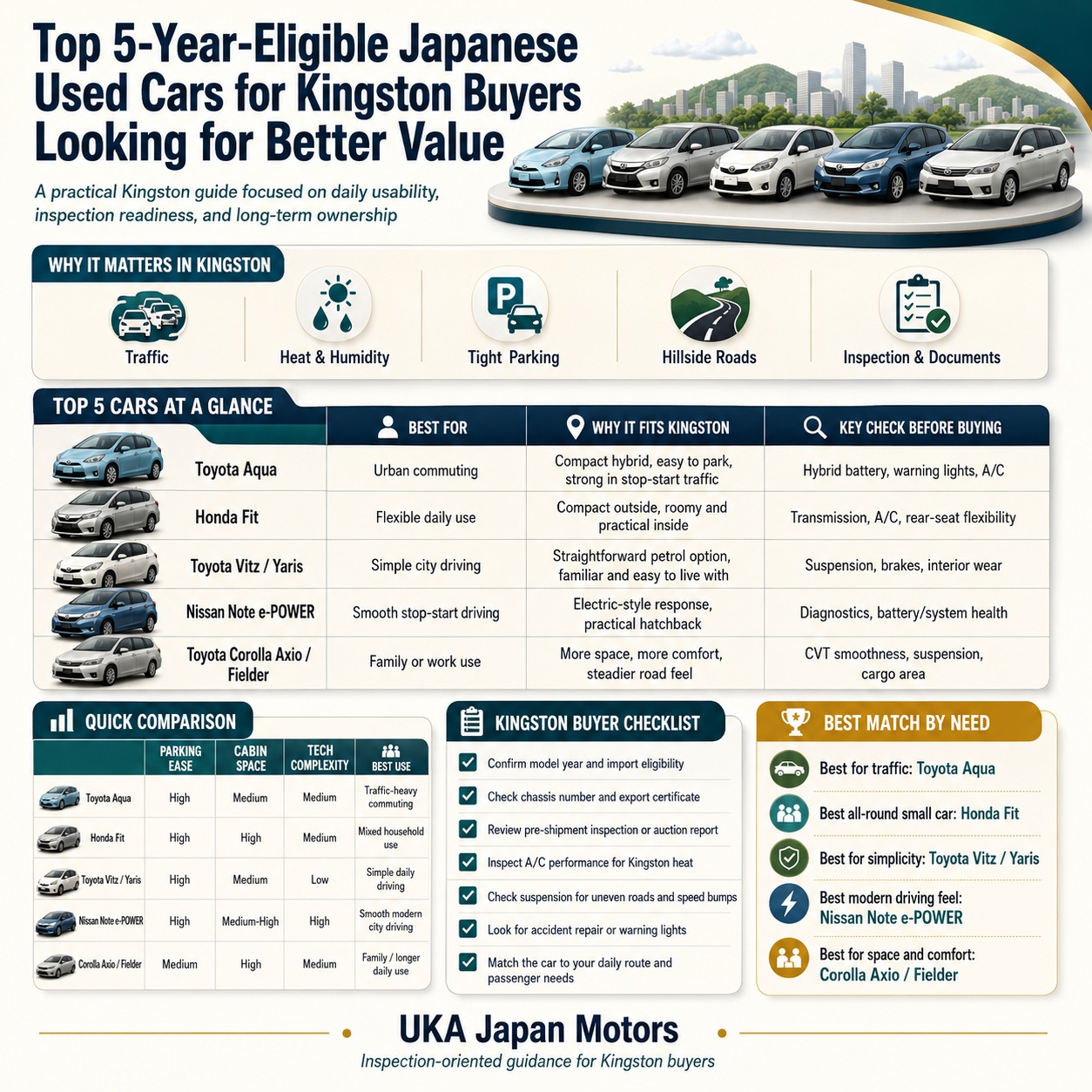
For Kingston buyers looking at five-year-eligible Japanese used cars, the strongest practical choices are:
- Toyota Aqua – Best for urban commuting and fuel-conscious daily driving
- Honda Fit – Best for flexible space in a compact body
- Toyota Vitz/Yaris – Best for simple city use and familiar maintenance
- Nissan Note e-POWER – Best for smooth stop-start driving and electric-style response
- Toyota Corolla Axio/Fielder – Best for drivers who want more cabin space and a steadier road feel
Each of these vehicles suits a different type of Kingston buyer. A compact hatchback may be better for Cross Roads, Liguanea, and New Kingston parking, while a Corolla Axio or Fielder may suit a household that regularly carries family members, work items, or luggage. A hybrid may be suitable for heavy city use, while a simpler petrol hatchback may suit buyers who prefer a more familiar mechanical layout.
The right choice depends on how the vehicle will be used, not only on the model name.
Why Five-Year Eligibility Matters for Kingston Buyers
Five-year eligibility matters because age affects more than import acceptance. It influences inspection condition, document consistency, mileage patterns, electronic system condition, hybrid battery health, suspension wear, interior condition, and the likely maintenance work needed after arrival.
A vehicle close to five years old may still have modern safety equipment, updated engine control systems, cleaner interior materials, and better corrosion protection than older units. However, age alone does not guarantee quality. A poorly used five-year-old car may be less suitable than a well-documented vehicle of the same model year with better inspection records.
For Kingston buyers, this is important because the vehicle will immediately face demanding local use. Kingston driving is not gentle. Many trips are short, slow, and heat-heavy. Engines may idle often. Air conditioning systems work hard. Suspensions deal with uneven surfaces, potholes, speed bumps, and broken road edges. Brakes see repeated low-speed use. A car that looks attractive on paper must still be assessed for real-world readiness.
A five-year-eligible Japanese used car should therefore be judged by:
- Chassis and model year clarity
- Auction sheet or inspection report details
- Mileage consistency
- Accident and repair history
- Hybrid battery and electrical condition where applicable
- Air conditioning performance
- Suspension and underbody condition
- Availability of familiar parts and service knowledge in Jamaica
- Suitability for Kingston traffic and parking
This is where a careful buying approach matters.
1. Toyota Aqua: Strong Urban Suitability for Kingston Driving
The Toyota Aqua is one of the most practical five-year-eligible Japanese used cars for Kingston buyers who spend most of their time in city traffic. It is compact, easy to park, and well suited to stop-start movement. In Kingston, where a daily route may include Half-Way Tree, Hope Road, Constant Spring Road, Old Hope Road, or downtown traffic, a small hybrid hatchback can feel easy to manage.
The Aqua’s appeal is its balance. It is small enough for tight spaces, but not so small that it feels limited for regular commuting. Its hybrid system is most useful in slow city movement, where the vehicle frequently transitions between low-speed electric assistance and petrol-engine operation. That makes it well matched to urban driving patterns.
For Kingston buyers, the Aqua suits:
- Daily commuters
- Small households
- Drivers who spend time in traffic
- Buyers who prefer compact parking convenience
- Drivers who do not regularly carry heavy loads
However, the Aqua is not ideal for everyone. Its rear seat and luggage area are modest. Buyers who often carry several adults, school bags, work equipment, or weekend luggage may find it less flexible than a Honda Fit or Corolla Fielder. It is also important to inspect the hybrid battery, cooling fan, inverter area, and dashboard warning lights carefully.
A five-year-eligible Aqua should be checked for:
- Hybrid battery condition
- Smooth engine start and stop behaviour
- Air conditioning strength
- Warning lights after startup
- Proper documentation of model year and chassis number
- Signs of previous accident repair
- Suspension noise over uneven surfaces
In Kingston, the Aqua works best when used as a disciplined daily commuter. It is not the strongest choice for rough rural use or frequent heavy loads, but for city movement, it remains one of the most sensible Japanese used car options.
2. Honda Fit: Compact Outside, Useful Inside
The Honda Fit is a strong choice for Kingston buyers who want a compact car but need better interior flexibility. Compared with many small hatchbacks, the Fit offers excellent cabin packaging. Its seating arrangement and cargo area make it useful for families, small business users, students, and professionals who need one car to handle different tasks.
In Kingston, this matters because a vehicle often has to do more than one job. It may take children to school in the morning, sit in traffic during the workday, carry groceries in the evening, and handle family visits on weekends. The Fit’s body size makes it easy to manage in city traffic, but its interior design gives it a wider range of use than many compact cars.
The Honda Fit suits:
- Buyers who need flexible seating
- Small families
- Drivers who carry bags or equipment
- Urban users who still need occasional cargo space
- Buyers who want a practical hatchback without moving into a larger vehicle
The Fit can be found in petrol and hybrid versions, depending on model year and specification. A petrol Fit may appeal to buyers who prefer a familiar drivetrain, while a hybrid Fit may suit heavier city use. Both require careful inspection.
Key inspection points include:
- Transmission smoothness
- Hybrid system condition where applicable
- Engine vibration
- Air conditioning performance
- Rear seat folding operation
- Suspension noise
- Dashboard warning lights
- Service record consistency
The Fit contrasts well with the Toyota Aqua. The Aqua is more focused on compact hybrid commuting, while the Fit is more flexible as a small all-purpose car. For a single driver who mostly moves through Kingston traffic, the Aqua may feel more direct. For a buyer who wants one small car to serve several household needs, the Fit may be more suitable.
3. Toyota Vitz/Yaris: Simple, Familiar, and Easy to Live With
The Toyota Vitz, also known in some contexts as the Yaris, remains one of the most familiar Japanese compact cars for Kingston buyers. Its main strength is simplicity. It is easy to drive, easy to park, and widely understood by many mechanics familiar with Japanese imports.
For Kingston ownership, simplicity should not be underestimated. A car used daily in heat and traffic benefits from a straightforward layout, familiar service requirements, and predictable behaviour. The Vitz is not usually chosen for advanced features or luxury. It is chosen because it does the basics well.
The Vitz suits:
- First-time car buyers
- Daily city drivers
- Students and professionals
- Buyers who prefer petrol-only simplicity
- Households needing a second vehicle
In Kingston, the Vitz is especially useful for short trips, tight parking, and moderate commuting. Its compact size helps in congested areas, while its straightforward engine and drivetrain make routine maintenance easier to understand.
The Vitz may not suit buyers who need generous rear passenger space, a large luggage area, or stronger performance for frequent hillside driving with passengers. It is best viewed as a practical urban car rather than a multi-purpose family vehicle.
Inspection priorities include:
- Engine idle quality
- Transmission response
- Air conditioning cooling strength
- Suspension wear
- Brake feel
- Accident repair evidence
- Interior wear consistent with mileage
- Proper export and registration documents
Compared with the Honda Fit, the Vitz is usually less flexible inside. Compared with the Aqua, it avoids hybrid-system complexity. For buyers who value straightforward petrol operation and compact convenience, it remains one of the most sensible five-year-eligible Japanese used cars for Kingston use.
4. Nissan Note e-POWER: Smooth City Response with Electric-Style Driving
The Nissan Note e-POWER is different from a conventional petrol hatchback and different from a standard hybrid. Its driving feel is often described as electric-style because the wheels are driven by an electric motor, while the petrol engine acts mainly as a generator. For Kingston’s stop-start traffic, that can create smooth acceleration and calm low-speed driving.
This model may appeal to buyers who want a modern driving feel without moving into a fully electric vehicle. In heavy traffic, the Note e-POWER can feel responsive and easy to control. Its cabin is also practical for a compact hatchback, making it useful for daily commuting and small-family use.
The Note e-POWER suits:
- Drivers who spend much of the day in city traffic
- Buyers who want smooth low-speed response
- Small households needing more room than some compact cars
- Drivers comfortable with newer drivetrain technology
- Buyers who will take inspection seriously before purchase
The key concern is not whether the system is interesting. The key concern is whether the specific vehicle has been properly inspected. e-POWER models rely on electrical components, battery condition, engine-generator operation, and correct diagnostic checks. A visual inspection alone is not enough.
Important checks include:
- Diagnostic scan for stored faults
- Battery condition
- Engine-generator operation
- Motor response
- Warning lights
- Cooling system condition
- Service history
- Accident repair around electrical components
Compared with the Toyota Aqua, the Note e-POWER may feel smoother and stronger at low speed. Compared with the Toyota Vitz, it is more technically complex. That means it may suit a buyer who wants a more modern feel and is willing to place strong emphasis on inspection records and system checks.
For Kingston, the Note e-POWER can be a strong choice, but only when the unit is clean, properly documented, and inspected by people who understand its drivetrain.
5. Toyota Corolla Axio/Fielder: More Space, More Stability, More Everyday Range
The Toyota Corolla Axio and Corolla Fielder are suitable for buyers who need more room than a compact hatchback provides. The Axio is a sedan, while the Fielder is a wagon. Both are popular among drivers who want a steadier road feel, more cabin comfort, and better everyday range for family and work use.
In Kingston, not every buyer wants the smallest possible car. Some drivers regularly carry passengers, commute from outside the city into Kingston, or need a vehicle that feels more settled on longer routes. The Corolla platform can suit those needs better than a smaller hatchback.
The Corolla Axio/Fielder suits:
- Families
- Professionals who drive often
- Buyers who need more rear-seat comfort
- Drivers who carry luggage or equipment
- Buyers who want a more planted feel than a compact hatchback
The Fielder is especially useful for buyers who need cargo space without moving into an SUV. The Axio suits those who prefer a traditional sedan layout. Both can be found in petrol and hybrid forms, depending on year and specification.
Inspection points include:
- Engine and hybrid system condition, where applicable
- CVT smoothness
- Suspension wear
- Rear cargo area condition in Fielder models
- Chassis alignment
- Accident repair signs
- Air conditioning cooling performance
- Document consistency
Compared with the Aqua or Vitz, the Corolla requires more parking awareness in tight Kingston spaces. However, it gives better passenger comfort and a more substantial driving feel. For buyers who regularly move between Kingston and other parishes, or who carry family members often, the Axio or Fielder may be a better long-term fit.
How These Five Cars Compare for Kingston Use
The best five-year-eligible Japanese used car depends on the buyer’s daily pattern.
The Toyota Aqua is best for city-focused commuting where compact size and hybrid operation matter most. It suits drivers who rarely need large cargo space.
The Honda Fit is best for buyers who want a small car but need flexible interior use. It is more adaptable than the Aqua or Vitz for household duties.
The Toyota Vitz/Yaris is best for simplicity. It suits buyers who want a compact petrol car with familiar maintenance behaviour.
The Nissan Note e-POWER is best for drivers who want smooth, modern city response and are comfortable relying on careful system inspection.
The Toyota Corolla Axio/Fielder is best for buyers who need more space, a steadier feel, and stronger family or work practicality.
For Kingston, the main contrast is between compact convenience and broader usability. Smaller cars are easier around traffic and parking. Larger compact sedans or wagons offer more comfort and carrying ability. Hybrid and electric-style drivetrains may suit stop-start traffic, but they require proper inspection. Petrol-only models may be simpler, but they still need careful checks for transmission, cooling, and suspension condition.
Local Relevance: What Kingston Driving Does to a Used Car
Kingston places specific demands on any used vehicle. Heat and humidity affect rubber parts, battery condition, interior plastics, cooling systems, and air conditioning performance. Traffic creates long idle periods. Short trips may prevent engines from operating at ideal temperature for long enough. Roads can vary from smooth main routes to uneven side streets, broken edges, and steep residential climbs.
For this reason, Kingston buyers should pay attention to:
- Cooling system condition
- Air conditioning performance
- Suspension firmness and noise
- Engine mounts
- Brake wear
- Tyre condition
- Battery health
- Hybrid cooling systems
- Underbody condition
- Cabin wear from heat exposure
A car that looks clean in photos may still need deeper inspection. For example, a hybrid battery cooling vent blocked by dust or interior debris can create long-term issues. A compact car with worn suspension may feel acceptable on a smooth road but noisy over Kingston’s uneven surfaces. A weak air conditioning system may become frustrating quickly in daily use.
This is why inspection should not be treated as a formality. It is part of choosing the right vehicle.
Documentation and Import Checks Buyers Should Understand
Before choosing a five-year-eligible Japanese used car, Kingston buyers should understand that documentation is part of vehicle quality. The Trade Board outlines that import permit applications require vehicle information and supporting documents such as supplier invoice or bill of sale, registration certificate, certificate of title or Japanese export certificate, valid identification, TRN, and a pre-shipment inspection certificate for used vehicles.
Important documents and checks include:
- Japanese export certificate
- Chassis number confirmation
- Model year confirmation
- Auction sheet or inspection report
- Pre-shipment inspection certificate
- Supplier invoice or bill of sale
- Import permit approval
- Customs processing documents
- Local registration and fitness steps after arrival
A buyer should not only ask whether the car is eligible. The better question is whether the documents clearly support the vehicle’s identity, year, condition, and inspection status.
For Kingston buyers, document accuracy matters because small errors can cause delays or complications. The chassis number, model code, engine type, seating capacity, and year information should be consistent across documents. Any mismatch should be addressed before the vehicle moves too far through the process.
Petrol, Hybrid, and e-POWER: Which Makes Sense?
Among the five models listed, there are petrol, hybrid, and electric-style options. Each has a place.
A petrol-only vehicle such as many Toyota Vitz models is straightforward. It may suit buyers who want familiar servicing and fewer high-voltage components.
A traditional hybrid such as the Toyota Aqua, some Honda Fit versions, and some Corolla Axio/Fielder versions can suit Kingston traffic because hybrid systems are useful in low-speed driving. However, buyers must inspect battery health, warning lights, cooling fans, and system behaviour.
An e-POWER vehicle such as the Nissan Note e-POWER gives a different driving feel. It may suit drivers who want smooth response in traffic, but it needs proper diagnostics and careful understanding of the system.
The right choice depends on use. A buyer doing mostly short urban trips may benefit from a hybrid or e-POWER layout, provided inspection is strong. A buyer who wants mechanical familiarity may prefer a petrol Vitz or petrol Corolla. A buyer needing family space may prioritize the Corolla Fielder over the drivetrain type.
No drivetrain should be chosen only because it sounds modern. It should match the buyer’s routes, service expectations, and inspection confidence.
When These Cars Suit Kingston Buyers
These five models generally suit buyers who:
- Drive daily in Kingston traffic
- Need a vehicle for commuting, school runs, errands, and family use
- Want Japanese build familiarity
- Prefer vehicles with known maintenance patterns
- Need compact or moderately sized cars
- Care about documentation and inspection
- Want a vehicle young enough to remain comfortably within import age expectations
They are especially relevant for buyers who want a practical ownership experience rather than a vehicle chosen only by appearance or specification sheet.
When These Cars May Not Suit
Even strong models are not right for every buyer.
The Toyota Aqua may not suit buyers who need generous rear space or regular heavy cargo ability. The Honda Fit may not suit buyers who prefer a more traditional sedan feel. The Toyota Vitz may not suit larger families or drivers who want more highway stability. The Nissan Note e-POWER may not suit buyers who are uncomfortable with newer drivetrain diagnostics. The Corolla Axio/Fielder may not suit buyers who need the easiest possible parking in dense Kingston areas.
A buyer who often travels on rougher routes, carries heavy items, or needs more ground clearance may need to consider a different vehicle category. However, that decision should still be guided by import eligibility, documentation, inspection condition, and long-term service support.
Practical Pre-Purchase Guidance
Before committing to any five-year-eligible Japanese used car, Kingston buyers should review the vehicle from several angles.
First, confirm eligibility. The model year, registration date, and category must be understood clearly. Age rules apply by category, and the car should be assessed against the correct classification.
Second, examine the inspection report. Accident history, repaired panels, interior grade, mileage notes, rust comments, and warning indicators all matter. A clean-looking car is not always a clean car.
Third, check the drivetrain. Petrol, hybrid, and e-POWER vehicles each require different inspection attention. A hybrid should not be bought only because it is popular. It should be checked properly.
Fourth, consider Kingston use. A vehicle that is excellent for light city commuting may not be ideal for constant family loading or hillside driving. Match the car to the route.
Fifth, plan for ownership. Routine servicing, tyres, battery condition, air conditioning maintenance, and suspension checks are part of keeping the vehicle reliable in Jamaica’s climate.
UKA Japan Motors’ Role in Helping Buyers Choose Properly
UKA Japan Motors’ role is to help buyers approach Japanese used cars with proper inspection awareness and clear documentation thinking. A good vehicle decision is not based only on model popularity. It comes from understanding the buyer’s use, the vehicle’s condition, and the documents that support the import process.
For Kingston buyers, UKA Japan Motors focuses on practical questions:
- Is the vehicle suitable for daily Kingston use?
- Are the documents consistent?
- Does the inspection information support the vehicle’s condition?
- Is the drivetrain appropriate for the buyer’s driving pattern?
- Are there warning signs in the auction sheet or report?
- Will the vehicle make sense for long-term ownership in Jamaica?
This approach supports better decision-making without exaggeration. The aim is to help buyers choose vehicles that fit real Jamaican conditions.
Frequently Asked Questions
1. What does five-year-eligible mean for Japanese used cars?
It generally refers to vehicles young enough to remain comfortably within Jamaica’s import-age framework. Current official guidance lists motor cars such as sedans, station wagons, and SUVs as not exceeding six years at importation, but many buyers use a five-year reference point as a conservative way to stay well within the acceptable range.
2. Which five-year-eligible Japanese used car is best for Kingston traffic?
The Toyota Aqua is one of the strongest choices for heavy city traffic because it is compact and hybrid-assisted. However, the best choice depends on whether the buyer needs passenger space, cargo flexibility, or a simpler petrol drivetrain.
3. Is the Honda Fit better than the Toyota Aqua?
The Honda Fit is better for buyers who need more interior flexibility. The Toyota Aqua is better for compact commuting. A Kingston buyer who carries family items or work bags often may prefer the Fit, while a single daily commuter may prefer the Aqua.
4. Is the Toyota Vitz still a good choice?
Yes, the Toyota Vitz remains a practical option for buyers who want a compact petrol car with familiar maintenance behaviour. It is best suited to city use, lighter passenger loads, and buyers who value simplicity.
5. Should Kingston buyers consider the Nissan Note e-POWER?
Yes, but only with proper inspection. The Note e-POWER can be smooth and responsive in traffic, but its electrical and generator systems should be checked carefully before purchase.
6. Is the Corolla Axio or Fielder too large for Kingston?
Not necessarily. It is larger than the Aqua, Fit, or Vitz, so parking requires more attention, but it offers better passenger comfort and more carrying ability. It suits buyers who need a more spacious daily vehicle.
7. Are hybrid cars suitable for Kingston?
Hybrid cars can suit Kingston’s stop-start traffic well, but condition matters. Buyers should check hybrid battery health, warning lights, cooling fans, and diagnostic results before making a decision.
8. What documents should buyers check before importing?
Buyers should review the Japanese export certificate, chassis number, model year, supplier invoice or bill of sale, inspection documentation, import permit details, and any other documents required for processing. Consistency across documents is very important.
9. Why is air conditioning inspection important?
Kingston heat makes air conditioning a daily-use system, not a minor comfort feature. Weak cooling, compressor issues, or electrical faults can affect everyday ownership quickly.
10. Which model is best for a small family?
The Honda Fit and Toyota Corolla Fielder are strong options for small families. The Fit is compact and flexible, while the Fielder offers more cargo space and a steadier road feel.
Conclusion
The best five-year-eligible Japanese used car for Kingston buyers is not the same for everyone. The Toyota Aqua suits compact city commuting. The Honda Fit suits buyers who need flexible space. The Toyota Vitz/Yaris suits simple daily driving. The Nissan Note e-POWER suits buyers who want smooth modern response with proper inspection. The Toyota Corolla Axio/Fielder suits buyers who need more room and a steadier feel.
For Kingston, the right car must be judged by real use: traffic, heat, parking, road surfaces, passenger needs, air conditioning performance, inspection records, and documentation. A good choice is not only eligible for import. It is suitable for how the buyer will actually live with the vehicle in Jamaica.
Contact UKA Japan Motors for availability and inspection guidance.