


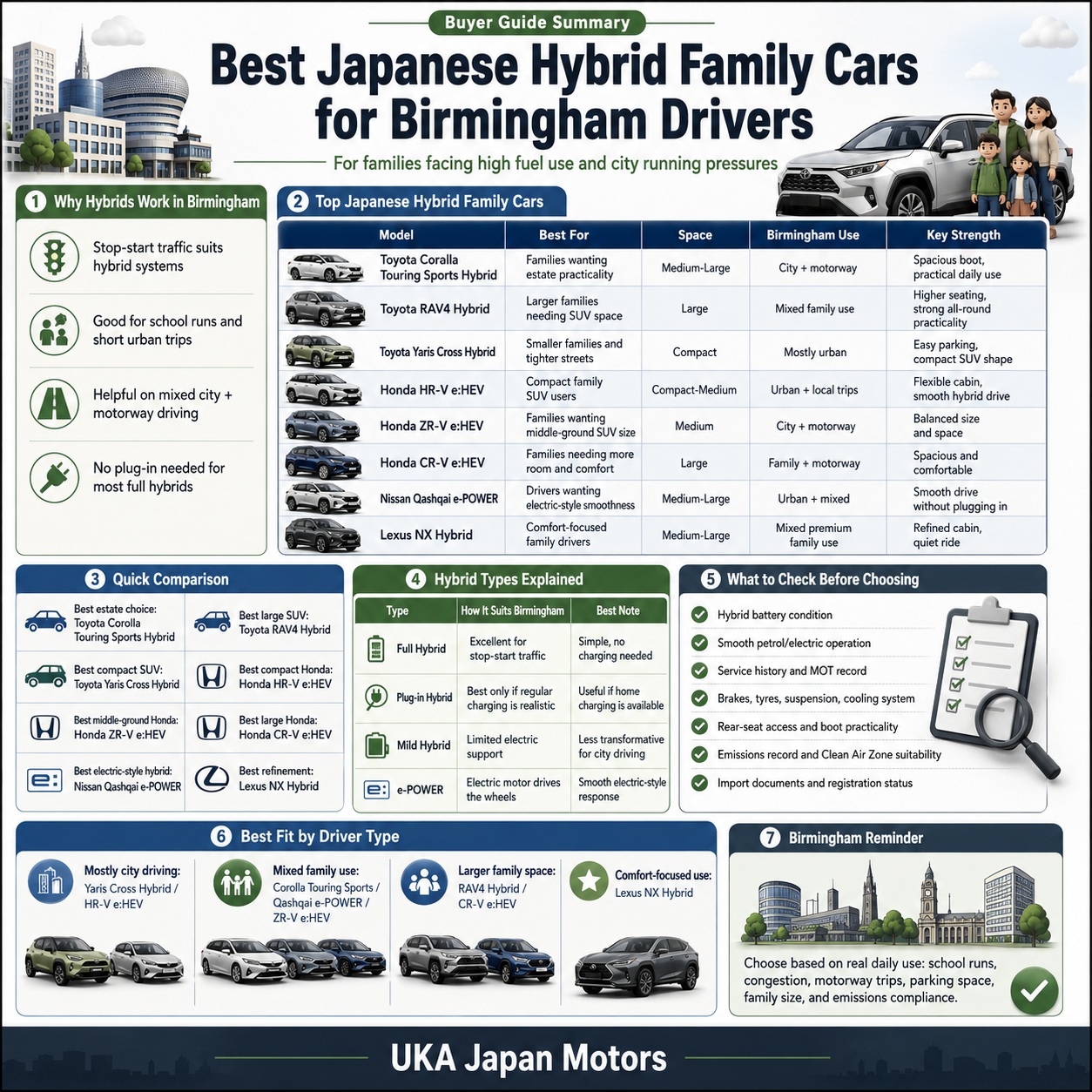
For many families in Birmingham, the family car has to deal with a demanding mix of short urban journeys, school traffic, supermarket trips, stop-start congestion, weekend motorway use, wet weather, and regular parking in tight residential streets. A good family car cannot simply be spacious. It also needs to feel calm in traffic, practical with children and luggage, suitable for local roads, and sensible to run over the long term.
Japanese hybrid family cars are often considered by Birmingham drivers because they combine petrol engines with electric assistance in a way that suits repeated low-speed driving. In areas such as Selly Oak, Erdington, Handsworth, Harborne, Moseley, Kings Heath, Solihull routes, and the wider West Midlands road network, hybrid systems can work well where traffic rarely flows at one constant speed.
This guide focuses on the best Japanese hybrid family cars for Birmingham drivers who want a practical vehicle for everyday use without moving straight to a fully electric car. It covers full hybrids, series hybrids, plug-in hybrids, and mild hybrids only where they are relevant to family life. The aim is not to promote one model aggressively, but to explain which type of Japanese hybrid family car may suit different Birmingham driving patterns.
Birmingham drivers should also consider local compliance. The Birmingham Clean Air Zone uses emissions standards, and official guidance states that cars must generally meet Euro 6 for diesel and Euro 4 for petrol to avoid Clean Air Zone charging; Birmingham’s own guidance also notes that petrol-electric and diesel-electric hybrids must meet the relevant emission standards for their fuel type.
Direct Answer: Which Japanese Hybrid Family Cars Suit Birmingham Best?
For most Birmingham family drivers, the strongest Japanese hybrid choices are:
Toyota Corolla Touring Sports Hybrid for families wanting estate practicality, easy everyday driving, and good road manners around the city and motorway network.
Toyota RAV4 Hybrid for families needing more space, a higher driving position, and stronger all-round practicality.
Toyota Yaris Cross Hybrid for smaller families who mainly drive in built-up areas and want a compact footprint.
Honda HR-V e:HEV for drivers wanting a compact SUV shape with flexible cabin use and a calm hybrid drive.
Honda ZR-V e:HEV for families needing more space than a compact SUV but not wanting the bulk of a larger SUV.
Honda CR-V e:HEV for families who regularly carry passengers, luggage, prams, or sports equipment.
Nissan Qashqai e-POWER for drivers who like electric-style smoothness but still want petrol refuelling convenience.
Lexus NX Hybrid for families wanting a refined Japanese hybrid SUV with a more comfort-focused cabin.
The best choice depends on where the car will spend most of its time. A compact hybrid SUV may be easier in Birmingham’s older residential streets, while a larger SUV or estate may make more sense for families travelling regularly on the M6, M5, M42, or A38.
Why Hybrids Make Sense for Birmingham Family Driving
Birmingham driving often involves repeated acceleration, braking, queuing, and short-distance journeys. This is where many hybrid systems feel most natural. Instead of asking the petrol engine to do all the work in stop-start traffic, a hybrid system can use electric assistance at low speeds, recover energy when slowing down, and reduce engine strain during gentle urban driving.
This matters for family use because city driving is rarely smooth. A typical Birmingham journey may include traffic lights, bus lanes, school drop-off congestion, pedestrian crossings, roundabouts, and slow-moving routes into shopping or hospital areas. A conventional petrol-only family car can feel busy in these conditions. A well-developed hybrid can feel quieter, smoother, and less stressed.
Hybrids are also useful for drivers who are not ready for a fully electric car. Some Birmingham households may not have off-street parking. Others may share a driveway, live in terraced housing, or regularly park on the road. A full hybrid does not require plugging in, which can make it more practical for families who want electric assistance without changing how they refuel.
However, not every hybrid works the same way. A mild hybrid gives only limited electrical support. A full hybrid can drive at low speeds using electric power for short periods. A plug-in hybrid can travel further using stored electrical energy, but only makes sense when regular charging is realistic. A series hybrid, such as Nissan’s e-POWER system, uses petrol to generate electricity while the wheels are driven by an electric motor; Nissan describes Qashqai e-POWER as requiring petrol to fuel the electric motor rather than being a fully electric vehicle.
What Birmingham Families Should Look For First
Before choosing a model, Birmingham drivers should think about how the car will actually be used.
A family in Edgbaston with regular city-centre journeys may value compact size, easy parking, and smooth low-speed response. A family in Sutton Coldfield or Solihull may need more motorway comfort and boot space. A family making daily school runs through congested roads may prioritise visibility, rear-seat access, and calm automatic driving. A household using the car for commuting and weekend family trips may need a stronger balance between urban economy, motorway refinement, and storage.
Key questions include:
Will the car mainly be used for school runs and short local journeys?
Does the family regularly travel on the M6, M5, M42, A38, or A45?
Is rear-seat access important for child seats?
Is the boot large enough for pushchairs, bags, or sports equipment?
Will the car often park on narrow residential streets?
Is a higher driving position helpful?
Is plug-in charging realistic at home or nearby?
Does the vehicle’s documentation clearly support its emissions and registration status?
The best Japanese hybrid family car is not always the largest one. In Birmingham, size can be both helpful and inconvenient. A larger SUV offers more space, but a compact hybrid may be easier to live with every day.
Toyota Corolla Touring Sports Hybrid: Best for Estate Practicality
The Toyota Corolla Touring Sports Hybrid is one of the most sensible Japanese hybrid family cars for Birmingham drivers who want space without moving into a larger SUV. Toyota’s UK hybrid range includes the Corolla Touring Sports among its hybrid options, positioning it as a spacious alternative within its wider hybrid line-up.
For family use, the estate shape is the key advantage. The lower boot floor and longer load area make it practical for pushchairs, school bags, folded scooters, shopping, and luggage. Compared with a high-riding SUV, it can feel easier to load heavy items into the back because the boot is not as high from the ground.
In Birmingham, the Corolla Touring Sports Hybrid suits families who split their time between city traffic and longer journeys. It is generally easier to place on the road than a large SUV, which helps on older streets, car parks, and residential areas where space can be limited. The hybrid system is also well suited to slow traffic, where smooth automatic response matters more than outright power.
Its limitation is that it does not give the high seating position some families prefer. Drivers who like SUV visibility may find the Corolla’s estate layout less commanding. Rear headroom and cabin height may also feel different from a taller family SUV. Still, for drivers who value practicality, calm road behaviour, and efficient use of space, the Corolla Touring Sports Hybrid is one of the strongest family-focused choices.
Toyota RAV4 Hybrid: Best for Larger Family Space
The Toyota RAV4 Hybrid suits Birmingham families who need more cabin space, a higher seating position, and SUV practicality. It works well for households carrying children, luggage, school equipment, and family items on a regular basis.
The RAV4 is especially useful for families who often travel beyond central Birmingham. On routes such as the M42, M5, M6, and A38, a larger SUV can feel more settled than a smaller city-focused hybrid. The higher driving position also helps visibility in heavy traffic, particularly around roundabouts, junctions, and multi-lane roads.
Compared with the Corolla Touring Sports Hybrid, the RAV4 offers more SUV presence and a more upright cabin. That can make child-seat access easier and provide a more open feeling for passengers. The trade-off is size. In tighter Birmingham streets or compact parking spaces, the RAV4 requires more care.
For families who need genuine all-round ability, the RAV4 Hybrid is a strong choice. It may be more vehicle than some city-only drivers need, but it makes sense for households that want one car to cover school journeys, commuting, family visits, and longer motorway travel.
Toyota Yaris Cross Hybrid: Best for Smaller Families and Tight Streets
The Toyota Yaris Cross Hybrid is well suited to Birmingham drivers who want hybrid efficiency in a compact SUV shape. It is not the roomiest option in this guide, but it can be one of the easiest to live with for smaller families, couples with a young child, or households that mainly drive locally.
The biggest advantage is its compact footprint. In parts of Birmingham where streets are narrow, parking is limited, and journeys are often short, a smaller hybrid SUV can feel more practical than a larger family car. It offers a higher driving position than a supermini but remains manageable in traffic and parking areas.
The Yaris Cross Hybrid is best for families who do not regularly need a large boot. It can handle school runs, shopping, and daily use, but families with multiple child seats, large pushchairs, or frequent luggage needs may outgrow it. For local driving, however, it makes sense because it is simple, compact, and well aligned with stop-start city use.
Compared with the RAV4 Hybrid, the Yaris Cross is easier in urban areas but less spacious on longer family trips. Compared with the Corolla Touring Sports, it gives a higher seating position but less estate-style load capacity. That contrast is important: Birmingham drivers should choose based on daily reality, not just body style preference.
Honda HR-V e:HEV: Best Compact Honda Hybrid SUV
The Honda HR-V e:HEV is a compact hybrid SUV that suits Birmingham families wanting a practical but not oversized car. Honda describes the HR-V e:HEV as a small full hybrid SUV, with hybrid technology designed for efficient and responsive driving.
The HR-V’s strength is its balance. It gives drivers a raised seating position, useful cabin flexibility, and a smooth hybrid driving feel without becoming too large for city use. For Birmingham drivers who regularly deal with traffic around schools, shopping streets, and local commuting routes, this balance can be very helpful.
The HR-V suits smaller families who want SUV practicality but do not need the size of a CR-V. It can also appeal to drivers moving from a conventional hatchback who want something easier to get in and out of. The cabin layout is generally family-friendly, and the hybrid system is well matched to gentle urban driving.
Its limitation is that larger families may need more rear-seat and boot space. If the car regularly carries teenagers, luggage, or bulky equipment, the ZR-V or CR-V may be more suitable. But for Birmingham families wanting a compact, refined hybrid SUV, the HR-V e:HEV deserves serious consideration.
Honda ZR-V e:HEV: Best Middle-Ground Honda Family Hybrid
The Honda ZR-V e:HEV sits between the smaller HR-V and the larger CR-V, making it a strong middle-ground choice for Birmingham family drivers. It is useful for households that need more space than a compact SUV but do not want the full size of a larger family SUV.
This makes the ZR-V particularly relevant for Birmingham. Many families need one car that can cope with both local traffic and longer journeys. A compact SUV may feel too limited for growing children, while a larger SUV may feel unnecessary for everyday urban use. The ZR-V fills that gap.
For school runs, commuting, shopping, and motorway travel, the ZR-V offers a balanced package. It gives the driver a confident seating position, enough cabin space for family use, and hybrid smoothness in traffic. Compared with the HR-V, it feels more substantial. Compared with the CR-V, it is easier to manage in tighter spaces.
The ZR-V may not be the first choice for families needing maximum boot space, but it is one of the most balanced Japanese hybrid family cars for Birmingham drivers who want versatility without excessive bulk.
Honda CR-V e:HEV: Best for Larger Honda Hybrid Practicality
The Honda CR-V e:HEV is the better Honda choice for families who need more space, comfort, and long-distance practicality. It suits Birmingham households that regularly carry passengers, luggage, child seats, or family equipment.
For motorway use, the CR-V feels more appropriate than smaller SUVs. It is better suited to longer journeys, family visits, and regular travel outside Birmingham. In city driving, the hybrid system helps provide smooth progress, but the CR-V’s size means drivers should consider parking and manoeuvring needs carefully.
The CR-V is best for families who will use the space often. If the extra room is only needed occasionally, the ZR-V may be more manageable. But for households with older children, frequent luggage demands, or regular passenger use, the CR-V e:HEV is a strong family hybrid.
Compared with the Toyota RAV4 Hybrid, the CR-V offers a different character. The RAV4 has a robust, practical SUV feel, while the CR-V leans towards comfort and family refinement. Both can work well in Birmingham, but the better choice depends on seating needs, boot use, and preferred driving feel.
Nissan Qashqai e-POWER: Best for Electric-Style Driving Without Plugging In
The Nissan Qashqai e-POWER is one of the most interesting Japanese hybrid family cars for Birmingham drivers because it feels different from a conventional full hybrid. Nissan explains that Qashqai e-POWER is not a fully electric vehicle and uses petrol to fuel the electric motor; the Qashqai is also described by Nissan UK as designed in Paddington, engineered in Cranfield, and built in Sunderland.
For Birmingham use, the appeal is smoothness. In traffic, electric-style drive response can feel calm and predictable. This can be useful on routes with frequent stop-start conditions, where smooth acceleration and controlled low-speed progress make family driving less tiring.
The Qashqai is also a familiar family SUV size. It is easier to manage than many larger SUVs but more practical than a small crossover. For families who want a mainstream hybrid SUV with a relaxed driving character, it is a strong candidate.
The main contrast is with Toyota and Honda full hybrids. Toyota and Honda systems blend petrol and electric power in established ways, while Nissan’s e-POWER approach uses the petrol engine differently. Birmingham drivers should focus on how the car feels in real traffic rather than choosing purely by technology description. A proper inspection and road assessment are important.
Lexus NX Hybrid: Best for Comfort-Focused Family Use
The Lexus NX Hybrid suits Birmingham families who want a more refined Japanese hybrid SUV. Lexus UK describes the NX as a mid-size SUV available as a self-charging hybrid or plug-in hybrid.
The NX is not the most compact option, and it may not be necessary for every family. Its strength is comfort, cabin finish, and a quieter driving experience. For drivers who spend time on both Birmingham roads and longer motorway routes, that refinement can matter.
As a family car, the NX is best suited to households that want a calm cabin and SUV practicality without needing the largest possible boot. It may suit families with older children, regular commuting needs, or a preference for a more composed driving environment.
Compared with a Toyota RAV4 Hybrid, the Lexus NX feels more comfort-focused. Compared with a Honda CR-V e:HEV, it may feel more premium in cabin character but not necessarily more practical for heavy family use. Birmingham drivers should check rear-seat space, boot shape, and visibility carefully before deciding.
Full Hybrid, Plug-In Hybrid, Mild Hybrid, and e-POWER: What Is Best for Birmingham?
A full hybrid is usually the simplest option for Birmingham family drivers. It does not need external charging and works naturally in city traffic. Toyota and Honda full hybrids are strong examples because they suit repeated braking, low-speed driving, and everyday urban use.
A plug-in hybrid can be suitable, but only when charging is realistic. For families with reliable home charging or consistent access to charging during the week, a plug-in hybrid may make sense. For drivers who park on the street or cannot charge regularly, a plug-in hybrid may not deliver its intended benefit.
A mild hybrid is the least transformative option. It can assist the engine, but it does not usually provide the same electric driving feel as a full hybrid. Mild hybrids can be perfectly acceptable, but Birmingham families specifically looking for smoother city use may prefer a full hybrid or series hybrid.
Nissan’s e-POWER system provides another route. It gives electric motor drive while still using petrol, which can feel smooth and responsive in traffic. It is especially relevant for drivers who like the feel of an electric car but do not want to depend on charging.
For most Birmingham families, the order of suitability is usually full hybrid first, e-POWER as a strong alternative, plug-in hybrid where charging is realistic, and mild hybrid where simplicity matters but full hybrid behaviour is not essential.
Clean Air Zone and Emissions Considerations
Birmingham’s Clean Air Zone makes documentation and emissions standards important. Official Clean Air Zone guidance sets minimum standards for cars at Euro 6 for diesel and Euro 4 for petrol, while Birmingham-specific guidance explains that hybrids are judged against the relevant petrol or diesel standard.
This means a hybrid badge alone is not enough. Drivers should check the vehicle’s recorded emissions standard, registration details, and official compliance status. This is especially important with imported vehicles, older hybrid models, or cars where documentation is incomplete.
A Birmingham family car should be assessed not just by fuel type but by paperwork. The V5C, emissions data, MOT history, import documents where relevant, and model specification all matter. A car may appear suitable on paper, but the registration record must support that.
For imported Japanese hybrid vehicles, compliance checks become even more important. The vehicle must be correctly declared, approved where required, registered, and documented before it can be used normally on England’s roads.
Inspection Points Before Choosing a Japanese Hybrid Family Car
A hybrid inspection should go beyond a normal visual check. Birmingham drivers should pay close attention to:
Hybrid battery condition and warning lights.
Smooth switching between petrol and electric operation.
Service history and correct maintenance records.
Cooling system condition, including hybrid-related cooling components.
Brake condition, especially because regenerative braking can affect wear patterns.
Tyre condition and alignment, particularly for city cars exposed to potholes and kerbs.
Suspension noise over rough local roads.
Air conditioning performance, as some hybrid systems rely on electrically driven components.
Boot space, rear-seat access, and child-seat practicality.
Documentation confirming identity, emissions status, registration, and MOT history.
For imported vehicles, official UK guidance explains that import steps can include making an import declaration, telling HMRC through NOVA, paying required duties, getting vehicle approval, and registering the vehicle.
Imported vehicles may also need Individual Vehicle Approval depending on circumstances, and official guidance states that IVA can be used when importing a single passenger car or a small number of vehicles.
Which Japanese Hybrid Family Car Fits Which Birmingham Driver?
The best car depends on the household.
Choose the Toyota Corolla Touring Sports Hybrid if you want estate space, easy loading, and a car that feels efficient without being bulky.
Choose the Toyota RAV4 Hybrid if you need SUV space, a higher seating position, and a strong all-round family car.
Choose the Toyota Yaris Cross Hybrid if your family use is mostly local and you value compact size.
Choose the Honda HR-V e:HEV if you want a compact SUV with practical cabin flexibility.
Choose the Honda ZR-V e:HEV if you need more family space than a compact SUV but still want manageable dimensions.
Choose the Honda CR-V e:HEV if you regularly carry passengers, luggage, or child-related equipment.
Choose the Nissan Qashqai e-POWER if smooth electric-style driving appeals but plugging in does not suit your routine.
Choose the Lexus NX Hybrid if comfort, refinement, and a quieter cabin are major priorities.
There is no single best Japanese hybrid family car for every Birmingham driver. A car that suits motorway-heavy family use may be less convenient around tight city streets. A compact hybrid may be ideal for school runs but limited for longer family travel. The right choice is the one that matches the household’s real driving pattern.
When a Japanese Hybrid May Not Be the Best Fit
A hybrid is not automatically right for every driver.
If a family regularly makes long motorway journeys with little city driving, a hybrid may not show its strengths as clearly. If a household needs maximum towing ability, some hybrids may not be suitable. If the car is often heavily loaded, a smaller hybrid SUV may feel underpowered or cramped. If plug-in charging is not available, a plug-in hybrid should be considered carefully.
Drivers should also avoid choosing a hybrid purely for the badge. Condition matters more than reputation. A poorly maintained hybrid can create avoidable problems, while a carefully inspected example can provide dependable family use.
For Birmingham drivers, the most important factor is balance. The car should suit local roads, family space needs, compliance requirements, and long-term maintenance expectations.
UKA Japan Motors’ Role in Hybrid Family Car Guidance
UKA Japan Motors approaches Japanese hybrid family cars from an inspection-led and compliance-aware perspective. The focus is not simply on matching a buyer with a recognisable model name. It is on understanding how the car will be used, whether the condition supports long-term ownership, and whether the documentation is clear.
For Birmingham drivers, this matters because daily use can be demanding. Short journeys, traffic, poor road surfaces, wet weather, and regular family loading all place stress on a vehicle. A hybrid car should be checked carefully before it is considered suitable.
UKA Japan Motors can guide buyers through model suitability, inspection priorities, import documentation, registration considerations, and practical ownership questions. The aim is to help drivers understand what they are looking at before making a decision, not to push a particular vehicle.
Related Internal Reading
Drivers considering this topic may also find value in supporting guides on:
Birmingham Clean Air Zone checks for imported vehicles.
Hybrid battery inspection before buying a used Japanese car.
Toyota hybrid family car comparisons for Birmingham drivers.
Honda e:HEV SUV ownership guidance.
Japanese import documentation and DVLA registration steps.
These topics connect naturally because choosing a hybrid family car is not only about model preference. It is also about compliance, condition, documentation, and daily suitability.
FAQs
1. What is the best Japanese hybrid family car for Birmingham city driving?
For mostly city-based family driving, the Toyota Yaris Cross Hybrid, Honda HR-V e:HEV, and Nissan Qashqai e-POWER are strong options. They are manageable in traffic, easy to use at lower speeds, and practical enough for everyday family journeys.
2. Which Japanese hybrid is best for a larger Birmingham family?
The Toyota RAV4 Hybrid, Honda CR-V e:HEV, and Lexus NX Hybrid are better suited to larger families needing more passenger room and luggage space. The Honda ZR-V e:HEV can also work well as a middle-ground option.
3. Is a full hybrid better than a plug-in hybrid for Birmingham?
A full hybrid is often simpler for Birmingham drivers because it does not need charging. A plug-in hybrid may suit drivers with reliable charging access, but it should not be chosen unless charging fits naturally into daily life.
4. Are Japanese hybrid cars suitable for Birmingham Clean Air Zone driving?
They can be, but the hybrid badge alone is not enough. The vehicle must meet the relevant emissions standard for its fuel type, and its official registration record should confirm the details.
5. Is the Toyota Corolla Touring Sports Hybrid good for families?
Yes, it is a strong family choice for drivers who want estate practicality, a useful boot, and smooth hybrid driving without choosing a larger SUV. It suits mixed Birmingham use well.
6. Is the Nissan Qashqai e-POWER a normal hybrid?
It is different from many full hybrids. The wheels are driven by an electric motor, while the petrol engine supports the system by generating power. This gives it a smooth, electric-style driving feel while still using petrol.
7. Which Honda hybrid SUV is best for family use?
The HR-V e:HEV suits smaller families, the ZR-V e:HEV suits families needing a balanced middle-size SUV, and the CR-V e:HEV suits larger families needing more space and comfort.
8. What should be inspected before buying a Japanese hybrid family car?
The inspection should cover hybrid system operation, warning lights, service history, battery condition, brakes, suspension, tyres, air conditioning, documentation, emissions status, and MOT history.
9. Are imported Japanese hybrid cars suitable for Birmingham roads?
They can be suitable when properly inspected, documented, approved, and registered. The vehicle’s condition and compliance record are essential.
10. Should Birmingham families choose an SUV or estate hybrid?
An estate hybrid such as the Toyota Corolla Touring Sports can be better for easy loading and road efficiency, while an SUV such as the RAV4, CR-V, or Qashqai can offer a higher seating position and more upright cabin space.
Conclusion
The best Japanese hybrid family cars for Birmingham drivers are the ones that match real local use. A compact hybrid SUV may be ideal for school runs, tight parking, and short urban journeys. An estate hybrid may suit families needing load space without SUV bulk. A larger hybrid SUV may be better for families who regularly carry passengers, luggage, and equipment across Birmingham and the wider motorway network.
Toyota, Honda, Nissan, and Lexus all offer strong hybrid options, but the right choice depends on size, driving pattern, documentation, compliance, and condition. For Birmingham families, a calm hybrid system, practical cabin, clear emissions record, and thorough inspection are more important than choosing the most familiar badge.
A Japanese hybrid family car can be a sensible long-term option when it is chosen carefully, inspected properly, and matched honestly to the household’s daily routine.
Contact UKA Japan Motors for availability and inspection guidance.