


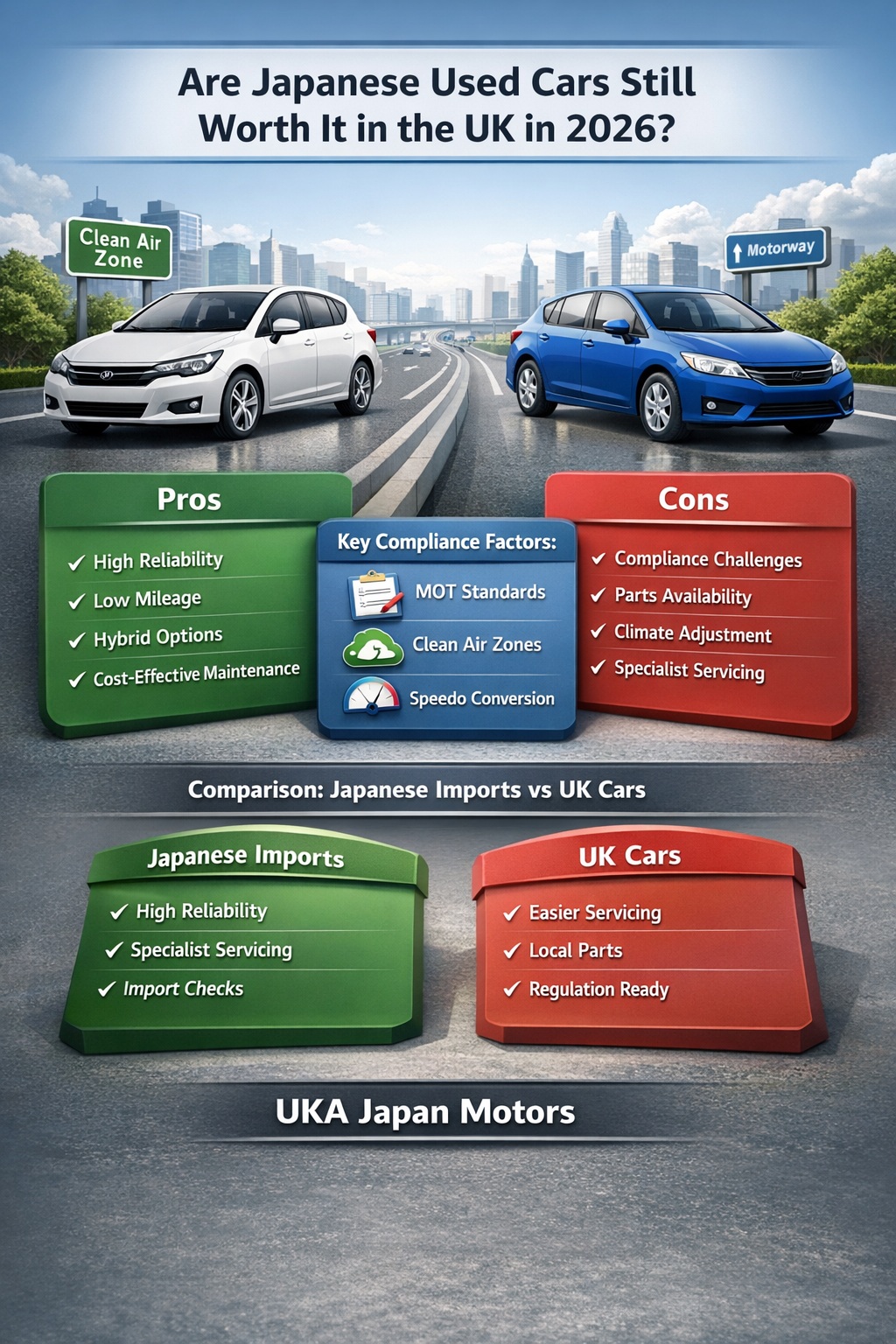
Japanese used cars have long held a strong position in the UK automotive landscape, particularly among drivers seeking dependable engineering and well-maintained vehicles. In Birmingham and across England, imported Japanese models are a familiar sight, ranging from compact hybrids navigating city congestion to larger estates used for motorway travel.
However, by 2026, the question is no longer straightforward. Regulatory shifts, evolving emissions standards, and changing driving patterns mean that the value of Japanese imports must be reassessed carefully.
This article provides a full, practical breakdown of whether Japanese used cars still make sense in the UK today, focusing on reliability, ownership realities, and long-term suitability within an English context.
Direct Answer: Are Japanese Used Cars Still Worth It in 2026?
Yes — Japanese used cars remain a strong option in the UK in 2026, particularly for drivers prioritising reliability, build quality, and consistency of performance.
However, their suitability depends on:
- Compliance with UK emissions and registration standards
- Availability of servicing support
- Driving environment (urban vs motorway)
- Long-term maintenance planning
They are not universally ideal, but when selected and inspected correctly, they continue to offer dependable ownership.
Why This Matters in Birmingham and Across England
Driving conditions in Birmingham highlight exactly where Japanese used cars either succeed or struggle.
Key local factors include:
- Urban congestion: Stop-start driving places stress on engines and transmissions
- Clean Air Zones (CAZ): Compliance is essential for city access
- Motorway usage: Regular high-speed driving demands stable engine performance
- Weather conditions: Damp winters and road salt impact underbody condition
Japanese imports are typically designed for smoother roads and milder climate exposure, meaning adaptation to UK conditions must be considered carefully.
Understanding Japanese Used Cars in the UK Context
Japanese used cars entering the UK are typically:
- Low mileage due to Japan’s inspection system
- Well-maintained under strict domestic regulations
- Right-hand drive, making them compatible with UK roads
However, they are also:
- Built for a different regulatory system
- Subject to import procedures and inspections
- Sometimes equipped with specifications not aligned with UK expectations
This combination creates both strengths and limitations.
Reliability: Where Japanese Cars Still Lead
1. Engineering Consistency
Japanese manufacturers are known for conservative engineering practices. Components are often designed for longevity rather than performance extremes.
This results in:
- Fewer unexpected mechanical failures
- Stable engine performance over time
- Lower likelihood of major drivetrain issues
2. Maintenance History in Japan
Vehicles exported from Japan typically come from a system where:
- Regular inspections are mandatory
- Maintenance records are detailed
- Owners tend to replace vehicles earlier
This often means the car arrives in the UK in relatively controlled condition.
3. Hybrid System Durability
Hybrid vehicles from Japan have proven particularly reliable in UK urban conditions.
In Birmingham traffic:
- Electric assistance reduces engine strain
- Brake wear is reduced due to regenerative braking
- Fuel system stress is lower in stop-start driving
Where Reliability Can Be Misleading
Despite their reputation, Japanese imports are not automatically trouble-free.
1. Age vs Mileage
Low mileage does not always mean low wear.
Issues can include:
- Rubber components degrading over time
- Seals drying out due to lack of use
- Battery deterioration in older hybrids
2. Climate Differences
Japan’s climate differs from England’s:
- Less exposure to salted winter roads
- Different humidity patterns
Once in the UK:
- Corrosion risk increases
- Underbody protection becomes more important
3. Parts Compatibility
Some imported models:
- Use region-specific components
- Have variations in electronics or software
This can affect:
- Diagnostics
- Replacement part sourcing
Cost Considerations (Without Financial Framing)
Although financial figures are not discussed here, “cost” in practical terms relates to:
- Effort required to maintain the vehicle
- Time spent sourcing parts or servicing
- Frequency of mechanical attention
Lower Ownership Burden
Japanese used cars often reduce:
- Frequency of major repairs
- Unexpected breakdown risk
- Engine-related maintenance complexity
Higher Effort Areas
However, they may require more effort in:
- Finding specialist mechanics
- Ordering specific parts
- Ensuring compliance paperwork is correct
Compliance and Registration in the UK
One of the most important considerations in 2026 is compliance.
Key Requirements
Imported vehicles must meet:
- DVLA registration standards
- MOT roadworthiness requirements
- Emissions regulations relevant to local zones
Clean Air Zones in Birmingham
Vehicles must be assessed for:
- Emissions category
- Eligibility for unrestricted urban access
Not all Japanese imports automatically qualify, even if they are efficient.
Modifications That May Be Required
Some imports need adjustments such as:
- Speedometer conversion
- Rear fog light installation
- Lighting alignment
These are essential for legal road use.
Comparison: Japanese Imports vs UK-Supplied Cars
Reliability
- Japanese Imports: Strong long-term consistency
- UK Cars: Varies widely depending on maintenance history
Maintenance Access
- Japanese Imports: May require specialist knowledge
- UK Cars: Easier access to general servicing
Compliance Simplicity
- Japanese Imports: Requires careful verification
- UK Cars: Already aligned with regulations
Driving Suitability
- Japanese Imports: Excellent in urban environments
- UK Cars: Broader suitability depending on model
Ownership Experience Over Time
Daily Use in Birmingham
Japanese used cars tend to perform well in:
- City commuting
- School runs
- Short-distance driving
Particularly for hybrids, urban driving is where they excel.
Motorway Driving
They are generally capable, but:
- Engine size and gearing matter
- Some models feel less suited to sustained high speeds
Long-Term Durability
With proper care, they can offer:
- Stable performance over years
- Predictable maintenance patterns
However, neglecting inspections can quickly reduce these advantages.
Inspection and Documentation: Critical Factors
Before ownership, inspection is essential.
What Must Be Verified
- Structural integrity
- Underbody condition
- Engine and transmission health
- Electrical system functionality
Documentation Checks
- Export certificate
- Service records
- Import documentation
- Registration status
Without these, long-term ownership becomes uncertain.
When Japanese Used Cars Make Sense
They are particularly suitable for:
- Urban drivers in Birmingham
- Those prioritising reliability over novelty
- Drivers comfortable with specialist servicing
- Hybrid users navigating congestion regularly
When They May Not Be Ideal
They may be less suitable for:
- Drivers wanting minimal administrative involvement
- Those relying solely on general garages
- High motorway mileage users without model-specific research
- Buyers unfamiliar with import compliance requirements
FAQ Section
1. Are Japanese used cars reliable in the UK climate?
Yes, but additional attention to corrosion prevention is necessary due to UK road conditions.
2. Do Japanese imports pass MOT tests easily?
They can, provided they are correctly modified and maintained to UK standards.
3. Are parts difficult to find?
Some parts may require sourcing through specialists, especially for less common models.
4. Are hybrids from Japan suitable for Birmingham driving?
Yes, they perform particularly well in stop-start urban conditions.
5. Do Japanese cars require special servicing?
Not always, but some models benefit from mechanics familiar with imports.
6. Are emissions standards an issue in 2026?
They can be, especially in Clean Air Zones, so verification is essential before purchase.
7. Is mileage a reliable indicator of condition?
Not entirely — age and maintenance history must also be considered.
8. Are Japanese imports good for motorway driving?
Some are, but suitability depends on engine size and vehicle type.
UKA Japan Motors: Role in Inspection and Compliance
UKA Japan Motors focuses on ensuring that Japanese used vehicles entering the UK meet practical ownership expectations.
This includes:
- Detailed inspection processes before availability
- Verification of structural and mechanical condition
- Guidance on UK compliance and documentation
- Support in understanding long-term ownership requirements
The emphasis is on transparency, ensuring that each vehicle is assessed not just for condition, but for suitability within Birmingham and wider UK driving conditions.
Conclusion
Japanese used cars remain a relevant and practical choice in the UK in 2026, but only when evaluated through a modern lens.
Their reliability continues to stand out, particularly in urban environments like Birmingham. However, this advantage must be balanced against compliance requirements, servicing considerations, and long-term ownership realities.
They are no longer a universally simple option — but when properly inspected and understood, they remain one of the most consistent and dependable vehicle choices available.
Contact UKA Japan Motors for availability and inspection guidance.