


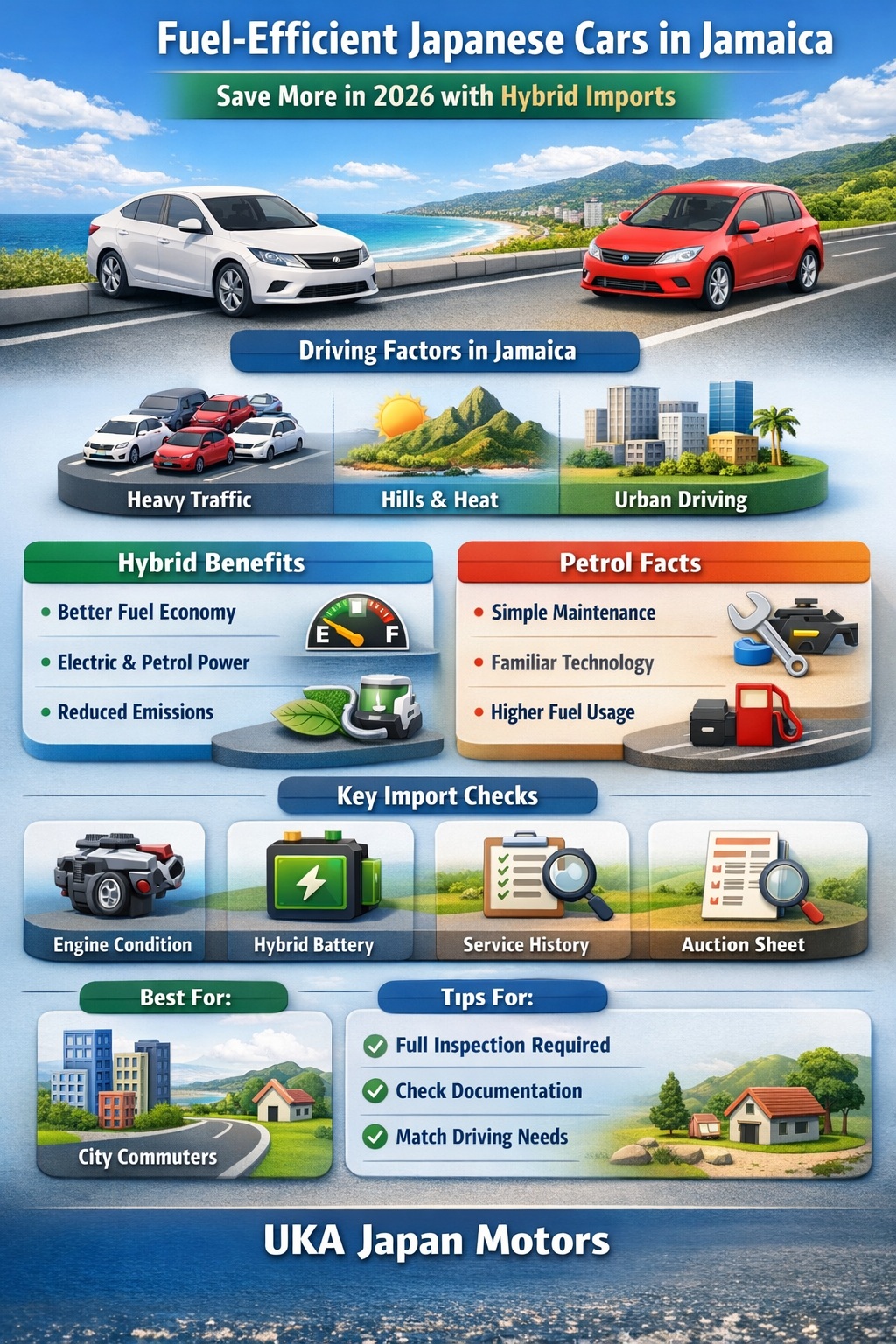
Fuel efficiency has become one of the most important considerations for drivers across Jamaica, especially in Kingston where daily traffic, stop-and-go driving, and extended idling are part of everyday commuting. Whether navigating Half-Way Tree congestion, climbing hillside communities, or driving along coastal roads, the amount of fuel a vehicle consumes directly affects long-term ownership experience.
Japanese vehicles have built a strong reputation in Jamaica for reliability and efficiency. In recent years, hybrid imports have added another dimension, offering improved fuel usage without compromising practicality.
This article explores how fuel-efficient Japanese cars and hybrid vehicles perform under Jamaican conditions, what makes them suitable, and how to choose the right option for long-term use.
Direct Answer: What Makes a Car Fuel-Efficient in Jamaica?
A fuel-efficient vehicle in Jamaica is one that:
- Uses less fuel in stop-and-go traffic
- Performs efficiently in hot, humid conditions
- Maintains consistent consumption on hills and uneven roads
- Requires minimal fuel-related maintenance issues over time
Hybrid vehicles improve efficiency further by:
- Reducing fuel use during idling and low-speed driving
- Using electric assistance in traffic-heavy areas
- Optimizing engine performance for urban environments
Why Fuel Efficiency Matters More in Kingston
Driving in Kingston is very different from highway-focused environments. Efficiency is not just about kilometers per liter on paper—it’s about how a vehicle behaves in real conditions.
Stop-and-Go Traffic
Daily commuting often involves:
- Long traffic queues
- Frequent braking and acceleration
- Extended idle times
Traditional engines burn fuel continuously in these conditions, while hybrids can operate partially on electric power.
Heat and Humidity
Jamaica’s climate affects fuel efficiency by:
- Increasing engine load
- Requiring constant air conditioning use
- Accelerating wear on components like filters and cooling systems
Fuel-efficient engines are designed to operate more effectively under these stresses.
Hills and Elevation Changes
Areas like St. Andrew’s hillside communities demand:
- Strong low-speed torque
- Efficient fuel use during climbs
Hybrid systems assist here by providing instant electric torque, reducing strain on the engine.
How Hybrid Cars Work in Jamaican Conditions
Hybrid vehicles combine:
- A petrol engine
- An electric motor
- A battery system
They automatically switch between or combine these systems based on driving conditions.
In Traffic
- Electric motor powers the vehicle at low speeds
- Engine shuts off during idle
- Fuel consumption drops significantly
On Open Roads
- Engine takes over for sustained driving
- Battery assists when needed
During Hills
- Electric motor provides additional power
- Engine operates more efficiently
This combination makes hybrids particularly well-suited for Kingston driving.
Common Fuel-Efficient Japanese Models in Jamaica
Japanese imports dominate the fuel-efficient segment due to their engineering focus and reliability.
Hybrid Sedans
These are among the most common choices for urban drivers:
- Smooth driving experience
- Excellent fuel management in traffic
- Comfortable for daily commuting
Examples typically include compact and mid-size hybrid sedans known for consistency and low consumption.
Compact Hatchbacks
Ideal for:
- Narrow streets
- Dense urban areas
- Short-distance travel
They offer:
- Lightweight design
- Smaller engines
- Reduced fuel usage
Hybrid SUVs
For drivers needing more space:
- Higher driving position
- Better road clearance
- Still relatively efficient compared to traditional SUVs
These are useful for mixed driving conditions, including rural trips.
Petrol vs Hybrid: Which Works Better in Jamaica?
Petrol Vehicles
Advantages:
- Simpler mechanical systems
- Easier familiarity for most mechanics
- Lower complexity during inspections
Limitations:
- Higher fuel consumption in traffic
- Less efficient during idle
- More fuel usage in urban environments
Hybrid Vehicles
Advantages:
- Reduced fuel usage in city driving
- Better efficiency in stop-and-go conditions
- Smoother performance in traffic
Limitations:
- More complex systems
- Requires proper inspection before import
- Battery condition must be verified
Real-World Comparison
In Kingston:
- Petrol vehicles consume more fuel during congestion
- Hybrids significantly reduce fuel usage during daily commuting
On highways:
- The difference becomes smaller
- Both perform similarly at steady speeds
Import and Inspection Considerations for Fuel-Efficient Cars
Fuel efficiency alone should not determine a vehicle choice. Import condition plays a major role.
Key Inspection Areas
Before importing:
- Engine condition
- Hybrid battery health (for hybrids)
- Transmission performance
- Cooling system functionality
Documentation Checks
Important documents include:
- Export certificate
- Auction sheet (if applicable)
- Service history
These help verify that the vehicle’s efficiency claims match its actual condition.
Hybrid Battery Considerations in Jamaica
One of the most discussed topics around hybrids is battery life.
How Batteries Perform Locally
In Jamaica:
- Warm climate can affect battery lifespan
- However, consistent use helps maintain performance
What to Check Before Import
- Battery health report
- No warning indicators
- Proper charging behavior
Long-Term Ownership
Hybrid batteries are designed for durability, but:
- Regular system checks are important
- Cooling systems must function properly
Maintenance Differences: Petrol vs Hybrid
Petrol Vehicles
Maintenance focuses on:
- Engine oil
- Filters
- Fuel system components
Hybrid Vehicles
In addition to petrol maintenance:
- Battery system checks
- Electrical components
- Cooling systems for hybrid components
Despite added complexity, hybrids often experience:
- Less engine wear
- Reduced brake wear due to regenerative braking
Driving Habits That Improve Fuel Efficiency
Regardless of vehicle type, driver behavior plays a major role.
Efficient Driving Techniques
- Smooth acceleration
- Avoiding excessive idling
- Maintaining steady speeds
- Proper tire pressure
In Kingston Traffic
- Anticipating stops reduces fuel usage
- Gentle braking improves hybrid efficiency
Ownership Experience Over Time
Fuel-efficient vehicles are not just about short-term benefits.
Long-Term Advantages
- Reduced fuel dependency
- Consistent daily performance
- Better suitability for urban life
Potential Challenges
- Hybrid system familiarity
- Need for proper diagnostics
- Importance of sourcing well-inspected units
Who Should Choose a Hybrid in Jamaica?
Hybrid vehicles are ideal for:
- Daily Kingston commuters
- Drivers facing heavy traffic regularly
- Those prioritizing long-term efficiency
Who May Prefer Petrol Vehicles?
Petrol vehicles may suit:
- Drivers in less congested areas
- Those preferring simpler systems
- Users with limited access to hybrid diagnostics
Common Misconceptions About Hybrid Cars in Jamaica
“Hybrids are not suitable for hot climates”
Modern hybrid systems are designed to handle heat, provided they are properly maintained.
“Battery replacement is frequent”
Hybrid batteries are built for long-term use and typically last for many years when properly maintained.
“Hybrids are complicated to maintain”
While more complex, proper inspection and servicing reduce most concerns.
Practical Buying Guidance
When selecting a fuel-efficient vehicle:
- Prioritize condition over model
- Ensure full inspection before import
- Match the vehicle to your driving pattern
- Verify documentation and history
Fuel efficiency should be part of a broader decision—not the only factor.
FAQ Section
1. Are hybrid cars reliable in Jamaica?
Yes, when properly inspected before import, hybrids perform reliably in local conditions.
2. Do hybrids actually save fuel in Kingston traffic?
Yes, especially in stop-and-go conditions where electric assistance reduces fuel use.
3. Is maintenance more difficult for hybrids?
It requires more specialized knowledge, but routine maintenance remains manageable.
4. How important is battery inspection before import?
It is critical, as battery condition directly affects performance and efficiency.
5. Are small petrol cars still a good option?
Yes, especially for short commutes and drivers who prefer simpler systems.
6. Do hybrids perform well on hills?
Yes, electric motors provide additional torque, improving hill performance.
7. Does air conditioning affect fuel efficiency?
Yes, but hybrids manage this better by optimizing engine use.
8. Are hybrid SUVs fuel-efficient?
They are more efficient than traditional SUVs, though not as efficient as smaller hybrids.
The Role of UKA Japan Motors
UKA Japan Motors focuses on:
- Careful inspection of fuel-efficient vehicles before export
- Verifying hybrid system condition and battery health
- Ensuring documentation accuracy
- Providing guidance based on real Jamaican driving conditions
This approach helps ensure that fuel efficiency is not just theoretical but practical in daily use.
Conclusion
Fuel-efficient Japanese vehicles, especially hybrid imports, align well with the realities of driving in Jamaica. From Kingston’s heavy traffic to hillside routes and coastal drives, efficiency depends on both vehicle design and real-world adaptability.
Hybrids offer clear advantages in urban environments, while petrol vehicles remain relevant for simpler use cases. The key lies in selecting the right vehicle based on driving habits, ensuring proper inspection, and understanding long-term ownership requirements.
Fuel efficiency is not just about saving fuel—it is about choosing a vehicle that performs consistently under Jamaican conditions.
Contact UKA Japan Motors for availability and inspection guidance.