


Japanese imported vehicles have become a familiar presence on the roads of Karachi and Lahore. From compact hatchbacks navigating narrow streets to hybrid sedans handling long daily commutes, these vehicles have shaped a significant portion of Pakistan’s automotive landscape.
A potential ban on Japanese car imports is often discussed in policy and economic circles. The reasoning usually revolves around strengthening local industry, reducing reliance on imports, and managing foreign exchange pressures. However, the actual impact of such a ban is far more complex.
This article explains how Japanese car imports have historically influenced Pakistan’s market, what changes a ban could bring, and whether such a move would benefit or challenge the economy and consumers.
Direct Answer: Would a Ban Be Beneficial?
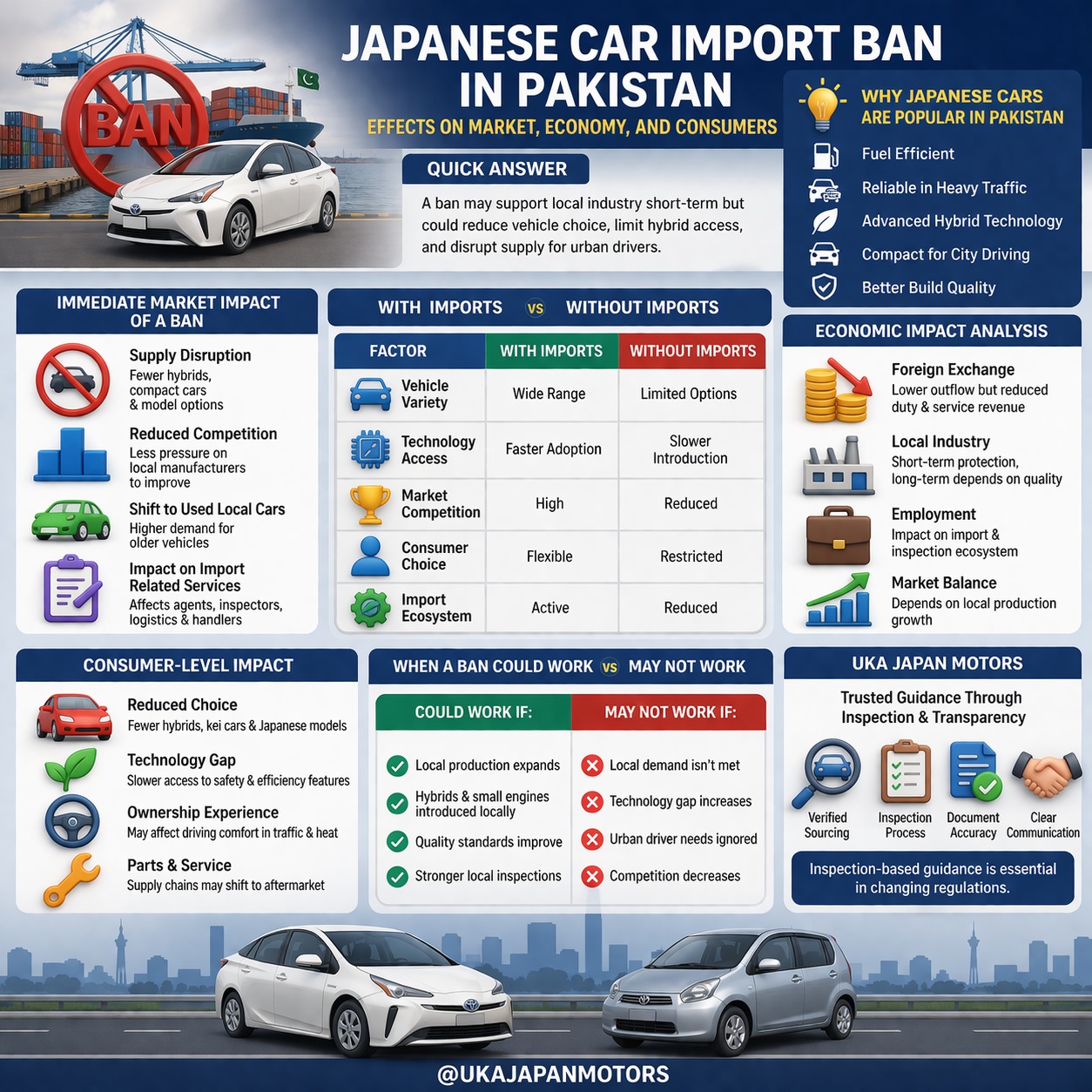
A ban on Japanese car imports may offer short-term structural support to local assemblers, but it is likely to create supply shortages, reduce consumer choice, and disrupt segments that rely heavily on imported vehicles—particularly hybrids and compact city cars.
In the long term, benefits depend entirely on whether local production can realistically fill the gap in quality, variety, and technology.
Understanding the Role of Japanese Imports in Pakistan
Japanese imports are not just an alternative—they have become a parallel segment of the market.
In cities like Karachi:
- Drivers prefer compact imported cars for maneuverability in congested areas
- Hybrid models are widely used for long commuting routes
- Imported kei cars are common in residential and commercial zones
In Lahore:
- Imported sedans and hybrids are often used for daily office travel
- Vehicles with advanced safety features attract family buyers
- Many buyers rely on imported units for better fuel efficiency in stop-and-go traffic
These vehicles typically arrive through structured import procedures, including auction sheets, inspection reports, and documentation verification.
How the Market Functioned Before Restrictions
Before strict regulatory tightening in previous years, Japanese imports:
- Created competition for locally assembled vehicles
- Introduced newer technologies earlier than local offerings
- Provided access to smaller engine and hybrid vehicles
- Offered higher build quality in certain segments
Importers developed a system involving:
- Auction sourcing from Japan
- Pre-shipment inspection
- Documentation verification
- Port clearance and registration
This ecosystem supported not only consumers but also a network of import agents, inspection handlers, and documentation specialists.
Immediate Market Impact of a Ban
1. Supply Disruption
A sudden ban would immediately reduce the availability of:
- Hybrid vehicles
- Small engine urban cars
- Specific models not produced locally
This would be especially noticeable in Karachi, where compact imported vehicles dominate certain neighborhoods.
2. Reduced Competition
Without imported vehicles:
- Local manufacturers face less pressure to improve features
- Model variety may shrink
- Innovation cycles could slow down
Competition has historically pushed improvements in:
- Safety features
- Fuel efficiency
- Interior quality
A ban may weaken this pressure.
3. Shift Toward Used Local Cars
Consumers unable to access imports may turn to:
- Older locally assembled vehicles
- Previously imported used cars already in the market
This can lead to:
- Increased demand for existing vehicles
- Greater pressure on inspection and verification processes
Economic Impact Analysis
Foreign Exchange Consideration
One of the main arguments for a ban is reducing foreign exchange outflow.
Imports require:
- Payment in foreign currency
- Shipping and port handling costs
A ban may reduce these outflows temporarily. However, the broader economic picture includes:
- Reduced activity in import-related services
- Impact on logistics and inspection sectors
- Decrease in government revenue from import duties
Local Industry Protection
A ban could provide short-term support to local assemblers by:
- Increasing their market share
- Ensuring stable demand
However, long-term success depends on:
- Ability to expand production
- Improvement in quality and technology
- Introduction of newer engine and hybrid options
Without these improvements, market imbalance can occur.
Employment and Ecosystem Effects
The import ecosystem supports:
- Clearing agents
- Vehicle inspectors
- Transport handlers
- Documentation specialists
A ban may reduce opportunities in these areas, particularly in port cities like Karachi.
Consumer-Level Impact
1. Reduced Choice
Consumers would lose access to:
- Hybrid technology in many segments
- Compact kei-class vehicles
- Specific Japanese models known for reliability
2. Technology Gap
Imported vehicles often introduce:
- Advanced safety systems
- Better fuel efficiency technologies
- Hybrid drivetrains
Without imports, this technology may take longer to appear in the local market.
3. Ownership Experience Changes
Daily driving conditions in Pakistan—heat, dust, traffic congestion—require reliable vehicles.
Imported Japanese cars are often preferred for:
- Consistent performance in heavy traffic
- Efficient cooling systems
- Smooth transmission in stop-and-go driving
A ban may shift consumers toward alternatives that may not offer the same driving experience.
Comparison: With Imports vs Without Imports
| Factor | With Japanese Imports | Without Japanese Imports |
|---|---|---|
| Vehicle Variety | Wide range | Limited to local options |
| Technology Access | Faster adoption | Slower introduction |
| Market Competition | Higher | Reduced |
| Consumer Choice | Flexible | Restricted |
| Import Ecosystem | Active | Reduced |
Inspection and Documentation Considerations
Japanese imports rely heavily on structured verification:
- Auction grading systems
- Chassis verification
- Export documentation
- Port clearance inspection
With a ban:
- These inspection processes become less relevant for new imports
- Focus shifts toward local used car inspection
- Risk of undocumented or poorly maintained vehicles may increase
Long-Term Ownership Considerations
Reliability and Maintenance
Imported vehicles are often chosen for:
- Build consistency
- Long-term reliability
Local alternatives must match these standards to maintain consumer confidence.
Parts and Service Availability
With a ban:
- Existing imported vehicles remain in use
- Parts demand may continue
- Supply chains may shift toward aftermarket solutions
Resale Market Behavior
Limited supply of imported vehicles could:
- Increase demand for already registered imports
- Shift resale patterns
- Place more importance on vehicle condition and documentation
When a Ban Might Work
A ban could be beneficial if:
- Local industry expands production capacity
- Hybrid and small-engine options are introduced locally
- Quality standards improve consistently
- Inspection systems for local vehicles become stronger
Without these developments, the market may face imbalance.
When a Ban May Not Work
A ban may create challenges if:
- Local production cannot meet demand
- Technology gap increases
- Consumer needs in urban environments are not addressed
- Market competition decreases significantly
Frequently Asked Questions (FAQs)
1. Why are Japanese cars popular in Pakistan?
They offer reliability, fuel efficiency, and features suited for urban driving conditions.
2. Will a ban reduce the number of cars on roads?
Not necessarily. Demand will shift toward locally assembled or used vehicles.
3. Does banning imports help the economy?
It may reduce foreign exchange usage but can impact other sectors negatively.
4. Will local manufacturers benefit?
Yes, in the short term, due to reduced competition.
5. What happens to existing imported cars?
They remain in use and may become more in demand.
6. Will hybrid cars still be available?
Availability may reduce unless local production increases.
7. Does a ban affect vehicle quality?
It may, depending on how local manufacturers respond.
8. How does it affect buyers in Karachi and Lahore?
Urban drivers may find fewer options suited to traffic-heavy conditions.
The Role of UKA Japan Motors
UKA Japan Motors operates with a strong focus on:
- Verified vehicle sourcing
- Transparent inspection processes
- Documentation accuracy
- Clear communication about vehicle condition
In a changing regulatory environment, the role of inspection-based guidance becomes even more important. Whether dealing with existing imported vehicles or navigating policy changes, structured verification remains essential for informed decision-making.
Conclusion
A ban on Japanese car imports in Pakistan is not a simple economic solution. While it may support local industry and reduce foreign exchange outflow in the short term, it also introduces challenges related to supply, technology, and consumer choice.
The long-term outcome depends on how effectively local production evolves to meet real-world driving needs in cities like Karachi and Lahore. Without that evolution, the market risks becoming constrained, less competitive, and less responsive to consumer demands.
Contact UKA Japan Motors for availability and inspection guidance.