


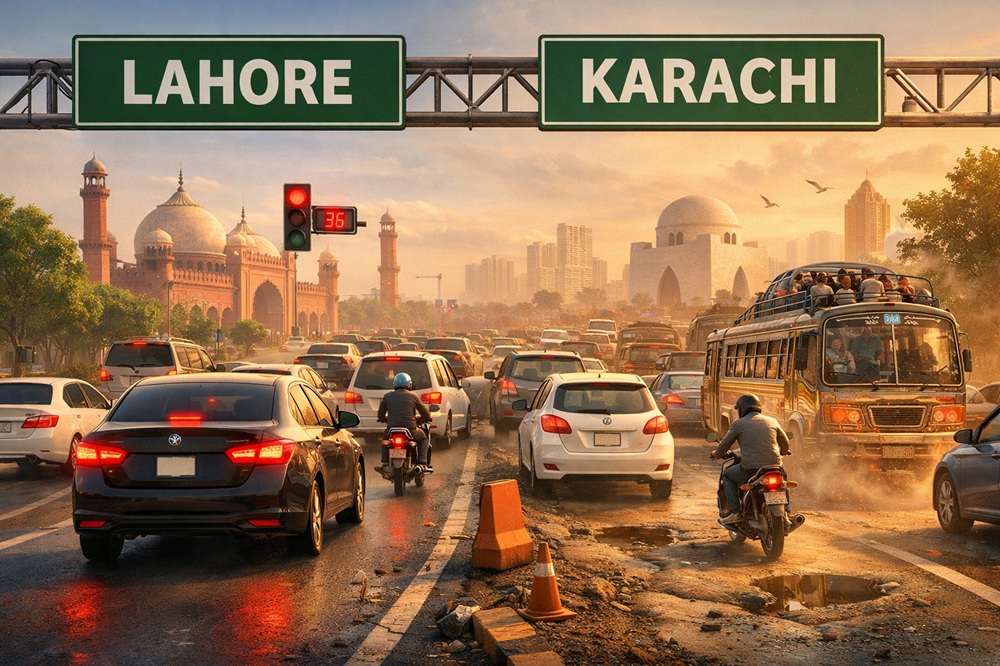
Urban driving in Pakistan is defined less by distance and more by traffic behavior. In cities like Lahore and Karachi, the same 10–15 kilometre journey can vary dramatically in time, fuel usage, and vehicle stress depending on traffic conditions.
For many car owners, especially those using imported vehicles, expectations based on smooth driving conditions often do not match the stop-start, high-density urban movement experienced locally.
Understanding how traffic patterns work—and how they affect a vehicle’s mechanical and hybrid systems—is essential for making informed ownership decisions.
Direct Answer: Why Traffic Patterns Matter
Traffic patterns in Lahore and Karachi directly affect:
- Fuel consumption
- Engine wear and heat buildup
- Transmission behavior
- Hybrid battery performance
- Brake and suspension lifespan
- Overall driving comfort
Unlike steady driving conditions, urban traffic places vehicles under constant low-speed load, which changes how engines, gearboxes, and cooling systems operate.
How Traffic Actually Moves in Lahore and Karachi
Traffic in both cities is not just heavy—it is unpredictable and inconsistent.
Karachi Traffic Characteristics
- Long, uninterrupted congestion on main arteries
- High volume of mixed vehicles (cars, bikes, buses, loaders)
- Frequent lane merging without structure
- Extended idling at signals and choke points
- Coastal humidity increasing engine load
Lahore Traffic Characteristics
- Signal-based congestion with periodic movement
- Dense traffic during office and school hours
- Wide roads but frequent bottlenecks
- Stop-and-go driving in urban zones
- Seasonal effects like fog and rain influencing flow
Stop-and-Go Driving vs Continuous Driving
This is one of the most important contrasts to understand.
Continuous Driving (Ideal Conditions)
- Engine operates at stable temperature
- Gear shifts are smooth and predictable
- Fuel efficiency remains consistent
- Minimal brake usage
Stop-and-Go Driving (Local Reality)
- Constant braking and acceleration
- Engine repeatedly heats and cools
- Gearbox shifts frequently at low speeds
- Fuel consumption increases significantly
In Lahore and Karachi, most daily driving falls into the second category, which directly impacts long-term vehicle behavior.
Impact on Fuel Consumption
One of the most common concerns among drivers is reduced fuel average after purchase.
Why Fuel Efficiency Drops in City Traffic
- Prolonged idling at signals
- Frequent acceleration from a complete stop
- Heavy use of air conditioning in heat
- Low-speed driving where engines are less efficient
Imported vehicles are often designed around steady driving cycles, which are rarely replicated in local conditions.
Hybrid Vehicles: A Different Behavior in Traffic
Hybrid cars behave differently—but not always in the way buyers expect.
Where Hybrids Perform Well
- Slow-moving traffic with gentle acceleration
- Short-distance movement with frequent stops
- Regenerative braking recovering energy
Where Challenges Appear
- Long idle periods with AC running
- High heat affecting battery cooling
- Sudden acceleration in aggressive traffic
In Karachi and Lahore, hybrids can perform efficiently, but only when driving style matches the system’s design.
Engine Stress in Urban Traffic
Engines are not under high-speed load in cities—but they are under continuous stress.
Key Stress Factors
- Heat buildup due to slow movement
- Limited airflow to the radiator
- Frequent throttle changes
- AC compressor load during idle
Over time, this leads to:
- Reduced engine smoothness
- Increased maintenance frequency
- Sensor sensitivity issues
Transmission Behavior in Traffic
Modern automatic transmissions behave differently in dense traffic.
Common Observations
- Frequent gear shifting at low speeds
- Slight jerks in stop-start movement
- Delayed response in crawling traffic
This is especially noticeable in:
- CVT transmissions
- Dual-clutch systems in low-speed driving
Understanding this helps avoid misdiagnosing normal behavior as a fault.
Brake Wear in Urban Conditions
Brakes are among the most affected components in city traffic.
Why Brake Wear Increases
- Constant stopping at signals
- Sudden braking due to unpredictable movement
- Short distances between stops
Result
- Faster brake pad wear
- Increased heat in brake discs
- Reduced braking smoothness over time
This is considered normal wear in Lahore and Karachi conditions.
Suspension and Road Interaction
Traffic patterns are closely tied to road conditions.
Urban Driving Reality
- Uneven patches and potholes
- Speed breakers at short intervals
- Frequent lane changes over rough surfaces
Combined with traffic, this leads to:
- Early wear of bushings and mounts
- Reduced ride comfort
- Increased cabin noise
Air Conditioning Load in Traffic
AC performance is heavily influenced by traffic behavior.
In Heavy Traffic
- Engine runs at low RPM
- Compressor works harder to maintain cooling
- Cabin cooling feels slower
In extreme heat, this becomes one of the largest contributors to engine load and fuel consumption.
Inspection Considerations Before Buying
Traffic-related wear is not always visible on the surface.
What Should Be Checked
- Brake condition and wear pattern
- Suspension noise over uneven roads
- Engine smoothness during idle
- AC performance in stationary conditions
- Transmission response in slow movement
Auction sheets do not reflect local traffic stress, making physical inspection essential.
Ownership Considerations for Daily Drivers
Drivers in Lahore and Karachi need to adapt their expectations and habits.
What Works Better in Local Traffic
- Smooth acceleration instead of aggressive driving
- Maintaining safe distance to reduce braking
- Regular maintenance of filters and fluids
- Monitoring AC performance
What Does Not Work Well
- Expecting highway-level fuel efficiency in city use
- Ignoring early signs of wear
- Delaying routine inspections
Comparison: Lahore vs Karachi Driving Experience
| Factor | Lahore | Karachi |
|---|---|---|
| Traffic Flow | Signal-based | Continuous congestion |
| Driving Pattern | Stop-start cycles | Long idle + crawl |
| Road Spread | Wider but bottlenecked | Dense and compressed |
| Climate Impact | Heat + seasonal fog | Heat + humidity |
| Hybrid Efficiency | Moderate | Can be high in slow flow |
Both cities create different types of stress, but the outcome—vehicle wear and fuel variation—is similar.
Common Misconceptions
“Fuel average is poor, something is wrong”
Often caused by traffic conditions, not a mechanical issue.
“Transmission is slipping”
Low-speed behavior is normal in stop-and-go traffic.
“AC is weak”
Performance changes in idle conditions are expected.
“Suspension is faulty”
Urban road conditions accelerate wear faster than expected.
Frequently Asked Questions
1. Why does my car consume more fuel in city driving?
Frequent stopping, idling, and acceleration reduce fuel efficiency significantly.
2. Are hybrids better for Lahore and Karachi traffic?
They can be, especially in slow-moving traffic, but heat and driving style affect performance.
3. Is engine heating common in traffic?
Yes, especially during long idle periods with AC running.
4. Why do brakes wear out faster in cities?
Constant stop-and-go driving increases brake usage.
5. Does traffic affect transmission life?
Yes, continuous low-speed shifting adds long-term stress.
6. Why does AC feel weaker in traffic?
Low engine speed reduces cooling efficiency.
7. Is suspension damage common in city driving?
Yes, due to uneven roads combined with traffic movement.
8. Can inspection reports show traffic-related wear?
Not always—many effects only appear during physical driving checks.
UKA Japan Motors – Inspection and Guidance Approach
Understanding traffic behavior is critical when evaluating imported vehicles. UKA Japan Motors focuses on:
- Identifying wear patterns caused by urban driving
- Evaluating engine and transmission response in real conditions
- Assessing hybrid system behavior under local stress
- Providing accurate guidance beyond auction sheet interpretation
This ensures that buyers are not relying solely on documentation but are aware of how the vehicle will perform in actual Lahore and Karachi environments.
Conclusion
Traffic patterns in Lahore and Karachi define how a vehicle performs more than any specification on paper. From fuel consumption to component wear, the daily reality of stop-and-go driving reshapes expectations for both conventional and hybrid vehicles.
Understanding these patterns allows drivers to:
- Set realistic expectations
- Maintain their vehicles more effectively
- Make better purchase decisions
Urban traffic is not just a driving condition—it is a primary factor in long-term vehicle behavior.
Contact UKA Japan Motors for availability and inspection guidance.