


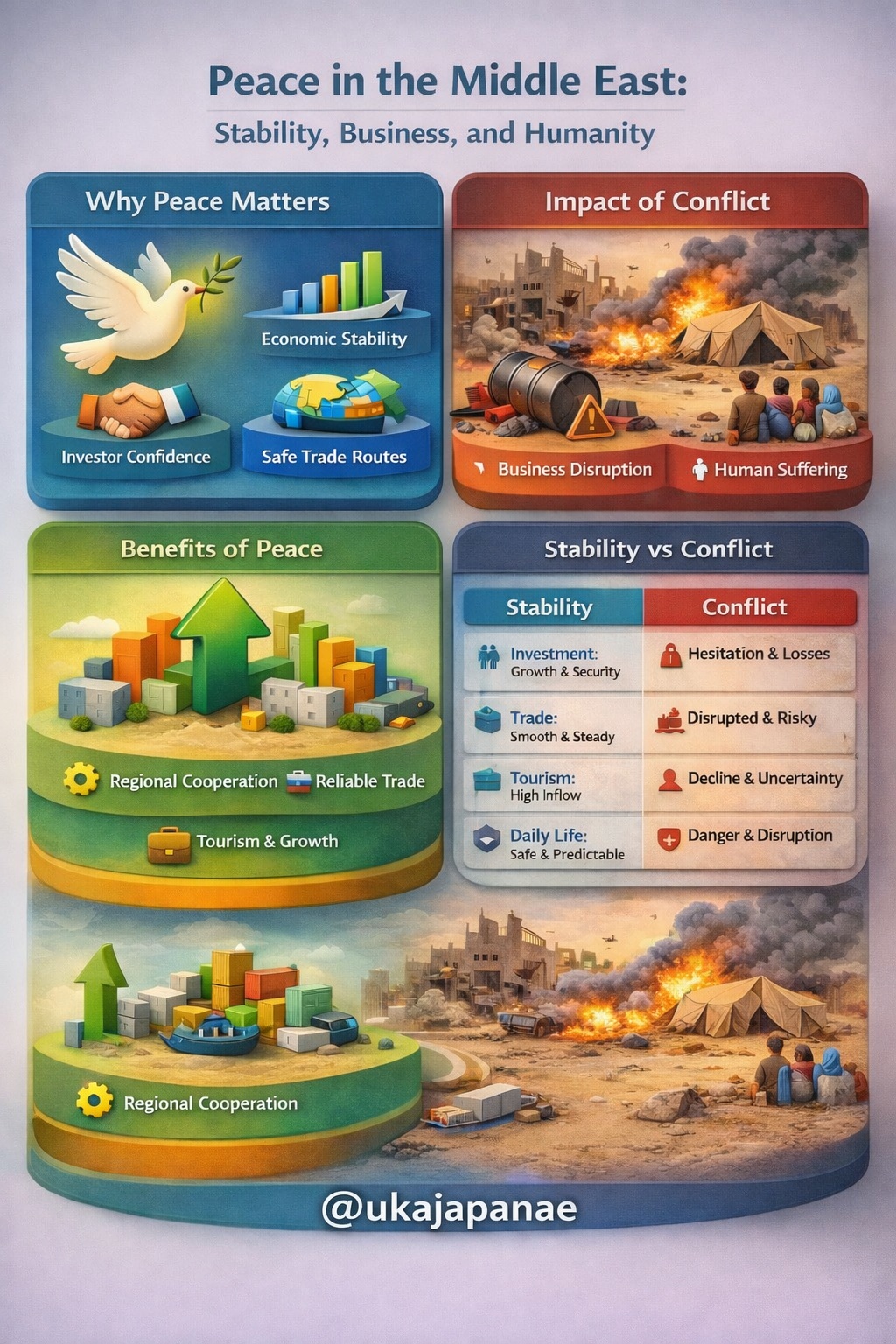
Peace in the Middle East is more than a diplomatic objective—it is the foundation upon which stability, economic continuity, and human well-being depend. In a region that connects global trade routes and supports rapidly growing economies, even small disruptions can have far-reaching consequences.
Countries such as United Arab Emirates, Iran, and Israel operate within a shared regional environment. When instability rises in one part, its effects are felt across borders—impacting businesses, infrastructure, and everyday life.
Peace is not simply an ideal. It is a requirement for sustainable growth.
Quick Summary: Why Peace Matters
- Peace ensures stable business operations and long-term planning
- Conflict disrupts trade, logistics, and investor confidence
- Human lives and communities are directly affected by instability
- Regional economies are interconnected—disturbance spreads quickly
- Sustainable development is only possible in a stable environment
Understanding the Regional Context
The Middle East holds strategic importance due to its geography, energy resources, and economic corridors. The UAE, particularly Dubai, has developed into a global hub for logistics, finance, and trade.
However, regional stability remains a critical factor.
According to global economic observations:
- Trade through Middle Eastern routes supports a significant portion of global shipping activity
- The UAE’s non-oil economy contributes over 70% of its GDP, heavily reliant on trade and services
- Regional disruptions can cause immediate slowdowns in logistics and aviation sectors
Even when conflict occurs outside UAE borders, the effects can still reach local markets through uncertainty and shifting business sentiment.
Why Peace Is Essential for Business Stability in the UAE
1. Predictability Drives Investment
Businesses rely on predictable environments. When regional tensions increase:
- Investment decisions are delayed
- Expansion plans are paused
- Risk assessments become stricter
The UAE has built its reputation on stability. This stability attracts international companies, but it is closely tied to the broader regional environment.
2. Trade and Logistics Depend on Regional Security
The UAE functions as a central logistics hub. Ports, airports, and free zones are critical to global supply chains.
Conflict can lead to:
- Delayed shipments
- Increased insurance requirements
- Route diversions
- Supply chain interruptions
Even indirect instability increases operational complexity for businesses operating in Dubai and other emirates.
3. Tourism and Mobility Are Highly Sensitive
Tourism is a key sector in the UAE. Visitor confidence is directly influenced by regional perception.
- Travelers often assess regional safety, not just individual cities
- Airline routes may be adjusted during heightened tensions
- Hospitality demand can fluctuate based on geopolitical developments
Peace ensures consistent movement of people, which supports hospitality, retail, and service sectors.
The Human Cost of Conflict
Beyond economics, the most significant impact of war is on people.
Loss of Life and Community Disruption
Conflict leads to:
- Civilian casualties
- Displacement of families
- Destruction of homes and infrastructure
These effects create long-term societal challenges that cannot be quickly resolved.
Psychological and Generational Impact
Children growing up in conflict zones face:
- Interrupted education
- Limited opportunities
- Long-term psychological stress
The effects of instability often extend across generations, shaping the future of entire societies.
No True Winners in War
It is often assumed that conflict benefits one side over another. In reality, all parties face consequences.
For example:
- Iran may face economic restrictions and internal strain
- Israel deals with ongoing security pressures
- United Arab Emirates experiences indirect economic and logistical effects
Regional instability creates a shared burden.
There is no sustainable advantage in prolonged conflict.
Why Peace Supports Long-Term Economic Growth
1. Encourages Regional Cooperation
Peace enables countries to collaborate on:
- Infrastructure development
- Trade agreements
- Technology exchange
These partnerships drive efficiency and innovation.
2. Strengthens Supply Chain Reliability
Stable regions allow:
- Consistent shipping schedules
- Reliable import and export systems
- Reduced operational risk
For the UAE, this is particularly important due to its reliance on international trade.
3. Supports Workforce Mobility
A peaceful environment allows professionals to:
- Travel freely
- Relocate for work
- Contribute to diverse industries
This supports economic diversification within the UAE.
Comparison: Stability vs Conflict in the Middle East
| Factor | Stable Environment | Conflict Environment |
|---|---|---|
| Business Growth | Consistent expansion | Delayed or reduced growth |
| Trade Operations | Predictable and efficient | Disrupted and uncertain |
| Investment | Increased confidence | Hesitation and withdrawal |
| Tourism | Steady inflow | Decline in visitors |
| Daily Life | Safe and structured | Uncertain and restricted |
This contrast highlights why peace is not optional—it is essential.
The Role of the UAE in Promoting Stability
The UAE has positioned itself as a center for:
- Diplomacy
- Economic cooperation
- International business
Its approach focuses on:
- Maintaining internal stability
- Supporting regional dialogue
- Building global partnerships
This model demonstrates how stability contributes to long-term development.
Practical Considerations for Businesses and Residents
For Businesses:
- Monitor regional developments closely
- Diversify supply chains where possible
- Maintain flexible operational strategies
For Residents:
- Stay informed through official sources
- Understand how regional events may affect travel and services
- Recognize the importance of stability in daily life
Why This Topic Matters Locally in the UAE
In the UAE, peace directly influences:
- Business continuity
- Infrastructure reliability
- Employment stability
- Quality of life
Even without direct involvement in conflict, the country’s position as a regional hub makes it sensitive to external instability.
FAQ: Peace in the Middle East
1. Why is peace important for the UAE economy?
Because the UAE relies heavily on trade, tourism, and international business, all of which depend on stability.
2. Does conflict outside the UAE affect local businesses?
Yes, through supply chains, investor confidence, and regional perception.
3. How does war impact logistics in the Middle East?
It can disrupt shipping routes, delay deliveries, and increase operational risks.
4. Why is investor confidence linked to peace?
Investors prefer predictable environments where risks are controlled.
5. Can one country benefit from regional conflict?
Short-term gains may occur, but long-term instability affects all countries.
6. How does peace affect tourism in Dubai?
Peace ensures consistent travel demand and positive global perception.
7. What are the long-term effects of conflict on society?
They include economic damage, psychological impact, and reduced opportunities.
8. Why is regional cooperation important?
It supports economic growth, infrastructure development, and shared stability.
UKA Japan Motors – A Trust-Based Perspective
At UKA Japan Motors, the focus remains on stability, compliance, and long-term reliability. The automotive industry depends heavily on consistent logistics, predictable regulations, and secure trade routes.
Regional peace supports:
- Smooth vehicle import processes
- Reliable inspection and compliance procedures
- Consistent availability of vehicles and parts
Understanding broader regional dynamics allows for better guidance and informed decision-making.
Conclusion
Peace in the Middle East is not just a political aspiration—it is a practical necessity. It supports economic systems, protects human lives, and enables long-term planning for businesses and governments alike.
Conflict creates disruption without delivering lasting solutions. Stability, on the other hand, builds opportunity, cooperation, and progress.
For countries like United Arab Emirates, maintaining and promoting peace is essential—not only for national growth but for the wider region’s future.
Contact UKA Japan Motors for availability and inspection guidance.