


Introduction
Fuel efficiency has become one of the most important considerations for vehicle ownership in Kenya. In 2026, drivers in Nairobi and Mombasa are increasingly prioritizing cars that can handle daily commuting, long-distance travel, and varying road conditions without excessive fuel consumption. Japanese vehicles—especially hybrid models—continue to dominate this space due to their engineering focus on efficiency, reliability, and adaptability.
Fuel-efficient cars are no longer limited to small engines or compact city vehicles. Today, hybrid technology allows larger sedans, crossovers, and even SUVs to deliver significantly improved consumption while maintaining performance and comfort. For Kenyan drivers dealing with traffic congestion, fluctuating fuel availability, and long travel distances, this shift has practical, everyday implications.
This article explores what fuel efficiency means in the Kenyan context, how hybrid systems work, which vehicle types are most suitable, and what long-term ownership looks like.
Quick Summary: Fuel Efficiency in Kenya 2026
- Hybrid vehicles combine petrol engines with electric motors to reduce fuel consumption
- Stop-and-go traffic in Nairobi makes hybrids particularly effective
- Coastal driving in Mombasa benefits from steady-speed efficiency systems
- Japanese imports offer consistent inspection standards and documented fuel performance
- Fuel efficiency is influenced by driving habits, road conditions, and maintenance
- Not all hybrids suit every driver—usage patterns matter
What Fuel Efficiency Really Means in Kenya
Fuel efficiency is often measured in kilometers per liter (km/L), but in Kenya, real-world conditions significantly affect how a vehicle performs.
Urban Driving in Nairobi
Nairobi presents one of the most demanding environments for fuel consumption:
- Frequent traffic congestion
- Long idle times
- Short-distance trips with repeated acceleration
In these conditions, traditional petrol engines consume more fuel because they continue running even when the vehicle is stationary.
Hybrid vehicles, however, can:
- Switch to electric mode during idle
- Reduce engine load during low-speed driving
- Recover energy during braking
This makes them particularly effective for daily commuting.
Coastal Driving in Mombasa
Mombasa offers a different driving profile:
- More consistent speeds
- Longer uninterrupted drives
- Higher humidity and salt exposure
Fuel efficiency in this environment depends on:
- Engine stability at cruising speeds
- Aerodynamic efficiency
- Proper cooling system performance
Hybrids still perform well here, but the difference compared to conventional petrol vehicles is less dramatic than in urban Nairobi traffic.
How Hybrid Cars Improve Fuel Efficiency
Hybrid vehicles operate using two main power sources:
- Petrol engine
- Electric motor powered by a battery
These systems work together to optimize energy use.
Key Hybrid Functions
1. Electric-Only Operation (Low Speed)
During slow movement or traffic, the car may rely entirely on the electric motor.
2. Engine Assistance
At higher speeds or during acceleration, the petrol engine supports the electric system.
3. Regenerative Braking
Energy lost during braking is captured and stored in the battery.
4. Automatic Switching
The system continuously adjusts power sources depending on driving conditions.
Why Japanese Hybrids Fit the Kenyan Market
Japanese manufacturers have refined hybrid systems over decades, focusing on:
- Consistent performance across varying conditions
- Efficient energy management
- Durability over long usage periods
For Kenyan imports, this matters because:
- Vehicles arrive with verified inspection records
- Mileage and condition are documented
- Hybrid systems are tested before export
This reduces uncertainty in long-term fuel performance.
Types of Fuel-Efficient Japanese Cars Available
Fuel efficiency is not limited to one vehicle category. Kenyan buyers can choose from several types depending on their needs.
1. Compact Hybrid Cars
These are ideal for city driving and daily commuting.
Characteristics:
- Smaller engine sizes
- Lightweight construction
- High efficiency in stop-and-go traffic
Best suited for:
- Nairobi commuters
- Short-distance travel
- Single drivers or small households
2. Hybrid Sedans
Sedans offer a balance between comfort and efficiency.
Characteristics:
- Stable highway performance
- Comfortable interiors
- Moderate fuel consumption
Best suited for:
- Mixed city and highway driving
- Family use
- Business and professional use
3. Hybrid SUVs and Crossovers
Modern hybrid SUVs provide space without significantly increasing fuel consumption.
Characteristics:
- Higher ground clearance
- Improved visibility
- Hybrid-assisted fuel savings
Best suited for:
- Drivers navigating uneven roads
- Long-distance travel
- Families requiring space and flexibility
4. Conventional Fuel-Efficient Petrol Cars
Not all efficient cars are hybrids. Some petrol engines are optimized for low consumption.
Characteristics:
- Simpler mechanical systems
- Lower complexity compared to hybrids
- Consistent performance with proper maintenance
Best suited for:
- Drivers who prefer traditional engines
- Areas with limited hybrid familiarity
- Lower maintenance complexity preference
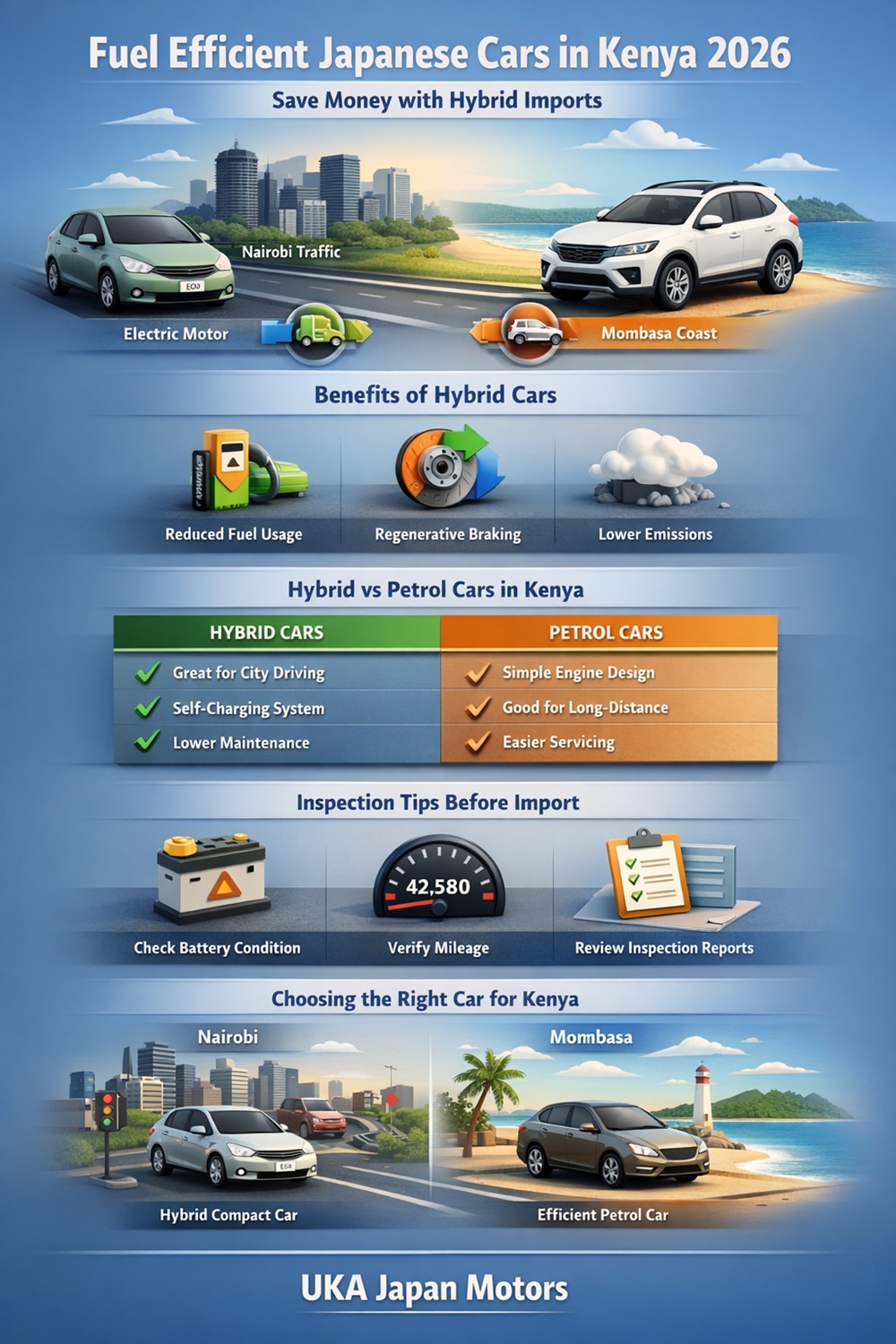
Hybrid vs Conventional Fuel Efficiency in Kenya
| Factor | Hybrid Vehicles | Conventional Petrol Vehicles |
|---|---|---|
| Traffic Efficiency | Very high in Nairobi | Lower due to idling |
| Highway Efficiency | Moderate to high | Consistent |
| Maintenance Complexity | Higher (battery system) | Lower |
| Fuel Consumption Stability | Adaptive | Fixed |
| Suitability | Urban + mixed use | Long-distance, simpler use |
Real-World Driving Considerations
Fuel efficiency depends heavily on how a vehicle is used.
Driving Style
Aggressive driving reduces efficiency even in hybrids:
- Rapid acceleration increases fuel use
- Sudden braking wastes stored energy
- Consistent speed improves efficiency
Road Conditions
Kenyan roads vary significantly:
- Smooth highways allow better fuel economy
- Rough or uneven roads increase engine load
- Stop-start traffic reduces petrol efficiency but benefits hybrids
Load and Usage
Heavier loads affect consumption:
- Carrying passengers or cargo increases fuel demand
- Roof racks and added weight reduce aerodynamic efficiency
Inspection and Import Considerations
Fuel-efficient vehicles, especially hybrids, must be carefully evaluated before import.
Key Inspection Areas
- Battery condition and performance
- Engine efficiency and service history
- Mileage verification
- Hybrid system diagnostics
Japanese inspection systems provide:
- Auction grading reports
- Mechanical condition summaries
- Verified usage records
These are critical in ensuring that a fuel-efficient vehicle performs as expected once in Kenya.
Ownership and Long-Term Use
Fuel-efficient cars offer benefits beyond immediate consumption.
Maintenance Considerations
Hybrid Vehicles:
- Require specialized understanding of battery systems
- Typically have fewer moving engine parts
- Brake systems last longer due to regenerative braking
Petrol Vehicles:
- Easier to service in most areas
- More familiar to local mechanics
- Require regular fuel system maintenance
Climate Impact
Kenyan climate affects vehicle efficiency:
- Heat can impact battery performance over time
- Coastal humidity requires corrosion awareness
- Cooling systems must be maintained properly
Daily Usability
Fuel-efficient cars must match daily needs:
- Hybrid systems excel in frequent short trips
- Petrol engines may suit long, uninterrupted drives
- Vehicle size should match road and parking conditions
When Hybrid Cars May Not Be Ideal
While hybrids offer advantages, they are not always the best choice.
They may be less suitable for:
- Drivers who mainly travel long distances at constant high speed
- Areas with limited technical familiarity for hybrid systems
- Users prioritizing mechanical simplicity over efficiency
Understanding usage patterns is essential before choosing a hybrid vehicle.
Practical Example: Nairobi vs Mombasa Usage
Nairobi Driver
- Daily commute through traffic
- Frequent stops and idle time
- Short-distance errands
Best fit: Hybrid compact or sedan
Mombasa Driver
- Longer, smoother drives
- Less congestion
- Coastal environmental exposure
Best fit: Hybrid sedan or efficient petrol vehicle
FAQs
1. Are hybrid cars reliable in Kenya?
Yes, provided they are properly inspected before import and maintained correctly.
2. Do hybrids require charging?
No, most Japanese hybrids are self-charging through driving and braking.
3. Is fuel efficiency consistent across all driving conditions?
No, it varies depending on traffic, road quality, and driving style.
4. Are hybrid batteries affected by heat?
High temperatures can influence battery lifespan, but proper maintenance reduces impact.
5. Can hybrid cars handle long-distance travel?
Yes, they perform well, though their biggest efficiency advantage is in urban driving.
6. Are fuel-efficient petrol cars still a good option?
Yes, especially for drivers who prefer simpler systems or consistent highway driving.
7. How important is inspection before import?
Critical. It ensures the vehicle meets efficiency expectations and avoids hidden issues.
8. Do hybrids reduce maintenance needs?
In some areas, yes—such as reduced brake wear—but they require attention to battery systems.
The Role of UKA Japan Motors
UKA Japan Motors focuses on ensuring that fuel-efficient vehicles imported into Kenya meet strict inspection and documentation standards. This includes verifying hybrid system performance, reviewing auction reports, and ensuring compliance with Kenyan import regulations.
For buyers in Nairobi and Mombasa, this level of inspection helps align vehicle choice with real-world driving conditions. Rather than focusing only on fuel economy figures, UKA emphasizes overall vehicle condition, long-term usability, and suitability for Kenyan roads.
Conclusion
Fuel-efficient Japanese cars—particularly hybrids—have become a practical solution for Kenyan drivers navigating both urban congestion and long-distance travel. Their ability to adapt to driving conditions, reduce unnecessary fuel consumption, and maintain performance makes them highly relevant in 2026.
However, fuel efficiency is not just about technology. It depends on how the vehicle is used, where it is driven, and how well it is maintained. Understanding these factors is essential when choosing between hybrid and conventional petrol options.
With proper inspection, realistic expectations, and alignment with local driving conditions, fuel-efficient vehicles can offer a balanced and reliable ownership experience across Kenya.
Contact UKA Japan Motors for availability and inspection guidance.