


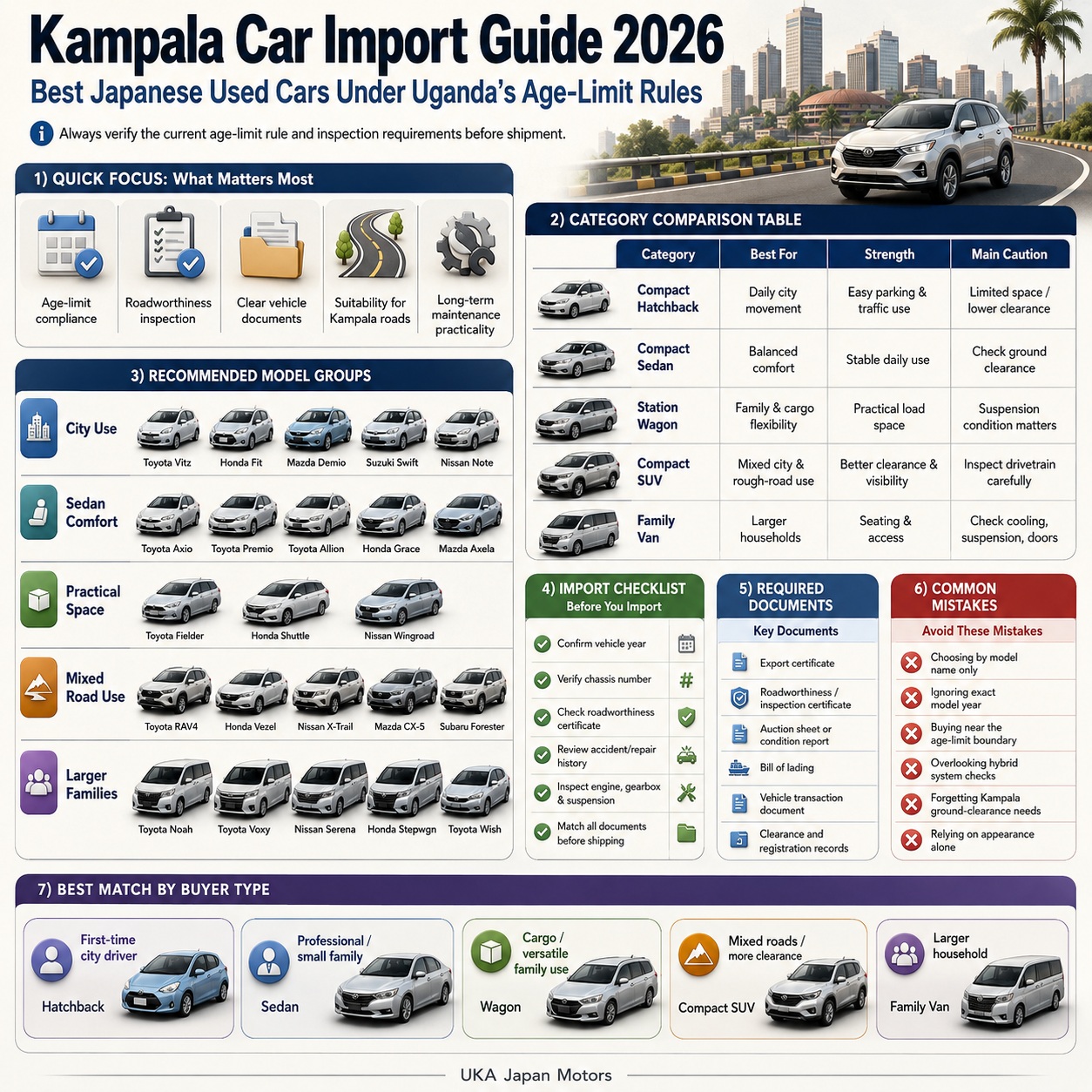
Importing a Japanese used car into Kampala in 2026 requires more than choosing a familiar model, checking mileage, and arranging shipment. Uganda’s vehicle import rules now play a major role in deciding whether a car is suitable before it ever reaches the registration stage. For buyers in Kampala, the age of the vehicle, inspection status, roadworthiness documents, and compliance record are just as important as engine size, ground clearance, fuel type, or interior condition.
Uganda currently applies an age restriction on imported used vehicles, and several 2026 policy discussions have focused on tightening that framework further. Public reporting in 2026 has stated that government proposals included reducing the maximum age of imported vehicles from 15 years to 13 years, alongside environmental levy changes for older vehicles. These proposals should be treated carefully until the final applicable rule is confirmed through the relevant authorities before import decisions are made.
For a Kampala buyer, the practical lesson is simple: do not select a car based only on appearance, auction grade, or popularity. The first question should be whether the vehicle fits Uganda’s current import eligibility requirements at the time it is shipped and cleared. A car that looks suitable on paper may create complications if its age, documentation, or inspection record does not align with Uganda’s rules.
This guide explains how Kampala buyers can think about Japanese used cars under Uganda’s 2026 age-limit environment. It does not focus on pricing, offers, or sales language. Instead, it explains what the rules mean in real ownership terms, which types of vehicles make sense for Kampala use, what documents matter, and how buyers can reduce avoidable compliance problems.
Direct Answer: What Should Kampala Buyers Focus on in 2026?
Kampala buyers importing Japanese used cars in 2026 should focus on newer, compliant, well-documented vehicles that are suitable for urban traffic, uneven roads, heat, dust, and daily stop-start driving.
The best choices are usually Japanese models that combine:
- Reliable engine and transmission history
- Comfortable ground clearance for Kampala roads
- Easy long-term maintenance
- Strong parts familiarity among local technicians
- Clear inspection and documentation records
- Import eligibility under Uganda’s current age-limit rules
- Practical fuel use for daily movement
- Stable performance in traffic and mixed road conditions
For many buyers, suitable categories include compact hatchbacks, compact sedans, station wagons, compact SUVs, and selected family vehicles. The right category depends on use. A car for daily Kampala commuting does not need to be the same as a vehicle for family travel, business movement, or regular use on rougher roads outside the city.
The key point is that a “best” Japanese used car in 2026 is not only the model with a strong reputation. It is the model that fits Uganda’s import rules, arrives with proper inspection documents, suits Kampala’s driving conditions, and can be maintained responsibly over time.
Understanding Uganda’s Vehicle Age Limit in Simple Terms
A vehicle age limit controls how old an imported used vehicle may be before it becomes restricted or prohibited for entry. In Uganda, this rule is important because many Japanese used cars are selected from earlier registration years. A buyer who does not check the age correctly may choose a vehicle that becomes difficult or impossible to clear.
The age of a vehicle should be checked carefully using official documentation, not assumptions. Buyers should pay attention to:
- Year of manufacture
- First registration date where applicable
- Export certificate details
- Chassis number consistency
- Auction sheet information
- Inspection certificate details
- Current Uganda clearance requirements
UNBS states that used motor vehicles require a Certificate of Road Worthiness from the country of origin or export before importation under the Pre-Export Verification of Conformity programme. This means age eligibility and inspection compliance should be treated as part of one decision, not separate steps.
In practical terms, Kampala buyers should avoid waiting until the car is already in transit before checking compliance. By that stage, correction options are limited. The safer approach is to confirm the vehicle’s age, condition, inspection pathway, and documents before committing to the import process.
Why This Matters More in Kampala Than Many Buyers Realise
Kampala is a demanding environment for vehicles. Traffic congestion, frequent braking, dusty conditions, uneven roads, drainage challenges, and heat all affect how a car performs over time. A vehicle that is already near the upper age limit may still look clean, but its long-term condition depends on maintenance history, engine health, suspension strength, cooling system condition, and transmission behaviour.
The age limit does not automatically tell you whether a car is good or bad. A newer car can still be poorly maintained. An older but eligible car can still be mechanically sound. However, the import rule creates a legal and practical boundary. Kampala buyers should therefore think in two layers:
First, is the vehicle eligible for import under Uganda’s rules?
Second, is the vehicle suitable for Kampala ownership after it is cleared and registered?
A buyer who answers only the first question may end up with a compliant car that is tiring to own. A buyer who answers only the second question may choose a desirable model that creates import-rule problems. The best decision balances both.
The 2026 Buyer Mindset: Compliance First, Model Choice Second
Many buyers begin by asking, “Which Japanese car should I import?” In 2026, a better first question is, “Which eligible Japanese cars make sense for my daily use in Kampala?”
This shift matters because the age-limit environment affects model availability. Some older models that were once common choices may become less practical as import rules tighten or policy discussions continue. A model’s reputation alone is no longer enough. Buyers should check whether the specific unit they are considering fits the current rule at the time of import.
A practical Kampala import checklist should begin with:
- Vehicle age confirmation
- Roadworthiness inspection arrangement
- Export document review
- Chassis number verification
- Engine and transmission condition review
- Accident repair history review
- Interior and electronics inspection
- Tyre, suspension, and brake condition review
- Compatibility with Kampala use
- Availability of maintenance knowledge locally
This approach reduces the chance of choosing a car emotionally and discovering problems later.
Best Japanese Used Car Categories for Kampala Under the Age Limit Rules
The best category depends on the buyer’s use pattern. Kampala has many different driving needs, from short daily commutes to family movement, business errands, school runs, and regular travel beyond the city. Below are the main vehicle categories that suit different buyer profiles under Uganda’s import-rule environment.
1. Compact Hatchbacks for Daily Kampala Movement
Compact hatchbacks are often suitable for buyers who spend most of their time within Kampala. They are easy to park, simple to manoeuvre in traffic, and practical for short daily trips. Many Japanese hatchbacks also have familiar engines and straightforward maintenance needs.
Common examples include:
- Toyota Vitz
- Toyota Passo
- Honda Fit
- Mazda Demio
- Suzuki Swift
- Nissan Note
These vehicles suit buyers who prioritise ease of driving, simple ownership, and city practicality. Their compact size helps in crowded parking areas, narrow lanes, and busy commercial zones.
However, compact hatchbacks may not suit every buyer. They can feel limited for large families, heavy luggage, regular rough-road use, or frequent long-distance travel. Ground clearance also varies by model and trim, so buyers should inspect suspension height carefully.
Kampala suitability
Compact hatchbacks work well around areas with heavy traffic and shorter trips. They are often easier to handle during peak movement and practical for drivers who do not need large cargo space. For buyers mainly moving between home, office, school, and urban errands, this category can be a sensible option.
Compliance consideration
Because many compact hatchbacks are available across several production years, buyers must avoid choosing a unit that falls outside the acceptable age range. The model name alone is not enough. A Toyota Vitz or Honda Fit may be suitable only if the specific unit’s year and documents fit Uganda’s import rules.
2. Compact Sedans for Balanced Comfort and Daily Use
Compact sedans offer more cabin separation, luggage space, and road stability than smaller hatchbacks. They are useful for buyers who want a car that feels comfortable in town but can also handle regular family or professional use.
Common examples include:
- Toyota Axio
- Toyota Premio
- Toyota Allion
- Nissan Sylphy
- Honda Grace
- Mazda Axela
These cars are often selected for a more settled driving feel. They can suit professionals, small families, and buyers who want a practical car for both weekday movement and weekend travel.
Kampala suitability
Compact sedans perform well on paved city roads and moderate mixed-use routes. They offer better boot space than hatchbacks and may feel calmer at steady speeds. In traffic, they remain manageable while offering more comfort than very small cars.
When sedans may not suit the buyer
Sedans may not be ideal for buyers who frequently use rough access roads, construction areas, or routes with deep potholes and uneven surfaces. Some sedan trims sit lower than expected, especially if fitted with sport suspension or low-profile tyres. Buyers should check ground clearance and underbody condition before selection.
Compliance consideration
Sedans are common in Uganda, but older units can fall close to the age-limit boundary. A buyer should confirm the year carefully and avoid relying only on exterior condition. A polished body does not prove import eligibility.
3. Station Wagons for Practical Space Without Large Vehicle Size
Station wagons are useful for buyers who need more cargo flexibility but do not want a large SUV. They can suit families, small business use, and drivers who carry luggage, equipment, or supplies around Kampala.
Common examples include:
- Toyota Fielder
- Honda Shuttle
- Subaru Impreza Sport
- Mazda Atenza Wagon
- Nissan Wingroad
The Toyota Fielder is especially familiar in Uganda because it combines practical space with manageable dimensions. Honda Shuttle and similar models may also suit buyers who want cabin flexibility and efficient daily movement.
Kampala suitability
Station wagons are practical for school runs, family errands, airport movement, business deliveries, and regular shopping. They offer better load flexibility than sedans while still being easier to drive than larger SUVs.
When station wagons may not suit the buyer
They may not be the best choice for buyers who regularly drive on very rough rural roads or need high seating position. Some wagons have moderate ground clearance, so suspension condition and tyre choice matter.
Compliance consideration
Because station wagons remain popular, buyers may be tempted to select older familiar models. In 2026, the safer approach is to focus on units that clearly meet the current age requirement and come with complete inspection documentation.
4. Compact SUVs for Kampala Roads and Mixed Use
Compact SUVs are attractive to Kampala buyers because they combine higher seating position, better ground clearance, and versatile cabin space. They can handle uneven roads better than many low sedans while remaining manageable in city traffic.
Common examples include:
- Toyota RAV4
- Honda Vezel
- Nissan X-Trail
- Mazda CX-5
- Subaru Forester
- Toyota C-HR
- Suzuki Escudo
This category suits buyers who want one vehicle for city driving, family use, and occasional upcountry movement. Compact SUVs are not all the same, however. Some are more road-focused, while others offer stronger rough-road confidence.
Kampala suitability
Compact SUVs are helpful around uneven roads, drainage channels, steep access points, and areas where sedans may scrape. Their higher seating position also improves visibility in traffic. For families, they provide flexible cabin and luggage space.
When compact SUVs may not suit the buyer
Some compact SUVs have more complex drivetrains, turbocharged engines, hybrid systems, or all-wheel-drive components that require careful inspection. Buyers should not select them only because they look strong. Maintenance history, gearbox condition, suspension health, and electronic systems should be reviewed.
Compliance consideration
Compact SUVs are often available in many years and trims. Buyers should confirm age eligibility, inspection readiness, and exact specifications. Two vehicles with the same model name can differ significantly in engine type, transmission, fuel system, and maintenance needs.
5. Family Vans and Multi-Purpose Vehicles for Larger Households
Family vans and multi-purpose vehicles suit buyers who carry more passengers regularly. They are useful for larger families, group movement, school transport within a household, and long-distance comfort.
Common examples include:
- Toyota Noah
- Toyota Voxy
- Toyota Wish
- Honda Stepwgn
- Nissan Serena
- Mazda Premacy
These vehicles provide more seating flexibility than sedans or compact SUVs. Sliding doors on some models are convenient in tight parking areas, especially around schools, residential compounds, and busy commercial spaces.
Kampala suitability
Family vans are practical for households that need space more than sporty handling. They offer comfortable passenger access and flexible seating. For city driving, they are manageable once the driver is used to their size.
When vans may not suit the buyer
Vans can require closer attention to suspension, cooling systems, sliding door mechanisms, transmission smoothness, and interior wear. Some models may have lower ground clearance than their size suggests. Buyers should inspect the underside and suspension carefully.
Compliance consideration
Because many family vans remain useful for long periods, some available units may be older than they appear. The year must be checked before selection. A clean interior does not guarantee compliance.
Comparing Vehicle Categories for Kampala Use
| Vehicle Category | Best For | Kampala Strength | Main Caution | Compliance Focus |
|---|---|---|---|---|
| Compact hatchback | Daily city movement | Easy parking and traffic handling | Limited space and ground clearance | Confirm year and inspection record |
| Compact sedan | Balanced comfort | Stable and familiar ownership | Lower clearance on some trims | Check age, chassis, and documents |
| Station wagon | Family and cargo flexibility | Practical load space | Suspension condition matters | Avoid borderline-age units |
| Compact SUV | Mixed city and rough-road use | Better clearance and visibility | More systems to inspect | Verify trim, drivetrain, and CRW |
| Family van | Larger households | Passenger space and access | Cooling, suspension, and doors | Confirm year and roadworthiness |
This comparison shows that the best car is not one model for every buyer. The right choice depends on where the vehicle will be driven, who will use it, how often it carries passengers, and whether its documents support smooth import processing.
Japanese Used Cars That Often Make Sense for Kampala Buyers in 2026
Below are practical model groups to consider. These are not ranked as a sales list. They are discussed based on suitability, maintenance familiarity, and Kampala usage patterns.
Toyota Vitz
The Toyota Vitz suits buyers who need a compact, simple city car. It is easy to manoeuvre, familiar to many technicians, and practical for daily urban movement. In Kampala, it works best for drivers who mostly carry one to three people and do not need large luggage space.
Its main advantage is simplicity. However, buyers should inspect engine condition, gearbox smoothness, suspension wear, and accident repair signs. Because many Vitz units have been imported over the years, the specific year matters greatly under age-limit rules.
Honda Fit
The Honda Fit offers excellent interior flexibility for a compact car. Its cabin layout makes it more practical than its exterior size suggests. It can suit buyers who want a small car but still need flexible seating and luggage space.
In Kampala, the Fit is useful for daily driving, errands, and small-family use. Buyers should pay attention to transmission behaviour, hybrid system condition where applicable, battery health, and service history. Hybrid versions require more careful inspection than simpler petrol-only units.
Toyota Axio
The Toyota Axio is a compact sedan that suits buyers who want a calm daily car with boot space. It is practical for office movement, family errands, and general Kampala driving. It is less bulky than larger sedans but more settled than many small hatchbacks.
Buyers should inspect suspension height, underbody condition, gearbox response, and dashboard warning lights. Axio hybrid variants may be suitable for some buyers, but they require proper battery and electrical system checks.
Toyota Fielder
The Toyota Fielder is a practical station wagon for buyers who need more space without moving into a larger SUV. It suits families, business errands, and buyers who carry luggage or equipment regularly.
For Kampala, its wagon body is useful because it offers flexible cargo space while remaining manageable in traffic. Buyers should inspect rear suspension, boot area condition, engine mounts, transmission behaviour, and hybrid system health where relevant.
Toyota Premio and Toyota Allion
Toyota Premio and Allion models are often appreciated for comfort, cabin space, and a mature driving feel. They suit buyers who want a refined sedan for professional or family use.
In Kampala, these models are comfortable for daily use, but ground clearance should be checked. Buyers should also inspect engine condition, steering components, suspension noise, and interior electronics. Because older units are common, age-limit compliance is especially important.
Honda Vezel
The Honda Vezel is a compact crossover that suits buyers who want a higher seating position and modern cabin feel without choosing a large SUV. It works well for urban movement and moderate mixed-use driving.
Buyers should inspect transmission behaviour, hybrid system condition where applicable, suspension health, and electronic features. The Vezel can be a good match for Kampala when properly inspected, but it should not be chosen casually without checking its drivetrain and documentation.
Toyota RAV4
The Toyota RAV4 suits buyers who want a stronger compact SUV feel. It is practical for mixed driving, family use, and routes where extra clearance is helpful. In Kampala, it offers visibility, comfort, and versatility.
Buyers should inspect four-wheel-drive components where fitted, suspension wear, engine condition, transmission response, and underbody condition. RAV4 units vary by generation, so the exact year and specification must be checked carefully.
Mazda CX-5
The Mazda CX-5 can suit buyers who want a compact SUV with a more refined driving character. It offers good cabin comfort and road presence, but it requires careful attention to engine type, service history, and electronic systems.
In Kampala, it may suit buyers who value comfort and mixed-use practicality. However, buyers should confirm parts familiarity for the specific engine and trim. Inspection should include diesel or petrol system checks depending on the unit.
Subaru Forester
The Subaru Forester is suitable for buyers who need stronger road confidence and practical ground clearance. It can handle mixed routes well, but it requires disciplined maintenance and careful inspection.
Buyers should check engine condition, all-wheel-drive system health, suspension components, gearbox behaviour, and service history. The Forester can be suitable for Kampala and wider Uganda use when properly maintained, but it may not suit buyers who want the simplest possible ownership experience.
Toyota Noah and Toyota Voxy
Toyota Noah and Voxy models suit families that need space and flexible seating. Their sliding doors are useful in tight parking areas, and their cabins work well for regular passenger movement.
In Kampala, they are practical for households with children, larger families, or frequent group movement. Buyers should inspect suspension, cooling systems, sliding doors, transmission behaviour, and interior wear. Because these vehicles often remain useful for many years, checking age eligibility is essential.
How to Choose Between Similar Japanese Used Cars
Many Kampala buyers compare models that appear to do the same job. For example, Toyota Fielder versus Honda Shuttle, Toyota Axio versus Honda Grace, or Toyota RAV4 versus Honda Vezel. The better choice depends on use and inspection outcome.
Toyota Fielder vs Honda Shuttle
The Fielder is often preferred for familiar maintenance and straightforward practicality. The Honda Shuttle can offer flexible cabin space and efficient driving, especially in hybrid form. However, hybrid inspection should be thorough. Buyers who want maximum simplicity may lean toward familiar petrol options, while buyers comfortable with hybrid checks may consider the Shuttle.
Toyota Axio vs Honda Grace
The Axio suits buyers who want a simple compact sedan with familiar ownership patterns. The Honda Grace may appeal to buyers looking for a modern cabin and efficient driving. The Grace, especially hybrid versions, requires more attention to electronic and battery systems.
Toyota RAV4 vs Honda Vezel
The RAV4 feels more like a traditional compact SUV and may suit rougher mixed use. The Vezel feels more urban and compact. A buyer who frequently uses uneven roads may prefer the RAV4 category, while a buyer who mostly drives within Kampala may find the Vezel practical if properly inspected.
Toyota Noah vs Toyota Wish
The Noah provides more passenger space and easier access through sliding doors. The Wish is lower and more car-like to drive. Larger families may prefer the Noah, while buyers who need occasional extra seats but want a lower vehicle may consider the Wish.
Inspection Requirements: What Buyers Should Understand
Inspection is not a formality. It is one of the most important parts of importing a Japanese used car into Uganda. UNBS explains that PVoC is carried out by appointed inspection agents in the country of export to verify compliance with technical regulations and standards.
For used vehicles, this process helps confirm that the vehicle meets roadworthiness expectations before importation. UNBS has also stated that used motor vehicles must come with a Certificate of Road Worthiness from the country of origin or export under the PVoC programme.
A proper inspection should help identify or confirm:
- Vehicle identity
- Chassis number consistency
- Roadworthiness status
- Major visible defects
- Safety-related issues
- Documentation accuracy
- Compliance with Uganda requirements
Buyers should not treat inspection as something separate from model selection. A car may be a suitable model but fail to be a suitable unit. The individual vehicle matters more than the badge.
Important Documents for Kampala Import Buyers
Documentation is central to a smooth import process. A buyer should ensure the vehicle has clear, consistent documents before it is shipped and during clearance.
Important documents may include:
- Export certificate
- Auction sheet or vehicle condition report
- Bill of lading
- Inspection certificate or roadworthiness certificate
- Commercial invoice or transaction document
- Chassis number record
- Registration-related documents
- Clearing documentation
- URA-related processing records
- Insurance and transit documents where applicable
The most important principle is consistency. The chassis number, model details, year, engine information, and inspection records should match across documents. Any mismatch can create delays or additional verification.
How Age Limit Rules Affect Model Selection
Uganda’s age limit rules affect not only whether a vehicle can be imported, but also which model years buyers should consider. A model may have an excellent reputation, but if most available units are close to the age boundary, buyers need to be more careful.
For example, some older Toyota Premio, Toyota Allion, Toyota Wish, Toyota RAV4, and Toyota Noah units remain popular in Kampala. However, their suitability depends on the exact year and documentation. A buyer should not assume that a familiar model is automatically safe to import.
The safest mindset is to select within a comfortable compliance window rather than choosing a unit close to the boundary. This helps reduce the risk of rule interpretation issues, shipment timing complications, or documentation disputes.
Kampala Road Conditions and Vehicle Choice
Kampala roads can vary significantly within short distances. A buyer may drive on smooth paved roads, rough access roads, steep residential lanes, and congested commercial streets in the same day. This makes vehicle choice more practical than emotional.
Important Kampala-related factors include:
- Ground clearance
- Suspension strength
- Cooling system condition
- Gearbox smoothness in traffic
- Brake condition
- Tyre size and availability
- Dust protection
- Air conditioning performance
- Electrical system reliability
- Ease of diagnosis by local technicians
A compact hatchback may be perfect for central urban movement but less comfortable on rougher access roads. A compact SUV may handle rougher surfaces better but requires more careful inspection. A family van may provide space but needs a strong cooling system and healthy suspension.
Fuel Type, Hybrid Systems, and Kampala Use
Japanese used cars now include many petrol, hybrid, and some diesel options. Each has advantages and considerations.
Petrol vehicles are familiar and widely understood by many technicians. They are often simpler for buyers who want straightforward maintenance. Hybrid vehicles can be suitable for stop-start Kampala traffic, but they require proper inspection of the battery system, inverter, cooling fans, dashboard warning lights, and service history.
Diesel vehicles should be approached carefully depending on model, engine type, and intended use. They may suit some heavier-use cases, but buyers should inspect fuel system condition, emissions-related components, turbo health, and service records.
Hybrid vehicles are not automatically unsuitable for Uganda. The issue is not the technology itself but whether the specific unit is healthy, properly documented, and supported by knowledgeable maintenance. A buyer choosing a hybrid should understand that inspection needs to go beyond the normal engine and body checks.
When a Newer Imported Car May Still Be the Wrong Choice
Age eligibility is not the same as quality. A newer vehicle can still have problems if it has poor service history, accident damage, flood exposure, weak battery systems, transmission issues, or hidden electronic faults.
A Kampala buyer should avoid selecting a car only because it is comfortably within the age limit. Important checks still include:
- Engine start-up behaviour
- Idle stability
- Gear engagement
- Suspension noise
- Brake feel
- Dashboard warning lights
- Hybrid battery condition where applicable
- Air conditioning performance
- Rust or underbody damage
- Evidence of major body repair
- Interior wear compared with mileage
- Service record consistency
The best import decision combines legal eligibility with mechanical confidence.
When an Older Eligible Car May Not Be Worth Choosing
A car may still fall within the allowed age range but be too close to the boundary for comfort. In 2026, with policy discussion around reducing the age cap, buyers should be especially careful with borderline units. Reporting in March and April 2026 described government plans to reduce the maximum allowable age for imported vehicles from 15 years to 13 years, although buyers should confirm the rule in force before importation.
Older eligible cars may also come with higher wear in:
- Suspension bushings
- Engine mounts
- Cooling systems
- Gearboxes
- Interior switches
- Door mechanisms
- Rubber seals
- Steering components
- Hybrid batteries where fitted
For buyers who want long-term reliability, the condition of these systems matters more than the surface appearance.
Practical Import Flow for Kampala Buyers
The import process should be handled in a disciplined sequence. Skipping steps can create avoidable problems.
1. Define the intended use
Before choosing a model, the buyer should define how the car will be used. A daily Kampala commuter, family vehicle, business-support car, and rough-road vehicle require different priorities.
2. Shortlist suitable categories
The buyer should compare hatchbacks, sedans, wagons, SUVs, or vans based on real use. This prevents choosing a vehicle that looks attractive but does not fit daily needs.
3. Confirm age eligibility
The vehicle year should be checked against Uganda’s current import rules before any further decision. The buyer should rely on documents, not assumptions.
4. Review inspection pathway
The buyer should confirm that the vehicle can undergo the required roadworthiness or conformity process before shipment.
5. Check vehicle condition
Mechanical, body, interior, electronic, and underbody condition should be reviewed. For hybrids, battery and system checks are important.
6. Verify documentation
All key documents should be consistent. The chassis number must match across records.
7. Arrange shipping and clearance support
Shipping and clearance should be handled with awareness of Uganda’s documentation and compliance requirements.
8. Prepare for registration and first maintenance
After arrival, the buyer should plan for registration flow, local inspection where required, and initial maintenance checks before regular use.
Common Mistakes Kampala Buyers Should Avoid
Choosing by model name only
A model’s reputation does not guarantee that a specific unit is compliant or mechanically sound.
Ignoring the exact year
The age-limit rule makes the exact year critical. Buyers should not estimate.
Overlooking inspection documents
A roadworthiness certificate or conformity document is not optional in the compliance process. UNBS requires used motor vehicles to have the relevant roadworthiness documentation from the country of origin or export under PVoC.
Buying close to the age boundary
Borderline vehicles may create more risk if rules shift or documents are interpreted strictly.
Ignoring Kampala ground clearance
Some attractive models sit too low for rough access roads or steep entries.
Failing to inspect hybrid systems
Hybrid vehicles need more than a normal engine check.
Assuming mileage tells the whole story
Mileage must be considered together with service history, condition, and wear patterns.
Not checking parts familiarity
A rare trim or engine can complicate maintenance even if the model name is familiar.
Which Japanese Used Cars Suit Different Kampala Buyers?
For first-time city drivers
Compact hatchbacks such as Toyota Vitz, Honda Fit, Mazda Demio, Suzuki Swift, and Nissan Note can be practical. They are easier to park and handle in traffic.
For professionals and small families
Toyota Axio, Toyota Premio, Toyota Allion, Honda Grace, and Mazda Axela can provide comfort, boot space, and calm daily driving.
For buyers needing cargo flexibility
Toyota Fielder, Honda Shuttle, Nissan Wingroad, and similar wagons provide useful space without becoming too large for city movement.
For mixed Kampala and rough-road use
Toyota RAV4, Subaru Forester, Nissan X-Trail, Mazda CX-5, and selected compact SUVs can suit buyers who need clearance and stronger road confidence.
For larger families
Toyota Noah, Toyota Voxy, Honda Stepwgn, Nissan Serena, and Toyota Wish can suit buyers who need flexible seating and passenger comfort.
When a Japanese Used Car May Not Be Suitable
A Japanese used car may not be suitable if:
- It falls outside Uganda’s current age limit
- It lacks proper inspection documentation
- The chassis number or year is unclear
- It has major accident history
- It has serious rust or underbody damage
- It shows transmission warning signs
- Hybrid battery condition is uncertain
- It has rare parts or unfamiliar systems
- It sits too low for the buyer’s routes
- It does not match the buyer’s daily use
This does not mean the model itself is bad. It means the specific unit may not be the right choice for Kampala ownership.
Long-Term Ownership Considerations in Kampala
A good import decision continues after registration. Kampala ownership requires ongoing attention to maintenance, driving conditions, and parts planning.
Important long-term considerations include:
- Regular oil and filter changes
- Cooling system maintenance
- Suspension checks
- Brake servicing
- Tyre condition monitoring
- Battery health
- Air conditioning servicing
- Gearbox fluid awareness
- Hybrid system inspection where applicable
- Electronic diagnosis when warning lights appear
Dust and heat can affect filters, cooling systems, and cabin comfort. Traffic can increase wear on brakes, gearboxes, cooling fans, and engine mounts. Rough roads can affect suspension, tyres, and steering components.
The best imported vehicle is one that the buyer can maintain properly in Kampala, not just one that clears successfully.
UKA Japan Motors’ Role in a Trust-Based Import Decision
UKA Japan Motors’ role should be understood as inspection-focused and compliance-aware guidance for buyers who want clarity before choosing a Japanese used car for Uganda. A responsible import process requires checking more than model popularity. It requires careful review of age eligibility, vehicle condition, documentation, inspection status, and suitability for Kampala use.
The value of professional guidance is in helping buyers avoid unclear documents, unsuitable model years, questionable vehicle condition, and choices that do not match local roads. This includes explaining what the vehicle is, how it fits Uganda’s rules, where inspection matters, and what ownership considerations may arise after arrival.
A transparent approach does not pressure a buyer toward one model. It helps the buyer understand the difference between a vehicle that looks attractive and a vehicle that is suitable, compliant, and practical for long-term use in Uganda.
Suggested Internal Reading Connections
This article naturally connects with broader and supporting topics such as:
- Best Japanese used cars for Kampala
- Most reliable Japanese used cars in Uganda
- Japanese SUVs for Ugandan roads
- Hybrid cars in Uganda explained
- UNBS vehicle inspection guide for used imports
- Toyota Fielder buyer guide for Uganda
- Toyota RAV4 buyer guide for Kampala
- Honda Fit and Toyota Vitz comparison for Uganda
These related articles can help buyers move from import-rule understanding to model-specific decisions.
FAQ: Kampala Car Import Guide 2026
1. What is the most important rule when importing a Japanese used car into Uganda in 2026?
The most important rule is to confirm that the vehicle meets Uganda’s current age-limit and inspection requirements before shipment. A car should not be selected only by model name or appearance. Its year, documentation, and roadworthiness status must be checked first.
2. Are Japanese used cars still suitable for Kampala buyers?
Yes, Japanese used cars can be suitable for Kampala buyers when they are compliant, properly inspected, and matched to local driving needs. The best choice depends on the buyer’s daily routes, passenger needs, maintenance expectations, and road conditions.
3. Which Japanese car category is best for Kampala traffic?
Compact hatchbacks and compact sedans are often practical for Kampala traffic because they are easier to manoeuvre and park. However, buyers who use rougher roads or carry family members regularly may prefer station wagons, compact SUVs, or family vans.
4. Is a compact SUV better than a sedan for Kampala?
A compact SUV may be better for buyers who need higher ground clearance, stronger road confidence, and flexible space. A sedan may be better for buyers who mostly drive on paved roads and want a calmer, more traditional driving feel. The better choice depends on actual use.
5. Should buyers avoid cars close to the age-limit boundary?
Buyers should be careful with cars close to the age-limit boundary. Borderline vehicles may create more risk if policy interpretation, shipment timing, or documentation checks become strict. A comfortable compliance margin is usually a more practical approach.
6. What documents should a buyer check before importing?
A buyer should check the export certificate, inspection or roadworthiness certificate, auction sheet or condition report, chassis number records, bill of lading, transaction documents, and clearance-related paperwork. The details should be consistent across documents.
7. Are hybrid Japanese used cars suitable for Uganda?
Hybrid Japanese used cars can be suitable when properly inspected and maintained. Buyers should check battery condition, inverter health, cooling fans, warning lights, and service history. Hybrid suitability depends on the specific unit, not only the model name.
8. What makes a car suitable for Kampala roads?
A suitable Kampala car should have appropriate ground clearance, strong suspension condition, reliable cooling, smooth transmission behaviour, good brakes, available maintenance knowledge, and clear documentation. It should also match the buyer’s daily use.
9. Is mileage enough to judge a Japanese used car?
No. Mileage is only one part of the assessment. Buyers should also check service history, accident signs, engine behaviour, gearbox condition, suspension wear, interior condition, and document consistency.
10. Why is roadworthiness inspection important?
Roadworthiness inspection helps confirm that the vehicle meets required standards before importation. It also supports documentation needed for compliance. UNBS identifies PVoC as an inspection and verification programme carried out in the country of export by appointed inspection agents.
11. Which car is better for a family in Kampala: Toyota Fielder or Toyota Noah?
The Toyota Fielder suits smaller families or buyers who need flexible cargo space without a large vehicle. The Toyota Noah suits larger families that need more seating and easier passenger access. The right choice depends on passenger needs, parking space, and driving routes.
12. Can a clean-looking car still be a poor import choice?
Yes. A car may look clean but still have hidden accident repairs, weak suspension, transmission problems, hybrid battery issues, or unclear documents. Buyers should inspect the specific unit carefully before importation.
Conclusion: The Best Import Choice Is Compliant, Practical, and Suitable
The best Japanese used car for Kampala in 2026 is not simply the most popular model. It is the vehicle that fits Uganda’s current age-limit rules, has proper inspection documentation, suits Kampala’s road conditions, and can be maintained responsibly over time.
For city drivers, compact hatchbacks and sedans may provide simple daily practicality. For families and business users, wagons and vans may offer better space. For mixed road conditions, compact SUVs may provide useful clearance and confidence. Each category has strengths, but every choice should begin with compliance and inspection.
Uganda’s import-rule environment makes careful selection more important than ever. Buyers should confirm the vehicle’s year, documents, roadworthiness status, and suitability before shipment. A disciplined process helps avoid unnecessary complications and supports better long-term ownership in Kampala.
Contact UKA Japan Motors for availability and inspection guidance.