


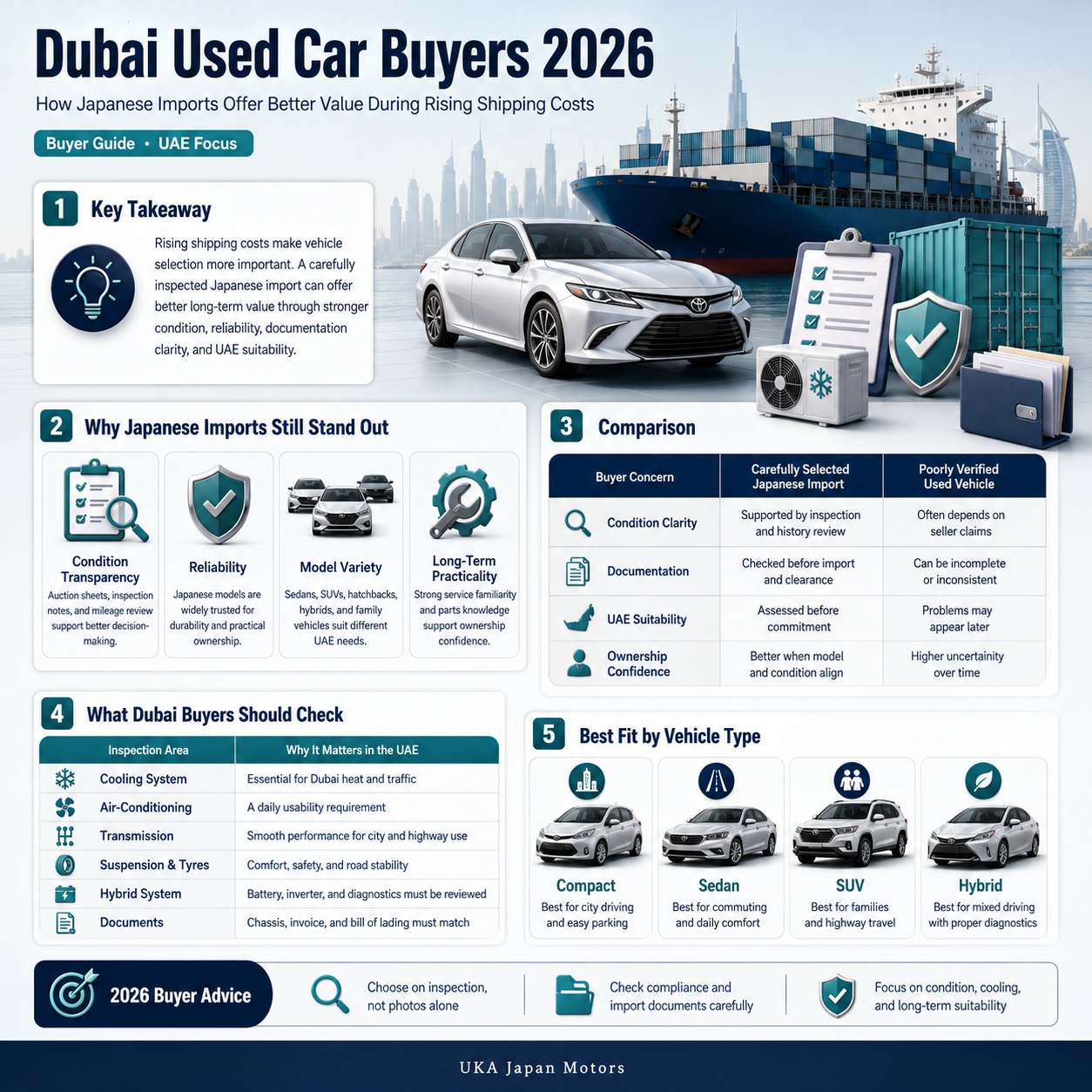
Dubai used car buyers in 2026 are looking at vehicles more carefully than before. The decision is no longer only about choosing a brand, body style, or model year. Buyers are now thinking about shipping pressure, import timing, documentation, inspection quality, long-term reliability, parts availability, fuel behaviour, road comfort, air-conditioning performance, and how well a vehicle can handle daily driving across Dubai and the wider UAE.
This is where Japanese imports continue to attract serious attention.
For many buyers in Dubai, Abu Dhabi, Sharjah, Ajman, Ras Al Khaimah, Umm Al Quwain, and Fujairah, Japanese vehicles are valued because they often combine practical engineering, strong reliability records, familiar maintenance needs, and a broad choice of sedans, hatchbacks, SUVs, hybrids, and family vehicles. During a period when freight conditions can change quickly, buyers are becoming more selective. They want vehicles that justify the effort of import, inspection, clearance, registration, and ownership.
This article explains how Japanese imports can offer better value for Dubai used car buyers in 2026, especially when rising shipping costs make poor selection more risky. The focus is not on prices or offers, but on the factors that create real ownership value: condition, compliance, durability, inspection quality, documentation, and suitability for UAE roads.
The article follows UKA Japan Motors’ publishing standards, including UAE-only context, inspection-focused guidance, neutral buyer education, and no pricing or promotional claims.
Direct Answer: Why Japanese Imports Still Make Sense for Dubai Buyers in 2026
Japanese imports can offer better value for Dubai used car buyers in 2026 because they often provide a stronger balance between vehicle condition, mechanical reliability, ownership practicality, and model variety. When shipping conditions are more volatile, the quality of the vehicle being imported becomes even more important. A poorly inspected car can create complications during customs clearance, registration, compliance checks, or daily ownership. A carefully selected Japanese import is more likely to justify the import process because the buyer is not only receiving a car, but also a vehicle with clearer condition expectations and stronger long-term usability.
For Dubai buyers, the most important point is this: rising shipping costs do not automatically make imports less attractive. They make vehicle selection more important. Buyers who focus on clean documentation, verified condition, inspection records, genuine mileage review, chassis checks, interior condition, engine health, hybrid system condition where relevant, and UAE suitability are better positioned than buyers who choose only by appearance.
In 2026, the smarter question is not simply “Is this car imported?” The better question is: “Is this imported vehicle suitable for UAE ownership after inspection, clearance, registration, and daily use?”
Why This Topic Matters in Dubai in 2026
Dubai’s used car market is practical, fast-moving, and highly condition-sensitive. Buyers may use one vehicle for daily commuting between residential communities and business districts, another for family travel across emirates, and another for mixed city and highway driving. The UAE environment places specific demands on every vehicle.
Heat is one of the biggest factors. A vehicle that performs well in mild conditions still needs to prove itself under Dubai’s summer climate. Cooling systems, air-conditioning compressors, radiator condition, battery health, rubber components, tyres, seals, and hybrid cooling systems all matter. Stop-start traffic, long highway stretches, sand exposure, and high cabin cooling demand can reveal weaknesses that are not visible during a basic visual check.
Shipping pressure adds another layer. When freight conditions are unstable, buyers cannot afford to treat import selection casually. Delays, route changes, documentation errors, and port processing requirements can affect the experience. Drewry’s May 2026 container market update noted a rebound in spot rates after several weeks of decline and described carriers as actively adjusting pricing and routing while monitoring Middle East tensions around the Strait of Hormuz.
For Dubai buyers, this means imported vehicles should be chosen with stronger discipline. The vehicle itself must be worth importing from a condition, compliance, and ownership perspective.
Japanese Imports and the Meaning of “Better Value”
“Better value” does not mean choosing the lowest-priced vehicle or chasing a bargain. In a serious buyer guide, value means the relationship between what the buyer receives and how well that vehicle performs over time.
For Japanese imports, value is usually created through several layers:
First, condition transparency matters. Many Japanese vehicles are sourced through systems where inspection details, grading, mileage records, and condition notes can support better decision-making before shipment. These details still need expert review, because grading does not replace physical and documentary verification, but it can help buyers avoid blind selection.
Second, Japanese engineering has a strong reputation for durability. Toyota, Honda, Nissan, Mazda, Lexus, Suzuki, Subaru, Mitsubishi, and other Japanese brands are familiar in the UAE. Mechanics understand many of these platforms, and parts knowledge is widespread. That familiarity supports long-term ownership confidence.
Third, model diversity is strong. Dubai buyers can consider compact hatchbacks for city use, sedans for commuting, SUVs for families, hybrids for mixed driving, and premium Japanese models for comfort-focused ownership. The range allows buyers to match the vehicle to their actual driving habits.
Fourth, Japanese interiors and mechanical systems often age well when properly maintained. This matters in Dubai, where buyers pay attention to cabin wear, dashboard condition, air-conditioning strength, suspension comfort, and electronics.
Fifth, a suitable Japanese import can hold practical appeal across different emirates because Japanese cars are already deeply understood in the UAE. A buyer in Dubai may have similar service expectations to a buyer in Sharjah or Ajman, while a family in Abu Dhabi or Ras Al Khaimah may focus more on highway comfort and cooling performance.
Rising Shipping Costs Change the Buyer Mindset
Rising shipping costs do not only affect logistics. They change how buyers evaluate risk.
When shipping pressure is low, some buyers may be more willing to take chances on vehicles with unclear history, questionable grading, limited inspection detail, or incomplete documentation. In 2026, that approach is less sensible. A vehicle that creates problems after arrival can become stressful because the buyer has already committed time, paperwork, and import effort.
A better approach is to view shipping as part of the total import journey, not a separate afterthought. The buyer should ask:
Is the vehicle condition strong enough to justify import?
Are the documents complete and consistent?
Does the chassis number match all records?
Is the mileage believable when compared with interior wear and inspection notes?
Is the vehicle likely to meet UAE registration and compliance requirements?
Are key systems ready for UAE use, especially cooling and air-conditioning?
Is the model practical to maintain in Dubai and other emirates?
If the answer to these questions is unclear, the vehicle may not offer good value even if it looks attractive in photos. If the answers are strong, a Japanese import can remain a rational choice despite freight pressure.
What Dubai Buyers Should Look for in a Japanese Import
A Japanese import should be judged through practical ownership filters rather than emotion. Appearance matters, but it is only one layer.
1. Exterior Condition
Dubai buyers should look beyond shine and body colour. The vehicle should be checked for panel alignment, paint consistency, repaired areas, corrosion risk, underbody condition, bumper mounting points, headlight clarity, and signs of structural repair.
Minor cosmetic wear may be acceptable depending on the vehicle’s use, but structural uncertainty is different. A car that has suffered poor repair work can create alignment issues, tyre wear, inspection concerns, and long-term ownership discomfort.
2. Interior Condition
Interior wear tells a story. Seat bolsters, steering wheel texture, dashboard surface, climate control buttons, gear selector, pedals, roof lining, infotainment controls, and door trims should be checked carefully.
A vehicle with unusually worn interior parts compared with its stated mileage deserves deeper review. Dubai buyers should also consider how the interior will handle UAE heat. Sticky dashboard surfaces, fading trims, weak vents, and ageing electronic switches can become more noticeable after summer exposure.
3. Engine and Cooling System
The cooling system is critical in the UAE. Japanese engines are often durable, but condition still matters. Radiator health, coolant condition, fan operation, hoses, water pump behaviour, thermostat function, and warning signs of overheating should be checked.
A vehicle that performs well during a short inspection in mild weather may behave differently in Dubai’s summer traffic. This is why serious inspection should focus on thermal behaviour, not only engine sound.
4. Transmission Behaviour
Smooth transmission operation is important for Dubai driving. Buyers should check shifting quality, hesitation, vibration, abnormal noise, fluid condition where visible, and driving behaviour during city and highway use.
Many Japanese vehicles use automatic transmissions, CVTs, or hybrid drive systems. Each type has different inspection needs. CVTs, for example, require careful review because poor maintenance can affect long-term smoothness.
5. Suspension and Steering
Dubai roads are generally well developed, but daily use can include speed humps, parking ramps, construction zones, and mixed road surfaces. Suspension condition affects comfort, tyre wear, steering confidence, and cabin noise.
Japanese sedans and SUVs can perform very well in UAE conditions when suspension components are healthy. Worn bushings, weak shocks, uneven tyres, or steering play should not be ignored.
6. Air-Conditioning Performance
Air-conditioning is not a luxury detail in the UAE. It is an ownership requirement. Buyers should check cooling speed, vent temperature consistency, blower strength, compressor engagement, cabin filter condition, condenser health, and rear cooling performance in family vehicles.
For hybrids, the cooling system may also support battery performance depending on the model. Cabin airflow and battery cooling pathways should be clean and functional.
7. Hybrid System Health
Hybrid Japanese imports can be attractive for Dubai buyers who drive in mixed traffic, but they require proper inspection. Battery condition, inverter health, warning lights, service records, cooling fans, regenerative braking behaviour, and diagnostic results should be reviewed.
A hybrid should not be judged only by fuel behaviour. It should be assessed as a complete system.
Japanese Imports vs General Used Car Buying in Dubai
A useful comparison is not between imported and non-imported cars in a simple way. The better comparison is between a properly inspected Japanese import and a poorly verified used vehicle.
| Buyer Concern | Carefully Selected Japanese Import | Poorly Verified Used Vehicle |
|---|---|---|
| Condition clarity | Can be supported by inspection notes, history review, and expert checks | Often depends on surface appearance and seller claims |
| Documentation | Should be checked before import and during clearance | May have missing, inconsistent, or unclear records |
| UAE suitability | Can be assessed before commitment | Issues may appear only after purchase |
| Mechanical confidence | Strong when model, mileage, and condition align | Uncertain if maintenance and usage history are unclear |
| Long-term ownership | Easier when parts knowledge and service familiarity are strong | Can become difficult if the model is unfamiliar or poorly maintained |
| Compliance readiness | Can be prepared through proper import steps | May face delays if documents or condition are not aligned |
The important lesson is that Japanese origin alone is not enough. Inspection quality is what turns an imported vehicle into a sensible ownership decision.
Import Documentation and UAE Compliance
Dubai buyers must understand that importing a used car is not only about choosing a vehicle and arranging shipping. Documentation and compliance matter from the beginning.
Dubai Customs states that new and second-hand vehicles can be imported according to import requirements, and when vehicles are brought by a shipping company, documents include the invoice, packing list, bill of lading, and passport copy. Dubai Customs also notes that imported vehicles are checked and evaluated by customs inspectors.
This matters because paperwork errors can delay the process. The vehicle details should match across documents. The chassis number, invoice information, bill of lading, and ownership records should be consistent. Any mismatch can create avoidable complications.
For used imported vehicles, the Ministry of Industry and Advanced Technology provides a service for issuing a product status statement. The service procedure includes registration on the ministry platform, applying for the statement, and receiving a digital copy. The ministry’s FAQ lists UAE ID copy and the vehicle’s unified identification number among requirements for obtaining the certificate.
For Dubai buyers, these steps show why professional guidance matters. A vehicle can look attractive in photos, but it still needs documentation discipline, import clearance awareness, and registration readiness.
Why Inspection Quality Becomes More Important During Freight Volatility
When shipping costs rise, buyers often become more cautious. That caution should be directed toward inspection, not panic.
Freight volatility can make the import journey feel more sensitive, but the largest avoidable risk is still poor vehicle selection. A weak inspection can miss accident repair, worn mechanical components, hidden corrosion, poor maintenance, cooling issues, odometer concerns, hybrid system warnings, or documentation inconsistencies.
A stronger inspection should include:
Chassis and body structure review
Engine bay inspection
Cooling system check
Transmission behaviour assessment
Suspension and steering review
Brake system condition
Tyre condition and age
Interior wear comparison
Electrical system check
Air-conditioning performance
Hybrid diagnostics where relevant
Document consistency review
UAE suitability assessment
This is where Japanese imports can offer better value when handled correctly. The buyer is not depending only on photos. The buyer is making a decision based on condition evidence.
Which Japanese Imports Suit Dubai Buyers in 2026?
Different buyers need different vehicles. A Japanese import should match the driver’s real lifestyle.
City-Focused Buyers
Drivers who spend most of their time in Dubai traffic may prefer compact hatchbacks, smaller sedans, or efficient hybrids. These vehicles are easier to park, practical in dense areas, and comfortable for daily commuting.
Suitable priorities include:
Easy visibility
Strong air-conditioning
Smooth automatic or hybrid drive
Simple maintenance
Cabin comfort
Reliable cooling system
Family Buyers
Families often look for sedans, crossovers, SUVs, or MPVs. In Dubai, family use places strong demand on rear-seat comfort, child-seat access, luggage space, rear air vents, ride comfort, and safety features.
Suitable priorities include:
Rear cooling performance
Cabin space
Suspension comfort
Reliable braking
Stable highway driving
Durable interior materials
Highway Commuters
Drivers moving between Dubai, Abu Dhabi, Sharjah, or other emirates need comfort, stability, and engine confidence. A vehicle that feels fine at low speed may not feel equally stable on longer highway routes.
Suitable priorities include:
Steering stability
Cabin insulation
Tyre condition
Engine temperature control
Transmission smoothness
Seat comfort
Hybrid Buyers
Hybrid Japanese imports can suit mixed-use drivers who spend time in both traffic and open roads. However, they require proper diagnostic checks.
Suitable priorities include:
Battery health review
Hybrid cooling inspection
Warning light scan
Service history review
Regenerative braking behaviour
Airflow path cleanliness
SUV Buyers
SUV buyers in Dubai often want higher seating, stronger road presence, and family practicality. Japanese SUVs can be well suited to UAE use when cooling, suspension, tyres, and drivetrain condition are verified.
Suitable priorities include:
Cooling capacity
Suspension condition
Drivetrain health
Tyre specification
Cabin cooling
Body structure inspection
When Japanese Imports May Not Be Suitable
A Japanese import may not be suitable for every buyer or every situation. This is important to say clearly.
A Japanese import may not be the right choice if the buyer wants immediate delivery without import processing, does not want to review documents, avoids inspection steps, or is considering a vehicle with unclear condition. It may also be unsuitable if the model is rare in the UAE and parts knowledge is limited.
Some imported vehicles may have specifications that need careful review for UAE conditions. Infotainment language, radio frequency compatibility, navigation systems, tyre specifications, lighting setup, and climate-related components should be checked. These are not always major issues, but they should be understood before purchase.
A Japanese import is strongest when the buyer values careful selection, verified condition, and long-term ownership suitability. It is weaker when selected quickly without proper checks.
The Role of Vehicle Grade and Auction Reports
Many buyers hear about Japanese auction grades and assume the grade tells the whole story. It does not.
Auction grade can be helpful, but it should be treated as one part of the decision. A grade may indicate overall condition, but buyers still need translation, expert interpretation, photo review, sheet remarks, repair notes, mileage assessment, and physical inspection where possible.
A vehicle with a respectable grade may still need attention in areas that matter in Dubai, such as tyres, cooling performance, air-conditioning output, battery condition, or underbody condition. Similarly, a vehicle with minor cosmetic remarks may still be mechanically strong.
The key is interpretation. A buyer should not choose a Japanese import only because a grade looks acceptable. The grade should be reviewed alongside the complete condition profile.
How UAE Climate Changes the Meaning of Condition
A car that looks clean is not always ready for Dubai. UAE climate makes certain systems more important.
Cooling System
High ambient temperature places sustained pressure on radiators, fans, coolant, hoses, and thermostats. Any weakness can become visible in summer traffic.
Air-Conditioning
Weak cooling is not a minor comfort issue in Dubai. It affects daily usability, passenger comfort, and overall satisfaction.
Battery and Electrical Components
Heat can affect battery life, sensors, wiring, and electronic modules. Buyers should check warning lights, charging behaviour, and electrical consistency.
Tyres and Rubber Parts
Tyres, bushings, seals, and mounts age under heat. Even a low-mileage vehicle can need careful rubber component inspection.
Interior Materials
Dashboard surfaces, screens, trim panels, and leather or fabric can react differently to heat and sun exposure. Interior condition matters for long-term ownership.
Why Japanese Brands Remain Familiar in the UAE
Japanese brands are deeply familiar in the UAE because they serve many use cases. Toyota and Lexus are widely understood for durability and service familiarity. Honda attracts buyers who value smooth engines and practical interiors. Nissan has strong recognition across sedans, SUVs, and family vehicles. Mazda appeals to buyers who want refined driving feel. Mitsubishi and Suzuki serve practical ownership needs in different vehicle sizes. Subaru attracts buyers who understand its drivetrain characteristics.
This familiarity matters because better value is not only created at purchase. It is created during ownership. A vehicle that mechanics understand, parts suppliers recognise, and buyers can maintain confidently has stronger practical appeal.
However, brand reputation should never replace inspection. A poorly maintained Japanese car is still a risk. A well-selected one can be a strong ownership decision.
Buyer Checklist Before Choosing a Japanese Import
Dubai buyers should follow a disciplined checklist before committing to any Japanese import.
Vehicle Identity
Confirm chassis number, model code, year details, trim level, engine type, and drivetrain.
Condition Evidence
Review auction sheet, inspection notes, photos, repair marks, wear indicators, and mechanical observations.
Mileage Logic
Compare mileage with seat wear, pedal wear, steering wheel condition, service records, and inspection comments.
UAE Suitability
Check cooling system, air-conditioning, tyre condition, ground clearance, spare parts familiarity, and model support.
Documentation
Confirm invoice, bill of lading, export-related documents, passport or ID requirements, and customs-related details where applicable.
Compliance
Check whether the vehicle can move through customs, product status requirements, inspection, and registration steps.
Ownership Fit
Decide whether the vehicle suits city use, highway driving, family needs, hybrid expectations, or SUV requirements.
How Japanese Imports Help Buyers Manage Risk
Japanese imports help manage risk when the process is handled correctly. The benefit comes from structured selection.
A buyer can review a wider range of vehicles, compare condition notes, avoid models with unclear history, and choose a vehicle that matches UAE driving needs. This structured process can be more reliable than buying based only on surface-level presentation.
Risk is reduced through:
Clearer pre-import evaluation
Document review before shipping
Model suitability checks
Mechanical inspection
Compliance awareness
Avoidance of poorly repaired vehicles
Better matching between buyer lifestyle and vehicle type
In a period of shipping volatility, this risk reduction becomes more valuable. The buyer wants fewer surprises after arrival.
Practical Comparison: Sedan, SUV, Hybrid, and Compact Japanese Imports
| Vehicle Type | Best Suited For | UAE Strengths | Inspection Focus |
|---|---|---|---|
| Compact hatchback | City driving, single drivers, short commutes | Easy parking, simple ownership, practical cabin | AC strength, suspension, transmission, interior wear |
| Sedan | Daily commuting, business use, family basics | Comfort, stable road manners, familiar maintenance | Engine cooling, transmission, tyres, cabin electronics |
| SUV | Families, highway driving, larger cabin needs | Space, visibility, road comfort | Drivetrain, suspension, tyres, cooling system |
| Hybrid | Mixed city and highway use | Smooth low-speed driving, efficient operation style | Battery health, inverter, cooling fans, diagnostics |
| Premium Japanese model | Comfort-focused buyers | Refinement, cabin quality, strong features | Electronics, suspension, service history, AC output |
This comparison shows why there is no single best Japanese import for every Dubai buyer. Better value comes from choosing the correct type for the correct use case.
Common Mistakes Dubai Buyers Should Avoid
Choosing by Photos Alone
Photos can hide important issues. Lighting, angles, polish, and camera quality can make a vehicle look better than it is.
Ignoring Auction Sheet Details
Auction sheets need proper interpretation. Small notes may indicate repair history, panel concerns, interior wear, or mechanical observations.
Overlooking Air-Conditioning
A weak AC system can affect daily usability in the UAE. It should be checked carefully before the vehicle is considered suitable.
Forgetting Compliance Steps
Importing is not complete when the vehicle arrives. Customs, product status, inspection, and registration steps matter.
Selecting Rare Specifications Without Planning
Some Japanese-market features may need adaptation or careful review. Buyers should understand infotainment, language, lighting, and parts considerations.
Assuming Brand Reputation Is Enough
A strong brand still needs inspection. Condition always matters.
Internal Reading Suggestions for Website Topic Grouping
This article can naturally connect with broader and supporting content on the UKA Japan Motors website. Suitable internal article connections include:
A broader guide on importing Japanese cars into Dubai
A supporting article on UAE vehicle inspection before registration
A guide to Japanese hybrid cars for Dubai driving
A comparison between Japanese sedans and Japanese SUVs for UAE buyers
A checklist for reading Japanese auction sheets
A guide to air-conditioning and cooling system checks for imported vehicles
These links should be placed naturally inside related paragraphs rather than forced into every section.
UKA Japan Motors’ Role in the Buyer Journey
UKA Japan Motors’ role is to help buyers approach Japanese imports with clarity, inspection awareness, and compliance understanding. The focus is not on pressure or exaggerated claims. The value lies in guiding buyers through the practical realities of imported vehicle selection.
That includes helping buyers understand whether a vehicle’s condition supports import, whether documents appear consistent, whether the model suits UAE use, and whether the car should be reviewed more deeply before any decision is made.
For Dubai buyers in 2026, this type of guidance matters because freight pressure makes mistakes more costly in terms of time, effort, and ownership stress. A better import decision begins before shipment, not after arrival.
UKA Japan Motors should be seen as inspection-focused, compliance-aware, professional, and transparent. The buyer should feel informed, not pushed.
FAQ: Dubai Used Car Buyers and Japanese Imports in 2026
1. Are Japanese imports still a good option for Dubai used car buyers in 2026?
Yes, Japanese imports can still be a strong option when the vehicle is carefully selected, properly inspected, and suitable for UAE conditions. The key is to focus on condition, documentation, compliance, and long-term ownership rather than appearance alone.
2. How do rising shipping costs affect Japanese import decisions?
Rising shipping costs make careful vehicle selection more important. Buyers should avoid weak-condition cars, unclear documents, and models that may create inspection or ownership issues after arrival.
3. What is the most important inspection area for Dubai conditions?
Cooling and air-conditioning are among the most important areas. Dubai’s heat places heavy demand on radiators, fans, hoses, batteries, AC compressors, condensers, and cabin airflow systems.
4. Do Japanese auction grades guarantee condition?
No. Auction grades are useful, but they do not replace expert review. Buyers should examine sheet remarks, photos, mileage logic, repair notes, and UAE suitability before making a decision.
5. Are Japanese hybrids suitable for Dubai?
Japanese hybrids can suit Dubai drivers, especially those who drive in mixed traffic and highway conditions. However, battery health, inverter condition, cooling fans, and diagnostic results should be checked carefully.
6. What documents matter when importing a used car into Dubai?
Dubai Customs identifies documents such as invoice, packing list, bill of lading, and passport copy when vehicles are brought by shipping company. Imported vehicles are also checked and evaluated by customs inspectors.
7. What is a product status statement for used imported vehicles?
It is a UAE service connected to used imported vehicles. The Ministry of Industry and Advanced Technology states that applicants can apply through its digital platform and receive a digital copy after completing the process.
8. Are Japanese SUVs better than Japanese sedans for Dubai?
It depends on the buyer. SUVs suit families, higher seating preferences, and larger cabin needs. Sedans can suit commuting, comfort, and daily city use. The better choice depends on driving habits, parking needs, passenger requirements, and inspection results.
9. What should buyers check before importing a Japanese car?
Buyers should check vehicle identity, auction details, mileage logic, body condition, engine health, transmission behaviour, cooling system, AC performance, documentation, and UAE compliance readiness.
10. Can a Japanese import be unsuitable for UAE use?
Yes. A vehicle may be unsuitable if it has unclear history, weak cooling, poor AC performance, questionable repairs, incomplete documents, rare parts requirements, or specifications that do not fit UAE ownership needs.
11. Why does documentation consistency matter?
Documentation consistency helps avoid delays and complications. The chassis number, invoice, bill of lading, and vehicle identity details should align clearly across records.
12. What makes Japanese imports valuable beyond purchase?
Long-term value comes from reliability, service familiarity, parts knowledge, comfort, inspection clarity, and suitability for daily UAE use. A car that remains practical after registration is more valuable than one that only looks attractive before import.
Conclusion
Dubai used car buyers in 2026 are making decisions in a more demanding environment. Rising shipping costs and freight uncertainty do not remove the appeal of Japanese imports, but they do raise the importance of careful selection. A vehicle must be worth the journey from inspection to shipping, customs clearance, compliance, registration, and daily ownership.
Japanese imports continue to stand out because they often provide a strong balance of reliability, model variety, mechanical familiarity, and practical ownership suitability. However, the benefit is not automatic. It depends on choosing the right vehicle, reading condition evidence properly, checking documents, understanding UAE compliance, and preparing the car for Dubai’s climate and driving patterns.
For buyers in Dubai and across the UAE, the best approach is disciplined and inspection-led. A Japanese import should not be selected because it looks clean in photos or because the brand has a strong reputation. It should be selected because its condition, documentation, mechanical health, and ownership profile make sense for UAE roads.
Contact UKA Japan Motors for availability and inspection guidance.