


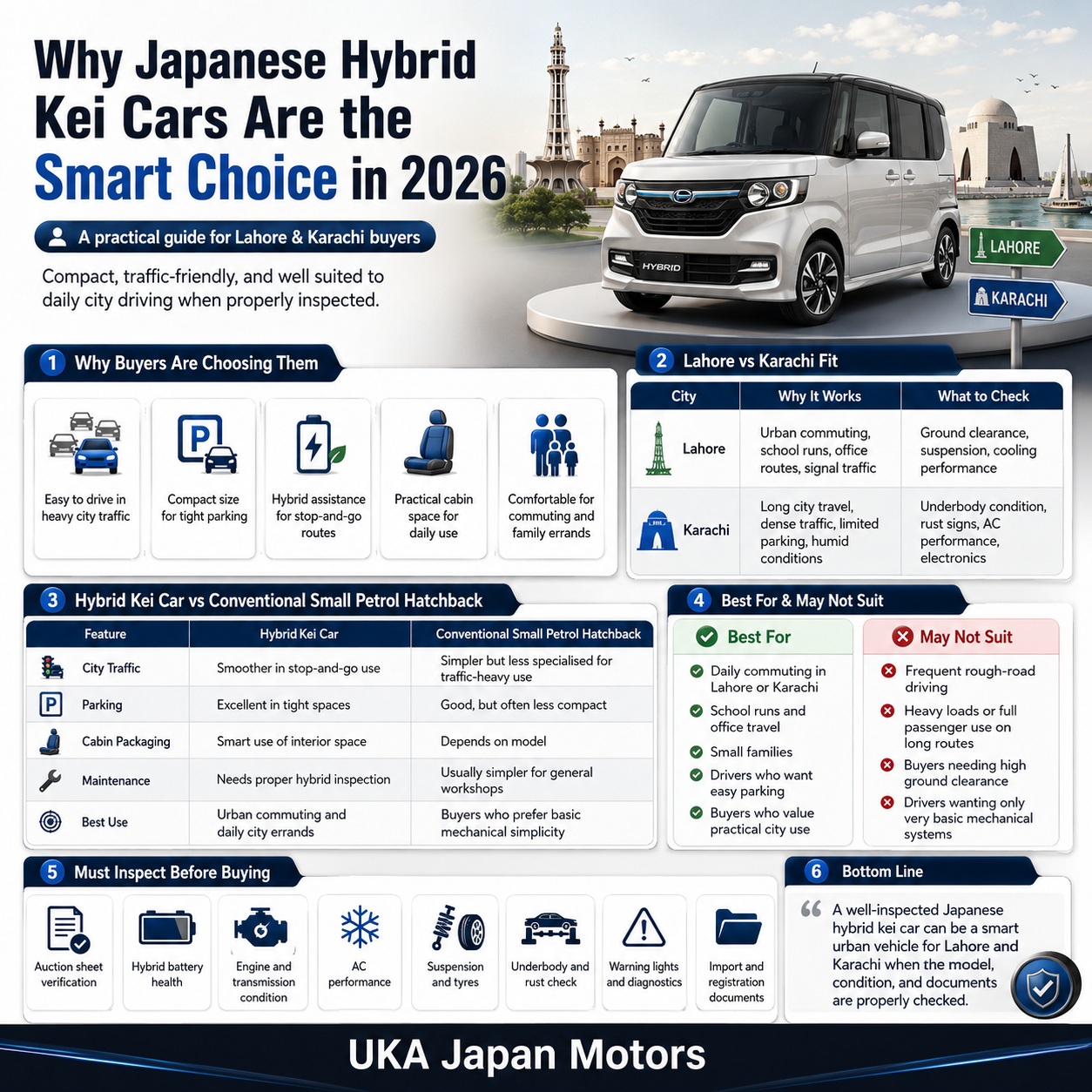
Japanese hybrid kei cars are becoming a serious consideration for many buyers in Lahore and Karachi because they match the way people actually drive in these cities. Daily routes are often slow, crowded, stop-and-go, and unpredictable. A car may spend more time crawling through traffic than moving at open-road speeds. In this environment, a compact hybrid vehicle can feel more practical than a larger car that is difficult to park, heavier to move through congestion, and less suited to narrow lanes.
A kei car is a compact Japanese vehicle designed around small dimensions, light body weight, efficient packaging, and practical urban use. When a hybrid system is added, the vehicle gains electric assistance during low-speed movement, acceleration support, and improved fuel behaviour in traffic-heavy conditions. This makes the hybrid kei car especially relevant for buyers who spend most of their time inside Lahore and Karachi rather than regularly driving long highway routes.
In 2026, buyer thinking is also changing. Many drivers are no longer looking only at engine size or exterior appearance. They are paying closer attention to inspection history, verified auction grades, battery condition, comfort in heat, road behaviour, ease of parking, and suitability for family routines. Japanese hybrid kei cars answer many of these concerns, but they must be selected carefully. Not every kei car suits every buyer, and not every imported unit has the same condition, documentation, or long-term ownership outlook.
This article explains what Japanese hybrid kei cars are, why they are becoming relevant for Lahore and Karachi, how their hybrid systems work in daily traffic, who they suit, when they may not be suitable, and what buyers should inspect before making a decision.
Quick Answer: Why Are Japanese Hybrid Kei Cars Becoming a Smart Choice?
Japanese hybrid kei cars are becoming a smart choice for Lahore and Karachi buyers because they are compact, easy to manage in traffic, convenient for tight parking spaces, and well suited to stop-and-go urban driving. Their hybrid systems support low-speed movement and reduce engine load during repeated acceleration, which is common in both cities.
They are especially suitable for buyers who need a practical daily car for school runs, office commutes, market visits, and inner-city movement. Their appeal is strongest where roads are crowded, parking is limited, and driving distances are repetitive rather than high-speed.
However, they are not ideal for every situation. Buyers who regularly travel with full passenger loads, drive on rough outer-city routes, require high ground clearance, or frequently use highways may need to evaluate carefully before choosing a hybrid kei car.
What Is a Japanese Hybrid Kei Car?
A Japanese hybrid kei car is a compact vehicle built under Japan’s kei car category and equipped with a hybrid assistance system. These cars usually have small engines, lightweight construction, compact dimensions, and cabin layouts designed to maximise usable space within a short body length.
The hybrid system in many kei cars is commonly designed to assist rather than fully replace the petrol engine. In simple terms, the system may help during acceleration, support smoother low-speed movement, and reduce the strain on the engine in traffic. This is different from larger hybrid vehicles that may operate more often on electric power alone.
For Lahore and Karachi buyers, the important point is not the technical label alone. What matters is how the car behaves in real daily use. A hybrid kei car should be judged by how smoothly it moves in traffic, how well its air conditioning performs in heat, how comfortable it feels on uneven roads, how easy it is to park, and whether its hybrid battery and electronic systems are in reliable condition.
Why Lahore and Karachi Are Natural Environments for Kei Cars
Lahore and Karachi have very different driving personalities, but both create conditions where compact hybrid kei cars can make sense.
Karachi has long commuting distances, dense commercial areas, coastal humidity, rough patches, uneven road repairs, traffic bottlenecks, and limited parking in many neighbourhoods. A buyer moving between areas such as Gulshan, DHA, Clifton, Saddar, Tariq Road, North Nazimabad, Korangi, or Shahrah-e-Faisal may deal with frequent braking, idling, lane changes, and heat exposure.
Lahore has its own pattern. Roads may be wider in some areas, but traffic density, signal waiting, school-time congestion, underpass queues, and seasonal weather changes affect daily driving. Areas such as Johar Town, Gulberg, Model Town, DHA, Ferozepur Road, Canal Road, and the inner city can all create different challenges for a daily-use vehicle.
In both cities, compact size matters. A car that can move through narrow gaps, turn easily, and park without stress becomes more than a convenience. It becomes part of daily comfort. Hybrid kei cars are gaining attention because they are designed around this exact type of use.
The Role of Hybrid Assistance in Stop-and-Go Traffic
Hybrid kei cars perform best when their systems are used in the type of driving they were designed for. Lahore and Karachi traffic often involves repeated movement from a standstill, short acceleration, braking, and waiting. This is where hybrid assistance can be useful.
In simple terms, the hybrid system helps reduce the pressure placed on the petrol engine during certain driving moments. When the car starts moving from low speed, the electric assistance can support smoother acceleration. In traffic queues, the system may help manage engine operation more efficiently. When braking or slowing down, some systems recover energy and store it for later assistance.
This does not mean all hybrid kei cars behave the same way. Some have mild hybrid systems, while others may offer stronger electric support. Buyers should not rely only on the word “hybrid” written in the listing. The actual system type, battery condition, inspection report, mileage record, and diagnostic results matter more.
For daily drivers in Lahore and Karachi, the practical benefit is smoother movement in traffic and less engine strain during repetitive city use. That is why these cars are becoming more relevant as buyers become more aware of how driving conditions affect long-term vehicle behaviour.
Compact Size Without Losing Practical Cabin Space
One reason Japanese kei cars attract attention is their clever interior packaging. Although the outer body is compact, many models offer a surprisingly usable cabin. Tall rooflines, flat floors, sliding doors in some models, upright seating, and flexible rear seats can make them practical for urban families.
This matters in Lahore and Karachi because many buyers use one car for multiple daily tasks. A car may carry children to school in the morning, handle office commuting during the day, visit markets in the evening, and manage family errands on weekends. A hybrid kei car can suit this routine if the buyer chooses the right body style.
A tall wagon-style kei car may suit buyers who prioritise easy entry and cabin openness. A compact hatchback-style kei car may suit those who prefer simpler handling and easier parking. A sportier kei model may look attractive, but it may not always offer the comfort or practicality needed for family use.
The key is to match the car to the routine, not just the shape.
Why Buyers Are Moving Toward Smaller, Smarter Cars
The idea of a “smart choice” in 2026 is not limited to vehicle size. Buyers are becoming more practical. Many now ask deeper questions before selecting a car:
Is it easy to drive every day?
Will it handle traffic without feeling tiring?
Is the cabin comfortable in summer?
Can it be parked near offices, schools, clinics, and markets?
Is the inspection history clear?
Are the documents complete?
Is the hybrid battery healthy?
Is the vehicle suitable for long-term local maintenance?
These questions show a shift from surface-level buying to ownership-focused decision-making. Japanese hybrid kei cars are benefiting from this shift because their strengths are practical rather than decorative. They are not chosen only because they are compact. They are chosen because compactness, hybrid assistance, and city-friendly design work together.
Hybrid Kei Cars Compared With Conventional Small Petrol Hatchbacks
A useful comparison is between a hybrid kei car and a conventional small petrol hatchback used in Lahore and Karachi.
A conventional small petrol hatchback is usually simpler mechanically. It may be easier for general workshops to understand, especially if the model is common locally. For buyers who prefer basic mechanical familiarity, this can be reassuring.
A hybrid kei car, however, offers a different kind of daily-use experience. It is usually more compact, often more efficient in space use, and designed for repeated urban movement. The hybrid system adds an electronic layer that can improve city driving behaviour, but it also requires proper inspection and more informed maintenance.
The comparison is not about one being universally better. It depends on the buyer. A conventional hatchback may suit someone who wants simplicity above all else. A hybrid kei car may suit someone who values traffic comfort, compact size, smoother movement, and modern urban practicality.
The better choice depends on usage pattern, route quality, family needs, and willingness to maintain the car correctly.
Inspection Matters More Than the Hybrid Badge
A Japanese hybrid kei car should never be selected only because it is hybrid. The word itself does not guarantee condition. The inspection process is where a buyer protects long-term ownership confidence.
Important inspection areas include:
Hybrid battery health
Engine condition
Transmission behaviour
Suspension noise
Air conditioning performance
Accident history
Auction sheet verification
Odometer consistency
Rust or underbody condition
Interior wear
Electronic warning lights
Sensor and diagnostic scan results
Karachi buyers should be especially careful about humidity-related wear, underbody condition, and air conditioning performance. Lahore buyers should consider heat performance, dust exposure, suspension condition, and how the car handles uneven road surfaces.
A hybrid kei car with clean documentation, verified inspection, and a healthy battery can be a practical daily vehicle. A poorly inspected unit can become difficult to own, even if the model itself is good.
Documentation and Import Handling Considerations
Imported vehicles require careful documentation review. Buyers should understand that vehicle import handling is not only about receiving the car. It includes verifying documents, customs clearance records, auction details, import file, registration readiness, and transfer process.
The Federal Board of Revenue states that Pakistani nationals residing abroad, including dual nationals, may import old and used vehicles under Personal Baggage, Gift Scheme, and Transfer of Residence, with cars not older than three years under those schemes. This is relevant because buyers must understand whether a vehicle’s import route and documentation are properly aligned before considering ownership.
In Lahore, transfer and registration procedures may involve biometric verification processes through the provincial excise system. Punjab Excise has published information on biometric verification for motor vehicle owners. In Karachi, buyers can also use Sindh’s official online vehicle verification system to check vehicle registration details.
These checks do not replace a full document review, but they are part of responsible buying. A clean car physically should also be clean on paper.
Suitability for Daily Lahore Driving
In Lahore, a hybrid kei car can suit buyers whose daily routes include office commutes, school runs, university travel, market visits, and movement through dense urban areas. The compact size helps in parking, while the hybrid system supports low-speed driving through congestion.
However, Lahore’s road conditions vary. Some areas have smooth main roads, while others include broken patches, raised lane edges, uneven service roads, and construction diversions. Ground clearance, tyre condition, suspension health, and underbody inspection are important.
A buyer who mostly drives within developed urban areas may find a hybrid kei car very practical. A buyer who regularly travels on rough peripheral routes should be more careful. Kei cars are compact and efficient, but they are not built to replace vehicles designed for heavier road abuse.
Suitability for Daily Karachi Driving
Karachi creates a different test. The city’s size, humidity, heat, traffic pressure, and road variation can expose weak vehicles quickly. A hybrid kei car can work well in Karachi when it has a strong air conditioning system, healthy cooling components, clean underbody, and reliable hybrid battery condition.
Parking is one of the strongest advantages. In many Karachi commercial and residential areas, a compact car is easier to live with. Narrow lanes, crowded markets, office parking limits, and apartment surroundings all favour smaller vehicles.
At the same time, Karachi buyers should be cautious about flood exposure, rust signs, repaired body panels, and electronic issues. Hybrid vehicles rely on sensors and control modules, so water exposure history must be taken seriously. A clean auction sheet and local inspection are both important.
Long-Term Ownership Behaviour
Long-term ownership of a hybrid kei car depends heavily on maintenance discipline. These cars should not be treated casually simply because they are small. Their compact design and hybrid systems require timely attention.
Owners should monitor warning lights, use suitable engine oil, maintain the cooling system, keep tyres properly matched, avoid careless jump-starting, and ensure that technicians understand hybrid basics. Air filters, cabin filters, plugs, transmission fluid, and battery ventilation should also be checked according to the vehicle’s condition and usage.
In Lahore and Karachi, dust and heat can affect filters and cooling performance. Long idling with air conditioning, slow traffic, and short repeated trips can also place specific demands on the vehicle. A properly maintained hybrid kei car can remain comfortable and practical, but neglect can reduce reliability.
Comfort, Visibility, and Ease of Driving
Many hybrid kei cars offer upright seating and excellent visibility. This matters more than many buyers realise. In congested traffic, good visibility reduces fatigue. A driver who can judge corners, motorbikes, rickshaws, roadside barriers, and parking edges more easily will feel more confident.
The light steering and compact body also help new drivers and family users. For buyers who drive mainly in urban areas, ease of operation can be more valuable than engine power. A car that feels relaxed in tight spaces often becomes more useful than a larger vehicle that feels stressful during daily errands.
That said, buyers should test seating comfort carefully. Some kei cars have narrow seats or firm suspension. Taller passengers may need to check headroom, legroom, and rear-seat comfort before choosing a model.
When a Hybrid Kei Car Makes Sense
A Japanese hybrid kei car makes sense when the buyer’s daily life matches the car’s strengths. It is suitable for:
Daily commuting within Lahore or Karachi
School and university routes
Office travel through traffic-heavy areas
Small family use
Short to medium urban trips
Drivers who need easy parking
Buyers who value compact handling
Owners willing to maintain hybrid systems properly
It is especially useful when most driving happens at moderate speeds and in repeated traffic cycles. The more urban the routine, the more relevant the kei car becomes.
When a Hybrid Kei Car May Not Be Suitable
A hybrid kei car may not suit every buyer. It may not be the right fit for people who regularly carry heavy loads, travel with full passenger capacity on rough routes, need high ground clearance, or frequently drive long-distance highway routes.
It may also not suit buyers who want a vehicle that any roadside mechanic can handle without diagnostic understanding. Hybrid systems require better inspection and maintenance awareness. While many issues can be managed with the right expertise, buyers should not ignore the technical side of ownership.
A buyer who expects a compact hybrid kei car to behave like a larger sedan or high-clearance vehicle may be disappointed. The best results come when expectations match the vehicle’s design purpose.
Common Mistakes Buyers Should Avoid
One common mistake is selecting a car only by appearance. Many kei cars look modern and attractive, but appearance does not confirm battery health, accident history, or mechanical condition.
Another mistake is ignoring the auction sheet. A verified auction sheet helps buyers understand grading, repairs, mileage, and condition notes. It should be reviewed carefully, not treated as a formality.
A third mistake is overlooking local suitability. A car that looks clean may still have low ground clearance, limited rear comfort, or weak air conditioning performance. In Lahore and Karachi, these factors affect daily satisfaction.
Buyers should also avoid assuming that all hybrid systems are the same. Mild hybrid, full hybrid, and assist-based systems behave differently. A buyer should understand the system in the specific model being considered.
Practical Pre-Purchase Checklist
Before choosing a Japanese hybrid kei car, buyers should review the following areas carefully:
Verified auction sheet
Import documents
Customs clearance record
Registration status or registration readiness
Body condition
Underbody condition
Hybrid battery health
Diagnostic scan results
Engine and transmission behaviour
Air conditioning performance
Suspension condition
Tyre size and condition
Warning lights
Interior electronics
Spare key availability
Service history where available
This checklist helps buyers move from emotional selection to informed decision-making. In imported vehicles, careful checking at the beginning often prevents uncertainty later.
How UKA Japan Motors Supports Buyers
UKA Japan Motors’ role is to help buyers understand the vehicle before they make a decision. The focus is inspection, documentation clarity, and practical suitability rather than pressure-based selling.
For Japanese hybrid kei cars, this means explaining auction grades, reviewing import details, checking condition indicators, guiding buyers on hybrid battery relevance, and helping them understand whether a specific vehicle suits Lahore or Karachi usage.
A buyer may like a model, but the specific unit still matters. UKA Japan Motors supports a more transparent process by helping buyers look beyond the badge, shape, and surface condition. The aim is to make the vehicle’s condition and suitability easier to understand.
Related Topics Buyers Should Explore
Buyers considering Japanese hybrid kei cars may also benefit from reading about:
How to read a Japanese auction sheet
Hybrid battery inspection basics
Kei car ground clearance for Pakistani roads
Japanese small cars for Karachi traffic
Best city car features for Lahore commuters
Imported car registration documents in Pakistan
Hybrid maintenance habits for hot weather
These topics connect naturally because choosing a hybrid kei car is not only about the model. It is about condition, documentation, route suitability, and long-term ownership behaviour.
FAQ: Japanese Hybrid Kei Cars for Lahore and Karachi Buyers
1. What is a Japanese hybrid kei car?
A Japanese hybrid kei car is a compact vehicle with a small engine and hybrid assistance system. It is designed mainly for urban use, easy parking, and efficient movement in traffic-heavy conditions.
2. Are hybrid kei cars suitable for Lahore traffic?
Yes, they can be suitable for Lahore buyers who drive mainly within urban areas. They work well for office commutes, school routes, market visits, and daily traffic, provided the car is properly inspected and maintained.
3. Are hybrid kei cars suitable for Karachi traffic?
Yes, they can suit Karachi driving because of their compact size, easy parking, and low-speed traffic behaviour. Buyers should pay close attention to air conditioning, underbody condition, rust signs, and electronic health due to Karachi’s humidity and road conditions.
4. Is every kei car hybrid?
No. Not every kei car has a hybrid system. Some are conventional petrol vehicles, while others have mild hybrid or stronger hybrid assistance. Buyers should confirm the exact system in the model they are considering.
5. Is hybrid battery inspection important?
Yes. Hybrid battery condition is one of the most important checks before buying a hybrid kei car. A diagnostic scan and inspection by someone familiar with hybrid systems can help identify warning signs.
6. Can a hybrid kei car handle rough roads?
It depends on the model, ground clearance, tyre condition, suspension health, and route type. Hybrid kei cars are best suited to urban roads. Buyers who regularly use rough routes should inspect ground clearance and suspension carefully.
7. Are hybrid kei cars good for small families?
Many hybrid kei cars can suit small families, especially for school runs, city errands, and daily commuting. Tall-body models often provide better cabin space and easier entry, but buyers should check rear-seat comfort before deciding.
8. What documents should buyers check?
Buyers should check import documents, customs clearance, auction sheet, registration status, transfer documents, and verification records. In Lahore and Karachi, provincial vehicle verification and transfer processes should also be reviewed carefully.
9. What is the biggest advantage of a hybrid kei car in city use?
The biggest advantage is the combination of compact size and hybrid assistance. This helps in traffic, parking, and low-speed daily driving, which are common conditions in Lahore and Karachi.
10. Who should avoid a hybrid kei car?
Buyers who regularly travel with heavy loads, need high ground clearance, frequently drive on rough outer-city routes, or prefer very simple mechanical systems may need to consider other options.
11. Does the auction grade matter?
Yes. Auction grade, inspection notes, mileage consistency, repair history, and interior condition all matter. Buyers should not rely on grade alone; the complete auction sheet should be reviewed.
12. What should be checked during a test inspection?
The inspection should include engine sound, transmission response, hybrid warning lights, battery health, air conditioning, suspension noise, braking behaviour, tyres, underbody, body panels, and electronic features.
Conclusion
Japanese hybrid kei cars are becoming the smart choice for many Lahore and Karachi buyers in 2026 because they match real urban driving needs. Their compact size, hybrid assistance, easy manoeuvrability, and practical cabin layouts make them well suited to daily city routines.
Their value is not in being trendy. Their strength is in how naturally they fit crowded roads, tight parking spaces, short trips, school routes, and office commutes. For buyers who understand their purpose, a hybrid kei car can be a calm and practical daily companion.
However, careful selection is essential. The right model, verified documents, clean auction history, hybrid battery inspection, air conditioning performance, and local road suitability all matter. A good hybrid kei car is not chosen by badge alone. It is chosen through inspection, documentation review, and a clear understanding of daily use.
For Lahore and Karachi buyers, the decision should be based on how the car will live every day: where it will be driven, who will use it, how often it will sit in traffic, and whether it can be maintained properly over time. When those factors align, a Japanese hybrid kei car becomes a sensible and well-matched urban vehicle.
Contact UKA Japan Motors for availability and inspection guidance.