


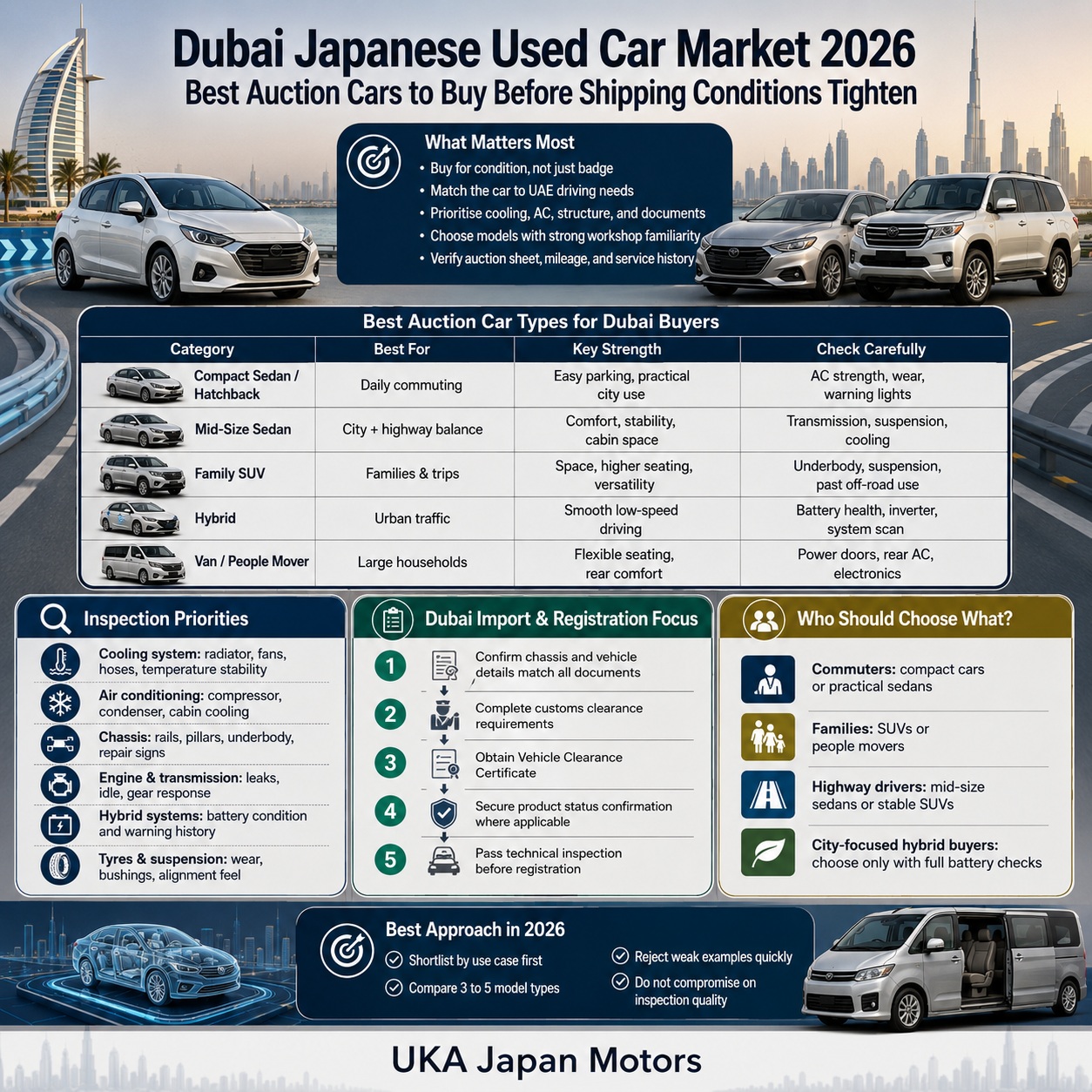
The Dubai Japanese used car market in 2026 continues to attract buyers who want well-built vehicles with strong daily usability, reliable engineering, and clear inspection potential before registration in the UAE. For many drivers in Dubai, Abu Dhabi, Sharjah, Ajman, Ras Al Khaimah, Umm Al Quwain, and Fujairah, Japanese auction cars offer access to sedans, SUVs, vans, hybrids, and compact city cars that may not always be available in the same condition through ordinary local listings.
The decision, however, should not be based only on make, model, or visual appeal. In the UAE, a used imported vehicle must make sense for the climate, road network, inspection process, documentation requirements, and long-term ownership pattern. A car that looks suitable on an auction sheet can still become a poor choice if it has hidden corrosion, unsuitable specifications, weak air conditioning performance, accident repairs, electronic issues, poor parts support, or compliance concerns.
This guide explains which types of Japanese auction cars deserve attention in Dubai during 2026, how to compare them, what to check before committing, and which models suit different UAE driving needs. The aim is not to push buyers toward one vehicle. It is to help them understand how auction-sourced cars should be assessed before shipment, inspection, and registration.
Direct Answer: Which Japanese Auction Cars Make the Most Sense for Dubai in 2026?
For Dubai buyers in 2026, the strongest Japanese auction car choices are usually practical models with strong reliability records, manageable electronics, good air conditioning performance, wide parts familiarity, and proven suitability for UAE roads. Toyota, Honda, Nissan, Mazda, Lexus, and Suzuki models often receive attention because many of their vehicles are already familiar to UAE workshops and inspection centres.
The most sensible auction choices generally fall into five groups:
- Compact sedans and hatchbacks for Dubai and Sharjah commuting
- Mid-size sedans for mixed city and highway use
- Family SUVs for school runs, inter-emirate travel, and weekend driving
- Hybrid models for smooth urban use and efficient daily operation
- Practical vans and people movers for larger households and business-related movement
The best choice depends on how the car will be used. A buyer who spends most of the week in Dubai traffic does not need the same vehicle as someone regularly driving between Dubai and Abu Dhabi. A family in Ajman or Sharjah may prioritise cabin space and cooling performance, while a buyer in Ras Al Khaimah or Fujairah may care more about engine response, ground clearance, and stable highway behaviour.
The key is to buy the condition, not only the badge. Auction grade, mileage consistency, chassis condition, interior wear, service evidence, underbody condition, battery health for hybrids, and air conditioning performance should carry more weight than colour, trim, or cosmetic extras.
Why the Dubai Japanese Used Car Market Matters in 2026
Dubai has a vehicle culture shaped by daily commuting, long highway routes, high summer temperatures, frequent air conditioning use, and a strong preference for reliable ownership. A car in Dubai may spend time in slow traffic, underground parking, open outdoor parking, high-speed highway movement, and repeated short trips within the same week. That mixture creates different demands from a simple city-only driving pattern.
Japanese used vehicles remain relevant because many UAE buyers value mechanical durability, cabin practicality, fuel efficiency, and ease of inspection. Dubai drivers often look for cars that can handle Sheikh Zayed Road, Al Khail Road, Emirates Road, Mohammed Bin Zayed Road, and dense residential traffic without becoming uncomfortable or difficult to maintain.
In 2026, timing also matters because shipping availability, documentation flow, inspection schedules, and vehicle selection can change during the year. When demand increases or logistics windows tighten, buyers may face fewer clean examples, longer movement timelines, and more pressure to choose quickly. That makes pre-selection discipline more important. A careful buyer should not rush into a weak vehicle simply because it appears available. The better approach is to know which models deserve attention before the search begins.
What Makes a Japanese Auction Car Suitable for UAE Use?
A suitable Japanese auction car for the UAE is not simply a clean-looking car with a recognisable badge. It should satisfy several practical conditions.
First, the vehicle should have a clear identity. The chassis number, auction sheet details, export documents, and vehicle description must align. Any mismatch can create delays or complications during clearance, inspection, or registration.
Second, the car should be structurally sound. UAE inspection standards pay close attention to safety-related areas, and buyers should be cautious with vehicles showing evidence of major accident repair, chassis correction, flood exposure, underbody damage, or airbag deployment.
Third, the mechanical condition should match UAE usage. The cooling system, air conditioning, engine mounts, transmission behaviour, suspension, brake system, and electronic modules are especially important. A vehicle that performs acceptably in mild use may struggle in UAE summer heat if cooling or electrical systems are weak.
Fourth, the model should have parts and service familiarity. A rare version may look appealing, but if local diagnosis, parts identification, or routine servicing becomes difficult, ownership can become inconvenient. For UAE buyers, practical workshop support is a major part of long-term satisfaction.
Fifth, the car should suit the actual driver. A compact hatchback may be excellent for Dubai parking and daily errands, but not ideal for a large family. A large SUV may be comfortable for long trips, but excessive for tight daily use in older areas of Dubai or Sharjah. A hybrid may suit urban driving, but it needs careful battery and electronic system checks before selection.
Best Auction Car Categories for Dubai Buyers in 2026
1. Compact Sedans and Hatchbacks for City Driving
Compact Japanese cars remain useful for Dubai residents who mostly drive between home, work, school, malls, clinics, and community areas. They are easier to park, simpler to manage in traffic, and generally practical for single drivers, couples, and small families.
Popular examples in this category include models such as the Toyota Corolla, Toyota Yaris, Honda Fit, Honda Grace, Nissan Note, Mazda Demio, Suzuki Swift, and similar compact platforms.
The main advantage of this group is daily usability. These vehicles are usually easy to manoeuvre in areas such as Deira, Bur Dubai, Karama, Al Barsha, Jumeirah Village Circle, International City, and busy Sharjah corridors. Their smaller size also helps in basement parking and tight residential spaces.
However, compact cars must be checked carefully for air conditioning strength. A small engine does not automatically mean weak cooling, but the system must be healthy. Compressor performance, condenser condition, blower motor strength, cabin filter housing, and cooling fan operation should be reviewed before shipment or during inspection.
Compact cars suit buyers who want simple daily movement, easy parking, and manageable ownership. They may not suit large families, frequent inter-emirate travellers with passengers, or buyers who regularly carry heavy luggage.
2. Mid-Size Sedans for Balanced UAE Driving
Mid-size Japanese sedans are often among the most balanced options for Dubai buyers. They offer stronger cabin comfort than compact cars while remaining easier to manage than large SUVs. For drivers who split time between city traffic and highway movement, this category is especially relevant.
Models often considered include the Toyota Camry, Honda Accord, Nissan Altima, Mazda Atenza, Lexus ES, and similar sedans.
This group works well for Dubai to Abu Dhabi commuting, Dubai to Sharjah movement, and regular highway use across the UAE. Mid-size sedans usually provide better cabin insulation, stronger air conditioning capacity, more stable highway cruising, and more comfortable rear seating than compact models.
The inspection focus should include transmission behaviour, suspension wear, steering response, brake vibration, engine cooling, and electronic warning lights. Some sedans may have advanced driver assistance features, lane support systems, radar units, or camera systems. These should be checked because electronic calibration and repair can be more involved than basic mechanical work.
Mid-size sedans suit professionals, small families, and drivers who want comfort without moving into a large SUV. They may not suit buyers who need seven seats, frequent rough-road access, or high cargo flexibility.
3. Family SUVs for Space and Versatility
SUVs remain a major part of the UAE used car market because families often want higher seating, flexible cargo space, stronger road presence, and comfortable weekend usability. Japanese auction SUVs can be attractive when selected carefully.
Common examples include Toyota RAV4, Toyota Harrier, Toyota Land Cruiser Prado, Honda CR-V, Nissan X-Trail, Mazda CX-5, Lexus RX, and Suzuki Escudo-type models.
For Dubai families, SUVs can be practical for school runs, supermarket trips, family visits, airport movement, and longer drives to Abu Dhabi, Ras Al Khaimah, or Fujairah. They also provide more flexible seating and luggage space than sedans.
The inspection priorities are different from compact cars. Buyers should check suspension bushings, differential condition where relevant, underbody wear, tyre age, brake condition, cooling system capacity, engine mounts, and evidence of past off-road use. Cosmetic SUV appeal should never replace a proper underbody and chassis check.
A family SUV suits households that need space, comfort, and flexibility. It may not suit a buyer who mainly drives alone in dense traffic, struggles with larger parking dimensions, or wants the simplest possible maintenance profile.
4. Hybrid Japanese Cars for Urban Smoothness
Hybrid vehicles continue to attract interest among Dubai buyers because they offer smooth low-speed operation, quiet cabin behaviour, and efficient daily driving. In stop-and-go traffic, hybrids can feel especially refined.
Models often considered include Toyota Prius, Toyota Aqua, Toyota Corolla Hybrid, Toyota Camry Hybrid, Lexus CT, Lexus ES Hybrid, Honda Vezel Hybrid, and similar systems.
The major difference with hybrids is inspection depth. A conventional engine and transmission check is not enough. Buyers should review hybrid battery condition, inverter health, cooling fan cleanliness, warning light history, system scan results, and service evidence. The battery cooling path is especially important in dusty and hot environments.
Hybrids can suit Dubai drivers who spend much of their time in city traffic, business districts, residential communities, and short daily commutes. They can also suit careful owners who are willing to follow proper diagnostic routines.
They may not suit buyers who want the simplest possible mechanical layout, rarely drive the vehicle, or are not prepared to verify hybrid system health before purchase. A clean exterior does not prove a healthy battery system.
5. Vans and People Movers for Larger Households
Japanese vans and people movers can be useful in the UAE because many households need more seating and flexible cabin arrangements. They may also suit business-related movement where passenger comfort and interior space matter.
Examples include Toyota Alphard, Toyota Vellfire, Toyota Estima, Honda Stepwgn, Nissan Serena, and similar multi-purpose vehicles.
These vehicles are attractive because they offer sliding doors, generous rear seating, strong cabin flexibility, and comfortable access for children or elderly passengers. In Dubai communities with regular school runs or family movement, they can be highly practical.
However, they need careful inspection. Sliding door mechanisms, electric seats, rear air conditioning, suspension, transmission, engine mounts, electronic modules, and interior wear should be checked. Many vans include comfort features that are useful when working properly but frustrating if neglected.
People movers suit larger families and buyers who prioritise comfort over sporty handling. They may not suit those who prefer compact parking, high ground clearance, or simple interiors with fewer electronic features.
Comparison: Sedan, SUV, Hybrid, or Van?
Choosing the right auction car category depends on the buyer’s actual UAE routine.
A sedan is often the best balance for highway comfort, daily commuting, and cabin refinement. It is a sensible choice for Dubai professionals, small families, and drivers who want comfort without extra size.
An SUV is better for families needing cargo space, higher seating, and flexible weekend use. It works well for drivers who often carry passengers or travel across emirates.
A hybrid is strongest for urban driving and smooth traffic movement. It is suitable for buyers who understand the need for proper diagnostic checks before purchase.
A van or people mover is ideal for larger households needing easy access, rear comfort, and flexible seating. It is less about driving excitement and more about passenger practicality.
A compact hatchback or small sedan is best for simple daily city use, especially where parking and traffic are daily concerns.
The mistake many buyers make is choosing based on image rather than routine. A car should fit the owner’s roads, parking, passengers, climate exposure, and maintenance expectations.
Best Japanese Auction Car Types by UAE Buyer Profile
For Daily Dubai Commuters
Daily commuters should focus on compact sedans, hatchbacks, and reliable mid-size sedans. The ideal car should have strong cooling, easy parking, predictable fuel use, and simple maintenance access.
Toyota Corolla, Honda Fit, Toyota Yaris, Nissan Note, Mazda Demio, and similar models can be practical when the inspection record is clean. Buyers should avoid cars with unclear mileage patterns, weak cooling, or dashboard warning lights.
For Families in Dubai, Sharjah, and Ajman
Families should consider mid-size sedans, compact SUVs, and people movers. Rear air conditioning, child-seat practicality, boot space, door opening angle, cabin durability, and ride comfort matter more than cosmetic styling.
Toyota Camry, Honda Accord, Toyota RAV4, Honda CR-V, Toyota Alphard, and Nissan Serena-type vehicles may suit family needs depending on seating requirements.
For Frequent Highway Drivers
Drivers regularly travelling between Dubai, Abu Dhabi, Sharjah, Ras Al Khaimah, and Fujairah should focus on stable highway cars with strong cooling, comfortable seats, and proven powertrain reliability.
Mid-size sedans and well-maintained SUVs usually make more sense than very small city cars. Highway use places more importance on tyre condition, alignment, brakes, suspension, and engine temperature stability.
For Hybrid-Focused Buyers
Hybrid buyers should prioritise Toyota and Lexus hybrid systems that are widely understood by UAE workshops. The vehicle should be scanned properly, and battery cooling should be inspected carefully.
A hybrid is not automatically the right choice for every buyer. It works best when the owner understands the system and checks it properly before registration.
For Larger Households
Large households should consider Japanese people movers and three-row SUVs. The main focus should be on rear cabin comfort, cooling across all rows, sliding door operation, suspension health, and interior durability.
A vehicle with many comfort features should be inspected more deeply because every feature adds another item that must work reliably in UAE use.
Auction Sheet Review: What Dubai Buyers Should Check First
The auction sheet is one of the first filters, but it should not be treated as the final truth. It can provide useful information about grade, mileage, visible defects, interior condition, repair notes, and general presentation. Still, buyers should combine it with photos, chassis checks, export documents, inspection reports, and professional review.
Important points include:
Auction grade: Higher grades usually suggest better cosmetic and structural condition, but buyers should still review the remarks.
Interior grade: UAE buyers should pay attention to seat wear, dashboard condition, smell, stains, sun exposure signs, and electronic feature condition.
Mileage: Mileage should be consistent with service records, wear patterns, pedal condition, steering wheel texture, seat bolsters, and overall cabin age.
Repair marks: Small cosmetic repairs are different from structural repair. Chassis, pillar, apron, and underbody concerns need expert review.
Rust or corrosion notes: Even minor corrosion should be understood before shipment. Underbody condition matters for inspection confidence and long-term use.
Warning lights: Any engine, hybrid, ABS, airbag, or steering warning must be taken seriously.
A clean auction sheet is helpful. A professionally interpreted auction sheet is better.
Inspection Priorities Before Selecting an Auction Car
A buyer should never rely only on exterior photos. The most important inspection areas for UAE use are mechanical health, cooling performance, structural integrity, and documentation consistency.
Cooling System
The UAE climate makes cooling system health essential. Radiator condition, coolant condition, thermostat operation, cooling fans, hoses, water pump, and temperature stability should be assessed. A car that overheats under load can become unsuitable for daily driving.
Air Conditioning
Air conditioning is not a comfort extra in the UAE. It is a daily requirement. Compressor operation, condenser condition, evaporator performance, blower motor, vent temperature, and rear cooling on larger vehicles should be checked.
Chassis and Structural Areas
Chassis rails, suspension mounting points, aprons, pillars, floor sections, and underbody should be reviewed carefully. A car with major structural repair may face inspection concerns and long-term safety issues.
Engine and Transmission
Smooth idle, cold start behaviour, gear engagement, vibration, fluid condition, leaks, and diagnostic codes should be reviewed. Many problems are easier to identify before selection than after arrival.
Hybrid and Electrical Systems
For hybrids, battery condition, inverter cooling, warning history, and scan data are important. For modern vehicles, radar sensors, cameras, power doors, electronic seats, infotainment units, and safety systems should also be checked.
Tyres and Suspension
Tyre age, uneven wear, shock absorbers, control arms, bushings, ball joints, and wheel alignment symptoms should be reviewed. UAE highway speeds make suspension and tyre condition especially important.
Compliance and Registration Considerations in Dubai
A Japanese auction car intended for use in Dubai must pass through the correct import, clearance, inspection, and registration path. Buyers should understand that paperwork is not a side issue. It is part of the vehicle’s eligibility.
Key documents and checks may include proof of ownership, export-related documents, shipping documents, customs clearance, vehicle clearance certificate, product status confirmation where applicable, insurance readiness, and technical inspection before registration.
The vehicle details must be consistent across the documents. Make, model, year, chassis number, engine details, and ownership information should not create confusion. Even a good car can face delays if paperwork is incomplete or inconsistent.
Inspection centres will look beyond appearance. Safety items, brakes, lights, tyres, emissions-related systems, chassis condition, and overall roadworthiness matter. A vehicle selected without regard for UAE inspection standards may create unnecessary complications.
This is why auction selection should begin with compliance thinking, not only model preference.
Local Driving Conditions That Affect Vehicle Choice
Dubai driving can place different demands on a car in the same day. A vehicle may sit in slow traffic in Business Bay, cruise on Sheikh Zayed Road, handle parking ramps in Downtown Dubai, and then spend hours under direct sun. This combination affects cooling systems, interiors, tyres, batteries, and electronic modules.
In Sharjah and Ajman, dense traffic and frequent short trips make cooling, brakes, transmission behaviour, and fuel system condition important. In Abu Dhabi, longer highway routes place more emphasis on stability, tyre condition, cabin comfort, and cruise refinement. In Ras Al Khaimah and Fujairah, changing road gradients and longer weekend travel can make engine response and suspension condition more important.
The best auction car is the one that matches these realities. A car chosen only for appearance may not be the best car to live with in the UAE.
Models That Deserve Careful Attention in 2026
The following model types are not recommendations based on appearance alone. They are practical categories that often suit UAE use when selected in clean condition.
Toyota Corolla and Similar Compact Sedans
The Corolla-type compact sedan remains useful because it is simple, familiar, and practical. It suits Dubai commuting, small families, and drivers who want predictable ownership. Buyers should check cooling, suspension, accident history, and cabin wear.
Toyota Camry and Honda Accord Type Sedans
These mid-size sedans are well suited to mixed UAE driving. They offer comfortable highway use and better cabin space than compact sedans. Buyers should inspect transmission behaviour, engine mounts, steering, air conditioning, and suspension.
Toyota RAV4 and Honda CR-V Type SUVs
Compact SUVs suit families who need more flexibility without moving into very large vehicles. Buyers should check all-wheel-drive components where fitted, suspension wear, rear cabin cooling, boot condition, and electronic systems.
Lexus ES and Lexus RX Type Vehicles
Lexus models appeal to buyers who want refinement and comfort. They can suit Dubai and Abu Dhabi highway use when properly maintained. Inspection should focus on electronics, suspension, cooling, service evidence, and accident repair signs.
Toyota Prius, Aqua, and Corolla Hybrid Type Vehicles
These hybrids suit urban driving and smooth daily use. The main focus should be battery health, hybrid system scans, cooling fans, service records, and warning light history.
Toyota Alphard, Vellfire, and Similar People Movers
These vehicles suit larger families and passenger-focused use. Buyers should inspect power doors, rear air conditioning, interior electronics, suspension, engine mounts, and cabin wear.
When a Japanese Auction Car May Not Be Suitable
A Japanese auction car is not always the right decision. Buyers should avoid vehicles with unclear documentation, major accident repair, flood indicators, inconsistent mileage, heavy corrosion, warning lights, missing parts, weak air conditioning, or unsupported rare specifications.
A vehicle may also be unsuitable if it has complex features that the owner does not need. Some high-trim cars include advanced electronics, adaptive suspension, camera systems, radar sensors, power seats, and rear entertainment equipment. These features are useful only when properly functioning and serviceable.
Buyers should also be cautious with vehicles selected only because they look unusual. A rare model can be interesting, but the UAE ownership experience depends on inspection, parts familiarity, service access, and long-term reliability.
The right vehicle is not always the most visually exciting one. It is the one that passes practical checks and fits the driver’s routine.
Ownership Considerations After Registration
After a Japanese auction car is registered in the UAE, ownership quality depends on maintenance discipline. The first service after arrival should be treated seriously. Fluids, filters, belts, hoses, brakes, tyres, battery, spark plugs where applicable, and cooling system components should be reviewed.
For hybrids, battery cooling paths should be cleaned where necessary, and diagnostic scans should be kept as part of the ownership record. For SUVs, suspension and tyres should be watched closely. For vans, door mechanisms and rear air conditioning should be maintained properly.
Parking habits also matter. Long exposure to direct sun affects paint, rubber seals, dashboards, batteries, and cabin materials. Regular cleaning, shaded parking when possible, and timely inspection of rubber components can help preserve vehicle condition.
Long-term ownership is not only about choosing the right car. It is about maintaining it in a way that respects UAE conditions.
How Buyers Should Prioritise Auction Cars Before Shipping Windows Tighten
When shipping timelines become less flexible, buyers should not lower their inspection standards. Instead, they should narrow their search in advance.
A sensible shortlist should include three to five model categories rather than one exact trim. For example, a family buyer may consider a RAV4-type SUV, CR-V-type SUV, or mid-size sedan rather than waiting only for one colour and trim combination. A commuter may compare Corolla, Yaris, Fit, Note, or Demio-type models depending on condition. A hybrid buyer may compare Prius, Aqua, Corolla Hybrid, or Lexus hybrid options based on diagnostic confidence.
The best approach is to define the required use first:
Daily commute or family use
City driving or highway driving
Compact parking or large cabin
Conventional engine or hybrid system
Simple features or comfort-focused equipment
Short-term use or longer ownership plan
Once the purpose is clear, auction selection becomes more disciplined. The buyer can reject weak examples quickly and focus on vehicles that pass inspection logic.
UKA Japan Motors’ Role in the Buying Process
UKA Japan Motors’ role is to help buyers approach Japanese auction cars with inspection awareness, compliance understanding, and practical UAE ownership expectations. The focus is not simply on finding a car that looks attractive. It is on helping buyers understand whether a vehicle makes sense before it reaches the road.
A professional review should include auction sheet interpretation, condition assessment, documentation awareness, model suitability, and guidance on likely inspection concerns. For Dubai buyers, this is especially important because the vehicle must move through clearance, inspection, and registration before it becomes a usable car.
UKA Japan Motors can support buyers by explaining what the auction sheet means, identifying potential red flags, comparing model suitability, and guiding the buyer toward vehicles that better match UAE roads, climate, and daily use.
The value of this approach is transparency. Buyers should know what they are selecting, why it suits their needs, and where caution is required.
Suggested Internal Links
For a complete topic cluster, this article can naturally connect to the following supporting articles:
Dubai Japanese Auction Sheet Guide for Used Car Buyers
How to Inspect Imported Japanese Cars Before UAE Registration
Best Japanese Hybrid Cars for Dubai Daily Driving
Japanese SUV Buying Guide for UAE Families
Used Imported Car Compliance Guide in Dubai
Toyota vs Honda Japanese Auction Cars for UAE Buyers
Hybrid Battery Inspection Guide for Dubai Buyers
Japanese Van Buying Guide for Large UAE Families
These internal links should be placed only where they support the reader’s next question. They should not interrupt the article flow or feel forced.
FAQ
1. Are Japanese auction cars suitable for Dubai in 2026?
Yes, Japanese auction cars can be suitable for Dubai when selected carefully. The vehicle should have clean documentation, a clear auction record, strong mechanical condition, healthy air conditioning, and no major structural concerns. Suitability depends on inspection quality, not only brand reputation.
2. Which Japanese auction cars are best for Dubai commuting?
Compact sedans, hatchbacks, and reliable mid-size sedans are often suitable for commuting. Toyota Corolla, Toyota Yaris, Honda Fit, Nissan Note, Mazda Demio, and similar models can work well when condition is verified. Cooling performance and transmission behaviour should be checked carefully.
3. Are Japanese hybrid cars a good choice for UAE driving?
Japanese hybrids can be a good choice for city-heavy driving in Dubai, Sharjah, and Ajman. They are smooth in traffic and can suit careful owners. However, hybrid battery condition, inverter health, cooling fan cleanliness, and warning light history must be checked before selection.
4. What should buyers check on an auction sheet?
Buyers should check auction grade, interior grade, mileage consistency, repair marks, rust notes, warning lights, and written remarks. The auction sheet should be interpreted by someone who understands structural terminology and UAE inspection concerns.
5. Is an SUV better than a sedan for Dubai families?
An SUV is better when the family needs higher seating, flexible cargo space, and more cabin practicality. A sedan may be better for smoother highway comfort, easier parking, and simpler daily use. The right choice depends on passengers, routes, parking, and ownership expectations.
6. Can a clean-looking auction car still have problems?
Yes. A clean exterior does not prove mechanical, structural, or electronic health. Buyers should review the chassis, underbody, cooling system, air conditioning, engine, transmission, hybrid system where applicable, and documentation consistency.
7. Why is air conditioning inspection so important in the UAE?
Air conditioning is essential because vehicles in the UAE operate in high temperatures for much of the year. Weak cooling can affect comfort, usability, and buyer satisfaction. Compressor health, condenser condition, blower operation, and rear cooling in larger vehicles should be checked.
8. What documents matter for imported used cars in Dubai?
Important documents may include ownership evidence, export-related documents, shipping documents, customs clearance, a vehicle clearance certificate, product status confirmation where applicable, and inspection-related records before registration. Details should match across the full document chain.
9. Are rare Japanese models a good idea for UAE buyers?
Rare models may suit enthusiasts, but they require caution. Parts familiarity, diagnostic support, inspection confidence, and long-term maintenance should be considered. A rare model is not automatically unsuitable, but it should be selected with more care.
10. When should a buyer avoid a Japanese auction car?
A buyer should avoid a car with unclear documents, major accident repair, flood indicators, inconsistent mileage, corrosion concerns, unresolved warning lights, weak air conditioning, or unsupported specifications. It is better to wait for a cleaner option than accept a vehicle with serious uncertainty.
Conclusion
The Dubai Japanese used car market in 2026 rewards buyers who think beyond appearance and badge reputation. The best auction cars are not simply the most popular models. They are the vehicles that match UAE driving conditions, pass inspection logic, support long-term ownership, and arrive with clear documentation.
Compact cars suit daily commuting. Mid-size sedans offer balance. SUVs support families. Hybrids work well for careful city drivers. Vans and people movers serve larger households. Each category has strengths, but each also requires a different inspection focus.
For Dubai buyers, the smartest approach is to define the use case first, shortlist suitable models, review auction sheets carefully, verify documentation, and inspect critical systems before committing. A Japanese auction car can be a strong choice when the selection process is disciplined, transparent, and aligned with UAE conditions.
Contact UKA Japan Motors for availability and inspection guidance