


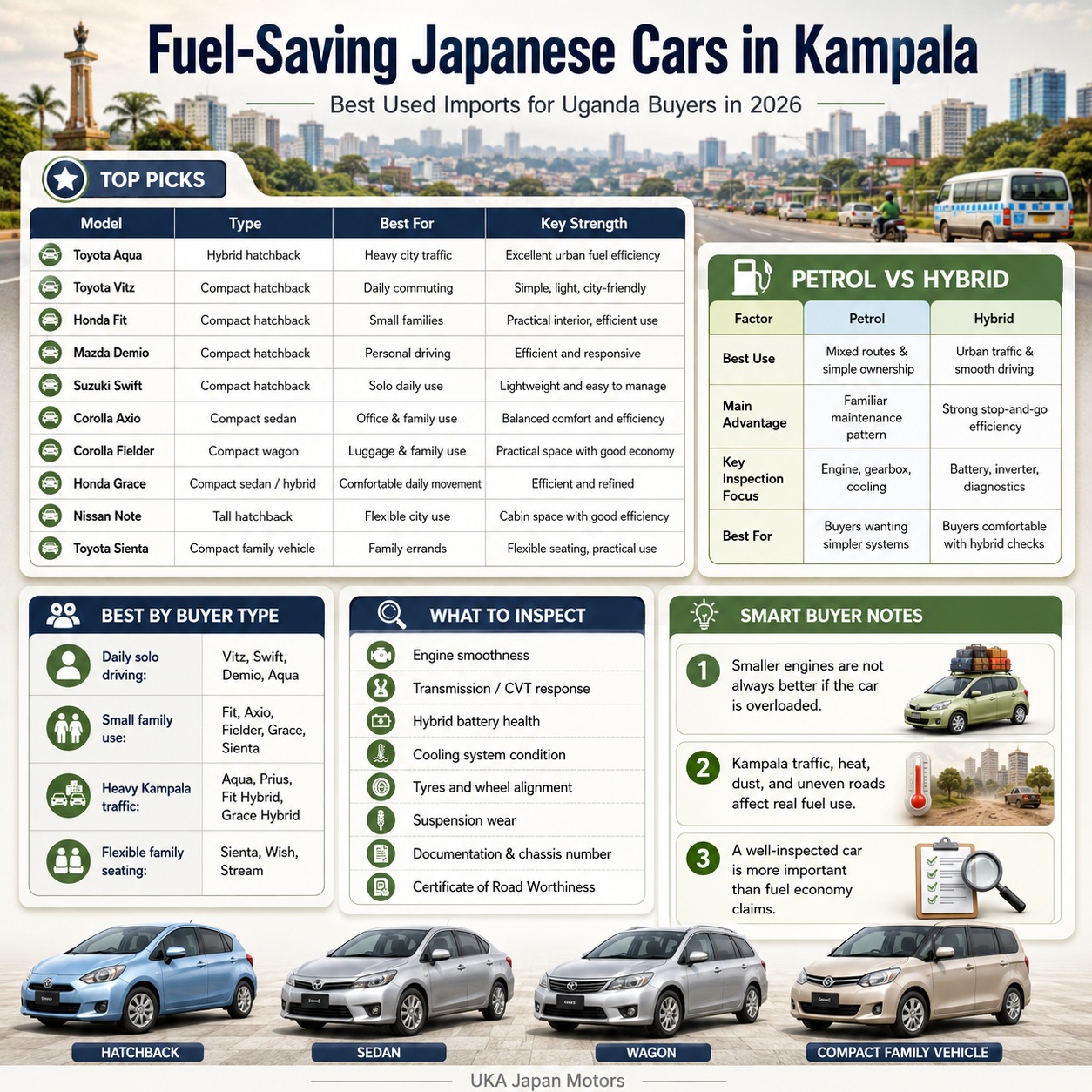
Fuel-saving Japanese cars are vehicles designed to use fuel carefully without making daily driving difficult. For Kampala buyers in 2026, this does not simply mean choosing the smallest engine available. A car must be able to move confidently through slow traffic, handle uneven roads, climb hilly sections, tolerate heat, and remain practical for normal family, work, and personal use.
In Kampala, fuel use is shaped by real driving conditions. A vehicle may look efficient on paper but behave differently in stop-and-go traffic around town, on busy junctions, during school runs, or along roads where repeated braking and acceleration are unavoidable. The best choice is therefore not always the car with the lowest engine size. It is the car whose engine, transmission, body weight, condition, and maintenance history work well together.
Japanese used imports remain popular among Uganda buyers because many models offer compact engines, reliable drivetrains, familiar service requirements, and practical layouts. However, fuel economy depends strongly on inspection quality. A neglected car can use more fuel than a larger but better-maintained vehicle. For that reason, buyers should look beyond model names and examine engine health, hybrid battery condition where relevant, transmission response, tyres, cooling system, air intake, exhaust condition, and documentation.
This guide explains the best fuel-saving Japanese used cars for Kampala buyers in 2026, how to compare them, where each model fits, and what to inspect before making a decision. The focus is on real Uganda ownership, not showroom claims or generic vehicle lists.
Direct Answer: Best Fuel-Saving Japanese Used Imports for Kampala in 2026
For most Kampala buyers, the best fuel-saving Japanese used imports in 2026 fall into five practical groups:
- Compact hatchbacks such as Toyota Vitz, Honda Fit, Mazda Demio, and Suzuki Swift suit daily city movement, personal use, and light family needs.
- Hybrid hatchbacks such as Toyota Aqua and Toyota Prius suit buyers who spend much of their time in urban traffic and want strong fuel efficiency when the hybrid system is healthy.
- Compact sedans and wagons such as Toyota Corolla Axio, Toyota Corolla Fielder, Honda Grace, and Nissan Sylphy suit buyers who need more cabin space without moving into a heavier vehicle category.
- Small crossovers such as Toyota Ractis, Honda Vezel, Toyota Sienta, and Nissan Note suit buyers who need easier entry, flexible seating, or more luggage practicality.
- Light-duty family vehicles such as Toyota Wish and Honda Stream suit buyers who need extra seating but still want better fuel discipline than larger multi-purpose vehicles.
The strongest all-round choices for Kampala are usually Toyota Aqua, Toyota Vitz, Honda Fit, Toyota Corolla Axio, Toyota Corolla Fielder, Mazda Demio, Honda Grace, Nissan Note, Suzuki Swift, and Toyota Sienta. The right option depends on passenger needs, route type, ground clearance expectations, inspection results, and long-term maintenance discipline.
Why Fuel-Saving Cars Matter in Kampala
Kampala driving places unique demands on vehicles. Traffic is often slow and inconsistent. Short trips are common. Drivers may spend long periods moving at low speed, stopping repeatedly, then accelerating again. These conditions affect fuel use more than steady highway driving.
A fuel-saving car matters in Kampala because it helps reduce fuel consumption during daily use, especially where the vehicle spends much of its time in urban traffic. But fuel efficiency is only one part of the decision. A vehicle must also be comfortable enough for daily use, strong enough for uneven road sections, and simple enough to maintain properly.
Kampala’s warm climate also matters. Cooling systems work hard. Air conditioning is used frequently. Dust can affect air filters, sensors, and throttle response. Potholes and uneven surfaces can affect wheel alignment, tyre wear, suspension condition, and rolling resistance. When these areas are neglected, fuel use increases even in models known for efficiency.
This is why buyers should treat fuel-saving as a whole-vehicle issue. The best fuel-saving car is not just a model with a small engine. It is a clean, well-inspected vehicle with the right engine size, correct tyres, healthy sensors, smooth transmission, stable suspension, and accurate documentation.
What Makes a Japanese Used Car Fuel-Saving?
A fuel-saving Japanese used car usually has a combination of several features:
- A modest engine size matched to the vehicle’s body weight
- Efficient automatic transmission or CVT operation
- Good aerodynamics for daily movement
- Low rolling resistance from correctly sized tyres
- A healthy air intake and fuel injection system
- Clean engine oil and correct maintenance intervals
- Stable cooling system performance
- For hybrids, a healthy battery, inverter, and electric motor system
Small engines can be efficient, but they should not be underpowered for the driver’s needs. If a car is too weak for its load, the engine may work harder and use more fuel. Similarly, a hybrid can be excellent in Kampala traffic, but only if the hybrid system is in good condition. A neglected hybrid battery or faulty cooling fan can reduce efficiency and create long-term inconvenience.
Transmission type also matters. Many fuel-saving Japanese cars use CVT transmissions. A healthy CVT gives smooth acceleration and helps keep engine speed controlled. However, a poorly maintained CVT may feel jerky, delayed, noisy, or weak under acceleration. That can affect both driving comfort and fuel use.
The best approach is to combine model selection with inspection. A buyer should never assume that a model name guarantees efficiency.
Fuel-Saving Car Types for Kampala Buyers
1. Compact Hatchbacks
Compact hatchbacks are among the most practical choices for Kampala. They are easy to park, simple to drive in traffic, and light enough to use fuel carefully. They also suit drivers who mostly move alone or with one to three passengers.
Examples include Toyota Vitz, Honda Fit, Mazda Demio, Suzuki Swift, and Nissan March.
These cars suit city errands, work commutes, student use, small families, and drivers who do not regularly carry heavy luggage. Their main limitation is space. Some may also have lower ground clearance, which means buyers should inspect suspension condition and avoid assuming every compact car will suit every road.
2. Hybrid Hatchbacks
Hybrid hatchbacks are strong options for Kampala buyers who spend much time in slow traffic. A hybrid system can assist during low-speed driving and reduce engine workload when functioning correctly.
Examples include Toyota Aqua, Toyota Prius, Honda Fit Hybrid, and Honda Grace Hybrid.
The main advantage is efficient urban movement. The main caution is inspection. Hybrid battery health, inverter cooling, warning lights, service history, and diagnostic scans must be checked carefully. A hybrid should not be chosen only because it carries a hybrid badge. Its system condition matters more than the label.
3. Compact Sedans and Wagons
Compact sedans and wagons suit buyers who need more space but still want a fuel-conscious vehicle. They are useful for small families, office use, long daily movement, and mixed city-suburban routes.
Examples include Toyota Corolla Axio, Toyota Corolla Fielder, Honda Grace, Nissan Sylphy, and Mazda Axela.
These vehicles usually offer better cabin comfort than very small hatchbacks. Wagons such as the Corolla Fielder also provide more luggage flexibility. Their limitation is that they are larger than hatchbacks, so tyre condition, suspension health, and engine size should be matched carefully to the buyer’s daily use.
4. Small Crossovers and Tall Compacts
Small crossovers and tall compact vehicles appeal to buyers who want easier entry, more flexible seating, or slightly better road confidence than a low hatchback. They are not always as fuel-light as smaller hatchbacks, but some offer a good balance.
Examples include Toyota Ractis, Toyota Sienta, Honda Vezel, Nissan Note, and Toyota Spade.
These models suit families, drivers with frequent errands, and buyers who need easy access for passengers. The caution is that larger tyres, heavier body design, and hybrid system complexity in some models require proper inspection.
5. Light Family MPVs
Light multi-purpose vehicles suit buyers who need extra seats but still want reasonable fuel discipline. They are not as fuel-saving as compact hatchbacks, but they can be more suitable than forcing a small car to carry too many passengers.
Examples include Toyota Wish, Honda Stream, and Toyota Isis.
These models suit families, shared use, and buyers who regularly carry more passengers. They may not be the best choice for someone who drives alone most of the time in central Kampala traffic. When passenger capacity is genuinely needed, however, they can be a practical middle ground.
Best Fuel-Saving Japanese Used Cars for Kampala in 2026
| Model | Body Type | Best For | Fuel-Saving Strength | Main Inspection Focus |
|---|---|---|---|---|
| Toyota Aqua | Hybrid hatchback | Urban traffic and daily commuting | Strong efficiency in stop-and-go driving | Hybrid battery, inverter cooling, dashboard warnings |
| Toyota Vitz | Compact hatchback | Simple city use | Light body and modest engine options | Engine mounts, CVT response, suspension |
| Honda Fit | Compact hatchback | Practical space in a small body | Efficient layout with flexible cabin | CVT condition, engine response, rear suspension |
| Mazda Demio | Compact hatchback | Drivers wanting a sharper compact feel | Efficient engines with good road manners | Engine health, transmission response, underbody |
| Suzuki Swift | Compact hatchback | Personal daily driving | Lightweight and easy to manage | Suspension, steering, service history |
| Toyota Corolla Axio | Compact sedan | Small families and office use | Balanced engine size and body weight | Engine condition, gearbox, mileage consistency |
| Toyota Corolla Fielder | Compact wagon | Buyers needing luggage flexibility | Practical space without excessive body size | Rear suspension, engine, cargo-area condition |
| Honda Grace | Compact sedan, hybrid options available | Comfortable daily movement | Efficient hybrid and petrol choices | Hybrid diagnostics, CVT, electrical systems |
| Nissan Note | Tall hatchback, petrol and e-POWER options | City use with more cabin flexibility | Efficient packaging and responsive driving | Battery system where applicable, CVT, sensors |
| Toyota Sienta | Compact family vehicle | Small families needing flexible seating | Practical use with moderate fuel demand | Sliding doors, suspension, engine, interior wear |
Toyota Aqua: Strong Urban Fuel Discipline
The Toyota Aqua is one of the most recognized fuel-saving Japanese used imports among Kampala buyers. Its compact size, hybrid system, and simple hatchback layout make it well suited to city movement. In slow traffic, the hybrid system can help reduce engine workload, especially when the vehicle is driven smoothly.
The Aqua suits drivers who spend most of their time around Kampala, including work commutes, errands, school movement, and short urban routes. It is easy to park and does not feel bulky in tight areas. For buyers who rarely carry heavy loads, it can be a very practical choice.
However, Aqua buyers must inspect the hybrid system carefully. The battery cooling fan should be clean, warning lights should be absent, and a proper diagnostic scan should be performed. The vehicle should accelerate smoothly without unusual hesitation. The air conditioning, inverter cooling, brake regeneration, and dashboard indicators should all be checked.
The Aqua may not suit buyers who regularly use rough roads, carry heavy passengers, or expect high ground clearance. It is best treated as an urban-focused vehicle that rewards smooth driving and careful maintenance.
Toyota Vitz: Simple, Familiar, and City-Friendly
The Toyota Vitz is a practical fuel-saving choice for Kampala because it is light, compact, and easy to use. It suits first-time buyers, daily commuters, and drivers who want a simple car for personal movement.
Its main advantage is simplicity. Compared with more complex hybrid models, the Vitz is straightforward to inspect and maintain. It is also easy to handle in traffic and convenient in tight parking spaces.
For Kampala use, buyers should check engine smoothness, gearbox response, suspension noise, steering feel, and cooling system condition. Some units may show wear from city driving, so the inspection should focus on stop-start fatigue, engine mounts, brake condition, and tyre wear.
The Vitz is not ideal for buyers who regularly carry many passengers or need large luggage space. It works best when used as a personal or light family vehicle.
Honda Fit: Small Outside, Practical Inside
The Honda Fit is a strong option for buyers who want compact fuel use but more interior flexibility than many small hatchbacks. Its cabin design allows useful passenger and luggage space, making it practical for Kampala errands and daily family movement.
The Fit suits buyers who want one car for commuting, shopping, light family use, and occasional longer movement within Uganda. It feels compact on the road but offers a surprisingly usable interior.
The inspection focus should be the CVT transmission, engine response, suspension, and electrical systems. A healthy Fit should accelerate smoothly without shuddering or delayed response. Buyers should also check that the rear seating mechanism works properly and that there is no water intrusion in the boot area.
The Honda Fit may not suit drivers who want very high ground clearance or those who regularly travel with heavy loads on rough road sections. For normal Kampala use, however, it is one of the most practical compact choices.
Mazda Demio: Efficient and Responsive
The Mazda Demio is useful for buyers who want a compact car that feels more responsive to drive while still being fuel-conscious. It suits urban drivers who want a small vehicle with stable road manners and good steering feel.
For Kampala, the Demio works well as a personal commuter car or small family runabout. It is light enough for fuel discipline and compact enough for traffic. Some versions also feel more planted than very soft city cars.
Inspection should focus on engine health, transmission smoothness, cooling system condition, underbody condition, and suspension. Because Kampala roads can expose weaknesses quickly, buyers should listen for knocking sounds, check tyre wear patterns, and confirm that the car tracks straight.
The Demio may not be the best fit for buyers who prioritize maximum rear-seat space or higher seating. It works best for drivers who value compact size, controlled handling, and efficient daily movement.
Suzuki Swift: Lightweight and Easy to Manage
The Suzuki Swift is another compact option for buyers who want a light, manageable Japanese used import. It is easy to drive in traffic and simple to position on narrow streets.
Its fuel-saving strength comes from low body weight and modest engine sizing. It suits personal commuting, light errands, and drivers who want a compact car with a confident feel.
Inspection should cover suspension bushings, steering components, tyre condition, engine smoothness, and previous maintenance quality. A Swift that has been poorly maintained may lose much of its efficiency advantage, so condition matters.
The Swift may not suit buyers who need larger rear-seat space or frequent family loading. It is best for light daily use around Kampala.
Toyota Corolla Axio: Balanced Sedan for Kampala Use
The Toyota Corolla Axio is a strong choice for buyers who want fuel efficiency but prefer a sedan shape. It offers more cabin comfort than many hatchbacks while remaining manageable for Kampala driving.
It suits office users, small families, and buyers who travel across different parts of Kampala daily. The Axio’s balanced size helps it feel stable without becoming heavy or difficult to park.
Inspection should focus on engine condition, gearbox response, suspension wear, mileage consistency, and interior condition. Buyers should also verify documentation carefully because Corolla models are common and should be checked by chassis number, year, grade, and engine type.
The Axio may not be suitable for buyers who need a large cargo opening or flexible rear loading. In that case, the Corolla Fielder may be a better match.
Toyota Corolla Fielder: Fuel-Conscious Space
The Toyota Corolla Fielder gives buyers more practicality than a sedan while staying within a compact wagon format. It suits families, professionals, and drivers who carry luggage, equipment, or supplies without needing a larger vehicle.
For Kampala buyers, the Fielder’s strength is balance. It offers useful interior and cargo space while remaining easier to manage than larger family vehicles. Hybrid versions can also be attractive, provided the hybrid system is properly inspected.
Inspection should include rear suspension, boot floor condition, engine health, gearbox performance, and hybrid diagnostics where applicable. Because wagons are often used for carrying loads, buyers should check for sagging suspension, uneven tyre wear, and signs of hard use.
The Fielder may not suit buyers who only need a small personal car for short trips. It is best for those who genuinely need extra space.
Honda Grace: Compact Comfort with Efficient Options
The Honda Grace offers sedan comfort in a compact package. It is suitable for buyers who want a refined daily vehicle with efficient petrol or hybrid options. The cabin feels more formal than a small hatchback, making it suitable for work and family use.
For Kampala, the Grace works well when driven smoothly and maintained correctly. Hybrid versions can be efficient in urban traffic, while petrol versions may appeal to buyers who prefer simpler inspection requirements.
The inspection focus should include CVT performance, hybrid system diagnostics where relevant, battery cooling, electrical accessories, and service history. A proper scan is important because warning lights may not tell the full story.
The Grace may not suit buyers who require very simple mechanical systems or high ground clearance. It is best for careful owners who value comfort, efficiency, and regular maintenance discipline.
Nissan Note: Compact Size with Flexible Space
The Nissan Note is a tall hatchback that offers more interior room than its exterior size suggests. It can suit Kampala buyers who want a compact vehicle but do not want a cramped cabin.
Petrol versions can be efficient when well maintained. e-POWER versions require more detailed inspection because the electric-drive system and related components must be healthy.
For Kampala use, the Note is practical for daily errands, family movement, and urban commuting. Its taller body can make entry and exit easier than in lower hatchbacks.
Inspection should focus on CVT operation in petrol versions, electric system condition in e-POWER versions, battery health, sensors, engine smoothness, and dashboard warnings. Buyers should avoid units with unclear service history or unresolved warning lights.
The Note may not suit buyers who prefer the widest local familiarity. It is a good option when the specific unit is clean, well documented, and properly inspected.
Toyota Sienta: Practical for Small Families
The Toyota Sienta is useful for Kampala buyers who need flexible seating and family practicality but still want a vehicle that does not feel unnecessarily large. It is especially helpful for school movement, family errands, and urban passenger use.
The Sienta’s sliding doors can be convenient in tight parking areas. Its cabin layout is practical for children, older passengers, and frequent short trips. It is not as fuel-light as a small hatchback, but it offers better practicality for buyers who genuinely need flexible seating.
Inspection should include sliding door function, suspension, engine condition, gearbox response, interior wear, seat mechanisms, and air conditioning. Because family vehicles often see heavy daily use, cabin condition can reveal how the vehicle was treated.
The Sienta may not be suitable for drivers who mostly travel alone. Buyers should choose it when passenger flexibility matters more than having the smallest possible car.
Petrol vs Hybrid for Kampala Buyers
Both petrol and hybrid Japanese used cars can make sense in Kampala. The right choice depends on driving style, inspection confidence, and maintenance discipline.
| Factor | Petrol Vehicle | Hybrid Vehicle |
|---|---|---|
| Best Use | Mixed routes and simple daily driving | Heavy urban traffic and smooth driving |
| Inspection Focus | Engine, gearbox, cooling, sensors | Hybrid battery, inverter, cooling fans, diagnostics |
| Ownership Style | Suits buyers wanting simpler systems | Suits buyers comfortable with hybrid checks |
| Kampala Advantage | Familiar maintenance pattern | Strong efficiency in stop-and-go movement |
| Main Caution | Poor maintenance increases fuel use | Weak hybrid battery reduces efficiency |
A petrol vehicle may be better for buyers who want simpler systems and broader familiarity. A hybrid may be better for buyers whose daily movement is mostly within Kampala traffic and who are willing to inspect the hybrid system properly.
The wrong approach is to choose a hybrid without diagnostics or to dismiss hybrids without understanding them. A healthy hybrid can be practical, but a neglected one can become frustrating. A clean petrol car can also be more reliable than a poorly inspected hybrid.
Engine Size: Why Smaller Is Not Always Better
Many buyers assume the smallest engine will always use the least fuel. In Kampala, that is not always true. A very small engine can become strained if the car regularly carries passengers, climbs hilly sections, or operates with air conditioning in heavy traffic.
A well-matched engine is better than an underpowered one. For a light hatchback, a small engine may work well. For a family wagon or compact MPV, a slightly larger but relaxed engine may perform more efficiently in real use than a smaller engine that struggles.
Buyers should think about:
- Daily passenger load
- Route terrain
- Air conditioning use
- Stop-and-go traffic
- Occasional luggage needs
- Driving style
- Road condition
For most Kampala buyers, balance matters more than engine size alone. The goal is not to choose the smallest engine. The goal is to choose an engine that moves the vehicle smoothly without unnecessary strain.
How Kampala Roads Affect Fuel Consumption
Fuel use in Kampala is affected by road surface, traffic flow, and vehicle condition. Uneven roads can affect wheel alignment, suspension, and tyre pressure. When wheels are misaligned, the engine works harder to move the car. Worn suspension can also make the car unstable and reduce efficiency.
Traffic behavior matters as well. Quick acceleration, sudden braking, unnecessary idling, and poor route planning can increase fuel consumption. Even a fuel-saving car will perform poorly if driven harshly.
Dust is another local factor. Dusty roads can clog air filters faster. A dirty air filter affects engine breathing and can increase fuel use. Buyers should also check the throttle body, spark plugs, oxygen sensors, and fuel injectors during inspection and maintenance.
A fuel-saving car in Kampala must therefore be maintained according to local conditions, not just according to general mileage intervals.
Inspection Checklist Before Choosing a Fuel-Saving Used Import
Before choosing any fuel-saving Japanese used import, a buyer should inspect the following areas:
| Inspection Area | What to Check | Why It Matters |
|---|---|---|
| Engine | Smooth idle, no smoke, no overheating | Poor engine health increases fuel use |
| Transmission | Smooth take-off, no jerking, no slipping | CVT or automatic faults affect efficiency |
| Hybrid System | Battery health, warning lights, cooling fan | Hybrid efficiency depends on system condition |
| Cooling System | Radiator, fans, coolant condition | Kampala heat exposes weak cooling systems |
| Tyres | Correct size, even wear, proper pressure | Tyres affect rolling resistance |
| Suspension | Bushings, shocks, noises, alignment | Poor suspension affects stability and fuel use |
| Air Intake | Air filter, throttle body, sensors | Engine breathing affects fuel consumption |
| Exhaust | Smoke, leaks, oxygen sensor behavior | Exhaust problems affect performance |
| Documentation | Chassis number, year, CRW, import papers | Compliance protects the buyer |
| Road Test | Acceleration, braking, steering, noise | Real driving reveals hidden issues |
A proper inspection should include both physical checks and diagnostic scanning. This is especially important for hybrids and modern compact cars with sensors, electronic throttle systems, and CVT transmissions.
Documentation and Compliance for Uganda Buyers
Fuel-saving should never distract buyers from documentation. A clean vehicle choice must be supported by clear paperwork. Used imported vehicles require careful verification before registration and use in Uganda.
Important documentation areas include:
- Chassis number confirmation
- Year of manufacture verification
- Export documentation
- Import clearance documentation
- Certificate of Road Worthiness where required
- Registration process records
- Consistency between the vehicle and paperwork
For Kampala buyers, the chassis number is especially important because it links the actual vehicle to its records. Any mismatch should be treated seriously. The year of manufacture also matters because Uganda applies age-related import controls and compliance requirements.
The Certificate of Road Worthiness is not just a formality. It supports the inspection and clearance process and helps confirm that the used vehicle meets required standards before entering Uganda. Buyers should also be aware that vehicles arriving without proper inspection documentation may face additional scrutiny and delays.
A buyer should avoid any vehicle with unclear paperwork, missing inspection evidence, altered identifiers, or unexplained document gaps. Fuel efficiency is valuable, but legal and mechanical clarity come first.
Best Choices by Buyer Type
Best for Daily Solo Driving
For drivers who mostly move alone or with one passenger, Toyota Aqua, Toyota Vitz, Suzuki Swift, Mazda Demio, and Honda Fit are strong options. They are compact, easy to park, and suitable for daily city movement.
Best for Small Families
For small families, Honda Fit, Toyota Corolla Axio, Toyota Corolla Fielder, Honda Grace, and Toyota Sienta offer better practicality. These models provide more passenger comfort and luggage flexibility while remaining fuel-conscious.
Best for Heavy Kampala Traffic
For buyers who spend long periods in traffic, Toyota Aqua, Toyota Prius, Honda Fit Hybrid, Honda Grace Hybrid, and Nissan Note e-POWER can be strong choices when inspected properly. Hybrid condition is essential.
Best for Mixed City and Suburban Use
For buyers who move between central Kampala, suburbs, and occasional longer routes, Toyota Corolla Axio, Corolla Fielder, Mazda Axela, Honda Fit, and Honda Grace provide good balance.
Best for Flexible Family Seating
For buyers who need flexible seating without moving into a much larger vehicle, Toyota Sienta, Toyota Wish, and Honda Stream can be practical. These are better suited when passenger use is frequent.
When a Fuel-Saving Compact Car May Not Be Suitable
A fuel-saving compact car is not always the right choice. Buyers should avoid choosing a very small vehicle if they regularly carry many passengers, use rough routes, transport heavy items, or need higher ground clearance.
A compact hatchback may also feel limited for families with growing children, regular school luggage, or frequent upcountry movement. In such cases, a compact wagon or small MPV may be more suitable.
Hybrids may not suit buyers who do not want diagnostic inspections or who cannot maintain the hybrid cooling system properly. A hybrid is not difficult to own when properly understood, but it should not be treated like a basic petrol car.
The best vehicle is the one that fits the buyer’s real use. Choosing a car only because it is known for low fuel consumption can lead to dissatisfaction if the body style, ground clearance, seating, or maintenance needs do not match daily life.
Practical Driving Habits That Support Fuel Efficiency
Even the best fuel-saving car needs good driving habits. Kampala drivers can support fuel efficiency by accelerating smoothly, avoiding unnecessary idling, keeping tyres properly inflated, servicing the air filter, and fixing warning lights early.
Air conditioning should be maintained, not avoided. A struggling air conditioning system can load the engine unnecessarily. Similarly, worn spark plugs, dirty injectors, weak oxygen sensors, and poor wheel alignment should not be ignored.
Fuel efficiency is not created by the vehicle alone. It is the result of the vehicle, driver, maintenance routine, route, and load working together.
Internal Reading Connections
This article naturally connects with broader and supporting buyer guides, including:
- Japan Used Cars Under Uganda’s Import Rules: Best Choices for Kampala Buyers
- Most Reliable Japanese Used Cars for Kampala Roads
- Hybrid Cars in Uganda: What Kampala Buyers Should Know Before Importing
- Toyota Aqua vs Honda Fit Hybrid for Kampala Daily Driving
- How to Inspect a Used Japanese Car Before Registration in Uganda
- Best Compact Family Cars for Kampala Buyers
These related topics help buyers understand how fuel efficiency connects with reliability, compliance, inspection, hybrid ownership, and long-term daily use.
UKA Japan Motors’ Role in Fuel-Saving Car Selection
UKA Japan Motors’ role is to help buyers make informed decisions based on inspection, documentation, and suitability. A fuel-saving vehicle should be assessed beyond model popularity. The actual condition of the vehicle matters.
For Kampala buyers, UKA Japan Motors focuses on practical verification: checking whether the vehicle suits the buyer’s route, passenger needs, road conditions, and maintenance expectations. This includes attention to engine health, transmission behavior, hybrid diagnostics where relevant, chassis details, documentation consistency, and compliance steps.
The aim is not to push one model for every buyer. A Toyota Aqua may suit one driver, while a Corolla Fielder or Honda Fit may suit another. A buyer with school runs, family use, and luggage needs may require a different solution from a single commuter moving through central Kampala.
Trust comes from clarity. Buyers should understand why a vehicle is suitable, what should be inspected, what limitations exist, and what documents must be confirmed before the vehicle becomes part of daily life in Uganda.
FAQ: Fuel-Saving Japanese Cars in Kampala
1. What is the best fuel-saving Japanese car for Kampala in 2026?
The best all-round options include Toyota Aqua, Toyota Vitz, Honda Fit, Toyota Corolla Axio, Toyota Corolla Fielder, Mazda Demio, Honda Grace, Nissan Note, Suzuki Swift, and Toyota Sienta. The best choice depends on driving routes, passenger needs, inspection results, and whether the buyer prefers petrol or hybrid systems.
2. Are hybrid cars good for Kampala traffic?
Yes, hybrids can work well in Kampala traffic because they are designed to reduce engine workload during low-speed movement. However, the hybrid battery, inverter, cooling fan, and diagnostic records must be checked before purchase.
3. Is Toyota Aqua suitable for Kampala roads?
Toyota Aqua is suitable for urban Kampala driving when the vehicle is clean, properly inspected, and used mainly on city routes. It may not suit buyers who frequently use rough roads, carry heavy loads, or require higher ground clearance.
4. Is Honda Fit better than Toyota Vitz for Kampala buyers?
Honda Fit offers more interior flexibility, while Toyota Vitz is simpler and very easy to manage in city traffic. The better choice depends on whether the buyer values cabin space or simple compact use.
5. Which fuel-saving car is good for a small family?
Toyota Corolla Axio, Toyota Corolla Fielder, Honda Fit, Honda Grace, and Toyota Sienta are strong options for small families. They offer more space than very small hatchbacks while remaining practical for Kampala driving.
6. Should I choose petrol or hybrid?
Choose petrol if you prefer simpler systems and mixed-route use. Choose hybrid if most of your driving is in Kampala traffic and the hybrid system has passed proper inspection. Both can be good choices when condition is verified.
7. Why does a fuel-saving car sometimes use more fuel than expected?
This can happen because of poor maintenance, dirty air filters, weak sensors, incorrect tyres, bad wheel alignment, worn spark plugs, transmission issues, or heavy driving habits. Kampala traffic and road conditions can also increase fuel use.
8. What documents should I check before importing a used fuel-saving car?
Check chassis number consistency, year of manufacture, export documents, import clearance records, Certificate of Road Worthiness where required, and registration details. The vehicle and paperwork must match clearly.
9. Are small engines always better for fuel efficiency?
No. A small engine can use more fuel if it struggles with passenger load, hills, air conditioning, or heavy traffic. The engine should match the vehicle’s weight and the buyer’s daily use.
10. Is Toyota Sienta fuel-saving enough for Kampala family use?
Toyota Sienta can be practical for families that need flexible seating. It is not as fuel-light as a small hatchback, but it may be more suitable for buyers who regularly carry passengers and need sliding-door convenience.
11. What should I inspect first on a hybrid used import?
Start with a diagnostic scan, hybrid battery health, inverter cooling, battery fan cleanliness, warning lights, and road-test behavior. The car should move smoothly and show no unresolved system warnings.
12. Can a compact wagon be a better choice than a hatchback?
Yes. A compact wagon such as Toyota Corolla Fielder can be better if the buyer needs luggage space, family flexibility, or mixed daily use. A hatchback is better for lighter personal movement.
Conclusion: Choose Efficiency That Fits Real Kampala Life
Fuel-saving Japanese cars can be excellent choices for Kampala buyers in 2026, but the best decision is not based on fuel economy reputation alone. The right vehicle must match the buyer’s routes, passenger needs, road conditions, comfort expectations, and maintenance discipline.
Compact hatchbacks such as Toyota Vitz, Honda Fit, Mazda Demio, and Suzuki Swift suit simple daily movement. Hybrids such as Toyota Aqua, Toyota Prius, Honda Fit Hybrid, and Honda Grace Hybrid suit traffic-heavy urban use when properly inspected. Compact sedans and wagons such as Toyota Corolla Axio and Corolla Fielder provide useful balance for small families and professional use. Practical models such as Toyota Sienta serve buyers who need flexible seating without moving into a much larger vehicle.
The most important step is inspection. A fuel-saving model with poor engine health, weak transmission, unresolved warning lights, incorrect tyres, or unclear documentation can disappoint. A well-inspected vehicle, correctly matched to the buyer’s life in Kampala, will deliver better long-term satisfaction.
Fuel efficiency should be treated as part of a full ownership decision. Buyers should consider condition, compliance, road suitability, service needs, and documentation before choosing any used import.
Contact UKA Japan Motors for availability and inspection guidance.