


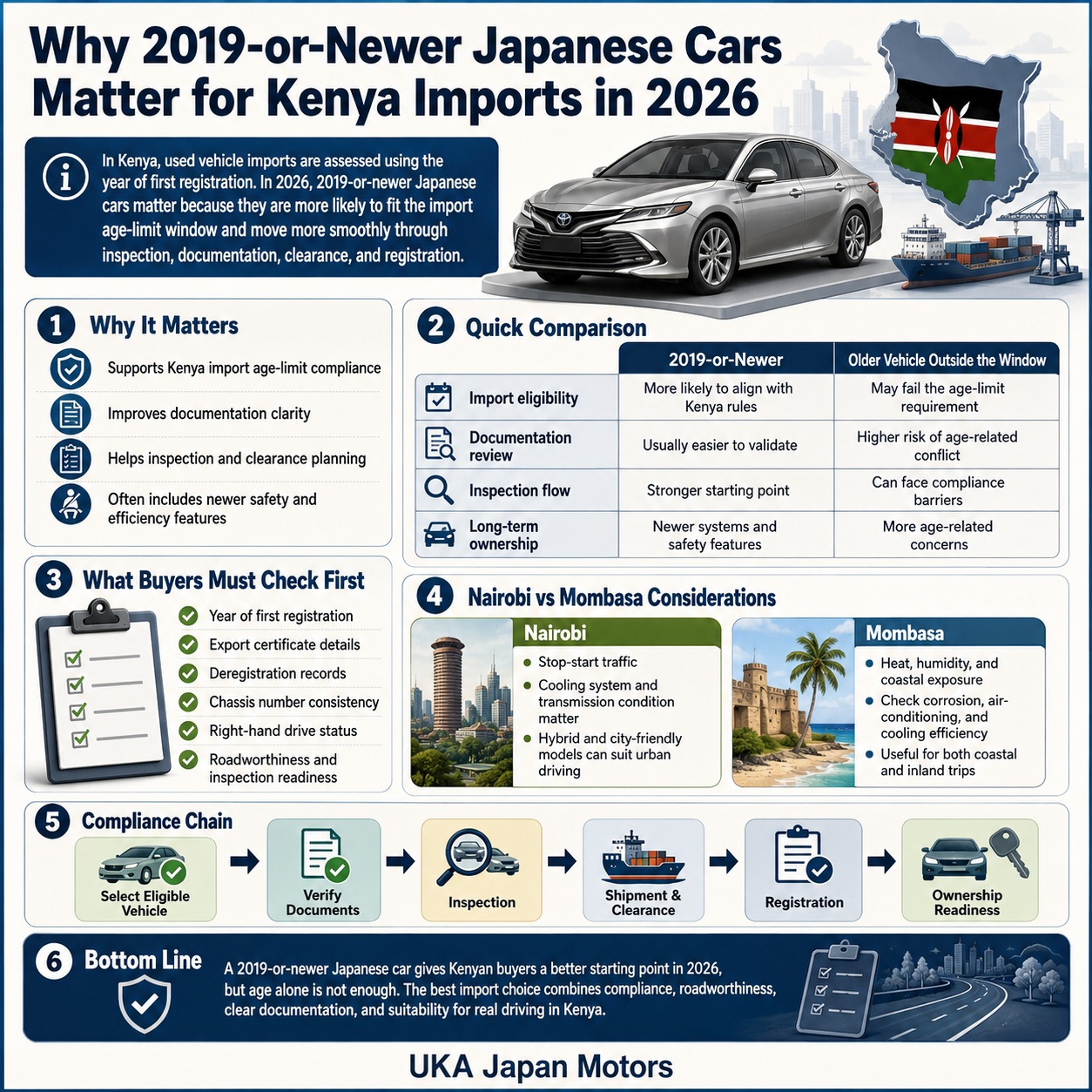
For Kenyan buyers planning to import a Japanese vehicle in 2026, the phrase “2019-or-newer” is more than a model-year preference. It directly affects whether a used vehicle can legally enter Kenya, pass the required inspection process, proceed through clearance, and move toward registration for road use.
Kenya applies an age-limit requirement for used motor vehicles under KEBS standards. The Kenya Revenue Authority explains that an imported vehicle must comply with KEBS requirements and KS1515:2000, including being less than eight years old from the year of first registration, being right-hand drive, and undergoing roadworthiness inspection by a KEBS-appointed inspection agent in the country of export. KEBS also states that KS 1515:2000 requires used motor vehicles imported into Kenya to be not more than eight years old from the Year of First Registration.
This makes 2019-or-newer vehicles especially important in 2026 because vehicles first registered before the eligible window may face compliance problems before they even become practical ownership options. For buyers in Nairobi, Mombasa, and other parts of Kenya, this rule affects selection, documentation checks, inspection timing, and long-term usability.
Direct Answer: Why 2019-or-Newer Matters in 2026
A 2019-or-newer Japanese car matters for Kenya imports in 2026 because it is more likely to fall within Kenya’s used-vehicle age requirement when assessed from the year of first registration. The key issue is not only whether the vehicle looks clean, drives well, or has attractive features. The first question is whether the vehicle can satisfy Kenya’s import rules.
A 2019-or-newer vehicle generally gives buyers a clearer compliance path because it aligns better with the age-limit window, inspection requirements, and documentation checks. A vehicle outside that window may appear suitable on paper but still become unsuitable once KEBS, KRA, and clearance processes are considered.
This is why Kenyan buyers should treat the year of first registration as a primary screening factor before considering engine size, body type, mileage, trim level, or interior features.
Understanding the 2019-or-Newer Requirement in Practical Terms
The 2019-or-newer focus comes from Kenya’s age-limit approach for used motor vehicle imports. KEBS identifies the Year of First Registration as the reference point for the eight-year rule, and its public notice highlights the need to validate documents such as logbooks, export certificates, and deregistration certificates to verify age-limit compliance.
This means the buyer should not rely only on the model year commonly advertised by sellers. In Japanese vehicle documents, the year of first registration, export certificate details, chassis number, and deregistration records all matter. A car may be described in general terms using one year, but Kenya’s compliance process looks at formal documentation.
For example, a buyer in Nairobi may be focused on a compact hybrid for daily traffic between residential estates, office zones, and bypass routes. A buyer in Mombasa may be looking at a vehicle that can handle coastal humidity, urban movement, and upcountry trips. In both cases, the first compliance question remains the same: does the vehicle’s documentation support eligibility for Kenya in 2026?
Why the Year of First Registration Matters More Than Appearance
A Japanese used vehicle can look well-maintained, have a clean interior, and present a strong auction grade, but appearance alone does not determine import eligibility. Kenya’s import process is documentation-led. The year of first registration must align with the rules before the vehicle becomes a realistic import choice.
This distinction is important because buyers often begin with visible condition. They look at paintwork, seats, dashboard condition, tyres, headlights, and general presentation. These are useful ownership indicators, but they do not replace the compliance check.
The year of first registration affects:
- Whether the vehicle can qualify under the age-limit rule
- Whether inspection and documentation can proceed smoothly
- Whether clearance planning is realistic
- Whether the buyer avoids selecting a vehicle that may later become unsuitable for Kenya import
In 2026, this makes 2019-or-newer screening a practical first step, not an afterthought.
2019-or-Newer Versus Older Japanese Imports
The clearest comparison is between a 2019-or-newer Japanese vehicle and an older vehicle that falls outside the current import window.
| Area of Comparison | 2019-or-Newer Japanese Vehicle | Older Vehicle Outside the Eligible Window |
|---|---|---|
| Import eligibility | More likely to align with Kenya’s 2026 age-limit requirement | May fail the age-limit requirement |
| Documentation review | Easier to assess when export and registration records are consistent | Higher risk of age-related document conflict |
| Inspection flow | Can proceed if roadworthiness and other requirements are met | May be blocked before practical ownership is considered |
| Buyer confidence | Stronger basis for planning import steps | Higher uncertainty during compliance review |
| Long-term ownership | Newer systems, parts, and safety features may support longer use | Age may create additional inspection and maintenance concerns |
This comparison does not mean every 2019-or-newer car is automatically suitable. A compliant age range does not replace roadworthiness, service history, body condition, mileage review, and documentation accuracy. It simply means the vehicle starts from a stronger compliance position.
How KEBS Inspection Fits Into the Import Decision
KEBS standards are central to Kenya’s used vehicle import process. KRA states that imported vehicles are subject to roadworthiness inspection by a KEBS-appointed inspection agent in the country of export. KEBS also explains that PVoC agents undertake conformity assessment activities in the country of origin for goods and vehicles being imported into Kenya, including inspection, testing, sealing where applicable, and issuance of conformity-related documents.
For a Japanese car, this means the buyer should think about inspection before shipment planning. A vehicle may be attractive in the marketplace, but if it cannot pass the required checks or if its documents do not support the required age position, it may not be suitable.
Inspection is not only a formality. It helps confirm that the vehicle meets Kenya’s entry requirements and supports road safety. For buyers, this creates an important discipline: select the car only after confirming that the vehicle’s age, documents, and physical condition can support inspection.
Documentation: The Part Buyers Should Not Rush
Documentation is where many import decisions become either clear or risky. KEBS has specifically highlighted validation of used motor vehicle importation documents for vehicles subject to destination inspection, including logbooks, export certificates, and deregistration certificates.
For Kenyan buyers, the key documents and details to check include:
- Year of first registration
- Export certificate details
- Chassis number
- Deregistration information
- Ownership and vehicle identity records
- Certificate of Roadworthiness where applicable
- Shipment details
- Clearance-related documentation
These documents should tell one consistent story. If the year, chassis number, or registration details do not align, the buyer should pause. In Kenya’s import environment, inconsistent documentation can create delays, inspection complications, or compliance rejection.
A 2019-or-newer vehicle with clean, consistent documentation is much stronger than a visually appealing vehicle with unclear records.
Why This Matters for Nairobi Buyers
Nairobi driving places vehicles under a particular kind of stress. Daily congestion, stop-start traffic, roundabout movement, bypass driving, estate roads, and frequent short trips all affect how a car performs over time.
A 2019-or-newer Japanese car can be especially relevant for Nairobi buyers because newer vehicles often come with more recent safety systems, improved fuel-management technology, better emissions design, and more modern comfort features. These qualities can matter during long periods in traffic and repeated urban driving.
However, Nairobi ownership also requires careful model selection. A vehicle that is compliant for import may still not suit every driver. Ground clearance, cooling system health, transmission condition, hybrid battery condition where applicable, and suspension durability remain important. A compact hatchback may suit daily city movement, while a taller crossover may suit mixed routes across uneven roads and estate access points.
The 2019-or-newer rule helps narrow the import window, but Nairobi buyers still need a realistic ownership review.
Why This Matters for Mombasa Buyers
Mombasa has a different ownership environment. Coastal humidity, salty air exposure, heat, and port-side handling realities make condition checks especially important. A 2019-or-newer vehicle may offer a better starting point, but buyers should still inspect for corrosion, underbody condition, cooling efficiency, air-conditioning performance, and electrical system health.
For Mombasa buyers, documentation and inspection also have a practical local connection because many imported vehicles enter through the Port of Mombasa. KEBS lists motor vehicle inspection-related contact points in Mombasa and Nairobi, reflecting the importance of local inspection support and verification access.
A buyer in Mombasa may also use the vehicle for coastal urban driving and longer inland trips. That makes cooling system performance, tyre condition, suspension condition, and service readiness especially important. The vehicle must not only meet import rules; it must also be prepared for real Kenyan use after registration.
The Compliance Chain: From Selection to Registration
A Japanese car import for Kenya should be viewed as a chain of compliance steps. Each step depends on the previous one being accurate.
The process usually begins with selecting a vehicle that appears eligible. Then the documents must be checked. After that, roadworthiness inspection and conformity processes become important. Shipment and clearance follow, then registration through the relevant Kenyan systems.
KRA states that vehicles must comply with KEBS requirements, including the age rule, roadworthiness inspection, and right-hand drive requirement. NTSA identifies vehicle registration and inspection among its services, making registration a separate stage after import compliance and clearance.
This means a buyer should not think of importation as one decision. It is a sequence:
- Confirm year of first registration
- Verify documents
- Assess roadworthiness
- Confirm right-hand drive status
- Prepare for inspection and conformity requirements
- Manage shipment and clearance documentation
- Complete registration steps in Kenya
- Prepare for practical ownership and maintenance
If the first step is wrong, the rest of the process becomes unstable.
Why 2019-or-Newer Vehicles Support Better Planning
Planning matters because import timelines involve several parties and documents. When a vehicle is clearly within the eligible age range, buyers, agents, inspectors, and documentation teams can work with fewer age-related uncertainties.
This does not remove every risk. A 2019-or-newer vehicle can still have accident history, poor maintenance, tampered mileage, weak hybrid battery health, worn suspension, or inconsistent records. But age eligibility removes one of the biggest initial barriers.
For Kenyan buyers, the benefit is clarity. A vehicle that starts with a compliant year of first registration gives the buyer a more stable foundation for inspection, clearance, and eventual use.
Not Every 2019-or-Newer Car Is the Right Choice
It is important to avoid treating 2019-or-newer as the only quality marker. A newer vehicle can still be unsuitable if it has poor condition, questionable documents, hidden damage, or features that do not match the buyer’s use.
For example, a low-slung vehicle may not suit a driver who regularly uses rough estate roads or rural routes. A high-performance engine may not suit a buyer mainly driving in Nairobi congestion. A hybrid may be excellent for stop-start use but still requires battery health checks, cooling system review, and proper diagnostic assessment.
The best import decision combines compliance and ownership suitability. The year opens the door, but inspection and practical evaluation determine whether the vehicle makes sense.
2019-or-Newer and Hybrid Imports
Many Japanese vehicles from 2019 onward include hybrid options, especially in compact cars, sedans, wagons, and crossovers. For Kenya, hybrids can be relevant for Nairobi traffic patterns, where stop-start movement is common. They can also suit buyers who combine city driving with longer routes.
However, hybrid imports require careful inspection. The buyer should confirm battery condition, inverter operation, cooling systems, diagnostic reports, and service history. Hybrid vehicles are not judged only by fuel behavior; they are judged by system health.
In Mombasa, heat and humidity make cooling and electrical condition especially important. In Nairobi, traffic conditions make battery management and cooling performance equally important. A 2019-or-newer hybrid may be attractive, but it should be selected with technical checks, not assumptions.
Safety and Technology Considerations
One reason newer Japanese vehicles matter is that they often include more recent safety and driver-support features. These may include improved braking systems, stability control, lane-related alerts, parking assistance, collision mitigation features, and better lighting systems depending on the model and trim.
For Kenya, safety technology is useful but should be assessed realistically. A driver in Nairobi may benefit from parking sensors and braking assistance in dense traffic. A driver frequently travelling longer routes may value stability control, strong lighting, and braking confidence. A Mombasa driver may prioritize air-conditioning reliability, visibility, and corrosion-resistant condition alongside safety features.
Technology should not distract from basics. Brakes, tyres, suspension, steering, lights, seatbelts, airbags, chassis integrity, and cooling systems remain essential.
Roadworthiness Still Comes First
A vehicle’s age may satisfy the rule, but roadworthiness determines whether the car is fit for use. The KRA import procedure makes roadworthiness inspection part of the import requirement through a KEBS-appointed inspection agent.
Roadworthiness involves the condition of safety-critical systems. These include braking, steering, suspension, lights, tyres, structural condition, and other mechanical areas that affect safe operation. A clean year of first registration does not replace these checks.
For Kenyan roads, this matters because vehicles face varied driving conditions. Nairobi’s congestion stresses transmissions, cooling systems, and brakes. Mombasa’s coastal climate stresses bodywork, electronics, rubber components, and air-conditioning systems. Upcountry routes can stress suspension, tyres, and underbody components.
The best 2019-or-newer import is one that is both eligible and mechanically suitable.
Common Mistakes Buyers Make
One common mistake is focusing on the model year without confirming the year of first registration. Another is assuming that a clean exterior means a clean compliance path. A third is waiting until late in the process to check documents.
Some buyers also focus too much on trim features. Leather seats, large screens, alloy wheels, and premium badges can be appealing, but they do not matter if the vehicle’s records are inconsistent or its inspection position is weak.
Another mistake is ignoring local use. A car that looks ideal online may not be ideal for daily movement in Nairobi, coastal conditions in Mombasa, or mixed urban and long-distance use across Kenya.
A disciplined buyer checks compliance first, condition second, and ownership suitability throughout.
How Buyers Should Assess a 2019-or-Newer Japanese Car
A practical assessment should begin with the documents. Confirm the year of first registration, chassis number, export certificate, and deregistration details. Then review the inspection position and roadworthiness readiness.
After that, assess the vehicle physically and technically. Look at mileage consistency, service records, underbody condition, tyres, suspension, engine bay, transmission behavior, cooling system, lights, interior electronics, and safety systems.
For hybrids, add battery health checks, diagnostic scans, inverter condition, and cooling system checks. For turbocharged engines, add turbo condition, oil service history, and heat-management review. For family vehicles, check seating, access, boot space, air-conditioning coverage, and safety equipment.
The goal is not to find the most feature-filled car. The goal is to find a compliant, inspectable, usable vehicle that fits Kenyan ownership.
Buyer Suitability: Who Benefits Most from 2019-or-Newer Imports?
A 2019-or-newer Japanese car is suitable for buyers who want a clearer compliance path in 2026 and who are willing to verify documents before committing to a vehicle. It suits private owners, family buyers, business users, and drivers who need a car that can proceed through Kenya’s import and registration process with fewer age-related concerns.
It is especially suitable for Nairobi drivers who need modern urban usability, Mombasa drivers who want a recent vehicle with stronger condition potential, and upcountry users who need a car with better long-term service prospects.
It may not suit a buyer who is only looking at visual appeal, ignoring records, or unwilling to carry out inspection checks. It may also not suit a buyer who chooses a model that does not match their driving environment, even if the car meets the age requirement.
What Happens When Buyers Ignore the Age Rule?
Ignoring the age rule can disrupt the entire import plan. If the vehicle does not meet Kenya’s requirements, later steps become difficult or impossible. Inspection, clearance, and registration depend on compliance, not preference.
KEBS has emphasized the need to validate import documents for vehicles without a Certificate of Roadworthiness, specifically to verify age-limit compliance and reduce the risk of forged or improperly acquired documents. This shows that document accuracy is not a minor administrative point. It is a central part of import control.
For buyers, the lesson is simple: do not treat documents as paperwork to be handled later. They are part of the vehicle’s eligibility.
UKA Japan Motors’ Role in a Compliance-Aware Import Decision
UKA Japan Motors’ role is to help buyers approach Japanese vehicle imports with clarity, patience, and proper verification. In the 2026 import environment, that means guiding buyers to look beyond appearance and focus on age eligibility, inspection readiness, documentation consistency, and Kenya-specific ownership suitability.
For a Nairobi buyer, this may include reviewing whether a selected model fits daily traffic, parking needs, fuel type preferences, road conditions, and long-term maintenance access. For a Mombasa buyer, it may include looking closely at corrosion exposure, cooling systems, air-conditioning condition, and suitability for coastal use.
UKA Japan Motors supports a transparent process by helping buyers understand what must be checked before a vehicle is treated as a serious import option. The aim is not to push a buyer toward any vehicle quickly, but to help them make a decision that respects Kenya’s import rules and real driving conditions.
Practical Checklist Before Selecting a 2019-or-Newer Japanese Car
Before selecting a vehicle for Kenya import in 2026, a buyer should confirm:
- The year of first registration
- The consistency of export and deregistration records
- The chassis number and vehicle identity
- Right-hand drive configuration
- KEBS inspection readiness
- Roadworthiness condition
- Service history and mileage consistency
- Suitability for Nairobi, Mombasa, or other Kenyan driving conditions
- Long-term parts and maintenance support
- Registration pathway after clearance
This checklist protects the buyer from focusing only on features while missing the compliance issues that matter most.
FAQ: 2019-or-Newer Japanese Cars for Kenya Imports in 2026
1. Why is 2019-or-newer important for Kenya imports in 2026?
It matters because Kenya applies an age-limit rule for used motor vehicles based on the year of first registration. In 2026, 2019-or-newer vehicles are more likely to align with the eligible import window, provided all other requirements are also met.
2. Is the model year the same as the year of first registration?
Not always. A vehicle may be described by one model year, but Kenya’s compliance process relies on official documentation. Buyers should check the year of first registration shown in the relevant records.
3. Does a 2019-or-newer car automatically qualify for import?
No. Age eligibility is only one part of the process. The vehicle must also satisfy inspection, documentation, right-hand drive, roadworthiness, and clearance requirements.
4. Why do documents matter so much?
Documents confirm the vehicle’s identity, registration history, and eligibility. If the documents do not align, the vehicle may face compliance problems even if it looks clean.
5. What should Nairobi buyers consider beyond the age rule?
Nairobi buyers should consider traffic use, cooling system health, transmission condition, suspension durability, parking practicality, and fuel or hybrid suitability for stop-start driving.
6. What should Mombasa buyers consider beyond the age rule?
Mombasa buyers should consider coastal humidity, underbody condition, corrosion checks, air-conditioning performance, cooling system reliability, and suitability for both coastal and inland driving.
7. Are hybrid Japanese cars from 2019 onward suitable for Kenya?
They can be suitable, especially for urban driving, but they require proper battery checks, diagnostic scans, cooling system review, and inspection of hybrid components.
8. Can an older Japanese car still be a good car but unsuitable for Kenya import?
Yes. A vehicle may be mechanically attractive but still unsuitable if it does not meet Kenya’s import eligibility rules. Compliance comes before preference.
9. What is the biggest mistake buyers make with 2019-or-newer imports?
The biggest mistake is assuming the advertised year is enough. Buyers must verify the official year of first registration and ensure the supporting documents are consistent.
10. How does UKA Japan Motors help with this decision?
UKA Japan Motors helps buyers review compliance, documentation, inspection readiness, and Kenya-specific ownership suitability before treating a vehicle as a serious import option.
Conclusion
In 2026, 2019-or-newer Japanese cars matter for Kenya imports because they sit at the centre of age-limit compliance, inspection readiness, and realistic ownership planning. The year of first registration should be one of the first details checked, not a detail reviewed after a vehicle has already been selected.
For Kenyan buyers, the best import decision is not based on appearance alone. It is based on clear documents, KEBS-aware inspection planning, roadworthiness, right-hand drive compliance, and suitability for real driving conditions in Nairobi, Mombasa, and beyond.
A 2019-or-newer vehicle offers a stronger starting point, but it still needs careful review. When buyers combine age eligibility with proper inspection, documentation checks, and practical ownership thinking, they reduce avoidable risk and make better long-term decisions.
Contact UKA Japan Motors for availability and inspection guidance.