


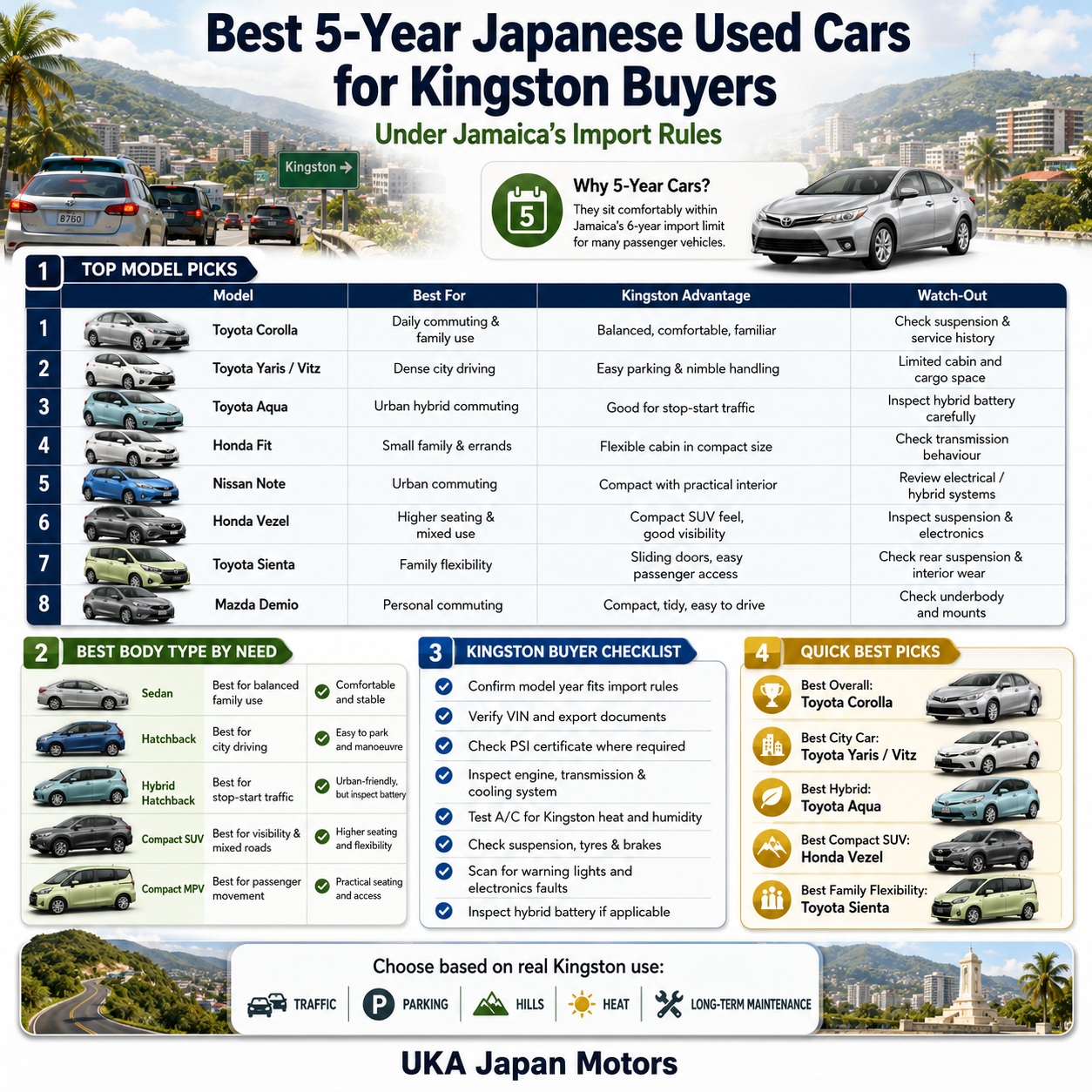
Five-year Japanese used cars can be a sensible category for Kingston buyers who want a vehicle that is still modern, usable, and comfortably within Jamaica’s import age requirements. For 2026 buyers, this usually means looking closely at vehicles from around the 2021 model year, while still confirming the exact model year, first registration details, VIN, seating capacity, and documentation before any import decision is made.
This matters because Jamaica’s rules do not treat every vehicle category the same. Public guidance from the Jamaica Trade Board lists motor cars as not exceeding six years, while Jamaica Customs also states that motor cars up to six years old can be imported. The Trade Board’s published age table also lists sedans, station wagons, and qualifying SUVs with an approved six-year age limit.
A five-year vehicle therefore offers an important timing advantage. It is not at the newest end of the used market, but it is also not sitting at the outer limit of the age rule. For a Kingston buyer, that extra margin can be useful when permit timing, shipping movement, documentation review, and clearance handling are considered.
Direct Answer: What Are the Best 5-Year Japanese Used Cars for Kingston Buyers?
The best five-year Japanese used cars for Kingston buyers are usually compact sedans, practical hatchbacks, small hybrids, and compact SUVs that balance city manoeuvrability, heat tolerance, parts familiarity, inspection clarity, and long-term usability.
Strong choices to consider include:
| Vehicle | Best suited for | Main Kingston advantage | Main caution |
|---|---|---|---|
| Toyota Corolla | Daily commuting and family use | Balanced size, comfort, and broad familiarity | Confirm service history and suspension condition |
| Toyota Yaris or Vitz | Dense city driving | Easy parking and simple daily handling | Cabin and luggage space may be limited |
| Toyota Aqua | Frequent urban use | Hybrid suitability for stop-start movement | Hybrid battery condition must be checked carefully |
| Honda Fit | Small family and mixed errands | Flexible cabin layout and compact size | Transmission behaviour must be inspected |
| Nissan Note | Urban commuting | Compact body with practical interior | Electrical and hybrid-related checks are important |
| Honda Vezel | Drivers wanting higher seating | Compact SUV feel without excessive size | Suspension, hybrid system, and interior electronics need review |
| Toyota Sienta | Family and passenger flexibility | Sliding-door practicality in tight spaces | Confirm seating, interior wear, and rear suspension condition |
| Mazda Demio | Personal commuting | Light, tidy, and easy to place in traffic | Check underbody, mounts, and electronic features |
The best choice depends less on brand preference alone and more on how the car will be used in Kingston: Half-Way Tree traffic, Cross Roads movement, New Kingston commuting, school runs, hillside roads, coastal humidity, and weekend driving beyond the city.
Why the Five-Year Category Matters Under Jamaica’s Import Rules
A five-year vehicle gives buyers room to work within the six-year age limit that applies to many passenger vehicles. This is different from choosing a vehicle already close to the maximum allowable age. When a vehicle is too close to the limit, any misunderstanding about model year, first registration, permit timing, or shipment handling can create avoidable stress.
The Trade Board’s motor vehicle import process also requires buyers to assess the age restriction, obtain pre-shipment inspection where applicable, apply electronically for the import permit, and ensure the permit is obtained before the vehicle arrives in Jamaica. Required permit documents include supplier invoice or bill of sale, registration certificate, certificate of title or Japanese export certificate, valid identification, TRN, and a PSI certificate for used vehicles.
This is why a five-year Japanese used car should not be judged only by appearance or mileage. It should be judged by eligibility, paperwork consistency, inspection record, mechanical condition, and suitability for Jamaican roads.
For Kingston buyers, the five-year category often provides a useful balance. The vehicle is old enough to have established reliability patterns, but young enough to include modern safety, comfort, efficiency, and convenience features. The key is selecting the right body type and drivetrain rather than simply choosing the most familiar badge.
Kingston Driving Conditions: What a Good Five-Year Car Must Handle
Kingston driving is not one simple environment. A vehicle may spend one hour crawling through traffic, then climb into hilly residential areas, then sit under direct sun for long periods, then handle rougher road sections after rain.
A good five-year Japanese used car for Kingston should manage:
- Slow-moving traffic without overheating
- Frequent braking and acceleration
- Tight parking spaces
- Hot cabin conditions
- Air-conditioning use in humid weather
- Uneven road surfaces
- Short-trip driving
- Occasional longer drives outside the city
- Dust, rainwater splash, and coastal air exposure
This is why compact sedans, hatchbacks, and compact SUVs often make sense. They are easier to manoeuvre than larger vehicles, simpler to park in Kingston’s busier commercial areas, and usually practical enough for daily family or work use.
A vehicle that feels impressive on paper may not be the best fit if it is too large for daily city parking, too complex for ordinary maintenance habits, or too sensitive to poor inspection history.
Best Overall Pick: Toyota Corolla
The Toyota Corolla remains one of the safest all-round choices for Kingston buyers looking at a five-year Japanese used car. It suits drivers who want one vehicle to cover commuting, family movement, errands, and occasional longer travel.
Its biggest strength is balance. It is not as small as a city hatchback, but it remains manageable in Kingston traffic. It offers more cabin comfort than many compact hatchbacks, but it does not feel oversized for everyday movement through areas such as New Kingston, Constant Spring, Liguanea, or Half-Way Tree.
For a five-year Corolla, buyers should pay attention to the suspension, steering feel, engine idle, transmission smoothness, air-conditioning performance, and body panel consistency. A clean-looking Corolla can still have worn bushings, weak shocks, hidden accident repair, or interior wear from heavy previous use.
The Corolla suits buyers who want predictability more than excitement. It may not be the most flexible cargo vehicle, and it may not offer the high seating position some drivers prefer, but it is one of the strongest choices for general Kingston use.
Best Compact City Choice: Toyota Yaris or Vitz
For buyers who spend most of their time in traffic, compact Toyota hatchbacks such as the Yaris or Vitz can be very practical. Their size is a major advantage in Kingston, especially where parking is tight and traffic gaps are small.
A compact hatchback is useful for daily movement through commercial roads, supermarket stops, office parking, and school pickups. It also tends to feel less tiring for drivers who do not need a large vehicle.
The limitation is space. Buyers carrying adults frequently in the rear seats, moving luggage often, or needing a more planted highway feel may find a compact hatchback too small. This does not make it a poor choice; it simply means the vehicle must match the buyer’s actual routine.
For inspection, look closely at front-end alignment, suspension noise, door seals, air-conditioning strength, dashboard warning lights, and previous body repair. Small cars are sometimes used heavily in tight urban conditions, so a tidy exterior should not replace a careful mechanical review.
Best Hybrid City Option: Toyota Aqua
The Toyota Aqua is a strong option for Kingston buyers who understand hybrid ownership and are prepared to inspect the hybrid system properly before committing. It is compact, practical for city use, and well suited to stop-start movement.
Aqua ownership should be approached carefully. The hybrid battery, cooling fan, inverter condition, dashboard warning lights, and service history all matter. Heat and humidity make proper battery ventilation especially important. A blocked or neglected hybrid battery cooling area can affect long-term performance.
The Aqua is best for drivers whose use is mostly urban and predictable. It may not be ideal for buyers who want a larger cabin, higher ground clearance, or a more traditional driving feel. It is also not the best choice for someone who wants to ignore hybrid-specific maintenance.
A properly inspected Aqua can serve Kingston buyers well, but the inspection must go beyond the engine bay. Hybrid health is part of the vehicle’s real condition.
Best Flexible Hatchback: Honda Fit
The Honda Fit is one of the most practical small Japanese used cars because of its cabin flexibility. It is compact outside but surprisingly useful inside, making it suitable for buyers who want city-friendly size without giving up too much usable space.
For Kingston, the Fit works well for errands, small-family use, and daily commuting. Its upright cabin and flexible seating make it more versatile than many similar-size hatchbacks.
The main area to inspect carefully is transmission behaviour. Buyers should look for smooth takeoff, steady acceleration, no harsh jerking, no warning lights, and no hesitation during low-speed movement. In Kingston traffic, transmission issues become noticeable quickly because the vehicle is constantly moving between stop, creep, and acceleration.
The Fit suits buyers who need practicality but do not want a sedan or SUV. It may not be the first choice for rougher hillside routes or frequent heavy loading, but for ordinary Kingston driving it remains a useful option.
Best Practical Compact Option: Nissan Note
The Nissan Note can be a smart Kingston choice for buyers who want compact dimensions with more interior usefulness than a very small hatchback. It is easy to place in traffic and practical for daily movement.
Some versions include more advanced drivetrain or electrical systems, so inspection is especially important. Buyers should confirm the exact variant, warning-light status, battery condition, charging behaviour where relevant, and general electrical health.
The Note suits commuters, small households, and drivers who want a compact vehicle that does not feel too basic inside. However, it should not be bought casually. A careful scan, road test, and inspection history review are important before selection.
Compared with a Corolla, the Note is easier to park and more compact. Compared with a Yaris or Vitz, it may offer more cabin practicality. The right choice depends on whether the buyer values simplicity, interior space, or long-term familiarity most.
Best Compact SUV Choice: Honda Vezel
The Honda Vezel suits Kingston buyers who want a higher seating position, a more substantial feel, and better flexibility than a hatchback, without moving into a large SUV category. It can work well for drivers who split time between city commuting, family use, and hillside roads.
The Vezel’s appeal is its blend of compact size and SUV-style confidence. It feels more elevated than a sedan and can be easier for some drivers to enter and exit. That is useful for families, older drivers, and buyers who prefer stronger visibility in traffic.
However, the Vezel needs careful inspection. Suspension condition, hybrid system health where applicable, gearbox behaviour, electronic parking brake function, air-conditioning performance, and dashboard warning lights should all be checked.
The Vezel may not suit buyers who want the simplest possible vehicle. It has more features and systems than many basic hatchbacks. For buyers willing to inspect properly and maintain consistently, it can be a strong five-year Japanese used car option for Kingston.
Best Family Flexibility Choice: Toyota Sienta
The Toyota Sienta is useful for Kingston buyers who need more passenger flexibility than a standard hatchback or sedan. Its sliding doors are practical in tight parking spaces, especially around schools, plazas, apartment complexes, and busy residential areas.
The Sienta is not for everyone. It has a different shape and driving feel from a Corolla or compact SUV. Buyers who rarely carry passengers may not need its layout. But for households that need flexible seating, easy entry, and practical cabin use, it can be one of the most useful five-year Japanese used vehicles.
Inspection should focus on door mechanisms, rear suspension, seat rails, interior trim, air-conditioning reach, and overall wear. Family-use vehicles often show condition in the cabin before the engine bay tells the full story.
The Sienta is a practical choice when people movement matters more than style. For Kingston families, that practicality can be more important than choosing a vehicle based only on exterior appearance.
Best Personal Commuter: Mazda Demio
The Mazda Demio can suit buyers who want a compact, neat, and enjoyable personal commuter. It is easy to drive in Kingston and offers a slightly different feel from the more common Toyota and Honda options.
The Demio is best for personal use, student movement, office commuting, and light errands. It may not be ideal for families needing regular rear-seat space or drivers who want a higher seating position.
Inspection should include engine mounts, suspension noise, underbody condition, air-conditioning strength, dashboard electronics, and transmission response. Because compact vehicles often spend their lives in short trips, buyers should also look for signs of neglected maintenance.
Compared with a Yaris or Vitz, the Demio may feel more engaging. Compared with a Corolla, it is smaller and easier to park but less spacious. For the right driver, it can be a sensible five-year choice.
Sedan, Hatchback, Hybrid, or SUV: Which Body Type Fits Kingston Best?
The best five-year Japanese used car is not the same for every buyer. Body type matters.
| Body type | Best for | Kingston strength | When it may not suit |
|---|---|---|---|
| Sedan | Daily commuting and balanced family use | Comfortable and stable | Less flexible cargo access |
| Hatchback | City driving and tight parking | Easy to manoeuvre | Limited rear and luggage space |
| Hybrid hatchback | Frequent stop-start movement | Good urban driving behaviour | Requires hybrid-specific inspection |
| Compact SUV | Visibility and mixed road conditions | Higher seating and more flexible feel | More systems to inspect |
| Compact MPV | Family movement and passenger access | Practical doors and seating | Not necessary for solo driving |
This comparison shows why the “best” vehicle cannot be chosen by model name alone. A buyer who lives in a hillside area and carries family members may need a different vehicle from a buyer commuting alone into New Kingston each day.
Inspection Priorities Before Choosing Any Five-Year Japanese Used Car
A five-year vehicle is still young enough to be attractive, but it is not automatically problem-free. Kingston buyers should inspect the vehicle as a complete ownership package.
Key inspection areas include:
Engine condition: The engine should idle smoothly, accelerate cleanly, and show no signs of overheating, heavy oil leaks, or unusual smoke.
Transmission behaviour: Low-speed smoothness matters because Kingston traffic exposes hesitation, jerking, slipping, or delayed engagement.
Suspension and steering: Rough roads, potholes, and hillside use can reveal worn bushings, weak shocks, steering noise, or uneven tyre wear.
Air-conditioning: In Kingston heat and humidity, weak cooling is not a small issue. The system should be tested at idle and while driving.
Hybrid system: For Aqua, Vezel, Note, and other hybrid models, battery health, cooling, warning lights, and scan results are essential.
Body and chassis: Look for uneven panel gaps, repainting, corrosion, underbody damage, poor repairs, or signs of previous impact.
Interior condition: Seat wear, steering wheel shine, pedal wear, and switch condition can reveal heavy usage.
Electronic systems: Modern five-year vehicles may include sensors, push-button start, electronic parking brakes, cameras, and advanced displays. All should be checked.
A proper inspection should protect the buyer from choosing a vehicle that looks clean but is unsuitable for long-term use in Jamaica.
Documentation Checks Under Jamaica’s Import Process
Documentation is not a side issue. It is part of the vehicle’s suitability.
Jamaica Customs states that bikes, trucks, and motor vehicles require an import licence, and the licence should be obtained from the Trade Board before importation. Customs also lists documents needed before importation, including the import licence, title, bill of lading/order, invoice, bill of sight, Tax Compliance Certificate, and E-sad document prepared by a licensed Customs Broker.
For the Trade Board permit process, the vehicle information and supporting documents must be submitted electronically, including ownership/export documentation showing model, year, VIN, colour, seating capacity, and unladen weight, along with identification, TRN, and the PSI certificate where the vehicle is used. The Trade Board also states that the permit must be obtained before the vehicle arrives in Jamaica.
For used vehicles, the PSI requirement is especially important. The Trade Board announced that, effective July 1, 2025, all used vehicles exported from designated countries must undergo Pre-Shipment Inspection, and that import licences for used vehicles entering Jamaica from specified countries would not be issued without a valid PSIC from that date forward.
For Kingston buyers, this means the best vehicle is not only the one with the right engine, colour, or features. It is the one with matching paperwork, clear inspection status, correct age eligibility, and no documentation gaps.
What Makes a Five-Year Car Better Than Waiting Until the Six-Year Limit?
A five-year Japanese used car gives the buyer more room inside the rule. A six-year vehicle may still be eligible where the category allows it, but it sits closer to the limit. That can make timing and paperwork more sensitive.
The contrast is simple:
A five-year car usually gives more room for documentation review, permit handling, and shipment timing.
A six-year car may still qualify, but there is less margin if there is confusion over model year, registration year, or arrival timing.
This does not mean every five-year car is better than every six-year car. A poorly maintained five-year vehicle can be a worse ownership choice than a carefully inspected older eligible vehicle. But from a compliance and planning standpoint, the five-year category is often easier to manage.
Ownership Considerations After the Vehicle Reaches Kingston
A good buying decision continues after the vehicle is registered and placed into daily use. Kingston conditions reward consistent maintenance.
Owners should pay attention to:
Cooling system care: Heat, traffic, and air-conditioning use place steady demand on the cooling system.
Tyre condition: Uneven surfaces and frequent braking make tyre inspection important.
Suspension checks: Bushings, shocks, mounts, and links should be monitored, especially if the vehicle is used on rougher roads.
Battery health: Both standard batteries and hybrid batteries need proper attention.
Air-conditioning servicing: Cabin comfort and demisting are important in humid weather.
Fluid maintenance: Engine oil, transmission fluid, coolant, and brake fluid should be handled according to the vehicle’s needs.
Brake condition: Stop-start Kingston driving places regular demand on pads, discs, and braking response.
A five-year vehicle should not be treated as maintenance-free. It is simply at an age where good inspection and steady care can support dependable ownership.
Which Buyers Should Choose Which Model?
A first-time Kingston buyer who wants the simplest all-round choice should consider the Toyota Corolla.
A buyer who mainly drives alone through city traffic should consider the Toyota Yaris, Vitz, Mazda Demio, or Nissan Note.
A buyer who wants compact size but more interior flexibility should consider the Honda Fit.
A buyer who understands hybrid inspection and drives mostly in stop-start traffic may consider the Toyota Aqua.
A buyer who wants higher seating and a more substantial feel should consider the Honda Vezel.
A family needing easier passenger access should consider the Toyota Sienta.
A buyer who often travels through hilly areas should place extra emphasis on engine response, cooling, transmission behaviour, and suspension condition, regardless of model.
When a Five-Year Japanese Used Car May Not Suit
A five-year Japanese used car may not suit every buyer. It may not be the best route if:
- The buyer cannot verify the documentation clearly
- The vehicle has warning lights or incomplete inspection details
- The model has complex systems the buyer does not intend to maintain
- The vehicle category, seating capacity, or unladen weight is unclear
- The buyer needs a body type different from the one being considered
- The vehicle shows signs of damage, poor repair, or heavy wear
- The buyer is choosing based only on appearance
Jamaica Customs states that damaged or salvaged motor vehicles are prohibited from importation. This makes condition verification more than a preference. It is a compliance and ownership concern.
Practical Selection Checklist for Kingston Buyers
Before choosing a five-year Japanese used car, confirm:
- The model year fits the import rule.
- The vehicle category is clear.
- Seating capacity matches the declared category.
- VIN and documentation match.
- The export certificate or title information is consistent.
- PSI documentation is available where required.
- The vehicle is not damaged or salvaged.
- The engine, transmission, suspension, brakes, and cooling system have been inspected.
- Hybrid components have been checked if applicable.
- The vehicle suits the buyer’s real Kingston driving routine.
A buyer who follows this checklist is less likely to choose a car that looks suitable but creates problems later.
UKA Japan Motors’ Role in Helping Buyers Choose Carefully
UKA Japan Motors’ role is to help buyers understand the vehicle before making a decision. That means looking beyond surface appeal and focusing on inspection, documentation, eligibility, and practical use in Jamaica.
For a Kingston buyer, guidance should include:
- Whether the model fits daily driving needs
- Whether the vehicle category is appropriate under import rules
- Whether the documentation supports the declared model year and details
- Whether the vehicle condition is consistent with long-term ownership
- Whether hybrid, transmission, and electronic systems need closer review
- Whether the body type suits city traffic, hillside driving, or family use
The aim is not to push one model for every buyer. The aim is to help each buyer understand which vehicle fits their routine, paperwork requirements, and ownership expectations.
A five-year Japanese used car can be a strong choice, but only when selected with care.
FAQ: Best 5-Year Japanese Used Cars for Kingston Buyers
1. Are five-year Japanese used cars allowed under Jamaica’s import rules?
For many motor cars, a five-year vehicle sits within the public six-year age guidance listed by Jamaica’s Trade Board and Customs. Buyers must still confirm the exact vehicle category, model year, documentation, and permit timing before importation.
2. Is a five-year car better than a six-year car?
A five-year car usually gives more timing margin under the age rule. A six-year car may still qualify in the relevant category, but it is closer to the limit. Condition and documentation still matter more than age alone.
3. What is the best five-year Japanese used car for general Kingston use?
The Toyota Corolla is one of the strongest all-round choices because it balances size, comfort, familiarity, and daily practicality. However, the best choice depends on the buyer’s route, family needs, parking situation, and maintenance expectations.
4. Is a hybrid a good choice for Kingston traffic?
A hybrid can suit stop-start Kingston driving, but it must be inspected carefully. Battery health, cooling, inverter condition, warning lights, and scan results should be reviewed before selection.
5. Should I choose a hatchback or sedan?
Choose a hatchback if parking ease and compact movement matter most. Choose a sedan if you want more cabin comfort, a more settled drive, and balanced family use.
6. Is a compact SUV better for Kingston roads?
A compact SUV can help with visibility, seating position, and mixed road conditions. However, it may have more systems to inspect than a simple hatchback or sedan.
7. What documents should be checked before importing?
Important documents include the import licence, title or export certificate, invoice, bill of lading/order, bill of sight, Tax Compliance Certificate, E-sad document, identification, TRN, and PSI certificate where required.
8. Why is PSI important for used vehicles?
PSI helps confirm that the used vehicle meets required inspection expectations before import licensing. It is part of the documentation and compliance process for used vehicle imports into Jamaica where applicable.
9. Can a damaged vehicle be imported if it is repaired first?
Jamaica Customs states that motor vehicles considered damaged or salvaged are prohibited from importation. Buyers should avoid vehicles with unclear damage history or poor repair evidence.
10. Which five-year Japanese used car is best for families?
The Toyota Corolla suits many small families, while the Toyota Sienta suits buyers who need flexible passenger access. The Honda Vezel may suit families wanting higher seating and compact SUV practicality.
11. Which model is best for tight Kingston parking?
The Toyota Yaris, Vitz, Mazda Demio, Honda Fit, and Nissan Note are strong compact choices for tight parking and city movement.
12. What should I inspect first on a five-year Japanese used car?
Start with documentation, then inspect the engine, transmission, suspension, brakes, cooling system, body structure, electronics, air-conditioning, and hybrid system if applicable.
Conclusion
The best five-year Japanese used cars for Kingston buyers are not chosen by name alone. They are chosen by matching the vehicle’s age, category, documentation, inspection condition, and real-world suitability for Jamaican driving.
For many buyers, the Toyota Corolla remains the strongest all-round option. For tighter city movement, the Yaris, Vitz, Demio, Fit, and Note deserve attention. For hybrid city use, the Aqua can be sensible when inspected properly. For higher seating and family practicality, the Vezel and Sienta can be strong choices.
A five-year vehicle gives useful room under Jamaica’s import age rules, but it still requires careful checking. The right choice should feel suitable not only on the day it arrives, but after months and years of Kingston traffic, heat, humidity, hillside roads, and regular maintenance.
Contact UKA Japan Motors for availability and inspection guidance.