


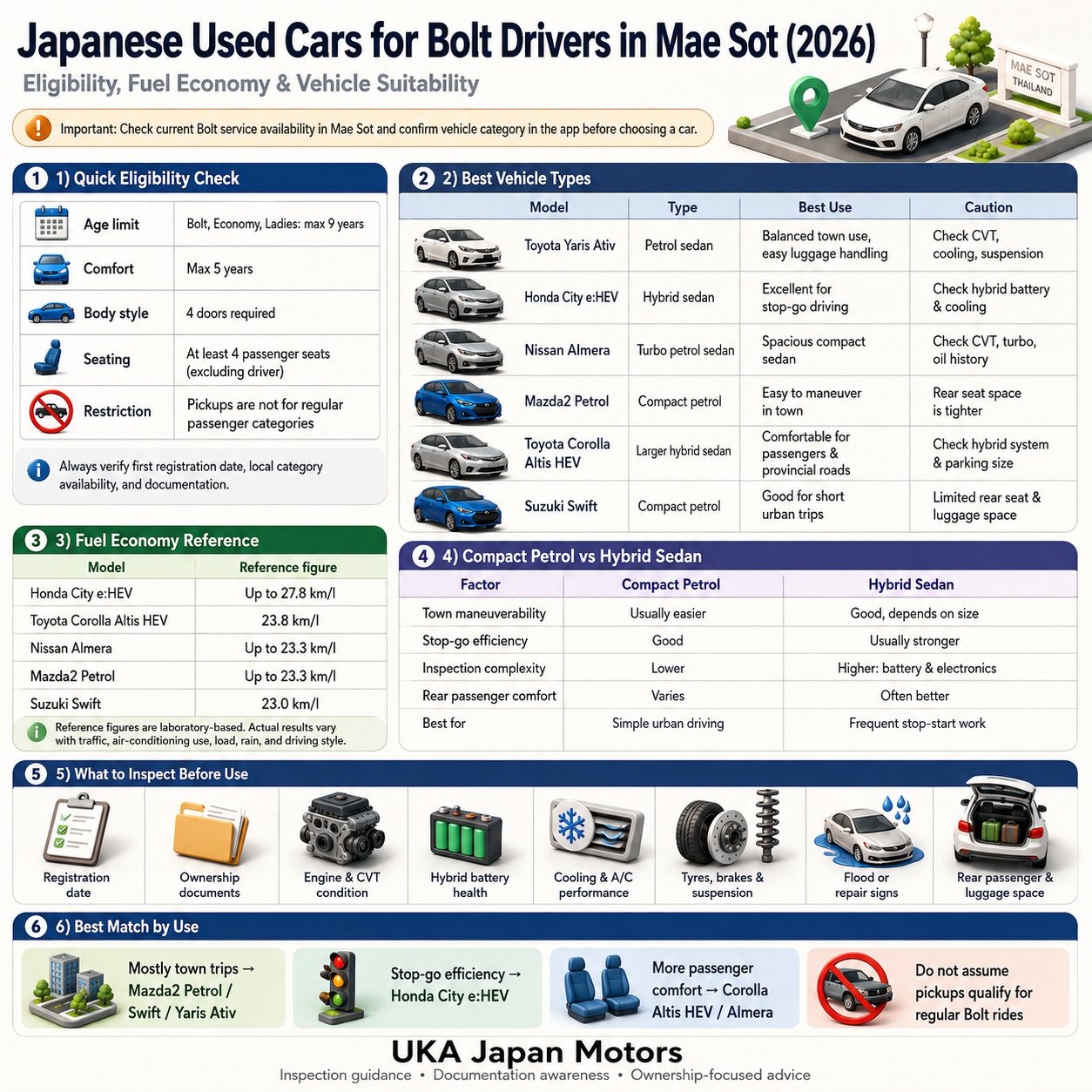
App-based passenger driving places different demands on a vehicle than ordinary private ownership. A car may be comfortable for occasional family use but become tiring, inefficient or maintenance-sensitive when driven through repeated short journeys, long periods of air-conditioning use and frequent passenger loading.
For drivers based in Mae Sot, vehicle selection also involves an important local question: whether the intended app and vehicle category are actually active in the area.
As of July 2026, Bolt’s official Thailand cities page lists 13 locations, including Bangkok, Chiang Mai, Chiang Rai, Phitsanulok and several other provincial cities, but it does not list Mae Sot. A separate Bolt driver-registration page states that driver registration is available nationwide. Because these official pages are not fully aligned, a Mae Sot driver should confirm current ride availability and driver-category activation directly in the Bolt Driver application before preparing a vehicle specifically for platform work.
This guide therefore focuses on Japanese used cars that can suit app-based passenger driving in Mae Sot and elsewhere in Thailand, provided the exact vehicle, registration year, documentation and local service area meet current platform and Department of Land Transport requirements.
Direct Answer: Which Japanese Used Cars Suit App-Based Driving?
The most practical Japanese used-car candidates for passenger-app driving generally fall into three groups:
- Compact petrol sedans such as the Toyota Yaris Ativ and Nissan Almera, which are easy to manoeuvre in town and provide usable rear-seat and luggage space.
- Compact petrol cars such as the Mazda2 and Suzuki Swift, which can suit frequent short journeys but require careful consideration of rear-seat comfort and luggage capacity.
- Hybrid sedans such as the Honda City e:HEV and Toyota Corolla Altis HEV, which can be well suited to repeated stop-and-go driving when the hybrid battery, cooling system and service history are in good condition.
The correct choice depends on more than published fuel economy. Drivers should examine:
- The vehicle’s exact registration date
- Platform eligibility for the intended category
- Rear-passenger comfort
- Air-conditioning performance
- Engine, transmission and hybrid-system condition
- Tyres, brakes and suspension
- Cooling-system health
- Flood or accident repair signs
- Ownership documentation
- Registration and inspection readiness
- Suitability for Mae Sot town traffic and provincial-road use
A highly efficient model in poor condition can be less dependable than a conventionally powered vehicle with clear records and consistent maintenance.
Important Bolt Availability Note for Mae Sot
Bolt’s current public city list does not identify Mae Sot as an operating city. The Thai locations shown on that page are Krabi, Bangkok, Khon Kaen, Chiang Rai, Chiang Mai, Nakhon Ratchasima, Nakhon Si Thammarat, Buriram, Phitsanulok, Phuket, Maha Sarakham, Surat Thani and Udon Thani.
This does not necessarily establish that future or limited driver activity is impossible in Mae Sot. Platform areas can change, and driver-registration pages may use broader wording than passenger-facing city lists. However, it means that vehicle selection should not begin with an assumption that ordinary Bolt passenger jobs are currently active throughout Mae Sot.
Before choosing a car for this purpose, a driver should check:
- Whether Mae Sot appears as an active driving area in the driver application.
- Whether the intended vehicle category is available locally.
- Whether the exact model is accepted by the platform.
- Whether the vehicle can be registered and inspected for lawful app-based passenger use.
- Whether local passenger demand matches the vehicle’s size and operating characteristics.
Even where one platform is not locally active, the same inspection and ownership principles can be useful for other authorised app-based passenger services operating under Thai requirements.
Bolt Vehicle Eligibility in Thailand in 2026
Bolt’s current Thailand vehicle-requirements page states that vehicles in the ordinary Bolt, Economy and Ladies categories must:
- Be no more than nine years old
- Have four doors
- Provide at least four passenger seats, excluding the driver
- Not be a pickup truck or lorry
The same page states that the Comfort category has a maximum vehicle age of five years. It also says that six-to-nine-seat XL vehicles are categorised in Bangkok and Phuket, while the Van category is limited to Phuket.
These rules have several practical implications for Mae Sot buyers.
Registration date matters more than model reputation
A well-maintained vehicle may still become ineligible when it passes the platform’s age limit. Buyers should check the first-registration date in the registration book rather than relying only on the model year shown in an advertisement or general description.
A vehicle registered late in one calendar year may retain eligibility longer than a similar vehicle registered earlier. The platform should be asked to confirm how it calculates the final eligibility date.
Four doors and passenger seating are essential
Two-door vehicles, commercial pickups and vehicles without suitable passenger seating should not be assumed eligible for ordinary passenger categories. This is particularly relevant in Mae Sot, where pickups are common for personal and business use but are not accepted by Bolt for normal passenger categories under the current vehicle page.
The model must still be recognised by the platform
Meeting the basic age and door requirements does not automatically confirm category acceptance. Bolt states that vehicles are assigned to applicable categories when entered into the system and advises drivers to contact support when a model cannot be found.
Imported specifications, unusual body styles and vehicles whose Thai registration description does not clearly match the platform database may require additional confirmation.
Driver and Documentation Requirements
Bolt’s Thailand driver-registration guide currently states that drivers must be at least 22 years old, hold a valid public driving licence and use a vehicle that meets the company’s conditions. The guide also describes uploading personal and vehicle documentation through the Bolt Driver application.
Another Bolt support page lists documents such as:
- Driving licence
- National identification
- Vehicle registration
- Vehicle photographs
- Driver profile photograph
- Relevant Department of Land Transport documentation
That page also explains that vehicle ownership details and supporting authorisation may be required when the registered owner and driver are not the same person.
Platform document acceptance should not be treated as a substitute for legal compliance. The Department of Land Transport has formal procedures covering approval, inspection, registration and taxation for vehicles used as electronic-system hire cars. The principal registration procedure has applied since 2021.
In June 2026, the Department of Land Transport also opened consultation on a draft amendment concerning the registration of electronic-system hire cars by legal entities. As of July 20, 2026, that proposal remained a draft consultation matter rather than a final rule that individual drivers should automatically rely upon.
For a vehicle based in Mae Sot, drivers should confirm the current procedure with the responsible Department of Land Transport office before beginning passenger operations.
Fuel Economy: Laboratory Figures Versus Mae Sot Driving
Manufacturer fuel-economy figures are useful for comparing powertrain types, but they do not predict every driver’s actual result.
Mae Sot operating conditions can include:
- Short journeys through town
- Frequent waiting with the air conditioner operating
- Passenger loading and unloading
- Stop-and-go movement near markets and commercial areas
- Longer journeys on provincial roads
- Heavy rain and standing water
- Hot, humid weather
- Dust and road-surface changes outside central areas
- Repeated acceleration after junctions or roadside stops
These conditions can reduce the distance travelled per litre compared with controlled laboratory testing.
The following figures should therefore be treated as technical reference points, not guaranteed results for a used vehicle:
| Model or powertrain | Published reference figure | Important qualification |
|---|---|---|
| Honda City e:HEV | Up to 27.8 km/l | Laboratory testing under UN R101; actual use varies |
| Toyota Corolla Altis HEV | 23.8 km/l | Eco Sticker and UN R101 reference for the stated HEV versions |
| Nissan Almera | Up to 23.3 km/l | Exact result depends on variant, condition and driving pattern |
| Mazda2 1.3 petrol | Up to 23.3 km/l | Published for the applicable Thai specification |
| Mazda2 1.5 diesel | Up to 26.3 km/l | Short-journey suitability requires additional consideration |
| Suzuki Swift | Up to 23 km/l | UN R101-certified figure for the applicable version |
Honda states that the City e:HEV can achieve up to 27.8 km/l under laboratory testing, while clearly noting that actual consumption depends on driving conditions and driver behaviour.
Toyota’s 2026 Corolla Altis catalogue lists a 23.8 km/l reference for the stated hybrid versions, based on Eco Sticker information and UN R101 laboratory testing.
Nissan publishes an efficiency figure of up to 23.3 km/l for the Almera.
Mazda has published reference figures of 23.3 km/l for the Mazda2 1.3 petrol and 26.3 km/l for the 1.5 diesel version.
Suzuki states a 23 km/l UN R101-certified figure for the applicable Swift powertrain.
When inspecting a used example, the vehicle’s displayed average consumption should be considered only supporting information. It may have been reset, measured over a favourable journey or affected by tyre pressure, traffic, air-conditioning use and driving style.
Most Suitable Japanese Used-Car Candidates
1. Toyota Yaris Ativ Petrol
The Toyota Yaris Ativ is one of the most balanced body styles for ordinary app-based driving. Its sedan shape gives passengers a separate luggage compartment, while its exterior size remains manageable in town.
It can suit:
- Frequent Mae Sot town journeys
- One or two rear passengers
- Airport or bus-terminal transfers with moderate luggage
- Daily commuting combined with occasional app use
- Drivers who prefer a conventional petrol powertrain
The Yaris Ativ should not be selected by model name alone. Several generations and engine specifications exist, and the exact registration date determines whether the vehicle remains inside the platform age limit.
Inspection priorities include:
- CVT smoothness during gentle and moderate acceleration
- Engine vibration when the air conditioner engages
- Cooling-system condition
- Front suspension noise
- Steering alignment
- Rear tyre wear
- Boot-floor and spare-wheel-well condition
- Signs of water entry or previous rear-body repair
A petrol Yaris Ativ may not match a full hybrid during repeated stop-start operation, but its conventional layout can be straightforward for drivers who prefer familiar servicing and do not want hybrid-system inspection to be part of the ownership process.
2. Honda City e:HEV
The Honda City e:HEV is particularly relevant for drivers expecting regular urban stop-and-go use. Hybrid operation can recover energy during deceleration and reduce the amount of time the petrol engine must provide all propulsion by itself.
It can suit:
- Frequent town operation
- Repeated junctions and low-speed traffic
- Drivers who regularly use air conditioning
- Passengers who expect sedan rear-seat space
- Mixed town and provincial-road driving
Honda publishes a laboratory fuel-economy figure of up to 27.8 km/l for the current City e:HEV specification. The figure should be used as a technical comparison rather than an expectation for every used example.
A used City e:HEV requires additional checks beyond those of an ordinary petrol car:
- Hybrid battery diagnostic condition
- Battery cooling intake cleanliness
- Warning-light history
- Smooth transition between electric and engine operation
- Correct operation of regenerative braking
- 12-volt battery health
- Cooling-system maintenance
- Service history appropriate to the vehicle’s age and distance travelled
A hybrid may be less suitable when the vehicle has unclear repair history, persistent warning lights, evidence of electrical modification or no reliable record of hybrid-system inspection.
3. Nissan Almera 1.0 Turbo
The Thai-market Nissan Almera combines a compact exterior with a comparatively spacious passenger compartment. Its 1.0-litre turbocharged engine is designed to provide usable low-speed response without requiring a large engine.
Nissan publishes a fuel-efficiency reference of up to 23.3 km/l for the applicable Almera specification.
It can suit:
- Mae Sot town driving
- Regular rear-passenger use
- Drivers who want a sedan with manageable dimensions
- Mixed short and medium-distance journeys
- Areas where easy parking and turning are important
Inspection should focus on:
- Turbocharger response without abnormal noise
- Consistent engine-oil maintenance
- CVT operation
- Cooling performance in hot weather
- Air-conditioning output at idle
- Engine mounts
- Front suspension
- Tyre condition and alignment
- Evidence of flood exposure around low-mounted electrical connections
Turbo engines depend heavily on correct lubrication and cooling. A vehicle with incomplete oil-change history, overheating evidence or irregular acceleration should receive further diagnosis before being considered for intensive daily use.
4. Mazda2 1.3 Petrol
The Mazda2 1.3 petrol is compact, manoeuvrable and capable of strong fuel efficiency for a conventional petrol vehicle. Mazda has published an applicable reference figure of up to 23.3 km/l.
It can suit:
- Mostly individual passengers
- Short urban journeys
- Drivers prioritising easy manoeuvring
- Narrow parking areas
- Light luggage requirements
- Mixed personal and app-based use
Its principal contrast with larger sedans is cabin packaging. Rear-seat passengers may find the available space more limited, particularly when the driver is tall or when three adults occupy the rear seat.
Inspection priorities include:
- Front and rear suspension condition
- Low-speed transmission smoothness
- Steering-centre accuracy
- Air-conditioning performance
- Seat and door-trim wear
- Underbody impact signs
- Water entry around the boot or hatch area
- Correct tyre type and matching tyre sizes
For intensive passenger work, the petrol version may be easier to match with repeated short journeys than the diesel version. Diesel efficiency can be attractive on paper, but a vehicle that spends most of its time on short, low-speed journeys may not provide the operating pattern that modern diesel emissions systems prefer.
5. Toyota Corolla Altis HEV
The Corolla Altis HEV is larger than the Yaris Ativ, Mazda2 or Swift. It offers a more substantial rear-passenger environment and can feel more settled on provincial roads.
Toyota lists a 23.8 km/l laboratory reference for current specified hybrid variants.
It can suit:
- Drivers who regularly carry adult rear passengers
- Longer journeys outside Mae Sot town
- Provincial-road operation
- Passengers carrying moderate luggage
- Drivers who prioritise cabin comfort over the smallest exterior dimensions
Compared with a compact sedan, the Altis requires more parking space and may feel less convenient in tight roadside areas. It also has additional hybrid-system inspection requirements.
A used Altis HEV should be checked for:
- Hybrid battery condition
- Cooling-fan cleanliness
- Warning-code history
- Smooth regenerative braking
- Engine start-stop behaviour
- Suspension condition
- Rear-seat and door-trim wear
- Boot-floor repair signs
- Underbody damage
- Consistent tyre wear
- Cooling-system service
A larger car does not automatically provide better app-based suitability. It should be chosen when passenger comfort and longer-road stability are genuinely relevant to the intended use.
6. Suzuki Swift
The Suzuki Swift is compact and easy to manoeuvre. Suzuki publishes a 23 km/l UN R101 reference for the applicable version.
It can suit:
- Short journeys with one or two passengers
- Central town driving
- Drivers who frequently enter confined parking areas
- Personal use combined with occasional app driving
- Light luggage use
The Swift’s main limitation is packaging. It does not provide the same rear-seat and luggage capacity as a compact sedan. Drivers expecting regular terminal pickups, family groups or multiple bags should assess whether the cabin and luggage area are sufficient.
Inspection priorities include:
- CVT behaviour
- Engine mounts
- Front suspension
- Rear wheel-bearing noise
- Air-conditioning output
- Door-seal condition
- Boot-floor water entry
- Tyre age and sidewall condition
7. Suzuki Ciaz
The Suzuki Ciaz offers a useful contrast with the Swift. Both are compact Japanese vehicles, but the Ciaz uses a sedan layout with greater emphasis on rear-seat and luggage space.
It can suit:
- Drivers who want a simple compact sedan
- Regular adult passengers
- Moderate luggage needs
- Longer daily operating periods
- Town and provincial-road use
Its eligibility window requires close attention because older examples may be near or beyond a platform age limit in 2026. Drivers should verify the exact registration date before examining any other suitability factor.
Inspection should include:
- CVT response
- Air-conditioning strength
- Rear suspension
- Steering alignment
- Engine mounts
- Cooling-system condition
- Boot sealing
- Accident-repair evidence
- Parts and service support for the exact year and specification
Compact Petrol Car Versus Hybrid Sedan
| Consideration | Compact petrol car | Hybrid sedan |
|---|---|---|
| Town manoeuvrability | Usually easier | Depends on vehicle size |
| Stop-and-go efficiency | Generally good | Often stronger when the system is healthy |
| Inspection complexity | Lower powertrain complexity | Battery and hybrid electronics require diagnosis |
| Rear-passenger space | Varies; may be limited | Often more generous in sedan models |
| Provincial-road comfort | Depends on wheelbase and suspension | Larger hybrids may feel more settled |
| Short-journey suitability | Generally straightforward | Often well suited to repeated deceleration and restart cycles |
| Risk from unclear history | Engine and transmission concerns | Engine, transmission and hybrid-system concerns |
| Long-term priority | Fluids, cooling, transmission and suspension | All conventional checks plus battery and hybrid cooling |
Neither type is automatically superior.
A compact petrol car may suit a driver who mainly makes short journeys with limited luggage and wants straightforward mechanical inspection. A hybrid sedan may suit a driver who operates regularly in stop-and-go conditions and needs greater rear-passenger comfort, provided the hybrid system has been professionally assessed.
Why Pickups Are Not the Normal Choice for Bolt Passenger Work
Pickups are widely used in Mae Sot for family transport, agriculture, deliveries and business activity. They are practical on provincial roads and can handle loads that would be unsuitable for a compact sedan.
However, Bolt’s current Thai vehicle page states that pickups and lorries are not accepted for ordinary Bolt, Economy or Ladies passenger categories. Another Bolt category page says pickups may be used only for parcel-delivery work rather than ordinary passenger rides.
This creates an important distinction:
- A pickup may be highly suitable for Mae Sot business use.
- The same pickup may not be eligible for standard app-based passenger service.
A driver should therefore select a vehicle according to the actual platform category, not simply according to what is common or practical in the local area.
Used-Car Inspection Checklist for App-Based Drivers
Confirm identity and registration information
The chassis number, engine number and registration-book information should correspond with the physical vehicle. Check the first-registration date carefully because platform age limits may be calculated from that date.
Review:
- Registered owner
- Vehicle category
- Engine number
- Chassis number
- Registration province
- Tax status
- Recorded modifications
- Transfer documentation
- Any supporting authorisation required for the intended driver
Examine mileage in context
Mileage should be compared with:
- Steering-wheel wear
- Pedal wear
- Driver-seat condition
- Door-handle wear
- Service records
- Tyre dates
- Brake condition
- Suspension condition
A low displayed figure does not prove light use. A higher figure does not automatically make a vehicle unsuitable when condition and maintenance are consistent.
Check for flood exposure
Mae Sot’s rainy season makes water-exposure inspection particularly important.
Look beneath:
- Carpets
- Seat rails
- Boot lining
- Spare-wheel storage
- Dashboard edges
- Door trims
- Electrical connectors
- Fuse-box areas
Watch for:
- Mud residue
- Unusual corrosion
- Water lines
- Mismatched carpet fasteners
- Persistent damp smell
- Repeated electrical warnings
Inspect the cooling system
App-based driving can involve extensive idling with the air conditioner operating.
Check:
- Radiator condition
- Coolant level and appearance
- Cooling fans
- Hoses
- Reservoir
- Water-pump noise
- Temperature stability
- Air-conditioning performance at idle
- Evidence of previous overheating
Evaluate the transmission
For a CVT-equipped vehicle, assess:
- Engagement from a stop
- Smoothness under light acceleration
- Behaviour during hill starts
- Delayed response
- Shuddering
- Unusual whining
- Correct service-fluid history
A short road assessment is not enough to prove long-term condition, but abnormal behaviour should never be dismissed as normal without diagnosis.
Inspect tyres, brakes and suspension
Frequent stopping and uneven provincial roads can accelerate wear.
Check:
- Tyre manufacturing dates
- Tread depth
- Sidewall cracking
- Matching tyre sizes
- Uneven wear
- Brake-disc condition
- Brake-pedal feel
- Shock absorbers
- Bushings
- Wheel bearings
- Steering joints
- Alignment
An efficient engine cannot compensate for unsafe tyres, weak brakes or unstable suspension.
Long-Term Ownership in Mae Sot
Air-conditioning is part of operational suitability
Passenger vehicles in Thailand must maintain effective cooling during hot, humid conditions. Weak cooling at idle can create driver fatigue and passenger discomfort even when the system feels adequate at higher road speeds.
Cabin filters, condenser cleanliness, fan operation and refrigerant-system condition should receive routine attention.
Rainy-season checks should be planned
Before and during the rainy season, inspect:
- Wiper blades
- Washer system
- Tyre tread
- Brake response
- Door and boot seals
- Exterior lighting
- Battery terminals
- Underbody panels
- Drainage channels
A vehicle used through standing water should later be examined for contaminated fluids, damaged underbody components and trapped moisture.
Hybrid battery cooling must remain unobstructed
Hybrid vehicles often use cabin air to help manage battery temperature. Dust, fabric fibres and blocked intake areas can interfere with airflow.
Drivers should avoid placing objects over cooling inlets and should include the battery-cooling system in periodic inspection.
Interior durability matters
A passenger car used intensively experiences repeated door operation, seat movement and luggage loading.
Inspect and maintain:
- Rear-door handles
- Window switches
- Seat-belt retractors
- Seat fabric
- Floor mats
- Boot hinges
- Interior lights
- Charging outlets
- Door seals
These details do not determine engine reliability, but they affect daily usability and passenger safety.
Maintenance records support long-term trust
A consistent service record helps a future owner or inspector understand how the vehicle has been maintained. Records should identify dates, mileage, fluids, filters, brake work, tyres, cooling-system service and hybrid-system checks where applicable.
When a Vehicle May Not Be Suitable
A Japanese used car may be unsuitable for app-based passenger work when:
- It is already close to the platform age limit.
- The model is not recognised in the intended category.
- The first-registration date is unclear.
- The owner and driver documentation cannot be aligned.
- The registration status does not support lawful passenger operation.
- The car has significant flood evidence.
- Structural repairs are poorly documented.
- The transmission behaves irregularly.
- The engine has overheating history.
- The hybrid system has unresolved warning codes.
- Rear-seat space is inadequate for expected passengers.
- Luggage capacity does not match local journey patterns.
- Air conditioning is weak during idling.
- Tyres, brakes or suspension are not inspection-ready.
- Mae Sot is not active for the intended platform or category.
Frequently Asked Questions
1. Is Bolt officially available in Mae Sot in July 2026?
Mae Sot is not shown on Bolt’s current public Thailand cities list. Another Bolt page uses nationwide registration wording, so drivers should verify active passenger service and available categories directly in the Bolt Driver application before preparing a vehicle.
2. How old can a private car be for Bolt in Thailand?
Bolt’s current vehicle-requirements page states that vehicles in the Bolt, Economy and Ladies categories must be no more than nine years old. Eligibility should be confirmed using the exact first-registration date.
3. Can a pickup be used for ordinary Bolt passenger trips?
Bolt’s current Thai guidance says pickups are not accepted for ordinary passenger categories. Another category page indicates that pickups may be limited to parcel-delivery work.
4. Which is better for Mae Sot town driving: a hybrid or petrol car?
A hybrid can be well suited to repeated stop-and-go driving when its battery, cooling system and electronics are healthy. A petrol car may offer simpler inspection and may suit drivers whose use is less intensive or includes more continuous-road driving.
5. Is the Honda City e:HEV suitable for app-based driving?
It can be suitable because it combines a sedan body with efficient hybrid operation. Honda publishes a laboratory figure of up to 27.8 km/l, but a used example should receive hybrid-battery, cooling and warning-code inspection.
6. Is the Nissan Almera suitable for carrying rear passengers?
The Almera can suit drivers who need a compact exterior with practical rear-passenger space. Inspection should concentrate on CVT behaviour, turbocharger response, cooling, engine-oil history and suspension.
7. Should a driver choose the smallest possible car?
Not necessarily. A very small car may be easy to manoeuvre but may provide limited rear-seat and luggage space. Vehicle size should match the expected passenger type, journey length and luggage requirements.
8. Are published fuel-economy figures realistic in Mae Sot?
They are controlled reference figures rather than guaranteed real-world results. Heat, air-conditioning use, idling, short journeys, passenger load, tyre pressure, rain and traffic can all affect actual consumption.
9. What documents should be checked before buying a used app vehicle?
Check the registration book, owner details, first-registration date, chassis number, engine number, tax status, transfer documents and any authorisation needed when the driver is not the registered owner. Platform documents and Department of Land Transport requirements should both be confirmed.
10. Does platform approval mean the car is legally ready?
Not automatically. Platform account acceptance and legal registration are related but separate matters. Drivers should confirm the applicable electronic hire-car registration, inspection and driving-licence requirements with the Department of Land Transport.
11. Is a diesel Mazda2 suitable for short passenger trips?
It may suit drivers who regularly complete longer continuous journeys. For predominantly short, low-speed trips, the petrol version can be easier to match with the operating pattern. The exact diesel emissions-system condition and service history should be professionally assessed.
12. What is the most important inspection for a used hybrid?
A diagnostic examination of the hybrid battery and control system is essential, but it should not replace normal checks of the engine, cooling system, brakes, suspension, tyres, body and documentation.
How UKA Japan Motors Supports Informed Vehicle Selection
UKA Japan Motors Thailand – Mae Sot approaches vehicle guidance through inspection, documentation awareness and long-term ownership suitability.
For drivers considering a Japanese used car for app-based passenger work, the focus should be on whether the vehicle can operate safely, lawfully and consistently under Mae Sot and Thailand conditions.
Relevant guidance may include:
- Checking vehicle identity and registration details
- Understanding the importance of the first-registration date
- Reviewing engine and transmission condition
- Assessing hybrid-system health
- Identifying flood or structural repair signs
- Checking tyres, brakes, steering and suspension
- Evaluating cooling and air-conditioning performance
- Reviewing passenger and luggage suitability
- Understanding transfer and registration documentation
- Preparing for inspection and compliance procedures
- Discussing long-term maintenance responsibilities transparently
Platform eligibility can change, and final approval remains with the platform and responsible Thai authorities. Clear inspection findings and documentation awareness help drivers make decisions based on the actual vehicle rather than its model name alone.
Neutral Expert Conclusion
The most suitable Japanese used car for a potential Bolt or app-based driver in Mae Sot is not simply the model with the highest published fuel-economy figure.
The vehicle must first be eligible for the intended platform category, within the permitted age window and supported by correct ownership and registration documents. Mae Sot drivers must also confirm whether the platform and vehicle category are currently active locally.
Compact petrol sedans such as the Toyota Yaris Ativ and Nissan Almera offer practical town use and passenger space. The Mazda2 and Suzuki Swift provide easy manoeuvring but require closer consideration of rear-seat and luggage needs. Hybrid sedans such as the Honda City e:HEV and Toyota Corolla Altis HEV can suit repeated stop-and-go operation when their battery, cooling and electronic systems have been properly inspected.
Whichever model is considered, condition matters more than reputation. Engine and transmission behaviour, hybrid diagnostics, tyres, brakes, suspension, cooling, air conditioning, flood history, body repairs and documentation should all be examined before the vehicle is prepared for intensive passenger use.
Contact UKA Japan Motors for availability and inspection guidance.