


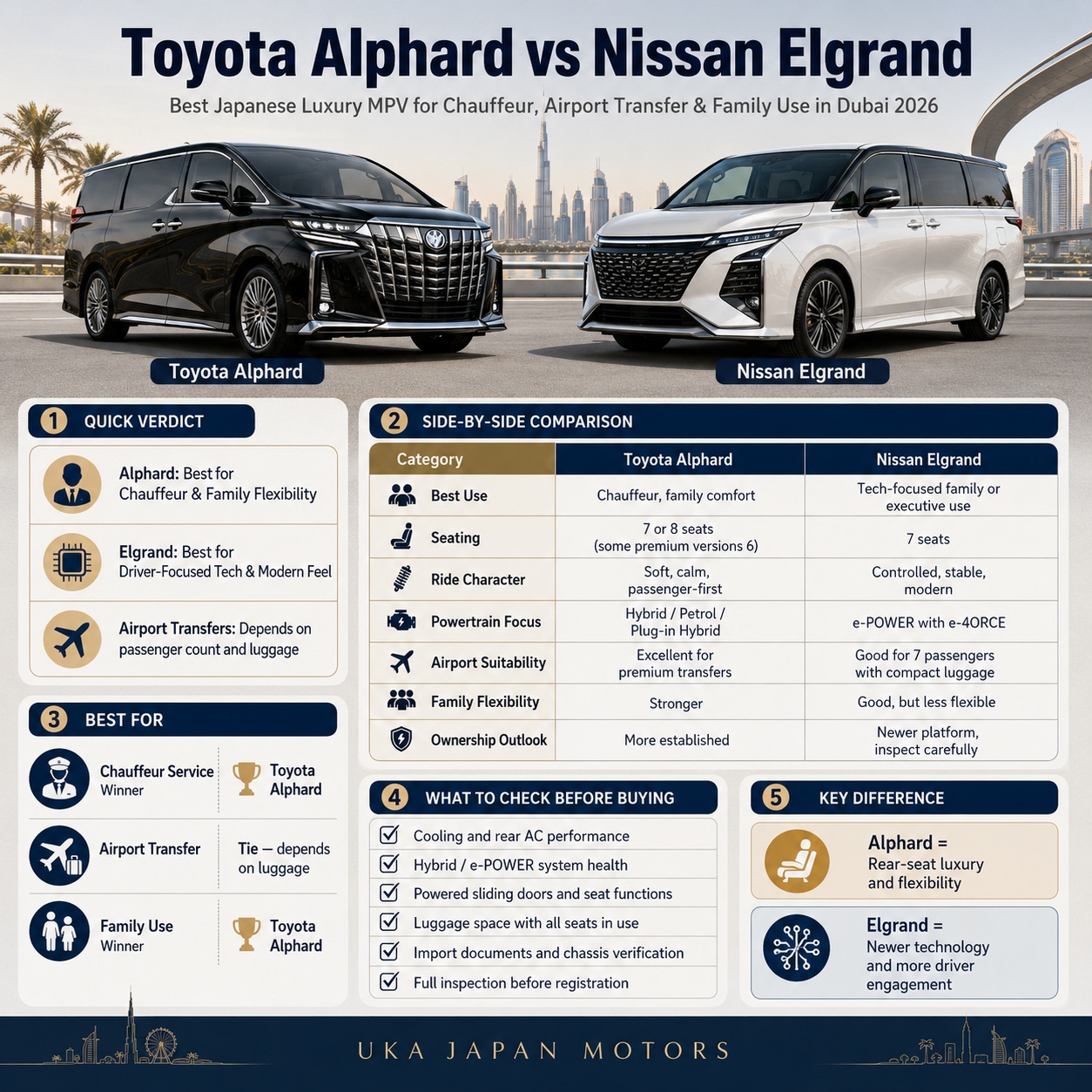
The Toyota Alphard and Nissan Elgrand are full-size Japanese luxury MPVs designed around passenger comfort rather than conventional van practicality. Both provide powered sliding doors, three-row seating, refined cabins and a commanding road presence, but they approach luxury transport differently.
The Toyota Alphard focuses strongly on rear-seat isolation, soft ride quality, easy passenger access and a formal chauffeur-oriented atmosphere. The latest Nissan Elgrand combines premium accommodation with a more driver-focused chassis, third-generation e-POWER technology, e-4ORCE electric all-wheel control and electronically managed suspension.
For Dubai buyers, the decision should not be based only on exterior design or the number of screens inside the cabin. The better vehicle depends on how it will actually be used: carrying executives between business districts, collecting passengers from the airport, transporting a family every day, or operating for long hours in dense traffic and extreme heat.
Direct Answer: Which Is Better in Dubai?
The Toyota Alphard is the stronger overall choice for established chauffeur operations, formal executive transport and buyers prioritising proven rear-seat comfort.
The new Nissan Elgrand is the more compelling option for buyers who want fresher powertrain technology, more engaging driving behaviour and a less conventional premium MPV.
For airport transfers, the answer depends heavily on passenger count and luggage. A seven-seat MPV does not automatically carry seven occupants and seven large suitcases comfortably. The latest Elgrand has been designed to carry seven occupants together with seven carry-on-size cases, according to Nissan, but full-size checked luggage still requires a realistic loading assessment.
For family ownership, the Alphard generally offers the easier decision because of its flexible seating choices, familiar hybrid system and strong focus on low-speed comfort. The Elgrand may suit families whose regular driver wants better body control and a more connected driving experience.
| Requirement | Stronger choice | Main reason |
|---|---|---|
| Formal chauffeur service | Toyota Alphard | More established executive character and rear-seat focus |
| Hotel and corporate transfers | Toyota Alphard | Refined passenger presentation and calm ride |
| Airport work with light luggage | Nissan Elgrand | Useful seven-seat and carry-on packaging |
| Driver involvement | Nissan Elgrand | e-4ORCE, selectable modes and controlled suspension |
| Family flexibility | Toyota Alphard | Broader seating configurations |
| New powertrain technology | Nissan Elgrand | Third-generation e-POWER motor-driven system |
| Quiet urban operation | Close comparison | Both prioritise noise and vibration control |
| Long-term predictability | Toyota Alphard | More mature current-generation ownership ecosystem |
This conclusion does not mean every Alphard is automatically suitable or every Elgrand is a risky choice. Condition, specification, import history, cooling performance and documentation are more important than the badge alone.
Understanding the 2026 Models Before Comparing Them
A major source of confusion is that “Nissan Elgrand” can refer to two very different vehicles in Dubai.
Older used imports are usually from the long-running E52 generation. The current 2026 model is the all-new fourth-generation Elgrand, commonly identified as the E53. Nissan officially launched the new model in July 2026, making it substantially newer than most Elgrands already circulating in the UAE.
This article compares the current Toyota Alphard with the all-new 2026 Nissan Elgrand. Buyers considering an older E52 Elgrand should not assume that its engine, transmission, cabin arrangement, safety equipment or driving behaviour matches the new model.
The current Alphard belongs to the fourth generation introduced in 2023. Toyota subsequently expanded the range with additional seating and electrified configurations, including hybrid and plug-in hybrid versions. Depending on grade, current Alphard configurations include seven- and eight-seat layouts, while certain high-level plug-in hybrid versions use six seats to create a more spacious rear compartment.
The 2026 Elgrand is configured as a seven-seat premium MPV. Nissan’s current model information highlights e-POWER propulsion, e-4ORCE control, electronically controlled shock absorbers, active noise management and premium rear accommodation.
That difference immediately establishes the central comparison:
- The Alphard provides greater variation in seating and powertrain configuration.
- The Elgrand offers a more concentrated seven-seat specification built around its latest electrified drivetrain.
Passenger Experience: The Most Important Comparison
Luxury MPVs should be judged from the second row before they are judged from the driver’s seat.
Toyota Alphard: A Rear-Seat-First Environment
The Alphard’s cabin is designed to reduce the physical effort of travelling. The floor height, sliding-door openings, powered seating functions and second-row adjustment range work together to create a private-lounge impression.
Depending on specification, second-row passengers may have individual captain’s chairs with powered reclining, adjustable ottomans, ventilation, heating and dedicated control panels. Toyota’s current owner information confirms that seven-seat variants can include ottoman-equipped second-row seats, while higher specifications provide extensive powered adjustment.
This matters in Dubai because chauffeur journeys often involve repeated short trips rather than one continuous motorway drive. Passengers enter at hotels, offices, residences and airport terminals. A luxury MPV must remain easy to board even when the passenger is wearing formal clothing, carrying a laptop bag or travelling with an older family member.
The Alphard’s strongest quality is not any single seat feature. It is the way the ride, seating position, door operation and cabin isolation feel coordinated around the passenger.
Toyota specifically developed the current Alphard to reduce road and wind noise, using low-noise tyres, additional sound-absorbing materials and aerodynamic changes around the bonnet, mirrors and pillars.
The result is especially valuable on routes that combine smooth motorway sections with expansion joints, access ramps, underground car parks and low-speed urban roads.
Nissan Elgrand: A More Technological Interpretation of Comfort
The new Elgrand is not simply attempting to copy the Alphard’s cabin formula. Nissan has added a stronger technical layer to its passenger-comfort strategy.
Its active noise-control system detects cabin sound and vibration, then generates counteracting sound to reduce both powertrain noise and road noise. Nissan also describes a zone-control function that can concentrate quietness around the rear passenger area on suitably equipped vehicles.
This approach could be particularly useful during phone calls, executive travel or family journeys with sleeping passengers. However, buyers should confirm the exact installed equipment rather than assuming every imported Elgrand has the same noise-control, infotainment or audio specification.
The Elgrand’s rear cabin feels more contemporary and architectural. Interior themes, large displays and modern materials give it a distinctive identity. Its seating still prioritises the second row, but the overall atmosphere is less traditional and more technology-led than the Alphard.
Which Cabin Is Better?
For passengers who want maximum softness, familiarity and a formal luxury environment, the Alphard has the advantage.
For passengers who appreciate advanced sound management, a newer design language and a more technical cabin character, the Elgrand is highly competitive.
For professional chauffeur use, the Alphard remains the safer all-round choice because its controls and passenger experience are easier to understand immediately. A traveller does not need to explore complex settings to appreciate the comfort.
The Elgrand may become equally convincing after correct setup, but specification differences require closer inspection.
Chauffeur Use in Dubai
A chauffeur vehicle has two customers: the person sitting in the rear and the driver responsible for delivering a smooth, consistent journey.
Passenger Priorities
A strong chauffeur MPV needs:
- Easy entry and exit
- Comfortable second-row seating
- Effective rear air conditioning
- Low cabin noise
- Smooth braking
- Controlled acceleration
- Privacy without poor outward visibility
- Sufficient space for personal bags
- Reliable door and seat mechanisms
The Alphard performs well because Toyota has intentionally reduced passenger movement during acceleration, cruising and stopping. The plug-in hybrid version includes Smooth Stop control intended to reduce the body’s pitching motion during deceleration. Toyota also states that the underfloor battery arrangement lowers the centre of gravity without removing passenger space.
Even where a buyer chooses a conventional hybrid rather than the plug-in system, the current Alphard platform has been engineered around body rigidity, reduced vibration and controlled passenger movement.
The Elgrand addresses the same objective through electric-motor response, e-4ORCE and intelligent dynamic suspension. Nissan says the system combines front and rear motors with electronically controlled dampers to balance driver enjoyment and passenger comfort.
Driver Priorities
Dubai chauffeur drivers may spend long periods moving between airport terminals, central business districts, hotels, exhibition venues and residential areas. Driver comfort therefore affects passenger service.
The Alphard’s driving position is upright and visibility is generally suitable for a vehicle of this size. Controls prioritise ease rather than sportiness. The hybrid system is smooth in traffic, although rapid acceleration can make the engine more audible.
The Elgrand is likely to appeal more strongly to a driver who wants greater chassis control. Electric motor propulsion provides immediate response without conventional gear changes, while e-4ORCE manages front and rear motor output. Nissan also offers multiple drive modes that alter powertrain and suspension characteristics.
On wide, fast roads, that extra control may make the Elgrand feel more stable and less van-like. It can also help the driver maintain a smoother line through interchanges and sweeping access roads.
However, technology does not replace chauffeur technique. Sudden accelerator inputs, late braking and aggressive lane changes will still disturb second-row passengers in either vehicle.
Chauffeur Verdict
The Alphard is better for operators who want a recognised, passenger-first executive MPV with predictable behaviour.
The Elgrand suits operators prepared to adopt a newly launched platform and who value driver confidence as much as traditional rear-seat softness.
Businesses should also separate vehicle suitability from operating permission. In Dubai, commercial luxury-passenger transport is a regulated activity. RTA services for registering vehicles in this category are intended for licensed companies holding a valid operating contract. A privately registered MPV should not automatically be treated as authorised for commercial passenger service.
Airport Transfer Use: Seats Are Not the Same as Capacity
Airport transport is where many luxury MPV comparisons become unrealistic.
A seven-seat vehicle may carry seven people. It may also carry several cases. It may not carry seven adults, seven large cases, cabin bags, a child seat and a pushchair at the same time without compromising visibility or passenger comfort.
Toyota Alphard Luggage Considerations
The Alphard’s third row can be folded or moved to release additional luggage space, depending on configuration. When all three rows are occupied, the rear luggage area becomes more limited.
A six-seat or seven-seat chauffeur configuration works well when transporting:
- Two rear passengers with several bags
- Four passengers with moderate luggage
- A family using part of the third row
- Executives with cabin cases and laptop bags
It is less suitable when every seat is occupied and every passenger has large checked luggage.
An eight-seat Alphard provides more seating flexibility, but the centre seating arrangement is usually less suitable for high-level chauffeur work than individual second-row captain’s chairs.
Nissan Elgrand Luggage Considerations
Nissan has specifically stated that the new Elgrand can accommodate seven occupants and seven carry-on-size suitcases. That is a useful indication of packaging efficiency, especially for hotel and airport work involving compact luggage.
The phrase carry-on-size is important. It should not be interpreted as seven full-size suitcases.
The Elgrand’s seven-seat-only approach creates a clear passenger layout. However, operators must still perform an actual loading check using the luggage profile common to their customers.
Practical Airport Loading Test
Before selecting either model for airport transfers, load the vehicle with realistic items:
- Place the intended number of passengers in all occupied seats.
- Load the expected mix of large cases, cabin cases and personal bags.
- Confirm the tailgate closes without pressing against the luggage.
- Ensure luggage cannot move forward during emergency braking.
- Check that the driver retains rearward visibility.
- Test suspension height and tyre loading.
- Run the rear air conditioning with the vehicle fully occupied.
- Confirm passengers can leave without unloading the entire luggage area.
This practical test is more meaningful than a brochure’s seating figure.
Airport Transfer Verdict
The Alphard is preferable for premium transfers involving fewer passengers, formal rear-seat comfort and flexible seating choices.
The Elgrand is attractive for seven-passenger trips with compact luggage, but the operator should verify how its quoted carry-on capacity translates to real Dubai airport usage.
For large families or groups carrying substantial luggage, neither vehicle should be overloaded merely to avoid using a second vehicle.
Family Use in Dubai
A family MPV has different priorities from a chauffeur vehicle. Children, groceries, school bags, sports equipment, elderly relatives and child seats change how the cabin is used.
Why the Alphard Works Well for Families
The Alphard’s availability in seven- and eight-seat arrangements is a major advantage. Seven-seat models provide a clear aisle between the second-row captain’s chairs. Eight-seat models give families an additional seating position and more flexibility when the centre row is frequently occupied by children.
Toyota’s current manual information confirms separate second-row arrangements for seven- and eight-seat vehicles and includes specific child-restraint guidance by seating position.
Powered sliding doors are valuable in tight residential parking spaces because children can board without swinging a conventional door into another vehicle. They also make it easier to assist an older relative.
The Alphard may be less suitable for a family that regularly needs a large permanent cargo area while keeping every seat available. Like most luxury MPVs, its generous passenger cabin requires compromises when the third row and luggage area are used simultaneously.
Why the Elgrand Works Well for Families
The Elgrand’s seven-seat layout should work well for families that prefer individual second-row seats and a walk-through aisle.
Its e-POWER drivetrain may also be appealing in daily urban driving. The petrol engine generates electricity, while the wheels are driven by electric motors. This produces smooth, immediate response without a conventional multi-speed transmission connecting the engine directly to the wheels.
For school runs and congested routes, this should create a calm low-speed experience. The electronically controlled suspension and selectable modes may also allow the driver to choose a more comfortable setup when carrying children.
The new Elgrand’s disadvantage is its recent introduction. In the UAE, very early imported examples should be assessed for software compatibility, replacement-part identification, diagnostic support and workshop familiarity.
That does not mean the model is unsuitable. It means buyers should not assume that knowledge developed around the older E52 Elgrand automatically applies to the E53.
Family Verdict
Choose the Alphard when seating flexibility, easier ownership planning and a familiar family-oriented cabin are the priority.
Choose the Elgrand when seven seats are sufficient and the regular driver values modern electric-motor response, controlled handling and a distinctive cabin.
Powertrain Comparison in UAE Conditions
Toyota Alphard Hybrid
The Alphard’s series-parallel hybrid system can propel the vehicle through the engine, electric motor or a combination of both. The current 2.5-litre hybrid system produces a stated maximum system output of 184 kW in the specification presented by Toyota at the fourth-generation launch.
Its main strengths in Dubai are smooth low-speed movement, established hybrid behaviour and reduced engine operation during suitable driving conditions.
The system still depends on the condition of the traction battery, inverter cooling circuit, engine cooling system and air-conditioning system. A hybrid badge should never be treated as proof that these systems are healthy.
Toyota Alphard Petrol
Certain Alphard grades use a naturally aspirated 2.5-litre petrol engine with a continuously variable transmission. This is a mechanically more conventional alternative for buyers who do not require an electrified drivetrain.
It may suit lower annual use or buyers prioritising simpler inspection familiarity. However, a fully occupied luxury MPV places significant demand on any naturally aspirated engine, particularly during repeated acceleration and prolonged air-conditioning use.
Toyota Alphard Plug-In Hybrid
The Alphard plug-in hybrid combines a 2.5-litre engine, larger battery, electric drive and E-Four. Toyota states that it offers a battery-based driving range of 73 kilometres under its specified test cycle and a maximum system output of 225 kW.
For a chauffeur operation with reliable charging at a depot or residence, the ability to complete suitable urban journeys using stored electrical energy may be useful. Yet a plug-in hybrid only delivers its intended operating pattern when it is charged consistently.
Buyers must also verify charging compatibility, cable specification, onboard charger condition and safe charging arrangements. A damaged or unsuitable imported charging system should not be adapted casually.
Nissan Elgrand e-POWER
The 2026 Elgrand uses Nissan’s third-generation e-POWER system. In this layout, the petrol engine generates electricity and the electric motors drive the wheels. Nissan describes the new Elgrand system as combining two high-output motors with e-4ORCE.
The practical benefit is EV-like response without requiring routine external charging. The engine may still be heard when generating power, particularly during high demand, but Nissan has used active noise control and additional refinement measures to reduce its cabin presence.
The system is technologically attractive for Dubai traffic, where smooth initial response and regenerative deceleration can reduce the need for repeated transmission shifting.
The inspection concern is its newness. Diagnostic equipment, technical information and model-specific replacement components should be verified before the vehicle becomes dependent transport for a family or company.
Ride and Handling on Dubai Roads
Dubai roads expose an MPV to several different conditions during one journey:
- Long, smooth motorway sections
- Multi-lane interchanges
- Short expansion joints
- Polished parking surfaces
- Steep ramps
- Speed-calming features
- Uneven access roads
- Stop-start congestion
Alphard Behaviour
The Alphard generally filters smaller road disturbances effectively and keeps the cabin calm. Its steering is tuned more for easy placement than detailed feedback.
That approach suits rear passengers, but the vehicle’s size and soft responses require the driver to plan lane changes carefully. Abrupt steering can create noticeable passenger movement because occupants sit high and far from the vehicle’s centre.
E-Four versions can provide additional traction management, but the Alphard remains a road-focused luxury MPV rather than a vehicle intended for loose sand or rough terrain.
Elgrand Behaviour
The Elgrand’s combination of e-4ORCE and electronically controlled suspension gives it the stronger technical basis for balancing ride comfort with body control. Nissan says the system coordinates the powertrain, four-wheel control and suspension across selectable drive modes.
This may help it remain composed through long curves and motorway transitions without relying on excessively firm suspension.
The Elgrand is still a large, heavy passenger vehicle. Its sophisticated control systems should not encourage faster cornering when carrying passengers. The goal is stability and reduced movement, not sporting performance.
Air Conditioning and Heat Management
Air-conditioning performance is not a secondary comfort feature in the UAE. It is part of the vehicle’s essential operating condition.
A proper inspection should assess:
- Front and rear vent temperature
- Cooling speed after heat soak
- Blower operation at every speed
- Airflow from roof or side vents
- Compressor noise
- Condenser cleanliness
- Cooling-fan operation
- Refrigerant leakage
- Cabin-filter condition
- Temperature consistency at idle
- Cooling with all seats occupied
The Alphard offers multi-zone climate control and specification-dependent ventilation for front and second-row seats. Toyota lists seat ventilation on selected grades, which can materially improve comfort during long journeys.
The Elgrand also offers a premium climate environment, but the exact configuration must be confirmed from the vehicle’s grade and equipment list.
On imported vehicles, buyers should inspect the air-conditioning system under UAE ambient conditions rather than accepting a cold start inside a shaded showroom. A vehicle can initially blow cool air yet lose performance after extended idling or when driven with all rear vents operating.
Cooling-system inspection is equally important. Radiators, fans, hoses, coolant condition and hybrid or electric-component cooling circuits must be checked for leakage, contamination and repair history.
Safety and Driver Assistance
The Alphard is available with Toyota Safety Sense and higher-level parking and congestion-support features, depending on grade. Toyota’s fourth-generation launch information includes proactive driving assistance, advanced parking support and traffic-congestion assistance.
The Elgrand provides Nissan’s 360-degree safety-assistance suite, with grade-dependent equipment including advanced driver-support functions. Buyers should verify the installed sensors, cameras and system status individually rather than relying on a dashboard icon or translated listing.
Imported driver-assistance systems require special attention because:
- Navigation-linked functions may not operate fully.
- Camera calibration may be affected by windscreen replacement.
- Radar sensors may have been disturbed during bumper repair.
- Warning messages may appear only in Japanese.
- Connected services may not be supported locally.
- Remote applications may depend on regional accounts.
- Replacement components may require programming.
A pre-purchase road test should confirm adaptive cruise operation, lane-support status, parking cameras, blind-spot warnings and emergency-braking indicators where fitted.
Assistance systems do not compensate for poor tyre condition, weak brakes or accident damage.
Import Inspection and Registration in Dubai
A Japanese luxury MPV should be treated as an imported vehicle first and a luxury vehicle second.
For Dubai registration, RTA identifies documentation that can include Emirates ID, an electronic customs certificate and the sale-and-purchase agreement. Where conformity with Gulf specifications is not indicated on the customs card, an additional conformity document may be required from the relevant UAE authority. The registration process can also require technical inspection before plates and the ownership certificate are issued.
Passing a registration inspection should not be confused with completing a comprehensive pre-purchase assessment. Registration testing establishes roadworthiness against the relevant requirements. It may not determine the long-term health of every powered seat, sliding-door motor, battery module, infotainment function or advanced driver-assistance component.
Essential Alphard and Elgrand Inspection Checklist
1. Identity and Documentation
Confirm:
- Chassis number matches every document.
- Model code matches the advertised generation.
- Manufacturing date is consistent.
- Customs documentation is complete.
- Export and import records are available.
- Seating capacity matches registration documentation.
- Major modifications are declared.
- Commercial-use eligibility is verified separately where applicable.
The chassis code is especially important for the Elgrand. An E52 and E53 are substantially different vehicles despite sharing the same model name.
2. Structural Condition
Inspect:
- Chassis rails
- Pillars
- Floor structure
- Sliding-door apertures
- Roof edges
- Rear body panel
- Suspension mounting points
- Underbody seams
- Signs of cutting, welding or pulling
Large sliding-door openings make correct structural repair essential. Poor alignment can also cause wind noise, water entry and repeated door-mechanism faults.
3. Hybrid and Electric Systems
For the Alphard hybrid or plug-in hybrid, inspect:
- Traction-battery health
- State-of-charge behaviour
- Inverter cooling
- Battery cooling ducts
- Warning-history records
- High-voltage insulation status
- Regenerative braking
- Charging operation on plug-in versions
For the Elgrand e-POWER, inspect:
- Generator-engine behaviour
- Front and rear motor systems
- Battery condition
- e-4ORCE warnings
- Regenerative braking
- Cooling circuits
- Power-electronics fault history
4. Sliding Doors and Tailgate
Operate each door repeatedly from:
- Exterior handles
- Interior handles
- Driver controls
- Remote key
- Kick or hands-free sensor, where equipped
Listen for cable strain, roller noise and latch hesitation. Test anti-pinch protection and confirm the doors stay aligned on slopes.
5. Seats and Cabin Electronics
Luxury seating mechanisms can be complex. Test:
- Forward and rearward movement
- Reclining
- Ottoman extension
- Memory functions
- Heating and ventilation
- Massage or relaxation functions
- Control panels
- USB and power outlets
- Rear screens
- Audio
- Sunshades
- Interior lighting
A seat that moves once during inspection may still have an intermittent switch, weak motor or damaged rail.
6. Diagnostic Scan
Use equipment capable of reading all available modules, not only the engine computer.
Check stored, pending and historical faults in:
- Powertrain
- Hybrid system
- Battery control
- Body control
- Sliding doors
- Air conditioning
- Suspension
- Steering
- Braking
- Cameras and radar
- Seat control
- Infotainment
Clearing warning lights before inspection does not repair the fault that created them.
Long-Term Ownership
Toyota Alphard Ownership Outlook
The Alphard’s advantage is maturity. The current generation has been available since 2023, and Toyota’s hybrid architecture is familiar to many specialist workshops.
That does not make every part readily interchangeable. Body panels, premium seating equipment, lighting assemblies, control modules and model-specific cabin electronics still require correct identification.
The most sensible Alphard is not necessarily the version with the longest equipment list. A slightly simpler grade with complete records, correct cooling performance and undamaged electrical systems may provide more dependable ownership.
Nissan Elgrand Ownership Outlook
The all-new Elgrand’s technology is one of its main attractions, but it also introduces uncertainty for early UAE adopters.
Before purchase, establish:
- Who can diagnose the third-generation e-POWER system?
- Who can calibrate its cameras and sensors?
- Are e-4ORCE components identifiable by chassis number?
- Can infotainment language and regional functions be managed correctly?
- Are body and cabin components obtainable?
- Is technical documentation accessible to the servicing workshop?
Because the E53 has only just entered production, buyers should not accept statements such as “Elgrand parts are available” without confirming that the statement applies to the new generation rather than the older E52.
Tyres and Alignment
Both vehicles place substantial demands on tyres because of their mass, high centre of gravity and passenger-carrying role.
Inspect:
- Manufacturing dates
- Correct size and load rating
- Uneven shoulder wear
- Sidewall cracking
- Previous puncture repairs
- Wheel damage
- Alignment
- Spare tyre or repair system
Tyre comfort should not come at the expense of load capability. Incorrectly rated tyres can affect braking, stability and heat resistance.
Who Should Choose the Toyota Alphard?
The Alphard is most suitable for:
- Chauffeur operators prioritising rear-seat comfort
- Corporate and hotel transport
- Families needing seven- or eight-seat flexibility
- Buyers who prefer a mature hybrid platform
- Owners who value a soft, isolated ride
- Passengers who frequently use powered ottoman seating
- Buyers seeking a formal luxury-MPV appearance
It may be less suitable for:
- Drivers wanting strongly responsive handling
- Buyers needing permanent cargo space with every seat occupied
- Owners who prefer a compact vehicle for narrow parking spaces
- Buyers unwilling to maintain complex powered cabin equipment
- Users expecting an MPV to perform as an off-road vehicle
Who Should Choose the Nissan Elgrand?
The new Elgrand is most suitable for:
- Buyers interested in the latest Japanese MPV technology
- Drivers who want better body control
- Families satisfied with seven seats
- Operators carrying passengers with compact luggage
- Owners attracted to e-POWER without routine plug-in charging
- Buyers wanting an alternative premium-MPV design
- Users who appreciate configurable driving modes
It may be less suitable for:
- Buyers wanting an established local knowledge base immediately
- Operators unable to tolerate early-model parts uncertainty
- Families requiring an eight-seat configuration
- Buyers who cannot confirm diagnostic support
- Owners assuming older Elgrand servicing knowledge applies fully to the E53
Toyota Alphard vs Nissan Elgrand: Final Use-Case Comparison
| Area | Toyota Alphard | Nissan Elgrand |
|---|---|---|
| Basic configuration | Six-, seven- or eight-seat options depending on grade | Seven-seat current-generation layout |
| Main luxury focus | Rear-seat isolation and relaxation | Passenger comfort combined with driver engagement |
| Hybrid approach | Series-parallel hybrid, with petrol and plug-in options in the wider range | e-POWER with electric motors driving the wheels |
| All-wheel system | E-Four on selected variants | e-4ORCE |
| Ride character | Soft, calm and passenger-led | Controlled, stable and technology-led |
| Chauffeur suitability | Excellent | Very good, subject to specification and support |
| Airport suitability | Best with controlled passenger and luggage count | Strong for seven occupants with compact cases |
| Family flexibility | Stronger | Good, but limited to seven seats |
| Ownership familiarity | More established | Newly introduced platform |
| Main inspection concern | Hybrid health and complex cabin equipment | New e-POWER, e-4ORCE and electronics support |
Frequently Asked Questions
1. Is the Toyota Alphard better than the Nissan Elgrand for chauffeur use?
For most established chauffeur operations, the Alphard is the stronger choice because its ride, rear seating and cabin presentation are closely aligned with formal passenger transport. The new Elgrand remains competitive and may provide better driver satisfaction, but its recent launch requires additional due diligence regarding parts and diagnostics.
2. Which MPV is better for Dubai airport transfers?
The Alphard works particularly well for smaller premium groups with several bags. The new Elgrand has useful seven-passenger and carry-on packaging, but neither model should be selected solely from its seat count. Actual luggage must be loaded before the vehicle is committed to airport work.
3. Can seven passengers and seven large suitcases fit in an Elgrand?
Nissan states that the new Elgrand can carry seven occupants and seven carry-on-size cases. This does not confirm capacity for seven large checked cases.
4. Is the Alphard available with eight seats?
Yes. Current Alphard configurations include seven- and eight-seat layouts depending on grade and powertrain. Some premium plug-in hybrid versions use a six-seat arrangement.
5. Does the new Elgrand need to be plugged in?
No. Its e-POWER system uses a petrol engine to generate electricity, while electric motors propel the vehicle. It does not operate like a plug-in hybrid.
6. Is the Alphard plug-in hybrid suitable for chauffeur work?
It can suit an operation with dependable charging and predictable daily routes. Toyota developed the system to provide extended electric driving capability while retaining the engine for longer journeys. Battery condition, charging compatibility and cooling performance must be verified before import or registration.
7. Which vehicle is more comfortable in the second row?
The Alphard generally provides the more traditional limousine-like experience, particularly in grades with powered ottomans and extensive adjustment. The Elgrand counters with advanced noise control, modern seating and a more technical ambience.
8. Which vehicle is better to drive?
The Elgrand is likely to feel more responsive and controlled because its electric motors, e-4ORCE and electronically controlled suspension are integrated around driver and passenger comfort. The Alphard is easier and more relaxed but places less emphasis on driver involvement.
9. Is an RTA inspection enough before buying an imported MPV?
No. Registration inspection and pre-purchase inspection serve different purposes. Buyers should independently assess structural condition, cooling systems, hybrid components, electronics, powered doors, seating mechanisms and diagnostic history.
10. Can a privately registered Alphard or Elgrand be used commercially?
Commercial passenger transport is regulated. Dubai luxury-passenger transport services and vehicle registration processes apply to appropriately licensed operators with valid operating arrangements. Buyers should confirm the applicable RTA permissions before assigning a vehicle to commercial chauffeur or airport work.
11. What should be checked on a Japanese-import infotainment system?
Check menu language, radio operation, navigation usability, Bluetooth, smartphone integration, rear screens, camera views, connected services and software warning messages. Confirm that modifications have not damaged factory wiring or disabled safety-related functions.
12. Is the older E52 Elgrand the same as the 2026 Elgrand?
No. The current 2026 vehicle is an all-new generation with e-POWER, e-4ORCE and different cabin and suspension technology. Older E52 inspection guidance should not be applied without recognising the mechanical and electronic differences.
UKA Japan Motors’ Role in the Selection Process
UKA Japan Motors’ role is to help buyers separate appearance and equipment from actual vehicle condition.
For an Alphard or Elgrand, inspection guidance should cover more than paintwork and mileage. The vehicle’s generation, chassis identity, seating specification, structural integrity, cooling performance, electrical operation and documentation must be reviewed together.
A suitable process includes confirming the chassis code, reviewing the available history, examining the structure, checking hybrid or e-POWER systems, operating every powered door and seat, scanning control modules and assessing whether the specification matches the buyer’s intended use in the UAE.
For chauffeur and airport operators, the evaluation should also include realistic passenger loading, luggage testing, rear air-conditioning performance and confirmation of the applicable commercial-use requirements.
This inspection-focused approach does not guarantee that one model is universally better. It helps identify whether a particular vehicle is the right example of that model.
Conclusion
The Toyota Alphard remains the benchmark choice for buyers who define a luxury MPV primarily through rear-seat comfort, easy access, flexible seating and a calm chauffeur-oriented experience. It is particularly well suited to corporate transport, hotel transfers and families wanting a more established ownership path.
The all-new Nissan Elgrand is a serious alternative rather than a secondary choice. Its third-generation e-POWER system, e-4ORCE control, active noise management and intelligent suspension give it a more technical and driver-aware character. It may be the better choice for an owner who wants premium accommodation without sacrificing responsiveness and body control.
For chauffeur work, the Alphard wins through consistency and passenger focus. For driver engagement, the Elgrand has the stronger proposition. For airport use, luggage testing is more important than seat count. For families, the Alphard offers greater configuration flexibility, while the Elgrand offers a fresh seven-seat experience.
The final decision should be made only after confirming the exact grade, generation, documentation, cooling performance, structural condition and diagnostic status of the individual vehicle.
Contact UKA Japan Motors for availability and inspection guidance.