


Electric vehicles have moved from being an unusual sight to becoming a serious part of Kenya’s transport discussion. Interest has grown around electric motorcycles, buses, commercial fleets and private passenger cars, while government policy has increasingly recognised electric mobility as part of the country’s transport and energy strategy.
For buyers considering a used electric vehicle imported from Japan, however, the central question is not simply whether import taxes are lower. It is whether the vehicle will remain practical after it has passed through customs, registration, charging installation, battery inspection and daily use in Kenya.
This distinction matters in 2026 because the tax position is changing. Kenya already applies a lower excise-duty category to fully electric vehicles, and in May 2026 the President announced that the first 100,000 electric vehicles imported for public or private use would be duty-free. The announcement is significant, but buyers should still confirm how the measure is being implemented through customs before assuming that every imported used EV automatically qualifies.
At the same time, charging access remains uneven, technical knowledge is still developing and a used EV’s remaining battery condition can matter more than its odometer reading. These practical factors differ between Nairobi and Mombasa.
Direct Answer: Are Lower Import Taxes Enough?
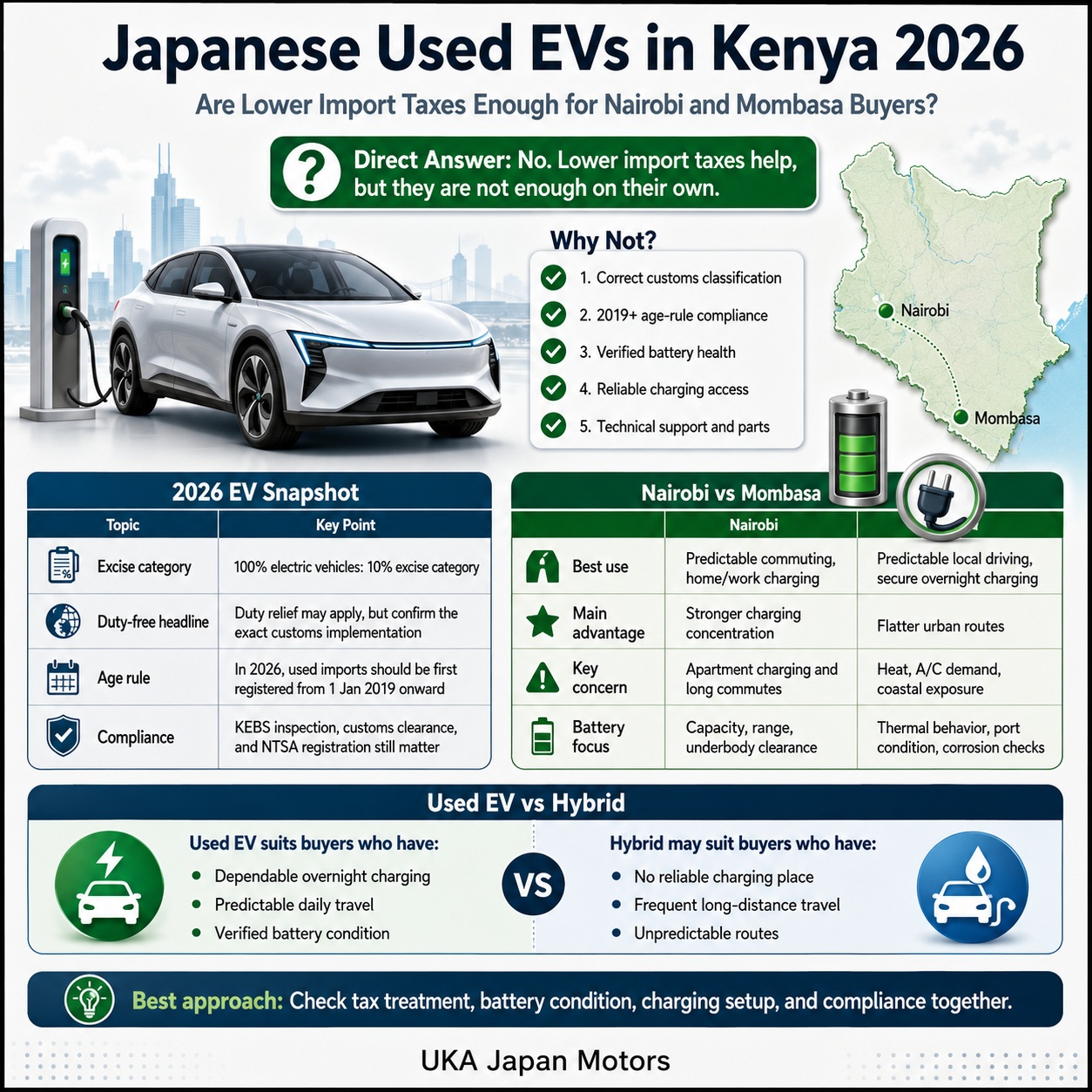
No. Lower import taxes can improve the entry conditions for a Japanese used EV, but tax treatment alone does not establish whether the vehicle is suitable for a particular Kenyan owner.
A sound decision in 2026 depends on five connected questions:
- Has the vehicle been correctly classified under the applicable customs rules?
- Does it satisfy Kenya’s age, right-hand-drive and inspection requirements?
- What is the verified condition of the traction battery?
- Can the owner charge reliably at home, work or another regular location?
- Is technical support available for the model, battery system and charging connector?
A buyer who receives favourable tax treatment but imports an EV with reduced battery capacity, incompatible charging equipment or unclear repair history may still face an unsuitable ownership experience. In contrast, a properly inspected EV with dependable overnight charging can work well even when the owner rarely uses public charging.
The appropriate way to assess a used EV is therefore to treat tax, battery condition, charging access and compliance as one ownership system.
What Has Changed for Electric Vehicles in Kenya in 2026?
Kenya launched its National Electric Mobility Policy in February 2026. The policy is intended to coordinate charging infrastructure, technical standards, local assembly, regulation, skills development and fiscal incentives. Government implementation work was still continuing through technical working groups in July 2026, showing that the policy environment is active rather than fully settled.
The policy launch also introduced green reflective number plates for fully electric vehicles. This gives battery-electric vehicles a clearer registration identity within Kenya’s transport system.
The most widely discussed 2026 measure came in May, when the President declared that the first 100,000 electric vehicles imported into Kenya would be duty-free. The statement covered both public-service and private vehicles.
That announcement should not be confused with a complete removal of every tax, levy or administrative requirement.
The phrase “duty-free” requires an implementing framework that explains matters such as:
- The exact commencement date
- Whether the relief applies only to import duty
- Whether used passenger EVs are included without additional conditions
- How the 100,000-vehicle allocation will be counted
- Which tariff classifications qualify
- What documentation must be entered in the customs system
- Whether the relief applies automatically or requires prior approval
Until those details are confirmed through the live customs process, a buyer should not commit to an import on the assumption that the presidential declaration has removed every tax layer.
A policy statement communicates the intended direction. A customs entry determines how a particular vehicle is actually treated.
Understanding the Existing EV Tax Advantage
Kenya’s Excise Duty Act lists 100 per cent electric vehicles under specified tariff classifications at an excise-duty rate of 10 per cent. Conventional passenger vehicles fall into other excise categories depending on their engine capacity and classification.
This lower excise category is important, but excise duty is only one component of vehicle import taxation.
KRA’s motor-vehicle import guidance lists the main tax layers as:
- Import duty
- Excise duty
- Value Added Tax
- Import Declaration Fee
- Railway Development Levy
The calculations are based on customs value, with some taxes applied after earlier duties have been included in the taxable base.
This means a lower excise percentage does not automatically produce proportionately lower total import taxation.
Why Customs Value Still Matters
Used vehicle taxation is not determined only by the amount shown on an overseas invoice. KRA uses customs valuation procedures and a Current Retail Selling Price framework when assessing imported vehicles.
The Ministry of Transport’s electric-vehicle taxation study found that an EV’s lower excise rate could be offset by a comparatively high customs value. Its analysis showed that tax treatment depends on both the applicable rate and the valuation assigned to the vehicle.
For Japanese used EVs, this is especially relevant where:
- A model has limited representation in KRA’s valuation database
- Different battery capacities exist under the same model name
- Trim levels vary significantly
- The vehicle has technology that is not reflected clearly in older valuation records
- The declared model description does not match its tariff classification
- A battery-electric version is confused with a hybrid or plug-in hybrid
A Nissan model name, for example, is not enough by itself. The chassis code, propulsion type, seating configuration, body type and exact variant must match the customs declaration.
Current Public Information Requires Careful Verification
There is an important inconsistency within publicly accessible KRA information.
KRA’s current motor-vehicle procedures page lists import duty at 25 per cent. However, KRA’s June 2025 clarification on the revised Current Retail Selling Price list stated that the motor-vehicle import-duty rate had increased from 25 per cent to 35 per cent in 2025.
This difference is precisely why buyers should request a vehicle-specific customs assessment rather than relying on a general online calculator or an older tax table.
The live tariff classification, customs entry and any operational 2026 EV exemption should be confirmed before the vehicle is purchased and shipped.
Duty-Free Does Not Automatically Mean Tax-Free
The 100,000-vehicle announcement may substantially change the import position once fully operational, but buyers should avoid interpreting the words “duty-free” as meaning that no government charges or compliance obligations apply.
Import duty, excise duty, VAT, the Import Declaration Fee and the Railway Development Levy are legally distinct elements. An exemption from one does not automatically remove the others unless the implementing law or notice says so.
The same principle applies to registration, inspection, port handling and electrical installation. Even where an EV qualifies for favourable customs treatment, it must still meet KEBS requirements, complete customs clearance and be registered through NTSA.
A responsible importer should obtain written confirmation covering:
- The vehicle’s tariff code
- The recognised propulsion category
- The applicable customs value
- The import-duty position
- The excise-duty position
- VAT treatment
- Applicable levies
- Eligibility under any 2026 EV quota or exemption
- Supporting documents required for the customs entry
Tax treatment should be confirmed against the exact chassis rather than against a general description such as “electric car”.
Kenya’s 2026 Age Rule for Japanese Used EVs
Kenya’s eight-year rule continues to apply to used electric vehicles. An EV is not exempt from the age limit simply because it has no combustion engine.
For 2026, only right-hand-drive used vehicles first registered from 1 January 2019 onwards are eligible under the normal used-vehicle import framework. Vehicles first registered in 2018 or earlier fall outside the permitted age window.
This has several consequences for the Japanese used-EV market.
First, many early-generation electric cars are no longer eligible for normal importation. Some of these older vehicles may appear attractive because they are widely available, but they should not be considered for a 2026 Kenyan import if their first-registration date is outside the permitted period.
Second, buyers must check the year of first registration rather than relying only on the model year, auction listing year or manufacturing date.
Third, shipping timing matters. A vehicle must remain compliant when it arrives for importation. A unit near the end of the eligible age window requires careful planning because delays can push it into the following year’s cut-off.
For a 2019 EV imported late in 2026, the arrival schedule deserves particular attention because the eligible first-registration year normally advances when the next calendar year begins.
Import Inspection and Documentation
A Japanese used EV must follow Kenya’s established vehicle import process.
KEBS requires imported products to comply with relevant Kenyan standards, and used vehicles are normally subjected to pre-export inspection through an appointed inspection agent. Non-compliant imports can be rejected.
KRA lists key supporting documents for motor-vehicle importation, including:
- Original commercial invoice
- Original cancelled foreign logbook or registration document
- Original bill of lading
- Pre-shipment inspection or roadworthiness certificate
- Importer’s KRA PIN documentation
Additional clearance records may be required depending on the customs entry and shipment.
The vehicle should also have consistent information across all documents. The chassis number, model, propulsion type, year of first registration, body configuration and ownership details should agree.
Discrepancies are particularly risky with EVs because generic descriptions may not distinguish correctly between:
- A battery-electric vehicle
- A conventional hybrid
- A plug-in hybrid
- A range-extended electric vehicle
- An electric commercial van
- An electric passenger car
Only a fully battery-electric vehicle classified under the relevant electric tariff category should be expected to receive the tax treatment assigned to 100 per cent electric vehicles.
What Normal Roadworthiness Inspection May Not Tell You
Passing a pre-export roadworthiness inspection is essential, but it should not be treated as a complete battery-condition assessment.
Kenyan EV standards cover areas such as rechargeable energy-storage safety, electrical safety, protection against failure and post-crash electrical safety. These standards support conformity and safe operation.
However, a vehicle can be roadworthy while still having materially reduced usable battery capacity.
A normal inspection may establish that the vehicle can operate safely at the time of examination. It does not necessarily tell the buyer:
- How much original battery capacity remains
- Whether all battery modules are ageing evenly
- Whether the vehicle has suffered repeated high-temperature exposure
- Whether it has been stored for long periods at an unsuitable state of charge
- Whether the battery has experienced abnormal rapid charging
- Whether an earlier collision affected the battery enclosure
- Whether a fault has been temporarily cleared before inspection
- How the range will change under Nairobi or Mombasa use
For a used EV, roadworthiness and battery health should therefore be treated as separate inspection questions.
The Battery Is the Main Ownership Test
A used EV’s traction battery is not equivalent to a fuel tank. A fuel tank generally retains the same storage volume throughout the vehicle’s life. A lithium-ion battery gradually loses usable capacity as it ages and cycles.
This means two vehicles of the same model, year and indicated mileage can provide noticeably different real-world range.
Minimum Battery Information to Obtain
Before shipment, the inspection report should establish as much of the following as the model permits:
1. State of Health
State of health estimates remaining capacity relative to the battery’s original capacity. It should be read through an appropriate diagnostic system rather than inferred only from the dashboard range estimate.
The dashboard range can change according to recent driving behaviour, air-conditioning use and terrain. It is not a substitute for diagnostic data.
2. Individual Cell or Module Balance
A battery may show an acceptable overall capacity figure while one group of cells is weaker than the rest. Excessive voltage difference between cell groups can cause rapid range loss under acceleration or at a low state of charge.
Cell balance should ideally be checked at more than one battery level and, where possible, under load.
3. High-Voltage Fault Codes
The scan should include the battery-management system, inverter, onboard charger, electric motor controller and insulation-monitoring system.
Recently erased codes, incomplete readiness data or communication faults should be investigated.
4. Battery Enclosure Condition
The underbody battery case should be examined for:
- Impact marks
- Distortion
- Scraping
- Incorrect lifting damage
- Corrosion
- Missing fasteners
- Damaged seals
- Signs of water entry
- Previous repair or removal
This is important for both Nairobi and Mombasa because speed humps, uneven road sections and incorrect workshop lifting can damage a low-mounted battery enclosure.
5. Charging Performance
The vehicle should be tested through its normal AC charging inlet. Where it supports DC rapid charging, that inlet should also be checked with compatible equipment.
A successful plug connection does not by itself prove that the vehicle charges correctly. The test should confirm stable charging, expected communication, absence of error messages and correct operation of the charge-locking system.
6. Battery Temperature Data
Battery-temperature sensors should produce believable and consistent readings. Abnormal temperature differences can indicate sensor faults, cooling problems or internal resistance variation.
7. Previous Battery Replacement or Repair
A replacement battery is not automatically a concern, but its identity and condition should be documented. The report should state whether the battery is original, replaced as a complete assembly or repaired at module level.
Unrecorded module replacement can create imbalance when cells of different age or condition are mixed.
Nairobi Ownership: Where a Used EV Can Work Well
Nairobi is currently Kenya’s strongest environment for private EV use, mainly because charging activity and technical interest are more concentrated there. The Ministry of Roads and Transport acknowledged in 2026 that charging infrastructure remained concentrated around Nairobi and needed to expand to other locations.
Kenya Power data also shows Nairobi leading electricity use associated with e-mobility.
That does not mean every Nairobi buyer is ready for an EV.
Nairobi Conditions That Suit an EV
A used EV can suit an owner who:
- Has an assigned parking space
- Can install a dedicated charging circuit
- Travels a reasonably predictable daily route
- Returns regularly to the same charging location
- Can complete most charging overnight
- Has access to a qualified EV technician
- Selects a battery with adequate verified remaining capacity
- Does not depend on unpredictable long-distance travel every week
Stop-and-go traffic can suit regenerative braking because the motor recovers part of the vehicle’s kinetic energy during deceleration. The EV also avoids prolonged engine idling during congestion.
However, congestion still consumes energy through climate control, vehicle electronics and repeated acceleration. Regeneration reduces some losses; it does not create unlimited range.
Nairobi Challenges
Apartment Charging
A buyer living in an apartment should not assume that a normal wall socket near a parking bay is suitable for continuous vehicle charging.
The property may require:
- Management approval
- A dedicated circuit
- Correct cable sizing
- Proper earthing
- Protective switching
- Controlled access to the charger
- Separate metering
- A safe route for electrical cables
- Protection against rain and physical damage
An owner who cannot establish reliable home or workplace charging may become dependent on public stations. That changes an EV from a vehicle charged during normal parking into one that requires separate charging trips.
Satellite-Town Commuting
Daily travel from areas outside central Nairobi can involve long distances, congestion and route diversions. The relevant figure is not the vehicle’s advertised range when new. It is the verified current range of the used battery, with a reserve for traffic, weather, detours and battery ageing.
Road Clearance
Some Japanese EV hatchbacks have modest ground clearance. The battery enclosure, front undertray and suspension should be considered where the vehicle regularly encounters rough access roads, steep parking entrances or aggressive speed humps.
Mombasa Ownership: Different Strengths and Risks
Mombasa presents a different EV environment.
The city’s generally flatter urban terrain can support predictable electric driving. Many daily journeys may also be suitable for overnight charging where the owner has secure parking.
However, Mombasa places greater emphasis on heat management, air-conditioning demand, coastal exposure and charging availability.
Heat and Battery Condition
Higher ambient temperatures can increase battery temperature, particularly when the vehicle is parked outdoors, driven repeatedly and charged soon after use.
The concern is not that an EV cannot operate in Mombasa. The concern is that a used battery with existing degradation has less reserve to absorb additional heat-related stress.
The inspection should therefore identify:
- The vehicle’s battery cooling design
- Battery-temperature behaviour during charging
- Evidence of previous overheating
- Any recorded thermal-management faults
- Whether rapid charging is restricted at elevated temperatures
- Whether the battery has uneven cell temperatures
An EV with active liquid cooling may respond differently from one that relies mainly on passive or air-based temperature control. The cooling system should be inspected according to the specific model rather than through general assumptions.
Air-Conditioning Use
Cabin cooling draws energy from the traction battery. In Mombasa, regular air-conditioning use should be included in range planning.
A road test with the air conditioner switched off may produce an unrealistic impression. The vehicle should be tested under the conditions in which it will normally be used.
Coastal Corrosion Inspection
Mombasa buyers should place additional attention on:
- Charging-port contacts
- Connector seals
- Underbody fasteners
- Battery-case edges
- Suspension components
- Brake components
- Earth connections
- Electrical terminals
- Previous water exposure
Regenerative braking can reduce the frequency with which friction brakes are used. This makes physical brake inspection important because low mechanical use does not automatically mean that discs, sliders and parking-brake components are in good condition.
Public Charging Availability
Charging infrastructure is growing, but Nairobi remains ahead in concentration. Kenya Power stated in February 2026 that additional chargers in Voi and Mombasa were at various stages of development.
A Mombasa buyer should therefore base the ownership plan on a dependable regular charger rather than on an expectation that public charging will always be nearby, available and compatible.
Nairobi Versus Mombasa: Practical Comparison
| Ownership factor | Nairobi | Mombasa |
|---|---|---|
| Public charging concentration | Stronger concentration, though availability still varies | Developing, with fewer assumptions possible |
| Typical traffic effect | Heavy congestion and repeated stop-start use | Urban congestion with generally flatter routes |
| Climate consideration | Moderate temperatures, with range affected by traffic and route elevation | Higher heat and frequent air-conditioning demand |
| Battery inspection priority | Remaining capacity, clearance damage and commuting range | Remaining capacity, thermal behaviour and coastal exposure |
| Home charging issue | Apartment access and shared parking are common barriers | Secure weather-protected installation and coastal electrical protection matter |
| Long-distance planning | Routes beyond the city require charger verification | Nairobi–Mombasa travel requires corridor planning and compatible charging |
| Best ownership pattern | Predictable commute with home or workplace charging | Predictable local use with secure overnight charging |
Neither city automatically makes a used EV suitable or unsuitable. The decisive issue is whether the owner’s charging arrangement and route pattern match the verified condition of the vehicle.
Charging Connector Compatibility
Japanese-market electric vehicles may use different charging interfaces depending on the model and production year.
The buyer should identify both:
- The AC charging inlet used for normal charging
- The DC inlet used for rapid charging, where fitted
A physical adapter is not always enough. Charging also depends on electrical supply, communication protocols, vehicle software and station configuration.
Before importation, confirm:
- Which AC connector the vehicle uses
- Whether a suitable wall charger is available in Kenya
- Whether the onboard charger accepts the local electrical supply
- The vehicle’s maximum AC charging rate
- Whether the DC rapid-charging connector is supported on the intended routes
- Whether replacement cables and charge-port components are available
- Whether the navigation system accurately displays Kenyan chargers
- Whether any connected-app functions remain usable after export
A vehicle that can be charged overnight at home may remain practical even when its rapid-charging standard is less common. A vehicle that depends heavily on public rapid charging needs much stronger connector compatibility.
Used EV Versus Hybrid for Kenyan Ownership
The relevant comparison is not whether an EV is more modern than a hybrid. It is which powertrain fits the owner’s actual operating pattern.
A Used EV Is More Suitable When:
- Overnight charging is dependable
- Daily travel is predictable
- Most journeys remain within a comfortable range reserve
- The owner accepts route planning for longer journeys
- Battery condition has been independently verified
- Local technical support exists
- The vehicle will spend most nights at a charging location
A Hybrid Is More Suitable When:
- Parking has no dependable electrical connection
- Travel distances change without notice
- The vehicle frequently operates far from established charging points
- Long-distance use is central to ownership
- The owner cannot verify charging availability at regular destinations
- Multiple drivers use the car without a consistent charging routine
A hybrid still depends on a combustion engine, fuel system, exhaust system and conventional engine servicing. A battery-electric vehicle removes those systems but introduces greater dependence on the traction battery, high-voltage electronics and charging infrastructure.
The correct choice depends on which set of requirements the owner can manage reliably.
Long-Term Ownership Considerations
Lower import taxes affect the beginning of ownership. Long-term suitability is determined by what happens after registration.
Battery Capacity Will Continue to Change
A used battery will continue ageing after arrival. The owner should maintain a range reserve rather than planning every journey around the maximum distance displayed on the dashboard.
A vehicle that barely meets the daily requirement at the time of import may become restrictive as capacity declines.
Software and Diagnostic Access
Some Japanese-market systems may display information in Japanese or depend on connected services that do not function fully after export.
The buyer should establish whether:
- The instrument display language can be changed
- Navigation data is useful in Kenya
- Diagnostic software is available
- Replacement electronic modules require coding
- Charging timers can be configured locally
- Warning messages can be interpreted accurately
Parts Support
EVs have fewer routine engine-service components, but they still require suspension parts, wheel bearings, air-conditioning components, brake parts, steering components, tyres, body parts and electronic modules.
Model rarity should be considered separately from propulsion type. A dependable battery does not solve limited availability of windshields, lamps, suspension arms or control modules.
Tyres and Alignment
Electric vehicles can deliver strong torque immediately and may carry substantial battery weight. Correct tyre specification, wheel alignment and suspension condition remain important.
Uneven tyre wear can reduce efficiency and may indicate accident repair or suspension damage.
Workshop Safety
High-voltage repairs should be performed by trained personnel using proper isolation procedures and protective equipment. General mechanical experience does not automatically qualify a workshop to open or repair a traction battery.
A Practical Pre-Import Decision Process
A buyer can reduce uncertainty by following a structured sequence.
Stage One: Confirm Eligibility
Verify:
- First-registration date
- Right-hand-drive configuration
- Chassis number
- Propulsion type
- Vehicle category
- KEBS inspection eligibility
- Availability of pre-export inspection
Stage Two: Confirm Tax Classification
Obtain a written assessment covering:
- Tariff code
- Customs value
- Excise category
- Import-duty treatment
- Eligibility under any 2026 EV exemption
- VAT and levy treatment
- Required customs documents
Stage Three: Complete an EV-Specific Inspection
Require:
- Battery state-of-health data
- Cell-balance information
- Full diagnostic scan
- Charging test
- Underbody battery inspection
- High-voltage insulation check where supported
- Air-conditioning test
- Accident and repair review
- Road test under realistic load
Stage Four: Verify Charging Before Shipment
Confirm:
- Regular charging location
- Electrical installation capacity
- Charger and connector compatibility
- Permission for installation
- Qualified installer availability
- Backup charging option
- Public charging on essential routes
Stage Five: Plan Registration and Support
Confirm:
- Correct customs documentation
- NTSA registration process
- Number-plate classification
- Workshop support
- Diagnostic equipment
- Replacement charging cable availability
- Suitable recovery arrangements
NTSA introduced electronic motor-vehicle registration certificates in June 2026. Registered owners now access their eLogbooks through the official NTSA Service Portal after completing the applicable registration process.
When a Japanese Used EV May Not Be Suitable
A used EV may not suit a buyer who:
- Has no dependable place to charge
- Relies entirely on public charging
- Regularly travels without predictable routes
- Needs the vehicle for frequent remote-area journeys
- Is considering a unit without battery diagnostic records
- Cannot confirm connector compatibility
- Is selecting a battery with little range reserve
- Has no access to qualified high-voltage support
- Is importing a rare model with limited parts availability
- Assumes favourable tax treatment will compensate for weak battery condition
Walking away from an unsuitable EV is not a rejection of electric mobility. It is a recognition that powertrain choice must match the owner’s circumstances.
UKA Japan Motors’ Role in a Used EV Import
UKA Japan Motors’ role should begin with verification rather than persuasion.
For a Japanese used EV, this means helping the buyer establish:
- Whether the vehicle meets Kenya’s 2026 age rule
- Whether the chassis and registration records are consistent
- Whether the vehicle is genuinely fully electric
- Whether the auction and export records disclose previous damage
- Whether battery diagnostic information is available
- Whether the charging equipment is suitable for Kenyan use
- Whether the vehicle can pass the required pre-export inspection
- Whether customs classification has been checked before shipment
- Whether the model suits Nairobi or Mombasa driving conditions
The purpose of this process is not to claim that every EV is the correct choice. It is to separate compliant, technically suitable vehicles from units whose battery condition, documentation or charging requirements create uncertainty.
For Nairobi buyers, this may involve examining commuting distance, apartment charging and public-charging alternatives.
For Mombasa buyers, it may involve closer review of thermal behaviour, air-conditioning demand, coastal exposure and regular charging access.
A transparent assessment should also explain when a hybrid or another vehicle category is better aligned with the buyer’s use.
Frequently Asked Questions
1. Are all electric vehicles duty-free in Kenya in 2026?
The President announced in May 2026 that the first 100,000 electric vehicles imported for private or public use would be duty-free. Buyers should still confirm the operational customs procedure, eligibility rules and quota position before shipment. A public declaration should not be treated as a vehicle-specific customs approval.
2. Does duty-free mean that no taxes or levies apply?
Not necessarily. Import duty, excise duty, VAT, the Import Declaration Fee and the Railway Development Levy are separate elements. The implementing rules must state which elements are removed and which remain.
3. What excise-duty rate applies to a fully electric passenger vehicle?
The Excise Duty Act lists specified 100 per cent electric vehicle classifications at 10 per cent. Correct tariff classification is essential because hybrids and plug-in hybrids fall under different descriptions.
4. Can a 2018 Japanese EV be imported into Kenya in 2026?
Not under the normal used-vehicle age rule. For 2026, eligible right-hand-drive used vehicles must have a first-registration date from 1 January 2019 onwards.
5. Is a dashboard range reading enough to assess the battery?
No. The range display is influenced by recent driving, climate-control use, speed and terrain. A proper assessment should include battery state of health, cell balance, fault codes, charging performance and physical battery condition.
6. Can a Japanese used EV be charged from a normal household socket?
Some vehicles can accept portable charging equipment, but the electrical circuit must be assessed for continuous load, earthing, protection and cable condition. A dedicated professionally installed charging circuit is the safer ownership basis.
7. Is public charging adequate for a private EV in Nairobi?
Nairobi has Kenya’s strongest concentration of charging activity, but station location, access, connector type and availability still vary. Home or workplace charging should remain the primary plan for most private owners.
8. Is a used EV practical in Mombasa?
It can be practical where the owner has secure overnight charging and the battery has been checked carefully. Battery temperature behaviour, air-conditioning demand, charging-port condition and coastal corrosion deserve additional attention.
9. Can a roadworthiness certificate confirm battery capacity?
A roadworthiness certificate supports compliance and safety assessment, but it should not be assumed to guarantee the battery’s remaining usable capacity. A separate EV diagnostic inspection is advisable.
10. Are Japanese rapid-charging connectors compatible with every Kenyan charging station?
No. Compatibility depends on the vehicle’s connector, charging protocol and the station’s equipment. Both AC and DC charging requirements should be checked before importation.
11. Is low mileage proof that a used EV battery is healthy?
No. Battery ageing also depends on time, storage conditions, charging behaviour, temperature exposure and cell condition. A low odometer reading cannot replace diagnostic testing.
12. Does an EV require less inspection because it has fewer engine components?
No. It requires a different inspection. The traction battery, high-voltage cables, inverter, onboard charger, charge ports, insulation system and underbody battery enclosure require specialist attention.
Conclusion
Lower import taxes can support the adoption of Japanese used electric vehicles in Kenya, but they are only one part of a successful ownership decision.
The 2026 duty-free announcement, lower excise category and National Electric Mobility Policy show a clear direction towards electric transport. However, customs implementation, charging infrastructure and technical support are still developing. Buyers should therefore distinguish policy momentum from the readiness of a particular vehicle and ownership environment.
For Nairobi, the strongest EV case is a predictable daily journey supported by home or workplace charging, adequate battery reserve and accessible technical support.
For Mombasa, the same foundation is required, with additional attention to battery temperature, air-conditioning use, charging equipment and coastal exposure.
The most important document is not a general EV tax headline. It is a complete vehicle-specific record covering eligibility, customs classification, battery condition, charging compatibility and registration compliance.
A properly inspected Japanese used EV can be a practical Kenyan vehicle. A poorly verified one can remain unsuitable regardless of the tax treatment it receives.
Contact UKA Japan Motors for availability and inspection guidance.