


Importing a Japanese used car into Jamaica involves more than selecting a suitable model and arranging shipment. Before the vehicle leaves Japan, its identity, condition and supporting records must pass through Jamaica’s Pre-Shipment Inspection programme.
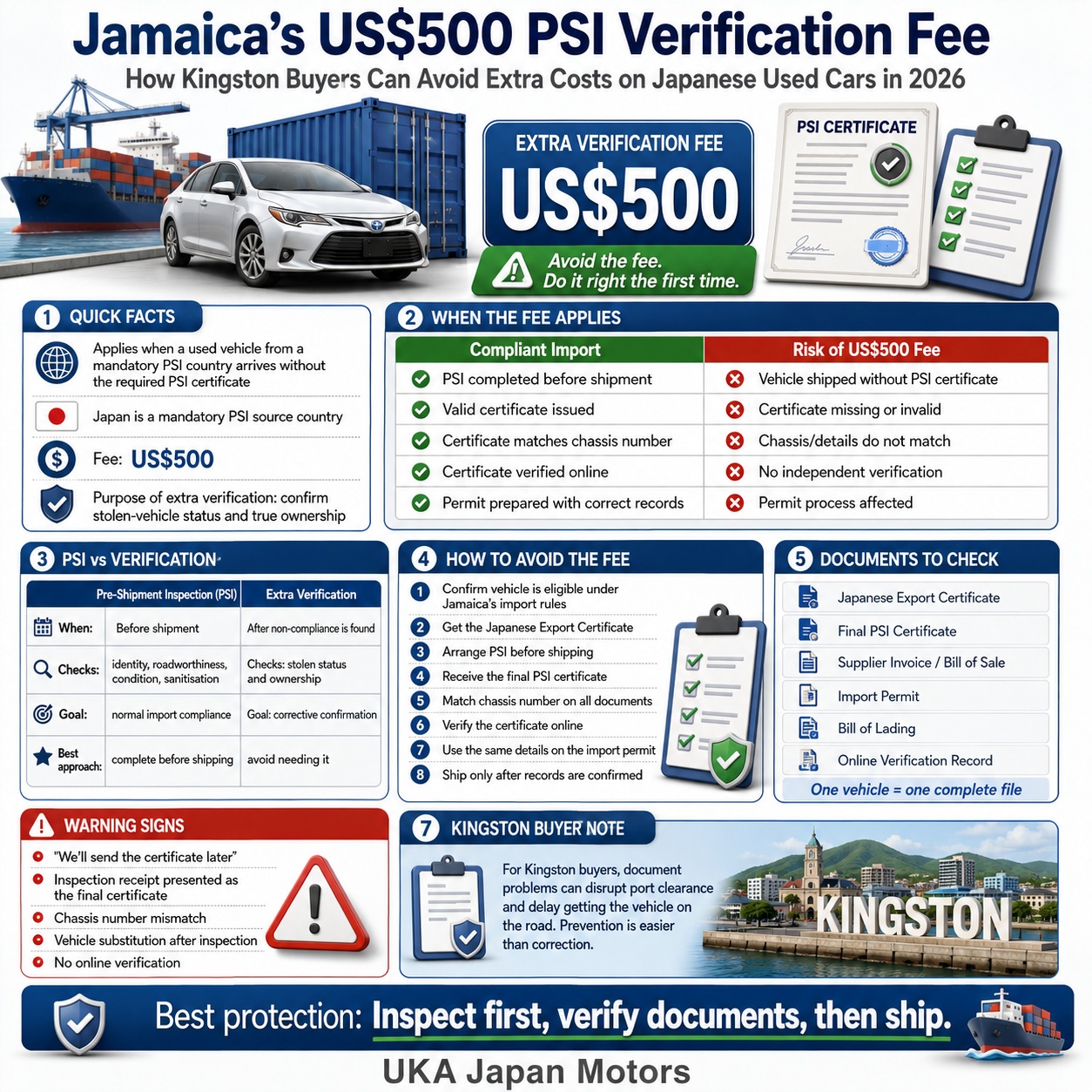
This requirement became especially important for Kingston importers on June 1, 2026. From that date, a used vehicle arriving from a country where Pre-Shipment Inspection is mandatory without the required inspection certificate became subject to an additional verification process. Jamaica Trade Board Limited states that this process attracts a US$500 verification fee, payable to Auto Terminal Japan.
The verification is intended to confirm whether the vehicle has been reported stolen and to validate its true ownership. It is not described as a replacement for the normal inspection process, nor does it remove every other consequence of failing to follow Jamaica’s Motor Vehicle Import Policy.
For a Kingston buyer, the central lesson is straightforward: the vehicle should not be treated as ready for shipment merely because it has been purchased, photographed or assigned a shipping date. Its Pre-Shipment Inspection Certificate must be issued, checked against the vehicle’s chassis number and incorporated into the import-permit process before the shipping stage is completed.
This guide explains what the verification fee means, why the requirement matters, how Pre-Shipment Inspection differs from ownership verification and what buyers can do to prevent avoidable documentation problems.
Direct Answer: How Can a Kingston Buyer Avoid the US$500 Verification Fee?
A buyer importing a Japanese used car can avoid the verification fee by ensuring that:
- The vehicle undergoes the required Pre-Shipment Inspection in Japan.
- A valid Pre-Shipment Inspection Certificate is issued before shipment.
- The chassis number or Vehicle Identification Number on the certificate matches the vehicle and all supporting documents.
- The certificate can be verified through the authorised online verification system.
- The certificate is attached to the Jamaica import-permit application.
- The import permit is approved before the vehicle arrives in Jamaica.
- The vehicle placed on the vessel is the same vehicle identified on the inspection certificate and permit.
The most important practical rule is this:
Do not allow a Japanese used vehicle to be shipped merely because an inspection has been requested. Confirm that the certificate has actually been issued, verified and matched to the vehicle first.
What Changed on June 1, 2026?
Jamaica Trade Board Limited announced that, effective June 1, 2026, a used vehicle imported from a designated PSI country without the required certificate would be placed through an additional verification process.
The notice identifies Japan among the countries from which Pre-Shipment Inspection is mandatory. The other designated locations listed in the 2026 notice are the United States, the United Kingdom, Canada, the United Arab Emirates, Thailand, Singapore and China.
For a Japanese used car, the rule means that the inspection requirement must be handled before export. It is not intended to be completed casually after the vehicle reaches Kingston.
The 2026 verification process is limited to two stated purposes:
- Checking whether the vehicle is listed as stolen.
- Confirming the true ownership of the vehicle.
The Trade Board also makes clear that the verification fee applies specifically to non-compliance with the PSI requirement. It is not presented as a general fee for every Japanese vehicle entering Jamaica.
A buyer whose vehicle has a valid and verifiable PSI certificate should therefore not be placed in the same category as an importer whose vehicle was shipped without one.
What Is Pre-Shipment Inspection?
Pre-Shipment Inspection, commonly shortened to PSI, is a formal assessment of a used vehicle before it is exported to Jamaica.
For vehicles coming from Japan, the programme is administered through an approved inspection provider. The inspection is designed to confirm that the vehicle meets relevant import-policy, safety, identity and biosecurity requirements before it is shipped.
Jamaica’s published PSI information explains that the certificate can provide details concerning:
- Year of manufacture and model year.
- First registration date.
- Recorded distance travelled.
- Accuracy of the odometer reading.
- Country of manufacture and export.
- Fuel type.
- Original manufactured colour.
- Modifications.
- Previous structural, flood or natural-disaster damage.
- Tyre condition.
- Vehicle weight and seating information where applicable.
- Microbial or radioactive contamination.
The programme is therefore much broader than a basic ownership search.
The official inspection criteria also cover roadworthiness items such as the engine, braking system, suspension, steering, tyres, lights, mirrors, windscreen, exhaust system, electrical components and seat belts. Used vehicles are also subject to sanitisation and quarantine-related checks intended to reduce the entry of regulated contaminants into Jamaica.
PSI and Post-Arrival Verification Are Not the Same Thing
The similarity in the words “inspection” and “verification” can cause confusion. They describe different processes.
| Area | Pre-Shipment Inspection | Verification Triggered by Missing PSI |
|---|---|---|
| When it happens | Before the vehicle leaves Japan | After non-compliance is identified |
| Why it happens | To assess the vehicle against Jamaica’s inspection requirements | To investigate vehicle history after the certificate requirement was not met |
| Main focus | Identity, roadworthiness, recorded condition, documentation and sanitisation | Stolen-vehicle status and true ownership |
| Normal or corrective? | Normal import procedure | Corrective response to non-compliance |
| Importer’s objective | Complete it before shipping | Avoid reaching this stage |
| Does it replace the other process? | No | The 2026 notice does not describe it as a substitute for a full PSI |
This distinction matters because an importer should not assume that paying for verification will transform an uninspected vehicle into a properly inspected one.
The Trade Board describes the 2026 verification as being intended “solely” to establish stolen-vehicle status and ownership. Based on that wording, it should not be interpreted as a complete examination of brakes, structural repairs, odometer accuracy, sanitisation or the other areas covered by a normal PSI.
Why Jamaica Requires the Inspection Before Shipment
A used vehicle may appear satisfactory in auction photographs or a seller’s video while still presenting questions that cannot be resolved visually.
Examples include:
- Whether the chassis identity agrees with the export records.
- Whether the odometer has been changed.
- Whether earlier structural repairs were completed properly.
- Whether corrosion affects a load-bearing section.
- Whether warning systems operate correctly.
- Whether the vehicle contains soil, plant material or other regulated contamination.
- Whether the model year stated by the seller agrees with the official export certificate.
- Whether the vehicle is eligible under Jamaica’s applicable age restriction.
The official inspection programme is designed to address these questions before the vehicle enters the shipping chain.
This timing is important. Problems discovered while the car is still in Japan can be examined before the vehicle is placed on a vessel. Once the car reaches Kingston, the buyer is dealing with a physical vehicle already inside the port and a documentation problem involving several parties.
A missing certificate therefore creates more than a missing sheet of paper. It interrupts the sequence on which the import permit, port processing and Customs handling depend.
How PSI Fits Into Jamaica’s Import Process
For a typical Japanese used car, the compliance sequence should be understood as one connected process.
1. Confirm That the Vehicle Is Eligible
Before inspection or shipment, the importer should confirm that the vehicle falls within the relevant Jamaican import category and age restriction.
Jamaica Trade Board Limited currently identifies a maximum age of six years for ordinary cars, station wagons and SUVs within the stated seating categories. Different limits apply to various commercial vehicles, buses, trucks, motorcycles and heavy-duty equipment.
The model year should be established from official documentation rather than an advertisement alone.
2. Obtain the Correct Japanese Vehicle Record
For a vehicle exported from Japan, the Japanese Export Certificate is a central document. It should show the vehicle’s identifying and descriptive information.
The published PSI criteria list the Export Certificate as the document required for a Japanese vehicle presented for inspection.
The importer should obtain a readable copy and check:
- Chassis number.
- Make and model.
- Model code.
- First registration details.
- Engine information where shown.
- Colour.
- Ownership or deregistration information.
- Any translated information supplied with the certificate.
A translation should not be used as a reason to ignore the original certificate. Both should relate to the same vehicle.
3. Arrange Inspection and Sanitisation
The vehicle must be made physically available to the authorised inspection provider.
This means the exporter or supplier needs enough time to transport the car to the inspection location, address any rejection items where permitted and complete the required sanitisation process.
A booking confirmation is not the same as an inspection result. A vehicle can be booked but not yet inspected, or inspected but not yet approved.
4. Receive the Actual PSI Certificate
The buyer should request the final certificate rather than relying on statements such as:
- “Inspection is in process.”
- “The vehicle passed.”
- “The report will come later.”
- “The shipping company already has it.”
- “We always handle inspection after booking.”
The final certificate should identify the exact vehicle. It should not be a generic report, an invoice for inspection services or a screenshot that omits the chassis number.
5. Verify the Certificate Independently
Jamaica Trade Board Limited provides a PSI verification route that allows importers to enter the vehicle’s chassis number or VIN into the approved system.
For vehicles from mandatory PSI locations, the Trade Board directs importers to the Auto Terminal Japan verification platform.
This check helps answer three practical questions:
- Does a certificate exist for this chassis number?
- Is the certificate recognised in the official system?
- Does the displayed vehicle information match the car being imported?
The verification should be completed before the buyer authorises shipment.
6. Apply for the Import Permit
The import-permit application is made through JSWIFT.
The published Trade Board procedure lists the following supporting items for used motor vehicles:
- Supplier invoice or bill of sale.
- Registration certificate, title or Japanese Export Certificate.
- Valid identification and proof of citizenship.
- Taxpayer Registration Number.
- Pre-Shipment Inspection Certificate.
The information entered in the application should match the certificate and export records exactly.
7. Obtain the Permit Before Arrival
The Trade Board procedure states that the import permit must be obtained before the vehicle arrives in Jamaica.
Waiting until the car is already approaching Kingston to resolve a permit query creates unnecessary pressure. A minor discrepancy that might have been corrected before shipment can become a port-clearance issue.
The Document Identity Chain
The most reliable way to manage PSI compliance is to treat every vehicle as having one identity that must remain unchanged across all records.
For a Japanese used car, the following items should form a consistent chain:
Physical chassis marking → Japanese Export Certificate → PSI Certificate → Supplier invoice → Bill of lading → Import permit → Customs declaration
Every link should refer to the same vehicle.
A missing digit, reversed character or incorrect model code can break that chain even where the car itself is legitimate.
Chassis Number Versus VIN
Many Japanese domestic vehicles are commonly identified by a chassis number rather than the 17-character VIN format familiar on some other vehicles. The exact format may vary by manufacturer and model.
The practical issue is not whether the identifier is called a VIN or chassis number. The issue is whether the same identifier appears consistently on:
- The vehicle body or identification plate.
- The export documentation.
- The PSI certificate.
- The shipping records.
- The permit application.
Spaces and hyphens may sometimes be displayed differently, but the letters and numbers must still identify the same unit.
A buyer should never assume that a one-character difference is harmless. Characters such as “0” and “O,” “1” and “I,” or “5” and “S” can be entered incorrectly when records are typed manually.
Common Reasons Buyers End Up Without a Valid PSI Certificate
Shipping Was Treated as the Main Deadline
Some buyers focus on securing a vessel space and regard inspection as a smaller administrative task.
The order should be reversed. Inspection and document verification should determine whether the vehicle is ready to ship.
The Seller Promised to Send the Certificate Later
A future promise does not prove present compliance. Once the car has left Japan, the buyer has less control over the inspection process.
A Booking Receipt Was Mistaken for a Certificate
A receipt or appointment notice may show that an inspection was requested. It does not prove that the vehicle passed or that a valid certificate was issued.
The Certificate Belonged to Another Vehicle
This can happen where a supplier handles several similar cars at the same time. Two vehicles may share a make, model, colour and model year while having different chassis numbers.
The chassis number, not the photograph or model description, determines whether the certificate belongs to the vehicle.
A Vehicle Was Substituted After Inspection
An exporter may replace one unit with another similar vehicle after a mechanical, auction or shipping issue. If the replacement vehicle was not inspected separately, the original certificate cannot simply follow the replacement.
The Certificate Contained an Entry Error
A typographical error can prevent the certificate from matching the export record or verification system.
Any difference should be corrected by the responsible issuing party before shipment.
The Importer Relied Entirely on an Intermediary
A broker, exporter or shipping representative can assist with the process, but the person or company named as importer remains exposed when required documentation is missing.
The buyer should receive and retain direct copies of the final records.
The Certificate Could Not Be Verified
A document may look genuine while failing to appear in the authorised verification system. The published inspection criteria specifically advise importers to verify certificate authenticity before applying for an import permit.
A Practical Pre-Shipment Control System
Kingston buyers can reduce errors by dividing the import into four control stages.
Stage One: Vehicle Selection Control
Before the vehicle is confirmed:
- Obtain the full chassis number.
- Obtain the Japanese Export Certificate or available official vehicle record.
- Confirm the model year under Jamaica’s age rules.
- Check that the vehicle category is correctly described.
- Ask whether the unit has already been inspected for Jamaica.
- Confirm who is responsible for arranging the PSI.
- Do not accept an inspection intended for a different destination as proof of Jamaican compliance.
Stage Two: Inspection Control
Before the vehicle enters the shipping yard:
- Confirm that an inspection booking has been made.
- Confirm that the physical vehicle was presented.
- Obtain the result.
- Check whether repairs or corrective work were required.
- Confirm that sanitisation was completed.
- Obtain the final certificate.
- Review all remarks recorded by the inspector.
The buyer should pay attention to inspection remarks even when the vehicle passes. A pass does not necessarily mean the vehicle is free from cosmetic wear or every maintenance concern.
Stage Three: Document Control
Before vessel loading:
- Compare the chassis number across every document.
- Verify the certificate online.
- Confirm the make, model, model code and year.
- Compare the colour description.
- Check the exporter and ownership information.
- Save a clear digital copy of the verification result.
- Keep the original certificate file rather than relying only on a messaging-app image.
- Ensure the import-permit application uses the same identifying information.
Stage Four: Shipment Control
Before approving shipment:
- Confirm that the inspected vehicle is the unit being loaded.
- Check that the bill of lading uses the correct chassis number.
- Confirm that the permit has been issued or that all required approvals are in the correct stage before arrival.
- Send the final document set to the licensed Customs broker handling clearance.
- Keep written confirmation from the exporter concerning the loaded vehicle.
- Retain the inspection, permit, export and shipping records in one vehicle file.
This four-stage system is more reliable than checking documents only after the car is at sea.
A Recommended One-Vehicle File
Each imported car should have its own folder. The folder can be electronic, physical or both.
It should contain:
| Document | Main Point to Check |
|---|---|
| Supplier invoice or bill of sale | Importer, exporter and chassis information |
| Japanese Export Certificate | Official vehicle identity and registration information |
| Translation | Agreement with the original export record |
| Auction or condition report, where supplied | Vehicle history and disclosed condition |
| PSI booking confirmation | Correct chassis and inspection location |
| Final PSI Certificate | Approval status and vehicle details |
| Online verification record | Evidence that the certificate was independently checked |
| Import permit | Correct importer and vehicle identity |
| Shipping instruction | Correct vehicle selected for loading |
| Bill of lading | Chassis number and shipment details |
| Correspondence | Written confirmation of corrections or explanations |
Keeping one folder per vehicle helps prevent records from similar cars being mixed together.
This is particularly important for dealers or business importers handling several Toyota, Honda, Nissan, Suzuki or Mazda units of the same colour and model year.
Why the Rule Matters to Kingston Buyers
Most imported vehicles entering the Kingston area must pass through a chain involving the importer, overseas exporter, shipping line, port operator, Customs broker, Jamaica Trade Board Limited and Jamaica Customs Agency.
When the paperwork is complete, these parties can work from one consistent set of information. When the PSI certificate is absent or mismatched, responsibility must be traced across multiple organisations and time zones.
The buyer may also have planned to use the vehicle immediately for commuting between communities such as Portmore, Half-Way Tree, New Kingston, Constant Spring or downtown Kingston. A documentation hold interrupts that plan before the vehicle has even entered normal daily service.
A vehicle waiting for clearance may also sit unused for longer than expected. Extended inactivity can contribute to a weak battery, reduced tyre pressure or surface deterioration, particularly where the vehicle was already stored before export.
The verification fee is therefore only one part of the risk. The wider issue is loss of control over the import timeline.
Roadworthiness Information Has Long-Term Ownership Value
PSI should not be viewed only as a border requirement. The certificate and inspection findings can also help the eventual owner understand the vehicle.
For Kingston use, several inspection areas are especially relevant.
Cooling System
Slow-moving traffic and high ambient temperatures place sustained demands on the cooling system. A vehicle with existing leaks, a weak fan system or deteriorated hoses can develop problems quickly in congested conditions.
The published PSI criteria require the cooling system to operate correctly and identify fluid leakage as a rejection concern.
Brakes
Frequent stops in Kingston traffic and regular hillside driving require a sound braking system. PSI criteria address brake pads, linings, hoses, pipes, calipers, parking brakes and other components.
Suspension and Steering
Potholes, patched road surfaces and uneven residential roads can expose looseness or wear that was less noticeable during brief vehicle-yard movement.
The PSI provides an initial control, although a local mechanical assessment after arrival remains sensible.
Air Conditioning and Electrical Load
The official criteria focus on safety-related electrical equipment and warning systems. Buyers should still evaluate the air-conditioning system separately because regular cooling is an important part of daily ownership in Jamaica.
Corrosion and Earlier Repairs
Coastal air and humidity make structural condition relevant over the long term. A car with poorly repaired earlier damage may deteriorate differently from a vehicle with an intact structure.
PSI information on structural damage, repairs and corrosion gives the buyer a stronger starting point for future maintenance planning.
What PSI Does Not Guarantee
A valid PSI certificate is important, but it should not be misunderstood as a permanent guarantee.
The inspection reflects the condition and records available at the time of assessment. A vehicle can develop a fault after inspection, during storage, while being moved through a shipping yard or during sea transport.
A PSI certificate also does not remove the need to:
- Check fluids after arrival.
- Test the battery and charging system.
- Inspect tyres for storage-related pressure loss.
- Confirm that all warning lights operate normally.
- Assess the air-conditioning system.
- Examine underbody areas after clearance.
- Establish a maintenance baseline.
- Preserve all import and ownership documents.
The correct approach is to treat PSI as the first formal layer of control, not the final act of vehicle maintenance.
What Should a Buyer Do if the Vehicle Has Already Shipped Without PSI?
A buyer who discovers the problem after departure should act immediately and keep every step documented.
First, confirm whether the certificate is genuinely missing. Ask the exporter for the final certificate number and independently search the authorised verification system using the chassis number.
Second, contact Jamaica Trade Board Limited and the authorised inspection provider. Provide the chassis number, export document, bill of lading, importer information and shipment details.
Third, notify the Customs broker expected to handle the vehicle in Kingston. The broker should not discover the missing document only when clearance is being attempted.
Fourth, do not create, alter or accept a certificate that cannot be independently verified. Jamaica’s published PSI criteria warn importers to ensure that certificates are valid before applying for a permit and state that fraudulent documentation may lead to enforcement action.
Fifth, understand that the 2026 verification process may answer ownership and stolen-status questions, but it does not necessarily correct every permit, inspection, sanitisation or policy issue connected with the shipment. The Trade Board should provide case-specific direction.
Earlier published inspection criteria warned that vehicles arriving without the required PSI certificate and import permit could face re-export or disposal through Customs procedures. The newer 2026 notice introduces a specific verification process for missing certificates, but importers should not assume that the verification fee removes all other consequences.
Compliant Import Versus Reactive Import
| Compliant Approach | Reactive Approach |
|---|---|
| Vehicle eligibility checked before confirmation | Eligibility examined after shipment |
| Export Certificate reviewed early | Export record requested during a dispute |
| PSI completed before loading | Inspection assumed or postponed |
| Certificate verified by chassis number | Document accepted without independent checking |
| Permit application uses matching records | Permit query appears after the car is moving |
| Broker receives documents before arrival | Broker is asked to solve missing records at the port |
| Importer retains control of the process | Importer depends on corrective verification |
The compliant pathway requires more attention before shipment, but it is also more predictable.
The reactive pathway begins with assumptions and ends with several parties trying to reconstruct what should have been confirmed earlier.
Warning Signs Before Buying or Shipping
A Kingston buyer should pause the process when an exporter or intermediary says:
- PSI is optional for the vehicle.
- The car can be inspected after it reaches Jamaica.
- A receipt is the same as the certificate.
- The certificate will be issued after vessel departure.
- The chassis difference is only a typing issue and does not need correction.
- An inspection for another car can be used because the vehicles are identical.
- The import permit can always be handled after arrival.
- The online verification system is unnecessary.
- The buyer does not need a copy of the certificate.
- The exporter cannot provide the original Japanese vehicle record.
Any one of these statements should trigger further checking before shipment authority is given.
Who Is Most Likely to Need This Guidance?
This guidance applies particularly to:
- Individuals importing a Japanese used car for personal use.
- Kingston residents working with an overseas supplier for the first time.
- Small businesses importing a vehicle for company operations.
- Certified dealers handling several units in one shipment cycle.
- Returning residents arranging a vehicle import.
- Buyers whose vehicle is being managed by a friend, relative or intermediary.
- Importers purchasing from an auction through an export agent.
- Buyers who have received several documents but are uncertain which one is the PSI certificate.
The fee does not apply simply because a person imports a used car. It applies where the required PSI certificate is missing in a situation covered by the policy.
UKA Japan Motors’ Role in PSI and Document Guidance
UKA Japan Motors’ role is to help buyers approach Japanese used-car imports with clear records, verified vehicle identities and realistic expectations about the inspection process.
A responsible import process should include:
- Confirming the chassis identity before shipment.
- Reviewing available Japanese vehicle documents.
- Ensuring that the selected vehicle is presented for the required inspection.
- Checking that the certificate corresponds to the actual car.
- Keeping the inspection and shipping records connected.
- Explaining certificate remarks without disguising their meaning.
- Alerting buyers when a document inconsistency needs to be corrected.
- Coordinating information required for the Jamaican import process.
No supplier can replace the authority of Jamaica Trade Board Limited or Jamaica Customs Agency. The appropriate role of a vehicle provider is to support compliance, maintain transparent records and avoid presenting assumptions as approvals.
For buyers, trust should be based on documents that can be checked independently rather than verbal assurances alone.
Frequently Asked Questions
1. What is Jamaica’s US$500 PSI verification fee?
It is a fee applied when a used vehicle is imported from a country where Pre-Shipment Inspection is mandatory but arrives without the required PSI certificate. The measure took effect on June 1, 2026.
2. Does the fee apply to every Japanese used car?
No. The Trade Board states that it applies specifically in cases of non-compliance with the PSI requirement. A Japanese used car with a valid and verifiable certificate should not be treated as a missing-certificate case.
3. Who receives the verification fee?
The official 2026 notice states that the fee is payable to Auto Terminal Japan.
4. What does the additional verification check?
The process is intended to determine whether the vehicle is listed as stolen and to validate its true ownership. Those are the two purposes identified in the Trade Board notice.
5. Is the verification the same as a full PSI?
No. A normal PSI covers a wider range of vehicle identity, roadworthiness, recorded condition and sanitisation matters. The corrective verification described in the 2026 notice focuses on stolen-vehicle status and ownership.
6. Can the vehicle be shipped while the PSI certificate is pending?
That is not a prudent approach. The importer should wait until the certificate has been issued, checked and verified. A pending application does not prove that the vehicle has passed.
7. How can I check whether a PSI certificate is genuine?
Jamaica Trade Board Limited directs importers to use an authorised online verification facility and enter the chassis number or VIN. For vehicles from mandatory locations, the Trade Board identifies the Auto Terminal Japan verification platform.
8. What should match across the documents?
The chassis number should match the physical vehicle, Japanese Export Certificate, PSI certificate, invoice, bill of lading, import permit and Customs documentation. The make, model, model year and other identifying details should also be consistent.
9. Is an auction sheet a PSI certificate?
No. An auction sheet may contain useful condition information, but it is not the official Pre-Shipment Inspection Certificate required for the Jamaican import process.
10. Is an inspection receipt enough?
No. A receipt may show that a service was booked or paid for, but it does not prove that the vehicle passed or that the final certificate was issued.
11. What happens when the chassis number on the certificate is incorrect?
The discrepancy should be referred to the issuing inspection provider and corrected before shipment. The importer should not manually alter the certificate or assume that the error will be ignored.
12. Does a valid PSI mean the vehicle needs no local inspection?
No. PSI provides an important pre-export assessment, but the owner should still examine the car after shipping and establish a maintenance baseline for Jamaican driving conditions.
13. Does PSI include sanitisation?
Jamaica’s published inspection criteria describe sanitisation and quarantine inspection as part of the pre-shipment regime for used vehicles. The purpose is to prevent regulated contaminants from entering Jamaica.
14. Can I apply for an import permit without the PSI certificate?
The Trade Board’s published procedure lists the PSI certificate among the supporting documents for a used-vehicle permit application. Buyers should therefore obtain and verify the certificate before submitting the completed application.
15. Must the permit be obtained before the car reaches Jamaica?
Yes. The published motor-vehicle import procedure states that the permit must be obtained before the vehicle arrives in Jamaica.
16. What should I do when an exporter refuses to provide the certificate?
Do not authorise shipment until the issue is resolved. Request the certificate number, final report and chassis-based verification. Where the exporter cannot provide them, contact the inspection provider or Jamaica Trade Board Limited for guidance.
17. Can a PSI certificate be transferred to a replacement vehicle?
No. The certificate relates to the specific chassis inspected. A replacement vehicle must have its own correct inspection record.
18. Who should keep the final PSI records?
The importer should keep them, even where a supplier, dealer, exporter or Customs broker is managing the transaction. Each party may need a copy, but the buyer should maintain an independent vehicle file.
Conclusion
Jamaica’s 2026 PSI verification fee reinforces a principle that has always been important in used-vehicle importing: documentation should be completed before the vehicle begins its journey to Kingston.
For Japanese used cars, compliance depends on more than arranging an inspection appointment. The vehicle must actually be inspected, the correct certificate must be issued, the chassis number must match every supporting record, the certificate must be independently verifiable and the import permit must be handled before arrival.
The most effective protection is a controlled document sequence. Buyers should confirm the vehicle’s identity at selection, inspection, permit and shipment stages rather than leaving all checking until the car reaches the port.
PSI also serves a wider purpose. It provides information about the vehicle’s identity, condition, history and roadworthiness that can support more informed ownership after clearance. It cannot eliminate every mechanical risk, but it creates a stronger and more transparent starting point.
A careful importer treats the US$500 verification fee not as another routine step, but as a preventable consequence of a broken compliance chain.
Contact UKA Japan Motors for availability and inspection guidance.