


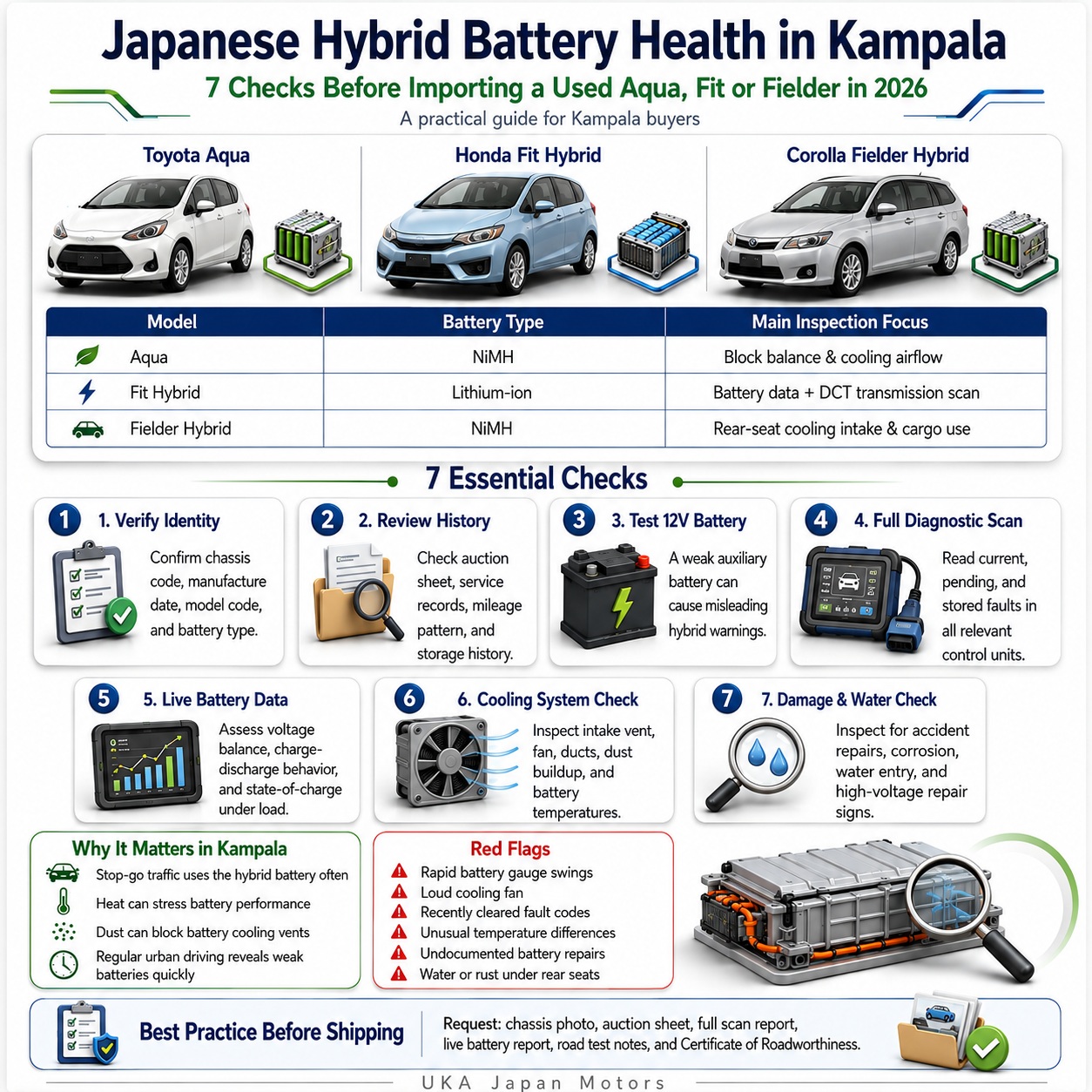
A used Japanese hybrid can suit Kampala driving remarkably well, particularly where daily journeys involve repeated stopping, slow-moving traffic and frequent changes between acceleration and braking. However, the condition of the high-voltage battery must be assessed carefully before the vehicle is shipped.
The hybrid battery is not the same as the small 12-volt battery used to operate the vehicle’s computers, locks, lights and control systems. It is a larger high-voltage energy-storage unit that works with the petrol engine, electric motor, inverter and regenerative braking system.
A vehicle may start normally, display no warning lights and move quietly around an auction yard while still having a weakened battery module, an obstructed cooling system, recently cleared diagnostic codes or irregular state-of-charge behaviour.
For Kampala buyers considering a Toyota Aqua, Honda Fit Hybrid or Toyota Corolla Fielder Hybrid in 2026, a basic roadworthiness inspection is therefore not enough. The vehicle should also undergo a model-specific hybrid evaluation using diagnostic data, a meaningful road test and careful verification of its history.
Direct Answer: What Should Be Checked Before Importing?
Before importing a used Japanese hybrid, complete these seven checks:
- Confirm the chassis code, manufacture date and battery technology.
- Review the auction record, maintenance history and periods of inactivity.
- Test the separate 12-volt auxiliary battery.
- Scan every relevant control unit for current, pending and historical faults.
- Analyse hybrid battery data during acceleration, cruising and regenerative braking.
- Inspect the battery cooling intake, fan, ducts and temperature readings.
- Check for accident damage, water exposure, high-voltage repairs and document inconsistencies.
None of these checks should be considered separately. A clean dashboard does not replace a diagnostic scan, and a diagnostic scan performed while the vehicle is stationary does not replace a battery load test.
The aim is not to find a battery that shows no ageing. Every used battery has experienced some level of degradation. The aim is to determine whether the battery remains balanced, thermally controlled and capable of supporting normal hybrid operation without abnormal charge swings, warning codes or reduced assistance.
Why Hybrid Battery Health Matters in Kampala
Kampala driving often places a hybrid vehicle in conditions where the battery is used repeatedly.
When the vehicle slows down, the electric motor can act as a generator and recover energy through regenerative braking. When the vehicle moves away again, the battery may provide electric assistance before or alongside the petrol engine. Toyota describes this cycle as a core part of its hybrid operation: energy is recovered during deceleration, stored in the traction battery and used again when driving conditions require assistance.
A healthy battery can move through these operating phases smoothly. A weakened or poorly balanced battery may still function, but the vehicle can rely more heavily on the petrol engine. The driver may notice frequent engine starts, rapid movement of the battery gauge, louder cooling-fan operation or inconsistent electric assistance.
Heat management also matters. Hybrid batteries are designed to work within controlled temperature ranges. Battery packs fitted beneath or behind the rear seating area normally use cabin air drawn through a cooling intake. Dust, fibres, seat covers, luggage or previous interior repairs can obstruct that airflow.
Toyota warns that blocking a hybrid battery cooling intake can restrict battery input and output, reduce electric operation and contribute to reduced system performance or failure. Its maintenance guidance also calls for periodic inspection and cleaning in dusty or high-traffic environments.
These concerns are particularly relevant after the vehicle reaches Kampala. A battery that is already running near its thermal or electrical limits in Japan may struggle more noticeably after entering regular urban service.
First Understand the Three Hybrid Systems
The Aqua, Fit Hybrid and Corolla Fielder Hybrid are often grouped together because they are compact Japanese hybrids. Their systems are not identical.
Toyota Aqua
The first-generation Toyota Aqua, commonly identified by the NHP10 chassis code, uses Toyota’s petrol-electric hybrid system with a nickel-metal hydride traction battery. Toyota’s original 2011 launch specifications identify the Aqua battery as nickel-metal hydride.
The second-generation Aqua, introduced in 2021, uses a newer bipolar nickel-hydrogen battery design in many versions. Toyota states that this battery provides higher output than the previous Aqua battery.
Most Aqua units considered by used-vehicle buyers should still be identified by chassis code rather than simply by registration year. Two cars described as “Toyota Aqua Hybrid” can belong to different generations and use different battery designs.
Honda Fit Hybrid
The GP5 and GP6 Honda Fit Hybrid models produced from 2013 to 2020 use a lithium-ion high-voltage battery. Honda describes the battery as a durable lithium-ion unit and states that service life depends partly on usage and operating conditions.
These Fit Hybrid models also use Honda’s i-DCD hybrid arrangement with a seven-speed dual-clutch transmission. This distinction is important because hesitation, delayed engagement, warning messages or irregular low-speed movement may come from the transmission or its control system rather than from the traction battery.
Honda issued several recall and service actions relating to the seven-speed transmission and its electronic controls on certain GP5 and GP6 vehicles. Battery inspection should therefore be combined with verification of the chassis number and applicable recall history.
Toyota Corolla Fielder Hybrid
The commonly imported NKE165 Corolla Fielder Hybrid uses Toyota’s 1.5-litre petrol-electric system with a nickel-metal hydride battery. Toyota’s specifications for the Fielder Hybrid identify the battery chemistry and show that the pack is positioned beneath the rear seat.
The Fielder has a larger body and different intended use from the Aqua. It may be chosen for passengers, work equipment or family luggage. That makes the condition of the rear-seat battery intake especially important because seat covers, cargo and interior modifications can interfere with battery cooling.
At-a-Glance Comparison
| Model | Common chassis code | Typical battery type | Important inspection distinction |
|---|---|---|---|
| Toyota Aqua | NHP10 | Nickel-metal hydride | Watch battery-block balance, cooling airflow and rapid charge-gauge movement |
| Honda Fit Hybrid | GP5 or GP6 | Lithium-ion | Separate battery symptoms from seven-speed transmission behaviour |
| Corolla Fielder Hybrid | NKE165 | Nickel-metal hydride | Inspect rear-seat cooling intake and signs of cargo-related interior damage |
The chassis code must always take priority over the seller’s description. A model name alone cannot confirm the exact hybrid system, battery technology, drivetrain or production revision.
Check 1: Confirm the Chassis Code, Manufacture Date and Battery Type
The first battery-health check begins before any scan tool is connected.
Request a clear image of the vehicle identification plate and confirm:
- Complete chassis number
- Model code
- Month and year of manufacture
- Engine code
- Drivetrain
- Hybrid designation
- Auction sheet chassis number
- Export documents
- Inspection documents
For the three models discussed here, common hybrid chassis codes include NHP10 for the first-generation Aqua, GP5 or GP6 for the third-generation Fit Hybrid and NKE165 for the Corolla Fielder Hybrid.
A description such as “2016 Fielder” is insufficient. The vehicle could be a petrol version, a hybrid version, a different drivetrain or a car registered in 2016 but manufactured earlier.
The manufacture date is also relevant to import eligibility. As of August 2026, the proposal to reduce Uganda’s vehicle import-age limit from 15 years to 13 years has been withdrawn. Parliament’s bill tracker records the withdrawal on 21 April 2026, while current URA guidance continues to show vehicles beyond the existing 15-year framework as not allowed.
Buyers should nevertheless verify the exact manufacture date before shipping. Import-age decisions should not be based only on the year printed in an advertisement because the production month, shipment date and supporting documentation may affect eligibility.
Confirming the model also tells the inspector which diagnostic parameters to read. A Toyota nickel-metal hydride pack should not be evaluated using assumptions intended for the Fit’s lithium-ion system.
What Should Raise Concern?
Pause the process when:
- The seller provides only a registration year.
- The identification plate is blurred or partly concealed.
- The auction sheet number does not match the vehicle.
- The chassis code is missing from the inspection report.
- The vehicle is advertised as a hybrid but the model code indicates otherwise.
- Battery information has been copied from a different vehicle generation.
A documentation mismatch does not automatically prove a mechanical fault, but it makes every later battery result less trustworthy.
Check 2: Review the Auction Record, Maintenance History and Storage Pattern
Battery ageing is influenced by more than mileage.
A low-mileage hybrid can still have an unhealthy battery if it remained unused for extended periods, experienced repeated deep discharge, was stored in a hot environment or had its cooling intake obstructed. Conversely, a regularly driven vehicle with higher recorded mileage may have more stable battery behaviour if it received consistent maintenance and remained in normal operation.
Honda specifically advises that the GP5 and GP6 Fit Hybrid should be driven for at least 30 minutes once every three months when stored for long periods. Honda explains that extended inactivity can reduce high-voltage battery charge capacity and shorten battery life.
Ask for:
- Japanese service records
- Previous inspection sheets
- Auction sheet and translation
- Odometer history
- Deregistration or export certificate
- Battery replacement or repair record
- Evidence of long-term storage
- Photographs taken at different dates
- Recall-completion evidence where applicable
What an Auction Sheet Can and Cannot Tell You
An auction sheet can help identify mileage, body condition, repair history and some warning lights noted during inspection. It is not normally a full hybrid battery capacity report.
A favourable auction grade does not prove that:
- Every battery module is balanced.
- The cooling fan is operating correctly.
- Diagnostic trouble codes have never been cleared.
- The vehicle can complete a sustained load test.
- The battery retains performance after warming up.
- The state-of-charge gauge behaves normally in traffic.
Treat the auction sheet as one part of the evidence rather than as a battery certificate.
Look for Gaps in the Timeline
A vehicle showing almost no mileage movement over a long interval may have been parked. This is not automatically unacceptable, but it should trigger closer investigation.
The inspector should establish:
- Whether the vehicle can enter READY mode normally.
- Whether the engine charges the traction battery predictably.
- Whether the battery holds charge after the engine stops.
- Whether warning codes return after a proper road test.
- Whether the battery temperature rises unusually quickly.
A seller’s statement that the vehicle “starts immediately” does not answer these questions.
Check 3: Test the 12-Volt Auxiliary Battery Separately
Many buyers focus entirely on the traction battery and forget the smaller 12-volt battery.
In a hybrid, the 12-volt battery normally powers control units and allows the high-voltage system to initialise. It does not perform the same function as the starter battery in a conventional petrol vehicle, but weak voltage can still cause communication faults, warning messages, failed READY activation or inconsistent diagnostic readings.
Honda lists a conventional 12-volt auxiliary battery separately from the GP5 and GP6 high-voltage lithium-ion battery.
The pre-import inspection should record:
- Resting voltage
- Voltage during system activation
- Charging voltage in READY mode
- Battery age
- Terminal condition
- Earth connections
- Evidence of repeated jump-starting
Why This Check Must Come Before the Hybrid Scan
A scan performed with an unstable 12-volt supply may produce misleading results. Control modules can lose communication, store low-voltage codes or fail to complete diagnostic routines.
The correct sequence is:
- Test the 12-volt battery.
- Stabilise or replace it where necessary.
- Confirm normal READY operation.
- Scan the complete vehicle.
- Begin high-voltage battery testing.
A weak auxiliary battery should not automatically be interpreted as a failed hybrid battery. Equally, replacing the 12-volt battery should not be used to dismiss genuine high-voltage faults.
Check 4: Scan All Relevant Control Units
A dashboard photograph showing no warning lamps is not a diagnostic report.
The vehicle must be scanned with equipment capable of communicating with the hybrid control system, battery-management system, engine control unit, braking system, inverter or motor controller and transmission controller where applicable.
A generic scanner that reads only basic engine-emission codes may miss the information that matters most.
Request the Full Scan Report
The report should include:
- Current diagnostic trouble codes
- Pending codes
- Historical or stored codes
- Permanent codes where supported
- Freeze-frame information
- Hybrid control data
- Battery-management data
- Inverter or motor-control faults
- Regenerative-braking faults
- Transmission faults
- Communication faults between modules
Do not accept only the phrase “no engine codes.”
Check for Recently Cleared Codes
A recently cleared system can temporarily show no active warning light.
Possible signs include:
- Multiple monitors showing incomplete status
- Missing historical information
- A recently reset clock or audio system
- Battery terminals that appear freshly disturbed
- Diagnostic data that has reset unusually recently
- Warning lights returning after the road test
Code clearing does not repair a battery. It only removes stored evidence until the control unit detects the problem again.
Model-Specific Interpretation Matters
On a Toyota Aqua or Fielder, the technician should pay particular attention to hybrid battery block-voltage irregularities, battery temperature, cooling-fan commands and hybrid control faults.
On a GP5 or GP6 Fit Hybrid, the report must distinguish high-voltage battery faults from transmission-control problems. Honda’s official records show that some Fit Hybrid units were affected by seven-speed dual-clutch control and engagement issues. Delayed movement, transmission warning indications or irregular gear engagement should therefore not automatically be labelled as battery failure.
The chassis number should be checked against applicable manufacturer campaigns before the vehicle is approved.
Check 5: Analyse Live Battery Data Under Load
This is the most important technical check.
A stationary scan can show stored codes and basic readings, but battery weakness often becomes visible only when the pack is asked to deliver or absorb energy.
The vehicle should be driven while the scan tool records data during:
- Initial start-up
- Low-speed electric movement
- Moderate acceleration
- Stronger acceleration
- Steady cruising
- Hill climbing where safely available
- Deceleration
- Regenerative braking
- Repeated stopping and restarting
- Operation after the battery has warmed
For Toyota Aqua and Fielder Models
Toyota battery-management systems commonly monitor the pack in groups or blocks rather than presenting every individual cell directly.
The technician should compare:
- Voltage of each monitored battery block
- Difference between the highest and lowest block
- Behaviour of each block during acceleration
- Behaviour during regenerative charging
- Internal-resistance readings where available
- Battery state of charge
- Battery temperatures
- Cooling-fan command
- Charging and discharging current
The most useful result is not a single voltage reading. It is the way the readings move together.
Healthy blocks should generally rise and fall in a reasonably consistent pattern. A weak block may drop faster than the others under acceleration and rise faster during regenerative braking. This difference can reveal reduced usable capacity even when the dashboard has not yet displayed a warning.
Avoid relying on a universal voltage-difference figure without considering model, temperature, state of charge, scanner accuracy and test conditions. The trend under load is more useful than an isolated screenshot.
For the Honda Fit Hybrid
The GP5 or GP6 Fit uses a lithium-ion pack and should be assessed through Honda-compatible battery-management data.
The technician should evaluate:
- Reported battery state of charge
- Cell-group voltage consistency
- Battery temperature readings
- Charge and discharge current
- Electric-motor assistance
- Regenerative charging response
- Battery-control faults
- Temperature or voltage sensor plausibility
The Fit’s state-of-charge movement may not look identical to Toyota’s display behaviour. The inspector must understand the specific Honda system rather than applying Toyota assumptions.
Watch the Dashboard Battery Gauge
The battery gauge is not a laboratory capacity measurement, but it can reveal suspicious patterns.
Warning signs include:
- Gauge dropping from high to low after brief acceleration
- Gauge rising from low to high after a short period of charging
- Petrol engine running repeatedly to restore charge
- Electric assistance disappearing quickly
- Battery gauge changing dramatically while driving gently
- Cooling fan becoming unusually loud
- Hybrid warning message appearing after the vehicle warms up
One rapid gauge movement is not enough to condemn a battery. The pattern should be repeated and compared with diagnostic data.
Check 6: Inspect Battery Cooling and Temperature Control
A battery can be electrically balanced during a short test and still be at risk because of restricted cooling.
Both Toyota and Honda use controlled airflow to manage traction-battery temperature. Toyota states that a blocked cooling intake can restrict battery output and contribute to malfunction. Honda also advises avoiding prolonged heat exposure and recommends shaded parking to help preserve Fit Hybrid battery life.
The inspection should cover:
- Cooling intake grille
- Intake filter where fitted
- Fan operation
- Fan noise
- Air ducts
- Electrical connectors
- Temperature sensors
- Rear-seat trim
- Signs of pet hair, dust or fibres
- Seat covers blocking the intake
- Previous interior modifications
Why Cooling Condition Reveals Past Treatment
A heavily blocked intake can indicate that the vehicle operated for a long time without proper cleaning. Even after the grille is cleaned, the battery may already have experienced repeated high-temperature operation.
Inspectors should therefore look beyond the visible vent. The fan and ducting may contain dust even when the outer grille appears clean.
The scan tool should also be used to compare battery temperature sensors. One sensor showing a reading that is implausibly different from the others may indicate:
- Uneven airflow
- A sensor fault
- Localised heating
- Poor battery-pack contact
- Previous repair
- A developing module problem
Kampala Ownership Considerations
After arrival, the cooling intake should remain unobstructed.
Owners should avoid placing thick seat covers, loose fabric, bags or other items over the intake area. The vent should be inspected during routine servicing, especially when the vehicle operates regularly on dusty roads or carries passengers and cargo throughout the day.
Cooling-system maintenance does not restore lost battery capacity, but it can prevent unnecessary thermal stress on a battery that is still serviceable.
Check 7: Inspect for Water, Accident Damage and Previous High-Voltage Repairs
The final check combines mechanical inspection with document verification.
Hybrid battery packs are protected inside metal enclosures, but the surrounding vehicle structure still matters. Collision repair, water entry, damaged seals, incorrect welding or disturbed high-voltage wiring can compromise safety and reliability.
Inspect:
- Battery enclosure
- High-voltage orange cables
- Service plug
- Cable brackets
- Wiring connectors
- Rear floor and seat mounting areas
- Boot floor
- Spare-wheel well where applicable
- Underbody near battery or cable routes
- Inverter and power-control unit
- Cooling ducts
- Warning labels
- Evidence of non-standard wiring
High-voltage components should not be opened by an unqualified person. The inspection must be performed using appropriate isolation procedures and protective equipment.
Signs of Water Exposure
Look for:
- Rust beneath seats
- Corrosion on brackets or connectors
- Water marks behind interior trim
- Damp carpet backing
- Silt in hidden cavities
- Mould or persistent odour
- Corrosion inside the spare-wheel area
- Replaced carpets without supporting explanation
A clean upper carpet does not prove that the floor beneath it is dry.
Signs of Previous Battery Work
Possible indicators include:
- Tool marks on battery-cover bolts
- Missing clips
- Incorrect sealant
- Non-original wiring
- Mismatched battery modules
- Handwritten markings
- Disturbed service-plug area
- Removed safety labels
- Battery identification numbers that do not match records
Previous battery work is not automatically unacceptable. A properly documented replacement may be preferable to an untouched but degraded original pack.
The concern is undocumented work, mixed components or repairs performed without clear evidence of testing.
Match the Vehicle to Its Documents
The following should correspond:
- Chassis number
- Manufacture date
- Auction sheet
- Export certificate
- Inspection report
- Bill of lading
- Battery or repair invoice where supplied
- Recall-completion record
Under Uganda’s current used-vehicle inspection system, vehicles exported from Japan require pre-export verification and a valid Certificate of Roadworthiness under the applicable UNBS programme. The mandatory arrangement applies to bills of lading issued after 14 April 2025.
The CRW is an important compliance document, but buyers should not assume that it represents a detailed traction-battery capacity test. A separate hybrid inspection report remains necessary.
How a Proper Hybrid Road Test Should Be Conducted
A meaningful road test should last long enough for the petrol engine, battery and cooling system to reach normal operating conditions.
The inspector should not simply move the vehicle a few metres around a yard.
Phase 1: Start-Up
Observe:
- Whether the vehicle enters READY mode promptly
- Warning-light sequence
- Engine start behaviour
- Battery state of charge
- Unusual fan noise
- Diagnostic voltage
- Any warning messages
Phase 2: Gentle Urban-Style Driving
Use light acceleration and repeated stops.
Observe:
- Electric assistance
- Smooth transition between engine and motor
- Regenerative braking
- Battery-gauge movement
- Engine restart frequency
- Transmission engagement on the Fit
Phase 3: Moderate Load
Accelerate firmly in a safe area.
Observe:
- Battery voltage balance
- Charge-discharge current
- Weak block or cell-group behaviour
- Sudden loss of motor assistance
- Warning codes
- Engine behaviour
Phase 4: Regenerative Charging
Decelerate steadily and observe whether the battery accepts energy normally.
A weakened battery may reach its upper displayed charge level very quickly because its usable capacity has reduced.
Phase 5: Heat-Soak Recheck
Continue until the system is warm, then repeat acceleration and regenerative braking.
Some batteries behave normally when cool but show greater imbalance after temperature rises. This is why a brief cold test should never be treated as conclusive.
Red Flags That Should Stop the Import Decision
Do not approve the vehicle until the cause has been identified when any of the following appears:
- Hybrid-system warning light
- Active or pending battery code
- Diagnostic communication failure
- Large and repeatable voltage deviation under load
- One battery temperature reading rising abnormally
- Cooling fan running at high speed without clear reason
- Battery gauge moving rapidly between extremes
- Petrol engine running continuously to maintain charge
- Missing or altered auction documentation
- Signs of water below the carpet
- Undocumented battery repair
- High-voltage cables that have been modified
- Chassis number inconsistency
- Recently cleared codes followed by returning warnings
- Fit transmission warning mistaken for a battery problem
A seller may describe these symptoms as normal behaviour for an older hybrid. That explanation should not replace a technical diagnosis.
Which Model Suits Which Kampala Owner?
Battery condition should come before model preference, but each vehicle has a different ownership character.
Toyota Aqua
The Aqua suits drivers who mainly need a compact vehicle for personal commuting and urban movement.
Its compact dimensions can be useful in congested areas and restricted parking spaces. The NHP10 hybrid system is widely understood, but many examples have now accumulated significant age and usage. Battery balance and cooling condition deserve careful attention.
It may be less suitable where the vehicle regularly carries several adults, bulky equipment or loads that obstruct the rear-seat cooling area.
Honda Fit Hybrid
The Fit Hybrid offers flexible interior space in a compact body. It can suit owners who need passenger room and adaptable seating without moving to a larger station wagon.
However, the GP5 and GP6 require inspection by someone familiar with both the lithium-ion hybrid system and the seven-speed dual-clutch transmission. A battery-only inspection is incomplete.
It may be less suitable for a buyer who cannot obtain a complete scan, recall verification and transmission evaluation before shipment.
Corolla Fielder Hybrid
The Fielder suits family, professional and mixed-use owners who need a longer luggage area and more carrying flexibility.
Its Toyota nickel-metal hydride system shares basic operating principles with the Aqua, but the vehicle’s cargo-oriented usage makes interior condition and cooling-intake protection especially important.
It may be less suitable where the intended load regularly blocks battery airflow or where the vehicle has evidence of heavy cargo use and poorly repaired rear-body damage.
Hybrid Battery Health Versus Ordinary Roadworthiness
A roadworthiness inspection and a hybrid battery inspection answer different questions.
A roadworthiness inspection generally focuses on whether the vehicle meets required safety and operational standards. UNBS identifies US 845:2017 as the compulsory standard for inspection and testing of used vehicles, and a Certificate of Roadworthiness is required within the applicable pre-export verification process.
A hybrid battery health inspection asks additional questions:
- Is the battery internally balanced?
- Can it deliver power under load?
- Can it accept regenerative charge?
- Are temperatures controlled?
- Is the cooling system functioning?
- Are faults stored in the battery or hybrid control units?
- Does the battery behave consistently after warming up?
A vehicle can satisfy basic roadworthiness requirements while still having a battery that is approaching the limit of reliable service.
For that reason, Kampala buyers should request both compliance evidence and a separate model-specific hybrid report.
Documents to Obtain Before Shipping
Keep clear copies of:
- Japanese export or deregistration certificate
- Auction sheet
- Auction-sheet translation
- Chassis-plate photograph
- Odometer photograph
- Full diagnostic scan report
- Hybrid battery live-data report
- Road-test observations
- Underbody and battery-area photographs
- Maintenance records
- Battery replacement record where applicable
- Recall or service-campaign evidence
- Certificate of Roadworthiness
- Bill of lading
- Import and customs documentation
The battery report should show the vehicle’s chassis number and inspection date. A generic report without clear vehicle identification should not be relied upon.
Long-Term Hybrid Battery Care in Kampala
Pre-import inspection reduces uncertainty, but ownership practices after arrival remain important.
Keep the Cooling Intake Clear
Do not cover the intake with fabric, luggage or seat accessories. Inspect it during normal servicing.
Avoid Long Periods of Inactivity
A hybrid should be driven regularly. Honda specifically warns that prolonged parking can reduce high-voltage battery charge capacity and battery life.
Maintain the 12-Volt Battery
Low auxiliary voltage can create confusing electronic symptoms. Test it before investigating more complex hybrid faults.
Use Hybrid-Capable Diagnostics
A basic engine scanner may not communicate with the battery-management system. Servicing should include equipment suitable for the exact model.
Investigate Warning Lights Immediately
Continuing to operate the vehicle after a hybrid warning appears can make diagnosis more difficult. Record the warning and scan the vehicle before codes are erased.
Protect the Interior from Water
Repair leaking door seals, blocked drains and damaged body seams. Water entering beneath the rear seat or luggage floor can affect wiring and battery-area components.
Do Not Open the Battery Pack Casually
High-voltage battery work requires training, isolation procedures and protective equipment. A traction battery may retain dangerous voltage even when the vehicle is switched off.
Frequently Asked Questions
1. Can mileage alone show whether a hybrid battery is healthy?
No. Mileage is useful context, but battery condition also depends on age, temperature, storage, charging behaviour, cooling and previous repairs. A low-mileage vehicle that remained parked for long periods may require more investigation than its odometer suggests.
2. Is the Toyota Aqua battery lithium-ion?
The first-generation NHP10 Aqua normally uses a nickel-metal hydride traction battery. The second-generation Aqua introduced in 2021 uses a newer bipolar nickel-hydrogen design in many versions. Always confirm the chassis code.
3. What battery does the GP5 Honda Fit Hybrid use?
The GP5 and GP6 Fit Hybrid use a lithium-ion high-voltage battery. Honda identifies this battery type in its official model information and battery-handling documentation.
4. Does the Corolla Fielder Hybrid use the same battery as the Aqua?
Both commonly use nickel-metal hydride technology in the generations frequently considered for import, but the pack construction, installation, control software and vehicle calibration are model-specific. They should not be treated as interchangeable based only on chemistry.
5. Can a hybrid battery be healthy when the dashboard shows no warning light?
Yes, but the absence of a warning does not prove full health. Early imbalance or reduced usable capacity may appear in live data before the system sets a dashboard warning.
6. Is a short auction-yard test enough?
No. The vehicle should be tested through acceleration, cruising, regenerative braking, repeated stops and warm operating conditions while live data is recorded.
7. Can a weak 12-volt battery cause hybrid warnings?
It can cause control-unit communication problems, failed system activation and low-voltage faults. The 12-volt battery should be tested before interpreting the high-voltage diagnostic results.
8. Does a Certificate of Roadworthiness prove the traction battery has full capacity?
No. The certificate is important for import compliance and roadworthiness, but a separate hybrid battery evaluation should be requested to assess balance, temperature, load response and diagnostic history.
9. Why does the battery gauge rise and fall quickly?
Rapid movement may indicate reduced usable capacity, although driving conditions and system strategy must also be considered. The behaviour should be compared with battery voltage, current, temperature and state-of-charge data.
10. Does a loud battery fan mean the battery has failed?
Not always. The fan may respond to high temperature, dust, a blocked intake or demanding operation. Persistent high-speed fan operation should trigger inspection of the intake, fan, ducts, sensors and battery data.
11. Should a previously replaced hybrid battery be rejected?
Not automatically. A properly documented replacement with consistent diagnostic data may be acceptable. Undocumented repairs, mixed modules, altered wiring or missing safety labels require further investigation.
12. Can the Honda Fit’s transmission behaviour be mistaken for a battery problem?
Yes. Some GP5 and GP6 vehicles were subject to manufacturer actions involving the seven-speed dual-clutch transmission and its control systems. Delayed engagement, warning indications and irregular low-speed movement should be diagnosed through both the hybrid and transmission systems.
13. Is the proposed 13-year import limit operating in Uganda in 2026?
No. Parliament’s official bill tracker records that the 2026 proposal was withdrawn on 21 April 2026. Buyers should still verify the current URA requirements and the exact manufacture date before shipping.
14. Which of the three models has the simplest battery inspection?
The Aqua and Fielder use related Toyota hybrid principles, but neither should be approved without a load test. The Fit requires additional attention because battery and dual-clutch transmission symptoms must be separated. The quality of the inspector matters more than choosing a model assumed to be simpler.
UKA Japan Motors’ Role in Hybrid Vehicle Inspection
UKA Japan Motors’ role is to help buyers assess the vehicle before shipment rather than relying only on photographs, seller descriptions or auction grades.
For a hybrid vehicle, this means confirming that the inspection evidence belongs to the correct chassis, reviewing available history, examining diagnostic data and identifying inconsistencies that require further investigation.
The process should remain transparent. A buyer should be told when:
- Battery data is incomplete.
- The test drive was too short.
- The scanner could not access the correct control unit.
- Codes appear to have been cleared.
- Battery repair history cannot be verified.
- The chassis is affected by an applicable service campaign.
- The roadworthiness certificate does not include a detailed battery assessment.
- Additional inspection is necessary before shipment.
No used hybrid can be guaranteed to retain identical battery performance throughout its remaining life. A careful pre-import inspection can, however, separate documented evidence from assumption and help the buyer understand the condition of the specific vehicle being considered.
Conclusion
A Toyota Aqua, Honda Fit Hybrid or Corolla Fielder Hybrid should not be imported based only on model reputation, mileage, auction grade or the absence of dashboard warnings.
A reliable decision requires seven connected checks: correct vehicle identification, history review, 12-volt testing, full-system scanning, live battery analysis, cooling inspection and examination for structural or high-voltage repair.
The Aqua and Fielder commonly use Toyota nickel-metal hydride systems, while the GP5 and GP6 Fit Hybrid use a lithium-ion battery combined with a seven-speed dual-clutch transmission. These technical differences affect how symptoms should be interpreted and how the inspection should be carried out.
For Kampala ownership, the strongest battery candidate is not simply the vehicle with the lowest displayed mileage. It is the vehicle with consistent records, stable battery data, controlled temperatures, clear cooling passages, no unresolved faults and documentation that matches the chassis.
Contact UKA Japan Motors for availability and inspection guidance.