


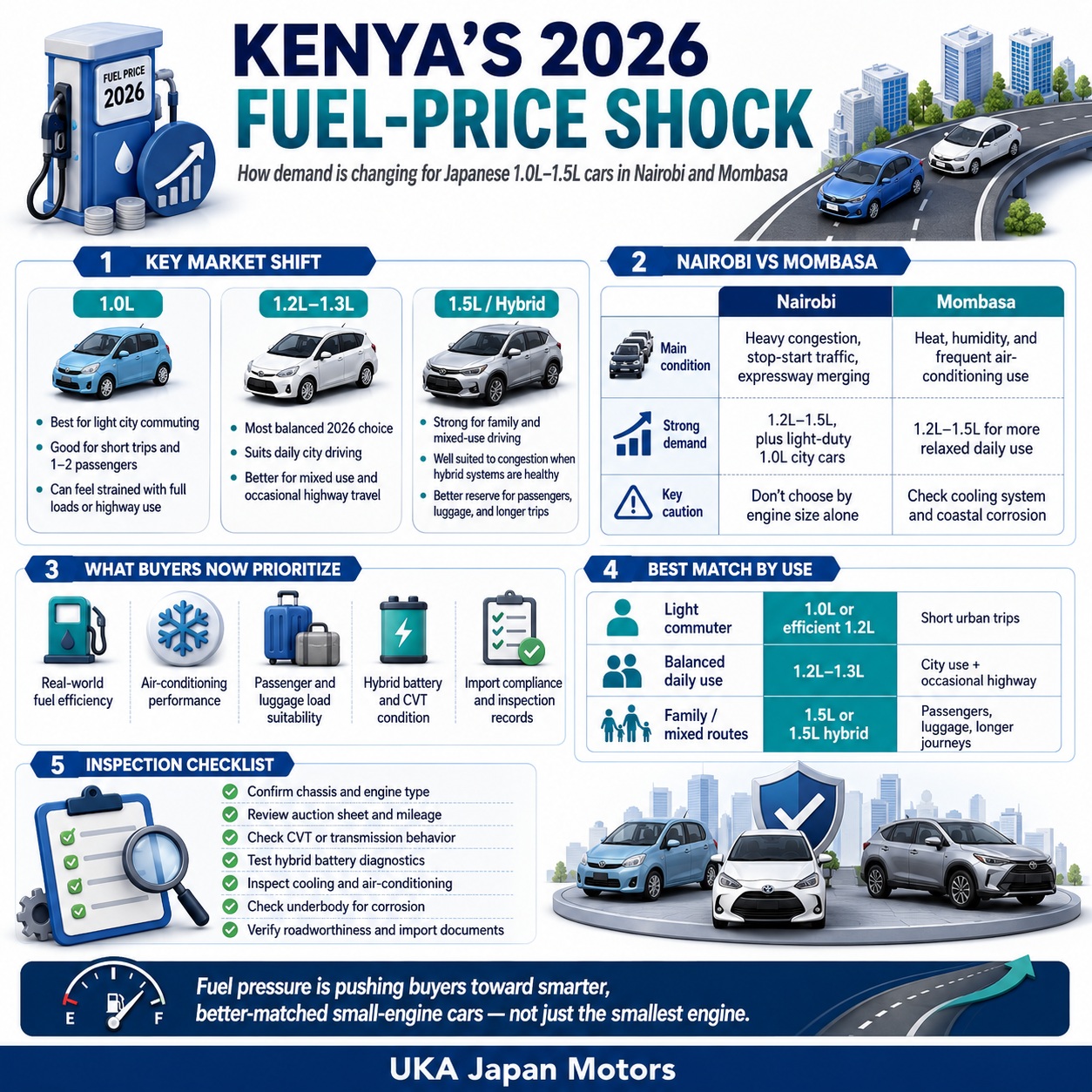
Kenya’s 2026 fuel-price shock is changing more than how frequently motorists visit filling stations. It is changing the questions buyers ask before selecting a vehicle.
Engine capacity has always influenced vehicle choice, but it is now being examined more carefully. Nairobi and Mombasa buyers are no longer treating every compact Japanese car as equally efficient simply because it has a small engine. They are comparing engine size with vehicle weight, transmission type, hybrid technology, air-conditioning demands, passenger load, road conditions and expected driving distance.
This has brought Japanese cars in the 1.0-litre to 1.5-litre range into sharper focus. The segment includes basic petrol hatchbacks, compact sedans, mild hybrids, full hybrids and series-hybrid vehicles. Although these vehicles occupy a relatively narrow engine-capacity band, they can behave very differently on Kenyan roads.
The 2026 fuel situation has been unusually disruptive. Kenya’s regulated pump-price system has been exposed to continuing international petroleum volatility, while local interventions have been used to limit abrupt changes at the pump. Kenya imports its refined petroleum requirements, making domestic fuel conditions sensitive to global product markets, exchange-rate movement and shipping disruption. The pressure has extended beyond private motorists into the public transport sector, demonstrating how strongly fuel conditions influence daily mobility in Kenya.
As a result, buyers are moving beyond the simple assumption that a 1.0-litre car must always be the most suitable choice. Demand is increasingly concentrating on vehicles that provide the right balance between fuel use and real-world capability.
Direct answer
Kenya’s 2026 fuel-price shock is strengthening demand for Japanese cars between 1.0 and 1.5 litres, but the strongest interest is not necessarily going to the smallest engine.
The market is separating into three practical groups:
| Engine group | Demand pattern in 2026 | Best suited to | Main concern |
|---|---|---|---|
| 1.0L | Strong interest from light urban users | Short city trips, solo commuting and light passenger loads | Can feel strained with full occupancy, constant air conditioning or frequent highway use |
| 1.2L–1.3L | Increasingly viewed as the balanced urban choice | Nairobi commuting, Mombasa city use and occasional longer journeys | Transmission and maintenance condition matter greatly |
| 1.5L | Strong demand among mixed-use and family buyers | City traffic, family use, regular highway driving and hybrid applications | Buyers must distinguish ordinary petrol systems from hybrid systems and inspect each correctly |
The main shift is therefore not simply from large engines to small engines. It is from loosely defined vehicle preferences to more calculated matching of engine, powertrain and daily use.
A 1.0-litre hatchback may be well matched to a lightly loaded Nairobi commuter. A 1.2-litre compact may provide a better balance for mixed urban duties. A 1.5-litre hybrid may use fuel more effectively in congestion than a smaller conventional petrol car driven continuously at high engine speed.
Engine capacity is becoming a starting point rather than the final decision.
A note on measuring demand
Publicly available Kenyan vehicle data does not yet provide a complete, current breakdown showing nationwide 2026 registrations by every small engine-capacity band, model and powertrain.
Demand changes should therefore be understood through observable buyer behaviour, model enquiries, importer sourcing patterns, vehicle availability and the questions being raised during selection. It would be misleading to present a precise national market-share percentage without sufficiently detailed registration evidence.
What can be established is that fuel pressure has made engine efficiency, hybrid condition and trip suitability more important in vehicle selection. The change is visible in how buyers compare vehicles, even where a complete national statistical breakdown is unavailable.
Why the 1.0L–1.5L range matters in Kenya
The segment is broad enough to serve several different ownership needs while remaining compact enough for dense urban use.
Japanese vehicles available within this range include:
- Lightweight 1.0-litre petrol hatchbacks
- 1.2-litre conventional petrol cars
- 1.2-litre series-hybrid vehicles
- 1.3-litre petrol hatchbacks and compact sedans
- 1.5-litre petrol hatchbacks, sedans and wagons
- 1.5-litre full hybrids
- Compact multi-purpose vehicles using 1.5-litre engines
Models commonly encountered include different versions of the Toyota Passo, Toyota Vitz, Toyota Aqua, Nissan March, Nissan Note, Suzuki Swift, Honda Fit, Mazda Demio or Mazda2, Toyota Corolla Axio, Toyota Corolla Fielder and Toyota Sienta.
Specifications vary by year, chassis code and grade. For example, Toyota offered 2019 Vitz versions with 1.0-litre and 1.3-litre engines, while its Aqua uses a 1.5-litre hybrid engine. Nissan’s Note range includes 1.2-litre petrol-based configurations, including e-POWER versions, and Mazda’s compact Mazda2 range includes 1.5-litre petrol applications.
These examples illustrate why engine capacity cannot be interpreted in isolation. A 1.2-litre Nissan Note e-POWER does not deliver power to the wheels in the same way as an ordinary 1.2-litre petrol hatchback. A 1.5-litre Toyota Aqua is not directly comparable with a conventional 1.5-litre sedan merely because the displacement figure is similar.
What the fuel shock is changing in buyer behaviour
Buyers are asking about actual use rather than brochure claims
Official consumption figures are recorded under controlled testing conditions. They are useful for comparing versions of the same model, but they cannot reproduce every Kenyan operating condition.
Nairobi congestion, repeated acceleration, road diversions, steep sections, long idling periods and inconsistent traffic flow can alter consumption substantially. In Mombasa, continuous air-conditioning, high ambient temperatures, short trips and coastal traffic patterns can produce a different result.
Buyers are therefore paying more attention to questions such as:
- How does the car behave in stop-and-go traffic?
- Does the engine remain relaxed with the air conditioner operating?
- What happens when four or five occupants are carried?
- Is the vehicle mainly for town use or regular highway travel?
- Is the transmission healthy?
- Does a hybrid battery still operate correctly?
- Is the engine being forced to work harder because the vehicle is overloaded or poorly maintained?
These questions are more useful than relying on engine capacity alone.
Demand is moving toward balanced powertrains
The fuel shock has made extreme choices less appealing.
At one end, a larger engine may be unsuitable for a buyer whose vehicle spends nearly all its time in dense city traffic. At the other end, the smallest available engine may operate under constant strain if the vehicle carries passengers, luggage or commercial loads.
This has increased interest in the middle of the segment, particularly efficient 1.2-litre, 1.3-litre and 1.5-litre configurations. These engines may provide enough reserve for merging, overtaking and carrying passengers without requiring heavy accelerator input during every journey.
Hybrid knowledge is becoming part of ordinary vehicle buying
Hybrid questions were once treated as specialist concerns. In 2026, they are becoming normal ownership questions.
Buyers now want to know:
- Whether the vehicle is a mild hybrid, full hybrid or series hybrid
- How the traction battery has been evaluated
- Whether warning lights have been cleared without resolving the underlying issue
- Whether cooling vents for the hybrid battery are clean
- Whether the system has stored diagnostic faults
- Whether replacement components can be correctly identified by chassis number
- Whether technicians familiar with the system are available in Nairobi or Mombasa
The growing interest is understandable. Stop-and-go traffic gives some hybrid systems frequent opportunities to recover energy during deceleration and reduce unnecessary engine operation. However, the benefit depends on system condition, driving pattern and correct maintenance.
Nairobi: why the smallest engine is not always the best answer
Nairobi creates a complex environment for small-engine cars.
The city includes severe congestion, short bursts of acceleration, long stationary periods and sections where drivers must merge decisively. A vehicle may spend much of the day moving slowly, yet still require adequate power for roundabouts, inclines, overtaking manoeuvres and expressway entry.
Where a 1.0L car works well in Nairobi
A well-maintained 1.0-litre hatchback can be suitable where the owner:
- Usually travels alone or with one passenger
- Carries little luggage
- Operates mainly within urban areas
- Uses the vehicle for short to moderate daily distances
- Does not regularly travel with full occupancy
- Maintains correct tyre pressure and service condition
- Accepts modest acceleration when the vehicle is loaded
Its compact dimensions also help in tight parking spaces and crowded streets.
Where a 1.0L car may become less suitable
The same vehicle may feel less appropriate when it is expected to:
- Carry several adults regularly
- Operate with the air conditioner continuously
- Climb steep sections under load
- Make frequent long-distance journeys
- Carry business equipment or heavy luggage
- Maintain highway speed for extended periods
- Accelerate repeatedly into fast-moving traffic
A small engine can consume more fuel than expected when the driver must use deep accelerator input continuously. The issue is not that the engine is defective. It may simply be mismatched to the assignment.
Why 1.2L–1.5L cars are gaining attention in Nairobi
A 1.2-litre or 1.3-litre hatchback can provide a useful compromise between compact dimensions and usable torque. A 1.5-litre petrol or hybrid vehicle may suit families, mixed city-highway driving and owners who require stronger acceleration.
The key is to compare complete vehicles rather than displacement labels.
A lightweight 1.2-litre hatchback may feel more responsive than a heavier 1.5-litre multi-purpose vehicle. A 1.5-litre hybrid may behave more smoothly in congestion than a conventional small petrol engine paired with an unsuitable transmission.
Mombasa: heat, air conditioning and coastal use change the calculation
Mombasa motorists face a different set of conditions.
Traffic congestion remains important, but heat and humidity make air-conditioning performance a more consistent part of daily vehicle use. A vehicle that appears efficient under mild operating conditions can behave differently when the compressor is engaged for much of the journey.
Why air-conditioning load matters
An air-conditioning compressor requires energy. In a conventional petrol vehicle, this load is ultimately supplied by the engine. The effect is usually more noticeable in a low-output engine, especially during acceleration or when the vehicle is carrying several occupants.
This does not automatically disqualify a 1.0-litre car from Mombasa. It means that the engine, cooling system, compressor and transmission must be in healthy condition.
A neglected cooling system can become particularly problematic in coastal heat. An inefficient compressor can place unnecessary load on the engine. A blocked condenser or weak cooling fan can reduce cabin cooling and raise operating temperatures.
Why 1.2L–1.5L vehicles may feel more relaxed in Mombasa
The additional engine reserve available in many 1.2-litre to 1.5-litre cars can make the vehicle feel less strained when:
- The air conditioner remains on
- Several passengers are carried
- Traffic repeatedly stops and starts
- The vehicle travels beyond the central urban area
- Luggage is carried
- The driver needs steady highway performance
The result depends on vehicle weight and gearing, but many buyers find the middle of the capacity range more adaptable than the smallest option.
Coastal inspection is essential
Fuel efficiency should not distract buyers from corrosion inspection.
A Japanese import should be examined for existing underbody corrosion before purchase and protected appropriately once used in Mombasa. Coastal air can accelerate deterioration of exposed fasteners, suspension components, exhaust sections, electrical connections and damaged body seams.
A fuel-efficient car with developing structural or electrical problems is not a sound long-term choice. Efficiency must be considered alongside condition.
Comparing the three main engine groups
1.0L: maximum simplicity for light-duty urban use
The typical 1.0-litre Japanese city car is compact and relatively light. Many use a three-cylinder naturally aspirated petrol engine paired with a continuously variable transmission.
Its strengths include easy manoeuvrability, modest fuel demand during light use and suitability for short urban journeys.
Its limitations appear when vehicle mass and operating load increase. Full occupancy, luggage, steep roads and continuous air-conditioning can require the engine to remain at higher speed.
Some drivers interpret high engine speed as a transmission fault. In a healthy continuously variable transmission, the system may hold engine speed where power is available while road speed rises. Nevertheless, persistent flaring, delayed engagement, vibration or poor acceleration still requires mechanical investigation.
A 1.0-litre vehicle is best selected for a clearly defined light-duty role.
1.2L–1.3L: the practical middle ground
This group includes ordinary petrol engines, mild hybrids and series-hybrid systems.
Conventional versions can provide useful urban performance without adding unnecessary vehicle size. Models such as the Suzuki Swift use 1.2-litre engine configurations, while Nissan’s compact Note family has used 1.2-litre petrol engines in both ordinary and e-POWER applications.
This capacity group often suits buyers who need:
- Daily city commuting
- Occasional family use
- Regular air-conditioning
- Moderate luggage capacity
- Periodic highway travel
- A balance between agility and usable power
The powertrain still matters. A series-hybrid vehicle uses its petrol engine primarily to generate electrical energy while an electric motor drives the wheels. Its response and maintenance requirements differ from those of a conventional petrol car.
1.5L: stronger mixed-use capability
The 1.5-litre group includes petrol hatchbacks, compact sedans, wagons, hybrids and multi-purpose vehicles.
A 1.5-litre engine generally provides more reserve for passenger loads and highway driving. It may be better suited to a family vehicle that must operate in Nairobi during the week and undertake longer Kenyan journeys when required.
Full hybrids in this group can be particularly well suited to congested urban use when the traction battery and related systems are healthy. The Toyota Aqua, for example, uses a 1.5-litre hybrid configuration, while 1.5-litre petrol configurations are also found in models such as the Mazda2.
However, a 1.5-litre badge does not guarantee better performance or lower consumption. A heavier body, poor maintenance, unsuitable tyres or deteriorated hybrid components can remove much of the expected advantage.
Nairobi and Mombasa comparison
| Ownership factor | Nairobi | Mombasa |
|---|---|---|
| Main efficiency challenge | Severe congestion, repeated acceleration and long idling periods | Heat, continuous air-conditioning and congested coastal traffic |
| Strong case for 1.0L | Light commuting with one or two occupants | Short urban journeys in a healthy, lightly loaded vehicle |
| Strong case for 1.2L–1.3L | Balanced commuting with occasional family and highway use | Urban use requiring more reserve for air conditioning and passengers |
| Strong case for 1.5L | Mixed family use, expressway sections and regular longer journeys | Family use, regular travel beyond central Mombasa and sustained air-conditioning |
| Critical inspection area | CVT behaviour, suspension wear, hybrid diagnostics and previous congestion-related use | Cooling system, air-conditioning, underbody corrosion and electrical connections |
| Common selection mistake | Choosing only by claimed fuel consumption | Ignoring air-conditioning load and coastal deterioration |
Why two cars with the same engine size can use fuel differently
Vehicle weight
A small engine in a light hatchback has less mass to move than the same engine in a tall or heavily equipped body.
Passengers, luggage and accessories also affect total operating weight. A car that performs efficiently with one occupant may behave differently with five occupants and a full luggage area.
Transmission design
Transmission behaviour strongly influences engine speed and throttle response.
A healthy CVT can keep the engine in an efficient operating range. A neglected CVT can produce hesitation, shuddering, overheating or excessive engine speed without proportional acceleration.
Traditional automatic transmissions, automated manuals and hybrid transaxles each behave differently. The correct fluid, inspection method and service procedure must be identified using the chassis and transmission code.
Tyres and wheel changes
Larger or heavier wheels can change rolling resistance and acceleration. Incorrect tyre pressure also increases the effort required to move the vehicle.
A Japanese compact originally designed for lightweight wheels may not maintain its expected efficiency after unnecessary wheel modifications. Tyre condition, specification and alignment should therefore form part of the inspection.
Engine condition
Worn spark plugs, dirty injectors, restricted air filters, failing sensors and incorrect oil can reduce efficiency.
A dashboard without warning lights does not prove that the engine-control system is healthy. Warning lights may have been recently cleared, while stored or pending diagnostic codes remain.
Driving style
Aggressive acceleration followed by abrupt braking wastes energy. This is particularly noticeable in a small naturally aspirated engine, where the driver may use high throttle input to compensate for limited torque.
Smooth anticipation is especially helpful in Nairobi traffic. In a hybrid, controlled deceleration can also improve regenerative-energy recovery.
Air-conditioning condition
A healthy air-conditioning system should cool the cabin without placing abnormal load on the engine.
A weak compressor, blocked condenser, failing fan or incorrect refrigerant condition can make the system operate inefficiently. In Mombasa, where air-conditioning may be used on most journeys, these faults deserve careful attention.
Conventional petrol, mild hybrid, full hybrid and e-POWER
The fuel shock is also increasing the need to understand powertrain terminology.
Conventional petrol
A conventional petrol vehicle uses the engine to propel the wheels through a transmission.
It is mechanically familiar to many technicians and may suit buyers who prefer a straightforward system. Its actual consumption depends heavily on engine load, gearing and traffic conditions.
Mild hybrid
A mild hybrid uses a small electric system to assist selected functions. Depending on the design, it may support acceleration, recover energy during deceleration and reduce engine operation in limited circumstances.
It normally cannot drive for meaningful distances using electrical energy alone.
Full hybrid
A full hybrid can use the petrol engine, electric motor or a combination of both. It is often effective in stop-start driving because it can recover braking energy and reduce unnecessary engine operation.
The traction battery does not need to be new to function correctly, but it must be balanced, properly cooled and free from significant diagnostic faults.
Series hybrid or e-POWER
In a series-hybrid arrangement, the electric motor drives the wheels while the petrol engine operates as part of the electrical generation system.
The driving response can feel similar to an electric vehicle because wheel torque comes from the motor. However, the vehicle still requires petrol and includes an engine, generator, inverter, battery and electric drive system.
This configuration should not be inspected as though it were an ordinary petrol hatchback. Nissan identifies e-POWER as a distinct electrified powertrain used in its Note range.
Inspection priorities before selecting a small-engine Japanese import
Fuel pressure can encourage buyers to focus too narrowly on the consumption figure. Condition remains more important than the badge on the boot.
Confirm the exact chassis and powertrain
The model name alone is insufficient.
One model may have several engines, transmissions, drive layouts and hybrid versions. The chassis code should be matched against the auction sheet, export certificate, inspection record and physical identification plates.
Review the auction documentation
The auction sheet should be examined for:
- Recorded mileage
- Repair history
- Panel replacement
- Corrosion remarks
- Interior condition
- Warning-light comments
- Underbody observations
- Model grade
- Chassis identification
A translated summary should not replace the original document.
Check cold-start behaviour
The engine should be observed before it has warmed up.
Cold-start inspection can reveal abnormal timing noise, unstable idle, smoke, delayed engagement or warning lights that become less obvious after warm-up.
Evaluate the transmission
A CVT or automatic transmission should engage smoothly and respond consistently.
Inspection should look for:
- Engagement delay
- Shuddering
- Abnormal whining
- Fluid leakage
- Overheating indications
- Stored transmission codes
- Engine-speed increase without suitable acceleration
Inspect hybrid systems properly
A hybrid inspection should include more than checking whether the vehicle starts.
Relevant checks include:
- Traction-battery data
- Battery block consistency
- Cooling-fan operation
- Inverter-related faults
- Regenerative-braking behaviour
- Hybrid warning history
- Twelve-volt battery condition
- Evidence of water intrusion
- Correct operation after full warm-up
Inspect the cooling system
Cooling condition is particularly important in Mombasa but remains necessary in Nairobi.
The radiator, coolant, hoses, water pump, cooling fans and reservoir should be examined. Signs of previous overheating require careful investigation.
Test air-conditioning performance
Cabin cooling should be assessed together with compressor noise, fan operation and engine response.
A weak system should not automatically be dismissed as requiring a simple refrigerant refill. Leakage, compressor wear and electrical faults must be considered.
Examine suspension and ground clearance
Compact Japanese cars are designed primarily for paved-road operation. Damaged undertrays, bent components, leaking dampers and worn bushes can affect stability and tyre wear.
The buyer should assess whether the chosen car’s clearance and suspension suit the roads used most often.
Check for corrosion
Underbody corrosion should be examined before shipment and after arrival.
Mombasa owners should pay particular attention to:
- Suspension mounting areas
- Brake pipes
- Exhaust joints
- Electrical earth points
- Fasteners
- Wheel arches
- Previous body repairs
- Drainage channels
Import and compliance requirements in 2026
Fuel efficiency does not override import compliance.
For 2026 entry into Kenya, used vehicles must observe the eight-year age requirement. Only qualifying right-hand-drive vehicles first registered from January 2019 onward are eligible under the applicable 2026 age window. KEBS also requires roadworthiness compliance, while KRA states that an imported used vehicle must be within the permitted age limit, right-hand drive and inspected by a KEBS-appointed agent before export.
Vehicles sourced from Japan are handled through KEBS-appointed inspection arrangements. KEBS identifies the Certificate of Roadworthiness as a core motor-vehicle conformity document, and its published inspection information provides facilities for verifying vehicle inspection details by chassis number.
Important supporting documents include:
- Original commercial invoice
- Original cancelled foreign logbook or appropriate export record
- Original bill of lading
- Certificate of Roadworthiness or pre-shipment inspection record
- Importer identification documents
- Matching chassis and vehicle details
KRA notes that the cancelled foreign logbook is required for the process leading to issuance of the Kenyan logbook through the National Transport and Safety Authority.
The year of manufacture should not be casually substituted for the year of first registration. The relevant records must be checked directly. A vehicle that appears to be a qualifying production year can still face compliance difficulty if its registration documentation does not support eligibility.
Matching engine capacity to real ownership patterns
Light Nairobi commuter
A 1.0-litre or efficient 1.2-litre hatchback may be suitable where the car normally carries one or two occupants and remains within urban areas.
Priorities should include compact dimensions, healthy CVT operation, good cooling performance and correct tyre specification.
Nairobi family with mixed driving
A 1.3-litre or 1.5-litre vehicle is often better matched to family loads, expressway use and occasional longer travel.
A healthy full hybrid may suit heavy congestion, while an ordinary petrol version may suit an owner seeking a simpler powertrain.
Mombasa urban user
A 1.0-litre or 1.2-litre car can work well for short journeys, but air-conditioning and cooling condition become decisive.
The vehicle should not be selected merely because its engine is small.
Mombasa family or mixed-route user
A 1.3-litre or 1.5-litre vehicle may provide better reserve when carrying passengers in hot conditions.
Underbody condition, air-conditioning performance and cooling-system health deserve particular attention.
Regular Nairobi–Mombasa traveller
A 1.5-litre car will generally provide a more relaxed match for sustained highway use, overtaking and luggage.
A smaller engine can complete the journey, but it may need to work harder, particularly when fully loaded. Tyres, brakes, cooling, suspension and transmission condition are at least as important as fuel efficiency.
Business user carrying equipment
A vehicle intended to carry tools, products or equipment should be assessed according to payload.
A small engine does not automatically provide lower fuel use when it is continuously overloaded. Vehicle classification, suspension design and cargo capacity should be appropriate for the assignment.
When a 1.0L car may not be suitable
A 1.0-litre vehicle may be unsuitable when:
- Full occupancy is common
- Heavy luggage is carried regularly
- Highway travel dominates
- Strong overtaking performance is required
- The vehicle operates on steep roads
- Air conditioning remains on continuously under load
- The body is relatively heavy
- Commercial duties exceed the vehicle’s intended design
- Ground clearance is inadequate for frequently used roads
The correct response is not necessarily to move to a much larger engine. A well-matched 1.2-litre, 1.3-litre or 1.5-litre vehicle may solve the capability problem while keeping fuel use controlled.
When a 1.5L car may be unnecessary
A 1.5-litre car may provide more capability than required where the owner:
- Travels only short urban distances
- Usually drives alone
- Rarely carries luggage
- Does not use highways regularly
- Prioritises compact parking dimensions
- Has no need for a larger body
Even then, displacement should not be treated as the only measure. A lightweight 1.5-litre hybrid can behave very differently from a heavier conventional 1.5-litre vehicle.
The question should remain: which complete vehicle best matches the intended use?
Long-term ownership under continued fuel pressure
Record actual consumption
Owners should record fuel filled and distance travelled rather than relying entirely on the dashboard display.
A sudden change can indicate tyre-pressure loss, brake drag, sensor problems, poor fuel quality, overdue servicing or changes in driving conditions.
Maintain the correct service specification
Engine oil, transmission fluid, coolant and spark plugs should meet the vehicle’s specified requirements.
Using a familiar but incorrect fluid can harm a Japanese compact’s CVT, hybrid transaxle or cooling system.
Keep the cooling system healthy
Cooling maintenance becomes increasingly important as vehicles age.
Radiator blockage, weak fans and deteriorated coolant can affect engine efficiency before a serious overheating event occurs.
Protect hybrid battery ventilation
Hybrid-battery cooling vents should remain clean and unobstructed.
Dust, fabric fibres and luggage can restrict airflow, raising battery temperature and reducing performance.
Avoid unnecessary wheel modifications
Heavier wheels and unsuitable tyre sizes can affect ride comfort, acceleration, steering and fuel use.
The original specification should remain the reference point.
Address warning lights properly
Clearing a warning code does not repair the fault.
Diagnostic results should be recorded, interpreted and followed by confirmation that the underlying problem has been resolved.
Manage coastal exposure
Mombasa vehicles should receive regular underbody and electrical-condition checks. Corrosion prevention is an ongoing ownership practice rather than a single inspection.
How demand is likely to develop after the 2026 shock
Interest in 1.0L–1.5L Japanese cars is likely to remain strong because fuel conditions have made efficiency a permanent ownership consideration.
However, the character of demand is becoming more informed.
Buyers are likely to separate the segment into:
- Basic light-duty city cars
- Balanced petrol hatchbacks
- Efficient compact sedans
- Full hybrids for congestion
- Series hybrids for smooth urban response
- Compact family vehicles with stronger 1.5-litre capability
The strongest models will not necessarily be those with the smallest engines. They will be vehicles that combine suitable capacity, manageable weight, reliable transmissions, available technical support and verified condition.
Demand may also become more chassis-specific. Two vehicles carrying the same model name can have different engines, safety equipment, transmissions and hybrid systems. Buyers who understand those differences will be better positioned to select a suitable vehicle.
UKA Japan Motors’ role in small-engine vehicle selection
UKA Japan Motors’ role is to help buyers examine whether a Japanese vehicle is mechanically, operationally and legally suited to use in Kenya.
For a 1.0L–1.5L vehicle, this means looking beyond the engine badge. Relevant areas include:
- Chassis and grade confirmation
- Auction-sheet review
- Mileage consistency
- Accident and repair history
- Engine and transmission condition
- Hybrid-system information
- Cooling and air-conditioning condition
- Underbody and corrosion observations
- Roadworthiness inspection status
- Import-document consistency
- Compliance with the applicable first-registration window
Guidance should also reflect how the vehicle will be used. A recommendation for a lightly loaded Nairobi commuter should not automatically be applied to a Mombasa family using air conditioning throughout the day.
The Nairobi and Mombasa branches can apply the same documentation and inspection principles while accounting for different local driving conditions.
Frequently asked questions
1. Is a 1.0L car always the most fuel-efficient option in Kenya?
No. A 1.0-litre car can be efficient when lightly loaded and used mainly in town. If it is continuously driven at high engine speed, fully occupied or used for highway travel, a larger but better-matched engine may operate more effectively.
2. Is a 1.0L car suitable for Nairobi traffic?
It can be suitable for a solo commuter or light urban user. Buyers should confirm that acceleration, transmission response, cooling and air-conditioning performance are adequate for their expected routes.
3. Is a 1.0L car suitable for Mombasa?
Yes, provided the vehicle is healthy and used within its capability. Air-conditioning load, engine cooling and coastal corrosion require particular attention.
4. Is a 1.5L hybrid better than a 1.0L petrol car?
Neither is automatically better. A 1.5-litre hybrid may suit congestion and family use, while a 1.0-litre petrol car may suit short, lightly loaded journeys. Battery condition, vehicle weight and driving pattern determine the better match.
5. What engine size is best for regular Nairobi–Mombasa travel?
A well-maintained 1.5-litre vehicle will generally provide more relaxed highway performance, particularly with passengers and luggage. Tyres, brakes, cooling and transmission condition must also be suitable for regular long-distance use.
6. Does a small engine struggle when the air conditioner is on?
The compressor adds load. The effect may be more noticeable in a low-output engine, especially during acceleration or with several occupants. A healthy system should remain usable, but poor cooling or compressor condition can make the effect worse.
7. Are all Nissan Note models ordinary 1.2L petrol cars?
No. The Note range includes different powertrains, including conventional petrol and e-POWER versions. The chassis code and system type must be confirmed before inspection or maintenance.
8. Does the Toyota Aqua have a small engine?
The Aqua uses a 1.5-litre petrol engine as part of its hybrid system. Its operating behaviour should be evaluated as a complete hybrid powertrain rather than compared with an ordinary petrol vehicle by engine capacity alone.
9. Should a buyer choose a car using the dashboard fuel-consumption display?
The display can be useful for observing trends, but it should not be treated as an independent verification. Actual distance and fuel records provide a stronger ownership reference.
10. What should be checked on a used Japanese CVT?
Check engagement, acceleration response, shuddering, noise, fluid condition, leaks, diagnostic codes and evidence of overheating. The correct service fluid must be identified from the vehicle specification.
11. What should be checked on a hybrid battery?
Inspection should review battery-block consistency, temperature readings, cooling performance, stored faults, warning history and general system operation. Simply confirming that the vehicle moves is insufficient.
12. What first-registration year qualifies for used imports in Kenya during 2026?
The applicable 2026 window permits qualifying right-hand-drive vehicles first registered from January 2019 onward. The registration and export documents must support the declared year.
13. Can a vehicle be selected using only the model name?
No. The model name may cover several engines, transmissions, drive systems and equipment grades. The chassis code should be confirmed before making technical or compliance conclusions.
14. Why is underbody inspection important for a fuel-efficient Mombasa car?
Coastal exposure can accelerate corrosion on metal components and electrical connections. Fuel efficiency does not compensate for structural, braking, suspension or electrical deterioration.
Conclusion
Kenya’s 2026 fuel-price shock is increasing demand for Japanese 1.0L–1.5L cars, but it is also making buyers more selective.
The smallest engine is no longer automatically treated as the correct answer. Nairobi buyers must consider congestion, acceleration, passenger load and occasional highway use. Mombasa buyers must also account for continuous air-conditioning, cooling-system demands and coastal corrosion.
For light urban duties, a healthy 1.0-litre car may be entirely appropriate. For broader use, the 1.2-litre to 1.3-litre range often provides a useful balance. A 1.5-litre petrol or hybrid vehicle may better suit families, longer journeys and regular passenger loads.
The correct choice comes from matching the complete vehicle to its intended role. Engine size, body weight, transmission, hybrid technology, documentation and mechanical condition must all be assessed together.
Contact UKA Japan Motors for availability and inspection guidance.