


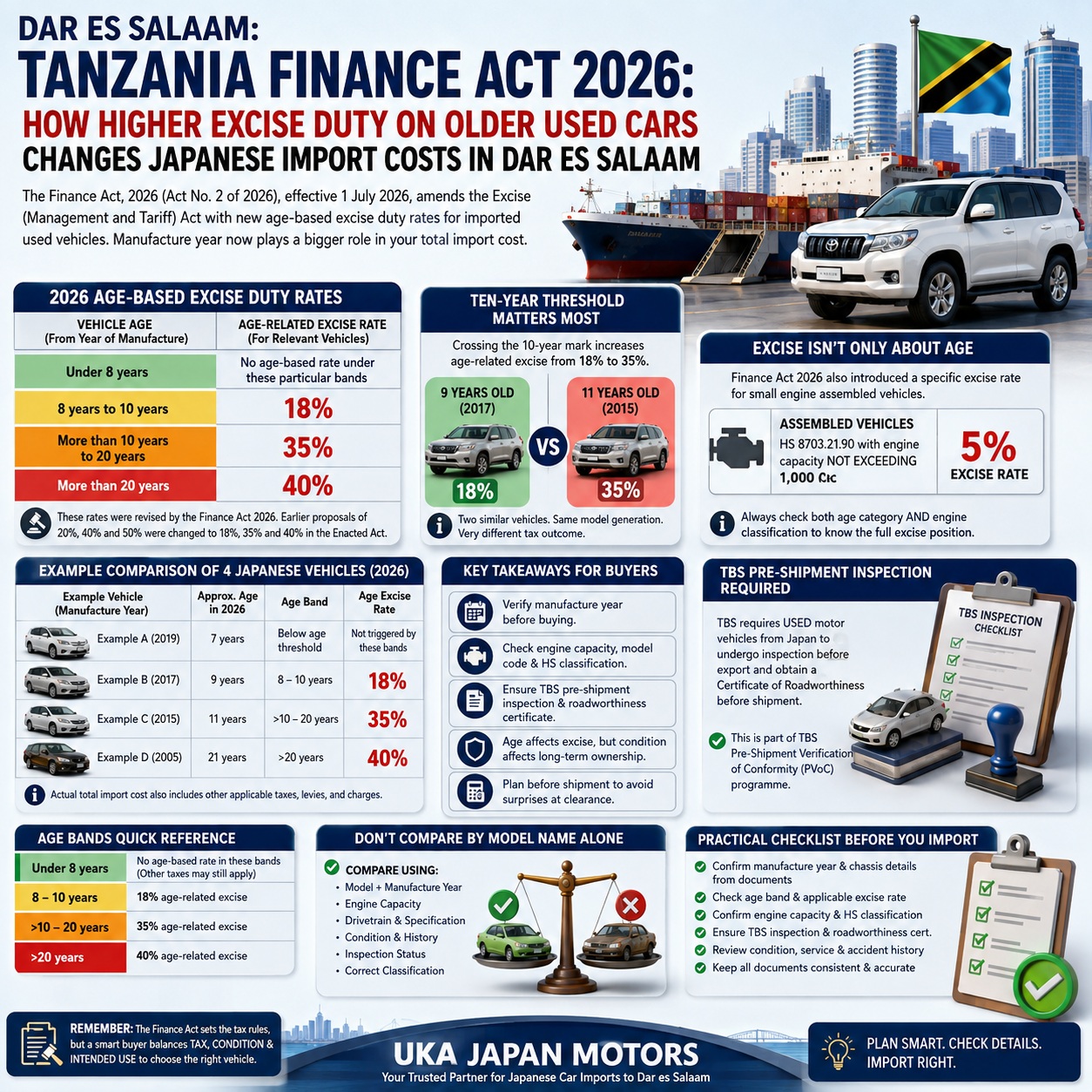
For buyers importing Japanese used vehicles into Dar es Salaam, the year of manufacture has become even more important under Tanzania’s Finance Act, 2026.
The Finance Act, 2026—Act No. 2 of 2026—came into operation on 1 July 2026. Among its amendments to the Excise (Management and Tariff) Act is a revised age-based excise structure for imported used vehicles. Vehicles aged eight years but not more than ten years are now subject to an 18% age-related excise duty, vehicles aged more than ten but not more than twenty years are subject to 35%, and vehicles exceeding twenty years are subject to 40%, subject to the classifications and exclusions contained in the underlying legislation.
That change alters the way a Dar es Salaam buyer should compare Japanese vehicles. A vehicle should no longer be judged primarily by model name, engine size, mileage or visible condition. Its manufacture year and applicable HS classification can materially change the tax treatment before it is released into Tanzania.
This makes a one-year difference surprisingly important around the ten-year threshold.
For example, two Japanese vehicles may use similar engines, offer comparable equipment and appear mechanically similar, yet sit in different excise bands simply because one has crossed the statutory age boundary.
The practical lesson for 2026 is straightforward: verify age, engine capacity, chassis details and tax classification before committing to a vehicle—not after it reaches Dar es Salaam.
Quick Answer: What Changed Under Tanzania’s Finance Act 2026?
For ordinary imported used vehicles falling within the relevant age-based excise provision, the 2026 structure is:
| Vehicle age | 2026 age-related excise rate |
|---|---|
| Under 8 years | No age-based rate under these particular bands |
| 8 years to 10 years | 18% |
| More than 10 years to 20 years | 35% |
| More than 20 years | 40% |
The Finance Act amended section 126 of the Excise (Management and Tariff) Act to create these bands. The legislation took effect on 1 July 2026.
Before the 2026 amendment, the revised Excise Act contained a 15% additional rate for imported vehicles aged eight years but not more than ten years and a 30% rate for vehicles aged more than ten years. The older provision also establishes that the relevant age is counted from the vehicle’s year of manufacture.
The important change is therefore not merely an increase in percentages. The legislation now creates a separate over-20-year category, while the difference between the 8–10-year and over-10-year groups has widened significantly.
Why the Change Matters Particularly in Dar es Salaam
Dar es Salaam is where the tax rule becomes a practical vehicle-selection issue.
A buyer choosing a Japanese import typically encounters several different questions before the vehicle can enter normal use:
- What is the confirmed year of manufacture?
- What engine is actually fitted?
- Which HS code applies?
- Has the vehicle undergone the required conformity inspection before shipment?
- Do the chassis and inspection documents agree?
- Which excise provisions apply when the vehicle is declared?
- Has the vehicle crossed an age threshold by the time the applicable tax rules are applied?
These questions are connected.
A vehicle that looks suitable from photographs can become problematic if the manufacture year has been misunderstood, the model code points to a different specification, or documentation supplied before shipment does not correspond exactly with the vehicle presented for clearance.
TBS also requires used motor vehicles from Japan to be inspected before export and issued with the required roadworthiness documentation. TBS has repeatedly reminded importers that used vehicles from Japan are covered by its pre-shipment conformity system rather than treating Dar es Salaam arrival as the normal first point of inspection.
That is why tax planning and inspection planning should happen together.
The 2026 Excise Bands Explained in Practical Terms
Vehicles Less Than Eight Years Old
A Japanese vehicle below the eight-year threshold does not enter the three age bands introduced in the amended section: 18%, 35% and 40%.
That does not mean the vehicle is outside the wider tax system.
It means only that the particular additional excise triggered by those age bands is not applicable on account of being eight or more years old. Other taxes, excise classifications, engine-capacity provisions and statutory obligations must still be considered according to the vehicle’s specification and customs classification.
For buyers comparing relatively recent Toyota, Nissan, Honda, Mazda, Subaru or Suzuki vehicles, this distinction makes manufacture-year verification particularly important.
Vehicles Aged Eight to Ten Years
This band now carries an 18% age-related excise duty.
The statutory wording covers an imported vehicle aged eight years but not more than ten years.
That means the ten-year point is significant: a vehicle that remains within the ten-year limit belongs to the 18% band, whereas one that is more than ten years old moves into the 35% category.
For a Dar es Salaam buyer, this is one of the most important dividing lines in the current system.
A ten-year-old vehicle and an eleven-year-old vehicle should therefore not automatically be treated as equivalent choices simply because they belong to the same generation.
Vehicles More Than Ten but Not More Than Twenty Years Old
The next category attracts 35% age-related excise.
This is the category likely to influence many older Japanese SUVs, sedans, wagons and MPVs.
The distinction can be particularly important with long-running model generations. A Toyota Prado, Harrier, RAV4, Noah, Alphard or similar vehicle may have been produced across several years while retaining broadly similar styling.
Two examples from the same generation can therefore receive different age treatment.
The newer vehicle may fall within the 18% bracket while the older example falls within the 35% bracket.
For import planning, generation alone is not enough. Manufacture year must be checked individually.
Vehicles More Than Twenty Years Old
The 2026 law expressly establishes a 40% age-related excise rate for imported vehicles aged more than twenty years.
This is a significant structural change because very old vehicles now occupy their own explicit category.
For a buyer looking at an older Japanese 4×4, performance vehicle, specialist wagon, commercial derivative or durable utility model, mechanical reputation does not override the tax classification.
A well-maintained older vehicle can still be mechanically attractive, but its import decision has to be assessed separately from its condition.
A vehicle can be mechanically sound yet fall into the highest age band.
Manufacture Year Is Now a Core Vehicle Specification
When examining a Japanese import, buyers often concentrate on:
Mileage.
Useful for understanding how much the vehicle has been operated.
Grade or trim.
Useful for determining equipment and specification.
Engine size.
Important for both operation and tax classification.
Drivetrain.
Relevant to road conditions and intended usage.
Condition.
Essential for reliability and ownership.
But under the 2026 tax structure, manufacture year deserves equal attention.
The pre-existing Excise Act frames the age test by reference to the year of manufacture, while the Finance Act 2026 changes the applicable age bands and percentages.
Do not assume that a registration date, auction date, model-generation launch year or seller’s description automatically establishes the relevant manufacture year for Tanzania clearance.
The chassis identity and accompanying records should support it.
A Simple 2026 Age-Band Comparison
Consider four hypothetical Japanese vehicles being assessed under the 2026 rules. These examples illustrate only the age-based excise provision and assume the vehicles fall within the relevant classification.
| Example manufacture year | Approximate age in 2026 | Age band | Age excise |
|---|---|---|---|
| 2019 | 7 years | Below age threshold | Not triggered by these bands |
| 2017 | 9 years | 8–10 years | 18% |
| 2015 | 11 years | >10–20 years | 35% |
| 2005 | 21 years | >20 years | 40% |
The most important contrast is between the 2017 and 2015 examples.
Both may belong to similar generations of vehicles. Their engines may be similar. Their equipment may overlap. Yet they enter substantially different age-related excise categories.
This is why a Dar es Salaam buyer looking at several Japanese listings should not shortlist solely by model.
Shortlist by model + year + engine + chassis specification + condition.
The Ten-Year Boundary Deserves Special Attention
Of all the thresholds, ten years may be the most consequential for mainstream Japanese imports.
The difference between the 8–10-year band and the more-than-10-year band is:
18% versus 35%.
That does not mean every newer vehicle is automatically the right choice.
A poorly maintained newer vehicle can still be a poor ownership decision. Likewise, an older Japanese vehicle with strong maintenance history may be mechanically superior to a neglected newer example.
The point is that condition and tax classification are separate questions.
An intelligent buying process evaluates both.
Vehicle A
Newer manufacture year, weaker condition history.
Vehicle B
Older manufacture year, stronger mechanical history.
The correct decision cannot be made from the age band alone. The buyer needs to consider whether the tax classification, condition, specification and intended long-term use make sense together.
How the New Age Rule Changes the Way Japanese SUVs Should Be Compared
SUVs deserve particular attention because popular Japanese models often remain in production for long periods.
Take vehicles such as:
- Toyota RAV4
- Toyota Harrier
- Toyota Land Cruiser Prado
- Nissan X-Trail
- Subaru Forester
- Mazda CX-5
A buyer may encounter multiple production years within a similar visual design.
Previously, choosing an older example might seem straightforward if the vehicle had acceptable mileage and condition.
In 2026, crossing the ten-year threshold produces a much larger excise distinction.
Therefore, a practical comparison should begin with:
1. Confirm the production year.
2. Establish the relevant age band.
3. Check engine capacity and HS classification.
4. Review condition records and auction documentation.
5. Confirm TBS pre-shipment inspection requirements before loading.
Only after those checks should options be compared as genuinely equivalent candidates.
Engine Size Still Matters: Age Is Not the Only 2026 Excise Change
The Finance Act 2026 also amended the Fourth Schedule of the Excise (Management and Tariff) Act by introducing a 5% excise rate for assembled vehicles under HS Code 8703.21.90 with cylinder capacity not exceeding 1,000 cc.
This matters because a vehicle’s tax profile cannot be determined from age alone.
Consider two variables:
Vehicle age
Determines whether the 18%, 35% or 40% additional age provision applies.
Engine and customs classification
Can trigger separate excise treatment under the tariff schedule.
A buyer considering a compact Japanese vehicle therefore needs to examine both.
This is particularly relevant for small-engine Japanese hatchbacks and city cars where engine capacities around 660cc to 1,000cc are common.
The 2026 change means that “small engine” should no longer automatically be interpreted as having no excise implications.
Why Buyers Should Avoid Comparing Cars Using Engine Capacity Alone
Engine size is easy to understand.
A listing may say:
- 996cc
- 1,198cc
- 1,496cc
- 1,797cc
- 1,986cc
- 2,493cc
But the clearance treatment involves more than that one number.
For a Japanese import, buyers should check the interaction between:
Engine displacement
Year of manufacture
Fuel and powertrain type
Vehicle body/classification
HS code
Applicable excise provisions
Inspection status
This is especially important for hybrid vehicles.
A Toyota hybrid and a conventional petrol model may appear almost identical externally while using different powertrains or model codes. The correct specification should therefore be confirmed from chassis and export documentation rather than inferred from photographs.
Model Codes Become More Important Under the New Rules
Japanese vehicles commonly use detailed chassis or model codes.
Examples may distinguish:
- engine family;
- drivetrain;
- body configuration;
- hybrid versus conventional powertrain;
- generation;
- production period.
For an experienced importer, the model code is not simply a catalogue detail. It is part of the evidence used to establish what the vehicle actually is.
Suppose a Dar es Salaam buyer wants a Toyota Harrier.
“Toyota Harrier” alone is too broad.
The buyer should establish:
- model/chassis code;
- manufacture year;
- engine;
- drivetrain;
- seating specification;
- condition history;
- inspection status.
The same approach applies to RAV4, Prado, Noah, Voxy, Alphard, Axio, Fielder and other frequently imported Japanese vehicles.
How TBS Inspection Fits Into the 2026 Buying Process
Tax compliance is only one part of import compliance.
TBS states that used motor vehicles from Japan must undergo inspection before export and be issued with a Certificate of Roadworthiness before shipment into Tanzania. TBS operates this through its Pre-Shipment Verification of Conformity framework for regulated imports.
TBS introduced Japan-based pre-shipment inspection of used vehicles in 2022 and has continued to remind importers to complete the process before shipment.
For the buyer, the practical order should therefore be:
Before shipment
Verify identity, year, specification and condition.
Before loading
Ensure the required TBS inspection process has been completed.
Before clearance
Ensure the customs declaration uses accurate vehicle information.
Before release
Confirm that the relevant tax and inspection requirements have been satisfied.
Trying to correct identity or specification problems after arrival can complicate the clearance process.
Why a Roadworthiness Certificate Is Not a Full Mechanical Guarantee
An inspection certificate and a buyer’s own condition assessment serve different purposes.
TBS’s inspection system exists to confirm conformity with applicable requirements.
A long-term ownership assessment should go further.
For a Japanese vehicle intended for Dar es Salaam use, buyers should still inspect or verify:
- engine condition;
- transmission behaviour;
- cooling system;
- suspension;
- steering components;
- brake wear;
- underbody condition;
- electronic warning systems;
- hybrid battery condition where applicable;
- previous accident repairs;
- corrosion;
- tyres;
- air-conditioning performance.
Passing the relevant conformity procedure should not be treated as a substitute for choosing a mechanically sound vehicle.
Dar es Salaam Conditions Make Condition Screening Important
The Finance Act encourages buyers to pay greater attention to manufacture year, but ownership decisions should not become tax-only decisions.
A vehicle used regularly around Dar es Salaam can experience prolonged low-speed operation, frequent braking and substantial air-conditioning use. Consequently, cooling-system condition, transmission behaviour, suspension health and air-conditioning performance remain important practical considerations.
A newer manufacture year may produce a different tax classification, but that alone cannot establish whether the vehicle is suitable for years of daily use.
The preferred vehicle is the one where regulatory suitability and mechanical suitability overlap.
Older Japanese Vehicles: When They Can Still Make Sense
The higher excise bands do not mean an older vehicle is automatically unsuitable.
There are legitimate reasons a buyer may choose an older Japanese vehicle:
- preference for a particular engine;
- established mechanical design;
- simpler electronics;
- specific 4WD hardware;
- seating requirements;
- utility-oriented construction;
- known maintenance history;
- availability of familiar replacement components;
- preference for a particular generation.
For example, certain older Toyota 4×4 generations are valued by owners because their design and mechanical configuration suit demanding use.
The new Finance Act does not make such vehicles unusable.
It changes the import-side assessment.
The buyer should knowingly account for the applicable age category rather than discovering it during clearance.
When an Older Vehicle May Be the Wrong Import Choice
An older Japanese vehicle deserves extra caution when several disadvantages appear together:
It falls into the over-10-year or over-20-year excise category.
Its history is unclear.
Its chassis shows corrosion or previous structural repair.
The engine or transmission has uncertain maintenance.
Parts for the specific model code are uncommon.
Electronic systems already show faults.
Its specification is difficult to verify from documentation.
At that point, the issue is not simply the higher excise rate.
It is the combined import and ownership risk.
The 20-Year Band Changes How Classic and Specialist Imports Should Be Evaluated
The 40% band for vehicles more than twenty years old means buyers interested in specialist older Japanese vehicles need a particularly disciplined approach.
A vehicle from an older production period may have:
- unusual model coding;
- discontinued electronics;
- ageing rubber components;
- deteriorated suspension bushes;
- older cooling components;
- corrosion;
- modifications by previous owners;
- non-standard wheels or suspension;
- replacement engines or transmissions.
These issues are independent of the statutory excise rate.
Therefore, importing an over-20-year vehicle should normally be a deliberate decision based on a specific use case or model preference rather than assuming it is interchangeable with a younger everyday vehicle.
Bill Proposals Versus the Final Finance Act: Do Not Use Draft Figures
This point is important because buyers may still encounter older articles discussing the 2026 Budget or Finance Bill.
Initial proposals discussed higher rates of 20% for the 8–10-year category, 40% for more than 10 but not more than 20 years, and 50% for vehicles exceeding 20 years. Those figures were subsequently revised during the parliamentary process.
The enacted Finance Act uses:
18%
35%
40%
This distinction shows why importers should rely on enacted legislation and current authority guidance rather than a summary of an earlier proposal.
Does Every Imported Passenger Vehicle Follow the Same Age Bands?
Not necessarily.
The underlying Excise (Management and Tariff) Act contains classification-specific provisions and exclusions. The age-based provision historically excludes certain passenger vehicles under specified HS codes within Heading 8702, while those categories are addressed separately elsewhere in section 126.
That distinction matters because the words “used vehicle tax” can create the misleading impression that every passenger-carrying vehicle receives identical treatment.
A normal Japanese private car or SUV commonly falls within Heading 8703, while certain vehicles designed to transport larger numbers of passengers can fall under Heading 8702.
The correct approach is therefore:
identify the vehicle first, classify it second, then apply the relevant duty rules.
Do not reverse that process by starting with a desired tax percentage and assuming the vehicle qualifies for it.
Practical 2026 Checklist Before Buying a Japanese Vehicle
A Dar es Salaam buyer can reduce uncertainty by using a document-first process.
Confirm the manufacture year
Do not rely solely on the seller’s headline listing.
Check the Japanese export documentation, chassis information and other available records.
Confirm the chassis/model code
This helps establish the precise generation and specification.
Confirm engine displacement
Do not assume all versions of the same model use the same engine.
Check the applicable age category
For relevant vehicles, establish whether the vehicle falls below eight years, within 8–10 years, over 10–20 years, or above 20 years.
Check the HS classification
This is essential where different vehicle categories receive different treatment.
Check whether another excise provision applies
The 2026 Finance Act’s 5% provision for assembled vehicles not exceeding 1,000cc under HS 8703.21.90 illustrates why age cannot be reviewed in isolation.
Confirm TBS pre-shipment inspection
Used vehicles from Japan should complete the required inspection process before export.
Review mechanical condition
Tax suitability does not correct mechanical defects.
Keep documents consistent
The chassis number, manufacture information, vehicle description and inspection documents should describe the same vehicle accurately.
A Better Way to Shortlist Japanese Imports in 2026
Instead of searching for a model and then selecting whichever listing looks attractive, buyers can use a staged shortlist.
Stage One: Intended Use
Determine whether the vehicle is needed for:
- Dar es Salaam commuting;
- family transport;
- mixed urban and highway use;
- higher-ground-clearance routes;
- seven-seat operation;
- commercial-style utility;
- long-distance travel.
Stage Two: Suitable Models
Select models whose engineering and body configuration fit the intended use.
Stage Three: Suitable Production Years
Now compare the year of manufacture against the Finance Act age thresholds.
Stage Four: Engine and Specification
Compare engine capacity, drivetrain and powertrain.
Stage Five: Condition
Reject vehicles with weak mechanical or structural evidence, regardless of their age category.
Stage Six: Documentation and Inspection
Verify the export and TBS compliance pathway before shipment.
This method prevents taxation from becoming an afterthought.
2017 Versus 2015: Why Two Similar Cars Can Be Very Different Imports
Imagine two comparable Japanese SUVs being considered during 2026.
SUV A
Manufactured in 2017.
Approximate 2026 age: nine years.
Relevant age band: 8–10 years.
Age excise: 18%.
SUV B
Manufactured in 2015.
Approximate 2026 age: eleven years.
Relevant age band: more than 10 but not more than 20 years.
Age excise: 35%.
The difference is not caused by engine size, badge or equipment. It results from the age threshold contained in the legislation.
Now suppose SUV B has a much stronger documented maintenance history.
The buying decision becomes a balance between:
- tax classification;
- mechanical condition;
- intended ownership period;
- model suitability.
This is a much more useful comparison than assuming “newer is always better” or “older is always better.”
Manufacture Year Should Be Checked Before the Vehicle Is Shipped
A common planning mistake is to treat tax classification as a clearance-stage task.
By then, the physical vehicle has already been selected.
A better sequence is:
Vehicle identified → chassis verified → manufacture year confirmed → engine confirmed → age band reviewed → inspection completed → shipment authorised → clearance documentation prepared.
This gives the buyer an opportunity to reconsider the vehicle while alternatives are still available.
Once the wrong vehicle has already been shipped, the buyer has far fewer practical options.
Long-Term Ownership After Clearance
The Finance Act controls the import tax treatment; it does not determine how the vehicle will behave after years of use.
For long-term ownership in Dar es Salaam, consider four areas.
Cooling System
Older radiators, hoses, thermostats, pumps and fans deserve careful examination, especially where a vehicle will spend substantial time operating at low road speeds.
Transmission
CVTs and conventional automatic transmissions should be evaluated for correct operation and maintenance history.
Suspension and Steering
Bushes, dampers, ball joints and steering components can deteriorate even on vehicles with acceptable recorded mileage.
Electronics and Hybrid Systems
Modern Japanese vehicles contain increasingly sophisticated control modules, sensors and hybrid components.
A younger vehicle may bring newer technology, while an older vehicle may offer simpler systems. Neither is automatically superior. The suitable choice depends on condition, diagnostics capability and intended ownership.
How the 2026 Rules May Influence the Japanese Vehicles Seen in Dar es Salaam
The enlarged gap between the 8–10-year and 10–20-year age brackets may encourage importers to scrutinise production years more closely.
That does not mean older vehicles will disappear.
Instead, the market is likely to become more segmented.
Relatively recent imports may increasingly be assessed partly around the statutory age thresholds, while older vehicles may need to justify themselves more strongly through condition, specification or a particular use case.
This is an inference from the structure of the new age-based rates rather than a guarantee of how every buyer will behave.
What the Finance Act Does Not Tell You
The legislation tells you the applicable tax rule.
It cannot tell you:
- whether an engine has been overheated;
- whether a CVT has been neglected;
- whether a hybrid battery is healthy;
- whether the vehicle suffered structural damage;
- whether its mileage history is credible;
- whether a previous owner modified it;
- whether its tyres and suspension are suitable;
- whether its specification matches your daily needs.
Those still require inspection and professional judgement.
The best import decision is therefore based on law + documentation + vehicle condition, not one of those factors alone.
UKA Japan Motors’ Role in a 2026 Import Decision
UKA Japan Motors’ role should be to help buyers understand what vehicle they are actually considering before shipment.
For a 2026 Japanese import into Dar es Salaam, that means paying particular attention to:
- year of manufacture;
- chassis and model code;
- engine specification;
- age-based excise category;
- relevant classification;
- pre-shipment inspection status;
- available condition evidence;
- consistency of documentation.
The objective is not to push a buyer toward the newest or oldest vehicle.
It is to make the choice transparent.
A properly reviewed vehicle should have an understandable regulatory profile and an understandable mechanical profile before it begins its journey to Dar es Salaam.
That inspection-focused approach is especially valuable when two apparently similar Japanese vehicles sit on opposite sides of the ten-year threshold.
Frequently Asked Questions
1. When did Tanzania’s Finance Act 2026 take effect?
The Finance Act, 2026 came into operation on 1 July 2026. It is Act No. 2 of 2026 and amended a number of revenue laws, including the Excise (Management and Tariff) Act.
2. What is the excise rate for an imported used vehicle aged eight to ten years?
For vehicles within the applicable provision, the rate is 18% for an imported vehicle aged eight years but not more than ten years.
3. What happens when a Japanese car is more than ten years old?
A relevant imported vehicle aged more than ten years but not more than twenty years falls into the 35% age-related excise category.
4. What is the 2026 excise rate for a vehicle over twenty years old?
The Finance Act establishes a 40% rate for relevant imported vehicles aged more than twenty years.
5. Is the vehicle’s Japanese auction year enough to determine its tax age?
No. Buyers should verify the actual year of manufacture and vehicle identity from appropriate documentation. The underlying age provision is based on age from the year of manufacture, so seller descriptions should not substitute for document verification.
6. Did the Finance Act also change excise treatment for small-engine vehicles?
Yes. The Finance Act added a 5% excise rate for assembled vehicles classified under HS 8703.21.90 with cylinder capacity not exceeding 1,000cc. It should be considered separately from the age-based analysis.
7. Does every Japanese used vehicle automatically pay 18%, 35% or 40%?
No. Vehicle classification matters. The underlying Excise Act contains exclusions and separate treatment for certain HS classifications. The exact vehicle should be classified before a rate is assumed.
8. Do Japanese used cars need inspection before being shipped to Dar es Salaam?
Yes. TBS states that used vehicles from Japan must undergo the applicable pre-shipment inspection process and obtain the required roadworthiness certification before export to Tanzania.
9. Does passing TBS inspection mean the car will have no mechanical problems?
No. Conformity inspection addresses applicable regulatory requirements. Buyers should separately investigate mechanical condition, accident history, drivetrain health, cooling system, suspension and other long-term ownership factors.
10. Is a ten-year-old car in the same category as an eleven-year-old car?
Not under the relevant 2026 age provision. A vehicle aged ten years remains within the 8–10-year category, while a vehicle more than ten years old moves into the 35% band.
11. Should I automatically choose a vehicle below ten years old?
Not automatically. Age affects the regulatory and excise profile, but condition, service history, drivetrain, intended use, documentation and inspection results remain essential. A manufacture-year advantage cannot compensate for serious mechanical deficiencies.
12. Are the 20%, 40% and 50% figures sometimes reported for 2026 still correct?
Those figures appeared during the proposal stage. Parliament revised the proposed vehicle rates, and the enacted Finance Act establishes 18%, 35% and 40% for the three relevant age categories. Buyers should therefore distinguish an early Finance Bill or Budget summary from the final Act.
Conclusion
Tanzania’s Finance Act 2026 has made the manufacture year of a Japanese used vehicle a more decisive part of import planning in Dar es Salaam.
From 1 July 2026, the applicable age-based excise structure places relevant imported vehicles into three important brackets: 18% at eight to ten years, 35% at more than ten to twenty years, and 40% beyond twenty years.
The largest practical lesson is at the ten-year boundary. Two Japanese vehicles from a similar generation can now occupy very different tax categories even when their body style, engine and equipment appear closely matched.
At the same time, age should never become the only buying criterion. Engine capacity, HS classification, TBS pre-shipment conformity, chassis identity, service history, accident evidence and long-term mechanical suitability all remain important.
For Dar es Salaam buyers, the strongest 2026 approach is therefore to determine the vehicle’s regulatory position before shipment, then assess whether its mechanical condition and specification justify choosing that particular unit.
That produces a more informed import decision than selecting a vehicle first and investigating its age classification only when clearance begins.
Contact UKA Japan Motors for availability and inspection guidance.