


Importing a used Japanese vehicle into Uganda involves more than selecting a vehicle, arranging shipment and completing registration. Before an imported vehicle can move through the customs process, Uganda Revenue Authority (URA) must establish the customs value that applies to it.
This is an important distinction for buyers in Kampala because the customs value should not automatically be understood as whatever figure appears on a seller’s invoice.
URA’s published guidance specifically explains that used motor vehicles are handled through a dedicated valuation approach. URA maintains a Used Motor Vehicle Valuation Database, and its import and export guidance states that this database forms the basis for valuing used motor vehicles rather than simply relying on the invoice presented by the importer. URA links this treatment to the East African Community administrative ruling on valuation of used goods dated 13 December 2013.
URA also publishes a Motor Vehicle Value Guide on its website. The current page identifies vehicle entries through information including HS code, country of origin, vehicle description, engine capacity and a CIF customs-value field. A Used Motor Vehicle Database dated 1 August 2026 is also available through URA’s website.
For a Kampala buyer, the practical lesson is straightforward:
The exact identity and specification of the vehicle matter.
A Toyota with one chassis code cannot automatically be treated as identical to another Toyota carrying a different model code. Engine displacement, model designation, body configuration and year of manufacture can all influence how the vehicle is identified in the valuation system.
Understanding these details before importation can make the customs process much easier to follow.
Quick Answer: How Does URA Value a Used Japanese Car?
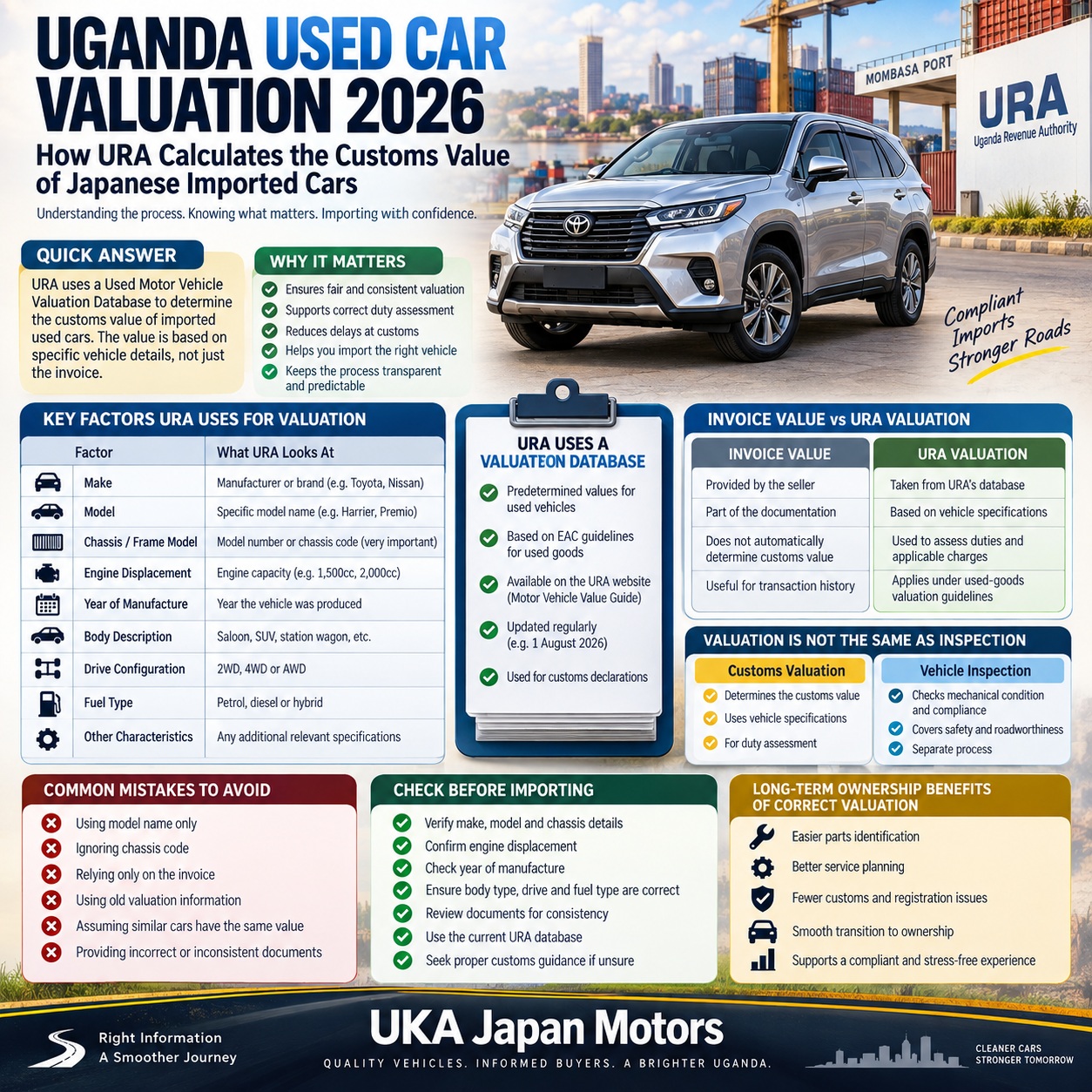
For used motor vehicles, URA publishes predetermined vehicle values through its motor vehicle valuation database. URA’s own customs guidance identifies several important parameters used in determining the appropriate vehicle value, including:
- Make
- Model
- Model number, frame model or chassis model
- Body description
- Engine displacement
- Year of manufacture
- Drive configuration
- Fuel type and other relevant characteristics
URA states that predetermined values for used vehicles are published for use when making customs declarations.
This means that a buyer should not look only at the familiar marketing name of a vehicle.
Knowing that a vehicle is a Toyota Premio, Toyota Harrier, Subaru Forester or Nissan X-Trail is useful, but it may not provide enough information to identify the correct valuation entry.
The chassis or frame model can be particularly important because different versions of the same model family can have different engines, drivetrains, body specifications or production periods.
The customs valuation process therefore starts with answering a more precise question:
Exactly which vehicle has arrived in Uganda?
What Is Customs Value?
Customs value is the value established for customs purposes when imported goods are assessed for duties and other applicable customs charges.
URA describes customs valuation as the procedure used to determine the value of imported goods for the purpose of applying duties that are calculated according to value.
For an imported used vehicle, customs value therefore performs a regulatory function.
It should not be confused with:
- the vehicle’s retail positioning in Kampala;
- the amount written casually in an advertisement;
- the owner’s personal opinion of the vehicle;
- the vehicle’s perceived condition;
- or the figure an importer expected customs to accept.
This distinction matters because buyers sometimes approach vehicle valuation from the perspective of a normal commercial purchase.
Customs is asking a different question.
The customs process must establish an acceptable value for taxation and clearance purposes according to the applicable valuation framework.
Why Used Vehicles Need a Specific Valuation Approach
Used vehicles present an unusual valuation problem.
Two vehicles may share the same model name and production year but have very different histories. One may have travelled substantially farther. Another may have undergone repairs. One may have a different engine specification, drivetrain or trim configuration.
URA’s explanation of used-goods valuation recognises the difficulty created by differences in wear and condition. Its published guidance says this is why a valuation database is used for used motor vehicles.
The database helps create a structured reference for customs declarations.
That does not mean vehicle identification becomes unimportant.
It means identification becomes more important.
Before the appropriate database value can be associated with a vehicle, the vehicle itself has to be classified correctly.
The URA Used Motor Vehicle Valuation Database
For a buyer researching a Japanese used vehicle before it reaches Kampala, the URA Motor Vehicle Value Guide is one of the most useful official references.
URA’s Motor Vehicle Value Guide displays entries using fields such as:
| Database field | Why it matters |
|---|---|
| HS code | Identifies the customs classification |
| Origin information | Helps identify the declared vehicle entry |
| Vehicle description | Distinguishes the relevant vehicle type or specification |
| Engine capacity | Separates vehicles with different engine configurations |
| CIF field | Shows the customs-value reference published for the entry |
URA’s Motor Vehicle Value Guide available in September 2026 states that its vehicle information is current as indicated on the guide and provides access to downloadable motor vehicle database guides.
Because databases and customs information can be revised, importers should work from the current URA publication applicable to their declaration, rather than relying on an old screenshot, an old spreadsheet or information remembered from an earlier import.
That is especially important when someone regularly imports similar vehicles.
The fact that a particular model was treated in a certain way during an earlier clearance does not by itself establish what will apply to another vehicle in 2026.
The Most Important Factors URA Uses to Identify a Used Vehicle
URA’s customs valuation FAQ provides a particularly useful list of the parameters influencing customs value for used vehicles. They include make, model, model or chassis designation, body description, engine displacement, year of manufacture and other characteristics such as drive and fuel type.
Understanding each factor helps explain why apparently similar cars can require different valuation entries.
1. Vehicle Make
The make identifies the manufacturer or brand.
Examples commonly encountered on Kampala roads include Toyota, Nissan, Subaru, Mitsubishi, Mazda, Honda and Suzuki.
Make is only the first level of identification.
It is not sufficiently precise on its own.
A Toyota passenger vehicle, for example, could belong to many model families and technical configurations.
2. Model
The model narrows identification to a particular vehicle family.
A model name is useful because it identifies the general vehicle buyers recognise. However, customs identification may need to go deeper.
A model can exist across several generations.
Within one generation there may also be several engines, drivetrain arrangements and body configurations.
This is why stopping at the model name can produce an incomplete understanding of customs valuation.
3. Chassis Model, Frame Model or Model Number
This is one of the most important details for anyone importing a Japanese used car into Uganda.
URA specifically lists model number/frame model/chassis model among the key parameters influencing used-vehicle customs value.
A chassis or frame designation can identify a much more precise version of a vehicle than the marketing name alone.
Consider two vehicles carrying the same familiar model badge.
They may look nearly identical from the outside but use different:
- engines;
- displacement classes;
- drivetrain configurations;
- production specifications;
- or model codes.
Those differences can affect how the correct database entry is located.
Why Kampala buyers should care
Before committing to an imported vehicle, obtain and verify the chassis information appearing on the vehicle documentation.
Do not rely only on an advertisement title such as:
Toyota Harrier 2018
or:
Subaru Forester 2017
Those descriptions may be useful for general shopping, but customs documentation requires much greater precision.
The chassis or frame information provides that precision.
4. Engine Displacement
Engine capacity is another parameter expressly identified by URA.
This matters because the same model family may be manufactured with several engine options.
For example, a buyer may find two visually similar vehicles from the same production period but discover that they use different engine capacities.
A database search based only on model name and year could therefore point toward the wrong entry.
Before customs declaration, engine information should agree across the relevant documents and physical vehicle identifiers.
For Kampala ownership, engine specification also matters beyond customs. It affects the vehicle’s driving characteristics, maintenance requirements, parts identification and suitability for the owner’s typical traffic and road use.
5. Year of Manufacture
Year of manufacture is another core valuation parameter identified by URA.
This should not automatically be treated as interchangeable with every other date associated with a vehicle.
A vehicle’s records may contain several dates relating to production, registration or documentation. What matters for customs is that the relevant year information is correctly established and supported.
This deserves particular attention because vehicle age can have consequences beyond basic database identification.
Uganda’s import requirements and environmental-levy framework can also depend on vehicle age and category. Therefore, verifying the year before shipment is part of responsible import planning, not merely an administrative detail.
6. Body Description
URA also identifies body description as a valuation parameter. Examples in its guidance include saloon, station wagon and different commercial body configurations.
Body type can affect classification.
A buyer should therefore avoid assuming that two vehicles sharing a model family necessarily belong to the same customs description.
Passenger vehicles, goods-carrying vehicles and special-purpose vehicles can fall into different categories.
URA’s published customs guidance identifies these broad categories separately.
Correct body description becomes especially important for vehicles whose design can exist in passenger and commercial configurations.
7. Drive Configuration
URA lists drive configuration among the additional characteristics that can influence identification and valuation.
This is relevant to many Japanese vehicles imported for use in Uganda.
A single model family may have:
- two-wheel-drive configurations;
- four-wheel-drive configurations;
- or electronically controlled all-wheel-drive systems.
The exterior differences may be minimal.
Documentation and chassis information therefore provide a more reliable basis for identification than visual appearance alone.
For Kampala ownership, drivetrain also has practical implications. A vehicle used mainly in urban traffic has a different operating pattern from one regularly travelling on rougher roads or regional routes. Customs classification and ownership suitability are separate questions, but both begin with correctly understanding the vehicle specification.
8. Fuel Type
Fuel type is another characteristic specifically mentioned in URA’s valuation guidance.
Modern Japanese used-car imports can include conventional petrol vehicles, diesel vehicles and hybrid configurations.
A model badge alone may not always reveal the full powertrain specification.
This is particularly relevant where a model family is available in both conventional and hybrid variants.
A buyer should therefore verify the actual specification rather than assuming that all versions of the same model are represented by a single database entry.
Database Value Versus Invoice Information
One of the most important points in Uganda’s used-car customs process is the relationship between the importer’s invoice and URA’s valuation framework.
URA’s import and export FAQ states that its Used Motor Vehicle Valuation Database forms the basis for valuing used motor vehicles and that the database, rather than the invoice figure alone, is used under the administrative framework applying to used goods.
This explains why an importer should never assume:
“My invoice contains a figure, so that must automatically become the customs value.”
Used vehicles are subject to the specific valuation treatment described by URA.
At the same time, customs documentation still matters.
An invoice is part of the documentary history of the import. Accurate information should be provided consistently throughout the declaration and clearance process.
The practical distinction is between documentary evidence and the customs valuation method applied to the used vehicle.
Used Vehicle Valuation Versus General Customs Valuation
This distinction helps prevent confusion.
For imported goods generally, URA explains that customs valuation follows six methods under the Agreement on Customs Valuation. These include transaction value, transaction value of identical goods, transaction value of similar goods, deductive value, computed value and fallback valuation.
Used vehicles have specific administrative treatment.
URA explains that the legal basis for determining the value of used vehicles and other used articles includes the EAC administrative ruling on valuation of used goods and the applicable customs legislation. It further states that predetermined used-vehicle values are published on the URA website for customs declarations.
For buyers, the practical comparison is:
| General imported goods | Used motor vehicles |
|---|---|
| Transaction information can be central to valuation | URA provides a dedicated used-motor-vehicle valuation database |
| Valuation methods operate sequentially where applicable | Used vehicles are handled under specific used-goods valuation guidance |
| Product identification remains necessary | Precise make, model, chassis, engine, body and year identification is especially important |
| Supporting documents establish the transaction and goods | Vehicle documents also establish the exact specification being declared |
The important point is not to apply a general understanding of imported-goods valuation blindly to a used Japanese vehicle.
What Happens When the Exact Vehicle Is Not Easy to Find?
Sometimes a buyer or clearing professional searches the current valuation database and cannot immediately identify an exact match.
This is where careful specification checking becomes essential.
First verify:
Make → Model → Chassis/Frame Model → Engine Capacity → Year → Body → Drive → Fuel Type
A model may be listed differently from the description used in an online advertisement.
The correct database search therefore needs to follow the vehicle’s technical identity rather than only the wording used by the seller.
Where uncertainty remains, the importer should seek proper customs valuation guidance rather than selecting a convenient entry that merely looks similar.
Customs declarations should reflect the actual vehicle.
Why the Chassis Number Deserves Special Attention
A vehicle’s chassis information connects several stages of the import process.
It can appear in:
- export documentation;
- inspection information;
- shipping documentation;
- customs declarations;
- vehicle identification records;
- and later registration documentation.
A simple transcription error can therefore cause more than one problem.
For example, confusing similar characters or entering an incomplete chassis designation can make database matching more difficult.
Before shipment and again before declaration, the vehicle identity should be checked across all available records.
The goal is consistency.
The vehicle physically presented, the inspection information and the documents submitted for customs processing should describe the same vehicle.
Customs Valuation and Vehicle Inspection Are Different Processes
Buyers sometimes combine inspection and valuation into one idea, but they perform different functions.
Customs valuation establishes the value used for customs purposes.
Vehicle inspection addresses the applicable inspection and compliance requirements associated with the imported vehicle.
Passing an inspection does not mean customs valuation has been completed.
Likewise, finding a vehicle in the URA valuation database does not replace the applicable inspection requirements.
For an orderly import process, think of the vehicle as moving through several verification layers:
Vehicle identity → inspection/compliance → customs declaration → valuation → applicable customs processing → registration
Each stage depends on accurate information from the stages around it.
Documentation to Check Before Importing
A Kampala buyer considering a Japanese used vehicle should verify the documentation early rather than waiting until customs clearance.
The exact documentary requirements depend on the transaction and import circumstances, but the buyer should pay particular attention to records establishing:
Vehicle identity
The make, model and chassis information should be clear and consistent.
Manufacturing information
The production or manufacturing year used for regulatory purposes should be supported correctly.
Engine specification
Engine capacity and other powertrain details should match the vehicle being imported.
Shipping information
The vehicle described in the shipping documents should correspond with the vehicle being declared.
Inspection documentation
Where inspection requirements apply, the relevant vehicle identifiers should match the other import records.
Customs declaration information
The declaration should use the correct vehicle details and appropriate database identification.
Accuracy across these records helps reduce avoidable questions during clearance.
A Practical Example: Two Similar Japanese SUVs
Imagine two Japanese used SUVs arriving for buyers in Kampala.
Both have:
- the same manufacturer;
- the same commercial model name;
- a similar body shape;
- and a similar production period.
At first glance, a buyer might assume they must receive the same customs treatment.
But Vehicle A has one chassis model and engine configuration.
Vehicle B has another chassis model, a different engine displacement and a different drivetrain.
From a casual buyer’s perspective, they are “the same model.”
From a customs-identification perspective, they are not necessarily the same specification.
This is precisely why URA identifies chassis model, displacement, year, body description, drive and fuel type as relevant valuation parameters.
The lesson is simple:
Visual similarity is not sufficient evidence of customs equivalence.
Why Valuation Matters Before a Vehicle Reaches Kampala
Understanding valuation before importation improves decision-making.
It allows the buyer to verify whether the vehicle description is complete and whether the model can be correctly identified using current customs information.
It can also reveal specification discrepancies early.
Suppose an advertisement describes a vehicle as one model year while supporting records indicate another relevant manufacturing year. Or the advertised engine description differs from the chassis specification.
Finding that discrepancy before shipment is much better than discovering it during customs processing.
Pre-import checking should therefore focus on three questions:
What exactly is the vehicle?
Do the documents consistently describe that vehicle?
Can its specification be correctly located or assessed under the current URA valuation framework?
Why Old Valuation Information Can Be Misleading
Customs references can change.
URA maintains current motor vehicle valuation resources and publishes downloadable database guides. In August 2026, URA published a Used Motor Vehicle Database dated 1 August 2026, while its Motor Vehicle Value Guide provides access to current vehicle valuation information.
That means buyers should avoid relying blindly on:
- an old valuation spreadsheet;
- a saved social-media screenshot;
- another owner’s previous declaration;
- remembered information from an earlier import;
- or an outdated vehicle calculator result.
Even when the model appears unchanged, the current official source should be checked.
Customs planning should be based on the information applicable when the declaration is being processed.
Valuation, Vehicle Age and Environmental Levy Are Separate Questions
Another important distinction concerns vehicle age.
The customs value identifies the valuation basis of the vehicle.
Environmental levy rules concern the applicable age and vehicle category framework.
These issues can interact during customs processing, but they should not be confused.
A vehicle having an identifiable customs value does not automatically mean that its age has no regulatory consequence.
URA’s published import guidance separately sets out environmental-levy treatment according to vehicle category and age.
For a buyer, this means checking both:
Valuation: What customs value applies to this exact vehicle?
Age/compliance: What rules apply to a vehicle of this category and manufacturing year?
This is particularly important for older Japanese used vehicles.
Customs Value Does Not Describe Mechanical Condition
Customs valuation should also not be mistaken for a mechanical assessment.
A database value does not tell you whether a particular vehicle has:
- worn suspension components;
- transmission problems;
- cooling-system issues;
- previous structural repairs;
- weak hybrid components;
- neglected fluids;
- damaged underbody components;
- or electrical faults.
These are ownership and inspection concerns.
A vehicle can be correctly identified for customs valuation while still requiring substantial mechanical attention.
That distinction matters in Kampala, where traffic congestion, heat, dust, uneven road surfaces and regular stop-start operation can expose weaknesses in cooling systems, suspension components, brakes, transmissions and hybrid systems.
Customs compliance and mechanical suitability should therefore be checked independently.
Common Valuation Mistakes Buyers Should Avoid
One recurring mistake is searching by model name alone.
Another is assuming the invoice determines everything.
Buyers may also overlook chassis codes, misunderstand manufacturing information, rely on old database material or assume that two visually identical vehicles must share the same specification.
A better approach is specification-first.
Start with the chassis information and supporting records.
Confirm the engine.
Confirm the body type.
Confirm the relevant year.
Confirm the drivetrain and fuel configuration where applicable.
Then use the current URA valuation information.
This sequence gives the buyer a much clearer understanding of how the vehicle is likely to be identified during customs processing.
What If You Disagree With a Customs Valuation?
The first step should be to understand exactly why a particular vehicle entry or valuation treatment has been applied.
Check whether the customs record accurately reflects:
- make;
- model;
- chassis or frame model;
- engine displacement;
- year of manufacture;
- body description;
- drive configuration;
- and fuel type.
If any identifying information is incorrect, supporting documentation becomes important.
Customs disputes should be approached through evidence rather than assumptions about what another vehicle received.
URA also warns that deliberately falsifying information or submitting incorrect documents can result in enforcement consequences.
The safest approach is therefore transparent documentation and correct vehicle identification from the beginning.
What Kampala Buyers Should Check Before Shipment
A sensible pre-import valuation review can be organised around a simple vehicle identity file.
Record:
- Full make and model.
- Chassis/frame model.
- Full chassis identifier.
- Engine displacement.
- Fuel type.
- Drive configuration.
- Body configuration.
- Manufacturing information.
- Relevant inspection details.
- Corresponding entry in the current URA valuation information.
Then compare the information across the documents.
Any contradiction should be investigated before the vehicle progresses further through the import process.
This is particularly useful when several versions of one model exist.
Long-Term Ownership Considerations After Customs Clearance
Customs valuation is only one part of selecting a suitable vehicle for Kampala.
Once registration is complete, the vehicle has to operate reliably under local conditions.
A buyer should therefore evaluate customs compliance alongside long-term practical factors such as:
- availability of appropriate service knowledge;
- parts identification using chassis information;
- suspension durability;
- ground clearance;
- cooling-system condition;
- transmission maintenance;
- hybrid-system condition where applicable;
- tyre specification;
- fuel compatibility;
- and suitability for daily traffic patterns.
Interestingly, some of the information needed for customs valuation remains useful throughout ownership.
The chassis model, for example, can help identify correct replacement components.
Engine designation helps with servicing and parts selection.
Manufacturing information helps distinguish between generations and specification updates.
Good import documentation therefore remains valuable long after the customs process has ended.
URA Database Valuation vs Mechanical Inspection
These two checks should work together rather than replace each other.
| Customs valuation review | Mechanical/condition review |
|---|---|
| Confirms vehicle identity for customs purposes | Establishes physical vehicle condition |
| Uses make and model | Checks actual mechanical systems |
| Uses chassis/frame information | Checks chassis and structural condition |
| Considers engine displacement | Checks engine operation and condition |
| Considers manufacturing year | Assesses age-related deterioration |
| Considers body/configuration details | Assesses body and underbody condition |
| Supports customs declaration | Supports ownership decision-making |
A well-documented vehicle can still have mechanical problems.
A mechanically sound vehicle can still encounter customs difficulties if its documentation is inconsistent.
Responsible importing requires both sides to be checked.
Frequently Asked Questions
1. Does URA use the seller’s invoice as the customs value of a Japanese used car?
URA’s published used-motor-vehicle guidance states that the Used Motor Vehicle Valuation Database forms the basis for valuing used vehicles rather than relying simply on the invoice figure.
The invoice remains part of the import documentation, but buyers should not assume its stated figure automatically becomes the customs value.
2. Where can I check URA vehicle valuation information?
URA publishes a Motor Vehicle Value Guide and downloadable Used Motor Vehicle Database resources through its official website. A Used Motor Vehicle Database dated 1 August 2026 is available on the URA site.
Use the current official resource rather than an old copy obtained elsewhere.
3. What vehicle information affects URA valuation?
URA identifies make, model, chassis/frame/model number, body description, engine displacement, year of manufacture and additional characteristics such as drive and fuel type among the key parameters.
4. Why is the chassis model important?
The chassis or frame model identifies the technical version of a vehicle more precisely than its marketing name.
Two cars can share a familiar model name while having different engines, drivetrains or technical specifications.
5. Can two cars with the same model name have different customs treatment?
They can require different valuation identification where their relevant specifications differ.
Engine capacity, chassis model, manufacturing year, body description, drive and fuel configuration can distinguish vehicles that look very similar.
6. Does vehicle inspection determine customs value?
No. Inspection and customs valuation perform different functions.
Inspection concerns the applicable vehicle inspection and compliance process, while customs valuation establishes the value used for customs purposes.
Accurate vehicle identification connects the two processes.
7. Does customs value tell me whether a vehicle is mechanically good?
No.
Customs value is not a mechanical-condition report.
A separate inspection of the engine, transmission, suspension, structure, cooling system, electronics and other relevant systems remains important.
8. Should I use an old URA valuation database if the vehicle model has not changed?
Current official information should be checked.
URA publishes and updates customs valuation resources, so a previous database should not automatically be treated as the applicable reference for a current declaration.
9. What should I do if the vehicle is difficult to identify in the database?
Start by verifying the exact make, model, chassis/frame model, engine displacement, year, body description, drivetrain and fuel type.
If an exact identification remains unclear, seek proper customs valuation guidance rather than selecting an entry merely because its model name looks similar.
10. Is year of manufacture important only for valuation?
No.
Year of manufacture can also matter to other vehicle-age and compliance considerations. URA separately publishes guidance concerning vehicle categories and environmental-levy treatment according to age.
11. Can I rely on another importer’s valuation for the same model?
It is safer to verify your own vehicle.
The other vehicle may have a different chassis designation, engine, production year, drivetrain or body specification. The applicable database information may also have changed.
12. What is the most important information to obtain before importing?
The full technical identity of the vehicle.
At minimum, verify the model, chassis/frame details, manufacturing information, engine specification, body configuration and relevant inspection documentation before shipment.
UKA Japan Motors’ Role in the Valuation Process
UKA Japan Motors’ role is to help buyers approach Japanese used-vehicle imports with accurate vehicle information, inspection awareness and proper attention to Uganda’s customs and compliance requirements.
That means valuation guidance should begin with the vehicle itself.
Before an imported vehicle reaches the registration stage, buyers should understand its chassis specification, engine configuration, manufacturing information and supporting documentation.
UKA Japan Motors can help buyers review these details and understand how they relate to the current URA valuation framework.
However, customs valuation remains a regulatory customs function.
The purpose of guidance is therefore not to promise a particular customs outcome. It is to help the buyer work with accurate information, identify discrepancies early and understand which details matter when a vehicle is presented for customs processing.
That transparent approach is particularly valuable for Japanese vehicles because one model family can contain numerous chassis, engine and drivetrain variants that are not obvious from the vehicle’s exterior appearance.
Conclusion: Identify the Car Before Trying to Understand Its Customs Value
URA used-car valuation becomes much easier to understand once the buyer stops thinking only in terms of vehicle names.
A Japanese used car imported into Uganda is not identified simply as a “Toyota,” “Subaru,” “Nissan” or even by a model name alone.
Its exact specification matters.
URA’s own guidance identifies make, model, chassis or frame model, body description, engine displacement, year of manufacture, drive and fuel type among the parameters relevant to used-vehicle customs valuation. URA also publishes a dedicated Used Motor Vehicle Valuation Database for customs declarations.
For Kampala buyers in 2026, the most reliable approach is therefore to verify the vehicle before shipment, check its chassis and technical specifications carefully, keep the documentation consistent and consult the current URA valuation information applicable to the import.
Do not treat an advertisement description as a customs specification.
Do not assume an invoice alone determines the customs value.
Do not assume two cars with the same badge are technically identical.
And do not rely on an old valuation simply because someone previously imported a similar vehicle.
Accurate identification, current official information, inspection awareness and consistent documentation provide the strongest foundation for a transparent import and registration process.
Contact UKA Japan Motors for availability and inspection guidance.