


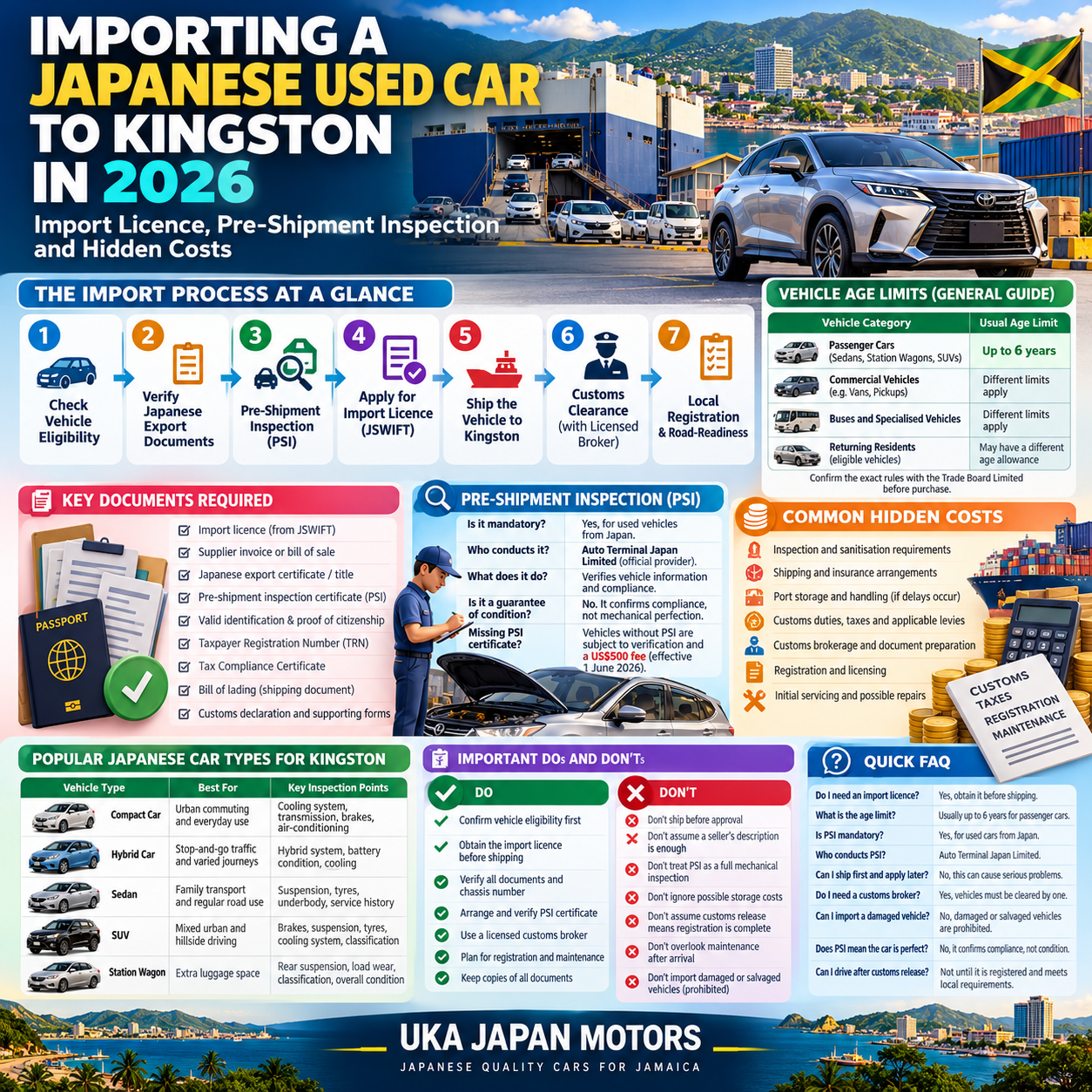
Introduction: What Kingston Buyers Need to Know Before Importing a Japanese Used Car
Importing a Japanese used car to Kingston involves more than selecting a vehicle from an auction or arranging international shipping. The process requires attention to Jamaican import regulations, vehicle age restrictions, pre-shipment inspection, ownership documentation, customs clearance and the requirements for registering the vehicle after importation.
A vehicle may appear suitable in an auction listing but still be unsuitable for importation if it does not meet Jamaica’s eligibility requirements. Likewise, a car that passes a mechanical inspection may encounter clearance difficulties if its export documents are incomplete or its import permit has not been approved before shipment.
These issues matter particularly to Kingston buyers who depend on a vehicle for daily commuting, family transport or regular journeys between urban areas and Jamaica’s more hilly districts. A problem discovered after the vehicle arrives can affect the clearance process, delay registration and complicate the transition to everyday use.
The correct approach is to treat importing as a sequence of connected decisions. First, establish whether the vehicle is eligible. Next, verify its condition and ownership history. Then complete the necessary inspection and licensing requirements before authorising shipment. Finally, prepare for customs clearance, local registration and any maintenance required before regular driving.
This guide explains the process applicable to importing a Japanese used car into Jamaica in 2026, with Kingston as the primary reference point. It also identifies the less obvious administrative, logistical and ownership obligations that buyers should consider before committing to a particular vehicle.
The Short Answer: What Must Be Completed Before the Car Arrives?
For a typical used passenger car imported from Japan, the essential steps are:
- Confirm that the vehicle meets Jamaica’s applicable age and import eligibility rules.
- Verify the vehicle’s chassis number, export documentation, ownership details and recorded condition.
- Arrange the mandatory pre-shipment inspection through the authorised inspection provider.
- Apply for and receive the required import permit from the Trade Board Limited through the appropriate electronic application process.
- Confirm that the approved permit and inspection certificate correspond to the actual vehicle being shipped.
- Arrange shipping and retain the bill of lading and supporting transaction documents.
- Prepare the customs declaration and supporting paperwork with a licensed customs broker.
- Complete the applicable customs requirements, duties and taxes, release procedures and local registration requirements.
The Jamaica Trade Board Limited and the Jamaica Customs Agency explain that the import licence must be obtained before shipping arrangements are made. Used vehicles from Japan are also subject to the applicable pre-shipment inspection requirements. These are essential compliance steps, not optional administrative formalities. Official guidance: Jamaica Customs Agency and Trade Board motor vehicle import procedures.
1. Establish Vehicle Eligibility Before Choosing a Car
The first question is not whether a Japanese car looks suitable for Kingston roads. It is whether that particular vehicle can legally be imported under the applicable Jamaican rules.
Understanding the vehicle age limit
The Trade Board Limited publishes category-specific age restrictions for imported motor vehicles. Its general guidance lists an age limit of up to six years for ordinary passenger cars, including qualifying sedans, station wagons and SUVs. Different limits apply to certain commercial vehicles and specialised categories.
Returning residents may qualify for a different age allowance, subject to the applicable rules and conditions. That allowance should not be assumed to apply to every importer or every vehicle.
Before purchasing, verify the vehicle’s manufacturing or model-year details, its classification and the precise age calculation accepted by the relevant authority. Do not rely solely on the year shown in a seller’s advertisement.
For example, a Japanese vehicle advertised by its registration year may have an earlier manufacturing date. If the vehicle is close to the permitted age limit, this distinction could affect eligibility.
The applicable rules should be confirmed directly with the Trade Board before a purchase becomes binding.
Check the vehicle category
A standard passenger sedan, a station wagon, an SUV and a commercial van may be subject to different classifications or conditions.
Classification can depend on factors such as seating capacity, vehicle type, unladen weight and intended use. A vehicle described casually as a family van may fall into a category with requirements different from those for an ordinary passenger car.
The same caution applies to pickups, buses and specialised vehicles.
Practical guidance: Obtain the exact model designation, chassis number, manufacturing details and export certificate information before submitting an import application. If the vehicle’s classification is unclear, resolve it with the Trade Board rather than relying on the seller’s description.
Individual and business importers
Import permissions can also depend on who is importing the vehicle.
The Trade Board’s general procedures distinguish between individual importers, non-dealer companies and certified motor vehicle dealers. Its published guidance sets limits and conditions for individuals and non-dealer companies, while certified dealers operate under a separate framework.
Do not assume that permission to import one vehicle automatically permits the importation of additional vehicles within the same period.
Applicants should confirm the rules applicable to their circumstances, including eligibility, frequency limits and any documentation required to establish their status.
What if the car is damaged or salvaged?
Jamaica Customs Agency guidance states that importing motor vehicles considered damaged or salvaged is prohibited.
This makes auction grading, photographs and condition reports particularly important. A vehicle with visible damage, missing components or an unclear accident history requires careful scrutiny before purchase.
A low grade does not necessarily tell the whole story. The underlying inspection notes, damage descriptions and available photographs should be examined together.
Where there is uncertainty about whether a vehicle qualifies as damaged or salvaged under Jamaican requirements, seek clarification from the relevant authority before committing to it.
2. How the Japanese Export Documents Should Be Checked
Japanese export documentation provides the information needed to establish the identity and recorded details of the vehicle.
For Jamaican import purposes, the documentation must agree with the physical vehicle and the information supplied in the import application.
Confirm the chassis number
The chassis number, commonly referred to as the vehicle identification number or VIN where applicable, is a central reference for identifying the vehicle.
Check that the number shown on the export certificate matches the number recorded in the inspection documentation and the import application.
Any mismatch should be investigated before shipment.
A discrepancy might arise from a transcription error, an incorrect document or a more serious identity problem. It should never be dismissed simply because the make, model and colour appear correct.
Review the export certificate
The relevant Japanese export documentation should be examined for the vehicle details needed by Jamaican authorities. Depending on the document, these may include:
- Manufacturer and model designation.
- Manufacturing or registration details.
- Chassis number.
- Colour.
- Seating capacity.
- Vehicle weight and other classification information.
- Recorded ownership or export details.
The precise information available depends on the document issued for the vehicle.
If a seller supplies only an auction listing or an informal sales sheet, ask for the appropriate export documentation needed to verify the vehicle and support the import application.
Compare the invoice with the vehicle documents
The supplier’s invoice or bill of sale should identify the actual vehicle being purchased.
Check that the invoice, export certificate, inspection records and application information all refer to the same vehicle.
The description should not be so vague that it becomes difficult to establish which unit was sold. Retain copies of the original transaction documents and any corrected versions issued by the supplier.
These records may be needed if questions arise during the import process or when the customs declaration is prepared.
3. Pre-Shipment Inspection: Why It Matters in Jamaica
Pre-shipment inspection, commonly abbreviated as PSI, is a mandatory compliance requirement for used vehicles imported from designated countries, including Japan.
The Trade Board Limited identifies Japan among the countries subject to this requirement. The inspection process is intended to support the verification of vehicle information and compliance with the applicable import policy.
For buyers, the central lesson is straightforward: the inspection must be arranged and documented correctly before the vehicle is shipped.
Who conducts the inspection?
For used vehicles imported from Japan, the official guidance identifies Auto Terminal Japan Limited as the relevant inspection provider.
Importers should consult the provider’s current instructions for arranging the inspection, preparing the vehicle and confirming the certificate.
The provider’s contact and verification information should be obtained through the official inspection or government guidance rather than through an unverified intermediary.
What should the buyer verify?
Before treating an inspection as complete, confirm the following:
- The inspection relates to the correct vehicle.
- The chassis number matches the export documentation.
- The certificate is genuine and can be verified.
- The inspection documentation is valid for the intended application.
- The required sanitisation arrangements have been addressed where applicable.
- Any discrepancy has been resolved before shipping.
The inspection certificate is not merely a receipt showing that an appointment occurred. It forms part of the supporting documentation for the import permit.
PSI is not a guarantee of mechanical reliability
A critical distinction must be understood: pre-shipment inspection for import compliance is not a guarantee that a vehicle will be free from every mechanical or electrical defect.
A vehicle may have an authentic inspection certificate and still require maintenance after arrival.
Potential issues include worn suspension components, deteriorated rubber parts, ageing batteries, air-conditioning faults, corrosion, damaged undertrays or problems that are not apparent in the available inspection record.
A buyer should therefore consider two separate questions:
- Does the vehicle satisfy the applicable import and documentation requirements?
- Is the vehicle mechanically suitable for the intended use in Jamaica?
The first question concerns compliance. The second concerns condition and ownership suitability.
Where the available inspection scope does not answer a mechanical question, request additional information before purchase whenever possible.
The importance of certificate verification in 2026
The Trade Board issued an advisory effective 1 June 2026 concerning non-compliance with mandatory pre-shipment inspection requirements.
According to that advisory, used vehicles imported from designated countries without the required PSI certificate are subject to a verification process intended to establish whether the vehicle is listed as stolen and to validate ownership. The advisory specifies a verification fee of US$500 for non-compliant cases.
This is a specific consequence of missing mandatory inspection documentation, not a routine charge applicable to every properly documented import.
Importers should therefore verify the certificate before submitting the import application rather than assuming that missing paperwork can be resolved without consequences after arrival.
Official reference: Trade Board advisory on PSI non-compliance, published 1 June 2026.
4. The Import Licence: Applying Before Shipment
The import licence is one of the most important parts of the process because it establishes the relevant authority’s permission to import the vehicle.
A buyer should not treat the licence as a document to obtain after the car has already left Japan.
Where is the application submitted?
The Trade Board Limited directs applicants to the Jamaica Single Window for Trade, known as JSWIFT, for electronic import permit applications.
The portal is available at JSWIFT.
Applicants should use the current application instructions and confirm the requirements that apply to their specific vehicle and circumstances.
Documents commonly required
The Trade Board’s published motor vehicle import procedures identify supporting documents that include:
- Supplier invoice or bill of sale.
- Registration certificate, title or Japanese export certificate containing the required vehicle information.
- Valid identification and proof of citizenship, as applicable.
- Taxpayer Registration Number (TRN).
- Pre-shipment inspection certificate for a used vehicle.
Additional information may be required depending on the application, applicant category or circumstances.
Documents should be legible, complete and consistent. If the application asks for information that differs from the documents supplied by the seller, resolve the discrepancy before submission.
Why the sequence matters
The correct sequence is to establish eligibility, prepare the documents, complete the required inspection, apply for the licence and receive the necessary approval before making shipping arrangements.
If the vehicle is shipped prematurely, the importer may face complications that could have been avoided by completing the process in the proper order.
A seller’s promise that the permit can be arranged later does not replace the importer’s obligation to follow Jamaican requirements.
What happens if the application is queried?
An application may require correction or additional information if details are missing, unclear or inconsistent.
For example, a discrepancy between the chassis number on the export certificate and the inspection certificate may prevent the application from progressing as expected.
When a query is raised, identify the exact issue, obtain the appropriate corrected document and follow the authority’s instructions.
Do not alter official documents yourself or submit a replacement document that cannot be independently verified.
5. Shipping the Vehicle to Kingston
Once the required approval is in place and the shipping arrangements have been confirmed, the vehicle can proceed through the agreed transport process.
At this stage, documentation remains important. The information recorded by the supplier, inspection provider, shipping agent and importer should continue to refer to the same vehicle.
The bill of lading
The bill of lading is a key shipping document. It records information relating to the shipment and is used during the import clearance process.
Retain the document supplied by the shipping agent and check the details carefully.
Errors involving the consignee, vehicle description or shipping information should be raised promptly with the responsible party.
Shipping arrangements and timing
The buyer should establish the shipping method, the expected departure and arrival information, and the process for receiving shipment updates.
Transit schedules can change. Port operations, vessel schedules, documentation delays and other logistical circumstances can affect the expected arrival date.
Avoid making registration, collection or other time-sensitive arrangements based entirely on an estimated arrival date.
Instead, maintain communication with the shipping agent and confirm the current position of the shipment.
Protecting the vehicle during transit
The condition of the vehicle at the point of shipment is relevant if damage is discovered later.
Retain available pre-shipment photographs, inspection records and the supplier’s condition report. These can help establish the vehicle’s documented condition before transport.
If damage or a discrepancy is discovered on arrival, document it promptly and notify the relevant shipping or handling party according to the applicable procedure.
6. Customs Clearance in Kingston
Arrival at the port does not mean that the vehicle is ready for collection or registration.
The vehicle must go through the applicable customs declaration, assessment, payment and release procedures.
The Jamaica Customs Agency provides guidance on the documents required for motor vehicle processing and explains the role of licensed customs brokers.
Documents for clearance
The supporting documentation commonly includes:
| Document | Why it matters |
|---|---|
| Approved import licence | Establishes the required import authorisation. |
| Title or export certificate | Supports vehicle identity and ownership documentation. |
| Bill of lading or shipping order | Identifies the shipment and its transport details. |
| Supplier invoice | Supports the declared transaction and customs assessment. |
| Pre-shipment inspection certificate | Provides evidence of the required inspection for applicable used vehicles. |
| Tax Compliance Certificate | Forms part of the documentation identified in Jamaica Customs guidance. |
| Customs declaration and supporting forms | Records the vehicle and the applicable customs treatment. |
The exact documentation needed should be confirmed with Jamaica Customs Agency and the licensed customs broker handling the clearance.
Why a licensed customs broker is important
Jamaica Customs Agency states that motor vehicles must be cleared through a licensed customs broker.
The broker prepares or handles the relevant customs declaration and supporting documentation in accordance with the applicable process.
The importer should still understand the declaration and provide accurate information. Appointing a broker does not remove the importer’s responsibility to ensure that the documents and vehicle details are correct.
Ask the broker to identify any outstanding documents, explain the basis of the customs declaration and clarify which steps remain before release.
Customs valuation and declared information
The supplier’s invoice is an important part of the customs documentation. Customs assessment is based on the applicable valuation rules and the supporting evidence required by the authorities.
Do not assume that a seller’s informal description, an auction estimate or an unexplained figure will automatically determine the customs treatment.
Provide authentic transaction documents and answer requests for clarification accurately.
If the declared information does not match the supporting evidence, the matter may require further examination.
Do not confuse port arrival with customs release
A vehicle can arrive in Kingston while clearance remains incomplete.
Outstanding paperwork, an application query, an assessment issue or an unresolved inspection requirement may prevent the vehicle from being released immediately.
Before arranging collection, confirm that the necessary release procedures have been completed and that the shipping agent or authorised party has confirmed the vehicle is ready.
7. Hidden Import Costs: The Obligations Buyers Often Overlook
The phrase hidden costs does not necessarily mean that a supplier has concealed information. It often refers to expenses and administrative obligations that buyers fail to include when planning an import.
These items should be identified before purchase so that the buyer understands the complete process rather than focusing only on the vehicle itself.
The following categories are important to examine.
Inspection and sanitisation requirements
The mandatory inspection process has its own requirements, and sanitisation arrangements may apply under the relevant programme.
Confirm which inspection services are required, what documentation will be issued and whether any additional handling or preparation is necessary.
A buyer should not assume that an inspection-related charge includes every other service connected with preparing the vehicle for export.
Shipping and handling obligations
International transport involves arrangements beyond selecting a vessel.
Depending on the shipping agreement, the importer may need to account for transport to the shipping point, export handling, shipping documentation, insurance arrangements, destination handling and other services specified by the relevant parties.
Clarify which responsibilities belong to the supplier and which remain with the importer.
Where insurance is arranged, understand what the policy covers, which exclusions apply and how a claim would be handled if damage occurs.
Port storage and delays
A delay in documentation or clearance can create additional handling or storage obligations, depending on the applicable arrangements.
For example, the vehicle might arrive while an import application is still being corrected or while a required document remains outstanding.
The best way to reduce this risk is to check the permit, inspection certificate and shipping paperwork before dispatch and to respond promptly to any official query.
Do not assume that storage or handling arrangements will remain unchanged if clearance is delayed.
Customs duties, taxes and applicable levies
Imported motor vehicles are subject to the customs treatment and charges applicable to the particular vehicle and import circumstances.
The assessment may depend on factors including the vehicle’s classification, customs value and the applicable tax and duty rules.
Ask a licensed customs broker to explain the relevant assessment and identify the documents used to support it. Confirm any applicable charges with the responsible authorities.
Do not rely on a general estimate from an unrelated vehicle listing or assume that another importer’s assessment will apply to your vehicle.
Customs brokerage and documentation
The clearance process involves preparing and submitting the required information in the appropriate form.
The importer should establish what services the broker is handling, which documents the importer must supply and whether any corrections or additional submissions are anticipated.
Keep copies of the completed paperwork and records of the clearance process.
Clear communication is particularly important where more than one intermediary is involved.
Registration and road-readiness obligations
Customs release is not the final stage of ownership.
The vehicle must also satisfy the applicable local registration and licensing requirements before it can be used lawfully on public roads.
Depending on its condition, it may require maintenance, repairs, roadworthiness-related checks or other work before it is suitable for daily driving.
These obligations should be considered separately from the expenses incurred during importation.
Maintenance after arrival
A used vehicle can require attention even when it arrives in apparently good condition.
Potential items include the engine oil and filters, transmission servicing, tyres, brakes, suspension components, battery, cooling system and air-conditioning system.
The actual requirements depend on the vehicle’s service history, mileage, condition and manufacturer guidance.
It is better to establish a maintenance plan from the available records and an appropriate inspection than to assume that a recently imported vehicle needs no immediate attention.
A practical planning checklist
Before authorising shipment, confirm that the following categories have been considered:
-
Vehicle eligibility and import licence.
-
Pre-shipment inspection and applicable sanitisation.
-
Vehicle purchase and export documentation.
-
Shipping arrangements and insurance, where applicable.
-
Destination handling and possible storage obligations.
-
Customs duties, taxes and applicable levies.
-
Customs brokerage and document preparation.
-
Local registration and licensing.
-
Initial servicing and any repairs identified after arrival.
This checklist is intended to help identify obligations, not to provide a universal estimate. The exact requirements depend on the vehicle and the circumstances of the import.
8. Choosing a Japanese Used Car for Kingston Conditions
Import compliance is only one part of a sound vehicle decision. The car must also suit the roads, traffic patterns and ownership habits of the person who will use it.
Kingston driving can involve repeated stopping, slow-moving traffic, short journeys, hot weather and regular use of the air-conditioning system. Routes beyond the city may introduce steep gradients, uneven road surfaces and different demands on the brakes, tyres and cooling system.
A vehicle should therefore be evaluated according to its intended use rather than its auction description alone.
Compact cars for daily commuting
A compact passenger car may suit drivers who mainly travel within Kingston and need a vehicle for everyday commuting, shopping and routine appointments.
Its suitability depends on more than exterior size. Buyers should examine cabin condition, visibility, air-conditioning performance, transmission behaviour and the availability of appropriate servicing information.
For a car frequently used in congested traffic, smooth low-speed operation and a properly functioning cooling system are especially relevant.
Hybrid vehicles for stop-and-go traffic
Hybrid vehicles combine an internal combustion engine with an electric drive system. Their behaviour and maintenance requirements differ from those of conventional petrol-only vehicles.
A buyer considering a Japanese hybrid should review the hybrid system’s condition, battery-related diagnostic information where available, cooling arrangements and maintenance history.
A hybrid should not be selected solely on the assumption that every example will perform identically in Kingston traffic. Actual performance depends on the model, battery condition, driving conditions and maintenance history.
SUVs for mixed road conditions
An SUV may suit a driver who regularly carries passengers or luggage, travels on a mixture of urban and hillside roads, or prefers a higher seating position.
However, an SUV is not automatically the best choice for every driver.
The buyer should consider vehicle dimensions, visibility, braking condition, suspension wear, tyre condition and how the vehicle behaves on the routes it will regularly use.
A larger vehicle may also have different maintenance and operating requirements from a compact passenger car.
A comparison based on intended use
| Vehicle type | Potentially suitable for | What to inspect carefully |
|---|---|---|
| Compact petrol car | Urban commuting and routine everyday use | Cooling system, transmission, brakes and air-conditioning |
| Hybrid car | Frequent urban driving and varied daily journeys | Hybrid system diagnostics, battery condition and cooling arrangements |
| Sedan | Family transport and regular road use | Suspension, tyre condition, underbody and service history |
| SUV | Mixed urban and hillside driving or additional passenger space | Brakes, suspension, tyres, cooling system and vehicle classification |
| Station wagon | Drivers needing additional luggage space | Rear suspension, load-related wear, classification and overall condition |
This is a practical comparison, not a guarantee that every vehicle within a category will be suitable. The condition and history of the individual car remain decisive.
9. The Inspection Priorities That Matter After Arrival
Once a vehicle has been released from customs, a separate assessment can help establish whether it is ready for regular use.
This should be based on the vehicle’s actual condition rather than the assumption that import clearance proves mechanical reliability.
Engine and cooling system
Check for fluid leaks, abnormal engine noise, irregular idling and signs of overheating.
The cooling system deserves particular attention because Kingston’s warm conditions, air-conditioning use and slow-moving traffic can place repeated demands on the engine cooling arrangement.
Inspect the relevant hoses, coolant condition, radiator and fans as appropriate for the vehicle.
Transmission and driveline
The transmission should be assessed according to the manufacturer’s service guidance and the type of transmission fitted.
Look for warning lights, unusual noises, abnormal engagement or other symptoms that warrant further investigation.
Do not assume that a vehicle is mechanically sound simply because it starts and moves during a brief inspection.
Brakes, tyres and suspension
Brakes and tyres directly affect vehicle control, particularly in wet conditions or during repeated stopping in traffic.
Check tyre condition, wear patterns and suitability. Examine the brakes and suspension for deterioration, leakage, damage or excessive play.
Where the vehicle will regularly travel on hilly routes, the condition of the braking system and suspension deserves particular attention.
Air-conditioning and electrical equipment
Air-conditioning is an important comfort and usability consideration in Jamaica’s climate.
Check whether the system cools consistently and whether the controls operate correctly.
Also inspect the lighting, windows, dashboard indicators, charging system and other relevant electrical equipment.
For hybrids, electric vehicles or vehicles with advanced driver-assistance equipment, use an appropriate diagnostic process when warning lights or suspected faults are present.
Underbody and corrosion
Inspect the underbody for damage, corrosion, disturbed components and evidence of poor previous repairs.
The available Japanese inspection and auction records may provide useful context, but they should not replace an examination of the vehicle in its current condition.
Any significant concern should be assessed by a qualified professional before the vehicle is placed into regular service.
10. Common Import Mistakes and How to Avoid Them
Several preventable mistakes can complicate an otherwise straightforward import.
Buying before checking eligibility. A vehicle may look attractive but fail to meet the applicable age or classification rules. Confirm eligibility first.
Shipping before receiving the required permit. Jamaica Customs Agency advises importers to obtain the licence before arranging shipment. Follow that sequence.
Assuming a seller’s description is sufficient. Confirm the actual vehicle identity and compare the export certificate, inspection documentation and invoice.
Treating PSI as a complete mechanical inspection. Verify import compliance separately from mechanical condition and long-term suitability.
Accepting an unverified inspection certificate. Use the relevant official verification process and resolve any discrepancy before submitting the application.
Ignoring possible storage and handling obligations. Ensure that documents are ready and maintain communication with the shipping agent and broker.
Assuming customs release means registration is complete. Confirm the separate local requirements before using the vehicle on public roads.
Failing to retain documents. Keep the invoice, export certificate, inspection certificate, import permit, bill of lading and customs clearance records together.
Overlooking maintenance after arrival. Establish the vehicle’s actual servicing needs instead of assuming that a recently imported car requires no work.
Each of these mistakes can be avoided more effectively by checking the relevant requirement before moving to the next stage.
11. How UKA Japan Motors Approaches Import Guidance
UKA Japan Motors approaches Japanese used vehicle imports with an emphasis on documentation, inspection awareness and practical ownership considerations.
An import decision should be based on a clear understanding of the vehicle being considered, the requirements that apply to it and the checks that remain necessary before it can be used in Jamaica.
That means distinguishing between an auction description, an export document, a pre-shipment inspection certificate and an independent assessment of mechanical condition. Each serves a different purpose, and none should be treated as a substitute for the others.
Where a buyer is considering a particular Japanese vehicle, the relevant questions include whether its details support the import application, whether the required inspection documentation is available and whether the vehicle’s condition appears appropriate for its intended use.
Regulatory requirements can change, so the Trade Board Limited, Jamaica Customs Agency and other responsible authorities remain the appropriate sources for confirming current import rules, licensing requirements and clearance procedures.
UKA Japan Motors’ role is to support an informed decision by helping buyers understand the documentation and inspection considerations involved. The objective is clarity about the process and the vehicle, rather than making assumptions about eligibility or condition.
Frequently Asked Questions
1. Do I need an import licence to bring a Japanese used car into Kingston in 2026?
Yes. Jamaica requires the relevant import authorisation for motor vehicles. The Trade Board Limited instructs importers to obtain the licence before making shipping arrangements. Confirm the requirements for your specific vehicle and applicant category before proceeding.
2. What is the usual age limit for importing a Japanese passenger car into Jamaica?
The Trade Board’s published guidance generally allows ordinary passenger cars up to six years old, subject to the applicable rules and vehicle classification. Returning residents and certain other categories may be subject to different conditions. Confirm the accepted age calculation with the Trade Board before purchase.
3. Is pre-shipment inspection mandatory for a used car from Japan?
Yes. Japan is listed among the countries for which pre-shipment inspection is mandatory for used vehicles imported into Jamaica. The required certificate should be valid and verifiable before the import application is submitted.
4. Who handles pre-shipment inspection for Japanese vehicles?
The official guidance identifies Auto Terminal Japan Limited as the relevant provider for used vehicles imported from Japan. Importers should obtain the current inspection instructions and certificate verification details through the provider’s official channels.
5. Can I ship the vehicle first and apply for the import licence later?
You should not. Jamaica Customs Agency states that the required import licence must be obtained before arrangements are made to ship the vehicle. Shipping before approval can create compliance problems, delays and additional obligations.
6. What documents are normally required to import a Japanese used car?
The commonly required documents include the import licence, supplier invoice or bill of sale, title or export certificate, pre-shipment inspection certificate for applicable used vehicles, identification and relevant tax information. Customs clearance also requires shipping documents and the applicable declarations and supporting paperwork.
The exact requirements should be confirmed with the Trade Board and Jamaica Customs Agency.
7. What happens if my Japanese car arrives without the required PSI certificate?
The Trade Board’s advisory effective 1 June 2026 states that vehicles imported from designated countries without the required PSI certificate are subject to a verification process. The advisory identifies a US$500 verification fee for non-compliant cases. This is not a routine fee for imports that comply with the inspection requirement.
8. Does passing pre-shipment inspection mean the car is mechanically perfect?
No. Pre-shipment inspection for import compliance should not be interpreted as a guarantee that every mechanical or electrical component is fault-free. Buyers should assess the available condition records and arrange appropriate mechanical checks where needed.
9. Do I need a customs broker to clear my imported vehicle?
Jamaica Customs Agency states that motor vehicles must be cleared through a licensed customs broker. The broker handles the applicable customs declaration and supporting documentation. The importer should still ensure that the information supplied is accurate and complete.
10. What is the bill of lading, and why should I keep it?
The bill of lading is a shipping document that records information about the vehicle’s transport. It is part of the documentation used in the customs clearance process. Keep a copy and verify that the shipment details agree with the information supplied by the shipping agent.
11. What are the hidden costs of importing a Japanese used car?
Potentially overlooked obligations include inspection and sanitisation requirements, shipping and insurance arrangements, destination handling, storage following delays, customs duties and taxes, customs brokerage, registration and initial maintenance.
These are different categories of obligation, and not every item applies identically to every import. Confirm the requirements with the relevant providers and authorities before committing to a vehicle.
12. Can I import a damaged or salvaged Japanese vehicle?
Jamaica Customs Agency guidance states that importing vehicles considered damaged or salvaged is prohibited. Buyers should carefully review auction information, inspection records and photographs. If the condition or classification is unclear, obtain official clarification before purchase.
13. What should I check if the chassis number differs between documents?
Stop the process and investigate the discrepancy before shipment or application submission. The relevant documents should identify the same vehicle. Obtain corrected official documentation where appropriate and verify the details with the responsible provider or authority.
14. Does customs release mean I can immediately drive the vehicle in Kingston?
Not necessarily. Customs release and local registration are separate stages. The vehicle must meet the applicable registration, licensing and road-use requirements before it is used on public roads. It may also require mechanical attention before regular driving.
15. Should I buy a hybrid or a petrol car for Kingston traffic?
The choice depends on the individual vehicle, its condition, maintenance history and intended use. A hybrid may suit certain urban driving patterns, but its battery and hybrid system require appropriate assessment. A conventional petrol vehicle has different maintenance considerations. Compare the actual condition and suitability of the vehicles rather than relying on the category alone.
16. Which government authorities should I consult before importing?
The Trade Board Limited is the primary authority for the import licence and relevant vehicle import policy. Jamaica Customs Agency provides guidance on customs clearance and required documentation. The relevant inspection provider should be consulted for PSI arrangements and certificate verification. For local registration and licensing, confirm the current procedures with the responsible Jamaican authority.
Conclusion: Make Every Import Decision Before Shipment
Importing a Japanese used car to Kingston in 2026 requires coordinated attention to eligibility, documentation, pre-shipment inspection, import licensing, shipping, customs clearance and local road-use requirements.
The most important decisions should be made before the vehicle leaves Japan. Confirm its eligibility, verify the chassis number and export documents, ensure that the required inspection certificate is valid and obtain the necessary import approval before shipping arrangements proceed.
Once the vehicle arrives, accurate documentation and coordination with a licensed customs broker help support the clearance process. After release, local registration requirements and a separate assessment of mechanical condition remain important.
A well-planned import is not simply a vehicle that reaches Kingston. It is a vehicle whose identity and paperwork can be verified, whose import requirements have been addressed and whose condition is suitable for the intended use.
For prospective owners, careful checks at each stage provide a clearer understanding of the process and help prevent avoidable complications.
Contact UKA Japan Motors for availability and inspection guidance.