


Introduction: Why Vehicle Age Matters When Importing a Japanese Car into Tanzania
When importing a Japanese used car into Tanzania, the vehicle’s age is more than a specification recorded in its documents. It is one of the factors that can determine the applicable tax treatment, alongside engine capacity, vehicle classification, customs valuation and other relevant characteristics.
For buyers bringing vehicles through the Port of Dar es Salaam, understanding this relationship is particularly important in 2026. Tanzania’s Finance Act 2026 introduced changes to the age-related excise duty applicable to qualifying imported used vehicles. The revised structure took effect on 1 July 2026, making the vehicle’s manufacturing year an essential part of the import assessment.
This matters because two Japanese vehicles with similar body styles, engine specifications and equipment may not fall into the same tax category. A difference in manufacturing year can place otherwise comparable vehicles in different age bands.
The practical challenge is not simply identifying an older or newer vehicle. It is determining how the vehicle’s legally relevant age interacts with the current tax provisions, how the relevant customs value is established, and whether the vehicle satisfies the inspection and documentation requirements for importation and registration.
A buyer who understands these factors before selecting a vehicle can make a more informed decision and reduce the risk of unexpected administrative complications during clearance.
This guide explains the 2026 age-related excise duty framework, the other taxes that may apply, the importance of vehicle documentation, and the steps involved in importing a Japanese used car through Dar es Salaam.
Quick Answer: How Does Vehicle Age Affect Import Taxes in Tanzania in 2026?
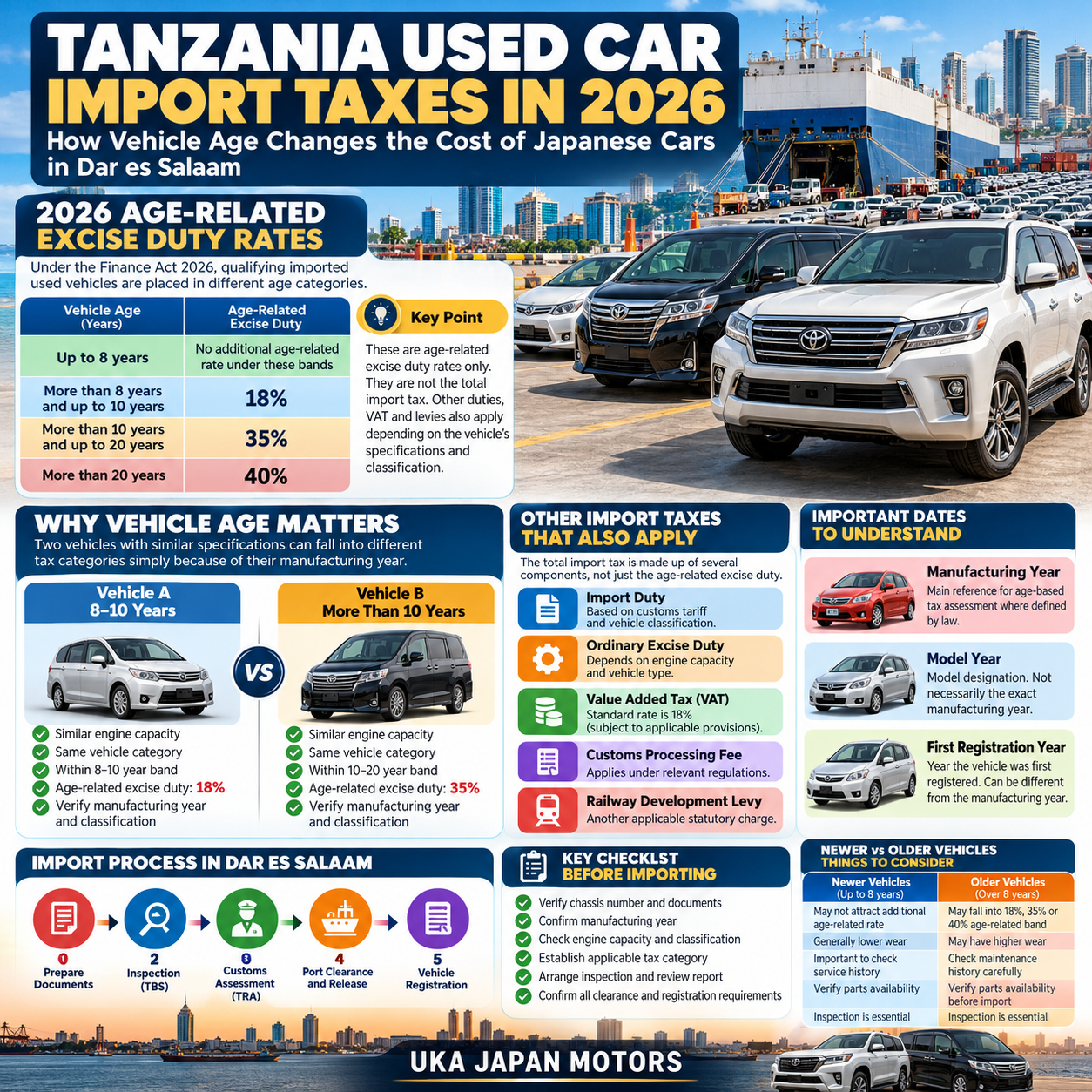
Under the age-related excise duty structure introduced by the Finance Act 2026, qualifying imported used vehicles fall into different categories according to age.
The revised age bands are reported as follows:
| Vehicle age | Age-related excise duty |
|---|---|
| Up to 8 years | No additional age-related rate under these particular bands |
| More than 8 years and up to 10 years | 18% |
| More than 10 years and up to 20 years | 35% |
| More than 20 years | 40% |
These percentages relate to the specific age-related excise duty provision. They are not the total import tax rate, and they should not be interpreted as a percentage of every amount involved in importing a vehicle.
The applicable classification, statutory basis, valuation method and effective provisions must be confirmed for the individual vehicle. The Tanzania Revenue Authority (TRA) and the current legislation are the appropriate references for establishing the final tax treatment.
The Tanzania Trade Portal also explains that vehicle import duties and taxes vary according to factors such as the brand, engine capacity and year of production. Its vehicle-import procedure directs importers to the TRA used motor vehicle valuation system for a vehicle-specific assessment.
Sources: Tanzania Trade Portal — Vehicle import procedure and The Citizen — Finance Act 2026 used-vehicle excise changes.
1. Understanding the 2026 Vehicle Age Bands
The first step is to understand what the age-related duty does and why the boundaries between categories matter.
Vehicles up to eight years old
Vehicles within this age range do not attract an additional age-related rate under the specific bands described above. This does not mean that they are exempt from all import taxes.
Import duty, ordinary excise duty where applicable, VAT and other relevant statutory charges may still apply. The correct assessment depends on the vehicle’s classification, customs value and applicable tax provisions.
A relatively recent vehicle must therefore still be assessed using its full technical and documentary details.
Vehicles more than eight years and up to ten years old
The reported age-related excise duty for qualifying vehicles in this category is 18%.
This category makes accurate age verification especially important. A vehicle described informally as a particular model year may have a different legally relevant manufacturing year recorded in its documentation.
Before proceeding with an import, confirm the manufacturing year using the available vehicle records and establish how TRA applies the statutory age definition.
Vehicles more than ten years and up to twenty years old
Qualifying vehicles in this category attract an age-related excise duty of 35% under the 2026 structure.
The distinction between this category and the preceding one is significant. A vehicle crossing the ten-year threshold may move into a substantially different age-related duty band.
This is why model names and registration descriptions are insufficient for determining the applicable tax treatment. The underlying manufacturing information and statutory classification must be checked.
Vehicles more than twenty years old
The 2026 structure also identifies a separate age category for qualifying vehicles older than twenty years, with a reported age-related excise duty of 40%.
For these vehicles, buyers should establish the applicable provisions before making a commitment. The assessment should confirm the vehicle’s exact age, tariff classification and eligibility under the relevant import requirements.
An older vehicle may also require more careful mechanical assessment because its maintenance history, deterioration and parts availability can affect its suitability for continued use in Tanzania.
2. Why a One-Year Difference Can Matter
Vehicle age is often treated as a simple descriptive detail. For import tax purposes, however, the relevant question is whether a vehicle falls within a particular statutory category.
Consider two Japanese passenger vehicles with similar engine capacity, body configuration and equipment. Assume that one falls within the eight-to-ten-year category while the other has crossed the ten-year boundary.
Even if their mechanical specifications are similar, their age-related excise duty may differ because they fall into different statutory bands.
This distinction becomes important when evaluating vehicles that are close to a category boundary.
The following comparison illustrates the principle without estimating the total tax payable:
| Assessment factor | Vehicle A | Vehicle B |
|---|---|---|
| Engine capacity | Similar | Similar |
| Vehicle category | Same | Same |
| Manufacturing year | Within the lower age band | Crosses into the next age band |
| Age-related excise category | Potentially 18% | Potentially 35% |
| Required verification | Manufacturing date and classification | Manufacturing date and classification |
The table is illustrative. It assumes that both vehicles fall within the relevant statutory provision and that the stated ages are confirmed.
The lesson is straightforward: compare vehicles using their verified manufacturing information, not merely their model names or advertised descriptions.
3. Manufacturing Year, Model Year and Registration Year
One of the most important checks in a used-vehicle import assessment is distinguishing between different dates associated with a car.
Manufacturing year
The manufacturing year records when the vehicle was produced. It is a central reference point in age-related import tax assessment where the legislation defines age by reference to manufacture.
Model year
The model year identifies the manufacturer’s model designation for a particular production period. It does not necessarily establish the exact date on which an individual vehicle was manufactured.
A vehicle’s model year should therefore not automatically be treated as conclusive proof of its manufacturing year.
First registration year
The first registration year records when the vehicle entered the registration system for road use. Depending on the vehicle’s history, this may differ from the year it was manufactured.
A car manufactured in one year but first registered later should not be assessed using an assumed manufacturing date without checking the applicable legal definition.
What should a buyer verify?
Before proceeding, check the following:
- The chassis or frame number recorded on the vehicle.
- The manufacturing information available from reliable vehicle records.
- The export documentation.
- The vehicle’s identification and technical specifications.
- Any discrepancies between the manufacturing, model and registration years.
- The method used by the clearing agent and TRA to determine the applicable age band.
If the documentation is inconsistent, resolve the discrepancy before relying on a tax assessment.
4. Import Taxes Are Not Determined by Age Alone
The age-related excise duty is only one part of the import tax framework. A vehicle-specific assessment must consider the other applicable duties and levies as well.
Import duty
Import duty is determined under the applicable customs tariff and vehicle classification. The general tariff framework should not be confused with the complete assessment for a particular used vehicle.
The correct tariff heading and any applicable special provisions must be established before calculating the duty.
Ordinary excise duty
Ordinary excise duty is distinct from the additional duty linked to vehicle age.
The applicable treatment may depend on engine capacity, vehicle type and the relevant statutory schedule. Buyers should confirm the current provisions rather than assuming that all vehicles with similar engine sizes receive identical treatment.
Value Added Tax
VAT is another element of the import tax framework. Tanzania’s Trade Portal identifies the standard VAT rate as 18%, while noting that the applicable treatment depends on the governing legislation and any relevant exemptions.
The standard VAT rate should not be confused with a total import tax rate.
Customs processing fee
A customs processing fee may also apply under the relevant provisions. Its basis and applicable rate should be confirmed using the current official guidance.
Railway Development Levy
The Railway Development Levy is another charge identified by the Tanzania Trade Portal within the import framework. The applicable basis and rate should be verified for the relevant import transaction.
The exact calculation sequence matters because different taxes and levies can use different valuation bases. It is not correct to assume that every charge is calculated independently on the same figure.
For current guidance, consult the Tanzania Trade Portal and the TRA vehicle import assessment procedure.
5. How Customs Valuation Affects the Assessment
Age determines which age-related provision may apply, but customs valuation is a separate part of the assessment.
The customs value is established under the applicable valuation rules. It should not automatically be assumed to be identical to an amount shown on an invoice or a buyer’s informal estimate.
The relevant assessment can depend on the accepted customs value, vehicle classification and the statutory calculation method for each charge.
This means two vehicles in the same age category can still receive different assessments if their specifications, classifications or accepted customs values differ.
A reliable assessment should identify:
- The vehicle’s verified manufacturing year.
- The applicable tariff classification.
- The engine capacity and relevant technical specifications.
- The customs valuation basis.
- The age-related excise duty provision.
- The other applicable duties, taxes and levies.
- Any additional documentation or procedural requirements.
A clearing agent should be able to explain the basis of the assessment and identify the official information used. If a calculation is presented without identifying the vehicle’s specifications or the relevant statutory provisions, request clarification before proceeding.
6. Choosing Between Newer and Older Japanese Used Cars
Selecting a vehicle involves more than comparing age-related duty categories. The intended use, condition, mechanical design and maintenance requirements also matter.
Newer used vehicles
A newer used vehicle may fall outside the additional age-related bands, depending on its verified age and the applicable law.
However, newer does not automatically mean mechanically sound. A vehicle with incomplete service records, accident damage or neglected maintenance can still require extensive attention.
Buyers should inspect the engine, transmission, suspension, braking system, cooling system, electrical components and structural condition.
Older used vehicles
Older vehicles may fall within higher age-related excise categories. They may also have accumulated more wear, although the actual condition depends heavily on maintenance and operating history.
An older vehicle can remain suitable for its intended purpose if its condition is well documented and its maintenance requirements are manageable. The assessment must be based on evidence rather than age alone.
A practical comparison
| Consideration | Newer vehicle | Older vehicle |
|---|---|---|
| Age-related duty | Depends on the applicable age band | May fall into a higher age-related band |
| Mechanical condition | Requires inspection | Requires inspection, with particular attention to wear |
| Maintenance history | Important | Especially important |
| Parts availability | Verify locally | Verify locally before commitment |
| Intended use | Match to daily requirements | Match to use, condition and maintenance capability |
| Documentation | Verify identity and manufacturing year | Verify identity and manufacturing year carefully |
Neither category is automatically the better choice. A suitable vehicle is one that meets the intended use, satisfies import requirements and has a verified tax and inspection position.
7. What This Means for Buyers in Dar es Salaam
Dar es Salaam is a major entry point for imported vehicles, and the import process involves more than the arrival of a shipment at the port.
Buyers must account for customs documentation, applicable taxes, inspection requirements, release procedures and vehicle registration.
The age-related tax provisions affect the assessment before the vehicle is released. They do not replace the separate requirements for identifying the vehicle, verifying its condition or completing the applicable clearance steps.
Urban driving and vehicle suitability
Dar es Salaam’s traffic conditions can involve frequent stopping, slow movement, congestion and extended periods of engine operation at low speeds.
A vehicle intended for routine city use should therefore be assessed for cooling-system performance, transmission behaviour, braking condition and general mechanical reliability.
These checks are relevant whether the vehicle is relatively recent or older.
Climate and environmental exposure
Heat, humidity, rainfall and exposure to water can affect a vehicle’s long-term condition. Inspect the body, underbody, electrical connectors, seals and signs of corrosion or water damage.
For older vehicles, pay particular attention to repairs that may conceal structural deterioration.
Use beyond Dar es Salaam
Some owners may need a vehicle suitable for travel between Dar es Salaam and other Tanzanian locations, including Dodoma, Morogoro, Arusha, Mwanza, Mbeya or Tanga.
In those cases, the assessment should consider sustained engine operation, cooling performance, tyre condition, suspension integrity and the availability of appropriate replacement parts.
The intended route and daily use should influence the vehicle inspection, but they do not change the need to establish the correct statutory tax classification.
8. Import Inspection and Documentation Requirements
Tax compliance and technical inspection are separate responsibilities. A vehicle should not be considered ready for use merely because its tax assessment has been completed.
The Tanzania Trade Portal describes a vehicle-import process that includes documentation, customs assessment, inspection, acceptance of the relevant inspection report, release procedures, port clearance and registration.
Requirements can vary according to the import procedure and applicable rules, so buyers should verify the current process for their specific vehicle.
Before shipment
Confirm that the vehicle’s identity and specifications are documented accurately. Check the chassis or frame number, manufacturing year, engine capacity and export documentation.
Arrange the required inspection through the applicable authorised process. For Japanese used vehicles, verify the current Tanzania Bureau of Standards (TBS) requirements and the inspection arrangements applicable to the shipment.
Do not assume that a Japanese export inspection or auction assessment automatically satisfies every Tanzanian import requirement.
During customs clearance
The clearing agent should lodge the relevant documents with TRA and establish the vehicle’s tax treatment.
The vehicle may need to undergo physical verification, and the information recorded during the process should correspond with the submitted documentation.
Any discrepancy involving chassis identity, engine information, manufacturing year or vehicle classification should be resolved through the appropriate official procedure.
Port release and collection
The import process can involve additional steps through the relevant port and shipping-line procedures.
These may include submitting cargo documents, obtaining the required delivery documentation, completing port formalities and arranging the vehicle’s authorised collection.
Customs release should not be confused with the completion of every subsequent registration requirement.
Registration
After the relevant clearance and verification stages, the vehicle must satisfy the applicable registration procedure.
Keep the supporting documents together, including customs clearance records, inspection documentation and vehicle identification details. Their completeness can help establish a clear record of the import and registration process.
9. A Pre-Import Verification Checklist
Before selecting a Japanese used vehicle, work through the following checks.
Vehicle identity
- Confirm the chassis or frame number.
- Match the vehicle details against the available export records.
- Verify the manufacturing year.
- Check engine capacity and vehicle classification.
- Resolve inconsistencies before proceeding.
Tax assessment
- Establish the relevant age-related excise category.
- Confirm the applicable ordinary excise duty.
- Verify the customs tariff classification.
- Confirm the customs valuation basis.
- Identify applicable VAT, processing fees, levies and other statutory charges.
- Request an assessment based on the current law and the actual vehicle specifications.
Inspection
- Confirm the current TBS inspection requirements.
- Establish which inspection arrangements apply to the vehicle.
- Review the inspection report and identify any conditions requiring attention.
- Check structural integrity, mechanical condition and signs of accident or water damage.
Clearance and registration
- Confirm the documents required by TRA.
- Establish the relevant port and shipping-line procedures.
- Verify the process for vehicle release.
- Confirm the registration requirements that apply after clearance.
This checklist is not a substitute for an official assessment. It is a practical way to identify issues that should be resolved before committing to the import process.
10. Common Mistakes to Avoid
Assuming the model year determines the tax band
The model year may differ from the manufacturing year. Verify the information that is legally relevant to the assessment.
Treating the age-related percentage as the total tax
The age-related excise duty is one component of the tax framework. Other applicable duties, taxes and levies must be assessed separately.
Relying on an outdated tax calculation
Finance Acts can amend tax provisions. A previous assessment may not reflect the rules effective on the date of the current import.
Always confirm the applicable law and rates for the relevant transaction.
Assuming vehicles with similar engines have identical tax treatment
Engine capacity is only one factor. Age, classification, customs valuation and other applicable statutory provisions can also influence the assessment.
Ignoring inspection until the vehicle arrives
Inspection and documentation requirements should be established before shipment. Delaying these checks can complicate the clearance process.
Confusing customs release with road registration
A customs release confirms a particular stage of the import process. It should not be treated as proof that every registration requirement has been completed.
Accepting an assessment without understanding its basis
A clear assessment should identify the vehicle, its relevant specifications, the applicable tax categories and the calculation method.
Request clarification if any of these elements is missing.
Frequently Asked Questions
1. Does vehicle age affect import taxes on Japanese used cars in Tanzania in 2026?
Yes. The 2026 age-related excise duty structure distinguishes qualifying imported used vehicles by age. The reported bands include 18% for vehicles more than eight and up to ten years old, 35% for vehicles more than ten and up to twenty years old, and 40% for vehicles older than twenty years.
These are age-related excise rates, not total import tax rates. Confirm the statutory classification and applicable provisions for the individual vehicle.
2. Does a vehicle become prohibited from importation when it reaches eight years old?
The age-related excise bands do not, by themselves, establish a blanket prohibition on importing every vehicle older than eight years.
Import eligibility must be assessed against the current applicable regulations, inspection requirements and any relevant restrictions. Do not interpret an age-related tax category as an automatic import ban.
3. Is the manufacturing year more important than the model year?
For an age-based tax assessment, the legally relevant manufacturing date is particularly important where the legislation defines vehicle age by reference to manufacture.
The model year is not necessarily identical to the manufacturing year. Verify the vehicle’s records and confirm the date used in the official assessment.
4. What happens if a vehicle crosses the ten-year age boundary?
A qualifying vehicle that moves from the eight-to-ten-year category into the more-than-ten-to-twenty-year category may fall under a different age-related excise rate.
The applicable age must be established using the statutory definition and verified documentation. Do not rely solely on an informal model-year description.
5. Are all import taxes included in the age-related excise percentage?
No. The age-related excise provision is distinct from other potentially applicable duties, VAT, customs processing fees and levies.
The total statutory assessment depends on the applicable provisions, customs valuation, vehicle classification and technical specifications.
6. Does engine capacity affect the import tax assessment?
Yes. Engine capacity can affect the applicable excise treatment and is one of the vehicle characteristics considered in the import assessment.
However, engine capacity alone is not sufficient to determine the complete tax treatment. The manufacturing year, vehicle classification, customs value and other relevant information must also be considered.
7. Where should a buyer verify the applicable vehicle import taxes?
The buyer should consult the Tanzania Revenue Authority and the official Tanzania Trade Portal. The TRA used motor vehicle valuation system is identified by the Trade Portal as a resource for vehicle-specific assessment.
A qualified clearing agent can assist with the documentation and clearance process, but the assessment should be based on the applicable official rules.
8. Is the customs value necessarily the same as the amount shown on the invoice?
Not necessarily. Customs valuation is governed by the applicable valuation rules and should be established through the relevant official assessment.
An invoice may be part of the supporting documentation, but it should not automatically be treated as the final customs value without applying the relevant rules.
9. Must a Japanese used car undergo inspection before import clearance?
Importers must confirm the current TBS inspection and roadworthiness requirements applicable to the vehicle and shipment.
The inspection process is separate from customs tax assessment. The required inspection documentation should be verified before shipment, rather than assumed to be complete once the vehicle reaches Dar es Salaam.
10. What documents should be checked before importing a used car?
Relevant records can include the vehicle’s export documentation, chassis or frame identification, manufacturing information, engine specifications, applicable inspection documents and customs clearance paperwork.
The precise documents required depend on the current import procedure. Confirm the requirements with the relevant authorities and the clearing agent handling the shipment.
11. Can two vehicles of the same model attract different tax treatment?
Yes. Vehicles of the same model may have different manufacturing years, engine specifications, classifications or accepted customs values.
Those differences can affect the assessment. A vehicle should be evaluated using its own verified details rather than an assessment prepared for a similar model.
12. Should buyers choose the newest vehicle available?
Not automatically. Vehicle age can affect the tax treatment, but the appropriate choice also depends on mechanical condition, service history, parts availability, intended use and compliance with import requirements.
A well-documented assessment and a thorough inspection are more reliable than selecting a vehicle on age alone.
The Role of UKA Japan Motors in the Import Decision
UKA Japan Motors approaches Japanese used-vehicle selection from the perspective of informed ownership, inspection and compliance.
The important first step is understanding the actual vehicle being considered. Manufacturing year, chassis identity, engine specifications and supporting documents should be reviewed before relying on an age-related tax assessment.
The second step is understanding the distinction between a tax estimate and a confirmed assessment. A preliminary calculation can help identify the relevant questions, but the applicable statutory treatment must be verified through the appropriate official process.
The third step is checking the vehicle’s condition and intended use. A vehicle’s age category does not establish whether its engine, transmission, suspension, cooling system, brakes or body structure are suitable for continued use.
UKA Japan Motors’ role is to help buyers approach these decisions with a clear understanding of the vehicle, the importance of documentation and the need for appropriate inspection guidance. Official tax assessments, regulatory decisions and statutory clearance remain matters for the relevant Tanzanian authorities and authorised service providers.
This approach supports a more transparent import process. It encourages buyers to verify important details before shipment rather than relying on assumptions that may become difficult to resolve during clearance.
Conclusion: Verify Vehicle Age Before Making an Import Decision
Tanzania’s 2026 used-vehicle import framework makes manufacturing year an important consideration when assessing Japanese cars entering through Dar es Salaam.
The age-related excise duty structure introduced under the Finance Act 2026 separates qualifying vehicles into distinct age categories. The reported rates are 18% for vehicles more than eight and up to ten years old, 35% for vehicles more than ten and up to twenty years old, and 40% for vehicles older than twenty years.
These rates must be understood as one part of the overall tax framework. Import duty, ordinary excise duty where applicable, VAT, customs processing fees, levies and other relevant requirements must be assessed separately under the applicable rules.
A sound import decision begins with accurate vehicle identification, verified manufacturing information, a vehicle-specific customs assessment and confirmation of the inspection and registration requirements.
Buyers should also consider mechanical condition, maintenance history, parts availability and the demands of their intended use in Tanzania. Neither age alone nor a single tax percentage provides a complete picture of a vehicle’s suitability.
The most reliable approach is to verify the relevant details before shipment, use current official guidance, resolve discrepancies early and maintain complete documentation throughout the import process.
Contact UKA Japan Motors for availability and inspection guidance.