


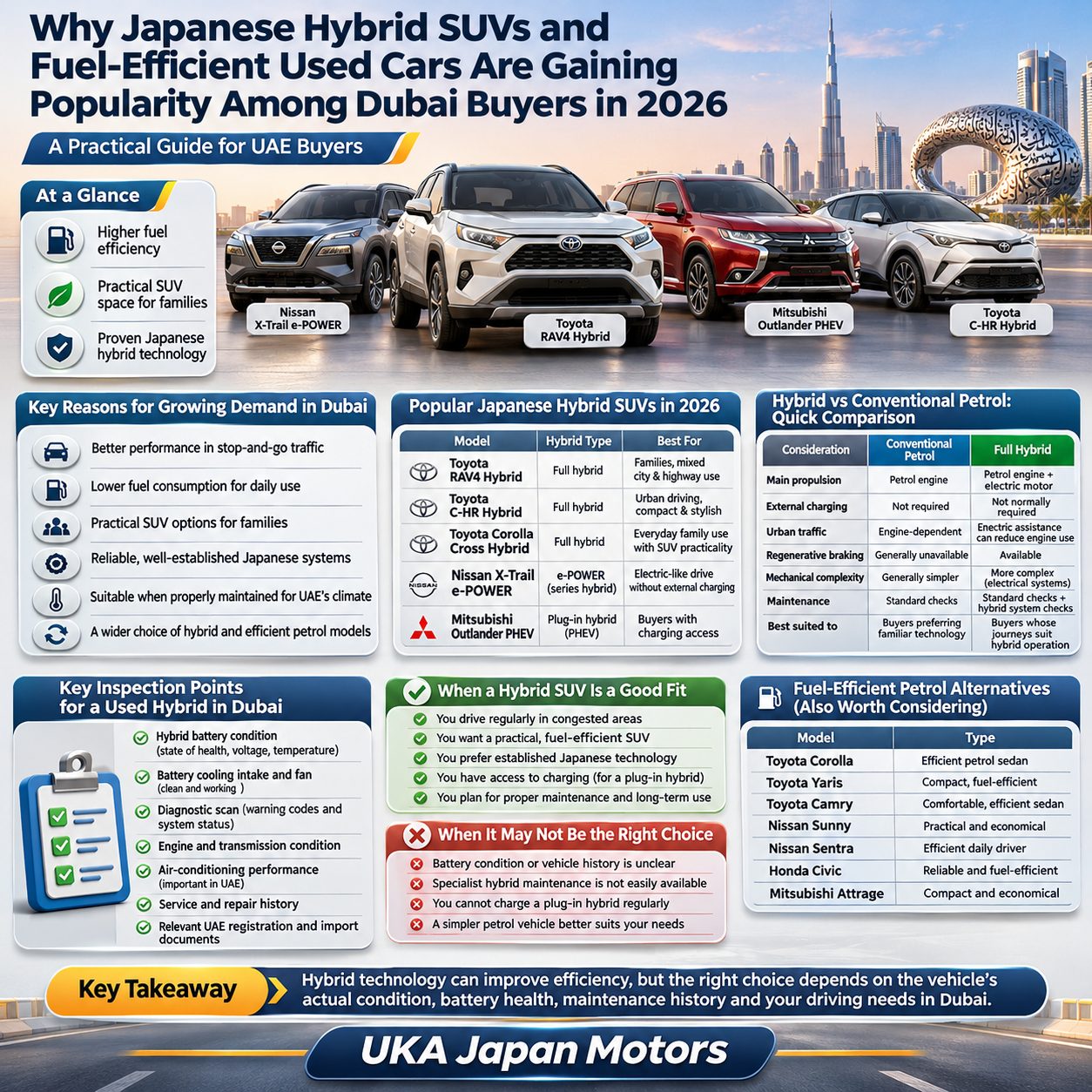
The way buyers evaluate used vehicles in Dubai is gradually changing. For many years, engine capacity, exterior appearance, passenger space and brand reputation were among the strongest considerations when selecting an SUV. These factors remain important, but another consideration is becoming increasingly influential in 2026: how efficiently a vehicle performs during everyday driving.
Dubai presents a distinctive driving environment. Motorists regularly experience congested urban roads, extended highway journeys, frequent acceleration and deceleration, and long periods of vehicle operation during warmer months. Families may use the same SUV for school journeys, shopping, inter-emirate travel and weekend activities. Professionals often cover substantial distances between residential communities and workplaces.
These conditions have encouraged more buyers to examine vehicles that combine practical cabin space with sensible fuel consumption.
Japanese hybrid SUVs and fuel-efficient used cars are attracting attention because they offer several characteristics that appeal to this changing approach to ownership. Japanese manufacturers have developed established hybrid technologies, compact powertrains and practical vehicle platforms that suit different driving requirements.
Models such as the Toyota RAV4 Hybrid, Toyota C-HR Hybrid, Toyota Corolla Cross Hybrid, Lexus NX Hybrid, Nissan X-Trail e-POWER and Mitsubishi Outlander PHEV illustrate the variety available within the Japanese SUV and crossover segment.
However, increasing interest does not automatically mean that every hybrid is suitable for every buyer. Battery condition, cooling performance, maintenance records, previous usage, vehicle specifications and registration requirements all influence whether a particular vehicle is appropriate.
Understanding these factors is essential before choosing a Japanese hybrid or fuel-efficient used vehicle in Dubai.
Quick Answer: Why Are Buyers Considering Japanese Hybrid SUVs More Seriously in 2026?
Japanese hybrid SUVs are gaining attention among Dubai buyers because they combine several practical ownership characteristics:
- Reduced engine dependence during suitable low-speed and stop-start driving conditions.
- Regenerative braking that recovers some energy during deceleration.
- Established hybrid systems from manufacturers with extensive automotive experience.
- SUV body styles offering family accommodation and useful luggage capacity.
- Greater awareness of fuel consumption during everyday commuting.
- More interest in battery condition and documented vehicle maintenance.
- Availability of different hybrid configurations for urban, highway and family use.
- An alternative to conventional petrol SUVs for buyers who prioritise efficiency.
The important distinction is that hybrid technology improves the way a vehicle uses energy, but it does not eliminate maintenance requirements or guarantee a particular fuel-consumption figure.
The condition of the individual vehicle remains more important than the hybrid badge alone.
1. Changing Driving Requirements in Dubai Are Influencing Vehicle Selection
One of the main reasons behind the growing interest in fuel-efficient vehicles is the variety of journeys undertaken by Dubai motorists.
A vehicle used primarily for short urban journeys faces different operating conditions from one regularly travelling between Dubai and Abu Dhabi.
Similarly, someone commuting between Sharjah and Dubai may spend considerable time in slow-moving traffic, while another driver may spend most of the day travelling along Sheikh Zayed Road or other major highways.
These differences influence how useful hybrid technology can be.
Stop-and-go traffic
In congested traffic, conventional petrol engines may repeatedly operate at low efficiency while accelerating and slowing down.
A conventional hybrid can use its electric motor to assist movement, reduce unnecessary engine operation and recover energy during braking.
This operating characteristic makes hybrids particularly interesting to motorists who frequently experience traffic congestion.
Frequent urban journeys
Dubai residents often make multiple short journeys throughout the day. These may include school drop-offs, office travel, supermarket visits and other daily activities.
Depending on the hybrid system, operating temperature and battery condition, some of these journeys can involve a greater contribution from electric propulsion.
However, short journeys do not always allow the engine and associated systems to reach their ideal operating conditions. A hybrid should therefore be assessed according to its actual usage pattern rather than assumed to be maintenance-free.
Long-distance highway driving
Highway journeys introduce a different consideration.
At sustained speeds, a hybrid may depend more heavily on its petrol engine because there are fewer opportunities for regenerative braking. Aerodynamics, vehicle weight, engine design, tyre condition and transmission characteristics become particularly important.
For buyers regularly travelling between Dubai, Abu Dhabi, Sharjah and other Emirates, an efficient petrol SUV may sometimes be a more straightforward choice than a hybrid with an unsuitable specification or uncertain maintenance history.
The best vehicle depends on the balance between urban and highway driving.
2. Why Japanese Manufacturers Have an Established Position in Hybrid Technology
Japanese manufacturers have spent decades developing petrol-electric powertrains.
Their experience has resulted in several different hybrid configurations rather than one universal system.
This matters to used-car buyers because two vehicles described as hybrids may operate in substantially different ways.
Toyota: Established hybrid engineering
<Entity value=”Toyota” category=”brand” disambig=”Japanese automobile manufacturer”/> is widely associated with full-hybrid technology.
Its hybrid systems combine a petrol engine, electric motor, battery and electronic power management.
Depending on driving conditions, the vehicle can operate using the electric motor, petrol engine or a combination of both.
The Toyota RAV4 Hybrid and C-HR Hybrid demonstrate how this technology is incorporated into different SUV and crossover categories.
The main attraction is the integration of the hybrid system into a practical vehicle platform rather than treating electrification as a completely separate driving experience.
Nissan: e-POWER technology
<Entity value=”Nissan” category=”brand” disambig=”Japanese automobile manufacturer”/> offers e-POWER technology, which uses an electric motor to drive the wheels while a petrol engine generates electricity.
This is different from a conventional Toyota-style power-split hybrid.
For the driver, the system provides electric-motor-driven acceleration without requiring regular external charging.
The Nissan X-Trail e-POWER is an example of this approach in a family SUV.
Buyers should understand the difference because inspection requirements and mechanical components vary between hybrid architectures.
Mitsubishi: Plug-in hybrid capability
<Entity value=”Mitsubishi Motors” category=”brand” disambig=”Japanese automobile manufacturer”/> has developed plug-in hybrid technology, particularly in the Outlander PHEV.
A plug-in hybrid combines an internal combustion engine, electric motors and a rechargeable battery that can accept energy from an external charging source.
Its operating characteristics differ from those of a conventional self-charging hybrid.
A buyer must therefore consider whether home or workplace charging is practical and whether the vehicle’s charging equipment and battery systems are functioning correctly.
Lexus: Hybrid technology in premium SUVs
<Entity value=”Lexus” category=”brand” disambig=”Japanese luxury automobile manufacturer”/> applies hybrid technology across several SUV models, including the NX and RX hybrid ranges.
These vehicles combine electrified powertrains with a greater emphasis on cabin refinement, comfort and equipment.
For used-car buyers, the additional electronic systems and equipment make a thorough inspection particularly important.
The central advantage of Japanese hybrid engineering is the availability of different technologies for different requirements. The buyer still needs to identify which system suits their driving habits.
3. The Role of Fuel Efficiency in Dubai’s Used-Car Market
Fuel efficiency is no longer simply a specification that buyers glance at before choosing a vehicle. It increasingly forms part of the wider ownership assessment.
A driver travelling long distances every working day may evaluate a vehicle differently from someone who mainly uses it for occasional family journeys.
Fuel consumption also varies considerably between individual vehicles, even when they share the same model designation.
Several factors explain why efficient vehicles are attracting attention.
Engine capacity and design: Smaller, appropriately engineered engines can reduce unnecessary fuel consumption, although engine size alone does not determine efficiency.
Vehicle weight: A lighter vehicle generally requires less energy to accelerate, all other conditions being equal.
Aerodynamics: Air resistance becomes increasingly important at highway speeds.
Transmission: The design and condition of the transmission influence how effectively engine power is delivered.
Tyres: Incorrect tyre pressure, unsuitable tyre specifications and excessive rolling resistance can affect fuel consumption.
Driving behaviour: Aggressive acceleration, unnecessary idling and repeated high-speed driving can increase fuel use.
Maintenance condition: Restricted airflow, worn ignition components, incorrect engine oil and other maintenance issues can reduce efficiency.
This explains why a well-maintained petrol crossover may sometimes be a more sensible choice than a neglected hybrid SUV.
The objective should be to select an efficient vehicle in sound mechanical condition rather than choosing a vehicle solely because its manufacturer advertises impressive laboratory figures.
4. Japanese Hybrid SUVs That Deserve Attention in 2026
Different Japanese hybrid SUVs serve different purposes. Buyers should compare their powertrain characteristics, passenger accommodation and intended driving environment.
Toyota RAV4 Hybrid: A Practical Family SUV
<text>Vehicle category: Compact to midsize family SUV</text>
The Toyota RAV4 Hybrid is relevant to buyers who want a conventional SUV layout with an established petrol-electric powertrain.
Its combination of passenger space, luggage capacity and hybrid assistance makes it suitable for families requiring a vehicle for everyday commuting and longer journeys.
Its hybrid system can provide useful assistance in urban traffic, while the petrol engine supports longer journeys without depending on external charging.
Important inspection areas include:
- Hybrid battery condition and diagnostic results.
- Battery cooling fan and air intake cleanliness.
- Engine and transmission-related operating condition.
- Hybrid system warning lights.
- Cooling system performance.
- Suspension and steering condition.
- Service records and previous repairs.
The RAV4 Hybrid is particularly worth considering when family practicality and mixed driving are equally important.
Toyota C-HR Hybrid: Urban-Friendly Crossover
<text>Vehicle category: Compact crossover</text>
The Toyota C-HR Hybrid is aimed at drivers who want a smaller vehicle with crossover styling.
Its compact dimensions can be useful when navigating busy commercial areas, residential parking facilities and crowded urban roads.
The hybrid system is suited to everyday commuting, particularly where traffic conditions allow regenerative braking and electric assistance to contribute regularly.
Its sloping roofline and smaller rear cabin should nevertheless be considered.
Families who regularly carry several adult passengers or bulky luggage may find a larger SUV more appropriate.
Buyers should also check rear visibility, parking sensors, camera operation and the condition of electronic driver-assistance features.
Toyota Corolla Cross Hybrid: A Balance Between Sedan and SUV
<text>Vehicle category: Compact family crossover</text>
The Corolla Cross Hybrid combines a relatively practical SUV body with Toyota’s established hybrid approach.
It may appeal to households that do not need the larger dimensions of a RAV4 but still want an elevated seating position and useful luggage accommodation.
Its compact exterior dimensions can be convenient for urban use.
Before purchasing, buyers should compare the exact model year, trim, powertrain specification and available safety equipment.
Nissan X-Trail e-POWER: Electric-Motor-Driven SUV
<text>Vehicle category: Family SUV</text>
The Nissan X-Trail e-POWER is an interesting alternative because its petrol engine generates electricity while electric motors provide wheel propulsion.
This arrangement produces a driving experience that differs from a conventional petrol SUV.
It can suit drivers who appreciate electric-motor response but prefer not to depend on regular external charging.
Depending on the variant, the X-Trail may also offer additional seating flexibility and family-oriented equipment.
Inspection should cover the generator engine, electric drive components, battery management, cooling systems and electronic controls.
It is especially important to verify that the vehicle’s exact e-POWER specification is correctly identified in its documentation.
Mitsubishi Outlander PHEV: For Buyers With Charging Access
<text>Vehicle category: Plug-in hybrid SUV</text>
The Outlander PHEV offers a different proposition from conventional hybrids.
Its rechargeable battery allows electric driving over a manufacturer-specified distance under suitable conditions.
The petrol engine provides additional operating flexibility when battery charge is reduced or when the vehicle’s control system requires engine operation.
However, its suitability depends partly on charging access.
Buyers living in apartments should establish whether their residential parking arrangements permit regular charging. Those who cannot charge consistently may not experience the intended benefits of plug-in technology.
Inspection must include the charging port, charging equipment, battery condition, electrical safety systems and hybrid operating modes.
A plug-in hybrid should never be evaluated using the same assumptions as a self-charging hybrid.
5. Efficient Petrol Cars Still Have an Important Place
The growing popularity of hybrids does not mean conventional petrol vehicles are becoming irrelevant.
For many Dubai motorists, a fuel-efficient petrol car remains an appropriate choice.
It can offer a simpler powertrain, familiar maintenance procedures and flexibility for people who do not want to consider hybrid battery condition or additional high-voltage components.
Some Japanese models worth considering include:
- Toyota Corolla petrol.
- Toyota Yaris petrol.
- Toyota Camry petrol.
- Nissan Sunny.
- Nissan Sentra.
- Honda Civic.
- Mitsubishi Attrage.
These vehicles demonstrate that efficiency is not exclusive to hybrid technology.
A compact petrol sedan may be particularly suitable for someone travelling alone or with a small family. A petrol crossover may offer the required passenger accommodation without the additional complexity of a hybrid system.
The correct decision depends on the vehicle’s actual condition, intended use and the buyer’s maintenance preferences.
6. Hybrid Versus Conventional Petrol: What Should Dubai Buyers Compare?
The following comparison highlights the practical differences between the two powertrain categories.
| Consideration | Conventional petrol | Full hybrid |
|---|---|---|
| Main propulsion | Petrol engine | Petrol engine and electric motor |
| External charging | Not required | Not normally required |
| Urban traffic | Engine-dependent | Electric assistance can reduce engine operation |
| Regenerative braking | Generally unavailable | Recovers some braking energy |
| Highway driving | Established petrol operation | Hybrid and petrol operation |
| Battery inspection | Conventional electrical battery | Additional high-voltage battery assessment |
| Mechanical complexity | Generally simpler | Additional electrical and control systems |
| Maintenance | Conventional engine and transmission checks | Conventional checks plus hybrid-system checks |
| Best suited to | Buyers preferring familiar technology | Buyers whose journeys suit hybrid operation |
There is no universal winner.
A petrol vehicle with excellent service records and sound mechanical condition can be a better ownership decision than a hybrid with battery deterioration, poor maintenance or incomplete history.
Likewise, a properly maintained hybrid may be particularly appropriate for a motorist who regularly drives through congested Dubai traffic.
The comparison should always begin with intended usage and individual vehicle condition.
7. Dubai’s Climate Makes Hybrid Battery Inspection Particularly Important
One of the most important considerations when selecting a used Japanese hybrid in the UAE is its thermal management system.
Dubai’s hot climate places additional demands on vehicle cooling systems.
Hybrid batteries generate heat during charging and discharging. Their operating temperature is monitored and managed through systems designed by the manufacturer.
Depending on the vehicle, battery cooling may involve dedicated air pathways, fans, liquid cooling or other thermal-management arrangements.
If cooling performance is compromised, the hybrid system may restrict its operation to protect components.
What should buyers inspect?
Battery cooling intake
The battery cooling air intake should be checked for dust, debris and obstruction.
In vehicles with air-cooled battery systems, restricted airflow can interfere with thermal management.
Cooling fan
The battery cooling fan should be checked for unusual noise, contamination and correct operation.
Battery temperature readings
A suitable diagnostic tool can provide battery temperature information and help identify abnormal differences between temperature sensors.
Battery condition
Battery state-of-health indicators, available capacity information and cell or block voltage behaviour should be assessed using compatible diagnostic equipment.
Warning lights
Hybrid warning lights or stored fault codes should never be ignored simply because the vehicle appears to drive normally.
Previous repairs
The inspection should establish whether battery modules, cooling components, wiring or high-voltage equipment have previously been replaced or repaired.
Why a normal road test is not enough
A hybrid vehicle may drive normally during a short test even when its battery performance is deteriorating.
A proper inspection therefore needs more than checking acceleration and listening for unusual sounds.
Diagnostic assessment and physical inspection should be considered together.
A healthy battery is important, but the entire hybrid system must also function correctly.
8. How Dubai’s Daily Driving Conditions Affect Hybrid Performance
Hybrid performance is closely connected to the way a vehicle is used.
Understanding this relationship helps buyers avoid unrealistic expectations.
During slow-moving traffic
A full hybrid can use its electric motor for certain low-speed movements.
Regenerative braking can also recover energy during deceleration.
This is one reason hybrid technology may be particularly useful in congested areas.
During highway travel
At sustained highway speeds, the petrol engine often becomes more important.
The amount of electric assistance depends on the hybrid system, road gradient, vehicle speed, battery charge and acceleration requirements.
A driver regularly travelling long distances should therefore assess real-world highway performance rather than relying only on urban fuel-consumption figures.
During high-temperature operation
Air-conditioning is an essential part of driving comfort in Dubai.
Depending on the hybrid design, cabin cooling can place additional demands on the electrical system, compressor and overall energy management.
Buyers should check whether the air-conditioning operates consistently, including when the vehicle is stationary and when the petrol engine switches on and off.
The cooling system should be tested under realistic operating conditions.
During repeated short journeys
Repeated short trips may prevent some vehicle systems from reaching their intended operating temperatures.
This applies to petrol and hybrid vehicles alike.
A buyer should consider the previous owner’s usage pattern and the service history when assessing a vehicle that has mainly been used for short-distance journeys.
9. Japanese Hybrid SUVs and Their Ownership Requirements
A hybrid SUV should be treated as a complete vehicle rather than a battery attached to a petrol engine.
Its long-term condition depends on several interconnected systems.
Petrol engine maintenance
Even when the electric motor contributes significantly to propulsion, the petrol engine remains an important component in most conventional hybrids.
Engine oil, filters, spark plugs, coolant and other scheduled maintenance items must be checked according to the manufacturer’s requirements.
A hybrid vehicle is not exempt from ordinary engine maintenance.
Transmission and drivetrain
Hybrid transmissions differ according to manufacturer and system design.
Buyers should not assume that every hybrid uses a conventional automatic gearbox.
A Toyota power-split system, Nissan e-POWER arrangement and Mitsubishi plug-in hybrid drivetrain have different operating characteristics.
The inspection should identify the exact system and follow the appropriate technical assessment.
High-voltage electrical components
High-voltage cables, connectors, inverters and associated electrical components require specialist attention.
These components should only be inspected or serviced by appropriately qualified technicians following manufacturer safety procedures.
Suspension and tyres
Hybrid SUVs can carry additional battery and electrical equipment.
Their suspension, tyres and braking systems must be assessed according to the exact vehicle specification.
Uneven tyre wear, worn bushes, damaged dampers and steering vibration should be investigated.
Electronic equipment
Modern hybrid SUVs contain numerous electronic systems.
These can include:
- Adaptive cruise control.
- Lane departure warning.
- Blind-spot monitoring.
- Parking cameras.
- Automatic emergency braking.
- Electronic parking brakes.
- Hybrid energy-management displays.
All equipment fitted to the particular vehicle should be tested.
A missing feature or malfunctioning sensor can affect the vehicle’s suitability even when the main powertrain is functioning correctly.
10. Japanese Import Vehicles: Why Specification Verification Matters
Japanese vehicles may attract Dubai buyers because of their engineering, equipment and model variety.
However, a vehicle originating from Japan should not automatically be assumed to have the same specification as a GCC-market version.
This distinction is particularly important for hybrids.
The same model name can cover different production years, engines, battery configurations, equipment levels and safety systems.
Before selecting an imported vehicle, buyers should establish:
Original market specification: Confirm the market for which the vehicle was manufactured.
Chassis identification: Verify the chassis or vehicle identification details against the available records.
Model year: Confirm the production year rather than relying exclusively on registration or advertisement information.
Powertrain: Identify whether the vehicle is a conventional hybrid, mild hybrid, plug-in hybrid or another electrified configuration.
Safety equipment: Check the presence and functionality of the safety features fitted to the actual vehicle.
Previous ownership: Review available ownership and maintenance documentation.
Accident history: Examine available records and conduct a physical inspection for evidence of structural repairs.
Modification history: Identify any non-standard wiring, electrical modifications or replacement components.
This verification is important because a vehicle’s nameplate alone cannot establish its technical condition or suitability for UAE registration.
11. Understanding UAE Vehicle Inspection and Registration Requirements
A used vehicle must meet the applicable UAE requirements before it can be registered and driven legally.
For Dubai buyers, this means considering registration documentation and technical inspection alongside the vehicle’s mechanical condition.
The UAE government outlines the general registration process, which includes an inspection at an authorised testing centre where applicable, valid insurance and submission of the required vehicle documents.
Requirements can vary according to vehicle age, registration status and individual circumstances.
For imported Japanese hybrids, buyers should pay particular attention to the following:
Vehicle identification and documentation
The vehicle’s chassis number and identification details should correspond with its supporting documents.
Any discrepancy should be resolved before proceeding with registration arrangements.
Roadworthiness
The vehicle should be assessed for:
- Braking system condition.
- Steering and suspension performance.
- Tyre condition and suitability.
- Lighting and electrical operation.
- Structural damage.
- Exhaust and emissions-related condition where applicable.
- Warning indicators and electronic faults.
Hybrid system condition
Although a vehicle may pass a general roadworthiness inspection, this should not be treated as a complete assessment of its hybrid battery or high-voltage components.
A separate specialist hybrid inspection is advisable.
Import documentation
Imported vehicles may require additional documentation depending on their import and registration circumstances.
Buyers should verify the relevant vehicle clearance, export or transfer documentation and applicable requirements through the appropriate UAE authorities.
Passing a technical inspection does not automatically establish that every aspect of an imported hybrid’s history or specification is satisfactory.
12. Japanese Hybrid SUVs Versus Large Conventional SUVs
Another reason efficient Japanese SUVs are attracting attention is the changing way some families approach vehicle selection.
A large conventional SUV may offer substantial passenger accommodation, strong engine performance and suitability for specific driving requirements.
However, not every household needs a large-displacement engine or a heavy vehicle.
For daily urban driving, a compact or midsize hybrid SUV may provide a more appropriate combination of passenger accommodation and efficiency.
| Feature | Large conventional SUV | Japanese hybrid SUV |
|---|---|---|
| Typical purpose | Large families and demanding use | Urban and family transportation |
| Engine configuration | Often larger petrol engines | Petrol engine with electric assistance |
| City driving | Depends heavily on engine and vehicle weight | Can benefit from electric assistance |
| Parking | Larger dimensions can require more space | Compact models can be easier to manoeuvre |
| Highway use | Often suitable for extended journeys | Also suitable when properly maintained |
| Battery assessment | Conventional starting battery | Additional hybrid battery assessment |
| Off-road suitability | Depends on drivetrain and ground clearance | Model-dependent; not all are designed for off-road use |
| Maintenance considerations | Engine, transmission and chassis | Engine, hybrid system and electrical components |
This comparison does not suggest that every family should replace a large SUV with a hybrid.
A household that regularly carries seven passengers, travels with substantial luggage or requires genuine off-road capability may have different priorities.
The important point is to avoid choosing a larger vehicle simply because it appears more capable than the household actually requires.
13. What Buyers Should Know About Hybrid Battery Life
Battery condition is one of the most frequently discussed subjects when evaluating a used hybrid.
A hybrid battery gradually changes as it experiences charging cycles, discharging cycles, temperature variations and general ageing.
However, battery deterioration does not follow an identical pattern across all vehicles.
Several factors influence its condition:
Age: Battery components naturally age over time.
Usage: Driving patterns and operating conditions affect charging and discharging behaviour.
Temperature: Repeated exposure to elevated operating temperatures can influence battery ageing.
Cooling maintenance: A blocked cooling intake or malfunctioning fan can affect thermal management.
Storage: Extended periods without appropriate use may affect certain battery and electrical systems.
Previous repairs: Replacement modules or repairs should be documented and assessed for technical suitability.
How can buyers assess battery health?
A comprehensive assessment should include:
- A diagnostic scan using equipment compatible with the vehicle.
- Review of available battery state-of-health information.
- Assessment of cell or battery-block voltage behaviour where supported.
- Examination of battery temperature readings.
- Inspection of the battery cooling system.
- Review of stored and historical fault codes where available.
- A road test to observe hybrid system operation.
- Verification of previous battery repairs or replacement work.
A single dashboard reading should not be considered conclusive evidence of battery health.
Likewise, the absence of a warning light does not prove that a battery is in perfect condition.
Buyers should request an inspection report that explains what was tested and identifies any limitations of the diagnostic equipment.
14. Does a Hybrid SUV Always Consume Less Fuel?
No.
Hybrid technology can improve energy efficiency, but actual consumption depends on the vehicle, driving conditions and maintenance.
A hybrid SUV travelling mainly on open highways may not demonstrate the same efficiency advantage as one operating in congested urban traffic.
Several factors can influence its performance.
Vehicle weight
A larger and heavier SUV requires more energy to accelerate.
Even when two vehicles use similar hybrid technology, their different weights can produce different consumption figures.
Tyre condition
Incorrect pressure and unsuitable tyre specifications increase rolling resistance.
This can affect both petrol and hybrid vehicles.
Air-conditioning
In Dubai, air-conditioning is essential for everyday comfort.
Its energy requirements should be considered when evaluating actual fuel consumption.
Driving style
Frequent aggressive acceleration and unnecessary high-speed driving can reduce efficiency.
Smooth acceleration, appropriate following distances and anticipating traffic changes can support more efficient driving.
Battery condition
A hybrid battery with deteriorating performance may not provide the intended electric assistance.
This can increase dependence on the petrol engine.
Maintenance
Incorrect engine oil, neglected filters, cooling problems and other mechanical faults can affect overall efficiency.
The most useful approach is to compare real-world consumption from vehicles operating under similar conditions rather than treating published figures as guaranteed results.
15. Which Buyers Are Most Likely to Benefit From Japanese Hybrid SUVs?
Japanese hybrid SUVs can suit several types of motorists in Dubai.
Daily commuters
Drivers travelling regularly through congested areas may benefit from the electric assistance and regenerative braking offered by a full hybrid.
The Toyota C-HR Hybrid and Corolla Cross Hybrid are examples worth examining for urban-oriented requirements.
Families
Households requiring a practical combination of passenger accommodation and everyday efficiency may consider the Toyota RAV4 Hybrid or Nissan X-Trail e-POWER.
The correct choice depends on seating requirements, luggage capacity and the exact vehicle specification.
Inter-emirate travellers
Drivers regularly travelling between Dubai, Sharjah and Abu Dhabi should prioritise highway comfort, cooling performance, service history and real-world highway efficiency.
A hybrid can still be suitable, but the buyer should assess its behaviour under sustained highway conditions.
Environmentally conscious motorists
Some buyers prefer vehicles that use energy more efficiently and reduce petrol-engine operation during suitable driving conditions.
A hybrid can support this objective, although its environmental performance depends on its complete lifecycle, usage and maintenance.
Buyers who prefer established automotive technology
Japanese hybrid systems may appeal to people who want an electrified driving experience without moving entirely to a battery-electric vehicle.
A conventional hybrid does not generally require the driver to locate external charging facilities.
However, plug-in hybrids have different requirements and should be assessed separately.
16. When Might a Japanese Hybrid SUV Not Be the Right Choice?
A balanced buying decision also requires recognising situations in which hybrid technology may not be appropriate.
When battery condition is uncertain
A hybrid with incomplete battery information or unexplained warning codes should not be selected without further investigation.
When specialist maintenance is unavailable
Some hybrid systems require technicians with suitable diagnostic equipment and high-voltage training.
Buyers should establish whether appropriate servicing support is accessible.
When the vehicle has an unclear history
An imported hybrid without reliable identification, service or repair records may require additional investigation.
When external charging is unavailable for a plug-in hybrid
A plug-in hybrid may not deliver its intended operating benefits if the owner cannot charge it regularly.
When the vehicle’s size does not suit the household
A compact hybrid crossover may not accommodate a large family, while a midsize hybrid SUV may be unnecessarily large for a driver who mainly travels alone.
When a simpler petrol vehicle better matches the requirement
A well-maintained petrol vehicle can remain an entirely reasonable choice for buyers who prioritise straightforward mechanical systems and familiar servicing arrangements.
Hybrid technology should solve a genuine ownership requirement rather than become an unnecessary selection criterion.
17. The Importance of Long-Term Ownership Planning
Choosing a used vehicle is only the first stage of ownership.
The buyer should also consider how the vehicle will be maintained and used over the coming years.
For a Japanese hybrid SUV in Dubai, long-term planning should include several areas.
Scheduled maintenance: Follow the correct service schedule for the exact model and powertrain.
Battery cooling: Keep the relevant intake and cooling components clean and unobstructed.
Air-conditioning: Monitor cooling performance and investigate unusual noises or reduced cooling.
Tyres: Maintain the correct manufacturer-recommended tyre specifications and pressures.
Diagnostic checks: Investigate warning lights and unusual hybrid behaviour promptly.
Service documentation: Retain records of maintenance, repairs and replacement components.
Software and electronic systems: Confirm that relevant control systems operate correctly and that any applicable technical updates have been addressed.
Driving patterns: Match the vehicle’s powertrain to the actual balance of urban and highway use.
A vehicle with a documented maintenance history generally provides a clearer basis for future ownership decisions than one with incomplete records.
18. How UKA Japan Motors Approaches Japanese Used Vehicle Selection
At UKA Japan Motors, Japanese vehicle selection should be approached through vehicle condition, documentation and suitability rather than model reputation alone.
The growing interest in Japanese hybrid SUVs makes careful assessment particularly important because hybrid vehicles combine conventional mechanical components with additional electrical and electronic systems.
A responsible vehicle assessment considers several areas.
Vehicle identity and specification
The model, year, chassis details, powertrain configuration and available documentation should be checked.
This is particularly important when different hybrid systems are offered under similar model names.
Physical inspection
The bodywork, structural condition, suspension, tyres, interior and visible mechanical components should be examined for signs of damage, wear or previous repairs.
Hybrid system assessment
Where a hybrid vehicle is being evaluated, the battery, cooling arrangements, electronic controls and relevant diagnostic information should be considered.
Maintenance history
Available service records and previous repair documentation help establish how the vehicle has been maintained.
Missing information should be identified rather than assumed.
UAE suitability
The vehicle should be considered in the context of Dubai’s climate, intended driving pattern, applicable inspection requirements and registration documentation.
UKA Japan Motors’ role is to help buyers understand vehicle specifications, condition and inspection considerations so they can make more informed decisions.
The purpose of this approach is not to suggest that every Japanese hybrid is automatically suitable. It is to recognise that informed vehicle selection begins with transparency and a clear understanding of the individual vehicle.
Frequently Asked Questions
1. Why are Japanese hybrid SUVs becoming popular in Dubai in 2026?
Japanese hybrid SUVs are attracting attention because they combine practical SUV accommodation with petrol-electric technology. Their ability to use electric assistance during suitable driving conditions makes them relevant to motorists who regularly experience urban congestion and stop-start traffic. Established hybrid systems from manufacturers such as Toyota, Nissan and Mitsubishi also provide buyers with several different powertrain choices.
2. Which Japanese hybrid SUV is suitable for daily driving in Dubai?
The Toyota C-HR Hybrid and Toyota Corolla Cross Hybrid are worth considering for drivers who prefer compact dimensions and urban practicality. The Toyota RAV4 Hybrid may suit households requiring additional passenger and luggage accommodation. The most appropriate choice depends on the model’s condition, specification and intended use.
3. Are Japanese hybrid cars suitable for Dubai’s hot climate?
They can be suitable when properly designed, maintained and inspected. However, the battery cooling system, air-conditioning, engine cooling system and electrical components require particular attention. Buyers should verify that the hybrid battery operates within the manufacturer’s intended temperature range.
4. How can I check the battery health of a used Japanese hybrid?
A specialist inspection should include compatible diagnostic equipment, available battery health information, voltage behaviour, temperature readings, cooling fan operation and stored fault codes. A road test should also be conducted. A normal driving experience or absence of warning lights alone cannot establish battery health.
5. Is a Japanese hybrid SUV better than a conventional petrol SUV?
Neither is universally better. A hybrid may suit drivers who frequently encounter congestion and want electric assistance during urban journeys. A conventional petrol SUV may be more appropriate for buyers who prefer a simpler powertrain or have specific requirements that do not benefit significantly from hybrid technology.
6. Does a Japanese hybrid SUV need external charging?
Most conventional full hybrids do not require external charging. Their batteries receive energy through the petrol engine and regenerative braking. Plug-in hybrid vehicles, such as the Mitsubishi Outlander PHEV, can also be charged externally and have different operating requirements.
7. Is Nissan e-POWER the same as Toyota hybrid technology?
No. Nissan e-POWER uses an electric motor to drive the wheels, while the petrol engine primarily generates electricity. Toyota’s conventional full-hybrid systems use a different powertrain arrangement in which the petrol engine and electric motor can contribute to propulsion. Both systems require their own inspection procedures.
8. What should I check before buying an imported Japanese hybrid SUV?
Check the vehicle’s chassis identification, original market specification, production year, maintenance history, accident history, hybrid battery condition, cooling system, electronic components and applicable UAE import and registration documentation. The inspection should also establish whether the exact vehicle meets relevant technical and registration requirements.
9. Can a hybrid SUV be used for regular travel between Dubai and Abu Dhabi?
Yes. Properly maintained hybrid SUVs can be used for inter-emirate travel. However, buyers should assess highway comfort, engine performance, cooling condition, tyre suitability and real-world fuel consumption during sustained driving. Hybrid efficiency advantages can differ between highway and congested urban conditions.
10. Do used Japanese hybrid SUVs require special maintenance?
They require normal vehicle maintenance as well as attention to their hybrid-specific systems. Battery cooling components, high-voltage electrical systems, inverters and hybrid control equipment should be assessed by appropriately trained technicians. The exact maintenance requirements depend on the manufacturer and powertrain configuration.
11. Are fuel-efficient petrol cars still worth considering in Dubai?
Yes. Conventional petrol vehicles remain relevant for buyers who prefer familiar technology and do not require hybrid operation. Models such as the Toyota Corolla, Toyota Yaris, Nissan Sunny and Honda Civic can provide practical everyday transportation when properly maintained.
12. What is the difference between a full hybrid and a plug-in hybrid?
A full hybrid normally charges its battery through the petrol engine and regenerative braking without requiring an external power source. A plug-in hybrid has a larger rechargeable battery that can accept electricity from an external charging connection. Plug-in hybrids can provide electric-only driving under suitable conditions, but their usefulness depends partly on regular charging access.
13. Does a hybrid battery inspection replace a complete vehicle inspection?
No. Battery assessment is only one part of the inspection. The engine, transmission or drivetrain, suspension, brakes, tyres, body structure, air-conditioning, electronics and documentation must also be checked. A hybrid vehicle should be assessed as a complete vehicle.
14. Why is the original specification important when buying a Japanese imported hybrid?
The same model name can represent different powertrain configurations, equipment levels and technical specifications. Original market identification helps establish the vehicle’s correct technical characteristics, safety equipment and applicable service requirements. It also helps prevent confusion between conventional hybrids, plug-in hybrids and other electrified systems.
15. What makes a used Japanese hybrid suitable for long-term ownership?
A suitable vehicle should have a verifiable identity, sound structural and mechanical condition, properly functioning hybrid components, satisfactory battery cooling, documented maintenance and appropriate UAE registration documentation. Availability of suitable technical support and the vehicle’s compatibility with the owner’s driving requirements are also important.
Conclusion: Efficiency Matters, but Vehicle Condition Matters More
The growing interest in Japanese hybrid SUVs and fuel-efficient used cars among Dubai buyers in 2026 reflects a more considered approach to vehicle ownership.
Motorists are paying closer attention to how vehicles perform during everyday commuting, how their powertrains respond to congestion and whether their size and capabilities match household requirements.
Japanese manufacturers offer several established approaches to hybrid technology, ranging from Toyota’s full-hybrid systems and Nissan’s e-POWER arrangement to Mitsubishi’s plug-in hybrid vehicles.
At the same time, conventional fuel-efficient petrol cars remain relevant for motorists who prefer simpler powertrains.
For buyers, the most important lesson is that technology alone does not determine whether a used vehicle is a good ownership choice.
Battery condition, cooling performance, mechanical health, maintenance history, original specification, inspection results and UAE registration requirements all deserve careful attention.
A properly selected vehicle should match the owner’s actual driving needs and remain suitable for Dubai’s climate and everyday road conditions.
The best decision is therefore not necessarily the vehicle with the most advanced technology or the strongest efficiency claim. It is the vehicle whose condition, specification and ownership requirements are clearly understood before purchase.
Contact UKA Japan Motors for availability and inspection guidance.