


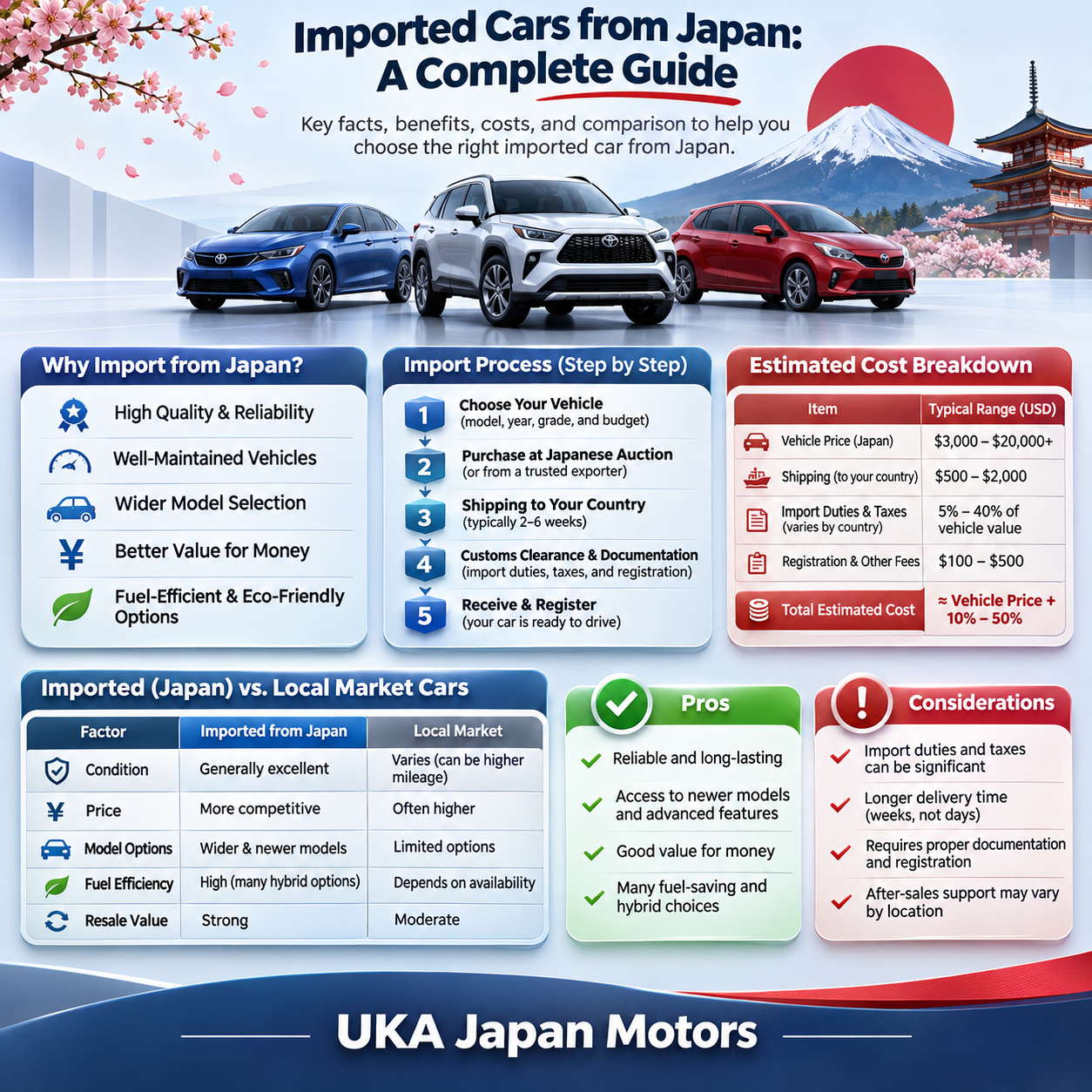
However, importing a Japanese used vehicle into Kenya in 2026 requires more than identifying a suitable model and confirming its condition. Buyers must understand two important areas that directly influence the importation process: the eight-year vehicle-age restriction and the taxes applied during customs clearance.
These requirements affect which vehicles can legally enter Kenya, how their customs values are determined, what documentation must accompany them and whether they can complete the inspection and registration process.
The requirements also have practical implications for buyers in Nairobi and Mombasa. Although both locations operate under the same national importation and taxation framework, their vehicle usage patterns, transport arrangements and ownership considerations are not identical.
Another important development is the adjustment of Kenya’s import taxation framework during 2026. Changes affecting import duty and statutory levies mean that information published in earlier years may no longer provide an accurate picture of the applicable requirements.
A vehicle that was eligible under an earlier importation cycle may no longer qualify under the current age restriction. Similarly, an older online tax calculation may use rates that have since changed.
This guide explains how the eight-year rule works in 2026, how the applicable taxes are structured, why customs valuation matters, what Nairobi and Mombasa buyers should examine and how to approach the importation process responsibly.
Quick Summary: What Japanese Car Buyers Need to Know in 2026
The main points are:
- Kenya maintains an eight-year age restriction for used vehicle imports, calculated using the year of first registration.
- For 2026, eligible passenger vehicles generally need to have been first registered in 2019 or later.
- The vehicle must meet the right-hand-drive requirement.
- The difference between the year of manufacture and the year of first registration must not exceed one year.
- Vehicles imported from Japan must satisfy the applicable KEBS inspection and roadworthiness requirements.
- Import duty, excise duty, VAT, Import Declaration Fee and Railway Development Levy form the main components of vehicle import taxation.
- The import duty applicable to the relevant passenger motor vehicle tariff classification is generally 35% under the 2026/27 Kenyan tariff arrangements.
- IDF is generally 2.5% and RDL is 2% of the applicable customs value.
- Excise duty depends on vehicle classification, engine capacity and fuel or propulsion type.
- KRA customs valuation does not necessarily follow the amount stated on a Japanese auction invoice.
- Buyers should verify eligibility, documentation, customs classification and inspection arrangements before committing to an import.
The most important distinction is that meeting the age requirement does not automatically mean a vehicle will pass every other importation requirement.
1. Understanding Kenya’s Eight-Year Used Vehicle Import Rule
The eight-year restriction is one of the most important regulations governing second-hand vehicle imports into Kenya.
It is implemented under the Kenya Bureau of Standards’ KS 1515 vehicle inspection requirements. Its purpose is to establish an age limit for imported used vehicles and support the inspection and quality requirements applicable to vehicles entering the country.
The restriction is based on the year of first registration rather than simply relying on the manufacturing year shown in a vehicle listing.
This distinction matters because a vehicle can be manufactured in one calendar year but first registered in another.
For example, a vehicle manufactured in 2018 but first registered in 2019 must be assessed using its actual first-registration information and the applicable standard.
Which registration years qualify in 2026?
For the 2026 importation cycle, KEBS requirements identify vehicles first registered from 1 January 2019 onwards as eligible under the eight-year age restriction, subject to the other applicable requirements.
| Vehicle’s first-registration year | 2026 import eligibility |
|---|---|
| 2017 | Not eligible |
| 2018 | Not eligible |
| 2019 | Generally eligible |
| 2020 | Generally eligible |
| 2021 | Generally eligible |
| 2022 | Generally eligible |
| 2023 | Generally eligible |
| 2024 | Generally eligible |
| 2025 | Generally eligible |
| 2026 | Subject to applicable used-vehicle classification and requirements |
The table illustrates the age requirement, not automatic approval. Other standards, documentation and inspection conditions remain applicable.
The effective date also matters. Vehicles first registered in 2018 were subject to the previous importation cycle, but their eligibility did not continue indefinitely. KEBS required vehicles in that category to arrive by 31 December 2025.
Consequently, buyers should not assume that a vehicle approved or advertised under the previous year’s eligibility requirements can still be imported during 2026.
Why does the rule use first registration?
First registration establishes when a vehicle entered registered road use.
Manufacturing year alone does not always provide a complete picture of the vehicle’s age. A vehicle can remain unregistered for a period after manufacture, meaning that two vehicles manufactured during the same year may have different first-registration dates.
Using first registration creates a consistent reference point for evaluating eligibility.
It also makes supporting documents important. Export certificates, deregistration records and original registration documents must provide information that can be checked against the vehicle’s identity.
The one-year manufacturing and registration difference
Another important requirement is the relationship between manufacture year and first-registration year.
The applicable standard restricts the difference between these years to no more than one year.
For example:
- Manufactured in 2018 and first registered in 2019: potentially compliant with the year-difference requirement.
- Manufactured in 2017 and first registered in 2019: does not meet the one-year difference requirement.
- Manufactured in 2019 and first registered in 2019: meets the year-difference requirement.
The actual documents must support the information presented.
A vehicle should not be selected solely because its advertisement displays a qualifying registration year.
2. Why the Eight-Year Rule Changes Japanese Vehicle Selection
The age restriction affects the range of Japanese vehicles available for importation into Kenya.
Japan has a large used vehicle market containing vehicles with different registration histories, specifications and mechanical conditions. However, not every vehicle available in Japan is eligible for importation into Kenya.
The Kenyan importation requirement must therefore be considered before evaluating a vehicle’s condition or suitability.
Older vehicles are not automatically acceptable
A Japanese vehicle can have an attractive maintenance history, a clean interior and a mechanically sound engine but still fail Kenya’s age eligibility requirement.
This is an important distinction between vehicle condition and import compliance.
Mechanical condition answers whether a vehicle is suitable for use. Import eligibility determines whether it meets the legal and technical requirements for entry into Kenya.
Both must be examined independently.
Registration history becomes a selection priority
When comparing Japanese vehicles, buyers should pay particular attention to:
- Original first-registration date.
- Manufacturing year.
- Export or deregistration certificate.
- Vehicle identification number.
- Chassis number.
- Registration details recorded in the exporting country.
- Consistency between auction information and official documentation.
A discrepancy between the registration date and manufacturing information should be resolved before the vehicle is shipped.
Why the arrival date matters
Eligibility is not determined only by when a vehicle is selected in Japan.
The applicable rules must be satisfied when the vehicle enters Kenya through the relevant importation process.
A vehicle purchased or prepared under an earlier eligibility cycle may encounter difficulties if its arrival falls into a later cycle.
This makes shipping schedules and documentation preparation important parts of import planning.
Buyers should establish the applicable registration-year cut-off for the expected arrival period rather than relying exclusively on the date of purchase.
3. Rising Import Taxes in Kenya: What Changed in 2026?
Vehicle taxation is another major consideration for Japanese used car imports.
Kenya applies several taxes and statutory levies to imported motor vehicles. These charges are calculated using the applicable customs valuation and tariff classification.
The important point in 2026 is that the tax structure cannot be understood by looking at import duty alone.
The applicable import duty, excise duty, VAT, IDF and RDL must be considered together.
The 2026 import taxation structure
For relevant conventional passenger motor vehicle classifications, the general taxation structure applicable under the 2026/27 framework is:
| Tax or levy | General applicable rate | Assessment basis |
|---|---|---|
| Import duty | 35% | Customs value |
| Excise duty | 20%, 25% or 35% | Customs value plus import duty |
| VAT | 16% | Customs value plus import duty and excise duty |
| Import Declaration Fee (IDF) | 2.5% | Applicable customs value |
| Railway Development Levy (RDL) | 2% | Applicable customs value |
These are general reference rates, not a universal calculation for every vehicle.
The exact treatment depends on the vehicle’s tariff classification, engine capacity, fuel or propulsion type and the regulations in force when customs entry is assessed.
Fully electric vehicles and certain other vehicle categories may have different classifications and rates.
Import duty: Why the 2026 rate matters
Import duty is one of the main taxes applied to vehicles entering Kenya.
Under the 2026/27 tariff arrangements, the applicable import duty for relevant conventional passenger vehicle tariff lines is generally 35%.
This is important because some older vehicle import guides continue to use the previous 25% rate.
The change means that calculations prepared using earlier rates may not accurately reflect the current customs assessment.
The applicable rate should always be checked against the current East African Community Common External Tariff and the Kenyan measures in force on the date of importation.
Excise duty: Engine capacity and vehicle classification
Excise duty is another important part of the importation process.
Unlike import duty, which is determined by the relevant customs tariff classification, excise duty can vary according to engine size, fuel type and the legal description of the vehicle.
For common passenger vehicle classifications, the general structure includes:
| Vehicle classification | General excise duty |
|---|---|
| Petrol vehicles up to 1,500cc | 20% |
| Petrol vehicles above 1,500cc up to 3,000cc | 25% |
| Petrol vehicles above 3,000cc | 35% |
| Diesel vehicles up to 1,500cc | 25% |
| Diesel vehicles above 1,500cc up to 2,500cc | 25% |
| Diesel vehicles above 2,500cc | 35% |
| Qualifying hybrid vehicles | Depends on applicable tariff and excise classification |
| Fully electric vehicles | Separate applicable classification |
These categories are provided as a general guide. The exact tariff description must be confirmed rather than assuming that every vehicle with a particular engine size receives identical treatment.
For example, a petrol vehicle with an engine capacity of 1,300cc and a diesel vehicle with an engine capacity of 1,300cc may not have the same excise treatment.
Similarly, hybrid vehicles should not automatically be treated as ordinary petrol vehicles or assumed to receive a particular tax treatment without checking their classification.
VAT: Why it is calculated after other taxes
Value Added Tax is generally applied at 16%.
However, it is important to understand that VAT on an imported vehicle is not simply calculated against the original purchase invoice.
The taxable import value incorporates the relevant customs value and applicable import and excise duties.
This creates a cumulative taxation structure.
Consequently, changes in import duty or excise duty can also affect the VAT calculation.
IDF and RDL
Two additional statutory charges are generally relevant to imported vehicles.
Import Declaration Fee (IDF)
IDF is generally calculated at 2.5% of the applicable customs value under the current framework.
Railway Development Levy (RDL)
RDL is generally calculated at 2% of the applicable customs value.
These levies are separate from import duty, excise duty and VAT.
Buyers should also distinguish statutory taxes from shipping, port handling, inspection and customs clearance arrangements. They are not interchangeable components of the tax calculation.
Why old online tax calculators can be misleading
A vehicle import calculator is only useful when it applies the correct legal rates, vehicle classification and valuation method.
Some online information continues to display earlier tax structures.
Other calculators may use a single excise rate for all passenger vehicles, even though the actual classification can differ.
A reliable assessment should identify:
- The applicable customs value.
- The correct tariff classification.
- The import duty rate.
- The relevant excise duty category.
- The VAT calculation base.
- The applicable IDF and RDL rates.
- Any relevant exemptions or special provisions.
Without these details, a calculated result should be treated as an estimate rather than an official customs assessment.
4. How KRA Determines the Customs Value of a Japanese Used Car
One of the most misunderstood parts of importing a Japanese used vehicle into Kenya is customs valuation.
Many buyers assume that KRA calculates import taxes directly from the amount recorded on the Japanese auction sheet or commercial invoice.
However, vehicle valuation is more structured than that.
KRA uses its applicable customs valuation framework and the Current Retail Selling Price (CRSP) reference system for used motor vehicles.
The customs value can therefore differ from the amount shown in the original purchase documents.
What is CRSP?
CRSP means Current Retail Selling Price.
It is a reference valuation system used in determining the customs value of imported motor vehicles.
The relevant vehicle details are considered against the applicable valuation information, including factors such as:
- Make and model.
- Model year.
- Vehicle classification.
- Engine capacity.
- Body type.
- Specification.
- Applicable depreciation.
- Other relevant valuation characteristics.
The customs value is then used as the basis for calculating the applicable import taxes.
Why the auction invoice is not the final tax assessment
Japanese auction information is important because it provides evidence of the vehicle selected and its condition.
However, the auction transaction and the Kenyan customs valuation serve different purposes.
For example, a vehicle may have been purchased at auction based on its grade, mileage, condition and specification.
KRA may assess the vehicle using its applicable reference valuation rather than accepting the auction amount as the final customs value.
This means that buyers should not prepare an import plan using only the auction invoice.
The customs valuation framework must be understood before making assumptions about the final import tax position.
Depreciation and vehicle age
KRA applies an age-related depreciation framework when determining the value of used vehicles.
The applicable depreciation schedule is important because the vehicle’s age can influence the customs value used for assessment.
However, depreciation does not mean that a vehicle automatically qualifies for importation.
This is a particularly important distinction.
A vehicle might fall within a particular customs depreciation category but still fail the separate eight-year import eligibility requirement.
The valuation rules and the KEBS age restriction perform different functions.
What buyers should check
Before proceeding with a vehicle, buyers should establish:
- Whether the model appears in the applicable KRA valuation references.
- Whether its specifications match the correct valuation category.
- Whether its manufacturing and registration years are consistent.
- Whether its engine capacity and fuel type are correctly recorded.
- Whether the tax calculation uses the current tariff and levy rates.
These checks help prevent misunderstandings during customs clearance.
5. How the Rules Affect Popular Japanese Used Vehicle Categories
The eight-year rule and tax structure apply across different eligible vehicle categories, but their practical effects vary.
Engine size, body design, fuel type, registration history and intended usage all influence the importation decision.
Compact hatchbacks
Compact Japanese hatchbacks are commonly considered by motorists who need vehicles for everyday urban use.
Their smaller dimensions can be useful in congested areas, while their cabin layouts may suit individuals, couples and smaller households.
When evaluating these vehicles, buyers should check:
- First-registration eligibility.
- Engine capacity and corresponding excise classification.
- Transmission condition.
- Engine performance.
- Suspension condition.
- Electronic components.
- Hybrid battery condition, where applicable.
A smaller engine does not remove the requirement to comply with the full import taxation and inspection process.
Japanese saloon cars
Saloon cars provide a different combination of passenger space, boot capacity and road behaviour.
They may be appropriate for personal transport, family use and regular journeys between urban areas.
Their importation assessment should consider engine capacity, equipment specification and customs classification.
A vehicle with a larger engine may fall into a different excise category from a smaller-engined alternative.
Station wagons
Station wagons are relevant to buyers who require more luggage space while retaining a passenger-car configuration.
They may be used for family journeys, professional transport and regular intercity travel.
Important inspection points include:
- Rear suspension condition.
- Boot floor condition.
- Rear door operation.
- Transmission performance.
- Engine cooling system.
- Tyre condition.
- Signs of previous accident repairs.
SUVs and crossovers
SUVs and crossovers have a wide range of engine capacities and drivetrain configurations.
Their classification must be established using the actual tariff description rather than assuming that all SUVs receive the same excise treatment.
Buyers should also examine whether the selected vehicle is two-wheel drive or four-wheel drive and whether its mechanical condition is suitable for the intended roads.
Larger engine capacities can influence excise duty classification, while additional drivetrain components create further inspection considerations.
Hybrid vehicles
Hybrid vehicles require particular attention because their powertrains combine an internal combustion engine with electric propulsion components.
The relevant customs and excise treatment must be established using the vehicle’s actual technical classification.
A hybrid vehicle should not be assumed to receive the same treatment as a fully electric vehicle.
Buyers should also examine the condition of:
- Hybrid battery.
- Battery cooling system.
- Inverter.
- Electric motor.
- Engine management system.
- Regenerative braking system.
A vehicle can meet the age requirement and still require substantial technical examination before being accepted as suitable for long-term ownership.
Diesel vehicles
Diesel vehicles require careful consideration of their engine capacity and applicable excise category.
Their suitability also depends on the intended usage.
Buyers should inspect the fuel system, turbocharger where fitted, injectors, exhaust components and cooling system.
The taxation category must be verified using the correct tariff classification rather than relying on general assumptions about diesel engines.
6. Nairobi Buyers: How the Import Rules Affect Vehicle Selection
Nairobi has a distinctive driving environment shaped by congestion, urban development, changing road conditions and frequent stop-and-go traffic.
These conditions influence the type of vehicle that may be suitable for everyday use.
The eight-year import rule affects the available registration-year range, while taxation affects the overall importation assessment.
However, the most suitable vehicle is not necessarily the one with the smallest engine or the newest registration year.
The decision should reflect actual driving requirements.
Urban congestion and engine suitability
Vehicles used regularly in Nairobi may experience prolonged periods of slow traffic.
This can place repeated demands on cooling systems, transmissions and braking components.
A vehicle intended primarily for urban driving should therefore be inspected for:
- Cooling fan operation.
- Radiator condition.
- Transmission response in slow traffic.
- Engine temperature stability.
- Air-conditioning performance.
- Brake condition.
- Battery and charging-system performance.
A vehicle with a technically compliant registration year may still be unsuitable if its mechanical condition is poor.
Parking and vehicle dimensions
Nairobi motorists often encounter limited parking space in residential buildings, offices, shopping areas and commercial premises.
Vehicle dimensions can therefore influence ownership convenience.
Compact hatchbacks may suit drivers who prioritise manoeuvrability, while saloon cars and SUVs may offer additional passenger or luggage capacity.
The decision should consider the actual parking environment rather than selecting a vehicle based only on its category.
Longer journeys outside Nairobi
Many Nairobi-based motorists also travel to other parts of Kenya.
A vehicle used for both city driving and longer journeys needs a broader inspection.
The engine, cooling system, suspension, braking system and tyres should be evaluated for sustained road use.
Buyers should also consider cabin comfort, luggage capacity and the availability of appropriate replacement components.
Documentation and customs preparation
Nairobi buyers should pay attention to the relationship between vehicle selection, import documentation and the customs clearance process.
The correct first-registration year, export records and vehicle identity details should be established before shipment.
Where destination inspection or document validation applies, the relevant requirements should be confirmed before the vehicle arrives.
This is particularly important when the vehicle is being imported close to a change in the annual age eligibility cycle.
7. Mombasa Buyers: Coastal Conditions and Importation Considerations
Mombasa occupies an important position in Kenya’s vehicle importation system because of its coastal location and the Port of Mombasa.
For buyers in Mombasa, the importation process and subsequent vehicle ownership involve considerations that differ from those experienced by motorists in Nairobi.
The same national customs and KEBS requirements apply, but local environmental conditions influence vehicle inspection and maintenance.
Humidity and corrosion
Coastal humidity can contribute to corrosion, especially where protective coatings have been damaged or moisture has entered enclosed vehicle sections.
When evaluating a Japanese used vehicle, buyers should pay attention to:
- Undercarriage condition.
- Suspension mounting points.
- Exhaust components.
- Brake lines.
- Door seams.
- Boot floor.
- Battery terminals.
- Electrical connectors.
A vehicle should be inspected for corrosion rather than assuming that a clean exterior indicates good overall condition.
Salt exposure and vehicle protection
The coastal environment can create additional corrosion risks where vehicles are exposed to salt-laden air.
Protective measures and regular inspections are important for maintaining the vehicle over time.
Undercarriage cleaning, inspection of damaged paintwork and attention to drainage areas can help identify developing problems.
Port arrival and clearance
The Port of Mombasa is a major entry point for imported vehicles.
However, arrival at the port does not mean that a vehicle has completed customs clearance or is ready for registration.
The vehicle must still satisfy the applicable documentation, valuation, taxation and inspection requirements.
Buyers should establish the status of:
- Bill of lading.
- Original export documentation.
- Customs declaration.
- KEBS roadworthiness documentation.
- Relevant vehicle identification details.
- Customs assessment and payment records.
- Any required document validation.
The port process should be coordinated with the customs clearing agent and the relevant inspection authorities.
Driving conditions in and around Mombasa
Mombasa motorists may encounter a mixture of urban congestion, coastal roads and longer journeys connecting different parts of the region.
The vehicle’s cooling system, air-conditioning, suspension, tyres and braking system should be evaluated according to its intended use.
Air-conditioning performance deserves particular attention because of the warm and humid coastal environment.
A vehicle with an ageing or poorly maintained cooling system may experience difficulties under demanding operating conditions.
Transporting vehicles from Mombasa to Nairobi
Some buyers based in Nairobi may have vehicles arriving through Mombasa.
This creates an additional consideration: the vehicle must be assessed not only for import compliance but also for its condition before onward movement.
A vehicle that has not completed the required clearance and registration process should not be treated as ready for ordinary road use.
The appropriate transport and release arrangements should be confirmed before it is moved from the port.
8. Nairobi vs Mombasa: What Should Buyers Consider?
The national import regulations do not change simply because a vehicle is intended for Nairobi rather than Mombasa.
However, ownership requirements can differ according to the environment in which the vehicle will operate.
| Consideration | Nairobi | Mombasa |
|---|---|---|
| Main driving environment | Congested urban roads and intercity routes | Coastal urban roads and regional routes |
| Vehicle cooling | Important during prolonged congestion | Important in warm coastal conditions |
| Air-conditioning | Important for urban and longer journeys | Particularly relevant in humid conditions |
| Corrosion inspection | Important for every used vehicle | Additional attention to coastal exposure |
| Vehicle size | Parking and traffic manoeuvrability | Parking, passenger and regional travel needs |
| Suspension inspection | Important for mixed road conditions | Important for urban and regional road use |
| Import regulations | National KEBS and KRA requirements | National KEBS and KRA requirements |
| Customs documentation | Required | Required |
The correct choice depends on where and how the vehicle will be used.
A vehicle selected for Nairobi should not be evaluated exclusively on its ability to navigate traffic. Its suitability for occasional longer journeys should also be considered.
Likewise, a vehicle selected for Mombasa should be examined for coastal environmental exposure and the demands of regular regional driving.
9. KEBS Inspection: What Happens Before a Japanese Used Car Enters Kenya?
KEBS inspection is a central part of the used vehicle importation process.
Japanese vehicles exported to Kenya must satisfy the applicable roadworthiness requirements.
Vehicles exported from Japan are subject to the relevant pre-export inspection arrangements, including the Certificate of Roadworthiness issued through the designated inspection process.
The inspection is intended to establish whether the vehicle meets the required technical and safety standards.
What does the inspection consider?
Inspection may cover several areas, including:
Vehicle identity
The chassis number, identification details and associated documentation must correspond.
Structural condition
The vehicle should be examined for structural damage, major repairs and conditions that may affect its safety.
Braking system
Brakes must be in suitable operating condition.
Steering and suspension
Steering components and suspension systems must be checked for defects that may affect handling and road safety.
Lighting and electrical equipment
Required lights, indicators and relevant electrical systems should operate correctly.
Tyres and wheels
Tyre condition and wheel suitability are important inspection considerations.
Engine and mechanical condition
The vehicle’s mechanical condition should be evaluated for defects that could compromise roadworthiness.
What if the vehicle does not have the required Certificate of Roadworthiness?
KEBS introduced a document-validation process for used vehicles subject to destination inspection.
The July 2025 notice explains that import documents for vehicles without the required Certificate of Roadworthiness must be validated through Quality Inspection Services Inc. Japan (QISJ) before destination inspection.
The process uses registration and export documentation to verify the vehicle’s age and identity.
This is particularly relevant where buyers encounter vehicles with incomplete, inconsistent or unverified export records.
A buyer should establish the correct inspection route before shipping rather than assuming that documentation problems can be resolved automatically after arrival.
10. Documents Buyers Should Verify Before Importing
Documentation is as important as the physical condition of the vehicle.
An eligible vehicle with incomplete or inconsistent records can encounter problems during inspection, customs processing or registration.
The following documents and records should be considered during the importation process.
Original commercial invoice
The commercial invoice records the transaction and identifies the vehicle and the relevant parties.
It should be consistent with the supporting export documentation.
Original export certificate or deregistration documentation
The original registration or export records are important for establishing the vehicle’s registration history.
They also help verify the first-registration year used for age eligibility.
Bill of lading
The bill of lading is an important shipping document identifying the consignment and its transportation details.
Vehicle information should correspond with the relevant export records.
Certificate of Roadworthiness
The certificate provides evidence that the vehicle has undergone the applicable roadworthiness inspection.
The relevant certificate should be checked for authenticity and consistency with the vehicle identification information.
Vehicle identification details
The chassis number and other identification information should match across the supporting records.
Any discrepancy should be investigated before proceeding.
Import declaration and customs assessment
The customs declaration records the details submitted for the importation process.
The assessment should reflect the correct vehicle classification and applicable tax structure.
Kenya Revenue Authority PIN documentation
The importer’s relevant tax identification documentation may be required as part of the customs process.
NTSA registration documentation
Following successful importation and completion of the relevant requirements, the vehicle must undergo the applicable registration process through the National Transport and Safety Authority.
The Kenyan registration records and logbook establish the vehicle’s registration status in Kenya.
11. The Importation Process: From Japanese Selection to Kenyan Registration
Understanding the order of the importation process helps buyers identify where compliance checks should take place.
Stage 1: Identify an eligible vehicle
Start by confirming the vehicle’s first-registration year.
For the 2026 importation cycle, the vehicle should generally have been first registered in 2019 or later.
Also verify that the manufacturing and first-registration years satisfy the applicable one-year difference requirement.
Stage 2: Check the vehicle specification
Establish the make, model, engine capacity, fuel type, transmission, drivetrain and equipment specification.
These details influence both the vehicle’s suitability and its customs classification.
Stage 3: Review the Japanese vehicle records
Examine the auction information and available export documentation.
The chassis number, manufacturing information and registration details should be consistent.
Stage 4: Confirm inspection requirements
Establish the relevant KEBS inspection arrangements and the documentation needed for the vehicle’s export from Japan.
Where a Certificate of Roadworthiness is required, verify that the applicable inspection has been completed.
Stage 5: Confirm the tax classification
The vehicle should be assessed using the relevant tariff classification, applicable import duty, excise duty, VAT, IDF and RDL.
A calculation based on outdated rates should not be used as the final reference.
Stage 6: Arrange shipping documentation
The relevant shipping and export documents should be prepared and checked.
This includes the bill of lading and the required commercial and vehicle records.
Stage 7: Customs declaration and assessment
A licensed customs clearing agent assists with the import declaration and customs processing.
KRA assesses the applicable taxes using the relevant customs valuation and tariff requirements.
Stage 8: Customs clearance and inspection
The required taxes must be addressed, and the vehicle must complete the applicable customs and KEBS procedures.
Any outstanding documentation or inspection issue should be resolved through the appropriate authority.
Stage 9: NTSA registration
After the relevant importation and clearance requirements have been satisfied, the vehicle proceeds through the applicable NTSA registration process.
The Kenyan registration documentation must be completed before the vehicle is treated as fully registered for ordinary road use.
12. Common Importation Mistakes Buyers Should Avoid
Many importation difficulties arise because important requirements are considered too late.
The following mistakes are particularly relevant in 2026.
Mistake 1: Using manufacturing year instead of first-registration year
A buyer may identify a vehicle by its manufacturing year without checking its first-registration date.
This can create an eligibility problem.
The first-registration year must be verified from the appropriate records.
Mistake 2: Relying on an old eligibility announcement
The annual age cut-off changes over time.
A vehicle that qualified in the previous importation cycle may not qualify in 2026.
Always confirm the current registration-year requirement.
Mistake 3: Assuming that an auction grade guarantees compliance
Auction grades describe aspects of the vehicle’s condition.
They do not replace Kenyan import regulations, customs valuation or KEBS inspection.
Mistake 4: Calculating taxes using outdated rates
Earlier import guides may show tax percentages that are no longer applicable.
The 2026/27 framework must be checked before preparing an import assessment.
Mistake 5: Assuming the invoice determines customs value
The Japanese invoice is an important supporting document, but KRA’s valuation framework must also be considered.
Buyers should understand CRSP-based valuation before making assumptions about the customs assessment.
Mistake 6: Ignoring engine and fuel classification
Vehicles with different engine capacities or propulsion systems can receive different excise treatment.
The correct tariff classification must be confirmed.
Mistake 7: Overlooking document inconsistencies
A difference between the chassis number, registration information and export documentation can complicate verification.
All records should be checked before shipment.
Mistake 8: Treating port arrival as completed importation
Arrival at Mombasa does not automatically mean that customs clearance, inspection and registration are complete.
Each stage must be properly addressed.
Mistake 9: Ignoring the vehicle’s intended operating environment
A vehicle that is mechanically suitable for one driving environment may require additional attention when used in another.
Nairobi congestion and Mombasa’s coastal conditions should both be considered when selecting and inspecting a vehicle.
Mistake 10: Confusing tax compliance with mechanical condition
A vehicle can satisfy every documentation requirement but still have mechanical defects.
Likewise, a mechanically sound vehicle may fail the import eligibility rules.
Both areas require separate attention.
13. How the 2026 Import Rules Affect Long-Term Vehicle Ownership
Importation is only the beginning of vehicle ownership.
A vehicle must remain suitable for the conditions in which it operates, and its maintenance requirements should be understood before purchase.
The age restriction may narrow the available registration-year range, but it does not guarantee that every eligible vehicle has been maintained properly.
Buyers should therefore assess the complete vehicle rather than focusing exclusively on its year of registration.
Engine and transmission maintenance
Japanese used vehicles should be checked for maintenance history, engine condition, transmission performance and signs of previous mechanical repairs.
Transmission servicing is particularly important for vehicles used regularly in congested urban traffic.
A smooth test of basic operation should not replace a detailed mechanical inspection.
Cooling system condition
Cooling system performance matters in both Nairobi and Mombasa.
Radiators, hoses, coolant condition, thermostats, fans and related components should be examined.
Overheating can lead to significant mechanical problems if ignored.
Suspension and steering
Kenyan road conditions can place varying demands on suspension and steering components.
Buyers should check shock absorbers, bushes, ball joints, wheel bearings and steering components.
Unusual noises, uneven tyre wear and unstable handling may indicate underlying defects.
Electrical and electronic systems
Modern Japanese vehicles may contain multiple electronic systems controlling engine performance, safety equipment, transmission operation and comfort features.
Diagnostic checks should be used where appropriate.
Warning lights should not be ignored or assumed to be minor without proper investigation.
Hybrid battery health
For hybrid vehicles, the condition of the high-voltage battery and associated cooling and control systems is an important part of the inspection.
The presence of a hybrid badge does not establish battery health.
A specialist assessment is useful where the vehicle’s hybrid system requires technical verification.
Coastal maintenance
Vehicles operating in Mombasa should receive attention to corrosion prevention and underbody condition.
Regular inspection can help identify corrosion at an early stage.
Urban maintenance
Vehicles operating primarily in Nairobi should receive attention to braking systems, cooling performance, transmission behaviour and suspension condition.
Frequent stop-and-go traffic can influence component wear.
Long-term suitability should be evaluated according to the vehicle’s actual use rather than its registration year alone.
14. Choosing Between an Older and a Newer Eligible Japanese Used Car
The eight-year rule means that buyers must work within the registration-year eligibility requirements.
However, the newest eligible vehicle is not automatically the best choice.
A sensible comparison should consider vehicle condition, maintenance history, specification and customs classification.
| Comparison factor | Earlier eligible vehicle | Newer eligible vehicle |
|---|---|---|
| Registration history | Requires careful age verification | Still requires verification |
| Mechanical condition | Maintenance history is especially important | Condition still requires inspection |
| Customs depreciation | Depends on applicable age category | Depends on applicable age category |
| Available technology | May have an earlier specification | May include newer equipment |
| Wear and tear | More attention may be needed | Still depends on actual usage |
| Parts and servicing | Confirm local availability | Confirm local availability |
| Import eligibility | Must meet 2026 rules | Must meet 2026 rules |
A vehicle with a complete maintenance record and sound mechanical condition may be a more appropriate ownership choice than a newer vehicle with an uncertain history.
The correct decision should be based on documented condition and intended usage.
15. What Buyers Should Confirm Before Committing to a Japanese Vehicle
Before proceeding with an import, buyers should work through several essential checks.
Eligibility
- Confirm the first-registration year.
- Confirm the manufacturing year.
- Check the one-year manufacturing and registration difference.
- Confirm right-hand-drive configuration.
- Establish the applicable arrival-date requirements.
Vehicle condition
- Review auction information.
- Examine accident and repair history.
- Check engine and transmission condition.
- Inspect suspension and steering.
- Examine underbody condition.
- Verify electrical systems.
- Assess hybrid components where relevant.
Taxation
- Confirm the correct KRA valuation reference.
- Identify the applicable customs classification.
- Verify the current import duty rate.
- Establish the correct excise duty category.
- Confirm VAT, IDF and RDL treatment.
- Obtain a properly supported customs assessment.
Documentation
- Check the original export records.
- Verify the first-registration information.
- Match chassis and vehicle identification numbers.
- Confirm the Certificate of Roadworthiness.
- Check the bill of lading.
- Confirm the import declaration requirements.
Ownership planning
- Consider whether the vehicle suits Nairobi or Mombasa driving conditions.
- Review the availability of maintenance support.
- Consider parts availability.
- Understand the vehicle’s service requirements.
- Identify any specialist maintenance requirements.
These checks help buyers distinguish between a vehicle that is merely available for export and one that is suitable for lawful importation and continued use in Kenya.
16. The Role of UKA Japan Motors in the Japanese Vehicle Importation Process
UKA Japan Motors recognises that importing a Japanese used vehicle into Kenya involves several connected decisions.
The vehicle itself is only one part of the process. Buyers must also understand registration-year eligibility, export documentation, inspection requirements, customs valuation and the applicable tax structure.
An informed vehicle selection process should therefore begin with compliance checks rather than treating them as final administrative steps.
The role of UKA Japan Motors is centred on helping buyers understand the practical requirements associated with Japanese used vehicles and the importance of appropriate inspection and documentation.
This includes helping buyers understand:
- The distinction between manufacturing year and first-registration year.
- The applicable eight-year import restriction.
- The importance of right-hand-drive compliance.
- The relevance of KEBS inspection and roadworthiness documentation.
- The need to verify vehicle identification records.
- The relationship between engine specifications and excise classification.
- The importance of current KRA customs valuation.
- The differences between import clearance and final vehicle registration.
- The mechanical considerations associated with Nairobi and Mombasa driving conditions.
UKA Japan Motors’ approach is based on transparent information, inspection awareness and compliance-focused guidance.
The objective is to help buyers make decisions with a clear understanding of the vehicle’s condition and the requirements that apply before it enters Kenya.
Import regulations and tax arrangements can change. For this reason, buyers should always verify the current position with the relevant government authorities and qualified customs professionals before committing to an importation.
Conclusion
Japanese used car imports into Kenya in 2026 are shaped by two major considerations: vehicle-age eligibility and the applicable customs taxation framework.
The eight-year restriction requires buyers to pay close attention to the year of first registration, with vehicles generally needing to have been first registered in 2019 or later for the 2026 importation cycle.
The manufacturing year must also satisfy the applicable one-year difference requirement, while right-hand-drive configuration and KEBS roadworthiness requirements remain essential.
On the taxation side, buyers must understand that import duty, excise duty, VAT, IDF and RDL work together. The relevant import duty and statutory levy rates changed over time, making older tax guides an unreliable basis for current import planning.
KRA valuation is another important consideration because the customs value may differ from the amount recorded on the Japanese auction invoice.
For Nairobi buyers, traffic conditions, vehicle dimensions, cooling performance and urban maintenance requirements should influence selection. For Mombasa buyers, coastal corrosion prevention, air-conditioning and regional driving requirements deserve particular attention.
Ultimately, a successful Japanese vehicle import depends on more than selecting an eligible registration year. It requires accurate documentation, appropriate inspection, correct customs classification and an understanding of long-term ownership requirements.
A careful approach to these areas helps buyers avoid preventable compliance problems and make better-informed vehicle decisions.
Contact UKA Japan Motors for availability and inspection guidance.