


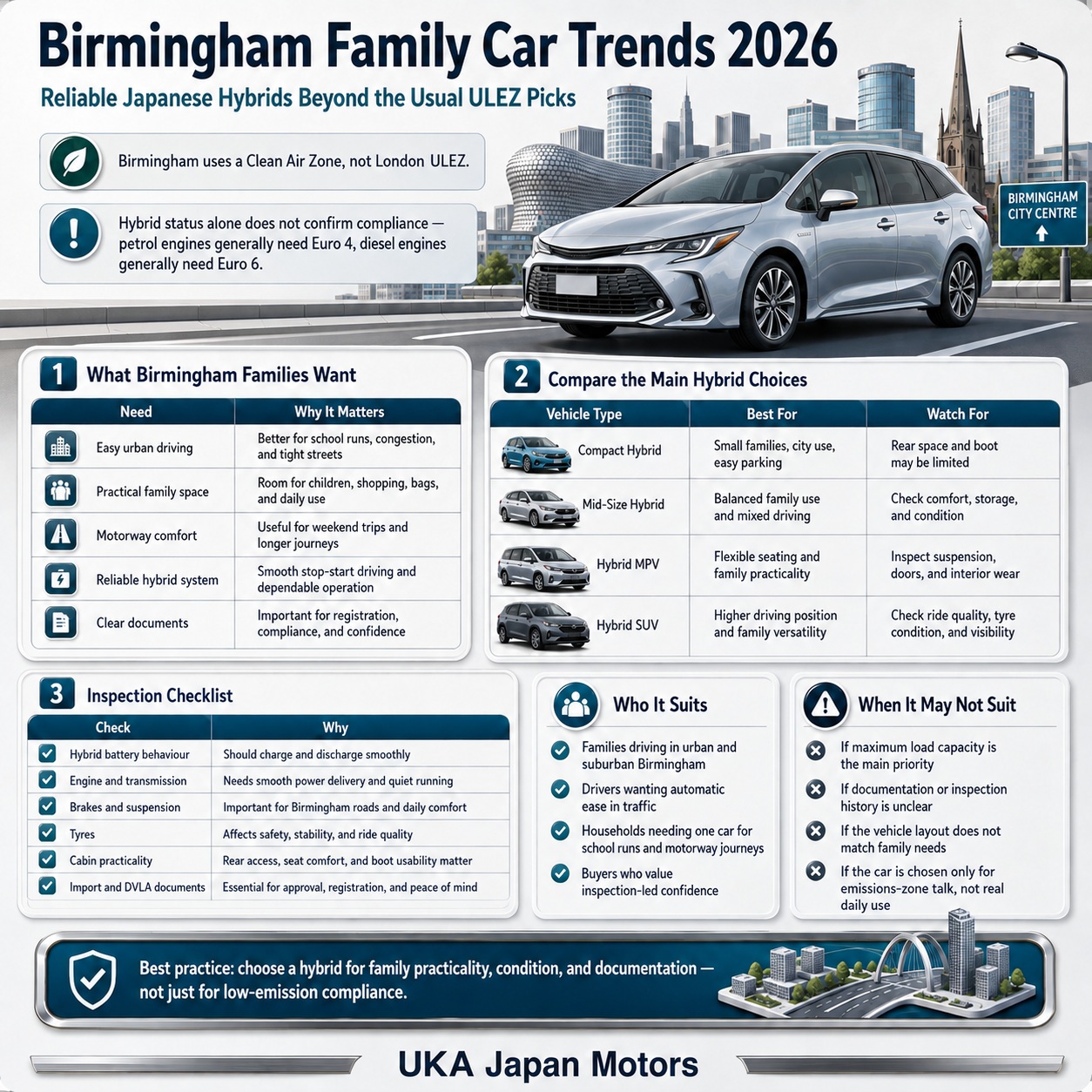
Family car buying in Birmingham is changing. In 2026, many households are no longer looking only for a vehicle that meets an emissions rule or avoids a city-centre charge. They are looking for something more complete: a dependable daily car that can handle school runs, supermarket trips, weekend motorway journeys, wet winter commutes, and the practical demands of family life without becoming complicated to own.
This is where reliable Japanese hybrids have become especially relevant. They are often discussed only in relation to low-emission driving zones, but for Birmingham families, the appeal goes further than compliance. A well-chosen hybrid can make sense because of how it drives in stop-start traffic, how calmly it manages urban journeys, and how suitable it can be for mixed use across the West Midlands.
The phrase “ULEZ picks” is often used casually by buyers when they talk about emissions-friendly cars, but Birmingham’s local system is the Clean Air Zone rather than London’s ULEZ. Birmingham’s Clean Air Zone does not ban vehicles from entering, but vehicles that do not meet the required emissions standards may be subject to a daily charge. Birmingham City Council explains that no vehicle is banned from the zone, but non-compliant vehicles are charged when they enter it. Government guidance states that cars, vans, taxis and private hire vehicles generally need to meet Euro 6 for diesel and Euro 4 for petrol to avoid Clean Air Zone charging.
For hybrid buyers, this distinction matters. A hybrid is not automatically suitable simply because it has an electric motor. The petrol or diesel engine still needs to meet the relevant emissions standard. Birmingham’s Clean Air Zone guidance notes that diesel-electric or petrol-electric hybrids must meet the relevant emissions standard for their engine type.
This guide looks beyond the usual compliance conversation and focuses on what Birmingham families should consider when choosing a reliable Japanese hybrid in 2026.
Direct Answer: What Are Birmingham Families Really Looking For in 2026?
Birmingham families are increasingly looking for hybrid cars that combine compliance awareness, everyday reliability, easy urban driving, practical cabin space, and long-term ownership confidence. The strongest choices are not always the most obvious models people mention first when discussing low-emission zones.
A suitable family hybrid for Birmingham should offer:
Good visibility for urban driving
Comfortable seating for regular family use
A boot shape that suits pushchairs, school bags, shopping, or luggage
Smooth performance in congestion
A reliable hybrid system with clear inspection history
Documentation that supports registration and compliance checks
A condition profile suitable for long-term use, not just short-term convenience
The most important point is that emissions suitability should be treated as one part of the decision, not the whole decision. A family car must work on ordinary days, not only when entering the city centre.
Why This Topic Matters in Birmingham
Birmingham places very specific demands on family cars. A vehicle may spend one morning crawling through local traffic, the afternoon parked in rain, and the next day travelling on the motorway with children, luggage, and a full cabin. That mixed pattern is different from choosing a car only for occasional city-centre access.
Many families move between residential areas, school routes, retail parks, hospitals, workplaces, and motorway connections. A practical car must feel manageable in tight urban streets while remaining stable and comfortable on faster roads. It also needs to cope with frequent cold starts, short trips, damp weather, and repeated low-speed use.
Hybrid vehicles can suit this pattern because they are designed to manage changing driving conditions. In slow traffic, the electric motor can support gentle movement. On open roads, the petrol engine works alongside the hybrid system. In family use, this can create a calmer driving experience than a traditional engine-only car, especially where journeys involve repeated braking, waiting, and acceleration.
However, not every hybrid is equally suitable. Some are compact and efficient but too limited for family luggage. Others have good space but may require closer inspection because of age, previous use, battery condition, or documentation gaps. The trend in 2026 is not simply “buy any hybrid.” It is “choose a hybrid that fits the family’s real driving pattern.”
Beyond the Usual ULEZ Picks: Why Buyers Should Look Wider
When emissions zones are discussed, buyers often hear the same familiar names repeated. These models may be good cars, but a narrow search can cause families to overlook alternatives that may suit their life more naturally.
The usual picks are often chosen because they are easy to recognise. Recognition is useful, but it does not confirm condition, comfort, seating suitability, boot usability, inspection quality, or long-term dependability. A Birmingham family should not choose a car only because it appears frequently in online emissions-zone discussions.
Looking beyond the obvious options can help buyers focus on:
Whether the rear seats genuinely suit children or adults
Whether the boot opening is practical for family items
Whether the vehicle feels comfortable in congestion
Whether the hybrid battery and charging behaviour are healthy
Whether service records and import documents are complete
Whether the model is suitable for local maintenance and inspection support
Whether the driving position suits daily use
This broader approach is especially important for Japanese hybrids, because the range of available models can be wider than many buyers first expect. Some models are well known, while others are quieter choices that suit families who prioritise comfort, reliability, and condition over badge familiarity.
The 2026 Birmingham Family Hybrid Profile
A family hybrid in Birmingham needs to satisfy several roles at once. It must be easy enough for city use, composed enough for motorway journeys, and practical enough for daily family routines.
1. The School-Run Car
For school routes, a car needs good visibility, smooth low-speed control, sensible door openings, and a cabin that does not feel cramped. Hybrids can be useful here because they often feel calm in slow traffic. The stop-start nature of school traffic can be tiring in some cars, but a well-functioning hybrid system can make this type of journey smoother.
The inspection focus should include brakes, tyres, suspension, door seals, seat condition, and cabin electronics. Family cars often experience heavy interior use, so condition inside the vehicle matters as much as engine performance.
2. The Weekend Family Car
At weekends, the same vehicle may need to carry passengers, bags, shopping, or sports equipment. This makes boot shape and seat-folding flexibility important. A hybrid with a slightly smaller boot because of battery packaging may still work well, but only if the layout suits the household’s real needs.
Buyers should check not just boot volume but also loading height, opening width, rear-seat folding arrangement, and whether the floor shape is practical.
3. The Motorway Car
Birmingham families often need a car that feels stable on motorway links. A suitable hybrid should not feel strained at higher speeds, especially when fully loaded. During inspection, attention should be paid to steering feel, alignment, tyre condition, engine response, and how smoothly the hybrid system transitions between electric assistance and engine power.
A hybrid that feels excellent in city traffic but unsettled on faster roads may not be the best family choice.
4. The Long-Term Ownership Car
Long-term suitability depends on more than model reputation. It depends on condition, maintenance evidence, battery health, previous usage, and whether the vehicle has been properly checked before sale or registration.
Japanese hybrids often have strong reliability reputations, but a reputation is not a substitute for inspection. Buyers should still expect careful checks of the hybrid system, engine, transmission, suspension, body condition, electronics, and documentation.
Reliable Japanese Hybrids: What Reliability Really Means
Reliability should not be understood as a guarantee that nothing will ever need attention. In family car buying, reliability means the vehicle has a sound design, predictable maintenance needs, durable major systems, and clear evidence that it has been looked after properly.
For Japanese hybrids, buyers often value the combination of petrol-electric engineering, smooth automatic driving, and established hybrid technology. But reliability depends on three layers.
Design Reliability
This is the reputation of the model and drivetrain. Some Japanese hybrid systems have become well regarded because they have been used widely and refined over time. For families, this matters because proven systems can reduce uncertainty.
Condition Reliability
This is the actual state of the individual car. Two cars of the same model can be very different depending on previous use, servicing, accident history, mileage pattern, tyre quality, and battery behaviour.
Documentation Reliability
This is the paper trail. A car with proper records, clear registration documents, and traceable inspection information gives buyers more confidence. For imports, documentation becomes even more important because DVLA registration and approval requirements must be handled correctly.
Government guidance explains that imported vehicles need approval to show they meet environmental and safety regulations, and proof of approval is required before registration and taxation. The wider import process includes getting approval, registering and taxing the vehicle with DVLA, and insuring it before driving on UK roads.
For Birmingham families, documentation is not a formality. It affects whether the car can be registered correctly, checked properly, and used with confidence.
Hybrid Types Birmingham Families Should Understand
Not all hybrids work in the same way. A buyer does not need to become a technician, but understanding the basic differences helps avoid confusion.
Self-Charging Hybrids
These are petrol-electric hybrids that use the engine, braking energy, and onboard systems to support the battery. They are common among Japanese family cars and can suit Birmingham driving because they work naturally in stop-start conditions.
They do not require the owner to plug them in. For families without off-street charging, this simplicity can be important.
Plug-In Hybrids
Plug-in hybrids have a larger battery and can drive for a distance using electric power when charged. They may suit some families, but they require a consistent charging routine to make full use of their design.
For households without reliable charging access, a plug-in hybrid may not deliver the expected benefit. It may still be a practical car, but the ownership pattern needs to match the technology.
Mild Hybrids
Mild hybrids use electrical assistance but cannot usually drive on electric power alone. They may improve smoothness and support efficiency, but they are different from full hybrids. Families should not assume all hybrid badges mean the same thing.
For Birmingham family use, full hybrids are often attractive because they combine simplicity, urban smoothness, and familiar petrol operation.
Why Japanese Hybrids Suit Birmingham Family Use
Japanese hybrid family cars can work well in Birmingham because their strengths align with local driving realities.
Smooth Low-Speed Driving
Birmingham congestion can make harsh acceleration, jerky gear changes, or heavy clutch use frustrating. Many Japanese hybrids use automatic systems that feel smooth in slow movement. This helps during school runs, city-centre approaches, and residential driving.
Calm Cabin Experience
Family journeys are often easier when the car feels quiet and predictable. A smooth hybrid system can reduce the sense of strain in traffic. For parents carrying children, passengers, or elderly relatives, comfort can be just as important as performance.
Practical Body Styles
Japanese hybrids are available in hatchback, estate, MPV-style, saloon, and SUV forms. This gives families several ways to match the car to their needs. A compact hybrid may suit a small household, while a larger hybrid may suit families carrying more passengers or luggage.
Established Engineering
Many Japanese manufacturers have long experience with hybrid systems. For buyers, this can make the ownership experience feel more familiar and easier to assess during inspection. The key is still to choose based on the individual vehicle, not only the badge.
Comparison: Familiar Low-Emission Picks vs Broader Japanese Hybrid Choices
A narrow low-emission search often begins with the most commonly discussed compact hatchbacks. These can be suitable for some buyers, especially those who mainly drive alone or with one passenger. However, families may need to look wider.
A familiar compact hybrid may offer easy parking and strong city usability, but it may not provide the rear space, boot shape, or motorway comfort needed for regular family use.
A larger Japanese hybrid estate, MPV-style model, or SUV may provide better family practicality, but it must be inspected carefully for suspension wear, tyre condition, bodywork, battery health, and service history.
The right comparison is not simply small versus large. It is whether the car matches the household’s use.
For example:
A compact hybrid may suit a couple with one child and mostly urban routes.
A mid-size hybrid hatchback or estate may suit a family needing more luggage space.
A hybrid MPV-style vehicle may suit households needing easy access and flexible seating.
A hybrid SUV may suit drivers who prefer a higher seating position and stronger road presence.
The best choice is the one that fits the buyer’s real week, not just one journey into the Clean Air Zone.
Clean Air Zone Awareness Without Letting It Dominate the Decision
Birmingham’s Clean Air Zone is an important factor, but it should not be the only one. A vehicle that meets emissions standards may still be unsuitable if it has poor condition, weak documentation, uncomfortable seating, or limited family practicality.
Buyers should remember three points.
First, Birmingham uses a Clean Air Zone framework, not the same system as London’s ULEZ. The language may overlap in everyday conversation, but the local rules and checks should be considered directly.
Second, hybrid status alone does not automatically confirm compliance. The engine standard matters. Official guidance makes clear that minimum standards apply by vehicle and engine type.
Third, imported vehicles require careful registration and documentation checks. A car should be assessed before purchase or handover so that compliance, identity, and condition are understood clearly.
A family car should be chosen for daily suitability first, with Clean Air Zone awareness forming part of the overall inspection and ownership review.
Inspection Priorities for Japanese Hybrid Family Cars
A proper inspection should go beyond a general visual check. Hybrid vehicles combine conventional mechanical parts with electrical systems, so both areas need attention.
Hybrid Battery Behaviour
The battery should charge and discharge smoothly. Warning lights, erratic energy display behaviour, or poor transition between petrol and electric operation should be investigated. A healthy hybrid system should feel natural and consistent.
Engine Condition
The petrol engine remains central to the car. It should start cleanly, run smoothly, and show no signs of overheating, unusual noise, or poor maintenance. Hybrid cars may use the engine intermittently, so smooth restarting and transition are important.
Transmission Smoothness
Many Japanese hybrids use automatic or electronically controlled drive systems. The car should move away smoothly and respond predictably. Hesitation, vibration, or harshness should be checked carefully.
Suspension and Steering
Birmingham roads can expose suspension wear. Uneven surfaces, potholes, and traffic-calming features place pressure on bushes, dampers, tyres, and alignment. Family cars should feel stable and quiet, not loose or unsettled.
Braking System
Hybrid braking can feel different because it may combine regenerative braking with conventional braking. The pedal should feel consistent, and the car should stop smoothly. Brake condition is especially important where the vehicle has spent much of its life in urban driving.
Interior Wear
Family suitability depends heavily on the cabin. Seat wear, door trims, controls, air conditioning, rear-seat access, and boot condition should all be reviewed. A mechanically strong car can still be frustrating if the interior does not suit daily use.
Electronics and Driver Assistance
Modern hybrids may include parking sensors, cameras, lane support, climate systems, and infotainment features. These should be checked individually. A family car often depends on small convenience features more than buyers realise.
Documentation and Compliance Checks
For imported Japanese hybrids, paperwork is part of the vehicle’s trust profile. Buyers should not treat documents as an afterthought.
Important checks include:
Identity and chassis details
Registration status
Approval evidence where required
Service records
Mileage consistency
Import documentation
MOT history once applicable
Clean Air Zone compliance checks
Evidence of inspection before handover
DVLA guidance notes that imported vehicles require extra supporting documents when being registered, and DVLA may ask to inspect the vehicle. This matters because a family buyer needs confidence that the car can be used properly, insured correctly, and understood clearly from the start.
Documentation should also support the vehicle’s condition story. A car with good physical condition but unclear paperwork needs careful review. Likewise, a car with documents but weak inspection results should not be treated as suitable simply because the paperwork appears complete.
Ownership Considerations for Birmingham Families
Long-term ownership is where a family car proves itself. The right Japanese hybrid should feel easy to live with after the excitement of purchase has passed.
Daily Practicality
The car should be easy to park, simple to load, comfortable for passengers, and manageable in tight streets. Families should think about repeated use rather than occasional convenience.
Weather Suitability
Birmingham weather places steady demands on tyres, wipers, lights, demisting systems, door seals, and underbody condition. Damp conditions can reveal weaknesses in electrical systems, poor seals, or neglected maintenance.
Tyres and Ride Comfort
A family hybrid should have tyres suitable for the vehicle and driving pattern. Poor tyre condition can affect comfort, braking, road noise, and stability. Ride comfort is especially important for children and longer journeys.
Servicing Familiarity
A hybrid should be serviced by people who understand both the engine and hybrid system. Routine servicing remains essential. Oil, filters, coolant, brake fluid, tyres, and suspension parts still matter.
Long-Term Suitability
A car that suits a family today may not suit it in three years. Buyers should consider whether the vehicle has enough space, seating flexibility, and comfort for changing routines. A compact car may be easy to drive but become restrictive as children grow or luggage needs increase.
Who These Cars Suit
Reliable Japanese hybrids can suit Birmingham families who want a calm, practical, emissions-aware car for mixed driving. They are especially relevant for households that:
Drive regularly in urban and suburban areas
Need automatic ease in traffic
Want a family car with a strong reliability profile
Prefer a petrol-based hybrid rather than a diesel family car
Need a car that can handle both local routes and motorway journeys
Value inspection and documentation clarity
Want practical ownership without unnecessary complexity
They may also suit families moving from an older petrol or diesel vehicle and looking for something more aligned with current urban driving expectations.
When a Japanese Hybrid May Not Be Suitable
A Japanese hybrid is not automatically the right answer for every family.
It may not be suitable if the buyer needs maximum towing ability, very large load capacity, or a vehicle used mainly for long high-speed journeys with little urban driving. Some hybrids can still manage these roles, but the buyer should choose carefully.
A hybrid may also be unsuitable if inspection records are weak, the battery system shows warning signs, the import documentation is incomplete, or the car’s seating and boot layout do not match family needs.
For some households, a non-hybrid petrol vehicle that meets the correct emissions standard may still be practical. For others, a full electric vehicle may be worth considering if charging access and journey patterns support it. The key is not to follow a trend blindly.
Birmingham Family Car Trends to Watch in 2026
Several trends are shaping how Birmingham families think about car choice.
Trend 1: Compliance Is Now a Starting Point
Buyers increasingly begin by checking whether a vehicle is suitable for urban emissions rules. This is sensible, but it should only open the conversation. The next step is condition, inspection, and daily practicality.
Trend 2: Families Want Automatic Ease
Stop-start traffic makes smooth automatic driving more appealing. Japanese hybrids often fit this preference because many are designed around automatic operation.
Trend 3: Practicality Is Beating Badge Familiarity
Families are becoming more willing to consider less obvious models if they offer the right seating, access, and boot layout. This is why looking beyond the usual ULEZ picks is important.
Trend 4: Inspection Quality Matters More
As hybrid vehicles become more common, buyers are paying closer attention to battery condition, service history, and electronic systems. A simple visual check is no longer enough.
Trend 5: Import Confidence Is Essential
Imported Japanese hybrids can offer strong options, but only when documentation and compliance are handled properly. Buyers want clarity before committing to ownership.
How UKA Japan Motors Helps Buyers Approach This Properly
UKA Japan Motors’ role is to help buyers approach Japanese hybrid family cars with inspection-led confidence rather than pressure. The focus is on condition, documentation, compliance awareness, and suitability for real use in Birmingham and across England.
This means looking at the vehicle as a complete ownership proposition. A hybrid family car should not be assessed only by its badge, body style, or emissions appeal. It should be reviewed for how it drives, how it has been maintained, whether its documents are clear, how suitable it is for family routines, and whether it is likely to remain practical over time.
UKA Japan Motors places importance on transparent guidance. Where a car is suitable, the reasons should be clear. Where a car may not suit a buyer’s usage, that should also be explained. This helps families make informed decisions based on evidence rather than assumptions.
For Birmingham buyers, this approach is especially valuable because local use is varied. A car may need to manage the Clean Air Zone, residential streets, school traffic, retail parks, motorway links, and seasonal weather. Inspection and guidance should reflect that full picture.
FAQ: Birmingham Family Car Trends 2026 and Japanese Hybrids
1. Are Japanese hybrids good family cars for Birmingham?
Yes, many Japanese hybrids can suit Birmingham family use because they often combine smooth automatic driving, petrol-electric efficiency, and practical everyday usability. The right choice depends on seating, boot space, condition, documentation, and how the car performs in both urban and motorway driving.
2. Is Birmingham’s Clean Air Zone the same as ULEZ?
No. Birmingham has a Clean Air Zone, not London’s ULEZ. Buyers often use “ULEZ” as casual shorthand for emissions-zone suitability, but Birmingham’s local rules should be checked directly. The vehicle’s emissions standard matters more than the label people use in conversation.
3. Does every hybrid meet Birmingham Clean Air Zone requirements?
No. A hybrid is not automatically compliant. The petrol or diesel engine must meet the relevant emissions standard. Petrol-electric and diesel-electric hybrids should be checked according to the engine type and official compliance records.
4. What type of hybrid is best for a Birmingham family?
For many families, a self-charging petrol hybrid can be a practical choice because it does not require plugging in and works well in stop-start driving. However, the best type depends on the household’s journeys, parking arrangements, charging access, and space needs.
5. Should families choose a compact hybrid or a larger hybrid?
A compact hybrid may suit smaller households and mainly urban routes, while a larger hybrid may better support passengers, luggage, and motorway use. Families should compare real seating comfort, boot access, and long-term practicality rather than choosing only by size category.
6. What should be inspected on a used Japanese hybrid?
The inspection should include hybrid battery behaviour, engine condition, transmission smoothness, suspension, brakes, tyres, electronics, service history, body condition, and documentation. For imports, registration and approval paperwork should also be reviewed carefully.
7. Are imported Japanese hybrids difficult to register?
They require the correct process and supporting documents. Imported vehicles may need approval evidence, DVLA registration, and supporting paperwork before they can be used properly on UK roads. The process is manageable when handled carefully, but it should not be ignored.
8. Do hybrids suit motorway driving around Birmingham?
Many hybrids can handle motorway driving well, but not all feel the same when fully loaded. Families should check road stability, engine response, tyre condition, noise levels, and comfort at higher speeds before deciding.
9. Is battery condition important on a hybrid family car?
Yes. The hybrid battery is a major part of the vehicle’s operation. Buyers should look for smooth charging and discharging behaviour, no warning lights, and a stable driving feel. Battery condition should form part of the inspection process.
10. Can a Japanese hybrid replace a diesel family car?
For many Birmingham families, yes, especially where driving includes urban routes, school traffic, and mixed local journeys. However, drivers who regularly carry heavy loads or spend most of their time on long motorway routes should compare suitability carefully before changing.
11. What makes a hybrid family car reliable?
Reliability comes from proven engineering, good individual condition, proper servicing, careful inspection, and clear documentation. A model’s reputation is helpful, but the actual vehicle must still be checked thoroughly.
12. Why look beyond the usual emissions-zone car choices?
The usual choices may not always offer the best seating, boot space, comfort, or family practicality. Looking wider allows buyers to choose a car that fits real daily life, not just a common online recommendation.
Conclusion
Birmingham family car trends in 2026 show a clear shift toward practical, reliable, emissions-aware vehicles that can support real household use. Japanese hybrids sit strongly within this trend, but the best choices are not always the most obvious names repeated in low-emission discussions.
For families, the right hybrid should be assessed as a complete car. It must suit school runs, shopping, passengers, motorway journeys, seasonal weather, parking, and long-term maintenance. Clean Air Zone awareness matters, but it should sit alongside inspection quality, documentation, comfort, and suitability.
The most sensible approach is to look beyond the usual ULEZ picks and focus on the individual vehicle. A carefully inspected Japanese hybrid with clear documents and the right family layout can be a strong match for Birmingham driving. A poorly checked hybrid, even from a respected brand, should not be treated as a safe choice without evidence.
For buyers, the aim should be confidence, not haste. The right family car should make daily life easier, remain practical over time, and be supported by transparent inspection and compliance guidance.
Contact UKA Japan Motors for availability and inspection guidance.