


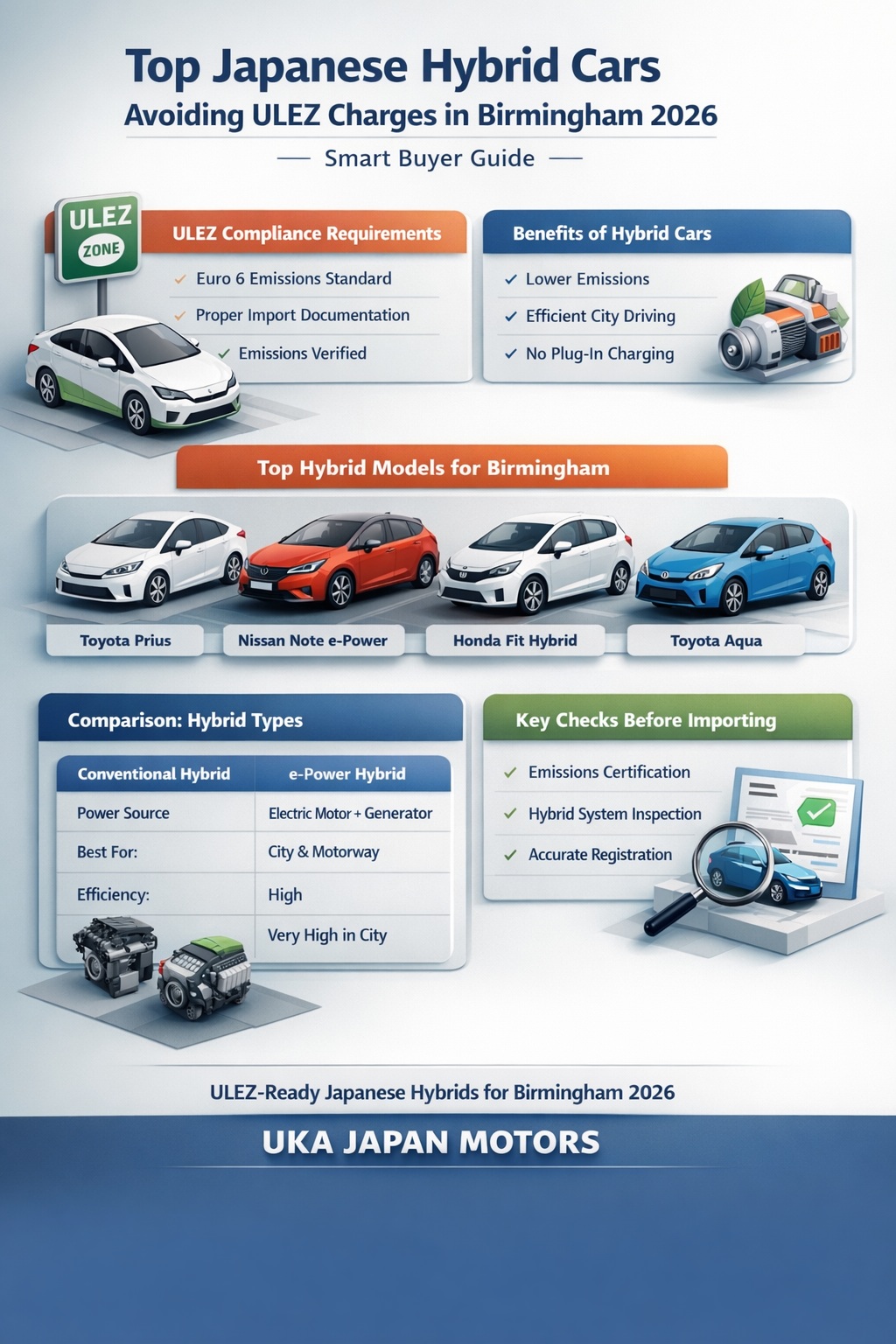
Urban driving in Birmingham continues to evolve, with emissions regulations shaping how vehicles are selected, used, and maintained. The introduction and expansion of low-emission zones have made it essential for drivers to consider compliance alongside reliability and practicality.
Japanese hybrid cars have become a consistent point of interest for drivers looking to navigate Birmingham’s Clean Air and Ultra Low Emission Zone (ULEZ) requirements without compromising usability. Known for engineering consistency and efficient drivetrain systems, these vehicles often meet emission thresholds while maintaining everyday practicality.
This guide explores which Japanese hybrid cars are most suitable for avoiding ULEZ-related restrictions in Birmingham in 2026. It focuses on how these vehicles perform in real conditions, what makes them compliant, and how they compare across different driving needs.
Quick Summary
Japanese hybrid cars can avoid ULEZ charges in Birmingham if they meet the required Euro emissions standards, typically Euro 6 for petrol-based hybrids.
Key takeaways:
- Most modern Japanese hybrids are compliant due to low emissions output
- Hybrid systems reduce emissions significantly during city driving
- Models differ in battery size, efficiency, and driving behaviour
- Compliance depends on engine type, registration year, and emissions certification
- Proper documentation and inspection are essential before import or registration
Why Hybrid Cars Matter in Birmingham’s ULEZ Environment
Birmingham’s driving conditions combine heavy urban traffic, frequent stop-start movement, and motorway connectivity. These factors directly influence emissions output.
Hybrid cars are particularly suited to this environment because:
- They rely on electric power during low-speed driving
- They reduce engine idling in congestion
- They improve fuel efficiency without requiring charging infrastructure
In areas such as the city centre, where traffic density is high and average speeds are low, hybrid systems operate more efficiently than traditional combustion engines.
How Japanese Hybrid Systems Work in Real Driving
Japanese hybrids typically use a self-charging system. This means:
- The battery charges during braking and deceleration
- No external charging is required
- The car automatically switches between petrol and electric power
In Birmingham traffic conditions:
- Electric mode is used more frequently in slow-moving areas
- Petrol engines assist during acceleration or motorway driving
- Overall emissions remain lower due to reduced engine workload
This balance is what allows many hybrid vehicles to meet ULEZ requirements without needing plug-in capability.
Key ULEZ Compliance Requirements for Hybrids
To avoid ULEZ-related charges in Birmingham, a hybrid vehicle must:
- Meet Euro 6 emissions standards (for petrol engines)
- Have verified emissions data during registration
- Be supported by correct import and compliance documentation
Important considerations:
- Older hybrids may not qualify if emissions exceed limits
- Imported vehicles must be properly inspected and certified
- Registration records must accurately reflect emissions compliance
Top Japanese Hybrid Cars Suitable for Birmingham ULEZ in 2026
Toyota Prius (Fourth Generation and Newer)
The Toyota Prius remains one of the most recognised hybrid vehicles globally. Its design prioritises efficiency, making it highly suitable for Birmingham’s stop-start traffic.
Why it works locally:
- Excellent fuel efficiency in urban driving
- Smooth transition between electric and petrol modes
- Low emissions profile aligned with ULEZ requirements
Real-world use:
- Performs best in congested city routes
- Stable on longer motorway journeys
- Minimal driver intervention required
Toyota Corolla Hybrid
The hybrid version of the Corolla offers a more conventional driving experience compared to the Prius while maintaining similar efficiency benefits.
Local advantages:
- Comfortable for daily commuting
- Reliable performance in mixed driving conditions
- Balanced handling in urban and motorway settings
Compared to Prius:
- More traditional styling and layout
- Slightly different driving feel, less focused on maximum efficiency
Nissan Note e-Power
The e-Power system differs slightly from conventional hybrids. The petrol engine acts as a generator rather than directly powering the wheels.
Why it stands out:
- Electric motor drives the wheels at all times
- Smooth acceleration in city traffic
- Reduced engine noise during low-speed driving
In Birmingham:
- Ideal for short-distance urban driving
- Performs efficiently in stop-start environments
Honda Fit Hybrid (Honda Jazz Hybrid Equivalent)
Compact and practical, this model is well suited for tight city streets and urban parking conditions.
Key strengths:
- Efficient hybrid system with consistent low emissions
- Compact size for navigating Birmingham’s narrow roads
- Flexible interior space
Compared to larger hybrids:
- Easier manoeuvrability
- Slightly less motorway-focused performance
Toyota Aqua (Prius C)
A smaller alternative within Toyota’s hybrid lineup, the Aqua is designed for urban efficiency.
Local suitability:
- Highly efficient in short-distance driving
- Lightweight design improves fuel economy
- Easy handling in congested areas
Consideration:
- Smaller interior compared to Corolla or Prius
Comparison: Hybrid Types and Driving Behaviour
| Feature | Conventional Hybrid | e-Power Hybrid |
|---|---|---|
| Power Source | Petrol + Electric | Electric-driven (engine generates power) |
| Driving Feel | Mixed petrol/electric | Fully electric feel |
| Best Use | Mixed city + motorway | Urban and stop-start driving |
| Efficiency | High | Very high in city conditions |
| Complexity | Moderate | Slightly different system architecture |
Understanding these differences helps match the vehicle to Birmingham’s specific driving patterns.
Inspection and Documentation Considerations
Before a hybrid vehicle is registered for use in Birmingham, several checks are essential:
Emissions Verification
- Confirm Euro 6 compliance
- Ensure emissions data is correctly recorded
Hybrid System Inspection
- Battery condition assessment
- Electrical system functionality
- Regenerative braking performance
Import Documentation
- Vehicle history verification
- Correct paperwork for UK registration
- Compliance certification
Errors in any of these areas can delay registration or affect compliance status.
Ownership and Long-Term Use in Birmingham
Daily Driving
Hybrid vehicles are particularly effective for:
- City commuting
- School runs
- Short-distance errands
Maintenance Considerations
- Hybrid batteries require monitoring but are generally durable
- Brake systems often last longer due to regenerative braking
- Regular servicing ensures emissions compliance remains valid
Seasonal Impact
Birmingham’s weather conditions can influence hybrid performance:
- Cold weather may slightly reduce battery efficiency
- Wet conditions do not affect hybrid operation significantly
- Consistent driving helps maintain system balance
When a Hybrid May Not Be Suitable
Despite their advantages, hybrids may not suit every driver:
- Drivers who primarily use motorways may see less efficiency gain
- Those requiring larger vehicles may find compact hybrids limiting
- High-performance driving expectations are not the focus of most hybrids
Understanding these limitations helps avoid mismatched expectations.
Common Mistakes When Choosing a ULEZ-Compliant Hybrid
- Assuming all hybrids are automatically compliant
- Ignoring emissions certification details
- Overlooking inspection requirements before registration
- Choosing a model not suited to actual driving patterns
- Failing to verify import documentation accuracy
Avoiding these mistakes ensures smoother ownership and compliance.
FAQs
1. Are all Japanese hybrid cars ULEZ compliant in Birmingham?
No. Compliance depends on emissions standards, not just hybrid status.
2. Do hybrids need to be plugged in to meet emissions rules?
No. Most Japanese hybrids are self-charging and still meet requirements.
3. How can I confirm if a hybrid is compliant?
Check emissions data and ensure it meets Euro 6 standards.
4. Are older hybrids suitable for Birmingham ULEZ?
Some are, but many older models may not meet current standards.
5. Does hybrid battery condition affect compliance?
Indirectly, yes. Poor battery performance can affect emissions efficiency.
6. Is city driving better for hybrids?
Yes. Hybrids perform most efficiently in stop-start traffic.
7. Are hybrid systems difficult to maintain?
No. They are generally reliable but require proper inspection.
8. Do imported hybrids need special checks?
Yes. Documentation and emissions certification must be verified before registration.
The Role of UKA Japan Motors
UKA Japan Motors focuses on inspection-led vehicle sourcing, ensuring that hybrid vehicles meet UK compliance standards before reaching Birmingham roads.
This includes:
- Detailed emissions verification
- Hybrid system inspection
- Documentation accuracy checks
- Import compliance guidance
The aim is to reduce uncertainty and ensure that vehicles are aligned with local regulations and real-world usage conditions.
Conclusion
Japanese hybrid cars offer a practical and reliable solution for drivers navigating Birmingham’s ULEZ requirements in 2026. Their ability to reduce emissions during everyday driving makes them particularly suited to urban environments.
However, compliance is not automatic. Careful selection, proper inspection, and accurate documentation are essential to ensure that a hybrid vehicle truly meets the necessary standards.
Choosing the right model depends on how and where the vehicle will be used. By understanding system types, local driving conditions, and regulatory requirements, drivers can make informed decisions that support both compliance and long-term usability.
Contact UKA Japan Motors for availability and inspection guidance.