


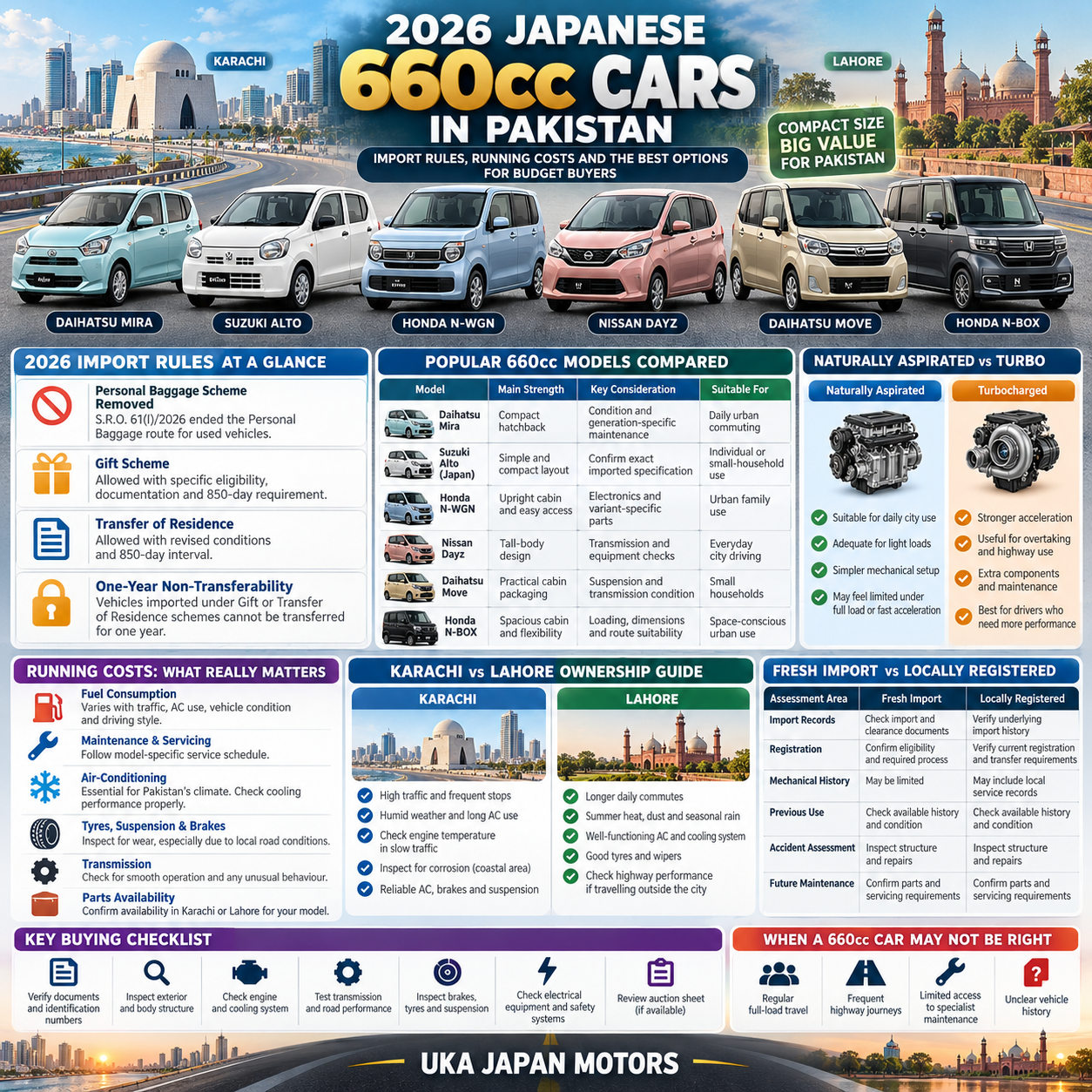
Japanese 660cc cars occupy a distinct position in Pakistan’s used-car market. These compact vehicles are designed around small-displacement engines and space-efficient body structures, making them relevant to drivers who regularly navigate congested roads, restricted parking spaces and busy residential streets.
In Karachi, a typical journey may involve prolonged traffic queues, narrow streets, humid weather and frequent stops. In Lahore, commuters may encounter crowded commercial areas, longer daily routes, summer heat and roads affected by seasonal rainfall. Under these conditions, a small hatchback can be easier to manoeuvre and park than a larger passenger vehicle.
However, engine capacity alone does not determine whether an imported car is suitable for everyday ownership. The vehicle’s age, mechanical condition, transmission, safety equipment, maintenance history, parts availability and import documentation all influence its practicality.
The regulatory position also requires attention in 2026. Pakistan’s used-vehicle import framework has changed, including the removal of the Personal Baggage Scheme through S.R.O. 61(I)/2026. Buyers must distinguish between a vehicle imported under an eligible personal scheme, one imported commercially and one that is already registered in Pakistan. These situations do not necessarily follow identical requirements.
This guide explains how Japanese 660cc cars work, which models deserve consideration, what to check before buying and how to assess their suitability for daily use without relying on advertised fuel figures or engine capacity alone.
The Short Answer: Are Japanese 660cc Cars a Practical Choice in 2026?
Japanese 660cc cars can be practical for urban driving when the selected vehicle has sound mechanical condition, verifiable documentation and sufficient space for its intended occupants.
They are generally worth considering for:
- Individuals travelling mainly within Karachi or Lahore.
- Small households that do not regularly carry large amounts of luggage.
- Drivers who value compact dimensions and easier parking.
- Commuters whose normal routes involve low-to-moderate urban speeds.
- Owners willing to maintain an imported vehicle according to its actual mechanical requirements.
They may be less suitable for households that frequently travel with several adult passengers, carry heavy luggage or drive on motorways and steep routes with a full load. Naturally aspirated and turbocharged versions also behave differently under acceleration and sustained engine load.
A sensible buying decision therefore depends on three questions:
- Is the vehicle legally imported and properly documented?
- Is its mechanical and structural condition suitable for continued use?
- Does its cabin, performance and maintenance profile match the owner’s routine?
If these questions cannot be answered satisfactorily, a familiar model name or attractive exterior should not be enough to justify a purchase.
1. Understanding the Japanese 660cc Car Category
Japanese 660cc cars are commonly known as kei cars. The category is associated with compact dimensions and small-displacement engines, with many vehicles using engines close to 660cc.
These cars are available in several body styles, including conventional hatchbacks, tall-body hatchbacks, small family-oriented vehicles and compact crossovers.
The same engine-capacity category can include very different driving experiences. A low, lightweight hatchback may feel responsive in urban traffic, while a taller vehicle with a larger cabin may offer easier entry and more useful headroom. A turbocharged version may respond differently during overtaking or when carrying passengers.
What does 660cc mean?
Engine displacement describes the combined volume swept by the engine’s pistons during their operating cycle. A 660cc engine has a displacement of approximately 0.66 litres.
Displacement is not a direct measurement of fuel consumption, reliability or performance. Two vehicles with similar engine capacity may differ considerably because of their weight, gearing, aerodynamic design, engine tuning and transmission.
For example, a naturally aspirated hatchback and a turbocharged tall-body hatchback may both have 660cc engines, yet their acceleration, fuel requirements and maintenance considerations can differ.
Why compact dimensions matter in Pakistan
Compact dimensions can be useful when navigating:
- Crowded streets and narrow residential lanes.
- Busy markets and commercial districts.
- Congested intersections and stop-start traffic.
- Underground or tightly arranged parking spaces.
- Roads where larger vehicles have limited turning room.
Nevertheless, a small footprint does not automatically mean every 660cc car is easy to park. Visibility, mirror placement, turning radius, rear-window design and parking sensors, where fitted, can influence manoeuvrability.
Buyers should assess the actual vehicle rather than assuming all imported kei cars offer identical driving characteristics.
2. Japanese 660cc Import Rules in Pakistan for 2026
Import regulations are among the most important considerations when assessing a Japanese used car. A vehicle’s country of manufacture does not establish whether its import was lawful, and a registration number alone does not answer every question about its import history.
The applicable rules depend on the import route, the vehicle’s classification, the date of import and the regulations in force at the relevant time.
The removal of the Personal Baggage Scheme
The Ministry of Commerce issued S.R.O. 61(I)/2026 on 15 January 2026, amending Pakistan’s Import Policy Order provisions for used vehicles. The amendment removed the Personal Baggage route from the relevant personal-import framework and revised conditions governing the remaining Gift and Transfer of Residence schemes.
The revised framework includes changes concerning eligibility, the interval between imports and restrictions on transferring vehicles imported under the retained schemes.
Official reference: Ministry of Commerce, S.R.O. 61(I)/2026
https://www.commerce.gov.pk/wp-content/uploads/2026/01/SRO-No.-61.pdf
This change matters because buyers should not assume that an import method used for an earlier vehicle remains available under the same conditions in 2026.
Gift Scheme and Transfer of Residence
The Gift Scheme and Transfer of Residence Scheme are separate routes with their own eligibility and documentation requirements.
Under the revised provisions, the rules include an 850-day requirement relevant to eligibility and the interval governing another import, as specified by the applicable provisions. Vehicles imported under the Gift or Transfer of Residence schemes are also subject to a one-year non-transferability requirement.
The precise application of these conditions should be confirmed against the operative rules and the individual’s circumstances before an import is arranged.
A buyer purchasing an already-imported and locally registered vehicle should not automatically assume that every condition governing a new import applies in the same way to their transaction. The vehicle’s actual import history, clearance records and registration status must be examined.
Commercial imports are a separate consideration
A vehicle brought into Pakistan through a commercial import channel should be assessed according to the requirements applicable to that channel.
Import eligibility, vehicle-age conditions, customs clearance, applicable duties and taxes, and other regulatory requirements can depend on the current policy and the date on which the relevant process occurs.
Do not rely solely on a seller’s statement that a vehicle is a fresh import or that a particular model is commonly available. Verify the relevant documentation and confirm which rules applied to the specific vehicle.
Vehicle age and eligibility
Age limits can differ according to the applicable import route and vehicle category. The revised personal-import provisions retain age-related restrictions, while commercial import requirements must be checked separately under the current policy.
For an imported used car, establish the manufacturing date, the method used to determine its regulatory age, the shipment details and the import declaration date where relevant.
A registration year, model-year description or advertisement heading should not be treated as conclusive evidence of the vehicle’s manufacturing date.
Documents that deserve attention
Depending on the vehicle’s import route and registration history, relevant records may include:
- Customs clearance and Goods Declaration documentation.
- Import-related shipping and identification records.
- Purchase or ownership documents.
- The original registration record and applicable transfer documents.
- Engine and chassis identification details.
- Documents supporting the vehicle’s import eligibility and clearance.
- Applicable tax and duty payment records.
Not every document has the same relevance to every transaction. The appropriate checklist should be established for the vehicle and the import route rather than assembled from a generic list.
For official background, consult the Federal Board of Revenue’s vehicle-import information alongside the applicable Ministry of Commerce notifications:
https://www.fbr.gov.pk/vehicles/51149/131187
Because official guidance pages may not immediately reflect every subsequent amendment, the current operative notification should take precedence where a conflict exists.
3. The Best Japanese 660cc Models to Consider
No single model is best for every driver. The right choice depends on cabin layout, visibility, engine configuration, passenger requirements, serviceability and the condition of the individual vehicle.
The following models offer different ownership characteristics worth evaluating.
Daihatsu Mira: A conventional city hatchback
The Daihatsu Mira is a useful starting point for buyers who prefer a conventional hatchback rather than a particularly tall body style.
Its compact dimensions can suit everyday commuting, residential streets and routine shopping trips. The relatively familiar hatchback layout also makes it straightforward to assess rear-seat access, boot space and parking visibility.
When examining a Mira, pay attention to:
- Engine response during repeated acceleration.
- Transmission operation in slow traffic.
- Air-conditioning performance in hot weather.
- Suspension noise over broken road surfaces.
- Cooling-system condition and signs of previous overheating.
- Availability of parts for the specific generation and engine variant.
Different generations and specifications should not be treated as mechanically identical. Confirm the exact model and variant before planning maintenance.
Who should consider it? A driver or small household seeking a compact vehicle primarily for urban use.
Suzuki Alto 660cc: Compact and specification-dependent
Japanese Suzuki Alto models are often considered by drivers who want a small hatchback with a simple, space-conscious layout.
The name alone is insufficient to identify the exact vehicle. Imported Alto versions can differ in generation, transmission, engine specification and safety equipment from vehicles sold under similar names locally.
This distinction matters when arranging servicing or sourcing replacement parts. The engine and chassis identifiers should be used to confirm compatibility rather than relying only on the badge.
Before buying, inspect the vehicle’s cooling system, transmission, suspension, engine performance and electrical equipment. Check the availability of parts for the exact imported variant in the city where the car will be maintained.
Who should consider it? Buyers who prefer a small hatchback and can verify the specific model’s parts and service requirements.
Honda N-WGN: A taller cabin layout
The Honda N-WGN uses a tall-body hatchback design that can provide a more upright seating position than a conventional low hatchback.
This layout may be useful for drivers who value easier entry and exit, a higher seating position and practical cabin packaging. The actual experience depends on seat adjustment, visibility, cabin dimensions and the particular vehicle’s equipment.
Inspect the door operation, seat condition, rear-seat space, visibility and the condition of the transmission. Check all installed driver-assistance or electronic features rather than assuming they work because they appear on the specification sheet.
Who should consider it? Drivers who value a taller cabin and convenient access, provided the selected variant suits their maintenance capabilities.
Nissan Dayz: An urban-focused tall hatchback
The Nissan Dayz is another compact option with a taller body design. Depending on the generation and trim, its cabin layout and equipment can differ from those of a conventional small hatchback.
This model may suit urban users who want a compact exterior with a more upright seating position. However, the exact generation is particularly important when checking electronic equipment, transmission behaviour and replacement parts.
Before purchase, verify the engine and chassis numbers, examine the dashboard for warning lights and test the air-conditioning system under realistic operating conditions.
Who should consider it? City commuters who want compact exterior dimensions without choosing a conventional low hatchback.
Daihatsu Move: More emphasis on cabin utility
The Daihatsu Move is designed around a taller body and practical interior packaging.
Depending on the generation, it may offer useful headroom and a cabin arrangement that works well for passengers entering and leaving the vehicle regularly. Its suitability still depends on actual rear-seat space, luggage requirements and the condition of the specific example.
Inspect the suspension carefully if the vehicle will regularly travel on uneven roads. Also verify transmission service history and the availability of model-specific components.
Who should consider it? Small households that want an urban vehicle with a more upright cabin than a conventional hatchback.
Honda N-BOX: Space within a compact footprint
The Honda N-BOX is a tall, box-shaped kei car with an emphasis on passenger space and cabin flexibility.
Its shape can be useful for households that need convenient access and a cabin that makes better use of its exterior dimensions. However, its tall body and particular configuration should be evaluated in relation to highway use, crosswinds, loading and the owner’s regular routes.
A larger cabin does not necessarily mean the vehicle has enough space for every family requirement. Check the rear-seat arrangement, child-seat compatibility where relevant, luggage capacity and the number of occupants who will routinely travel together.
Who should consider it? Buyers prioritising passenger access and cabin flexibility within a compact vehicle.
Model comparison at a glance
| Model | Main strength | Main consideration | Suitable use |
|---|---|---|---|
| Daihatsu Mira | Conventional compact hatchback | Condition and generation-specific maintenance | Daily urban commuting |
| Japanese Suzuki Alto | Compact, straightforward layout | Confirm exact imported specification | Individual or small-household use |
| Honda N-WGN | Upright cabin and convenient access | Electronics and variant-specific parts | Urban family use |
| Nissan Dayz | Tall-body design and city manoeuvrability | Transmission and equipment checks | Everyday city driving |
| Daihatsu Move | Practical cabin packaging | Suspension and transmission condition | Small households |
| Honda N-BOX | Cabin flexibility and passenger access | Loading, dimensions and route suitability | Space-conscious urban use |
This comparison describes general design characteristics, not a ranking of every generation. A well-maintained example of one model can be a better ownership decision than a neglected example of another.
4. Naturally Aspirated Versus Turbocharged 660cc Engines
One of the most important distinctions within this category is whether the engine is naturally aspirated or turbocharged.
A naturally aspirated engine draws air into the cylinders without a turbocharger. A turbocharged engine uses exhaust-driven equipment to compress intake air, allowing the engine to produce more power under suitable operating conditions.
Neither configuration is automatically the better choice.
Naturally aspirated versions
Naturally aspirated versions can suit drivers whose routine consists mainly of city commuting, moderate speeds and relatively light passenger loads.
Their response may be adequate for normal urban movement, but acceleration can feel limited when the vehicle is fully occupied or when the driver needs to merge quickly into faster traffic.
Buyers should assess the vehicle under realistic conditions rather than judging it only while stationary or during a short, lightly loaded drive.
Turbocharged versions
Turbocharged variants may provide stronger acceleration when additional power is required. This can be useful during merging, overtaking or driving on routes where traffic speeds vary.
However, the presence of a turbocharger introduces additional components and inspection considerations. The turbocharger, lubrication system, intake plumbing and cooling arrangements should be assessed according to the vehicle’s specification and service history.
A turbocharged engine should not be purchased on the assumption that its stronger performance comes without additional maintenance requirements.
Which is better for Karachi and Lahore?
For predominantly urban driving, a naturally aspirated model may be sufficient for a driver who rarely carries a full load and does not routinely need rapid acceleration.
A turbocharged model may suit someone who places greater emphasis on acceleration, but only if the vehicle is mechanically sound and its servicing requirements can be met.
In both cases, safe driving depends on leaving enough room for acceleration, anticipating traffic movements and avoiding risky overtaking.
5. Running Costs: What Owners Should Actually Evaluate
Running costs are not limited to fuel consumption. A small-displacement engine may use less fuel under comparable conditions, but an imported car’s overall ownership requirements also depend on its mechanical condition, maintenance schedule and parts availability.
For a meaningful assessment, examine the following factors separately.
Fuel consumption in real traffic
Fuel consumption varies with traffic density, average speed, journey length, air-conditioning use, tyre pressure, vehicle load and driving style.
Karachi’s stop-start traffic can reduce efficiency compared with steady movement. Lahore’s long urban journeys can also involve repeated acceleration and extended air-conditioning use, particularly during hot weather.
A short trip may be less efficient than a longer journey because the engine spends a greater proportion of the trip warming up and operating under changing conditions.
Do not assume that an advertised figure, an instrument-cluster reading or another owner’s experience will accurately predict your own results.
Maintenance and servicing
Routine maintenance includes the items specified for the particular vehicle, such as engine oil, filters, cooling-system checks, brake inspection, tyre care and transmission servicing where applicable.
The required service intervals and fluid specifications should be confirmed using the exact model and engine details.
A used imported vehicle with incomplete service history may need closer examination to establish what maintenance has already been completed and what work is due.
Air-conditioning demand
Air-conditioning is especially important in Pakistan’s climate. A weak cooling system can make daily driving uncomfortable and may indicate a problem requiring investigation.
Test the air-conditioning after the vehicle has been running long enough to assess its performance. Check whether cooling remains consistent while the engine is idling and whether there are unusual noises, smells or signs of abnormal engine temperature.
A properly functioning cooling system and air-conditioning system should be assessed separately. Cabin cooling performance does not prove that the engine cooling system is healthy.
Tyres, suspension and brakes
Repeated contact with potholes, uneven road surfaces and poorly maintained patches can place stress on tyres, suspension components and steering joints.
Inspect tyres for uneven wear, cracks and unsuitable replacement sizes. Check for suspension noises, steering play, vibration and braking irregularities.
Tyres should match the vehicle’s approved specification, and replacement components should be selected for the actual model rather than assumed to be interchangeable with another small car.
Transmission condition
Many Japanese 660cc cars use automatic or continuously variable transmissions, although the configuration depends on the model and generation.
Transmission problems can appear as delayed engagement, abnormal noises, shuddering, inconsistent acceleration or warning lights. Some symptoms may only appear after the vehicle has warmed up.
A short demonstration may not reveal an intermittent problem. A qualified inspection should include suitable operating conditions and a review of available service records.
Parts availability
Parts availability is a practical ownership issue, especially for less common variants and equipment-specific components.
Before selecting a model, check whether routine service items, suspension parts, electrical components and relevant transmission parts can be obtained in Karachi or Lahore.
Do not assume that two cars with the same badge use identical components. Confirm the chassis code, engine specification and part number wherever necessary.
6. How to Assess Fuel Economy Without Misleading Yourself
Fuel-economy claims should be treated as estimates unless they reflect a repeatable measurement under conditions similar to the owner’s daily use.
Three factors are particularly important.
First, compare similar journeys. A vehicle driven through congested streets should not be compared directly with another vehicle driven mostly on open roads.
Second, distinguish displayed figures from measured results. A dashboard reading may use the car’s internal calculation and may not match actual fuel consumed.
Third, account for vehicle condition. Incorrect tyre pressure, dragging brakes, poor maintenance, engine faults and transmission problems can all affect consumption.
Owners who want to measure their car’s actual fuel use can record the fuel added and the distance travelled over several normal driving cycles. Repeating the measurement helps reduce the influence of unusually short journeys or one-off traffic conditions.
A useful record should also note whether the vehicle was heavily loaded, whether air-conditioning was used regularly and whether most journeys took place in heavy traffic.
The purpose is to understand the individual vehicle’s behaviour, not to promise a particular fuel average for every Japanese 660cc car.
7. Buying a Fresh Import or a Locally Registered Vehicle?
A fresh import and a locally registered imported car present different verification requirements.
A fresh import may offer access to a particular generation or specification, but the buyer must establish that the relevant import route is permitted and that clearance and identification records are complete.
A locally registered vehicle may have a more developed ownership and registration record. However, local registration alone does not establish that the car is mechanically sound or free from undisclosed accident damage.
| Assessment area | Fresh import | Locally registered imported car |
|---|---|---|
| Import records | Examine the applicable import and clearance documents | Verify the underlying import history where available |
| Registration | Confirm eligibility and required registration procedures | Verify current registration and transfer requirements |
| Mechanical history | May be limited or incomplete | May include local service and repair records |
| Previous use | Examine available history and physical condition | Examine available history and physical condition |
| Accident assessment | Inspect structure and repairs | Inspect structure and repairs |
| Future maintenance | Establish parts and servicing requirements | Establish parts and servicing requirements |
Neither category should be considered automatically superior. The decision should follow document verification and an independent assessment of the actual vehicle.
8. Inspection Checklist Before Buying a Japanese 660cc Car
A structured inspection reduces the chance of overlooking problems that are difficult to identify from photographs or a brief conversation with the seller.
Identity and documentation
Begin with the vehicle’s identity.
- Compare the chassis number on the vehicle with the available records.
- Verify the engine number where recorded and applicable.
- Check the registration record and ownership-transfer requirements.
- Examine the relevant customs clearance and import documentation.
- Confirm that the model year and manufacturing information are consistent with the records.
- Review available auction, export or service documents, while recognising that their authenticity and relevance must be verified.
Any mismatch should be resolved before proceeding. A seller’s explanation should not replace independent verification.
Exterior and structural condition
Inspect the body in daylight where possible. Look for uneven panel gaps, differences in paint finish, signs of welding, distorted panels and evidence of poorly repaired structural damage.
Examine the front and rear sections, door openings, boot area and underbody where accessible.
Not every repaint indicates a serious accident, but repairs affecting structural integrity or safety systems require closer assessment.
Engine and cooling system
Look for fluid leaks, unusual noises, excessive vibration, visible corrosion and evidence of previous overheating.
The engine should be assessed both when cold and after reaching normal operating temperature. Warning lights should be investigated rather than ignored because they disappear during a demonstration.
The cooling system deserves particular attention in Pakistan’s hot climate. A vehicle that overheats during slow traffic may not reveal the problem during a short drive on an open road.
Transmission and road test
Test the transmission according to the vehicle’s configuration.
Observe engagement from a stop, acceleration at different speeds, deceleration and reversing. Pay attention to hesitation, shuddering, unusual noises and warning indicators.
A road test should be conducted safely and legally, with sufficient opportunity to observe the car under ordinary operating conditions.
Brakes, tyres and suspension
Check braking response, steering stability, tyre condition and suspension noises. Inspect for uneven tyre wear, which may indicate alignment issues or worn suspension components.
If the vehicle pulls to one side, vibrates or produces repeated knocking sounds, the cause should be investigated before the vehicle is accepted.
Electrical equipment and safety systems
Test the lights, indicators, wipers, windows, locks, air-conditioning and dashboard functions.
Check the operation of installed safety equipment, including airbags and warning indicators. If diagnostic equipment is available, a qualified technician should examine relevant electronic systems.
Do not assume that a car has a particular safety feature simply because another version of the same model includes it.
9. Auction Sheets and Imported Vehicle History
Auction sheets and other vehicle-history records can help buyers understand a car’s earlier condition, but they should not be treated as infallible evidence.
A document must correspond to the actual vehicle. Confirm the identifying details, including the chassis number, and use a suitable verification method to establish whether the record is genuine.
The condition described in an earlier inspection is also not a guarantee of the vehicle’s present condition. Damage may have occurred later, and repairs may have changed the vehicle since the record was issued.
Where an auction sheet is unavailable, do not automatically assume that the car is defective. Instead, recognise the information gap and rely on a thorough independent inspection, available ownership records and any other verifiable documentation.
Be cautious if a seller refuses to permit reasonable verification or if the records contain unexplained inconsistencies.
10. Karachi and Lahore: How Local Conditions Affect Ownership
The same Japanese 660cc car may perform differently depending on its route, maintenance and operating environment.
Karachi
Karachi’s urban traffic can involve frequent stopping, slow movement, humid weather and long periods of air-conditioning use.
For this environment, prioritise:
- Consistent engine temperature in slow traffic.
- Reliable air-conditioning operation.
- Smooth transmission behaviour during repeated stops.
- Sound suspension and steering components.
- Effective brakes and suitable tyres.
- Clear registration and ownership documentation.
Where a vehicle is regularly exposed to coastal humidity, examine accessible metal areas and underbody components for corrosion. The presence and extent of corrosion should be assessed rather than assumed from the vehicle’s location alone.
Drivers who regularly travel between distant parts of the city should also consider seat comfort, cabin noise and the vehicle’s behaviour over longer journeys.
Lahore
Lahore’s urban routes can combine congested commercial areas, longer commuting distances and exposure to summer heat, dust and seasonal rain.
For regular use, inspect the air-conditioning, cooling system, filters, wipers, tyres and suspension. Dust exposure makes appropriate maintenance important, while rainfall increases the importance of functioning wipers, lights and tyres with adequate tread.
Road conditions vary considerably between routes. A car used mainly on smooth urban roads may experience different wear from one regularly driven over broken surfaces.
Drivers who travel between Lahore and other cities should assess highway stability, overtaking performance, cabin comfort and the limitations of a small engine under a full passenger load.
What about motorway driving?
A 660cc car can undertake suitable longer journeys when maintained correctly and operated within its capabilities, but the driver should consider the particular engine configuration, vehicle load, weather and road conditions.
A naturally aspirated variant may require more planning for acceleration than a turbocharged version. Neither should be driven in a way that leaves insufficient room for safe merging or overtaking.
For frequent motorway travel with several adults and luggage, a larger vehicle may provide a more suitable performance and space profile.
11. When a Japanese 660cc Car May Not Be the Right Choice
Compact cars are useful, but their limitations should be understood before purchase.
Regular full-load travel
When all seats are occupied and luggage is added, acceleration, braking and available cabin space become more important. A vehicle that works well for one or two commuters may not suit a household’s regular travel pattern.
Frequent highway journeys
A driver who regularly travels at higher speeds may prefer a vehicle with greater power reserves, more space and characteristics better suited to sustained highway use.
The decision should reflect actual route requirements rather than a general assumption that a small car cannot travel outside the city.
Limited access to specialist maintenance
A less common imported model may require particular parts, diagnostic equipment or technical knowledge. If these are difficult to access locally, ownership can become inconvenient.
Before selecting an unusual variant, speak with a competent workshop and verify the availability of the components most relevant to that model.
Unclear vehicle history
A vehicle with inconsistent identification records, unresolved import questions or signs of serious structural damage should not be accepted merely because its exterior appears clean.
If essential checks cannot be completed, delaying the decision is more sensible than accepting uncertainty about legal status or safety.
12. Choosing the Right Model for Your Driving Pattern
A useful way to narrow the options is to begin with the daily journey rather than the model name.
A driver travelling alone through congested streets may place the highest priority on compact dimensions, visibility and predictable low-speed operation. A household carrying older passengers may care more about door access, seat height and rear-seat comfort.
Someone using the car for longer journeys should assess acceleration, seating comfort, cabin noise and highway behaviour. A household requiring flexible passenger space may prefer a tall-body model, provided its loading and driving characteristics match their needs.
Before making a final selection, answer these practical questions:
- How many occupants normally travel in the vehicle?
- How much luggage is carried on a typical day?
- Are most journeys short, congested urban trips or longer commutes?
- Will the vehicle regularly be driven on motorways?
- Is a naturally aspirated engine sufficient for the expected load?
- Can a competent workshop maintain the exact variant?
- Are the relevant documents available and consistent?
- Has the vehicle passed a satisfactory mechanical and structural inspection?
These questions help separate genuine suitability from assumptions based on appearance, badge or engine capacity.
13. The Role of Inspection and Documentation in a Responsible Purchase
A Japanese imported vehicle should be assessed through two separate processes: document verification and physical inspection.
Document verification establishes whether the vehicle’s identity, ownership, registration and relevant import records are consistent. It can also help identify questions that need to be resolved before a transaction proceeds.
Physical inspection examines the vehicle’s present condition, including its structure, engine, transmission, cooling system, suspension, brakes and electrical equipment.
Neither process replaces the other. Complete paperwork cannot guarantee mechanical condition, and a well-running engine cannot establish lawful importation or valid ownership.
UKA Japan Motors’ role should be understood in this context: helping buyers approach vehicle selection with attention to available documentation, condition assessment and inspection requirements. Any assessment should distinguish verified facts from information that remains uncertain.
Where a vehicle’s import eligibility, registration status or mechanical condition cannot be established confidently, the outstanding questions should be made clear rather than concealed by general assurances.
A responsible buying process allows the customer to understand what has been checked, what evidence supports the findings and which issues require further professional or official confirmation.
Frequently Asked Questions
1. Are Japanese 660cc cars suitable for daily driving in Pakistan?
Yes, they can be suitable for daily urban driving when the vehicle is mechanically sound, properly documented and appropriate for the owner’s passenger and luggage requirements. Their compact dimensions can help in crowded areas, but performance and cabin space vary between models.
2. Which Japanese 660cc car is best for Karachi traffic?
There is no single best option for every driver. The Daihatsu Mira and Japanese Suzuki Alto are conventional hatchback options, while the Honda N-WGN, Nissan Dayz and Daihatsu Move offer taller body designs. Compare visibility, transmission condition, air-conditioning, parking requirements and parts availability before choosing.
3. Which Japanese 660cc car is suitable for a small family?
The Honda N-WGN, Daihatsu Move and Honda N-BOX may appeal to households that prioritise a taller cabin and passenger access. The correct choice depends on actual rear-seat comfort, the number of occupants, luggage needs and the condition of the individual vehicle.
4. Can Japanese 660cc cars be driven on motorways?
They can be used for appropriate longer journeys, subject to the vehicle’s condition, capabilities and applicable road requirements. Naturally aspirated variants may have more limited acceleration under load than turbocharged versions. Drivers should allow adequate room for merging and overtaking and avoid operating the vehicle beyond its capabilities.
5. Are naturally aspirated or turbocharged 660cc cars better?
Naturally aspirated models may suit routine city use with relatively light loads. Turbocharged versions can offer stronger acceleration but have additional components and maintenance considerations. The better option depends on the driver’s route, passenger load, maintenance access and the condition of the vehicle.
6. What changed in Pakistan’s Japanese used-car import rules in 2026?
S.R.O. 61(I)/2026, issued on 15 January 2026, removed the Personal Baggage Scheme from the relevant used-vehicle personal-import framework and amended conditions for the Gift and Transfer of Residence schemes. Eligibility, vehicle age, import intervals and transfer restrictions should be checked against the operative rules.
7. Can I import a Japanese 660cc car under the Gift Scheme?
Eligibility depends on the applicable scheme conditions, the sender’s circumstances, the recipient’s relationship and the required documentation. The revised framework includes specific stay-abroad and import-interval requirements. Confirm the current requirements with the relevant authorities before arranging shipment.
8. Can a vehicle imported under the Gift or Transfer of Residence Scheme be transferred immediately?
The 2026 amendments introduced a one-year non-transferability requirement for vehicles imported under these schemes. Buyers should establish the vehicle’s import route and relevant dates and obtain confirmation of its transfer eligibility before proceeding with a transaction.
9. How can I verify the import documents of a Japanese 660cc car?
Request the relevant customs clearance and import records, compare the vehicle’s identification numbers with the documents, and verify registration and ownership information. Where the applicable route requires additional records, check those as well. Unresolved inconsistencies should be clarified through the appropriate authorities or qualified professionals.
10. Is an auction sheet enough to prove a car’s condition?
No. An auction sheet can provide useful historical information if it is genuine and matches the vehicle, but it does not establish the car’s current condition. A physical inspection remains necessary to identify subsequent damage, repairs, mechanical faults and other issues.
11. What mechanical checks are most important before buying?
Prioritise the engine, cooling system, transmission, suspension, steering, brakes, tyres, electrical equipment and air-conditioning. Inspect the body structure for signs of serious damage and check available service history. A qualified inspection should be tailored to the exact model and engine specification.
12. Do all Japanese 660cc cars use the same parts?
No. Components can differ by manufacturer, model generation, engine, transmission and trim. Confirm compatibility through the chassis code, engine specification and relevant part numbers. Parts availability should be checked before selecting a less common variant.
13. Will a 660cc car automatically deliver good fuel economy?
No. Engine capacity is only one factor. Traffic, driving style, air-conditioning, vehicle condition, tyres, passenger load and transmission behaviour all influence fuel consumption. Real-world measurements over representative journeys are more useful than assuming a particular fuel average.
14. Should I buy a fresh import or a locally registered Japanese 660cc car?
Either can be suitable, provided the relevant requirements are met and the vehicle passes the necessary checks. A fresh import requires attention to import eligibility and clearance documentation. A locally registered vehicle requires verification of ownership, registration, underlying import history where available and present mechanical condition.
15. What should I do if the engine or chassis number does not match the documents?
Do not proceed on the basis of an informal explanation alone. Request clarification and verify the discrepancy through the appropriate registration, customs or other relevant authority. The issue should be resolved before the transaction continues.
16. Are Japanese 660cc cars appropriate for long daily commutes?
They can be, but the decision should consider seat comfort, cabin noise, air-conditioning, traffic conditions, road quality and the engine’s behaviour over longer journeys. A compact vehicle that suits short city trips may not provide the same comfort or performance for a driver who spends extended periods on highways.
Conclusion: Make the Decision on Evidence, Not Engine Capacity Alone
Japanese 660cc cars can provide a practical form of urban transport in Pakistan, particularly for drivers who need compact dimensions, manageable cabin layouts and a vehicle suited to everyday commuting.
The category includes several distinct types of vehicles. Conventional hatchbacks, taller family-oriented models and turbocharged variants each have different strengths and limitations. Choosing between them requires an understanding of the intended journey, passenger requirements and maintenance arrangements.
In 2026, import documentation deserves equal attention. Changes to Pakistan’s used-vehicle import framework mean that older assumptions about import routes and eligibility should not be relied upon without verification. The vehicle’s actual import history, applicable regulatory conditions and registration status should be established independently.
For owners in Karachi and Lahore, the most useful approach is to prioritise mechanical condition, effective cooling, reliable air-conditioning, transmission health, suitable tyres, parts availability and clear documentation. A model’s reputation is helpful context, but it cannot replace inspection of the individual vehicle.
A sound purchase decision comes from matching the car to its intended use, understanding its limitations and resolving important questions before ownership begins.
Contact UKA Japan Motors for availability and inspection guidance.