


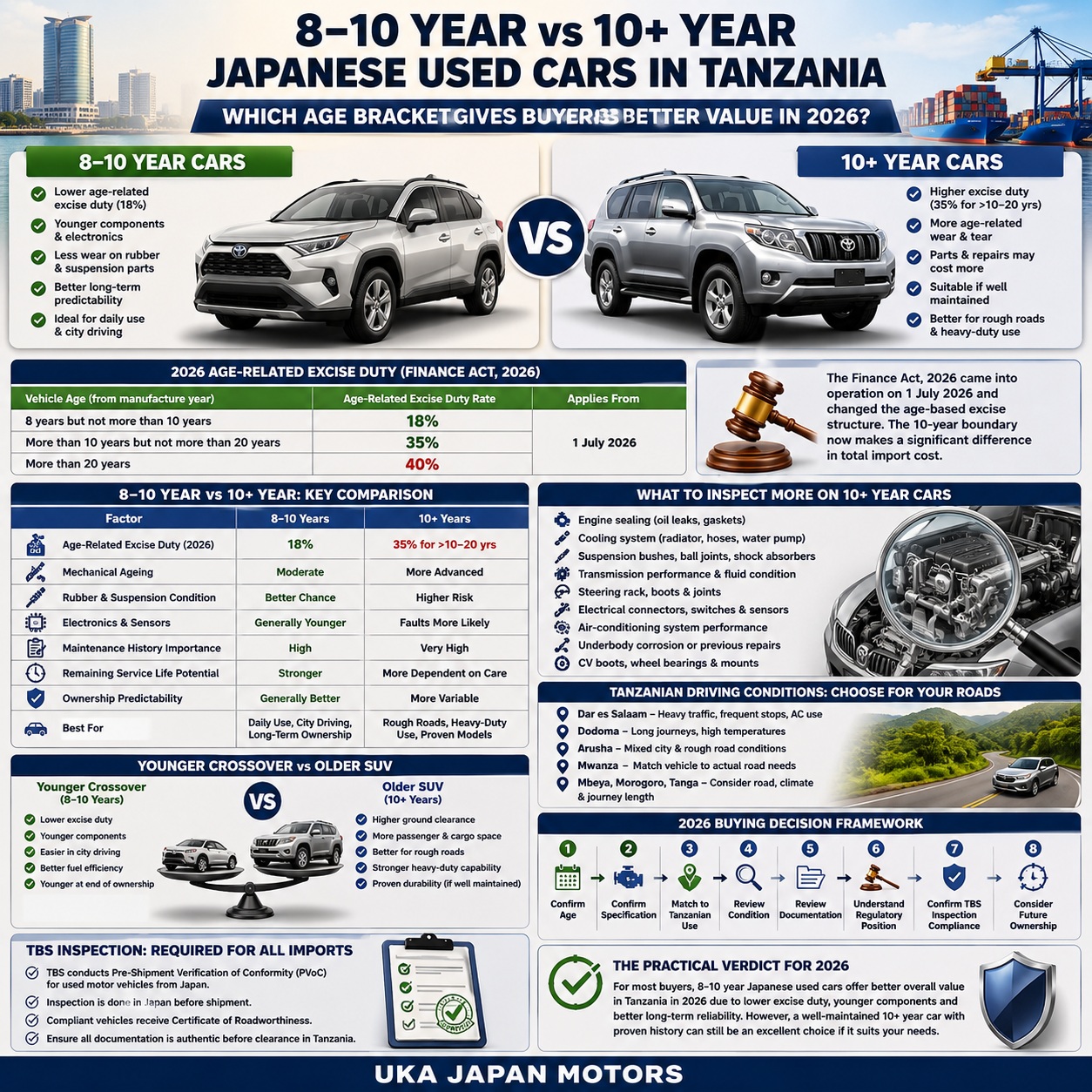
Age has always mattered when choosing a Japanese used vehicle in Tanzania, but in 2026 it deserves considerably more attention.
A buyer comparing two Toyota RAV4s, Nissan X-Trails, Toyota Harriers, Honda CR-Vs or similar Japanese vehicles may initially focus on mileage, engine size, equipment, exterior condition and service history. Yet if one vehicle is within the eight-to-ten-year age bracket and another has passed ten years, the difference goes beyond ordinary mechanical ageing.
Tanzania’s Finance Act, 2026 changed the age-related excise-duty structure applying to imported used vehicles. The Act came into operation on 1 July 2026 and establishes an 18% age-related excise rate for an imported vehicle aged eight years but not more than ten years, 35% for a vehicle more than ten years but not more than twenty years, and 40% for one more than twenty years old.
That makes the ten-year boundary particularly important.
But age-related tax treatment is only one part of the decision.
A nine-year-old Japanese vehicle with neglected maintenance is not automatically a better vehicle than an eleven-year-old example with excellent history and condition. Likewise, a well-presented older vehicle should not automatically be considered the stronger choice simply because its engine and body still appear sound.
For buyers in Dar es Salaam, Dodoma, Arusha, Mwanza, Mbeya, Morogoro and Tanga, the useful question is therefore broader:
Which age bracket provides the better combination of regulatory position, mechanical condition, remaining service life, maintenance predictability and suitability for Tanzanian driving conditions?
For many mainstream buyers in 2026, the 8–10-year bracket has become the stronger overall position, provided the individual vehicle passes a thorough condition and documentation assessment.
There are, however, circumstances where a carefully selected 10+ year vehicle can still make sense.
Quick Answer: 8–10 Years or More Than 10 Years?
For an ordinary buyer looking for a Japanese used vehicle for regular use in Tanzania, an 8–10-year-old vehicle will often provide the more balanced ownership proposition in 2026.
The main reasons are:
| Factor | 8–10 Years | More Than 10 Years |
|---|---|---|
| 2026 age-related excise band | 18% | 35% for >10–20 years |
| Mechanical ageing | Moderate | More advanced |
| Rubber and suspension ageing | Needs checking | Greater inspection priority |
| Electronics and sensors | Generally younger | Age-related faults more likely |
| Maintenance history importance | High | Very high |
| Remaining service-life potential | Usually stronger | More dependent on previous care |
| Inspection preparation | Important | Particularly important |
| Long-term ownership predictability | Generally better | More variable |
| Suitability for high annual use | Often stronger | Requires careful selection |
| Main buying advantage | Balance of age and condition | Proven models can remain durable |
The 2026 Finance Act is particularly significant because the statutory age-related excise rate rises from 18% in the eight-to-ten-year category to 35% once the vehicle is more than ten years old.
That difference does not prove that an 8–10-year-old vehicle is mechanically better. It does mean that buyers now have another strong reason to investigate manufacture year before choosing between otherwise comparable vehicles.
Why the Ten-Year Mark Matters More in Tanzania in 2026
Vehicle age is not simply a number on an export certificate.
It influences three separate areas:
regulatory treatment, physical condition and future ownership.
The regulatory distinction is particularly clear under the Finance Act, 2026. The legislation states that an imported vehicle aged eight years but not more than ten years falls under an 18% age-related excise rate, while a vehicle aged more than ten years but not more than twenty years falls under a 35% rate. Vehicles beyond twenty years enter a 40% category.
The Act took effect on 1 July 2026.
This creates a distinct boundary at ten years.
Consider two vehicles from the same model generation.
One may have been manufactured late enough to remain within the 8–10-year category. Another may have been produced only a year or two earlier and therefore fall into the over-ten-year category.
Their body designs may be nearly identical.
Their engines may come from the same engine family.
Their cabins may have similar equipment.
Their dimensions and practical abilities may be essentially the same.
Yet their age classification is different.
This means Tanzanian buyers should stop treating a vehicle generation as though every production year within that generation has the same import position.
Model generation and statutory vehicle age are two different things.
What “Better Value” Should Mean for a Tanzanian Buyer
Value should not be reduced to the apparent attractiveness of an older vehicle.
For long-term ownership, better value means receiving the right combination of:
- mechanical integrity;
- documented history;
- regulatory suitability;
- sensible engine specification;
- usable remaining component life;
- parts availability;
- appropriate ground clearance and suspension;
- manageable complexity;
- reliable cooling and air-conditioning;
- suitability for the owner’s normal roads;
- predictable maintenance requirements.
This definition is especially useful in Tanzania because vehicle usage varies significantly.
A vehicle used primarily for commuting through Dar es Salaam faces repeated low-speed operation, congestion, heat and frequent braking.
A vehicle regularly travelling between Dodoma and surrounding areas may spend much more time at sustained road speeds.
An owner in Arusha may combine urban driving with routes where road surfaces change substantially.
Drivers in Mwanza, Mbeya, Morogoro and Tanga can similarly place very different demands on suspension, tyres, cooling systems and drivetrains depending on where they travel.
The “best age” is therefore partly an ownership question.
However, once two vehicles are equally suitable for the intended use, the 8–10-year example increasingly deserves priority.
The Case for an 8–10-Year-Old Japanese Vehicle
An eight-to-ten-year-old Japanese vehicle occupies an interesting middle ground.
It is old enough that its original early-life depreciation is irrelevant to the practical ownership discussion, yet it may still be young enough to retain substantial component life when properly maintained.
More importantly in 2026, it remains within the lower of the two age bands being compared in this guide.
1. The 2026 Age-Related Excise Position Is More Favourable
The clearest distinction is regulatory.
The Finance Act, 2026 specifies 18% for imported vehicles aged eight years but not more than ten years, compared with 35% for vehicles aged more than ten years but not more than twenty years.
These percentages should not be interpreted as a complete vehicle-import calculation. Customs treatment depends on the vehicle and applicable classification.
But when two otherwise similar Japanese vehicles sit on opposite sides of the ten-year boundary, their age-related excise position is clearly not the same.
That makes production year an important filtering criterion before shipment.
2. Rubber Components May Have Experienced Less Ageing
Mileage attracts enormous attention in used-car buying, but calendar age matters independently of kilometres travelled.
Rubber and polymer components deteriorate with time.
These can include:
- suspension bushes;
- engine mounts;
- gearbox mounts;
- coolant hoses;
- weather seals;
- CV boots;
- steering boots;
- vacuum hoses;
- belt components.
A vehicle does not need extremely high mileage for these components to age.
At eight to ten years, inspection is already important. However, compared with an otherwise equivalent vehicle several years older, there is generally a better chance that more original components remain within a useful service period.
Condition must still be verified individually.
3. Interior and Electrical Ageing May Be Less Advanced
Tanzanian driving conditions make reliable air-conditioning, cooling, electrical controls and instrumentation practically important.
As vehicles become older, buyers should pay closer attention to items such as:
power-window operation, door locks, climate-control actuators, infotainment systems, reversing cameras, switches, sensors and wiring repairs.
An 8–10-year-old vehicle can certainly have electrical problems.
The advantage is simply that it has experienced fewer years of environmental exposure than a substantially older equivalent, all else being equal.
4. Safety Technology May Be More Current
Vehicle specifications differ by model and trim, so this cannot be assumed from age alone.
Nevertheless, later production years may offer newer generations of electronic stability systems, braking assistance, cameras, airbags or driver-support technology.
Buyers should verify the exact chassis specification rather than assuming that every vehicle carrying the same model badge has identical safety equipment.
5. Long-Term Ownership Can Be Easier to Plan
For an owner intending to keep a vehicle for several years, starting with a somewhat younger example can create a more comfortable age position later in the ownership cycle.
An eight-year-old vehicle retained for five years becomes thirteen years old.
A thirteen-year-old vehicle retained for the same period becomes eighteen years old.
That does not mean the younger vehicle will automatically be more reliable. Maintenance quality can easily reverse that expectation.
It does mean the older vehicle enters a more advanced stage of component ageing sooner.
Where a 10+ Year Japanese Vehicle Can Still Make Sense
Crossing ten years does not suddenly make a Japanese vehicle unsuitable for Tanzania.
Many Japanese engines, transmissions and chassis platforms are capable of long service lives when correctly maintained.
The real issue is that condition becomes increasingly important as age rises.
A 10+ year vehicle deserves consideration when its condition can be verified convincingly and its characteristics suit the intended use.
Strong Maintenance History Can Outweigh a Small Age Difference
Imagine comparing:
Vehicle A: nine years old, uncertain service history, visible underbody corrosion and neglected fluids.
Vehicle B: eleven years old, documented servicing, clean structural condition, smooth drivetrain and evidence of careful ownership.
The age bracket favours Vehicle A.
The mechanical assessment may favour Vehicle B.
This demonstrates why buyers should never use taxation or production year as a substitute for inspection.
A poor vehicle does not become good because it falls into a preferable age bracket.
Simpler Older Specifications Can Be Attractive
Some older Japanese vehicles use comparatively straightforward mechanical systems.
Depending on model and specification, that may mean fewer complicated electronic features and familiar engines or transmissions already widely understood by technicians in Tanzania.
This can be useful for owners whose priority is durability and straightforward maintenance.
However, “older means simpler” is not a universal rule.
A 10+ year-old luxury SUV can contain considerably more electronic and hydraulic complexity than a younger basic hatchback or crossover.
The actual specification matters more than age alone.
Established Parts Availability Matters
A long-established Japanese model with substantial presence in Dar es Salaam and other Tanzanian cities can be easier to support than an uncommon younger model.
Toyota models are obvious examples of vehicles with widespread familiarity, but the principle applies more broadly.
Before selecting an older vehicle, buyers should consider whether routine service components, suspension parts, sensors, body components and drivetrain items are reasonably familiar within Tanzania.
An older vehicle becomes much less attractive when its age combines with unusual specification and difficult component sourcing.
8–10 Years vs 10+ Years: The Mechanical Difference
The most useful comparison happens underneath the bodywork.
A polished exterior can conceal ageing that matters much more during ownership.
Suspension
Tanzanian roads can expose worn suspension quickly.
Older shock absorbers, control-arm bushes, stabiliser links, ball joints and mounts can produce noise, vague handling or uneven tyre wear.
An 8–10-year-old vehicle should still receive a thorough suspension inspection.
For a 10+ year vehicle, suspension condition should be treated as a major selection criterion rather than a minor check.
Cooling System
Cooling-system condition matters in Tanzania’s warm operating environment.
Inspect:
- radiator condition;
- coolant quality;
- hoses;
- reservoir;
- water-pump evidence;
- fan operation;
- thermostat behaviour;
- signs of previous overheating.
A durable engine can still suffer serious problems if the cooling system has been neglected.
Older vehicles deserve particularly close attention because plastic fittings, hoses and seals have experienced more heat cycles.
Transmission
Age alone does not determine automatic-transmission health.
Maintenance and use history matter enormously.
A buyer should check for:
delayed engagement, abnormal vibration, slipping, harsh shifts, warning lights and signs of unsuitable fluid servicing.
For CVT-equipped vehicles, correct maintenance history becomes particularly valuable.
Steering
Check steering-rack condition, boots, joints, assistance systems and abnormal noises.
Play in the steering should not be dismissed as normal simply because the vehicle is older.
Air Conditioning
Effective air-conditioning is not merely a comfort detail for everyday Tanzanian use.
A weak system may indicate refrigerant leakage, compressor wear, electrical faults, condenser problems or previous temporary repairs.
Older vehicles need careful assessment rather than a simple test that cold air appears briefly from the vents.
Mileage Versus Age: Which Matters More?
Neither should be judged alone.
A ten-year-old vehicle with relatively low displayed mileage is not automatically preferable to a younger vehicle with higher mileage.
Low annual usage can involve:
- repeated short trips;
- extended periods parked;
- infrequent fluid changes;
- battery deterioration;
- rubber ageing;
- internal moisture;
- stop-start urban operation.
Conversely, a vehicle with higher recorded mileage may have accumulated much of it during steady driving while receiving consistent servicing.
The best assessment combines:
age + mileage + maintenance evidence + physical condition + operating history.
Mileage should also be checked for consistency.
Service records, inspection documentation, interior wear and mechanical condition should tell a coherent story.
If the odometer suggests unusually limited use but the steering wheel, driver’s seat, pedal surfaces and suspension show heavy wear, further investigation is sensible.
Why Manufacture Year Must Be Verified Before Shipment
The ten-year boundary means buyers should confirm the year of manufacture early in the selection process.
Do not rely only on:
- listing titles;
- registration descriptions;
- model-generation assumptions;
- visual appearance.
Verify the relevant vehicle documentation and chassis details.
A Japanese model generation can remain in production for many years. A 2015 and 2017 example, for instance, may look extremely similar while occupying different age categories when assessed in 2026.
The decision sequence should therefore be:
Identify model → verify chassis → verify manufacture year → confirm engine/specification → inspect condition → establish applicable import classification → complete required pre-shipment inspection → authorise shipment.
That sequence reduces avoidable uncertainty.
TBS Inspection Requirements Apply Regardless of Which Age Bracket You Choose
Age classification does not replace Tanzania’s vehicle-conformity requirements.
The Tanzania Bureau of Standards operates Pre-Shipment Verification of Conformity to Standards for regulated imports. TBS states that consignments subject to PVoC must obtain the required conformity documentation before shipment.
For used motor vehicles from Japan, TBS moved the inspection process to Japan from 20 July 2022.
The TBS vehicle procedure describes a process in which inspection is requested, compliance with the applicable standard is evaluated, a Certificate of Roadworthiness is issued where the vehicle complies, documentation is submitted for authentication, and the authenticated certificate is then used during clearance.
TBS also reminded importers in 2025 that regulated goods, including used motor vehicles subject to PVoC, must be inspected before shipment.
This is important when comparing age groups.
An older vehicle should not be selected on the assumption that visible mechanical durability is sufficient.
Compliance documentation matters regardless of whether the vehicle is nine, eleven or fifteen years old.
What Should Be Inspected More Closely on a 10+ Year Vehicle?
When considering an older Japanese import, the inspection mindset should change.
The question should not simply be:
“Does the car currently run well?”
A more useful question is:
“Which components have already aged, which have been renewed correctly, and which are likely still original?”
Particular attention should go to:
Engine sealing
Look for oil seepage around rocker covers, timing covers, crank seals and other known leakage points for the specific engine.
Cooling components
Ageing radiators, hoses, plastic tanks and fittings deserve careful examination.
Engine and transmission mounts
Deteriorated mounts can cause vibration that is sometimes incorrectly attributed to larger drivetrain problems.
Suspension bushes
Cracked or softened rubber can significantly affect road behaviour.
Wheel bearings
Listen for abnormal humming or roughness.
CV joints and boots
Damaged boots can allow contamination and lead to accelerated joint wear.
Electrical connectors
Poor-quality previous repairs can become increasingly common as a vehicle passes through multiple owners.
Underbody condition
Inspect for corrosion, impact damage and repairs.
Air-conditioning system
Verify sustained operation, not merely initial cooling.
Warning lights
Ensure dashboard warning lamps illuminate correctly during startup and extinguish normally afterward. A missing warning light can itself justify further investigation.
How Tanzanian Driving Conditions Affect the Age Decision
Vehicle age becomes more meaningful when considered against intended use.
Dar es Salaam
Heavy traffic can mean extended idling, repeated braking, frequent gear engagement and substantial air-conditioning use.
For this environment, cooling-system condition, transmission behaviour, engine mounts, braking components and air-conditioning performance deserve particular attention.
An 8–10-year vehicle in strong condition can offer a good balance for regular urban use.
Dodoma
Warm conditions and longer road journeys make cooling reliability, tyres and general mechanical condition important.
A vehicle intended for frequent intercity travel should be assessed for sustained-road reliability rather than appearance alone.
Arusha
Usage can range from ordinary urban driving to more demanding roads outside the city.
Suspension, ground clearance, tyres and underbody condition may therefore carry more importance depending on the driver’s normal routes.
Mwanza
Drivers should similarly match vehicle type to actual roads rather than assuming an SUV is automatically necessary.
A younger crossover in strong condition may be more appropriate than an older, heavier SUV when serious off-road capability is rarely needed.
Mbeya, Morogoro and Tanga
Road environment, climate, journey length and local use patterns vary, but the same principle remains:
buy for the route, not for the image of the vehicle.
A 10+ year large SUV does not automatically represent greater practical value if the owner spends almost all driving time on ordinary paved roads.
A Younger Crossover Versus an Older SUV
This is one of the most useful comparisons for Tanzania in 2026.
Suppose a buyer is deciding between:
Option A: an 8–10-year-old compact Japanese crossover.
Option B: a 10+ year-old larger Japanese SUV.
The older SUV may provide:
- greater ground clearance;
- heavier-duty construction;
- additional interior space;
- stronger rough-road capability;
- four-wheel-drive hardware depending on specification.
The younger crossover may provide:
- younger mechanical components;
- a lower 2026 age-related excise band;
- easier urban manoeuvrability;
- potentially simpler daily operation;
- less age-related wear;
- a younger position at the end of a long ownership period.
Which one is better?
For a buyer regularly travelling on difficult roads and genuinely requiring the larger vehicle’s capability, the older SUV may still be justified.
For a driver mainly travelling within Dar es Salaam or between major urban centres on ordinary roads, choosing the older SUV purely because it appears more substantial may be unnecessary.
Capability has value only when it is actually used.
Who Is Better Suited to an 8–10-Year Vehicle?
The 8–10-year bracket deserves particular consideration from buyers who:
drive regularly;
expect to retain the vehicle for several years;
want a more predictable maintenance outlook;
use the vehicle for daily commuting;
frequently make intercity journeys;
prefer a vehicle with somewhat younger electronics and rubber components;
want to remain within the 18% age-related excise category applicable to this bracket in 2026.
It can also make sense for families who depend on one primary vehicle and therefore place a high priority on availability and maintenance predictability.
Who Might Still Consider a 10+ Year Vehicle?
A vehicle more than ten years old can still be appropriate for a buyer who:
understands the specific model well;
has access to competent mechanical inspection;
can verify maintenance history;
is selecting a mechanically proven specification;
needs capabilities not offered by the younger alternatives under consideration;
has confirmed parts support in Tanzania;
is prepared to maintain ageing suspension, cooling, sealing and electrical components appropriately.
The important point is that a 10+ year vehicle should generally be chosen because the individual vehicle and specification justify it, not simply because older Japanese cars have a reputation for durability.
Reputation cannot inspect a particular chassis.
When an 8–10-Year Vehicle May Not Be the Better Choice
The younger bracket is not automatically superior.
Reject or investigate an 8–10-year vehicle when there is evidence of:
- structural accident repair;
- significant corrosion;
- overheating history;
- neglected transmission maintenance;
- inconsistent mileage;
- poor-quality electrical modifications;
- warning-light faults;
- severe suspension wear;
- inadequate documentation;
- uncertain chassis identity;
- flood-related damage;
- poor maintenance history.
A properly maintained eleven-year-old vehicle can be a better ownership proposition than a neglected nine-year-old example.
The age band should help narrow the search.
It should never replace inspection.
Long-Term Ownership: Think About the Vehicle Five Years From Now
One of the most useful ways to compare used cars is to stop thinking only about their condition on arrival.
Think about their future age.
A vehicle that is nine years old in 2026 will be fourteen years old in 2031.
A vehicle that is thirteen years old in 2026 will be eighteen years old in 2031.
During those years, both vehicles will accumulate additional kilometres and heat cycles while operating on Tanzanian roads.
Suspension components will continue ageing.
Cooling components will require attention.
Air-conditioning systems may require repairs.
Sensors and electrical components will become older.
Interior materials will experience heat and sunlight.
Seals and mounts will continue deteriorating.
This is why buyers intending long ownership periods should consider remaining service life rather than current appearance alone.
The younger vehicle begins that ownership period with a chronological advantage.
The 2026 Decision Framework
Rather than asking whether all 8–10-year cars are better than all 10+ year cars, use a staged decision.
Stage 1: Confirm age
Verify the manufacture year and determine which age bracket applies.
Stage 2: Confirm specification
Check engine, transmission, drivetrain, chassis code and equipment.
Stage 3: Match it to Tanzanian use
Consider urban traffic, intercity driving, rough-road exposure, passenger needs and cargo requirements.
Stage 4: Review condition
Examine engine, transmission, cooling, suspension, steering, brakes, electronics, underbody and body structure.
Stage 5: Review documentation
Make sure chassis and vehicle records are consistent.
Stage 6: Understand the regulatory position
For 2026, recognise the substantial difference between the 8–10-year and more-than-ten-year age-related excise bands.
Stage 7: Confirm TBS inspection compliance
Ensure required pre-shipment inspection and roadworthiness documentation are correctly completed before shipment.
Stage 8: Consider future ownership
Ask what condition and age the vehicle is likely to reach after several years of Tanzanian use.
This approach produces a much stronger decision than choosing according to year, mileage or model badge alone.
The Practical Verdict for Tanzania in 2026
For most buyers comparing genuinely similar Japanese used vehicles, the 8–10-year bracket is increasingly the stronger overall position in 2026.
The reason is not simply that newer vehicles are better.
They are not always better.
The advantage comes from several factors working together.
First, the Finance Act, 2026 places vehicles aged eight years but not more than ten years in an 18% age-related excise category, while vehicles over ten years but not more than twenty years enter a 35% category.
Second, a younger vehicle has experienced fewer calendar years of rubber, seal, electronic and suspension ageing.
Third, the vehicle will remain younger throughout the owner’s future ownership period.
Fourth, when two vehicles share similar condition, specification and suitability, there is usually little reason to ignore the chronological advantage of the younger example.
But the word similar is crucial.
Condition can overturn the age advantage.
A clean, documented and carefully maintained older Japanese vehicle may be a much more sensible ownership choice than a newer vehicle with accident damage, questionable mileage or neglected mechanical systems.
The correct hierarchy is therefore:
Compliance first. Condition second. Suitability third. Age and specification considered together.
Not age alone.
Frequently Asked Questions
1. Is an 8–10-year-old Japanese car better than a 10+ year car in Tanzania?
For otherwise comparable vehicles, the 8–10-year example often provides the stronger overall position in 2026 because it falls within a lower age-related excise band and has experienced fewer years of component ageing. However, individual condition and maintenance history remain essential.
2. What is the age-related excise rate for an 8–10-year vehicle in Tanzania in 2026?
The Finance Act, 2026 provides an 18% rate for an imported vehicle aged eight years but not more than ten years.
3. What happens when an imported used vehicle is more than ten years old?
Under the Finance Act, 2026, an imported vehicle aged more than ten years but not more than twenty years falls under a 35% age-related excise rate. A vehicle more than twenty years old falls under a 40% rate.
4. Did these rules apply throughout 2026?
The Finance Act, 2026 came into operation on 1 July 2026. Buyers should therefore use the applicable framework for the relevant import and assessment period rather than assuming one rule applied unchanged for the entire calendar year.
5. Is mileage more important than vehicle age?
Neither should be considered independently. A sound assessment combines age, mileage, service history, mechanical condition, structural condition and previous usage. Very low displayed mileage should also be checked for consistency with documentation and physical wear.
6. Are Japanese cars more than ten years old still suitable for Tanzania?
Many can be. Suitability depends on the individual vehicle, engine and transmission condition, maintenance history, parts support, intended roads and inspection results. Crossing ten years does not automatically make a vehicle mechanically unsuitable.
7. Does a Japanese used car need inspection before shipment to Tanzania?
TBS operates PVoC requirements for regulated imports, and used motor vehicles from Japan are inspected before shipment under the applicable procedure. Vehicles that comply are issued the relevant roadworthiness documentation for the clearance process.
8. What should I inspect most carefully on a 10+ year Japanese car?
Pay particular attention to cooling components, suspension bushes and joints, engine and transmission mounts, seals, steering components, CV boots, wheel bearings, air-conditioning, underbody condition, electronics and evidence of previous repairs.
9. Is a younger crossover better than an older SUV for Tanzania?
It depends on usage. For predominantly urban and paved-road driving, a younger crossover can be the more balanced choice. An older SUV may remain appropriate when additional ground clearance, passenger capacity, drivetrain capability or rough-road durability is genuinely required.
10. Should I avoid every Japanese vehicle over ten years old?
No. A blanket rule would ignore condition and specification. Instead, apply a stricter inspection standard and confirm that the vehicle’s mechanical condition and intended purpose justify selecting it despite its greater age.
11. Can a well-maintained older car be better than a neglected younger car?
Absolutely. A properly maintained older vehicle with sound structure and documented servicing can offer more dependable ownership than a younger example suffering from accident damage, overheating, neglected fluids or questionable history.
12. What is the most important document detail to check when comparing these age brackets?
Confirm the vehicle’s identity, chassis information and manufacture year against the relevant documentation. Do not determine age merely from exterior design or model generation.
How UKA Japan Motors Approaches Vehicle Age and Inspection
UKA Japan Motors treats vehicle age as one part of a wider suitability assessment.
A production year alone cannot establish whether a Japanese used vehicle is appropriate for a buyer in Tanzania.
The more useful approach is to consider the relationship between:
manufacture year, chassis specification, mechanical condition, inspection status, documentation, engine type, drivetrain, intended use and long-term ownership requirements.
This becomes particularly important around the ten-year threshold in 2026 because vehicles on either side of that boundary can occupy substantially different age-related excise positions while appearing almost identical externally.
UKA Japan Motors’ role is therefore inspection-focused and compliance-aware: helping buyers understand what they are looking at before a vehicle is treated as a suitable import.
That includes recognising when an apparently attractive older vehicle carries mechanical concerns that deserve further investigation, and equally recognising when a properly maintained older example may deserve consideration despite its age.
The objective is not to assume that newer is always better.
It is to make sure the vehicle’s age, condition and documentation tell the same story.
Conclusion: Which Age Bracket Gives Buyers Better Value in 2026?
For mainstream Japanese used-car buyers in Tanzania, 8–10 years is generally the stronger age bracket to investigate first in 2026.
The Finance Act has made the ten-year boundary more consequential: an imported vehicle aged eight years but not more than ten years falls within an 18% age-related excise band, while one more than ten years but not more than twenty years falls within a 35% band.
There is also a mechanical argument for beginning the search in the younger bracket.
Fewer years of heat cycles, rubber deterioration, suspension ageing, electrical exposure and previous ownership can improve the probability of finding a vehicle with a longer predictable service life.
But probability is not proof.
A vehicle must still be judged individually.
A 10+ year Toyota, Nissan, Honda, Subaru, Mazda, Mitsubishi or Suzuki with verifiable history and strong mechanical condition can remain entirely suitable for Tanzanian use. Conversely, an 8–10-year example with poor maintenance or structural damage should not be preferred simply because its production year places it in the younger category.
The best 2026 buying strategy is therefore to treat the age bracket as an early screening tool rather than a final verdict.
Verify the manufacture year. Understand the applicable age classification. Check the chassis and specification. Inspect the vehicle thoroughly. Confirm TBS requirements before shipment. Consider how the vehicle will actually be driven in Tanzania. Then assess how its present condition is likely to translate into several years of ownership.
When two vehicles are otherwise closely matched, the 8–10-year example now has a meaningful advantage.
When their condition differs substantially, inspection should decide the outcome.
Contact UKA Japan Motors for availability and inspection guidance.