


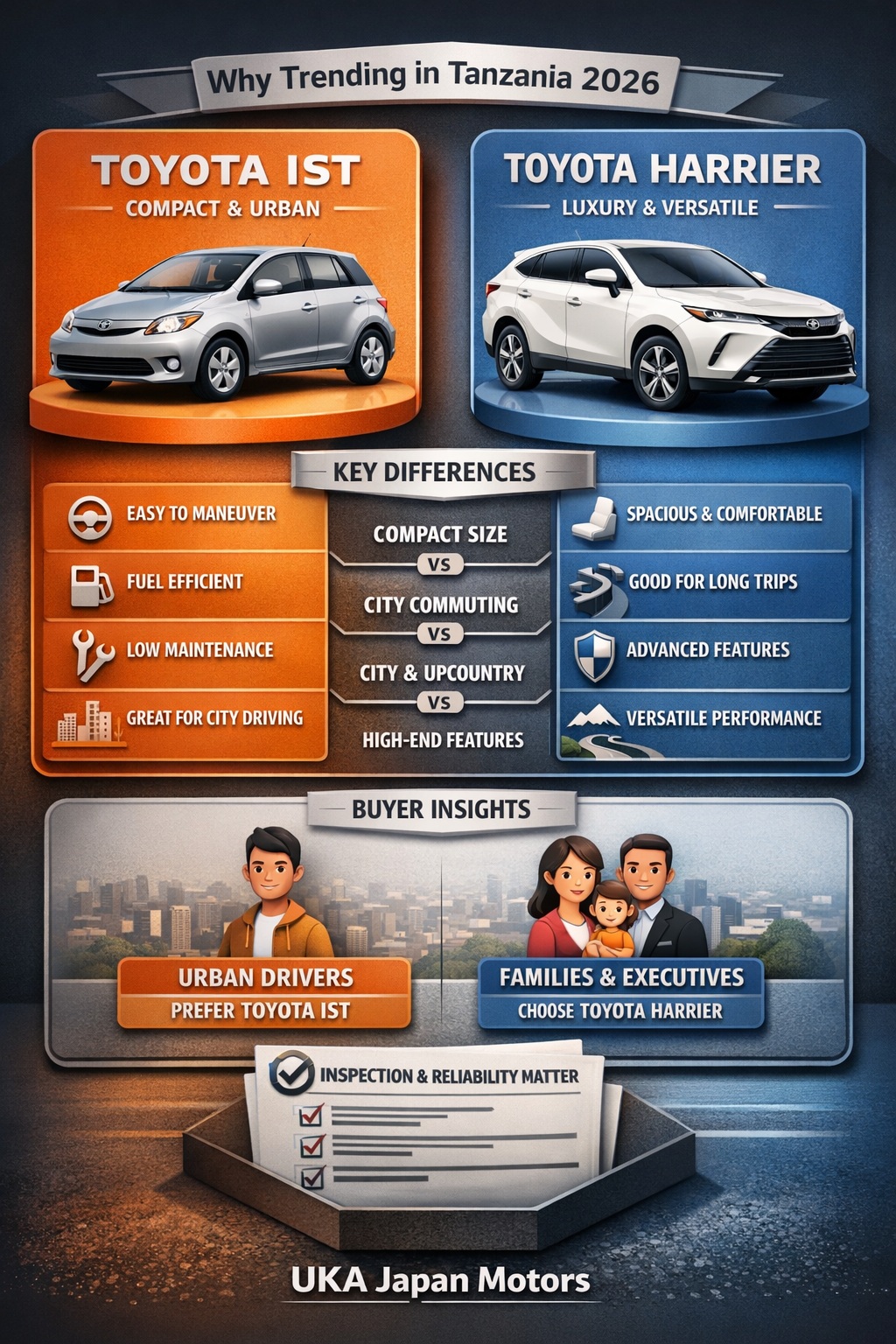
Across Tanzania’s major cities—Dar es Salaam, Arusha, Mwanza, and Dodoma—vehicle preferences are evolving. Buyers are no longer choosing cars based purely on brand familiarity. Instead, decisions are increasingly shaped by practical usability, road adaptability, and long-term reliability.
Two models that have quietly risen in demand during 2026 are the Toyota IST and Toyota Harrier. Despite serving very different market segments, both vehicles are seeing consistent interest among private owners, professionals, and returning diaspora buyers.
This article explores why these two models are trending, what makes them relevant locally, and how they compare in real-world Tanzanian conditions.
Quick Summary: Why These Two Models Stand Out
- Toyota IST
- Compact, urban-friendly design
- Reliable for daily commuting
- Easier maneuverability in dense traffic
- Lower complexity in maintenance
- Toyota Harrier
- Premium SUV comfort and road presence
- Strong performance on highways and mixed terrain
- Preferred for executive and family use
- Advanced safety and driving features
Both vehicles succeed for different reasons—but share one key trait:
They align well with Tanzanian driving realities.
Understanding Buyer Behavior in Tanzania (2026 Shift)
Car buyers in Tanzania are becoming more informed. The shift includes:
- Increased awareness of vehicle inspection standards
- Greater focus on durability over appearance
- Preference for multi-purpose vehicles
- Growing interest in SUVs and crossovers
- Demand for vehicles that handle mixed road conditions
In this context:
- The Toyota IST appeals to urban practicality
- The Toyota Harrier appeals to status + comfort + versatility
Why the Toyota IST Is Gaining Popularity
1. Ideal for Urban Driving Conditions
Dar es Salaam traffic, narrow streets in older neighborhoods, and frequent stop-and-go driving make compact vehicles highly desirable.
The Toyota IST offers:
- Tight turning radius
- Easy parking in crowded areas
- Smooth handling in traffic-heavy zones
This makes it particularly attractive for:
- Young professionals
- First-time car owners
- Daily commuters
2. Compact but Elevated Design
Unlike traditional sedans, the IST has a slightly raised ride height, which helps in:
- Navigating uneven roads
- Handling potholes and speed bumps
- Providing better road visibility
This “mini-SUV feel” is a key reason for its growing appeal.
3. Mechanical Simplicity
Compared to larger SUVs, the IST is:
- Less complex mechanically
- Easier to inspect and maintain
- More forgiving in long-term ownership
In Tanzania, where access to specialized diagnostics can vary, this simplicity is highly valued.
4. Fuel Efficiency Awareness
Although cost discussions are avoided, fuel usage matters in practice. The IST’s smaller engine and lighter body make it suitable for:
- Daily city movement
- Short-distance travel
- Consistent usage without strain
Why the Toyota Harrier Is Trending Strongly
1. Strong Road Presence
The Toyota Harrier is widely recognized across Tanzanian roads for its:
- Bold exterior design
- Premium interior finishing
- Elevated driving position
For many buyers, it represents a balance between luxury and practicality.
2. Comfort for Long-Distance Travel
Travel between cities like:
- Dar es Salaam to Morogoro
- Arusha to Dodoma
- Mwanza to regional areas
requires a vehicle that can handle:
- Long hours of driving
- Variable road surfaces
- Passenger comfort
The Harrier excels in:
- Suspension quality
- Cabin quietness
- Seating comfort
3. Multi-Purpose Usage
The Harrier is not limited to one role. It suits:
- Family transportation
- Business travel
- Executive use
- Weekend trips to rural areas
This versatility is a major factor behind its rising demand.
4. Advanced Features and Safety
Modern Harrier models include:
- Stability control systems
- Multiple airbags
- Driver assistance features
- Enhanced braking systems
As awareness of safety grows in Tanzania, these features influence purchasing decisions.
Toyota IST vs Toyota Harrier: Key Differences
| Feature | Toyota IST | Toyota Harrier |
|---|---|---|
| Size | Compact | Mid-size SUV |
| Usage | Urban commuting | Mixed use (city + highway) |
| Ride Height | Moderate | High |
| Comfort Level | Basic to moderate | High |
| Complexity | Low | Moderate to high |
| Target Buyer | First-time / city driver | Family / executive |
| Road Adaptability | Urban-focused | Versatile |
Why Both Models Can Coexist in High Demand
At first glance, these vehicles seem unrelated. However, they reflect two major buyer segments in Tanzania:
Segment 1: Practical Urban Drivers
- Choose Toyota IST
- Focus on simplicity, ease, and efficiency
Segment 2: Comfort & Versatility Seekers
- Choose Toyota Harrier
- Value comfort, space, and multi-purpose use
This explains why both models are trending simultaneously.
Inspection & Compliance Considerations
Before import or purchase, both vehicles must undergo proper inspection.
Key Areas to Check:
For Toyota IST:
- Suspension condition (due to urban wear)
- Engine health from stop-start driving
- Interior wear and tear
For Toyota Harrier:
- Electronic systems functionality
- Transmission condition
- Suspension and underbody (for mixed terrain use)
In Tanzania, compliance checks ensure:
- Roadworthiness
- Safety standards
- Documentation accuracy
Skipping proper inspection can lead to long-term issues.
Ownership Experience in Tanzania
Toyota IST Ownership
Best suited for:
- Daily commuting
- City-based lifestyles
- Drivers who prefer minimal maintenance complexity
Limitations:
- Not ideal for rough rural terrain
- Limited cargo space
Toyota Harrier Ownership
Best suited for:
- Families
- Long-distance travel
- Mixed road conditions
Limitations:
- More complex systems require proper servicing
- Larger size may be less convenient in tight urban areas
Long-Term Demand Outlook
The popularity of both models is expected to continue due to:
- Increasing urbanization
- Rising demand for SUVs
- Growing awareness of vehicle inspection
- Preference for reliable Japanese vehicles
However, demand will likely evolve as:
- Hybrid models gain attention
- Fuel efficiency awareness increases
- Infrastructure improves in major cities
Frequently Asked Questions (FAQ)
1. Is the Toyota IST suitable for Tanzanian roads?
Yes, especially for urban areas with moderate road conditions.
2. Is the Toyota Harrier good for long-distance travel?
Yes, it is designed for comfort and stability over longer journeys.
3. Which is easier to maintain?
The Toyota IST is generally simpler and easier to maintain.
4. Does the Harrier handle rough roads well?
It performs better than smaller cars due to its size and suspension.
5. Is the IST good for first-time car buyers?
Yes, it is often preferred for its ease of use and manageable size.
6. Are both vehicles reliable?
Both are known for reliability when properly inspected and maintained.
7. Which is better for families?
The Toyota Harrier is more suitable due to space and comfort.
8. What should I check before importing either model?
Focus on inspection reports, mechanical condition, and compliance documentation.
The Role of UKA Japan Motors
Choosing the right vehicle is not just about the model—it is about condition, inspection accuracy, and compliance with Tanzanian requirements.
UKA Japan Motors supports buyers by:
- Conducting detailed vehicle inspections before export
- Ensuring compliance with Tanzanian import standards
- Providing transparent condition reports
- Guiding buyers toward vehicles that suit their real usage needs
This approach helps reduce uncertainty and supports long-term ownership satisfaction.
Conclusion
The rising popularity of the Toyota IST and Toyota Harrier in Tanzania reflects a broader shift in buyer behavior.
- The IST meets the needs of urban practicality and simplicity
- The Harrier fulfills demand for comfort, versatility, and road presence
Together, they represent two ends of a growing market that values reliability, adaptability, and informed decision-making.
Understanding how each vehicle fits your lifestyle is essential before making a choice.
Contact UKA Japan Motors for availability and inspection guidance.