


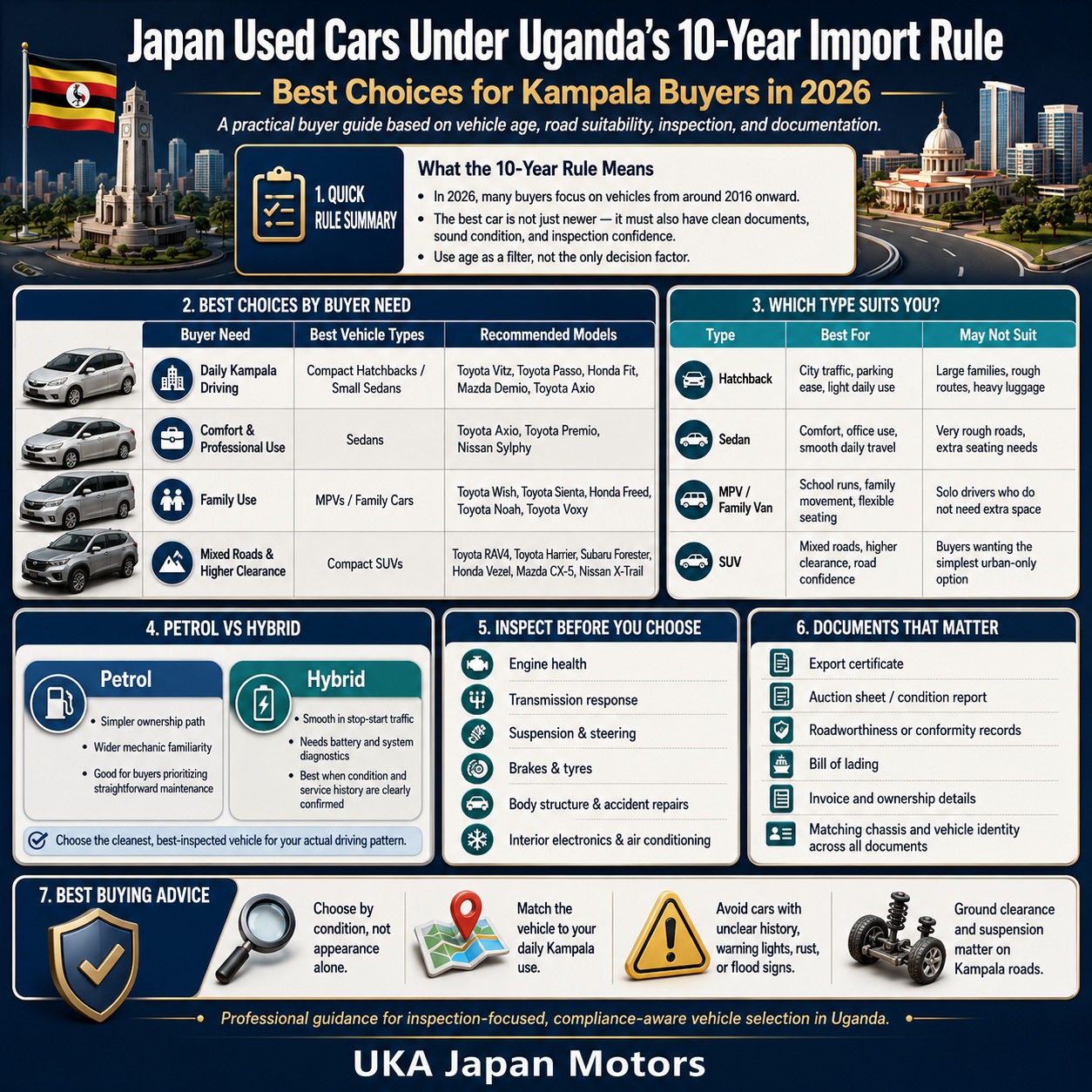
For many Kampala buyers, the phrase “10-year import rule” is less about chasing the oldest vehicle allowed and more about choosing a Japan used car that still feels modern, manageable, compliant, and suitable for Uganda’s everyday driving conditions. In 2026, this matters because vehicle age affects more than eligibility. It influences inspection attention, documentation review, emissions concerns, parts planning, resale confidence, and how the car performs after months of traffic, heat, dust, potholes, and stop-start movement around Kampala.
A Japan used car within a practical 10-year window gives buyers a clearer balance. It is usually recent enough to offer improved safety systems, better fuel management, cleaner engine performance, and more comfortable daily use, while still fitting the ownership patterns many Ugandan drivers understand well. However, age alone does not make a vehicle suitable. A well-kept older unit can sometimes be more dependable than a newer unit with poor maintenance history, accident repairs, weak suspension, or incomplete export documentation.
This guide explains how Kampala buyers should think about Japan used cars under Uganda’s 10-year import planning approach in 2026. It focuses on realistic choices for city driving, family movement, business use, weekend travel, and mixed-road ownership within Uganda. It also explains what to inspect, which documents matter, and how UKA Japan Motors helps buyers approach the process with caution, clarity, and compliance awareness.
Direct Answer: What Are the Best Japan Used Cars for Kampala Buyers in 2026?
The best Japan used cars for Kampala buyers under a practical 10-year import planning window are vehicles that combine road clearance, parts familiarity, fuel efficiency, durable suspension, clean documentation, and reliable inspection history.
For daily Kampala use, compact hatchbacks and sedans such as the Toyota Vitz, Toyota Passo, Toyota Axio, Toyota Premio, Honda Fit, Mazda Demio, and Nissan Note suit buyers who mostly drive in traffic, residential areas, and paved urban routes.
For families and mixed use, the Toyota Wish, Toyota Sienta, Toyota Noah, Toyota Voxy, Honda Freed, and Subaru Forester offer more cabin space and flexibility. Buyers who frequently use uneven roads, carry passengers, or travel beyond central Kampala may find these more practical than smaller cars.
For higher ground clearance and stronger road confidence, compact SUVs such as the Toyota RAV4, Toyota Harrier, Subaru Forester, Honda Vezel, Nissan X-Trail, and Mazda CX-5 can be good choices, provided inspection confirms that the suspension, transmission, engine condition, electronics, and underbody are sound.
For work-related use within Uganda, station wagons and practical vans should be selected carefully based on load pattern, road use, engine condition, and documentation. The best choice is not the largest vehicle, but the one whose condition, age, inspection record, and mechanical design match the buyer’s daily use.
Understanding the 10-Year Import Planning Approach in Uganda
Uganda’s import environment makes vehicle age an important consideration. Buyers need to pay attention to the year of manufacture, roadworthiness requirements, environmental compliance, and the condition of the car before shipment and registration. In Kampala, many buyers use a 10-year planning window because it helps narrow choices to vehicles that are not too old for practical ownership and not too complex for local maintenance.
A 10-year window means that in 2026, buyers often focus on vehicles manufactured from around 2016 onward. This does not mean every 2016 or newer vehicle is automatically a good choice. It simply creates a sensible starting point. Within that range, buyers can compare service history, mileage consistency, accident record, auction grade, inspection notes, engine type, transmission type, interior wear, and suitability for Kampala roads.
This approach also helps buyers avoid some common issues associated with much older units. As cars age, rubber components harden, suspension parts weaken, engine seals may leak, cooling systems become more sensitive, and electronic sensors may need closer attention. Kampala’s driving conditions can expose these weaknesses quickly. A car that looked acceptable during purchase may begin showing problems after repeated slow traffic, heat exposure, dusty parking areas, and uneven road movement.
For this reason, the 10-year planning approach is not just a compliance habit. It is a practical ownership filter.
Why Vehicle Age Matters for Kampala Buyers
Vehicle age affects Kampala ownership in four main ways: inspection, mechanical reliability, comfort, and long-term upkeep.
First, inspection attention increases as vehicles get older. A used vehicle must be assessed carefully for roadworthiness, structural condition, emissions-related systems, lights, braking performance, tyres, and general safety. A newer vehicle can still fail inspection if it has been poorly maintained, but older vehicles naturally require deeper checks because age-related wear is more likely.
Second, mechanical reliability depends on both age and history. Kampala driving is demanding because of slow-moving traffic, sudden braking, potholes, rough shoulders, road humps, and frequent short trips. These conditions affect engines, gearboxes, suspension, cooling systems, brake components, and steering parts. A car that performs well on smooth roads may feel different after daily movement through areas such as Nakawa, Kira Road, Bweyogerere, Nansana, Entebbe Road, or the industrial zones.
Third, age affects cabin comfort. Buyers often focus on engine size and body shape, but comfort matters in Kampala because drivers spend long periods in traffic. Air conditioning, seat condition, dashboard electronics, door seals, sound insulation, and visibility all influence the ownership experience. A vehicle under a 10-year planning window is more likely to have better cabin refinement, but condition still matters more than model year alone.
Fourth, long-term upkeep becomes easier when a model has strong parts familiarity in Uganda. A rare model may look attractive, but if its sensors, body panels, hybrid components, gearbox parts, or suspension pieces are difficult to source locally, ownership becomes less predictable. Kampala buyers should therefore choose vehicles that mechanics understand and that have a known maintenance path.
Best Compact Cars for Kampala Daily Driving
Compact cars remain popular in Kampala because they are easier to park, easier to manoeuvre in traffic, and suitable for daily personal movement. They work well for buyers who drive mostly within the city, carry light luggage, and do not frequently travel on rough rural routes.
Toyota Vitz
The Toyota Vitz is one of the most familiar compact Japan used cars in Uganda. It suits first-time buyers, students, professionals, and urban drivers who need simple daily movement around Kampala. Its compact size helps in tight parking areas, narrow residential roads, and congested streets.
The main strength of the Vitz is familiarity. Many mechanics understand it, parts knowledge is widespread, and its engine layout is straightforward. However, buyers should inspect the suspension, steering rack, engine mounts, cooling system, and transmission response. Some units may have been used heavily before export, so the condition should be confirmed rather than assumed.
The Vitz suits buyers who mostly drive alone or with one or two passengers. It may not be ideal for large families, frequent luggage, or regular use on rough roads with deep potholes.
Toyota Passo
The Toyota Passo is another practical city car. It offers easy entry, light steering, and good visibility. Compared with some compact hatchbacks, it can feel more upright and relaxed in daily driving. This makes it suitable for buyers who want a simple vehicle for errands, school runs, and short commutes.
The Passo should be inspected for engine condition, suspension noise, dashboard warning lights, and previous body repairs. Because it is a small car, buyers should be realistic about ground clearance and load limits. It is a Kampala-friendly car when used within its intended purpose, but it should not be treated like a rough-road vehicle.
Honda Fit
The Honda Fit offers a flexible cabin and clever interior space. It suits buyers who want compact dimensions but more usable storage. The rear seat arrangement makes it practical for errands, small business movement, and mixed personal use.
However, inspection is important. Buyers should pay close attention to transmission behaviour, engine smoothness, hybrid-system condition where applicable, dashboard warnings, and service history. The Fit can be a strong choice, but it rewards buyers who take inspection seriously.
The Honda Fit suits Kampala buyers who need space efficiency without moving into a larger vehicle class.
Mazda Demio
The Mazda Demio is compact, stylish, and pleasant to drive. It suits urban drivers who value steering feel, neat interior design, and efficient daily use. In Kampala, it works best for buyers whose routes are mostly paved and who do not overload the vehicle.
Inspection should focus on engine performance, gearbox response, suspension condition, and electronic systems. Some Mazda models require careful maintenance discipline, so buyers should confirm the vehicle’s service history and avoid units with unclear warning lights or rough idle.
The Demio is a good fit for disciplined owners who want a compact car with a slightly more engaging feel than basic city hatchbacks.
Best Sedans for Comfort and Professional Use
Sedans remain relevant for Kampala buyers who want a more settled driving feel, better cabin comfort, and a formal appearance. They suit professionals, small families, and drivers who spend long hours moving between offices, homes, schools, and meetings.
Toyota Axio
The Toyota Axio is one of the most practical sedan choices for Uganda. It offers a balanced size, familiar mechanical layout, and comfortable cabin for daily use. It is not too large for Kampala traffic, yet it feels more stable than a small hatchback.
Buyers should inspect engine condition, transmission smoothness, suspension bushings, shock absorbers, braking performance, and underbody condition. The Axio is generally sensible for buyers who want reliability without unnecessary complexity.
It suits professionals, small families, and drivers who want a calm daily car.
Toyota Premio
The Toyota Premio offers more comfort and refinement than smaller sedans. It is suitable for buyers who want a more spacious cabin, softer ride, and mature driving character. In Kampala, it works well for professional use, family errands, and longer drives within Uganda.
Because the Premio is often valued for comfort, buyers should inspect interior condition carefully. Seat wear, dashboard condition, air conditioning performance, suspension softness, and engine smoothness should all be checked. A clean Premio can offer strong long-term satisfaction, but a poorly maintained unit may require close mechanical attention.
The Premio suits buyers who want comfort and a settled road feel rather than compact-car simplicity.
Nissan Sylphy
The Nissan Sylphy offers a comfortable sedan layout and can suit Kampala buyers who prefer a refined driving experience. It is spacious enough for family use and generally pleasant for daily traffic.
Inspection should focus on transmission performance, suspension, engine response, and electronic systems. Buyers should also consider parts familiarity and maintenance support before choosing a specific unit. The Sylphy may suit careful owners who want comfort and are willing to maintain the car properly.
Best Family Cars for Kampala Households
Family buyers usually need more than basic transportation. They need space, flexible seating, reliable air conditioning, good visibility, safe access for children, and enough luggage room for daily routines. Kampala family use often includes school runs, church, shopping, medical appointments, visits across town, and weekend travel.
Toyota Wish
The Toyota Wish is a practical family vehicle with flexible seating and a manageable body size. It offers more space than a sedan without feeling too large for Kampala roads. It suits families that need extra seats occasionally but still want a vehicle that can move easily through city traffic.
Inspection should focus on suspension wear, engine mounts, gearbox response, braking performance, door mechanisms, and interior trim. Because family vehicles often carry passengers regularly, suspension condition is very important.
The Wish suits families that need flexibility without moving into a full-size van.
Toyota Sienta
The Toyota Sienta is useful for buyers who want compact size with sliding-door practicality. It is especially helpful in tight parking spaces and school pickup areas. Its cabin layout makes entry and exit easier for children and older passengers.
Buyers should inspect sliding doors, interior mechanisms, suspension, engine condition, and air conditioning. The Sienta should not be overloaded beyond its design, but when used properly, it is a strong Kampala family option.
It suits young families, urban households, and buyers who value easy access.
Toyota Noah and Toyota Voxy
The Toyota Noah and Toyota Voxy are suitable for larger families or buyers who regularly carry passengers. They offer spacious interiors, higher seating, and good visibility. In Kampala, they work well for family movement, group travel, and multi-purpose use.
However, their size requires more care in parking, narrow streets, and congested areas. Buyers should inspect suspension, engine condition, transmission, cooling system, sliding doors, air conditioning, tyres, and underbody. Larger vehicles often reveal poor maintenance through suspension noise, uneven tyre wear, and weak cooling performance.
The Noah and Voxy suit buyers who genuinely need space. They may not be suitable for buyers who mostly drive alone and rarely carry passengers.
Honda Freed
The Honda Freed is a compact multi-purpose vehicle that offers good seating flexibility without being as large as a full van. It can suit Kampala households that want family usefulness in a manageable size.
Inspection should be detailed, especially for transmission behaviour, hybrid condition where applicable, sliding doors, electronics, suspension, and service history. A clean Freed can be very practical, but buyers should avoid units with unclear warning lights or inconsistent maintenance records.
Best Compact SUVs for Kampala and Mixed Roads
Compact SUVs appeal to Kampala buyers because of their higher seating position, improved ground clearance, and stronger road presence. They are useful for drivers who move between paved roads, rough residential routes, construction areas, and upcountry trips within Uganda.
Toyota RAV4
The Toyota RAV4 is a familiar compact SUV with strong appeal for Uganda. It suits buyers who want practicality, ground clearance, and a proven ownership path. It is useful for families, professionals, and drivers who regularly move across mixed road conditions.
Inspection should focus on suspension, drivetrain, engine health, gearbox response, underbody condition, and previous accident repair. Buyers should also check tyre condition and alignment because SUV suspension problems can become obvious on uneven roads.
The RAV4 suits buyers who need more road confidence than a sedan or hatchback can offer.
Toyota Harrier
The Toyota Harrier offers comfort, refinement, and a more premium cabin feel. It is suitable for buyers who want an SUV with smoother driving character and stronger comfort levels. In Kampala, it works well for professional and family use, especially where comfort matters.
However, buyers should inspect electronics, suspension, engine condition, gearbox response, interior features, and air conditioning. The Harrier may include more comfort systems than simpler vehicles, so inspection should be thorough.
It suits buyers who want comfort and road presence, but it may not be suitable for those who prefer the simplest maintenance path.
Subaru Forester
The Subaru Forester is valued for stability, visibility, and road confidence. It can suit buyers who regularly drive beyond central Kampala or use uneven routes. Its all-wheel-drive nature can be useful, but it also requires disciplined maintenance.
Inspection should focus on engine condition, oil leaks, cooling system, suspension, drivetrain, gearbox, and service history. Buyers should avoid units with unclear mechanical records or signs of neglect.
The Forester suits drivers who appreciate strong road feel and are prepared for proper maintenance.
Honda Vezel
The Honda Vezel is popular among buyers who want modern styling, compact SUV practicality, and efficient urban performance. It works well for Kampala buyers who need a higher driving position but do not want a large SUV.
Inspection is critical, especially for hybrid-system condition, gearbox behaviour, electronic warnings, battery health, and service history. A good Vezel can be a refined daily vehicle, but buyers should not ignore inspection because its systems are more complex than older simple models.
The Vezel suits careful owners who want a modern compact SUV and understand the need for proper diagnostics.
Mazda CX-5
The Mazda CX-5 offers a comfortable interior, strong design, and confident driving feel. It suits buyers who want a modern SUV with good cabin quality and balanced performance.
Inspection should include engine health, gearbox response, suspension, dashboard warnings, electronics, and previous repairs. Buyers should confirm that maintenance support is available for the specific engine and trim.
The CX-5 suits buyers who want a refined SUV and are prepared for consistent maintenance discipline.
Petrol, Hybrid, or Smaller Engine: What Works Best in Kampala?
Kampala buyers often compare petrol and hybrid vehicles, especially when looking at Japan used cars from recent years. Both can work, but the right choice depends on driving pattern, maintenance access, inspection quality, and owner expectations.
A petrol vehicle is often simpler to understand and maintain. Many mechanics are familiar with common Toyota, Honda, Nissan, Mazda, and Subaru petrol engines. Petrol vehicles suit buyers who want straightforward ownership and easier diagnosis.
A hybrid vehicle can be smooth and efficient in stop-start traffic, which makes it attractive for Kampala. However, hybrid buyers must inspect the battery system, inverter, cooling fan, dashboard warnings, service records, and diagnostic results. A hybrid should not be purchased only because it is newer or popular. It should be selected because its condition is confirmed.
Smaller engines work well for city driving, but buyers should consider load and road use. A small engine may be suitable for one person or a small household moving around Kampala, but it may feel strained when frequently carrying passengers, luggage, or climbing hilly routes. A larger engine may provide more relaxed movement, but it should match the buyer’s actual use rather than personal preference alone.
The best decision is not petrol versus hybrid in general. The best decision is the cleanest, best-inspected vehicle that matches the buyer’s daily driving pattern.
Documentation Buyers Should Check Before Importing
A Japan used car may look attractive in photos, but documents determine whether the import process is clean and traceable. Kampala buyers should pay attention to documentation before making a decision.
Important documents and records include the export certificate, auction sheet where applicable, inspection records, roadworthiness or conformity documentation, bill of lading, invoice, ownership details, and any paperwork needed for customs and registration. Buyers should ensure that the vehicle identity matches across documents. Chassis number, year of manufacture, model code, engine details, and ownership information should be consistent.
Documentation problems can create delays, uncertainty, and compliance issues. A mismatch in vehicle identity, unclear year of manufacture, missing inspection certification, or questionable repair history can affect the buyer even after the vehicle arrives.
For Kampala buyers, documentation is not just paperwork. It is part of ownership protection.
Inspection Priorities Before Choosing a Japan Used Car
Inspection should be treated as a decision-making tool, not a formality. The following areas matter most for Uganda-bound vehicles.
Engine condition should be checked for smoke, leaks, abnormal noise, overheating signs, rough idle, oil sludge, and warning lights. Kampala traffic puts pressure on cooling systems, so radiator condition, fans, hoses, thermostat function, and coolant condition should not be ignored.
Transmission condition is also important. Buyers should check smooth gear changes, delayed engagement, shuddering, slipping, or warning lights. Automatic and CVT systems require careful assessment because repairs can be complex if problems are ignored before purchase.
Suspension and steering must be inspected because Kampala roads expose weak shock absorbers, worn bushings, tired ball joints, damaged control arms, and loose steering components. A vehicle with weak suspension may feel acceptable in photos but become uncomfortable quickly after local use.
Body structure matters. Buyers should check for accident repairs, uneven panel gaps, rust, underbody damage, repaired chassis sections, flood signs, and poor paintwork. A clean exterior does not always mean clean structure.
Interior and electronics should be reviewed carefully. Air conditioning, power windows, dashboard controls, infotainment, warning lights, seatbelts, airbags, and door mechanisms all affect daily use. For hybrid and newer vehicles, diagnostic scanning is especially important.
Tyres and brakes should not be overlooked. Uneven tyre wear may indicate alignment, suspension, or accident issues. Brake vibration, weak pedal feel, or worn discs can affect safety.
A good vehicle should pass both visual inspection and document review.
Comparing Small Cars, Sedans, Family Vehicles, and SUVs
Kampala buyers often struggle because many vehicle types seem suitable at first glance. A compact hatchback, sedan, family van, and SUV can all serve different needs, but they should not be chosen for the same reason.
A compact hatchback is best for city convenience. It is easy to park, simple to manoeuvre, and practical for light daily movement. It suits single drivers, couples, and small households. It is less suitable for frequent passengers, rough routes, and heavy luggage.
A sedan is better for comfort and formal daily use. It offers a more settled ride and better cabin separation from luggage. It suits professionals and small families. It is less suitable where higher ground clearance or flexible seating is required.
A family van or compact MPV is best where passenger space matters. It suits school runs, family errands, and group movement. It is less suitable for buyers who do not need the extra cabin space because larger interiors come with more components to maintain.
A compact SUV is best for mixed-road confidence. It suits buyers who drive across uneven roads, hilly areas, and routes beyond central Kampala. It is less suitable for buyers who only need a small city car and want the simplest ownership experience.
The right vehicle is the one that matches the buyer’s actual routine, not the one that looks most impressive.
How Kampala Road Conditions Affect Vehicle Choice
Kampala roads vary widely. A buyer may drive on smooth tarmac in one area, then encounter potholes, rough shoulders, drainage cuts, steep entrances, dusty diversions, and narrow roads within the same day. This makes ground clearance, suspension strength, tyre profile, visibility, and cooling performance important.
Cars with very low clearance may scrape on humps, uneven driveways, and broken road edges. Vehicles with delicate suspension may develop noise quickly if used frequently on rough roads. Models with weak cooling systems may struggle in slow traffic if maintenance has been neglected.
Dust also affects vehicles. Air filters, cabin filters, sensors, door seals, and cooling fins may need closer attention in Kampala conditions. Buyers should choose cars that can be maintained consistently and inspected easily.
Rainy conditions add another layer. Poor drainage, muddy access roads, and standing water can expose weak tyres, low air intakes, underbody damage, and electrical vulnerabilities. Buyers should avoid vehicles with flood history or suspicious interior moisture signs.
In Kampala, a good car is not only one that drives well during a short test. It must remain stable through changing road conditions.
Who Should Choose Which Type of Japan Used Car?
A first-time buyer who mostly drives within Kampala should consider a compact Toyota, Honda, Nissan, or Mazda model with strong inspection history and simple maintenance. The priority should be clean condition, manageable size, and parts familiarity.
A professional driver or office commuter may prefer a sedan such as the Toyota Axio, Toyota Premio, or Nissan Sylphy. These offer comfort and a more settled feel for daily movement.
A young family may benefit from a Toyota Sienta, Honda Freed, or Toyota Wish because these offer more flexible seating without becoming difficult to manage in the city.
A larger household may need a Toyota Noah or Toyota Voxy, especially where school runs, family visits, and passenger movement are common.
A buyer who regularly drives on mixed routes may prefer a Toyota RAV4, Subaru Forester, Honda Vezel, Toyota Harrier, Nissan X-Trail, or Mazda CX-5. The decision should depend on inspection results, maintenance comfort, and road-use pattern.
A buyer who wants hybrid technology should choose only after diagnostic checks confirm the condition of the hybrid system. Hybrid ownership can work well in Kampala, but it should never be approached casually.
When a Japan Used Car May Not Be Suitable
A Japan used car may not be suitable if the buyer ignores inspection, chooses based only on appearance, or selects a model that does not match local use. A stylish vehicle with weak documentation, unclear history, or rare parts may create ownership stress.
A small hatchback may not suit a large family. A large van may not suit a driver who mostly moves alone through congested areas. A hybrid may not suit a buyer who has no access to proper diagnostics. A premium SUV may not suit someone who wants the simplest maintenance path. A low-clearance car may not suit a driver who regularly uses rough access roads.
Buyers should also be cautious with vehicles that show inconsistent mileage, repaired airbags, dashboard warning lights, rust, underbody damage, poor repainting, missing documents, or signs of flood exposure.
The safest decision is to reject a vehicle that raises too many questions, even if the model itself is popular.
Practical Buyer Checklist for 2026
Before choosing a Japan used car for Kampala, buyers should review the following points:
Confirm the year of manufacture and whether it fits the intended import planning window.
Check that the chassis number and model details match across documents.
Review the auction sheet or inspection report where available.
Confirm roadworthiness or conformity documentation.
Inspect engine, transmission, suspension, steering, brakes, tyres, body structure, and interior systems.
Check for accident repairs, rust, flood signs, and dashboard warnings.
Consider whether local mechanics understand the model.
Think about the buyer’s daily routes, passenger needs, parking space, and long-term use.
Avoid choosing based only on photos, popularity, or exterior appearance.
This checklist helps buyers make a decision based on evidence rather than assumption.
UKA Japan Motors’ Role in Helping Kampala Buyers
UKA Japan Motors’ role is to help buyers approach Japan used cars with clear information, inspection discipline, and compliance awareness. The focus is not on pushing a buyer toward a specific model, but on helping them understand whether a vehicle is suitable for Uganda, Kampala driving, and long-term ownership.
This includes paying attention to vehicle age, condition, inspection records, documentation, roadworthiness requirements, and the buyer’s intended use. A responsible import process should identify concerns early, before they become registration or ownership problems.
For Kampala buyers, this guidance matters because many vehicle decisions are made from photos, short descriptions, or model reputation. UKA Japan Motors supports a more careful approach by encouraging buyers to look at the complete picture: age, condition, paperwork, mechanical suitability, and local usability.
A trustworthy vehicle choice is not simply the newest option. It is the vehicle whose condition, documentation, and purpose align with the buyer’s needs.
FAQ: Japan Used Cars Under Uganda’s 10-Year Import Planning Rule
1. What does the 10-year import rule mean for Kampala buyers?
For many buyers, the 10-year rule is a practical planning approach that focuses attention on vehicles manufactured within the last decade. It helps buyers avoid very old units and encourages them to select cars with better inspection prospects, more modern features, and stronger long-term usability.
2. Is every Japan used car under 10 years old a good choice?
No. Age is only one factor. A vehicle under 10 years old can still have accident history, poor maintenance, transmission problems, worn suspension, or incomplete documentation. Buyers should always inspect the specific unit before making a decision.
3. Which Japan used car is best for daily Kampala traffic?
For daily city movement, compact cars such as the Toyota Vitz, Toyota Passo, Honda Fit, Mazda Demio, Nissan Note, and Toyota Axio are practical choices. The best option depends on passenger needs, driving routes, inspection condition, and maintenance support.
4. Are SUVs better than sedans for Kampala?
SUVs offer higher ground clearance and stronger confidence on uneven roads, but they are not automatically better for every buyer. A sedan may be more suitable for a professional commuter who mostly drives on paved roads, while an SUV may suit a buyer who uses rougher routes or travels more often beyond central Kampala.
5. Should Kampala buyers consider hybrid Japan used cars?
Hybrid vehicles can work well in Kampala, especially in stop-start traffic, but they require proper diagnostic inspection. Buyers should check the hybrid battery, inverter, cooling system, warning lights, and service history before choosing a hybrid model.
6. What documents matter when importing a Japan used car into Uganda?
Important documents include the export certificate, roadworthiness or conformity documents, bill of lading, invoice, inspection records, and registration-related paperwork. Buyers should ensure that chassis details, year of manufacture, and vehicle identity match across the documents.
7. Why is roadworthiness inspection important?
Roadworthiness inspection helps confirm whether the vehicle meets required safety and condition expectations before or during the import and clearance process. It protects buyers from vehicles with serious defects, poor repairs, or compliance problems.
8. Which family car is suitable for Kampala?
The Toyota Wish, Toyota Sienta, Honda Freed, Toyota Noah, and Toyota Voxy are practical family options. The right choice depends on family size, parking space, route conditions, seating needs, and inspection results.
9. What should buyers avoid when choosing a Japan used car?
Buyers should avoid vehicles with unclear documents, accident repairs, dashboard warning lights, rust, flood signs, weak suspension, irregular mileage records, or poor inspection history. They should also avoid choosing a car only because the model is popular.
10. Does engine size matter for Kampala driving?
Yes. Smaller engines are practical for city use, while larger engines may feel more relaxed with passengers, hills, or longer routes. Buyers should match engine size to daily use rather than choosing based only on preference.
11. Are newer vehicles always easier to maintain?
Not always. Some newer vehicles have more advanced electronics, hybrid systems, sensors, and transmission designs. They may be excellent choices when inspected properly, but buyers should confirm that maintenance support is available locally.
12. How can a buyer know whether a car suits Uganda?
A buyer should consider road clearance, suspension strength, engine condition, documentation, inspection history, parts familiarity, and daily use. A vehicle that suits smooth city driving may not suit rougher routes, heavy passenger use, or frequent long-distance travel.
Conclusion
Japan used cars remain important for Kampala buyers in 2026 because they offer a wide range of body styles, engine options, comfort levels, and ownership paths. However, choosing well requires more than selecting a familiar badge or recent model year. Buyers need to think carefully about Uganda’s import environment, roadworthiness expectations, documentation, Kampala driving conditions, and long-term maintenance realities.
A practical 10-year import planning window helps narrow the search to vehicles that are more likely to offer modern usability and stronger ownership confidence. Still, the final decision should depend on inspection results, vehicle history, road suitability, and the buyer’s daily needs.
For compact daily driving, models such as the Toyota Vitz, Toyota Passo, Honda Fit, Mazda Demio, Nissan Note, and Toyota Axio remain sensible options. For families, the Toyota Wish, Toyota Sienta, Honda Freed, Toyota Noah, and Toyota Voxy offer more space and flexibility. For mixed-road confidence, SUVs such as the Toyota RAV4, Toyota Harrier, Subaru Forester, Honda Vezel, Nissan X-Trail, and Mazda CX-5 deserve consideration when their condition is verified.
The best Japan used car for Kampala is not simply the newest, largest, or most popular vehicle. It is the one that enters Uganda with clean documentation, passes inspection expectations, suits local roads, and supports the owner’s daily routine over time.
Contact UKA Japan Motors for availability and inspection guidance.