


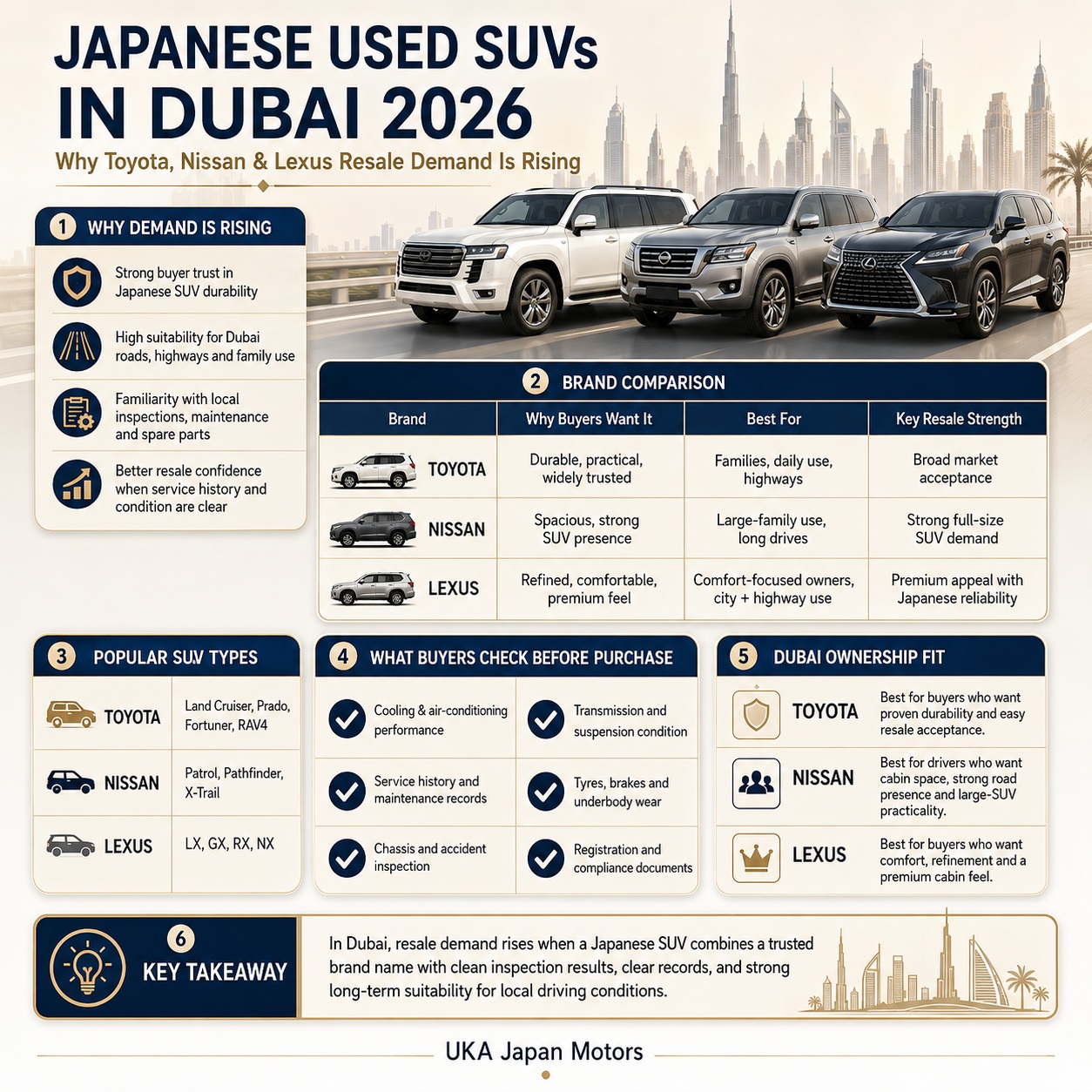
Japanese used SUVs have become a steady part of Dubai’s vehicle landscape in 2026, especially among buyers who want strong daily usability, proven mechanical durability and confidence when it is time to sell or upgrade later. Within this demand, Toyota, Nissan and Lexus stand out because their SUVs match many of the realities of driving and ownership in the UAE: long highway journeys, high summer temperatures, mixed urban and desert-edge use, family transport needs and the importance of inspection-backed purchase decisions.
This article belongs to the Buyer Guides category because it focuses on how buyers in Dubai can understand rising resale demand before choosing a used Japanese SUV. It does not treat resale demand as a simple popularity trend. Instead, it explains the practical reasons behind it: brand familiarity, spare parts availability, workshop knowledge, road suitability, inspection confidence, documentation clarity and long-term ownership behaviour across Dubai, Abu Dhabi, Sharjah, Ajman, Ras Al Khaimah, Umm Al Quwain and Fujairah.
In Dubai, resale demand is not shaped by one factor alone. A used SUV may attract attention because of its badge, but sustained buyer interest depends on condition, service history, mileage pattern, accident background, chassis integrity, cooling system health, transmission behaviour, interior wear, tyre condition, registration readiness and whether the vehicle feels suitable for UAE driving. Toyota, Nissan and Lexus models often perform strongly because many buyers already understand their strengths and because the local automotive ecosystem is familiar with maintaining them.
Direct Answer: Why Is Demand Rising?
Demand for Japanese used SUVs in Dubai is rising in 2026 because buyers are placing more importance on long-term confidence, predictable ownership and easier resale acceptance. Toyota, Nissan and Lexus SUVs are widely recognised in the UAE, and many models have built strong reputations for handling heat, highway use, family driving and mixed road conditions.
Toyota appeals to buyers who prioritise durability and broad market acceptance. Nissan attracts buyers who want strong SUV presence, practical cabin space and familiar large-SUV capability. Lexus appeals to buyers who want comfort, refinement and Toyota-linked engineering with a more premium ownership feel.
However, brand reputation alone is not enough. A Japanese used SUV only becomes a strong resale candidate when its condition supports buyer confidence. In Dubai, inspection results, accident history, maintenance records, import documentation and registration readiness matter as much as the badge on the bonnet.
What Counts as a Japanese Used SUV in Dubai?
In the Dubai used vehicle market, the phrase “Japanese used SUV” usually refers to a used SUV from a Japanese brand such as Toyota, Nissan or Lexus. It may include vehicles already registered and driven in the UAE, as well as imported used vehicles that must meet local documentation, inspection and compliance requirements before they can be registered for road use.
For buyers, the important point is not only where the SUV came from. The more useful question is whether the vehicle is suitable for UAE ownership now. A clean-looking SUV can still need careful inspection if it has weak cooling performance, hidden underbody damage, poor tyre condition, worn suspension parts, unclear service records or electronic faults caused by heat and age.
This is why the term “Japanese used SUV” should never be treated as a guarantee by itself. Toyota, Nissan and Lexus are respected brands in Dubai, but every used SUV must still be judged individually. Two vehicles from the same model year can have very different ownership quality depending on how they were driven, maintained, stored and repaired.
Why SUVs Fit Dubai Ownership Patterns
SUVs suit Dubai because they match several common daily-use patterns. Many residents use one vehicle for school runs, office commuting, airport trips, weekend travel, shopping routes and inter-emirate driving. A well-selected SUV can handle these varied needs better than a smaller vehicle when cabin space, luggage room, seating position and road presence are priorities.
Dubai roads also encourage SUV demand. Wide highways, long distances between communities and regular travel between emirates make stable cruising and cabin comfort important. Areas such as Dubai Marina, Jumeirah, Business Bay, Downtown Dubai, Al Barsha, Mirdif, Arabian Ranches and Dubai Hills often involve different traffic conditions in the same week. A buyer may move between tight parking areas, fast arterial roads and long highway stretches.
The UAE climate adds another layer. A used SUV must be able to cope with high ambient temperatures, stop-start traffic, long air-conditioning use and heat exposure while parked. Buyers often pay attention to cooling system health, air-conditioning performance, dashboard condition, rubber seals, tyre age, battery condition and electronic reliability. Toyota, Nissan and Lexus SUVs are often favoured because many workshops across the UAE understand these systems well.
Why Resale Demand Matters Before Buying
Resale demand matters because it reflects how easily future buyers may understand and trust the vehicle. A used SUV with broad resale demand tends to attract a larger pool of potential buyers when ownership needs change. In Dubai, where many residents’ vehicle needs evolve due to family size, job location, school routes, villa moves or inter-emirate travel, a vehicle that remains widely acceptable can be easier to transition from.
This does not mean every Toyota, Nissan or Lexus SUV will automatically perform well in resale. A poorly repaired vehicle, a neglected engine, weak air-conditioning, inconsistent mileage records or missing documentation can reduce buyer confidence regardless of brand. Resale demand is strongest when the model’s reputation is supported by the actual condition of the vehicle.
For this reason, a buyer should think of resale demand as a combination of three elements: brand confidence, model suitability and verified condition. Toyota, Nissan and Lexus often start with strong brand confidence in the UAE, but inspection is what confirms whether a specific SUV deserves that confidence.
Toyota SUVs: Why Demand Remains Strong
Toyota SUVs continue to attract strong attention in Dubai because they are familiar, practical and widely understood. Models such as Land Cruiser, Prado, Fortuner and RAV4 serve different buyer needs, from large family transport to daily commuting and outdoor-oriented use. Toyota’s reputation in the UAE is strongly linked to mechanical endurance, straightforward maintenance and long-standing local trust.
For Dubai buyers, Toyota’s strength is not only durability. It is also recognition. Many buyers, inspectors and workshops know what to look for on Toyota SUVs. Common inspection points are well understood, parts knowledge is widespread and model expectations are clear. This helps buyers feel more confident when evaluating a used Toyota SUV.
The Land Cruiser is often seen as a benchmark for large SUV usability in the UAE. It suits families, long highway journeys and drivers who want a commanding vehicle. The Prado is often viewed as a balanced option for buyers who want SUV strength in a slightly more manageable format. The Fortuner appeals to buyers who want practical three-row usability, while the RAV4 suits those who prefer a more compact SUV for urban use.
Toyota resale demand rises when a vehicle has clean documentation, consistent servicing, healthy cooling performance, smooth transmission behaviour and a body structure free from serious repair concerns. Buyers should be especially careful with vehicles that look cosmetically refreshed but show uneven panel gaps, overspray, warning lights, underbody damage or signs of neglected maintenance.
Nissan SUVs: Why Patrol and Related Models Stay Relevant
Nissan SUV demand in Dubai is strongly connected to road presence, cabin space and the popularity of large SUVs. The Nissan Patrol remains one of the most recognised SUVs on UAE roads, with a reputation shaped by family use, highway confidence and strong local familiarity. Other Nissan SUVs also appeal to buyers who want practicality and a comfortable driving position.
The Patrol has a particular place in Dubai because it fits the expectations many buyers have from a full-size SUV. It offers a spacious cabin, a strong road image and a driving character that suits long-distance use. For families, the wide cabin and seating flexibility can be important. For daily drivers, the high seating position and smooth highway behaviour can make it feel suitable for both city and inter-emirate travel.
Nissan demand is also supported by local workshop familiarity. Many technicians in Dubai and Sharjah understand Patrol inspection points, common wear areas, cooling concerns, suspension checks and drivetrain behaviour. This matters because used SUV buyers often want confidence that future maintenance will be understandable and manageable from a technical perspective.
At the same time, Nissan SUVs require careful inspection. Large SUVs may have been used heavily in family, highway or outdoor settings. Buyers should check suspension condition, steering response, engine cooling, transmission smoothness, brake performance, tyre wear patterns and signs of body repair. A Patrol or other Nissan SUV with strong service records and clean inspection results can remain highly attractive, but one with unclear history should be approached carefully.
Lexus SUVs: Why Premium Japanese Demand Is Rising
Lexus SUVs are gaining strong resale attention in Dubai because they combine comfort, refinement and Toyota-linked engineering. Models such as Lexus LX, GX, RX and NX appeal to buyers who want a premium cabin experience without moving away from the reliability expectations associated with Japanese engineering.
In Dubai, Lexus demand is often driven by buyers who want a quieter cabin, smoother ride quality, higher interior comfort and a more refined ownership experience. The LX attracts attention from buyers who want a large premium SUV with strong road presence. The GX appeals to those who like traditional SUV strength in a more premium format. The RX and NX suit buyers who prefer urban comfort, easier manoeuvrability and a more refined daily drive.
Lexus resale demand depends heavily on interior condition and electronic health. Because Lexus vehicles are often chosen for comfort and premium features, buyers inspect seat wear, dashboard condition, infotainment performance, air-conditioning operation, sensor behaviour, suspension comfort and cabin noise more closely. A Lexus SUV with neglected interior care or unresolved electronic faults may not create the same confidence as one with a clear service trail and clean inspection report.
The Lexus advantage in Dubai is that it offers a premium feel while still being familiar to many UAE workshops. Buyers often see Lexus as a bridge between comfort and long-term confidence. This is one reason resale demand remains strong when condition, documentation and maintenance history are properly verified.
Toyota vs Nissan vs Lexus: How Buyer Demand Differs
Toyota, Nissan and Lexus do not attract exactly the same buyer. Their resale demand overlaps, but each brand appeals to a different ownership profile.
Toyota is usually chosen by buyers who want broad acceptance and practical durability. It is often the safest emotional choice for someone who wants a used SUV that many future buyers will recognise quickly. Toyota SUVs are especially strong when the buyer wants a straightforward ownership experience.
Nissan is often chosen by buyers who value strong SUV character, spaciousness and road presence. The Patrol in particular has a loyal following in Dubai because it fits large-SUV expectations and feels well matched to UAE roads. Nissan demand can be very strong when the vehicle is clean, well-maintained and inspected properly.
Lexus is chosen by buyers who want comfort and refinement along with Japanese-brand confidence. It attracts a more comfort-focused buyer who may care deeply about cabin quietness, features, materials and ride quality. Lexus resale demand is strongest when the vehicle feels premium inside and mechanically well cared for.
The contrast is useful for buyers. Toyota may suit those who want the widest acceptance. Nissan may suit those who want a confident full-size SUV feel. Lexus may suit those who want a more refined cabin and ownership experience. The right choice depends on how the SUV will be used in Dubai, not only on the badge.
Why Dubai Buyers Trust Familiar Models
Dubai’s used SUV market rewards familiarity. Buyers often prefer models they have seen regularly on UAE roads, heard about from other owners and know can be inspected by experienced technicians. This helps explain why Toyota, Nissan and Lexus SUVs maintain demand across different buyer groups.
Familiarity also reduces uncertainty. A buyer considering a used Land Cruiser, Patrol, Prado, Fortuner, RX or LX can usually find local knowledge about common checks, service expectations and ownership behaviour. This does not remove the need for inspection, but it helps buyers ask better questions.
In contrast, an unfamiliar SUV may require more research, more specialist knowledge and more caution around parts, diagnostics and long-term support. That does not make unfamiliar models unsuitable, but it changes the level of confidence a buyer may feel. Toyota, Nissan and Lexus benefit because their models are already embedded in UAE ownership culture.
Climate, Heat and Resale Confidence
Heat is one of the most important realities of SUV ownership in Dubai. Any used SUV must be assessed for how well it handles prolonged heat exposure, especially during daily summer use. High temperatures affect batteries, cooling systems, tyres, rubber components, fluids, paint, interior materials and electronic modules.
Toyota, Nissan and Lexus SUVs are often seen as suitable for UAE conditions because many models have proven themselves over years of local use. Still, heat-related inspection should never be skipped. Buyers should check radiator condition, coolant quality, fan operation, thermostat behaviour, hose condition, air-conditioning cooling strength, compressor noise, cabin vent performance and engine temperature stability during extended operation.
Interior heat damage is also important. Dashboard cracks, sticky surfaces, faded trim, weakened seals and worn leather can reduce buyer confidence later. A used Lexus with excellent mechanical condition but poor interior care may not attract the same resale demand as a cleaner example. Similarly, a Toyota or Nissan SUV with strong engine health but neglected cabin condition may raise concerns about overall care.
In Dubai, resale demand often rewards vehicles that have been preserved well inside and outside. Heat-resistant ownership habits, covered parking when available, regular servicing and proper tyre replacement all help maintain confidence.
Inspection and Compliance: What Buyers Should Verify
Inspection is central to buying any used Japanese SUV in Dubai. A clean body, polished paint and detailed interior can create a positive first impression, but they do not confirm mechanical integrity. The inspection must look deeper.
A proper inspection should review chassis condition, accident signs, paint thickness, panel alignment, engine performance, transmission response, differential and drivetrain behaviour, suspension wear, brake condition, steering components, underbody condition, tyre age, warning lights, air-conditioning performance and electronic systems. For hybrid Lexus or Toyota SUV variants, battery health and hybrid system diagnostics may also be relevant.
Compliance matters as well. Used imported vehicles must align with UAE requirements before registration and road use. Vehicles with serious histories such as flood damage, major structural damage, dismantling, scrapping or severe defects can create major registration and ownership issues. Buyers should make sure the SUV’s documentation is consistent and that the vehicle can proceed through the appropriate inspection and registration channels.
For Dubai ownership, registration readiness is not a small detail. A used SUV must be legally registerable, insurable and suitable for road use. Buyers should verify customs documents where relevant, ownership documents, inspection status, Emirates ID requirements, insurance readiness and any authority-specific process that applies to the vehicle.
The Role of Service History
Service history is one of the strongest resale confidence factors for Japanese used SUVs. A well-documented service record shows that the vehicle has been cared for over time. It can also help identify whether maintenance was preventive or reactive.
For Toyota SUVs, buyers often look for regular engine oil service, cooling system maintenance, transmission servicing where applicable, brake care and suspension work. For Nissan SUVs, cooling performance, drivetrain care, suspension condition and transmission behaviour are especially important on larger models. For Lexus SUVs, service history should support both mechanical health and the condition of comfort features.
A missing service record does not automatically mean a vehicle is unsuitable, but it increases the importance of inspection. In Dubai, many used SUVs have passed through different ownership patterns. Some are family vehicles, some are daily commuters, some are used for long highway travel and some may have had more demanding usage. Service records help explain that story.
Mileage Patterns Matter More Than Mileage Alone
Mileage is important, but the pattern behind the mileage matters more. A used SUV with higher mileage but consistent servicing and mostly steady highway use may feel stronger than a lower-mileage SUV with poor maintenance, long idle periods, heat exposure and unclear repairs.
Dubai driving can create different types of wear. Stop-start traffic affects cooling systems, brakes and transmissions. Long highway journeys affect tyres, suspension components and engine load patterns. Short urban trips can affect batteries and fluids. Outdoor use can affect underbody components, dust exposure and suspension wear.
For resale demand, buyers want a vehicle that feels honest. Mileage should match the wear visible on seats, steering wheel, pedals, tyres, suspension, engine bay and service records. Any mismatch should be investigated carefully.
Documentation and Ownership Clarity
Documentation is a major part of resale confidence. A Japanese used SUV in Dubai should have a clear ownership trail and documents that support registration and transfer. Buyers should avoid relying only on verbal assurances.
Important documents may include registration details, inspection records, insurance status, service invoices, import-related documents where relevant, customs documentation where applicable and identification requirements for transfer. The exact process may vary depending on whether the SUV is already registered in Dubai or being prepared for first registration after import.
Clear documentation supports trust. When a future buyer reviews the vehicle, clean documents help reduce hesitation. This is one reason buyers who think ahead about resale demand should organise their ownership records from the first day.
Which Toyota SUVs Suit Which Dubai Buyers?
A Toyota Land Cruiser suits buyers who need a large SUV with strong road presence, cabin space and long-distance comfort. It is commonly considered by families and drivers who want a vehicle that feels confident across many UAE driving conditions.
A Toyota Prado suits buyers who want traditional SUV strength in a slightly more manageable size. It can work well for families, daily commuters and drivers who want a balance of comfort and capability.
A Toyota Fortuner suits buyers who want practical three-row use and a durable SUV layout. It is often considered by families who need seating flexibility and straightforward usability.
A Toyota RAV4 suits buyers who prefer a compact SUV for city driving, school routes and daily commuting. It may suit those who want easier parking and a more urban-friendly footprint.
Each model can attract resale demand, but the strongest examples are those with clean inspection results, clear records and condition that matches buyer expectations.
Which Nissan SUVs Suit Which Dubai Buyers?
A Nissan Patrol suits buyers who want a full-size SUV with strong road presence, spacious seating and highway comfort. It is especially relevant for families and drivers who prefer a large SUV feel.
A Nissan Pathfinder may suit buyers who want family practicality in a more road-focused SUV format. It can be appropriate for daily use, school runs and inter-emirate travel when condition is strong.
A Nissan X-Trail may suit buyers who want a more manageable SUV for urban driving, family use and commuting. It is generally more city-oriented than the Patrol and easier to place in tighter spaces.
Nissan buyers should pay close attention to cooling, transmission behaviour, suspension condition and service records. Resale demand is strongest when the vehicle has been maintained carefully and inspected thoroughly.
Which Lexus SUVs Suit Which Dubai Buyers?
A Lexus LX suits buyers who want a premium large SUV with comfort, presence and long-distance refinement. It often appeals to buyers who like the strength of a large SUV but want a more luxurious cabin environment.
A Lexus GX suits buyers who prefer a traditional SUV feel with premium features and a more compact footprint than the largest Lexus SUV. It can suit drivers who want capability and comfort together.
A Lexus RX suits buyers who want a refined daily SUV for city and highway use. It is often chosen for comfort, quietness and ease of use.
A Lexus NX suits buyers who want a smaller premium SUV for urban driving, commuting and lighter family use. It can appeal to drivers who prioritise cabin quality and easier manoeuvrability.
For Lexus, resale demand depends strongly on interior care, feature operation, smooth driving feel and complete inspection. Buyers expect a Lexus to feel refined, so small faults may matter more than they would on a more utility-focused SUV.
When a Japanese Used SUV Makes Sense
A Japanese used SUV can make sense for Dubai buyers who want a recognised brand, broad workshop familiarity, practical cabin space and strong future buyer interest. It is especially suitable for families, commuters, frequent highway drivers and people who want a vehicle that fits common UAE ownership patterns.
It may also suit buyers who want long-term confidence from a model with established local knowledge. Toyota, Nissan and Lexus SUVs have the advantage of being widely understood by inspectors, mechanics and future buyers.
However, suitability still depends on the individual vehicle. A buyer should not choose a used SUV only because it carries a respected badge. The vehicle must pass inspection, have clear documentation and match the buyer’s usage.
When It May Not Be Suitable
A Japanese used SUV may not be suitable if the buyer mainly drives in tight urban areas and does not need SUV space. Large SUVs can feel less convenient in dense parking areas or short daily routes. A compact SUV may be more suitable in such cases, but even then, inspection remains essential.
A used SUV may also be unsuitable if its history is unclear. Warning signs include missing documents, inconsistent mileage, visible accident repairs, poor cooling performance, dashboard warning lights, transmission hesitation, uneven tyre wear, fluid leaks or signs of flood exposure.
Buyers should also be cautious if the vehicle has been heavily modified. Some modifications may affect inspection, comfort, reliability or future resale demand. In Dubai, a clean and original-feeling SUV often gives future buyers more confidence than one with unclear changes.
Practical Buying Checklist for Dubai
Before choosing a Japanese used SUV in Dubai, buyers should review the vehicle from three angles: condition, compliance and suitability.
Condition means the vehicle’s mechanical, structural, interior and electronic health. Compliance means whether it can meet UAE registration and inspection requirements. Suitability means whether it fits the buyer’s daily life, family needs, route patterns and long-term ownership expectations.
The buyer should inspect the engine bay, cooling system, air-conditioning, tyres, brakes, suspension, steering, transmission, underbody, chassis areas, paint condition, cabin materials and electronics. A road test should check smooth acceleration, braking stability, steering alignment, gear changes, cabin noise, temperature behaviour and warning lights.
The buyer should also review the documents carefully. A vehicle with strong documents and a clean inspection is easier to trust now and easier to explain later when resale time comes.
Why Resale Demand Is Rising in 2026
In 2026, resale demand for Japanese used SUVs in Dubai is rising because buyers are becoming more selective. Many are looking beyond appearance and focusing on vehicles that can remain practical over several years. They want SUVs that are familiar, inspectable, serviceable and accepted by a wide group of future buyers.
Toyota benefits from trust built around durability and broad acceptance. Nissan benefits from strong SUV identity and local popularity, especially in the large-SUV segment. Lexus benefits from comfort, refinement and confidence linked to Japanese engineering.
The UAE’s driving environment supports this trend. Heat, highway use, family transport needs and the importance of inspection all encourage buyers to choose vehicles with proven local relevance. A used Japanese SUV that is clean, compliant and well maintained can meet these expectations better than a vehicle with unclear history or limited local familiarity.
Internal Reading Connections
This article naturally connects with broader and supporting UKA Japan Motors topics such as:
Japanese Used Cars in Dubai: Complete Buyer Guide
Toyota Land Cruiser Used SUV Inspection Guide in Dubai
Nissan Patrol Used SUV Buying Guide for UAE Drivers
Lexus LX vs Lexus RX: Which Used SUV Suits Dubai Buyers?
Imported Used Car Compliance in the UAE
How Vehicle Inspection Helps Used SUV Buyers in Dubai
These related topics help buyers move from general understanding to model-specific decisions.
UKA Japan Motors’ Role
UKA Japan Motors’ role is to help buyers approach Japanese used SUVs with inspection-led confidence. The focus is not on pushing a buyer toward a specific badge or model. The purpose is to help each buyer understand whether a vehicle is suitable, compliant and aligned with their ownership needs in the UAE.
For Toyota, Nissan and Lexus SUVs, UKA Japan Motors can guide buyers through the practical questions that matter: vehicle condition, inspection findings, documentation clarity, registration readiness, model suitability, service history and long-term ownership considerations.
This trust-based approach is important because resale demand should not be treated as a shortcut. A strong brand can support buyer confidence, but only a properly inspected vehicle can justify that confidence. UKA Japan Motors places emphasis on transparency, compliance awareness and careful evaluation so buyers can make informed decisions.
FAQ
1. Why are Japanese used SUVs popular in Dubai in 2026?
Japanese used SUVs are popular in Dubai because many buyers trust their durability, practicality and local familiarity. Toyota, Nissan and Lexus models are widely recognised, and many workshops across the UAE understand their maintenance needs.
2. Which Japanese SUV brands have strong resale demand in Dubai?
Toyota, Nissan and Lexus are among the most recognised Japanese SUV brands in Dubai. Toyota is known for broad acceptance, Nissan for strong SUV presence and Lexus for premium comfort with Japanese engineering confidence.
3. Does a Toyota SUV always have strong resale demand?
Toyota SUVs often attract strong resale demand, but condition still matters. A Toyota with poor maintenance, accident history or weak inspection results may not create buyer confidence. The brand helps, but the specific vehicle must be sound.
4. Why does the Nissan Patrol remain popular in Dubai?
The Nissan Patrol remains popular because it suits many UAE driving patterns. It offers strong road presence, spacious seating and a full-size SUV feel that many families and drivers in Dubai appreciate.
5. Why do Lexus SUVs attract premium used SUV buyers?
Lexus SUVs attract buyers who want comfort, quietness, refined interiors and Japanese-brand confidence. Their resale demand is strongest when the vehicle has been maintained well and all comfort and electronic features work properly.
6. What should I inspect before buying a Japanese used SUV in Dubai?
Important inspection areas include chassis condition, accident signs, cooling system health, air-conditioning performance, transmission behaviour, suspension wear, brake condition, tyre age, service records and electronic systems.
7. Are imported Japanese used SUVs suitable for UAE registration?
They can be suitable when they meet UAE requirements and have the correct documentation. Buyers should verify compliance, inspection readiness and registration documents before committing to any imported used SUV.
8. Is mileage the most important factor in resale demand?
Mileage matters, but it is not the only factor. Service history, driving pattern, condition, documentation and inspection results often explain the vehicle better than mileage alone.
9. Which is better for Dubai: Toyota, Nissan or Lexus?
There is no single answer. Toyota suits buyers who want broad acceptance and durability. Nissan suits buyers who want strong SUV presence and space. Lexus suits buyers who want comfort and refinement. The best choice depends on usage and condition.
10. Can a luxury SUV lose buyer confidence if the interior is worn?
Yes. Lexus and other premium SUVs are often judged closely on interior condition, feature operation and cabin comfort. Worn seats, damaged trim or faulty electronics can reduce buyer confidence.
11. Why is documentation important for resale demand?
Clear documentation helps future buyers trust the vehicle. Registration records, service history, inspection reports and import-related documents where relevant all support transparency.
12. Should I buy a used SUV without inspection?
A used SUV should not be judged by appearance alone. Inspection helps identify hidden mechanical, structural, cooling, electronic or compliance concerns before ownership begins.
Conclusion
Japanese used SUVs from Toyota, Nissan and Lexus are seeing rising resale demand in Dubai in 2026 because they fit the UAE’s ownership realities. Buyers want vehicles that are familiar, practical, inspectable and suitable for heat, highways, family use and long-term confidence.
Toyota continues to attract buyers who value durability and broad acceptance. Nissan remains strong among those who want SUV presence, space and local familiarity. Lexus is increasingly attractive to buyers who want refinement and comfort while staying within a Japanese engineering environment.
The key lesson for buyers is that resale demand begins before resale time. It starts with choosing the right model, verifying condition, checking documentation and confirming compliance. A respected badge may open the door, but inspection and transparency are what protect buyer confidence.
Contact UKA Japan Motors for availability and inspection guidance.