


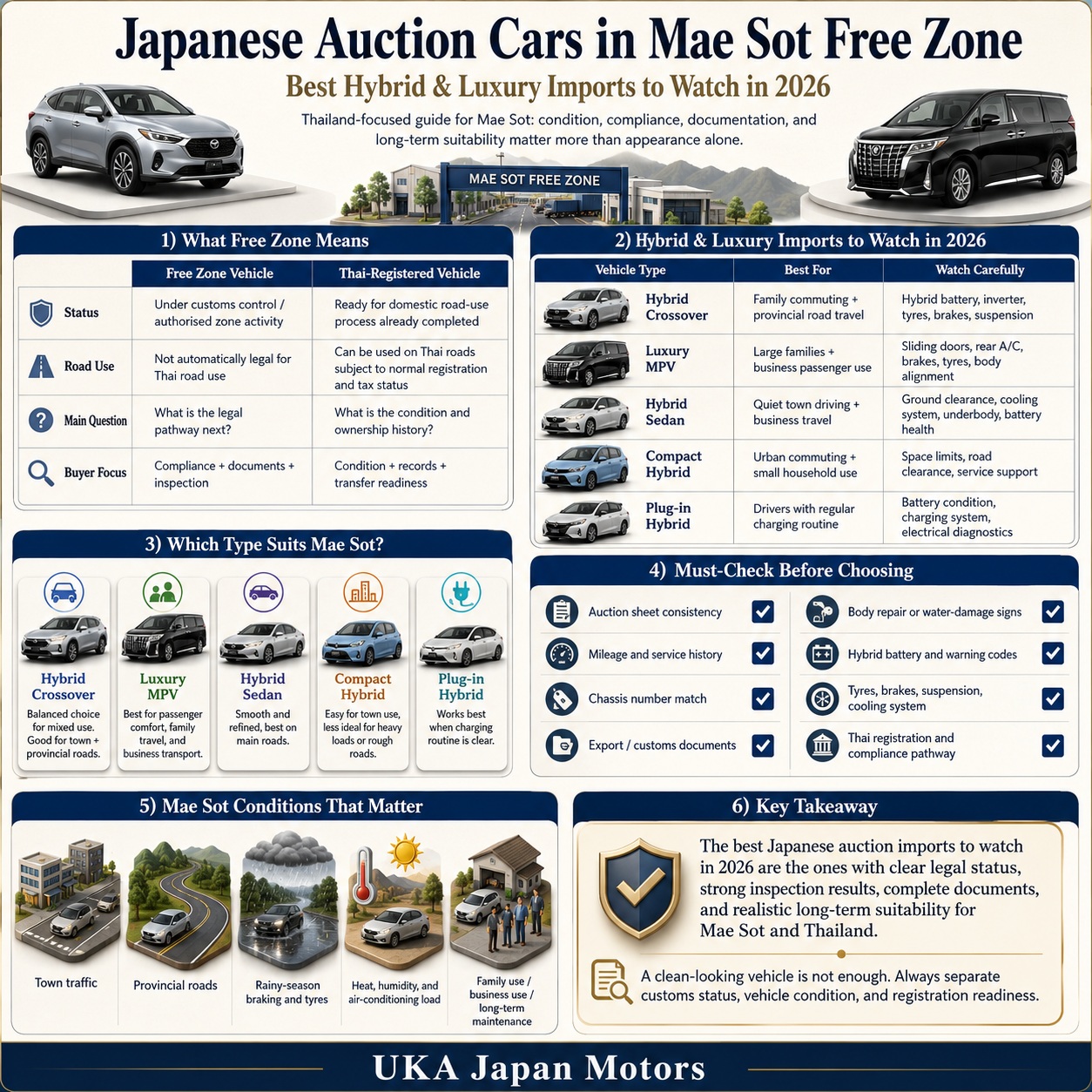
Japanese auction cars attract attention in Mae Sot because they often appear clean, well-documented, and technically interesting, especially in hybrid and luxury segments. For drivers, families, and business owners in Tak province, the idea of a Japanese auction vehicle can sound appealing: a hybrid MPV for family travel, a refined sedan for business use, a quiet crossover for daily commuting, or a luxury model with comfort features suited to long provincial journeys.
However, Japanese auction cars in the Mae Sot Free Zone require careful understanding. A Free Zone is not the same as normal Thai road registration. A vehicle being present in a customs-controlled area does not automatically mean it is ready for use on Thai roads. In 2026, the most important question is not simply which hybrid or luxury model looks attractive. The more important question is whether the vehicle has a clear legal pathway, complete documentation, transparent condition history, and realistic long-term ownership suitability in Thailand.
Mae Sot adds its own practical context. Local driving includes town traffic, border-area logistics, school and family trips, business travel, rural roads, wet-season conditions, heat, humidity, and longer routes toward Tak city or nearby provinces. A suitable vehicle for Mae Sot must be more than visually clean. It must handle daily heat, uneven road surfaces, rainy-season braking demands, cooling-system stress, tyre wear, and documentation checks.
This article explains how Japanese auction hybrid and luxury vehicles should be viewed in the Mae Sot Free Zone in 2026. It covers what the Free Zone means, why auction documentation matters, which types of hybrid and luxury imports deserve attention, when these vehicles may be suitable, when they may not be suitable, and what owners should check before thinking about registration and long-term use in Thailand.
Category: Import Policy & Regulations
Direct Answer: What Should Buyers Watch in 2026?
In 2026, the most practical Japanese auction hybrid and luxury imports to watch in Mae Sot are not simply the newest or most feature-rich models. The most suitable candidates are vehicles with clear auction documentation, consistent mileage records, strong body condition, no unclear repair history, complete export paperwork, and a realistic compliance pathway for Thailand.
Hybrid crossovers, luxury MPVs, refined hybrid sedans, and selected plug-in hybrid models may attract attention because they suit different needs in Mae Sot. A hybrid crossover may suit family commuting and provincial-road use. A luxury MPV may suit family or business passenger needs. A hybrid sedan may suit daily town driving and longer road travel. A plug-in hybrid may suit owners who understand charging habits, battery checks, and documentation requirements.
The key caution is compliance. Many Japanese auction vehicles are used vehicles. Thailand has strict rules on used vehicle importation, and a vehicle inside a Free Zone is not automatically cleared for domestic road use. Buyers should always separate three issues: customs status, vehicle condition, and Thai registration readiness. A car may look attractive at auction but still be unsuitable if the paperwork, import status, or inspection findings are unclear.
Understanding the Mae Sot Free Zone Context
The term “Mae Sot Free Zone” is often used in a general way when people talk about border trade, customs-controlled activity, and business movement around Tak province. For vehicle buyers, it is important to understand the meaning carefully. A Free Zone is connected to customs control and approved commercial activity. It is not simply a normal storage yard, showroom, or road-use area.
A Japanese auction car may be brought into a Free Zone for specific authorised purposes. This may involve storage, inspection, preparation, export-related activity, or other approved operations. But domestic use in Thailand is a separate matter. Once a vehicle is intended to leave the Free Zone for use in Thailand, documentation, customs clearance, import eligibility, excise considerations, registration readiness, and Department of Land Transport requirements all become important.
This distinction matters in Mae Sot because the town has border activity, cross-border business movement, and a mix of private and commercial vehicle needs. It is easy for buyers to focus on the vehicle itself and overlook its status. A clean auction sheet does not replace Thai import approval. A clear chassis number does not replace registration readiness. A hybrid system check does not replace customs compliance.
For anyone looking at Japanese auction vehicles around Mae Sot, the first question should be: what is the vehicle’s legal status now, and what is its intended next step? If it is held inside a Free Zone for re-export, the requirements are different from a vehicle intended for Thai road registration. If it is being discussed as a future domestic-use vehicle, the legal pathway must be checked before any ownership decision is made.
Why Japanese Auction Cars Draw Interest in Mae Sot
Japanese auction vehicles are often discussed because auction sheets usually provide structured condition information. These sheets may include overall grade, exterior notes, interior grade, mileage, equipment notes, repair indications, and visible damage markings. For hybrid and luxury models, this documentation can help identify whether the vehicle has signs of careful use or possible hidden concerns.
In Mae Sot, buyers often want vehicles that can handle mixed use. A family may need a quiet cabin, good air-conditioning, and enough space for school runs, market trips, and weekend travel. A business owner may need a comfortable vehicle for clients or regular travel between districts. A driver who spends time in town traffic may appreciate smooth hybrid operation. Someone who travels provincial roads may care more about suspension, tyres, brakes, and cooling condition.
Japanese hybrid and luxury models also tend to come with advanced equipment. This may include driver assistance systems, electric sliding doors, hybrid battery management, multi-zone air-conditioning, adaptive lighting, electronic parking systems, and advanced infotainment. These features can improve comfort, but they also increase inspection responsibility. The more complex the vehicle, the more important it becomes to check condition, software compatibility, parts support, and service knowledge in Thailand.
Auction Sheet Quality: Useful, But Not Enough
An auction sheet is helpful, but it should never be treated as the full answer. A high auction grade can indicate strong overall condition, but it does not guarantee suitability for Mae Sot roads or Thai registration. A lower grade does not automatically make a vehicle unsuitable, but it should lead to deeper checking.
The most important auction sheet details include mileage consistency, accident or repair codes, interior condition, rust notes, underbody comments, warning-light remarks, battery-related notes, and any mention of water exposure. For hybrid and luxury vehicles, buyers should pay special attention to electrical warnings, dashboard lights, air-conditioning performance, suspension noises, and body repair signs.
A vehicle marked with repair history needs careful review. For Mae Sot use, structural repair quality matters because provincial roads, wet-season potholes, and long-distance travel can expose weaknesses. Poorly repaired body sections may affect alignment, tyre wear, door sealing, water resistance, and long-term safety.
Mileage should also be checked against service records where available. Hybrid vehicles may perform well at higher mileage if maintained properly, but inconsistent records are a warning sign. A low mileage reading should still be examined against interior wear, steering-wheel condition, pedal wear, seat condition, auction history, and export documents.
Hybrid Imports to Watch in 2026
Hybrid vehicles remain relevant for Mae Sot because they can work well in town traffic and mixed-speed driving. In slow movement around town, school areas, markets, and business districts, hybrid systems can reduce engine running time and provide smooth acceleration. On provincial roads, they can also provide calm cruising when the engine, battery, transmission, and cooling system are in good condition.
Toyota and Lexus Hybrid Crossovers
Japanese auction hybrid crossovers such as Toyota Harrier Hybrid, Lexus NX Hybrid, Lexus RX Hybrid, and similar models are likely to remain closely watched in 2026. Their appeal is practical: raised seating, comfortable cabins, good air-conditioning, and road presence without the size of a large van.
For Mae Sot, a hybrid crossover may suit families or professionals who need one vehicle for town driving and longer road travel. The raised driving position helps on uneven roads, while the enclosed cabin and refined suspension can make daily driving more comfortable. However, inspection should focus on hybrid battery condition, cooling fans, inverter operation, air-conditioning strength, tyre condition, brake wear, and suspension bushings.
Luxury hybrid crossovers also need careful electronic inspection. Sensors, cameras, radar units, powered seats, tailgate systems, and infotainment features should all be tested. A vehicle with many features can be comfortable, but each feature adds long-term maintenance responsibility.
Toyota Crown Hybrid and Lexus ES Hybrid
Hybrid sedans such as Toyota Crown Hybrid and Lexus ES Hybrid attract attention because they offer quiet cabins, smooth power delivery, and comfortable seating. For Mae Sot business use, a refined sedan can be suitable for daily town driving and longer journeys on main roads. It may also suit drivers who prefer a lower seating position and stable highway feel.
The limitation is ground clearance and road condition tolerance. Compared with a crossover or MPV, a sedan may require more caution on uneven provincial roads, steep entrances, wet-season surface damage, or unpaved access roads. Buyers should inspect underbody panels, suspension arms, shock absorbers, wheel alignment, tyres, and signs of underside contact.
Hybrid sedans also need battery and cooling checks. In Mae Sot’s heat and humidity, air-conditioning load can be high. A weak cooling system, clogged hybrid battery fan, or tired auxiliary battery can create long-term inconvenience.
Compact Hybrids and Small Family Cars
Compact Japanese hybrids such as Toyota Aqua-type vehicles, Honda Fit e:HEV-type vehicles, and similar small models may interest buyers who focus on town driving. Their smaller size is useful in Mae Sot streets, parking areas, and daily commuting routes.
However, compact hybrids must be judged carefully. A smaller body may not suit large families, frequent provincial-road travel, or business use requiring passenger space. Some Japanese domestic models may also have equipment, language, navigation, or parts-support differences that need checking before long-term use in Thailand.
For Mae Sot, compact hybrids are most suitable when the buyer’s use is mostly urban, daily, and predictable. They may not be ideal for rough-road access, heavy passenger loads, or frequent long-distance travel with luggage.
Luxury Imports to Watch in 2026
Luxury imports in the Japanese auction system often attract attention because they may include high-comfort cabins, refined materials, advanced safety systems, and strong road manners. In Mae Sot, luxury vehicles may suit business owners, families needing comfort, or drivers who travel regularly between districts.
However, luxury vehicles should be approached with discipline. Comfort features are useful only when they work properly and can be maintained. A luxury vehicle with unclear service history, repaired electronics, weak air-conditioning, poor tyres, or incomplete documentation can become difficult to manage.
Toyota Alphard, Vellfire, and Lexus LM-Type MPVs
Luxury MPVs are among the most watched Japanese auction vehicles because they combine passenger comfort with practical space. For Mae Sot, this type of vehicle may suit larger families, business passenger transport, hospitality-related use, or owners who regularly travel with elders or children.
The main strength of a luxury MPV is cabin access and comfort. Sliding doors, captain seats, strong air-conditioning, and flexible seating can be useful in Thailand’s heat and daily family routines. Compared with a luxury sedan, an MPV is easier for passengers to enter and exit. Compared with a pickup, it offers a more enclosed and comfortable passenger environment.
The inspection focus should include door motors, seat motors, air-conditioning vents across all rows, rear suspension, tyres, braking system, cooling system, underbody condition, and body alignment. Larger MPVs place more load on tyres and brakes, especially in town traffic and on rainy roads. Any sign of poor repair, misaligned sliding doors, water leakage, or uneven tyre wear should be treated seriously.
Lexus RX, NX, and Similar Luxury Crossovers
Luxury crossovers offer a middle path between sedan comfort and MPV practicality. In Mae Sot, they can work well for drivers who want comfort, visibility, and easier road clearance than a sedan, without moving into a large van body.
The contrast with luxury MPVs is important. A crossover is usually easier to drive and park in town, while an MPV provides stronger passenger space. A crossover may suit a small family or professional use, while an MPV is better for multiple passengers and frequent rear-seat comfort needs.
For inspection, the same caution applies: hybrid battery health, inverter condition, air-conditioning performance, electronic systems, suspension, tyres, brakes, and body repair signs all need attention. Because these vehicles often have advanced safety systems, sensor alignment after any body repair is important.
Luxury Plug-In Hybrids
Plug-in hybrids may receive more attention in 2026 because Thailand’s policy environment continues to discuss electrified vehicle development. For Mae Sot owners, a plug-in hybrid can make sense only when charging habits, service support, battery condition, and documentation are understood clearly.
A plug-in hybrid is different from a normal hybrid. It has a larger battery and depends more on charging behavior. If a buyer cannot charge regularly or does not understand battery inspection, a normal hybrid may be simpler for long-term use. In Mae Sot, a plug-in hybrid may suit a driver with predictable daily routes, reliable home or workplace charging, and access to competent inspection support.
Inspection should include the high-voltage battery, charging port, charging cable compatibility, onboard charger, cooling system, warning lights, and service history. The vehicle should also be checked for flood exposure, underbody damage, and electrical repairs.
Hybrid vs Petrol vs Battery Electric for Mae Sot
A useful comparison in Mae Sot is hybrid versus petrol versus battery electric. Each type has strengths, and none is automatically suitable for every owner.
A petrol vehicle is familiar, widely understood, and usually straightforward to inspect. It may suit drivers who want mechanical simplicity and broad service familiarity. However, town driving in heat and slow traffic can place stress on the cooling system, fuel system, and transmission, especially if maintenance has been inconsistent.
A hybrid vehicle can be smooth and efficient in mixed driving, especially in town traffic. It suits daily commuting, family use, and drivers who want quiet operation without depending entirely on external charging. The trade-off is that hybrid battery condition, inverter health, cooling fans, and electronic diagnostics must be checked carefully.
A battery electric vehicle can be quiet and mechanically simple in some ways, but ownership depends more heavily on charging routines, battery management, software, and service access. For some Mae Sot drivers, especially those with predictable routes and charging access, it may be practical. For others who travel unexpectedly, use rural roads, or lack reliable charging options, a hybrid may feel more flexible.
For Japanese auction vehicles, the hybrid category often creates the most balanced discussion, but only when the legal pathway and documentation are clear.
Free Zone Vehicle vs Thai-Registered Vehicle
One of the most important contrasts is between a vehicle held in a Free Zone and a vehicle already registered in Thailand.
A Free Zone vehicle may still be under customs control. It may be present for authorised activity, storage, preparation, or re-export. It may not yet be cleared for Thai domestic road use. Its future depends on import eligibility, customs process, supporting documents, and compliance checks.
A Thai-registered vehicle has already passed through a road-use registration process. It has a registration book, Thai plate history, tax record, ownership transfer pathway, and Department of Land Transport record. Inspection still matters, but the compliance situation is different.
For buyers in Mae Sot, this distinction should be clear before any serious decision. A Free Zone vehicle should not be viewed in the same way as a Thai-registered used car. It may be interesting as stock, inspection subject, export-related inventory, or future candidate only if the legal pathway is confirmed. Without clear status, the vehicle should remain a compliance question, not an ownership decision.
Documentation That Should Be Reviewed
Documentation is central to Japanese auction vehicles. A clean body and attractive equipment list are not enough. The paperwork must support the vehicle’s history and intended use.
Important documents may include the Japanese auction sheet, export certificate or deregistration-related paperwork, chassis number record, ownership trail, invoice or purchase evidence, shipping documents, customs declarations where applicable, Free Zone entry records, and any documents required for the intended next step.
For Thailand road registration, the documentation discussion becomes more serious. Customs clearance, import eligibility, excise handling, technical compliance, Department of Land Transport requirements, compulsory insurance, and ownership documents all need proper review. The exact requirements depend on the vehicle’s status and pathway.
Buyers should be cautious if documents are incomplete, inconsistent, translated poorly, or unavailable for review. In Mae Sot, where border activity can involve different types of vehicle movement, document clarity is especially important. The vehicle’s chassis number, engine number where relevant, model code, year, fuel type, and ownership trail should match across records.
Inspection Priorities for Hybrid and Luxury Auction Cars
A proper inspection should cover more than exterior appearance. For Mae Sot use, the inspection should be practical and local.
The body should be checked for accident repair, panel alignment, paint differences, rust, water marks, and underbody damage. Rainy-season driving makes water sealing important. Door rubbers, boot seals, floor carpets, and electronic modules should be checked for moisture signs.
The engine should start smoothly, idle correctly, and show no overheating behavior. Cooling-system condition is critical in Thailand’s heat. Radiator, fans, hoses, coolant condition, water pump behavior, and warning lights should all be inspected.
The hybrid system requires diagnostic scanning. Battery state, cell balance where readable, inverter condition, cooling fan operation, auxiliary battery condition, and warning codes should be checked. Hybrid systems can be reliable, but poor inspection can miss early warnings.
The transmission should be smooth and free from abnormal noise. Brakes should be checked carefully because hybrid regenerative braking can hide friction-brake wear until a closer inspection is done. Tyres should be assessed for age, tread condition, cracking, uneven wear, and suitability for rainy roads.
Luxury equipment should be tested one function at a time. Powered doors, seats, sunroof, air-conditioning zones, cameras, parking sensors, radar systems, screens, audio systems, and lighting should all work properly. A single non-working feature may indicate simple wear, but multiple electronic issues may suggest deeper problems.
Mae Sot Road and Climate Suitability
Mae Sot’s driving environment places real demands on vehicles. Town traffic can involve slow movement, frequent braking, motorcycles, delivery vehicles, school traffic, and tight parking. Provincial roads can include higher speeds, uneven surfaces, wet-season potholes, and changing visibility. Heat and humidity affect rubber parts, batteries, air-conditioning systems, tyres, and cooling systems.
For hybrids, heat management is important. Hybrid battery cooling fans should not be blocked by dust, pet hair, or interior debris. Air-conditioning performance should be strong because cabin cooling can indirectly affect battery cooling in some vehicles. The auxiliary battery should also be checked because weak low-voltage power can trigger confusing electronic issues.
For luxury vehicles, suspension and tyres matter. A comfortable ride depends on well-maintained dampers, bushings, alignment, and tyre quality. Large wheels may look attractive, but they can be more sensitive to road impacts. In Mae Sot, practical tyre condition is more important than appearance.
For MPVs, braking and air-conditioning should receive special attention. Carrying passengers in hot weather places extra load on the system. Rear air-conditioning must be checked properly, not assumed to work because the front vents feel cold.
Which Vehicles Suit Which Owners?
A hybrid crossover may suit a Mae Sot family that needs town comfort, provincial-road ability, and flexible luggage space. It is a balanced choice for mixed driving when the vehicle condition and documentation are clear.
A luxury MPV may suit larger families, business passenger use, or owners who regularly travel with elders, children, or clients. It is stronger for comfort and space but requires more careful inspection of doors, suspension, brakes, tyres, and air-conditioning.
A hybrid sedan may suit a professional driver or small family that mostly uses main roads and wants quiet comfort. It may not be ideal for rough access roads or frequent heavy passenger loads.
A compact hybrid may suit daily town use, solo commuting, or small-family errands. It may not suit drivers who need larger cargo space, strong road clearance, or regular longer trips with passengers.
A plug-in hybrid may suit an owner who has a clear charging routine and understands battery inspection. It may not suit someone who wants the simplest possible ownership experience.
When a Japanese Auction Hybrid or Luxury Import May Not Be Suitable
A Japanese auction vehicle may not be suitable if its legal pathway is unclear. This is the first and most important concern. If the vehicle cannot be clearly explained in terms of customs status, import eligibility, and registration possibility, it should not be treated as ready for ownership in Thailand.
It may also be unsuitable if the auction sheet shows repair history that cannot be properly verified. Structural repairs, water exposure, unclear mileage, missing documents, or conflicting records should raise caution.
Hybrid and luxury vehicles may not be suitable for buyers who want very simple maintenance. These vehicles can be dependable, but they require proper diagnostic tools, knowledgeable inspection, and attention to electrical systems. A buyer who does not want to monitor battery condition, software issues, advanced safety systems, or air-conditioning complexity may be better served by a simpler vehicle type.
Some models may also be unsuitable if parts support is uncertain. Japanese domestic models can include equipment that differs from Thai-market versions. Before considering any vehicle, owners should ask whether normal service items, body parts, electronic components, batteries, and diagnostic support are realistically available in Thailand.
Long-Term Ownership Considerations in Mae Sot
Long-term ownership should be considered before the vehicle is selected. The right question is not only whether the vehicle looks good today. It is whether the vehicle can be maintained clearly and responsibly over several years of Thai road use.
For hybrid vehicles, long-term care includes battery cooling, regular diagnostic checks, auxiliary battery replacement awareness, brake-system checks, inverter cooling, and proper air-conditioning maintenance. Drivers should avoid ignoring warning lights, even if the vehicle still drives normally.
For luxury vehicles, owners should plan for consistent maintenance of electronic systems, suspension, tyres, interior features, and climate control. A luxury cabin is useful in Mae Sot heat only if the cooling system is strong and all vents work properly.
For family use, space, seat comfort, child access, luggage needs, and rainy-season safety matter. For business use, reliability, clean documentation, passenger comfort, and predictable servicing matter. For provincial-road use, tyres, brakes, lights, suspension, and cooling system condition matter more than optional features.
Seasonal checks are especially important. Before the rainy season, tyres, wipers, brakes, lights, seals, and underbody condition should be checked. Before long hot-season travel, coolant, fans, belts, batteries, and air-conditioning should be inspected. A vehicle that is suitable for Mae Sot should be prepared for both seasons.
Compliance Awareness in 2026
In 2026, compliance awareness is central to any discussion about Japanese auction cars in the Mae Sot Free Zone. Thailand’s treatment of used vehicle imports is strict, and Free Zone status does not remove the need for proper customs and registration processes when a vehicle is intended for domestic use.
Buyers should be careful with any claim that sounds too simple. A vehicle being in Mae Sot does not mean it can automatically receive Thai plates. A vehicle being a hybrid does not automatically make it eligible. A vehicle being from a Japanese auction does not automatically make the documents sufficient. Each step needs confirmation.
The safest approach is to view Japanese auction vehicles through three layers. First, confirm legal status. Second, inspect physical and technical condition. Third, review long-term ownership practicality. If any one layer is weak, the vehicle may not be suitable.
Practical Checklist Before Considering a Vehicle
Before considering any Japanese auction hybrid or luxury vehicle in or around the Mae Sot Free Zone, buyers should review the following points.
Confirm the vehicle’s current customs status and intended pathway. Ask whether it is held for Free Zone activity, re-export, or possible domestic registration. Do not rely on verbal explanations alone.
Review the auction sheet and translated notes. Pay attention to repair marks, mileage, warning-light comments, rust, corrosion, water signs, and interior grade.
Match the chassis number across documents and the vehicle body. Any mismatch must be resolved before further discussion.
Check export and customs-related paperwork. The document trail should be clear, consistent, and suitable for the intended next step.
Inspect the vehicle physically. Focus on body structure, underbody, tyres, brakes, suspension, cooling system, hybrid system, battery cooling, air-conditioning, and electronics.
Check service support in Thailand. Ask whether key parts, diagnostic tools, hybrid battery knowledge, and model-specific maintenance support are realistic.
Consider Mae Sot use. Think about town driving, family needs, business use, rainy-season roads, heat, parking, passenger comfort, and long-distance travel.
Avoid assuming that luxury equipment equals better suitability. A simpler, cleaner, better-documented vehicle may be more practical than a feature-rich vehicle with unclear history.
Internal Reading Connections
This topic connects naturally with broader guidance on Thai vehicle registration documents, hybrid battery inspection in Thailand’s climate, and how to read Japanese auction sheets before making an ownership decision. A supporting article on hybrid versus petrol ownership in Mae Sot can also help readers compare vehicle types by daily use rather than appearance.
FAQ: Japanese Auction Cars in Mae Sot Free Zone
1. Can a Japanese auction car in the Mae Sot Free Zone be driven normally in Thailand?
Not automatically. A vehicle in a Free Zone may still be under customs control. Normal Thai road use depends on import eligibility, customs clearance, registration readiness, and Department of Land Transport requirements.
2. Are hybrid Japanese auction cars suitable for Mae Sot?
They can be suitable when documentation is clear and the hybrid system is properly inspected. Mae Sot town driving can suit hybrid operation, but heat, humidity, battery cooling, air-conditioning, and service support must be checked carefully.
3. What is the most important document for a Japanese auction car?
There is no single document that answers everything. The auction sheet is important for condition history, but export documents, customs records, chassis number consistency, and registration-related paperwork are also essential.
4. Is a high auction grade enough to trust the vehicle?
No. A high auction grade is useful, but it does not replace physical inspection, diagnostic scanning, documentation review, or Thai compliance checks. The vehicle still needs local suitability assessment.
5. Which is more practical in Mae Sot: a hybrid crossover or a luxury MPV?
A hybrid crossover is usually easier to drive and park in town, while a luxury MPV offers stronger passenger comfort and space. Families or business users carrying several passengers may prefer an MPV, while smaller households may find a crossover more manageable.
6. Are plug-in hybrids a good choice for Mae Sot?
A plug-in hybrid may suit an owner with a reliable charging routine and proper battery inspection support. Without regular charging access or clear service knowledge, a normal hybrid may be easier to manage.
7. What should be checked first on a luxury Japanese auction vehicle?
Documentation and legal status should be checked first. After that, inspect body condition, repair history, suspension, tyres, brakes, air-conditioning, electronic features, and diagnostic fault codes.
8. Why is rainy-season inspection important?
Rainy-season roads in Mae Sot can expose weak tyres, poor brakes, worn wipers, water leaks, damaged underbody parts, and suspension issues. Vehicles should be inspected for wet-road readiness before regular use.
9. Can Japanese domestic models be difficult to maintain in Thailand?
Some can be more complex if parts, software, language settings, or model-specific systems differ from Thai-market vehicles. Before considering one, check whether service support and parts access are realistic.
10. What makes a vehicle inspection-ready for Thai ownership?
An inspection-ready vehicle has consistent documents, matching chassis details, clear registration or import pathway, sound body structure, healthy tyres and brakes, good cooling performance, no unresolved warning lights, and complete ownership records.
UKA Japan Motors Thailand – Mae Sot: Trust-Based Guidance
UKA Japan Motors Thailand – Mae Sot approaches Japanese auction vehicles with an inspection-focused and compliance-aware mindset. The role is not to pressure buyers toward a vehicle, but to help them understand condition, documentation, registration readiness, and long-term ownership suitability.
For hybrid and luxury imports, this means looking beyond appearance. UKA Japan Motors focuses on auction sheet interpretation, mileage awareness, body condition, repair signs, tyres, brakes, suspension, cooling system, air-conditioning, hybrid system indicators, and electronic features. Documentation is treated as part of the vehicle’s condition because unclear paperwork can affect ownership as much as mechanical problems.
In the Mae Sot context, guidance also includes practical road-use awareness. A vehicle should suit town driving, family routines, business use, rainy-season roads, heat, humidity, and provincial travel. A clean-looking import is not automatically the right vehicle if it lacks clear documents, realistic service support, or road-use suitability.
UKA Japan Motors’ role is to support transparent communication, inspection guidance, registration understanding, and compliance awareness so that buyers can make informed decisions with confidence and caution.
Neutral Expert Conclusion
Japanese auction cars in the Mae Sot Free Zone deserve careful attention in 2026, especially in hybrid and luxury segments. Hybrid crossovers, luxury MPVs, refined hybrid sedans, compact hybrids, and selected plug-in hybrids may all be worth watching, but only when their legal status, documentation, inspection results, and long-term ownership suitability are clear.
For Mae Sot drivers, the right vehicle must suit more than personal preference. It should handle town traffic, provincial roads, rainy-season conditions, heat, humidity, family or business needs, and realistic maintenance support in Thailand. A Free Zone location should be understood as a customs and compliance matter, not as automatic road-use approval.
The most responsible approach is to review every vehicle in three stages: legal pathway, technical condition, and ownership practicality. When these areas are checked carefully, Japanese auction hybrid and luxury vehicles can be assessed with clarity rather than assumption.
Contact UKA Japan Motors for availability and inspection guidance.