


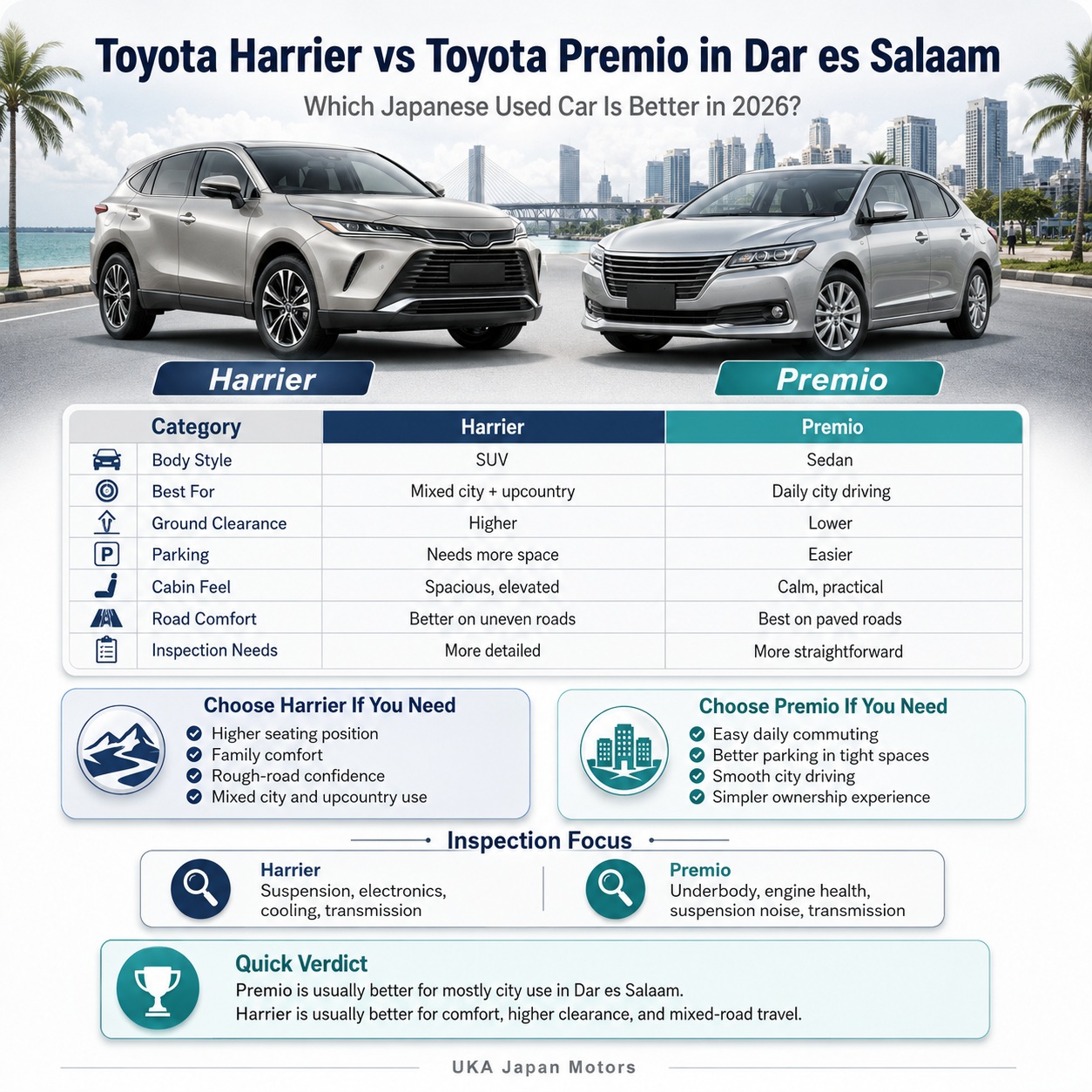
For many Dar es Salaam buyers, the Toyota Harrier and Toyota Premio represent two different ideas of a dependable Japanese used car. The Harrier is often viewed as a comfortable, higher-riding SUV-style vehicle with a more premium feel. The Premio is known as a refined sedan that suits daily movement, office use, family errands, and predictable city driving.
In 2026, the question is not simply which model is “better.” The better question is: which one fits the way a driver actually uses a car in Dar es Salaam?
Dar es Salaam has a mixed driving environment. A car may spend the morning in slow traffic around business areas, pass over rough patches after rain, carry family members in the evening, and occasionally travel toward Morogoro or Dodoma. Because of this, buyers need to consider more than appearance. Ground clearance, cabin comfort, fuel behaviour, engine condition, suspension durability, body size, cooling performance, inspection history, and documentation all matter.
The Toyota Harrier and Toyota Premio can both be strong choices, but they serve different ownership needs. The Harrier suits buyers who want comfort, road presence, cabin space, and easier movement over uneven roads. The Premio suits buyers who prefer a lighter, simpler sedan with calm handling, easier parking, and practical daily use in Dar es Salaam traffic.
This comparison explains the differences clearly so buyers can make a more informed decision before committing to a Japanese used car in 2026.
Direct Answer: Which Is Better for Dar es Salaam in 2026?
The Toyota Premio is usually the more practical choice for Dar es Salaam buyers who mainly drive within the city, value easy handling, prefer sedan comfort, and want a car that feels simple to manage every day.
The Toyota Harrier is usually the better choice for buyers who want a higher seating position, more cabin presence, stronger comfort on uneven surfaces, and a vehicle that feels more suitable for mixed city and upcountry use.
In simple terms:
| Buyer Priority | Better Fit |
|---|---|
| Daily office movement in Dar es Salaam | Toyota Premio |
| Higher ground clearance | Toyota Harrier |
| Easier parking and tighter movement | Toyota Premio |
| More commanding road presence | Toyota Harrier |
| Calm sedan comfort | Toyota Premio |
| More SUV-like comfort | Toyota Harrier |
| Family use with more cabin height | Toyota Harrier |
| Lower ownership complexity | Toyota Premio |
| Mixed city and upcountry travel | Toyota Harrier |
| Simpler inspection focus | Toyota Premio |
The Premio is not automatically weaker because it is a sedan, and the Harrier is not automatically better because it has a higher body. The right decision depends on the driver’s route, family needs, parking space, road exposure, and willingness to inspect more components before purchase.
Why This Comparison Matters in Dar es Salaam
Dar es Salaam driving places special demands on used vehicles. Traffic can be slow and stop-start, especially during peak hours. Heat affects cooling systems, batteries, engine mounts, rubber seals, interior materials, and air-conditioning performance. Roads may be smooth in some areas and rough or uneven in others. Rain can expose weaknesses in tyres, suspension, seals, wipers, and electrical systems.
A buyer comparing a Harrier and a Premio must therefore think beyond the showroom impression. A car that feels attractive during a short viewing may behave differently after several months of daily use.
The Harrier and Premio also attract different types of owners. Harrier buyers often care about comfort, height, image, and a stronger presence on the road. Premio buyers often care about easy driving, calm design, predictable maintenance, and suitability for city routines.
In Dar es Salaam, a vehicle is not judged only by how it looks. It must handle heat, traffic, potholes, parking limits, service access, and long idle periods without becoming difficult to live with. That is why this comparison should focus on practical ownership rather than emotion alone.
Toyota Harrier: What It Offers Dar es Salaam Buyers
The Toyota Harrier is a mid-size SUV-style vehicle known for comfort, cabin refinement, and a higher driving position. It appeals to buyers who want a car that feels more substantial than a sedan without moving into a large utility vehicle category.
In Dar es Salaam, the Harrier’s higher seating position is one of its strongest practical advantages. It gives the driver better visibility in traffic and a more confident view of road conditions ahead. When moving through uneven sections, rough access roads, or areas affected by rain, the Harrier feels more forgiving than many sedans.
The cabin also gives a stronger comfort impression. Passengers sit higher, entry and exit are easier for many people, and the vehicle feels composed during longer drives. For families, professionals, and buyers who frequently carry passengers, this can make a noticeable difference.
However, the Harrier also requires careful inspection. Because it has a larger body, more complex comfort features, and a heavier structure than the Premio, buyers should pay close attention to suspension condition, engine mounts, transmission smoothness, steering components, electronic features, air-conditioning performance, and tyre wear patterns.
A Harrier that has been well inspected can be a comfortable long-term vehicle. A Harrier chosen mainly for appearance, without proper mechanical and documentation review, can become demanding to maintain.
Toyota Premio: What It Offers Dar es Salaam Buyers
The Toyota Premio is a refined sedan that has earned a strong reputation among Dar es Salaam drivers because it is easy to use, comfortable enough for family or professional needs, and well suited to daily city movement.
Its strength lies in balance. It is not too large for urban parking, not difficult to manoeuvre in traffic, and not overly complex for regular servicing. The Premio’s sedan layout makes it stable on paved roads, calm at moderate speed, and comfortable for passengers who prefer a traditional car feel.
For drivers who move between home, office, school runs, shops, and regular city appointments, the Premio fits naturally. It does not demand the same space awareness as the Harrier, and its lower body can feel easier to place in tight parking areas.
The Premio also appeals to buyers who want a clean, mature design without an overly sporty or aggressive appearance. It suits owners who prefer quiet reliability, practical cabin space, and a predictable ownership experience.
Its main limitation is ground clearance. Dar es Salaam roads are mixed, and some access roads, raised entrances, rough compounds, and rainy-season patches may require extra care. A Premio can manage city life well, but it is less forgiving than a Harrier when road conditions become uneven.
Body Style and Road Presence
The Harrier and Premio differ most clearly in body style. The Harrier has an SUV-like structure with a higher stance. The Premio has a sedan structure with a lower centre of gravity and a more compact road feel.
For Dar es Salaam buyers, this difference affects daily confidence. The Harrier feels more visible and more commanding in traffic. Drivers can see over smaller cars more easily and approach uneven surfaces with less concern. The Premio feels more settled and easier to guide through crowded lanes, narrow entrances, and tight parking spaces.
| Area of Difference | Toyota Harrier | Toyota Premio |
|---|---|---|
| Seating position | Higher and more commanding | Lower and more sedan-like |
| Parking feel | Needs more space awareness | Easier in tighter areas |
| Road confidence | Strong on uneven surfaces | Strong on smoother city roads |
| Visual presence | More noticeable | More understated |
| Driver feel | SUV-like comfort | Sedan-like calmness |
A buyer who spends more time on rough access roads may appreciate the Harrier. A buyer who spends more time in central traffic and compact parking areas may find the Premio easier to live with.
Comfort in Dar es Salaam Traffic
Comfort matters in Dar es Salaam because many drivers spend long periods in slow-moving traffic. A vehicle’s seat support, air-conditioning, cabin insulation, visibility, and driving posture can affect daily fatigue.
The Harrier generally gives a more relaxed seating position. Its cabin feels taller, and passengers may enjoy better entry and exit. The higher body also helps when the driver needs to observe traffic movement ahead.
The Premio provides a different type of comfort. It feels quieter in a simple, sedan-like way and is easy to control at low speeds. Steering inputs are usually light, and the vehicle does not feel bulky in traffic. For daily office movement, this calmness can be more useful than extra size.
When inspecting either model, buyers should not judge comfort only by the seat condition. They should check air-conditioning strength at idle, dashboard warning lights, seat adjustment mechanisms, window operation, cabin odours, interior water stains, and sun damage. Dar es Salaam heat can reveal weaknesses that may not be obvious during a short viewing.
Fuel Behaviour and Daily Use
Fuel behaviour is a major practical difference, but it should be understood carefully. The Premio is generally the lighter and more sedan-focused vehicle, so it normally suits city movement where traffic is slow and trips are repetitive. The Harrier is larger and heavier, so buyers should expect a different fuel behaviour pattern.
This does not mean the Harrier is unsuitable for Dar es Salaam. It means the buyer must match the vehicle to the use case. A driver who values height, comfort, and space may accept the Harrier’s stronger ownership demands. A driver who mainly wants efficient city movement may prefer the Premio.
Driving habits also matter. Sudden acceleration, poor tyre pressure, weak oxygen sensors, dirty air filters, worn spark plugs, and poor wheel alignment can affect both models. In traffic-heavy areas, even a normally efficient vehicle can perform poorly if maintenance is neglected.
For a 2026 buyer, the best approach is to inspect the actual unit rather than rely only on the model name. A clean Premio with poor maintenance history may be less pleasant than a properly inspected Harrier. Likewise, a neglected Harrier may not deliver the comfort buyers expect.
Engine and Transmission Considerations
Both the Toyota Harrier and Toyota Premio can be found with different engine types depending on model year and trim. The exact engine should always be checked from the vehicle documents, chassis details, and physical inspection.
The Premio is often preferred by buyers who want a simpler sedan experience. Its engine bay is generally easier to understand, and many service points are familiar to technicians who handle Toyota sedans in Dar es Salaam.
The Harrier may offer stronger comfort and performance feel, but buyers should inspect more carefully because the vehicle’s size and feature level can place greater demands on the drivetrain. Transmission smoothness is especially important. During a road test, the car should move smoothly from standstill, change gears without harsh delay, and avoid vibration when slowing down.
Important checks for both models include:
| Inspection Area | Why It Matters |
|---|---|
| Cold start behaviour | Reveals engine condition before it is warmed up |
| Idle stability | Shows possible sensor, mount, or fuel system issues |
| Transmission response | Helps identify slipping, hesitation, or harsh shifts |
| Engine mounts | Important in stop-start traffic |
| Cooling system | Critical in Dar es Salaam heat |
| Exhaust smoke | Can indicate internal engine wear |
| Warning lights | Must not be ignored or cleared without diagnosis |
A clean dashboard alone is not proof of a clean vehicle. Proper diagnostic scanning and physical inspection are important before final acceptance.
Suspension and Ground Clearance
This is one of the strongest comparison points.
The Harrier has a clear advantage in ground clearance and rough-road confidence. In Dar es Salaam, this can matter when passing over uneven road edges, raised entrances, road repairs, water-damaged sections, or unpaved access routes.
The Premio, being a sedan, requires more careful driving in such conditions. It can still serve well in Dar es Salaam, but the driver must be more aware of approach angles, speed bumps, and loaded passenger weight.
However, the Harrier’s advantage comes with a wider inspection responsibility. SUV-style vehicles often place more load on suspension components. Buyers should check shock absorbers, control arm bushes, ball joints, stabilizer links, steering rack condition, tyre wear, and underbody marks.
The Premio’s suspension is generally simpler in feel, but it is not immune to wear. A sedan that has been driven carelessly on rough roads may show noise, uneven tyre wear, or poor alignment.
| Suspension Factor | Harrier | Premio |
|---|---|---|
| Uneven road confidence | Stronger | Moderate |
| Speed bump comfort | Better when suspension is healthy | Good with careful driving |
| Component inspection needs | More detailed | More straightforward |
| Underbody risk | Lower than many sedans | Higher if driven carelessly |
| Best use | Mixed roads | Mainly paved city routes |
For buyers living in areas with rougher access roads, the Harrier may feel more reassuring. For buyers whose routes are mostly paved, the Premio remains very practical.
Cabin Space and Family Suitability
The Harrier offers a more spacious and elevated cabin experience. Families may appreciate the higher seating, wider feel, and easier loading of luggage. The rear area can feel more flexible for weekend movement, airport pickups, family errands, or travel toward Morogoro or Dodoma.
The Premio provides good sedan space but in a more traditional layout. It suits small families, professionals, and drivers who do not need SUV-style cargo flexibility. Its boot is practical for everyday luggage, documents, shopping, and school items, but it does not offer the same vertical loading advantage as the Harrier.
Passenger comfort also depends on seat condition, interior cleanliness, air-conditioning vents, door seals, and suspension health. A Harrier with worn suspension may feel less comfortable than a well-kept Premio. A Premio with a clean interior and stable ride may serve a family very well if the routes are mostly urban.
The right question is not only “Which has more space?” The better question is “What kind of space do I need?” If height, loading flexibility, and rear passenger comfort are priorities, the Harrier has the advantage. If everyday cabin practicality and easy city handling matter more, the Premio is a strong match.
Parking and Manoeuvring in Dar es Salaam
Dar es Salaam parking can be tight, especially around offices, shops, residential compounds, and busy commercial areas. This is where the Premio often feels easier.
The Premio’s sedan size gives the driver more confidence in narrow spaces. It is easier to judge in tight parking areas and less demanding when turning in confined spaces. For drivers who regularly park in busy compounds or move through narrow internal roads, this matters.
The Harrier requires more awareness. Its higher body and larger presence can feel comfortable on open roads but needs careful attention in tight spaces. Parking sensors, mirrors, cameras, and steering response should all be checked before purchase.
A buyer choosing the Harrier should inspect reverse camera clarity, side mirror folding, parking sensor function, steering smoothness, and bumper condition. A buyer choosing the Premio should still check visibility, mirror adjustment, and body alignment, especially if the car has previous repair signs.
For a new owner in Dar es Salaam, ease of daily parking can affect long-term satisfaction more than expected.
Inspection and Compliance Before Import or Purchase
For both the Toyota Harrier and Toyota Premio, inspection and compliance are essential. A Japanese used car should not be judged by photos, mileage display, or interior cleanliness alone.
Before a vehicle enters Tanzania, buyers should pay attention to roadworthiness inspection, documentation, chassis identity, export details, and import clearance requirements. Once the vehicle is in Dar es Salaam, registration and ownership records must also be reviewed carefully.
Important documentation and compliance areas include:
| Area | What to Check |
|---|---|
| Chassis number | Must match documents and physical vehicle identity |
| Year of manufacture | Important for import classification and compliance review |
| Roadworthiness status | Confirms inspection before shipment where applicable |
| Import documents | Must be complete and consistent |
| Clearing process | Should follow the proper customs procedure |
| Registration details | Must match the vehicle after clearance |
| Engine details | Should align with records and physical inspection |
| Ownership transfer | Must be properly documented |
For the Harrier, inspection should be especially careful around suspension, electronics, transmission, cooling, power features, and underbody condition. For the Premio, inspection should focus on engine health, transmission smoothness, suspension noise, body repair quality, interior condition, and ground-clearance-related underbody marks.
A compliant car is not only easier to register and use. It also gives the buyer more confidence that the vehicle’s identity and condition have been checked properly.
Long-Term Ownership in Dar es Salaam
Long-term ownership depends on matching the vehicle to the driver’s real life.
A Harrier owner should be ready for a vehicle that delivers comfort, presence, height, and flexibility. It may feel more satisfying for families, professionals who prefer a more elevated cabin, and drivers who move beyond smooth city roads. However, it should be inspected carefully because comfort features and suspension components play a major role in the ownership experience.
A Premio owner should expect a calmer sedan experience. It is easy to drive, easy to park, and well suited to routine movement. It may not offer the same commanding position as the Harrier, but it can feel more natural for daily Dar es Salaam driving.
In both cases, long-term satisfaction depends on regular servicing, quality parts, proper tyres, clean fluids, cooling system care, and timely inspection. Delayed maintenance can affect either model.
A buyer should also think about who will drive the car. If the vehicle will be shared among family members, the Premio may be easier for different drivers to manage. If the main driver values height and comfort, the Harrier may feel more suitable.
When the Toyota Harrier Makes More Sense
The Toyota Harrier is a better match when the buyer wants:
A higher seating position for better visibility in traffic.
More comfort on uneven roads and raised entrances.
A more spacious cabin feel for family use.
More confidence during mixed city and upcountry travel.
A vehicle that feels more substantial and refined.
The Harrier is also suitable for drivers who frequently carry passengers, travel with luggage, or move through areas where road surfaces are not always predictable. It works well for buyers who want a car that feels composed in different environments, not only on smooth city roads.
However, the Harrier may not be ideal for a buyer who wants the simplest possible daily sedan experience, parks in very tight areas, or wants a lighter vehicle feel. It also requires a more detailed inspection before purchase because more comfort features and suspension components must be checked.
When the Toyota Premio Makes More Sense
The Toyota Premio is a better match when the buyer wants:
A practical sedan for everyday Dar es Salaam movement.
Easier parking and manoeuvring.
A calm driving feel in traffic.
A simpler ownership experience.
A mature design suitable for professional and family use.
The Premio is particularly suitable for office users, small families, and drivers whose routes are mostly paved. It works well for regular city schedules, including commuting, errands, school movement, and business appointments.
However, the Premio may not be ideal for drivers who regularly face rough access roads, need higher ground clearance, carry heavier loads, or prefer a more commanding seating position. It can manage Dar es Salaam well, but it asks the driver to be more careful on uneven roads.
Harrier vs Premio: Practical Dar es Salaam Decision Table
| Buyer Situation | Recommended Choice | Reason |
|---|---|---|
| Mostly city traffic and office parking | Toyota Premio | Easier to drive and park daily |
| Frequent uneven roads | Toyota Harrier | Better ground clearance and road confidence |
| Family comfort with more cabin height | Toyota Harrier | More spacious and elevated feel |
| First-time Japanese used car buyer | Toyota Premio | Simpler to understand and manage |
| Mixed city and upcountry use | Toyota Harrier | More suitable for varied road conditions |
| Tight residential parking | Toyota Premio | More compact sedan feel |
| Driver wants stronger road presence | Toyota Harrier | Higher stance and more noticeable body |
| Driver prefers quiet understated design | Toyota Premio | Mature sedan character |
This table should guide the decision, but the final choice should always depend on the condition of the actual unit. A well-inspected Premio is better than a neglected Harrier. A properly documented Harrier is better than a Premio with unclear history. The model name matters, but condition matters more.
Common Mistakes Buyers Should Avoid
One common mistake is choosing the Harrier only because it looks more premium. A larger, more comfortable vehicle still needs careful inspection. Buyers should not ignore suspension wear, electronic faults, engine vibration, or transmission behaviour.
Another mistake is assuming the Premio is always the safer choice because it is a sedan. A Premio with poor maintenance history, accident repairs, overheating signs, or weak transmission response can create ownership problems.
A third mistake is focusing only on mileage. Mileage should be considered, but it must be compared with service history, interior wear, steering condition, pedal wear, engine response, and documentation. An odometer reading alone does not tell the full story.
Buyers should also avoid rushing the import or purchase process without checking roadworthiness, chassis identity, age classification, import documents, and registration requirements. Compliance protects the buyer from avoidable confusion after the vehicle arrives or changes ownership.
Internal Reading Connections
For buyers still deciding between vehicle categories, this comparison connects naturally with a broader guide on choosing Japanese used cars for Dar es Salaam driving. It also supports future articles on Toyota SUV ownership, sedan buying checks, import inspection procedures, and how road conditions affect suspension life in Tanzania.
A Harrier buyer may also benefit from reading a guide on inspecting used Japanese SUVs before import. A Premio buyer may benefit from a guide on choosing reliable sedans for daily Dar es Salaam use. Buyers comparing fuel behaviour should also review educational content on how traffic, tyres, servicing, and engine condition affect fuel use.
These connected topics help buyers understand not only which vehicle to choose, but how to inspect, own, and maintain it responsibly.
UKA Japan Motors’ Role in This Decision
UKA Japan Motors’ role is not to push one model over the other. The more useful role is to help buyers understand condition, suitability, inspection findings, and compliance details before making a decision.
For a Toyota Harrier, UKA Japan Motors can guide buyers on areas such as suspension condition, underbody checks, engine and transmission behaviour, electronic features, roadworthiness documentation, and whether the vehicle suits Dar es Salaam and occasional upcountry use.
For a Toyota Premio, UKA Japan Motors can guide buyers on body condition, engine health, transmission response, interior wear, ground-clearance considerations, documentation consistency, and whether the vehicle suits daily city driving.
The goal is transparency. A buyer should know why a specific unit is suitable, what has been inspected, what documents support it, and what ownership expectations are realistic. This approach is especially important in 2026 because buyers are more informed and expect clearer guidance before choosing a Japanese used car.
FAQ: Toyota Harrier vs Toyota Premio in Dar es Salaam
1. Is the Toyota Harrier better than the Toyota Premio for Dar es Salaam?
The Toyota Harrier is better for buyers who want higher ground clearance, more cabin height, and stronger comfort on uneven roads. The Toyota Premio is better for buyers who mainly drive in city traffic and want easier parking and sedan simplicity.
2. Which car is easier to drive in Dar es Salaam traffic?
The Toyota Premio is generally easier to drive in tight traffic because it has a more compact sedan feel. The Harrier is comfortable, but its larger body requires more space awareness.
3. Which car is better for rough roads?
The Toyota Harrier is better for rougher or uneven road sections because of its higher stance. The Premio can manage normal city roads but needs more careful driving over bumps, raised entrances, and damaged surfaces.
4. Is the Toyota Premio suitable for family use?
Yes, the Toyota Premio can suit small families and daily family movement in Dar es Salaam. It has a comfortable sedan cabin and practical boot space, but it does not offer the same cabin height or loading flexibility as the Harrier.
5. Is the Toyota Harrier suitable for daily city use?
Yes, the Harrier can be used daily in Dar es Salaam, especially by drivers who value comfort and visibility. However, buyers should consider parking space, traffic movement, and inspection requirements before choosing it.
6. Which model needs more detailed inspection?
The Toyota Harrier usually needs more detailed inspection because it has a larger body, more comfort features, and stronger suspension demands. The Premio also needs proper inspection, but its sedan layout is generally more straightforward.
7. Which car is better for a first-time used car buyer?
The Toyota Premio may be easier for many first-time buyers because it is simple to drive, easier to park, and practical for city routes. A first-time buyer can still choose a Harrier, but should rely on detailed inspection guidance.
8. Should I choose based on mileage only?
No. Mileage is only one part of the decision. Buyers should also check engine condition, transmission response, suspension noise, body repairs, interior wear, chassis identity, roadworthiness documents, and registration details.
9. Which car is better for upcountry travel from Dar es Salaam?
The Toyota Harrier is generally better for mixed city and upcountry movement because it has more ground clearance and a more comfortable high-riding body. The Premio can travel outside the city, but route conditions and vehicle loading should be considered.
10. Which model is more suitable for professional use?
Both can suit professional use. The Premio gives a clean, understated sedan image, while the Harrier gives a stronger road presence and more premium cabin feel. The better choice depends on the owner’s daily route and preference.
11. What documents should be checked before buying either model?
Buyers should check chassis details, year of manufacture, import documents, roadworthiness status where applicable, registration details, ownership records, and consistency between the vehicle and its documents.
12. Can a poorly maintained Premio be worse than a well-kept Harrier?
Yes. Condition matters more than the model name. A well-inspected Harrier can be a better ownership choice than a Premio with unclear history, accident repairs, or neglected maintenance.
Expert Conclusion
For Dar es Salaam buyers in 2026, the Toyota Harrier and Toyota Premio are both sensible Japanese used car options, but they are not built around the same ownership priorities.
Choose the Toyota Harrier if you want higher ground clearance, a more commanding seating position, stronger comfort on uneven surfaces, and a vehicle that feels more suitable for mixed city and upcountry movement.
Choose the Toyota Premio if you want a practical sedan for daily Dar es Salaam driving, easier parking, calm handling, and a simpler ownership experience.
The Harrier wins on height, presence, cabin flexibility, and rough-road confidence. The Premio wins on ease of use, city practicality, manoeuvrability, and straightforward daily ownership. Neither choice should be made by appearance alone. The final decision should depend on inspection results, documentation, compliance, driving routes, and the condition of the actual vehicle.
A buyer who understands these differences will make a better long-term decision than one who simply asks which model is more popular. In Dar es Salaam, the best Japanese used car is the one that matches your roads, your routine, your passengers, and your inspection standards.
Contact UKA Japan Motors for availability and inspection guidance.