


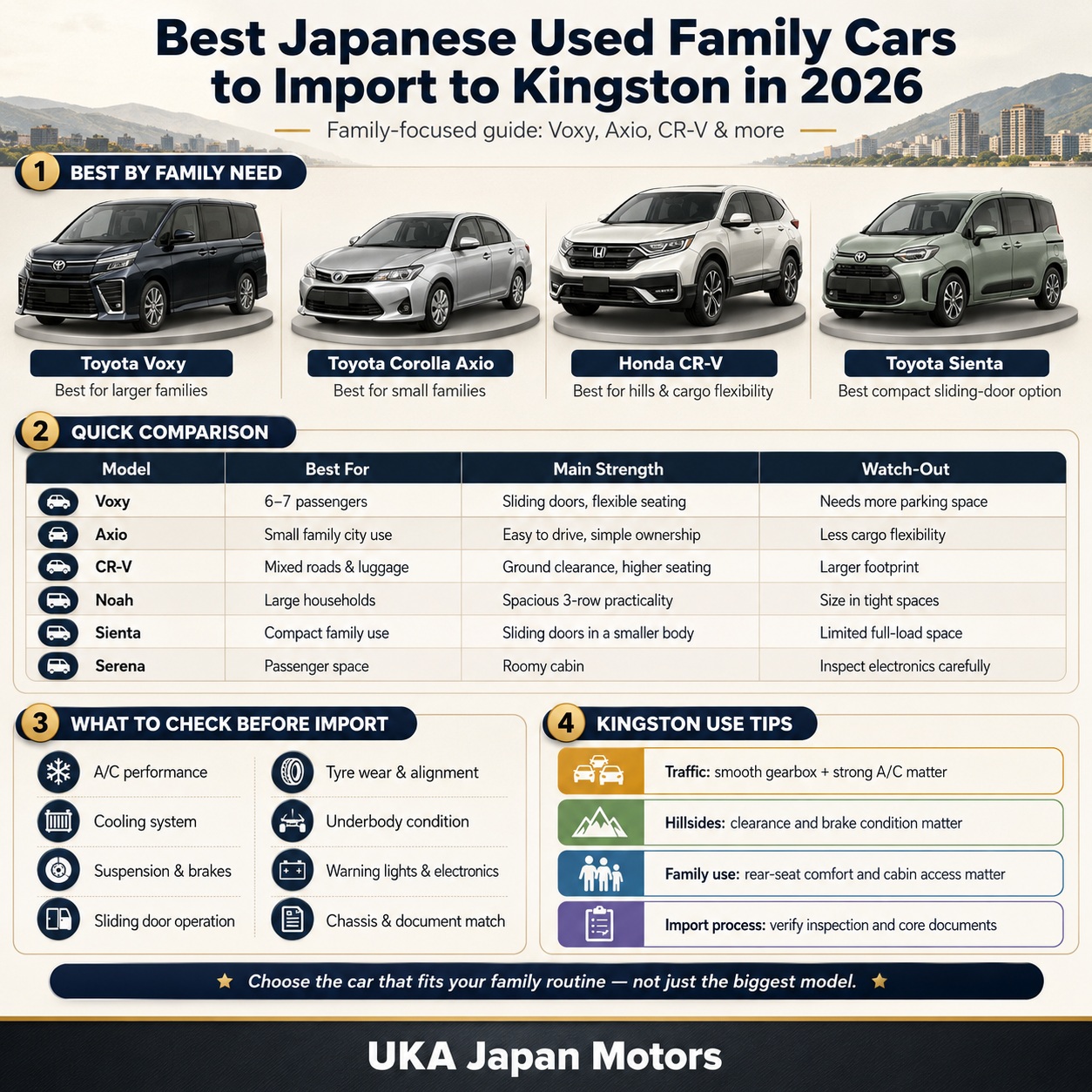
Choosing a Japanese used family car for Kingston in 2026 is not only about seating space or brand familiarity. A suitable family vehicle must handle daily traffic, school runs, supermarket trips, weekend errands, hillside routes, coastal air, heavy rain, heat, humidity, and the practical realities of import documentation. For many families, the right vehicle is the one that fits everyday routines without creating avoidable ownership stress.
Kingston driving places different demands on a family vehicle throughout the week. Morning and evening congestion can make cabin comfort, visibility, air conditioning performance, and smooth low-speed driving more important than outright engine strength. A family living in a flatter urban area may need easy parking and moderate fuel use, while another family regularly travelling through hilly communities may need stronger pulling power, ground clearance, and suspension durability. Households with children, elderly relatives, school bags, groceries, sports gear, and weekend luggage also need to think carefully about interior layout, door access, boot shape, and rear-seat comfort.
This guide looks at several Japanese used family vehicles that are commonly considered for Kingston ownership in 2026: Toyota Voxy, Toyota Corolla Axio, Honda CR-V, Toyota Noah, Toyota Wish, Nissan Serena, Honda Stepwgn, Toyota Sienta, Honda Fit Shuttle, and Mazda Premacy. The goal is not to declare one vehicle perfect for every family. Instead, the article explains which type of family each model suits, where it may not be ideal, what should be inspected before import, and how documentation should be handled.
Direct Answer: Which Japanese Used Family Cars Make the Most Sense for Kingston?
For larger families that need sliding doors, flexible seating, and easy passenger access, the Toyota Voxy and Toyota Noah are among the strongest choices. They suit school runs, shared family movement, and households that regularly carry several passengers.
For smaller families that mainly drive around Kingston, the Toyota Corolla Axio is a sensible sedan option. It suits families that do not need three-row seating but still want a calm, practical daily vehicle with straightforward ownership habits.
For families that travel through hilly areas, carry more luggage, or want a higher seating position, the Honda CR-V is a strong compact SUV choice. It suits drivers who want more road presence and ground clearance than a sedan, without moving into a large bus-style vehicle.
For families that need a middle ground, the Toyota Sienta, Toyota Wish, Honda Fit Shuttle, Mazda Premacy, and Nissan Serena all deserve attention depending on passenger needs, parking space, and usage patterns.
The best family car is the one that matches the household’s routine. A seven-seat vehicle is useful only if the extra seating is genuinely needed. A compact sedan is practical only if the family does not regularly need additional cargo space. A compact SUV makes sense when road conditions, ground clearance, and boot flexibility matter more than maximum seating capacity.
Why Family-Car Choice Matters in Kingston
Kingston driving can be demanding because family vehicles often do many jobs in the same day. One vehicle may take children to school in the morning, handle work commuting, sit in midday heat, collect groceries in the evening, and then travel through rain or uneven road surfaces after dark. A car that looks suitable on paper may feel inconvenient if the seating layout, air conditioning, suspension, or door access does not match real use.
Heat and humidity are major ownership factors. A family car’s air conditioning system must cool the cabin quickly, especially after being parked outside. Larger vehicles such as the Toyota Voxy, Toyota Noah, Nissan Serena, and Honda Stepwgn need strong rear cooling performance because passengers in the second and third rows can feel heat more intensely. For sedans such as the Corolla Axio, cooling is usually simpler because the cabin is smaller, but inspection should still confirm proper compressor operation, clean vents, and stable airflow.
Traffic is another major consideration. Stop-and-go driving places steady pressure on cooling systems, transmission behaviour, brakes, engine mounts, and suspension components. A vehicle that feels smooth at cruising speed may show weaknesses in Kingston traffic, especially if the gearbox hesitates, the idle is rough, or the air conditioning load affects engine smoothness.
Road surfaces also vary. A family vehicle may move from smooth main roads to broken edges, steep lanes, potholes, water pooling, or narrow residential routes within the same journey. This makes ground clearance, tyre condition, steering response, and suspension inspection especially important.
How to Think About Vehicle Types Before Choosing a Model
Before focusing on a specific nameplate, families should decide which body style genuinely fits their daily routine.
| Family Need | Best-Fit Vehicle Type | Why It Helps in Kingston |
|---|---|---|
| Five-person household, mainly city use | Compact sedan or wagon | Easier to park, simple cabin layout, practical for daily commuting |
| Six or seven passengers often | MPV or minivan | Better passenger access, flexible seating, sliding doors on some models |
| Hillside routes and rougher roads | Compact SUV | Higher seating position, stronger clearance, more confident road feel |
| Mixed passengers and luggage | Wagon, compact MPV, or SUV | Better cargo flexibility than a traditional sedan |
| Elderly relatives or young children | Sliding-door MPV | Easier entry and exit in tight parking areas |
| Narrow parking at home | Sedan, compact wagon, or small MPV | Less demanding to manoeuvre than larger family vans |
A common mistake is choosing the largest vehicle simply because it seems more family-friendly. Larger vehicles can be excellent, but they require more parking awareness, more careful inspection of sliding doors and rear air conditioning, and a realistic understanding of daily manoeuvring. A smaller vehicle may serve a family better if most trips involve two to four occupants and only occasional luggage.
Toyota Voxy: Best for Larger Families and Daily Passenger Movement
The Toyota Voxy is one of the most practical Japanese used family vehicles for Kingston households that need frequent passenger space. Its boxy body, sliding doors, upright seating, and flexible interior make it useful for school transport, family outings, and households that regularly carry children, grandparents, or multiple adults.
The Voxy’s main strength is access. Sliding doors are especially useful in tight Kingston parking spaces where a wide-opening traditional door can be awkward. Children can enter and exit more easily, and elderly passengers may find the upright cabin less difficult than climbing down into a low sedan.
The cabin layout also makes the Voxy useful for families that carry people and bags in different combinations. Seats can be folded or adjusted depending on the trip. This flexibility matters when the same vehicle must handle school bags in the morning and larger household items later in the day.
However, the Voxy may not suit every family. Its height and shape mean drivers must be comfortable with a taller vehicle. Parking in tight spaces requires awareness of length, side clearance, and rear visibility. Families that rarely use the third row may find a smaller vehicle easier to live with.
Inspection should focus on the sliding doors, rear air conditioning, suspension, engine mounts, radiator condition, fan operation, electronic controls, and underbody condition. Because MPVs often carry passengers frequently, interior wear can reveal how heavily the vehicle was used. Seat rails, door motors, window switches, roof lining, and rear-seat mechanisms should all be checked.
Toyota Corolla Axio: Best for Smaller Families and Straightforward Daily Use
The Toyota Corolla Axio is a strong option for small families that do not need seven seats. It suits Kingston drivers who want a practical sedan for commuting, school runs, errands, and moderate family use. Its appeal comes from simplicity, manageable size, and a familiar driving feel.
For a family of three to five, the Axio can be enough if luggage needs are modest. It is easier to park than a larger MPV and feels more natural in narrow city spaces. For parents who spend more time in Half-Way-Tree-style traffic, residential roads, office parking areas, and supermarket car parks, this size can be easier to manage.
The Axio is not the right choice for every family. Rear-seat space is suitable for normal daily use, but it is not as flexible as a wagon, MPV, or SUV. Families with several children, bulky school items, sports equipment, or frequent long-distance luggage may outgrow it. It also lacks the higher seating position of an SUV and the sliding-door convenience of a Voxy or Sienta.
Inspection should focus on engine smoothness, gearbox response, suspension noise, air conditioning performance, dashboard warning lights, brake feel, tyre wear, and signs of previous impact repair. Because compact sedans are often used heavily for commuting, the condition of the driver’s seat, steering wheel, pedals, and service records should be reviewed carefully.
Honda CR-V: Best for Ground Clearance, Comfort, and Mixed Road Conditions
The Honda CR-V suits families that want more height, boot flexibility, and confidence on mixed road surfaces. It is especially useful for households that move between Kingston’s urban areas and hillside communities, or families that often carry groceries, luggage, and child-related items.
The CR-V’s higher seating position gives the driver a clearer view in traffic. Its cargo area is more flexible than a sedan’s boot, and rear-seat comfort is generally better suited to family use than many compact cars. For drivers who regularly encounter uneven roads, steep driveways, rainwater channels, or rougher surfaces, the CR-V’s stance can feel more reassuring.
The trade-off is size and inspection complexity. A CR-V is larger than an Axio and requires more attention when parking. It may also have more suspension and drivetrain components to inspect depending on the specific version. Families should not choose a CR-V only for appearance. It should be selected because the household genuinely needs its ground clearance, cargo flexibility, and driving position.
Inspection should include the suspension, steering rack, engine mounts, transmission response, cooling system, air conditioning, brake condition, rear hatch operation, water leaks, tyre wear, and underbody condition. For any family SUV, tyre matching and alignment are important because uneven tyres may point to suspension wear or previous road impact.
Toyota Noah: A Close Alternative to the Voxy
The Toyota Noah is closely related in purpose to the Voxy. It offers similar family practicality, three-row seating, sliding-door access, and a high-roof cabin. For Kingston families comparing Voxy and Noah, the decision often comes down to condition, trim, seating layout, and inspection results rather than the badge alone.
The Noah suits larger households, shared family transport, and drivers who need easy passenger movement. It is also useful where children and elderly relatives regularly travel together. Like the Voxy, it should be inspected carefully for sliding-door operation, rear cooling performance, electronic functions, and suspension condition.
The Noah may not suit households with limited parking space or drivers who prefer a lower, more sedan-like driving experience. It is best for families that will regularly use the extra seating and interior flexibility.
Toyota Wish: A Lower Family MPV for Drivers Who Do Not Want a Tall Van
The Toyota Wish is a useful option for families that want more seating flexibility than a sedan but do not want the height and bulk of a Voxy or Noah. Its lower roofline gives it a more car-like feel, while still providing additional passenger options.
For Kingston, the Wish can work well for households that occasionally need extra seats but mostly drive with fewer passengers. It is easier to handle than a larger box-style MPV and may feel more comfortable for drivers moving from a sedan.
The limitation is that the third row is not as spacious or easy to access as in larger MPVs. Families with regular third-row passengers may prefer a Voxy, Noah, Serena, or Stepwgn. The Wish is best seen as a flexible family wagon rather than a full passenger carrier.
Inspection should focus on rear-seat folding mechanisms, suspension noise, cooling performance, transmission smoothness, and signs of interior wear.
Nissan Serena: Spacious, Practical, but Inspection Matters
The Nissan Serena is another family MPV option with generous interior space and sliding-door practicality. It suits larger families that need passenger capacity and cabin flexibility. Its shape makes it useful for school runs, family errands, and weekend travel.
The Serena’s strength is space. Families that regularly carry several passengers may appreciate its cabin design. However, inspection discipline is especially important. Buyers should pay close attention to transmission behaviour, engine cooling, electronic sliding doors, air conditioning, suspension condition, and warning lights. A spacious vehicle is only useful if its mechanical and electronic systems are healthy.
For Kingston families, the Serena can be practical when carefully selected. It may not be the best choice for buyers who want the simplest ownership experience, especially if they are not prepared to inspect electronic and drivetrain systems thoroughly before import.
Honda Stepwgn: Comfortable Passenger Space with Careful Pre-Import Review
The Honda Stepwgn is similar in purpose to the Voxy, Noah, and Serena. It offers a tall cabin, practical seating, and family-friendly access. For larger households, it can be a comfortable people-mover.
The Stepwgn suits families that need passenger space but want a slightly different cabin feel from Toyota MPVs. It can be useful for school transport, group movement, and regular family use. As with any tall MPV, rear air conditioning and door systems should be checked carefully.
The Stepwgn may not suit families that want the most familiar parts and service pathway. Before choosing one, buyers should consider workshop familiarity, parts sourcing habits, and the specific condition of the vehicle being imported. Inspection should cover engine operation, gearbox smoothness, cooling system performance, suspension, sliding-door mechanisms, air conditioning, electronics, and underbody condition.
Toyota Sienta: Compact Sliding-Door Practicality
The Toyota Sienta is a smaller family MPV that can suit Kingston very well. It offers sliding-door convenience in a more compact body, making it useful for parents who need easy child access but do not want a larger Voxy or Noah.
For smaller families, the Sienta can be a smart middle ground. It is easier to park, easier to manoeuvre, and still more flexible than a standard sedan. The sliding doors are especially useful in tight residential spaces and school pickup areas.
The limitation is space. The Sienta cannot offer the same third-row comfort or luggage flexibility as a full-size MPV. It is best for families that need occasional extra seating rather than regular full-passenger use.
Inspection should focus on door operation, interior seat mechanisms, engine smoothness, hybrid system condition if applicable, air conditioning performance, and suspension condition.
Honda Fit Shuttle: Wagon Practicality for Small Families
The Honda Fit Shuttle suits families that want cargo flexibility but do not need a large vehicle. It offers a wagon-like layout, useful boot access, and manageable size for city driving.
For Kingston households that carry school bags, groceries, and everyday items but rarely need more than five seats, the Fit Shuttle can be practical. It is easier to park than a large MPV and more cargo-friendly than many compact sedans.
The Fit Shuttle may not suit families that regularly travel with several adults or need high ground clearance. It should be chosen for compact practicality, not for heavy passenger carrying. Inspection should include gearbox response, hybrid system condition if relevant, air conditioning, suspension, brake feel, and battery health indicators where applicable.
Mazda Premacy: Flexible Seating with a Car-Like Feel
The Mazda Premacy is another option for families that want a balance between compact handling and extra seating flexibility. It does not feel as tall as a Voxy or Serena, but it provides more adaptability than a sedan.
For Kingston, the Premacy can suit families that want occasional third-row use, easier manoeuvring, and a lower driving position. It may appeal to drivers who prefer a car-like feel but still need more family flexibility.
The limitation is that third-row space and luggage room are not as generous as larger MPVs. Inspection should focus on suspension, engine mounts, transmission smoothness, air conditioning, sliding-door or rear-door operation depending on version, and interior wear.
Model Comparison for Kingston Family Use
| Model | Best For | Main Strength | Main Limitation |
|---|---|---|---|
| Toyota Voxy | Larger families | Sliding doors, flexible seating, strong cabin practicality | Requires more parking awareness |
| Toyota Corolla Axio | Small families | Simple sedan use, easy city handling | Limited cargo and passenger flexibility |
| Honda CR-V | Mixed roads and cargo | Ground clearance, boot flexibility, higher seating | Larger than a sedan |
| Toyota Noah | Larger households | Similar practicality to Voxy | Size may not suit tight parking |
| Toyota Wish | Occasional extra seating | Lower MPV feel, flexible layout | Third row is not ideal for regular adults |
| Nissan Serena | Maximum passenger space | Spacious cabin and sliding doors | Needs careful drivetrain and electronic inspection |
| Honda Stepwgn | Larger family movement | Comfortable people-moving layout | Requires careful parts and system review |
| Toyota Sienta | Compact family access | Sliding doors in a smaller body | Limited space when fully loaded |
| Honda Fit Shuttle | Small family cargo needs | Wagon practicality and compact size | Not for larger families |
| Mazda Premacy | Flexible city family use | Car-like handling with added seats | Less spacious than full MPVs |
What to Inspect Before Importing a Family Vehicle
Inspection is especially important for family cars because they carry people who depend on safety, comfort, and reliability. A clean exterior alone is not enough. The inspection process should look at the vehicle as a complete ownership package.
Key areas include:
- Engine starting behaviour, idle stability, and visible leaks
- Transmission smoothness during low-speed movement and acceleration
- Cooling system condition, including radiator, fans, hoses, and coolant quality
- Air conditioning strength at the front and rear where applicable
- Suspension noise, bushing wear, shock absorber condition, and steering response
- Brake feel, rotor condition, pad condition, and warning lights
- Tyre matching, tyre age, and uneven wear patterns
- Seat belts, airbags, dashboard lights, and electronic safety systems
- Sliding doors, rear hatch, power windows, mirrors, and central locking
- Interior wear, odour, water stains, and signs of heavy previous use
- Underbody condition, corrosion, repairs, and accident evidence
- Chassis number consistency across records and vehicle markings
For family MPVs, rear air conditioning deserves special attention. A front cabin that cools properly does not always mean the rear passengers will be comfortable. For sliding-door models, both manual and power functions should be checked. Door hesitation, unusual noise, or sensor issues may become daily irritation.
For sedans and wagons, boot sealing and rear suspension condition matter. Family use often involves luggage and repeated loading, which can expose weak shocks or worn rear components.
For SUVs, ground clearance should not distract from inspection discipline. Suspension wear, tyre mismatch, and steering issues can reduce comfort and safety.
Documentation and Import Handling for Kingston Buyers
Documentation should be treated as part of the vehicle’s condition. A suitable family car is not only mechanically sound; it must also be properly documented for import, Customs processing, registration, and fitness handling.
For a Japanese used vehicle, buyers should pay attention to the export certificate, invoice or bill of sale, import licence, bill of lading or order, Tax Compliance Certificate where required, and broker-prepared declarations. The chassis number, model year, seating capacity, colour, engine details, and other identifying information should be consistent across the documents.
A used vehicle should also have the required pre-shipment inspection process completed before import. This is not a minor step. It helps confirm that the vehicle meets import expectations before it reaches Jamaica. Any mismatch or missing detail can create delays, queries, or avoidable stress.
Families should also understand that vehicle fitness is not just a formality. The roadworthiness process checks safety-related areas such as brakes, lights, horn, exhaust, tyres, tint level, steering, and front-end integrity. A family vehicle should be prepared with these checks in mind before it is placed into regular daily use.
Kingston Ownership Factors After Registration
Once the vehicle is registered and in use, ownership habits become just as important as the original selection. Family vehicles often experience short trips, frequent stops, long idling with air conditioning, and repeated loading. These patterns can affect batteries, cooling systems, brakes, tyres, and suspension components.
For Kingston use, owners should pay attention to:
- Regular air conditioning servicing
- Cooling system checks before heavy traffic or long trips
- Tyre pressure and alignment
- Brake inspection after repeated stop-and-go use
- Suspension inspection after rough-road driving
- Interior cleaning to manage humidity and odour
- Battery condition, especially with frequent short trips
- Engine oil and fluid condition
- Wiper blades and lights before rainy periods
For hillside driving, brakes and transmission behaviour deserve special care. Drivers should avoid ignoring vibration, delayed gear response, or overheating signs. For coastal exposure, underbody and paint condition should be monitored because salt air and humidity can affect long-term vehicle condition.
Who Should Choose Each Vehicle?
A Toyota Voxy or Noah suits families that regularly carry more than five people, need sliding doors, and want a flexible cabin. These are strong options for school runs, church movement, family gatherings, and households with elderly passengers.
A Toyota Corolla Axio suits smaller families that mostly drive in Kingston and want a manageable sedan. It is practical for daily commuting, school drop-offs, and simple ownership routines.
A Honda CR-V suits families that want higher ground clearance, a stronger luggage area, and a more confident feel on uneven roads. It is a good match for mixed city and hillside use.
A Toyota Sienta suits families that like sliding doors but do not need a large vehicle. It is useful for young children and tight parking spaces.
A Toyota Wish, Mazda Premacy, or Honda Fit Shuttle suits families that need more flexibility than a sedan but less size than a full MPV.
A Nissan Serena or Honda Stepwgn suits larger families that need passenger capacity and cabin comfort, provided inspection confirms the vehicle is mechanically and electronically sound.
When These Vehicles May Not Suit
A large MPV may not suit a driver with very limited parking space or a household that rarely carries more than four people. The extra seating may become unnecessary size.
A sedan may not suit a family with several children, bulky cargo, or frequent group travel. Even a reliable sedan can feel restrictive if the household has outgrown its space.
An SUV may not suit buyers who only want a higher appearance but do not need its practical benefits. A compact SUV should be chosen for road conditions, cargo needs, and seating preference, not simply because it looks stronger.
A compact MPV may not suit families that expect full adult comfort in every row. Smaller three-row vehicles often work best when the third row is occasional rather than constant.
Practical Selection Method for Families
A useful way to choose is to list the family’s real weekly routine before selecting a model.
Ask:
- How many people travel in the vehicle most days?
- How often is the third row needed?
- Is parking at home narrow or open?
- Are hillside roads part of the normal route?
- Is the vehicle used mostly in traffic or longer drives?
- Are elderly passengers or small children entering often?
- Is luggage space needed while all seats are occupied?
- Will rear passengers need strong air conditioning?
- Are sliding doors important for school pickup and tight spaces?
- Is the driver comfortable with a taller vehicle?
The answers usually make the choice clearer. A family that needs third-row access every day should look closely at Voxy, Noah, Serena, or Stepwgn. A family of four with tight parking may be better served by Axio, Fit Shuttle, Sienta, or Premacy. A family that regularly moves through hilly areas may find CR-V more suitable.
UKA Japan Motors’ Role in the Family-Car Import Process
UKA Japan Motors’ role is to support buyers with inspection-oriented guidance, documentation awareness, and practical model selection. For family vehicles, the focus should always be on suitability, condition, and transparency rather than pressure.
A careful import process looks beyond the model name. It considers the vehicle’s grade, mileage reading consistency, chassis details, interior condition, accident history indicators, mechanical inspection notes, export documentation, and whether the vehicle matches the buyer’s daily use in Jamaica.
For a Kingston family, this kind of guidance can prevent a common mistake: choosing a vehicle that is popular but not personally suitable. A Voxy may be excellent for one household and unnecessary for another. An Axio may be ideal for one family and too limited for another. A CR-V may be practical for mixed roads but excessive for a household that only needs compact city movement.
UKA Japan Motors helps buyers think through these details in a structured way, with attention to inspection, documents, and real ownership conditions after the vehicle reaches Jamaica.
FAQ
1. What is the best Japanese used family car to import to Kingston in 2026?
There is no single best choice for every family. The Toyota Voxy is strong for larger families, the Toyota Corolla Axio suits smaller families, and the Honda CR-V is useful for families needing ground clearance and cargo flexibility.
2. Is the Toyota Voxy good for Kingston family use?
Yes, the Toyota Voxy is well suited to larger families because of its sliding doors, flexible seating, and spacious cabin. It is especially useful for school runs and households that regularly carry several passengers.
3. Is the Toyota Corolla Axio enough for a family?
The Axio can be enough for a small family that mainly drives around Kingston and does not need extra seating. It may not suit families that frequently carry bulky luggage or more than five people.
4. Is the Honda CR-V better than a sedan for family use?
The CR-V is better when the family needs higher ground clearance, flexible cargo space, and a higher seating position. A sedan may still be more suitable when parking ease and simple city use matter more.
5. Should a family choose a seven-seater even if it is rarely full?
Not always. Extra seats are useful only when they are regularly needed. If most trips involve three or four people, a smaller sedan, wagon, compact MPV, or SUV may be more practical.
6. What should be inspected on a used family MPV?
Sliding doors, rear air conditioning, suspension, engine mounts, cooling system, brakes, tyres, electronic controls, seat mechanisms, and underbody condition should all be reviewed carefully.
7. Why is rear air conditioning important in family vehicles?
Rear passengers can feel heat more strongly in larger cabins, especially after the vehicle has been parked in the sun. Strong rear cooling is important for comfort during Kingston traffic.
8. What documents matter when importing a Japanese used family car?
Important documents include the import licence, export certificate or title, invoice or bill of sale, bill of lading or order, tax-related documentation where required, pre-shipment inspection certificate, and broker-prepared declarations.
9. Is a compact MPV like the Toyota Sienta good for families?
Yes, the Sienta is useful for small families that want sliding-door access without moving into a larger MPV. It is best when the third row is needed occasionally rather than constantly.
10. Is the Nissan Serena a good family option?
The Serena can be a good option for families that need space and sliding-door practicality. Inspection is important, especially for transmission behaviour, electronics, cooling, suspension, and air conditioning.
11. Which vehicle suits hillside driving better?
A Honda CR-V may suit hillside and uneven-road use better than a low sedan because of its higher ground clearance and stronger road presence. However, suspension and drivetrain condition must be checked carefully.
12. What is the safest way to choose between Voxy, Axio, and CR-V?
Choose based on real family use. Pick the Voxy for regular passenger capacity, the Axio for smaller daily city use, and the CR-V for ground clearance, cargo flexibility, and mixed road conditions.
Conclusion
The best Japanese used family car to import to Kingston in 2026 depends on how the family actually uses the vehicle. The Toyota Voxy and Noah are strong for larger households that need sliding doors and flexible seating. The Toyota Corolla Axio suits smaller families that want a simple daily sedan. The Honda CR-V works well for families that need higher clearance, cargo flexibility, and confidence on mixed roads. Other models such as the Toyota Sienta, Toyota Wish, Nissan Serena, Honda Stepwgn, Honda Fit Shuttle, and Mazda Premacy can also be practical when matched carefully to household routines.
A good decision should consider passenger needs, parking space, road conditions, air conditioning performance, inspection results, documentation accuracy, and long-term ownership habits. Family vehicles carry more responsibility than ordinary daily transport, so condition and suitability should always guide the choice.
Contact UKA Japan Motors for availability and inspection guidance.