


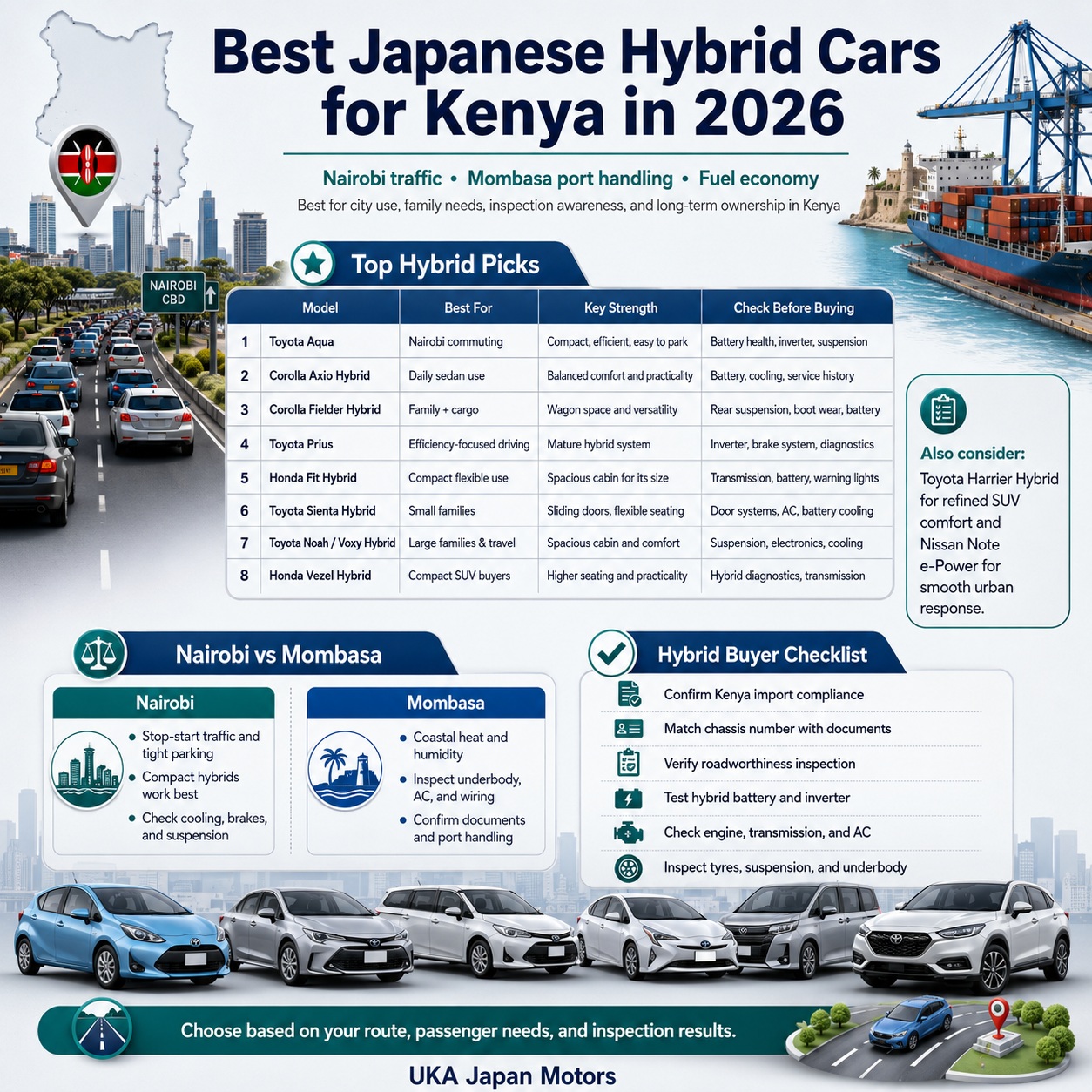
Japanese hybrid cars have become a serious consideration for many Kenyan buyers in 2026, especially for people who drive daily in Nairobi traffic, travel regularly between towns, or need a vehicle that balances fuel economy with reliable everyday use. A hybrid is not just a petrol car with an added battery. It is a vehicle designed to use a petrol engine and an electric motor together, allowing the car to manage energy more efficiently in traffic, at low speeds, and during repeated stopping and starting.
For Kenya, this matters because vehicle use is rarely simple. A car may spend one day moving slowly through Nairobi traffic, another day climbing hilly roads around Kiambu or Limuru, and another covering long-distance routes toward Mombasa, Nakuru, Kisumu, Eldoret, or other parts of the country. In Mombasa, coastal heat, humidity, and port handling conditions add another layer to the ownership decision. A hybrid that performs well in one environment may need more careful inspection before it is considered suitable for another.
This guide explains the best Japanese hybrid cars for Kenya in 2026 from a practical buyer’s point of view. It looks at Nairobi traffic use, Mombasa port handling, fuel economy behaviour, inspection realities, documentation, compliance, battery condition, spare parts considerations, and long-term ownership. The aim is not to push one model over another, but to help buyers understand which hybrid type fits their driving pattern.
Direct Answer: Which Japanese Hybrid Cars Suit Kenya Best in 2026?
For most Kenyan buyers, the best Japanese hybrid cars in 2026 are the Toyota Aqua, Toyota Corolla Axio Hybrid, Toyota Corolla Fielder Hybrid, Toyota Prius, Honda Fit Hybrid, Toyota Sienta Hybrid, Toyota Voxy Hybrid, Toyota Noah Hybrid, Honda Vezel Hybrid, Toyota Harrier Hybrid, and Nissan Note e-Power.
The Toyota Aqua suits city users who want a compact hybrid for Nairobi traffic and easy parking. The Corolla Axio Hybrid and Corolla Fielder Hybrid suit buyers who want familiar Toyota practicality in sedan or wagon form. The Prius suits drivers who prioritise refined hybrid operation and steady fuel economy. The Honda Fit Hybrid is useful for compact-space flexibility, while the Toyota Sienta Hybrid suits families that need sliding doors and a practical cabin. The Voxy Hybrid and Noah Hybrid suit larger families and passenger needs. The Honda Vezel Hybrid suits buyers who prefer a compact SUV feel. The Harrier Hybrid suits drivers who want a more premium SUV experience. The Nissan Note e-Power suits urban users who want electric-motor driving feel with petrol-engine support.
The right choice depends on how the car will be used. Nairobi buyers should focus on stop-start efficiency, cooling-system condition, battery health, suspension condition, and transmission smoothness. Mombasa buyers should pay close attention to underbody condition, coastal exposure, air-conditioning performance, rubber seals, electronic connectors, and inspection records. Buyers using the Nairobi-Mombasa route should consider luggage space, cabin comfort, tyre condition, engine response, and cooling performance under sustained highway use.
Why Japanese Hybrids Matter in Kenya in 2026
Hybrid cars are relevant in Kenya because they match many local driving patterns. Nairobi traffic involves repeated braking, short acceleration, idling, and slow movement. These conditions are difficult for many conventional petrol vehicles because the engine works often without steady movement. A hybrid system can recover some energy during braking and use electric assistance when moving from low speed. This helps the vehicle operate more efficiently in the type of traffic many Nairobi drivers face every week.
In Mombasa, the question is different. The driving environment includes warmer coastal air, humidity, salt exposure, and road conditions that can affect underbody parts, paintwork, suspension components, and electrical connectors. A hybrid car can work well in Mombasa, but it must be inspected carefully because hybrid systems rely on sensors, wiring, cooling fans, control modules, and battery ventilation.
For long-distance driving, hybrids are not all the same. Some are strongest in urban traffic, while others feel better on open roads. A compact hybrid may be excellent for Nairobi daily use but less comfortable for a full family on repeated highway journeys. A larger hybrid SUV or MPV may offer better space and comfort but needs more careful inspection of battery condition, suspension wear, tyres, cooling system, and service history.
Understanding How Hybrid Cars Work
A hybrid car combines a petrol engine with one or more electric motor functions. The electric side of the system supports the car during low-speed driving, acceleration, and stop-start movement. The petrol engine operates when more power is needed, when the battery requires support, or when the vehicle is moving at higher speeds.
Most Japanese hybrid cars use regenerative braking. This means that when the driver slows down, the system recovers energy that would otherwise be lost as heat through braking. The recovered energy is stored in the hybrid battery and later used to support driving.
In Kenya, this is useful because braking and moving again are common in Nairobi traffic, school runs, urban errands, and busy commercial areas. However, hybrid performance depends on the condition of the battery, inverter, cooling fans, sensors, engine, transmission, and related wiring. A hybrid should never be judged only by body appearance or mileage. The technical inspection is just as important.
Nairobi Traffic: What Makes a Hybrid Suitable?
Nairobi driving places special demands on any vehicle. Heavy traffic, short trips, uneven roads, steep sections, and long idling periods can expose weaknesses in cooling systems, batteries, suspensions, and transmissions. A good Nairobi hybrid should be easy to manoeuvre, efficient in stop-start driving, comfortable in traffic, and reliable when used daily.
Compact hybrids such as the Toyota Aqua, Honda Fit Hybrid, and Nissan Note e-Power are well suited to Nairobi because they are easy to park, responsive at low speeds, and practical for daily movement. They are useful for office commutes, errands, school runs, and city-based ownership.
Sedan and wagon hybrids such as the Corolla Axio Hybrid and Corolla Fielder Hybrid suit buyers who want more cabin or boot space without moving into a larger SUV. They are also familiar to many Kenyan mechanics and parts suppliers because the Corolla platform is widely understood locally.
Larger hybrids such as the Harrier Hybrid, Voxy Hybrid, and Noah Hybrid can work in Nairobi but require more careful consideration. They offer space and comfort, but their size may be less convenient in tight parking areas and congested streets. Their suspension, battery cooling, tyres, and electronic systems should be checked thoroughly before purchase.
Mombasa Port Handling and Coastal Use Considerations
For many imported Japanese vehicles, Mombasa is the entry point into Kenya. Port handling is not just a logistics step; it is part of the vehicle’s early journey into local ownership. Documentation accuracy, inspection records, chassis details, export certificates, and clearing order all matter.
A buyer considering a hybrid imported through Mombasa should pay close attention to the relationship between the vehicle’s documents and its physical condition. The chassis number should match the documents. The year of first registration should be checked against Kenya’s import rules. The roadworthiness inspection should be valid and connected to the specific vehicle. The export certificate, bill of lading, inspection certificate, and registration process should be handled with care.
Coastal use adds another practical issue. Mombasa’s humidity and salt air can affect exposed metal parts, terminals, brackets, suspension areas, and underbody sections. This does not mean a hybrid should be avoided in Mombasa. It means buyers should inspect more deeply. A clean exterior is not enough. The underbody, battery compartment area, engine bay, wiring connectors, brake components, and air-conditioning system should be assessed carefully.
Hybrid batteries also need cooling. Many hybrids use cabin air to cool the battery through vents and fans. In dusty or humid environments, those vents and fans should be checked and cleaned when necessary. A blocked cooling path can affect battery performance over time.
Comparison: Nairobi Daily Use vs Mombasa Coastal Use
| Factor | Nairobi Use | Mombasa Use | What Buyers Should Check |
|---|---|---|---|
| Traffic pattern | Heavy stop-start movement | Mixed town and coastal driving | Hybrid battery response, brake regeneration, cooling system |
| Climate pressure | Heat during congestion | Heat, humidity, salt exposure | Air-conditioning, wiring connectors, underbody condition |
| Road use | Congested roads, uneven sections, hills | Urban roads, coastal roads, port movement | Suspension, tyres, ground clearance, steering feel |
| Vehicle priority | Compact size, easy parking, fuel economy | Corrosion resistance, cooling, cabin comfort | Underbody inspection, AC performance, battery ventilation |
| Ownership concern | Battery health in daily traffic | Moisture exposure and electronic reliability | Diagnostic scan, service records, physical inspection |
This comparison shows why the same hybrid may be judged differently depending on where it will be used. A Toyota Aqua may be ideal for a Nairobi commuter but may feel limited for a large family based in Mombasa. A Harrier Hybrid may feel comfortable on longer trips but may not be the simplest choice for tight Nairobi parking. The best choice is the one that matches the buyer’s route, load, parking, family needs, and maintenance expectations.
Best Japanese Hybrid Cars for Kenya in 2026
1. Toyota Aqua Hybrid
The Toyota Aqua is one of the most practical Japanese hybrid cars for city-based Kenyan buyers. It is compact, efficient, easy to park, and well suited to Nairobi traffic. Its size makes it useful for daily commutes, errands, and drivers who often move through tight roads and busy parking areas.
The Aqua suits buyers who mostly drive alone, as a couple, or with a small family. It is not the best choice for large households or frequent long-distance luggage-heavy travel, but it performs well as a city vehicle. Because it is popular, parts knowledge is relatively strong in Kenya, and many technicians are familiar with its basic hybrid system.
Inspection should focus on battery health, inverter condition, cooling fan cleanliness, accident history, suspension noise, brake feel, and dashboard warning lights. A diagnostic scan is important because hybrid issues may not always be visible during a simple road check.
2. Toyota Corolla Axio Hybrid
The Corolla Axio Hybrid is suitable for buyers who want a compact sedan with familiar Toyota practicality. It offers a more traditional body style than the Aqua, making it attractive to buyers who prefer a saloon car for daily use, office movement, and family needs.
In Nairobi, the Axio Hybrid performs well in traffic while offering better boot separation than a hatchback. For drivers who carry documents, work items, or personal luggage, the sedan layout can be useful. On longer routes, it feels more settled than smaller hybrids, though buyers should still check tyre quality, suspension condition, and cooling performance.
The Axio Hybrid suits buyers who want a balanced vehicle rather than a very small city car or a larger SUV. Inspection should include hybrid battery condition, engine smoothness, gearbox response, brake regeneration feel, and body alignment.
3. Toyota Corolla Fielder Hybrid
The Corolla Fielder Hybrid is a strong option for buyers who need more cargo flexibility. Its wagon body gives it an advantage over sedans when carrying luggage, family items, small business goods, or travel bags. This makes it useful for buyers who move between Nairobi and other towns or need a car that can handle both family and practical tasks.
In Kenya, the Fielder name is well understood, which helps with general ownership confidence. The hybrid version adds better fuel economy behaviour in traffic while retaining the useful wagon layout. It is especially suitable for buyers who want a practical vehicle but do not want an SUV.
Inspection should focus on rear suspension condition, boot area signs of heavy use, battery health, underbody condition, and service history. Buyers should also check whether the hybrid battery cooling area is clean and unobstructed.
4. Toyota Prius
The Toyota Prius is one of the most established hybrid models. It suits buyers who prioritise refined hybrid behaviour, smooth driving, and strong fuel economy in mixed conditions. The Prius is especially good for drivers who understand hybrid ownership and want a vehicle designed around efficiency rather than simply adapted from a petrol platform.
In Nairobi, the Prius works well in stop-start traffic. On longer routes, it can feel stable and composed when well maintained. However, buyers should remember that the Prius has a distinctive body shape and driving feel. It may not suit someone who wants higher seating, SUV styling, or rugged-road confidence.
Inspection should be detailed. The battery, inverter, cooling system, electronic modules, suspension, brake actuator behaviour, and dashboard warnings should all be checked. A clean service record is valuable because the Prius depends on proper system health.
5. Honda Fit Hybrid
The Honda Fit Hybrid is a compact car with clever interior packaging. It suits buyers who want a small vehicle that feels more spacious inside than its exterior suggests. In Nairobi, it is useful for city movement, parking, and daily commuting.
The Fit Hybrid may appeal to younger professionals, small families, and drivers who want a flexible hatchback. Its rear seat and boot arrangement can be practical for daily life. However, buyers should pay close attention to transmission behaviour, hybrid system condition, and maintenance history. Some Honda hybrid systems require careful inspection to ensure smooth operation.
For Kenya, the Fit Hybrid is best for drivers who want compact practicality but are disciplined about maintenance. It may not be the right choice for buyers who want the simplest possible ownership path without paying attention to system-specific checks.
6. Toyota Sienta Hybrid
The Toyota Sienta Hybrid is useful for families who want sliding doors, flexible seating, and better access in tight spaces. In Nairobi, sliding doors can be helpful in narrow parking spots, school drop-off areas, and busy residential compounds. In Mombasa, the airy cabin and practical layout can suit family movement and daily errands.
The Sienta Hybrid is not as large as the Noah or Voxy, but it offers more family flexibility than a small hatchback or sedan. It suits buyers who need occasional extra seating but do not want a full-size MPV.
Inspection should focus on door mechanisms, hybrid battery condition, suspension wear, seat condition, air-conditioning performance, and underbody checks. Because family vehicles often carry passengers frequently, buyers should also check interior wear carefully.
7. Toyota Voxy Hybrid
The Toyota Voxy Hybrid is suitable for larger families, group movement, and buyers who need an MPV with modern hybrid support. It offers a spacious cabin, sliding doors, and comfortable seating. For Nairobi families, it can handle school runs, family errands, and weekend travel. For longer journeys, it offers better passenger space than compact hybrids.
The Voxy Hybrid needs careful inspection because larger hybrid vehicles have more systems to evaluate. Suspension condition, tyres, battery health, cooling performance, air-conditioning, sliding doors, and electronic features should all be checked.
It suits buyers who genuinely need space. It may not suit drivers who mostly travel alone in congested areas, because its size can be less convenient in tight urban spaces.
8. Toyota Noah Hybrid
The Toyota Noah Hybrid is closely related in purpose to the Voxy Hybrid. It suits families and buyers who need practical passenger space. The Noah has a more conservative design character than the Voxy, which may appeal to buyers who prefer a simpler appearance.
In Kenya, the Noah Hybrid is useful for family travel, school movement, and longer journeys where comfort matters. It is not a small vehicle, so buyers in Nairobi should consider parking space and daily route conditions. In Mombasa, air-conditioning and underbody condition should receive extra attention.
Inspection should include the hybrid battery, cooling fans, cabin electronics, door operation, suspension, brake condition, and service record. The buyer should also confirm that the vehicle’s documents match the chassis number and import requirements.
9. Honda Vezel Hybrid
The Honda Vezel Hybrid suits buyers who want a compact SUV shape with hybrid technology. It offers higher seating than a hatchback and a more modern design character. In Nairobi, the Vezel can feel comfortable because of its seating position and compact SUV layout. It is also practical for buyers who want a vehicle that feels more substantial than a small hatchback.
However, buyers should inspect the transmission and hybrid system carefully. Smooth low-speed response, warning lights, service history, and diagnostic results are important. The Vezel Hybrid can be a good fit when properly selected and inspected, but it should not be bought on appearance alone.
It suits urban professionals, small families, and drivers who want compact SUV practicality without moving into a larger vehicle.
10. Toyota Harrier Hybrid
The Toyota Harrier Hybrid suits buyers who want a more refined SUV experience. It offers comfort, cabin quality, and a stronger road presence. For buyers who travel between Nairobi and other towns, the Harrier Hybrid can provide comfort and stability when well maintained.
The Harrier Hybrid is not the simplest hybrid to inspect casually. Because it is more complex and has more features, a full inspection is important. Battery condition, inverter health, suspension, electronic systems, tyres, cooling, air-conditioning, and body condition should all be reviewed.
It suits buyers who value comfort and space. It may not suit someone seeking a compact city car for tight Nairobi routes or a vehicle with minimal system complexity.
11. Nissan Note e-Power
The Nissan Note e-Power is different from many conventional hybrids because the petrol engine primarily supports electric-motor driving rather than operating like a normal drivetrain at all times. This gives the car a smooth and responsive urban feel, especially in stop-start driving.
For Nairobi, the Note e-Power can be appealing because of its low-speed response and compact size. It suits daily commuting and city movement. However, buyers should understand that its system layout is different from Toyota’s hybrid approach. Proper diagnostics and technician familiarity are important.
Inspection should focus on battery condition, electric motor response, engine operation, warning lights, service record, and cooling system. Buyers should also consider parts familiarity in their area before choosing it.
Model Comparison for Kenyan Buyers
| Model | Best Use in Kenya | Strong Point | Main Inspection Focus | May Not Suit |
|---|---|---|---|---|
| Toyota Aqua | Nairobi city driving | Compact and efficient | Battery, inverter, cooling fan | Large families |
| Corolla Axio Hybrid | Daily sedan use | Familiar Toyota platform | Battery, suspension, documents | Buyers needing wagon space |
| Corolla Fielder Hybrid | Family and cargo flexibility | Practical wagon body | Rear suspension, boot wear, battery | Buyers wanting high seating |
| Toyota Prius | Efficiency-focused mixed driving | Mature hybrid design | Battery, inverter, brake system | SUV-style buyers |
| Honda Fit Hybrid | Compact urban use | Flexible cabin | Transmission, battery, diagnostics | Rough-road heavy use |
| Toyota Sienta Hybrid | Small family use | Sliding doors and seating flexibility | Door systems, AC, battery | Heavy passenger needs |
| Voxy Hybrid | Larger family movement | Spacious cabin | Battery, suspension, electronics | Tight city parking |
| Noah Hybrid | Family and long-distance comfort | Practical MPV layout | Cooling, battery, doors | Solo city users |
| Honda Vezel Hybrid | Compact SUV ownership | Higher seating | Transmission, hybrid diagnostics | Buyers avoiding system complexity |
| Harrier Hybrid | Comfort-focused SUV use | Refined cabin and ride | Electronics, battery, suspension | Compact-car buyers |
| Nissan Note e-Power | Urban electric-motor feel | Smooth city response | Battery, motor system, cooling | Buyers wanting traditional hybrid feel |
Inspection Priorities Before Buying a Japanese Hybrid in Kenya
Hybrid inspection should be more detailed than ordinary visual checking. A clean body and neat interior do not confirm hybrid health. Buyers should ask for a proper inspection that covers both mechanical and electronic systems.
The first priority is battery condition. The hybrid battery should be tested through diagnostics where possible. Uneven module behaviour, warning lights, weak performance, or cooling issues can affect long-term reliability. The battery cooling fan and vents should also be checked because dust and blocked airflow can shorten system life.
The second priority is the inverter and electrical system. The inverter manages power between the battery, motor, and petrol engine. It should operate without warning lights, overheating signs, or unusual behaviour.
The third priority is engine and transmission condition. A hybrid still has a petrol engine, and that engine needs proper maintenance. Oil condition, coolant condition, engine noise, acceleration smoothness, and service history all matter. Transmission feel should be smooth, especially in Honda hybrids where system behaviour can differ from Toyota models.
The fourth priority is suspension and underbody condition. Kenyan roads can be demanding, and imported vehicles may already have wear before arrival. Bushings, shocks, tyres, steering components, brake parts, and underbody panels should be inspected.
The fifth priority is documentation. The chassis number, export certificate, inspection certificate, bill of lading, and registration details should align. A mismatch can delay registration or create ownership problems.
Documentation and Compliance for Kenya
A Japanese hybrid being imported into Kenya must be considered from both a technical and compliance point of view. The vehicle should meet Kenya’s import requirements, including the age rule, right-hand-drive requirement, and roadworthiness inspection by an appointed agent before export.
Documentation should not be treated as a secondary matter. A buyer should confirm the year of first registration, chassis number, export certificate, inspection certificate, and shipping documents before the vehicle is processed for local registration. Once the vehicle arrives through Mombasa, the clearing process should follow the correct order so that registration can proceed smoothly.
For hybrid vehicles, documentation also supports technical confidence. Service records, auction sheets where available, inspection notes, and mileage consistency help form a clearer picture of the vehicle’s history. A car with unclear records should be approached carefully, especially if it is a hybrid with complex electrical systems.
Fuel Economy in Real Kenyan Conditions
Hybrid fuel economy depends on driving style, traffic, battery health, tyre condition, load, road gradient, and maintenance. A hybrid performs best when the system is healthy and the driver uses smooth acceleration and steady braking. In Nairobi traffic, hybrids can be especially useful because they are designed to manage repeated stopping and moving.
However, buyers should avoid assuming that every hybrid will perform the same. A poorly maintained hybrid may not deliver the expected fuel economy. A vehicle with weak battery performance, dirty filters, worn tyres, dragging brakes, or old engine oil may lose efficiency. Larger hybrids may use more fuel than compact hybrids because they carry more weight.
On the Nairobi-Mombasa route, hybrid behaviour can differ from city use. At steady highway speeds, the petrol engine may operate more frequently. The benefit remains, but the strongest hybrid advantage is often seen in urban and mixed driving. Buyers who mostly drive long distances should consider comfort, engine response, cooling performance, tyre condition, and luggage space alongside fuel economy.
Who Should Choose a Hybrid in Kenya?
A hybrid suits a buyer who drives often in Nairobi traffic, wants efficient urban movement, and is willing to maintain the vehicle correctly. It also suits families that need practical fuel economy without giving up comfort, especially in models such as the Sienta Hybrid, Fielder Hybrid, Noah Hybrid, and Voxy Hybrid.
A hybrid can also suit Mombasa buyers when the vehicle is inspected properly for coastal exposure, air-conditioning strength, wiring condition, and underbody protection. For buyers who drive between Mombasa and other towns, a well-maintained hybrid SUV or wagon can provide comfort and efficiency.
A hybrid is also suitable for buyers who value quiet operation, smooth low-speed movement, and modern vehicle technology. Many hybrids feel relaxed in traffic because the electric motor supports low-speed movement.
When a Hybrid May Not Be Suitable
A hybrid may not suit a buyer who does not want system-specific inspection or maintenance. Hybrid vehicles are reliable when properly maintained, but they should not be treated as ordinary petrol vehicles. Battery cooling, diagnostics, inverter checks, and proper service routines matter.
A hybrid may also not suit a buyer who frequently uses very rough roads, carries heavy loads beyond the vehicle’s intended use, or lacks access to technicians who understand hybrid systems. Some rural-use patterns may be better served by simpler vehicles, depending on the route and maintenance support available.
A compact hybrid may not suit a large family, while a large hybrid MPV may not suit someone who mostly drives alone in crowded Nairobi streets. The right match is more important than simply choosing the most popular model.
Long-Term Ownership Considerations
Long-term hybrid ownership in Kenya depends on maintenance discipline. Owners should service the petrol engine on schedule, keep air filters clean, check coolant condition, maintain tyres properly, and pay attention to warning lights. Hybrid battery cooling vents should not be blocked by luggage, seat covers, dust, or interior modifications.
Air-conditioning should also be maintained well. In Nairobi traffic and Mombasa heat, the AC system works often. In many hybrids, cabin temperature and battery cooling are connected indirectly because the battery may rely on cabin air. A weak AC system can make the cabin uncomfortable and may affect battery cooling conditions.
Tyres are another important point. A hybrid’s fuel economy can be affected by tyre size, tyre pressure, wheel alignment, and rolling resistance. Incorrect tyres can make the vehicle feel heavier and reduce efficiency.
Owners should also avoid ignoring dashboard warning lights. Hybrid systems are designed to alert the driver when something needs attention. Delaying diagnosis can allow small issues to become more complicated.
Toyota vs Honda vs Nissan Hybrid Systems in Kenya
Toyota hybrids are widely understood in Kenya because many Toyota hybrid models are already familiar to local buyers and technicians. Models such as the Aqua, Prius, Corolla Axio Hybrid, Fielder Hybrid, Sienta Hybrid, Noah Hybrid, and Voxy Hybrid benefit from broad recognition.
Honda hybrids can be rewarding, especially the Fit Hybrid and Vezel Hybrid, but they require careful inspection of transmission behaviour and hybrid system condition. They suit buyers who want practical design and a slightly different driving feel from Toyota.
Nissan e-Power models such as the Note e-Power offer a different experience. The electric motor feel can be very smooth in city driving, but buyers should confirm technician familiarity and parts support before choosing one.
The best brand choice depends on the buyer’s area, intended use, inspection results, and maintenance support. A properly inspected Honda or Nissan can be a good vehicle, while a poorly inspected Toyota can still cause ownership concerns. Brand reputation should support inspection, not replace it.
Practical Buying Checklist
Before choosing a Japanese hybrid for Kenya in 2026, buyers should confirm the following:
- The vehicle meets Kenya’s import eligibility requirements.
- The chassis number matches all documents.
- The inspection certificate is valid and vehicle-specific.
- The hybrid battery has been checked.
- The inverter and electrical system show no warning signs.
- The engine runs smoothly.
- The transmission behaves correctly.
- The cooling system is healthy.
- The air-conditioning performs well.
- The suspension and underbody are in good condition.
- The tyres are suitable and evenly worn.
- The service history is clear where available.
- The vehicle suits the buyer’s actual route and passenger needs.
This checklist helps prevent buyers from focusing only on appearance. A hybrid should be selected through a combination of compliance review, technical inspection, and practical ownership planning.
How UKA Japan Motors Supports Hybrid Buyers
UKA Japan Motors’ role is to help buyers approach Japanese hybrid cars with inspection awareness, documentation clarity, and realistic ownership expectations. The focus is not only on finding a vehicle, but on helping the buyer understand whether that vehicle suits Kenyan use.
For Nairobi buyers, this means considering traffic patterns, parking realities, road conditions, hybrid battery health, suspension durability, and daily comfort. For Mombasa buyers, it means paying attention to port documentation, coastal exposure, air-conditioning performance, underbody condition, and electrical reliability.
UKA Japan Motors approaches hybrid selection through transparency. A buyer should understand the vehicle’s condition, compliance status, inspection points, and suitability before making a decision. Hybrid cars can be excellent for Kenya, but only when chosen carefully and inspected properly.
This inspection-focused approach is especially important in 2026 because more buyers are considering hybrids, yet not every buyer understands battery condition, inverter health, cooling requirements, or documentation flow. Clear guidance helps buyers avoid assumptions and choose vehicles that fit their real lives.
Related Topics for Further Reading
This guide naturally connects with broader and supporting topics such as hybrid battery inspection in Kenya, Toyota Aqua ownership in Nairobi, Toyota Fielder Hybrid buyer guidance, Honda Vezel Hybrid inspection points, Japanese vehicle import documentation, and Mombasa port clearing preparation. Buyers comparing several models should also review model-specific guides before making a final choice.
Frequently Asked Questions
1. Are Japanese hybrid cars good for Kenya in 2026?
Yes, Japanese hybrid cars can be good for Kenya when selected and inspected properly. They are especially useful for Nairobi traffic, daily commuting, and mixed urban driving. However, buyers should check battery health, cooling systems, documentation, and service history before choosing one.
2. Which Japanese hybrid is best for Nairobi traffic?
The Toyota Aqua, Toyota Corolla Axio Hybrid, Honda Fit Hybrid, Toyota Prius, and Nissan Note e-Power are strong options for Nairobi traffic. They are compact, efficient in stop-start movement, and easier to manage in busy urban areas.
3. Which hybrid is better for family use in Kenya?
For family use, the Toyota Sienta Hybrid, Corolla Fielder Hybrid, Toyota Noah Hybrid, and Toyota Voxy Hybrid are practical choices. The right model depends on family size, luggage needs, parking space, and driving routes.
4. Is a hybrid suitable for Mombasa?
A hybrid can be suitable for Mombasa if it is inspected carefully. Buyers should check underbody condition, air-conditioning performance, wiring connectors, battery cooling, and signs of moisture or coastal exposure. Documentation should also be handled carefully because many imports enter Kenya through Mombasa.
5. What should I inspect first in a hybrid car?
The first inspection priorities are hybrid battery health, inverter condition, warning lights, cooling fans, engine smoothness, transmission behaviour, and documentation accuracy. A diagnostic scan is strongly recommended.
6. Is the Toyota Aqua a good first hybrid in Kenya?
The Toyota Aqua can be a good first hybrid for city-based buyers. It is compact, efficient, and practical for Nairobi daily use. It may not suit large families or buyers who frequently carry heavy luggage over long distances.
7. Is the Honda Vezel Hybrid reliable in Kenya?
The Honda Vezel Hybrid can be a good vehicle when properly inspected and maintained. Buyers should pay close attention to transmission behaviour, hybrid system diagnostics, service history, and warning lights before choosing one.
8. Is the Toyota Harrier Hybrid suitable for Kenyan roads?
The Toyota Harrier Hybrid can suit Kenyan roads when it is in good condition and used appropriately. It offers comfort and a refined driving experience, but buyers should inspect suspension, tyres, battery health, electronics, and cooling systems carefully.
9. Do hybrids need special maintenance?
Hybrids need normal engine maintenance plus system-specific care. Battery cooling vents, diagnostic checks, inverter condition, and warning lights should be monitored. Proper maintenance helps the hybrid system operate reliably.
10. Should I choose a Toyota, Honda, or Nissan hybrid?
Toyota hybrids are widely familiar in Kenya, Honda hybrids offer practical and modern options, and Nissan e-Power models provide a smooth electric-motor driving feel. The best choice depends on inspection results, technician support, parts availability, and how the vehicle will be used.
11. Can a hybrid handle long-distance travel in Kenya?
Yes, many hybrids can handle long-distance travel when well maintained. For regular highway use, buyers should consider comfort, luggage space, cooling performance, tyre condition, engine response, and service history.
12. Why is documentation important when importing a hybrid?
Documentation confirms the vehicle’s identity, age eligibility, inspection status, and registration path. The chassis number, export certificate, inspection certificate, and shipping documents must match. Proper documentation helps prevent delays and compliance problems.
Conclusion
Japanese hybrid cars are a strong option for many Kenyan buyers in 2026, especially when the choice is based on real driving needs rather than popularity alone. Nairobi buyers should focus on traffic efficiency, compact size, cooling health, and battery condition. Mombasa buyers should pay close attention to port documentation, coastal exposure, underbody condition, and air-conditioning strength. Families should compare cabin space, seating layout, luggage needs, and long-term maintenance support before selecting a model.
The best Japanese hybrid car for Kenya is not one single vehicle. It may be a Toyota Aqua for a Nairobi commuter, a Corolla Fielder Hybrid for practical family use, a Sienta Hybrid for flexible seating, a Voxy or Noah Hybrid for larger households, a Vezel Hybrid for compact SUV preference, or a Harrier Hybrid for comfort-focused driving. What matters most is inspection quality, documentation clarity, and suitability for Kenyan roads.
A well-selected hybrid can provide smooth driving, strong fuel economy, and practical everyday ownership. But buyers should remain careful, especially with battery health, electronics, cooling, and compliance records. With the right guidance, Japanese hybrids can fit Kenya’s urban, coastal, and long-distance driving realities very well.
Contact UKA Japan Motors for availability and inspection guidance.