


For many Kingston drivers, the six-year import limit is one of the first practical rules to understand before considering a Japanese used car. It affects which model years can be considered, how carefully documentation must be reviewed, and whether a vehicle is suitable for daily use in Jamaica after it lands. The rule is not only about age. It also encourages buyers to think more carefully about condition, inspection history, mileage consistency, parts support, fuel type, seating needs, and the kind of driving the vehicle will face once it is registered and used locally.
In 2026, a Kingston driver looking at Japanese used cars under Jamaica’s six-year import limit should focus on vehicles that are recent enough to meet the age requirement while still being practical for Jamaican roads. The best choices are not always the most attractive vehicles on paper. A car may have a clean shape, modern cabin, and efficient engine, but still be unsuitable if the suspension is delicate, the battery system is poorly documented, the ground clearance is too low, or the model has limited local parts familiarity. A smart pick is one that balances age eligibility with real-world dependability.
This guide explains how to think about Japanese used cars within the six-year import window for Jamaica in 2026, with Kingston as the main driving environment. It looks at vehicle categories, practical model types, inspection issues, documentation checks, and long-term ownership concerns. The aim is not to promote one vehicle as perfect for everyone, but to help buyers understand which cars make sense for different driving needs.
Direct Answer: What Are the Smart Picks?
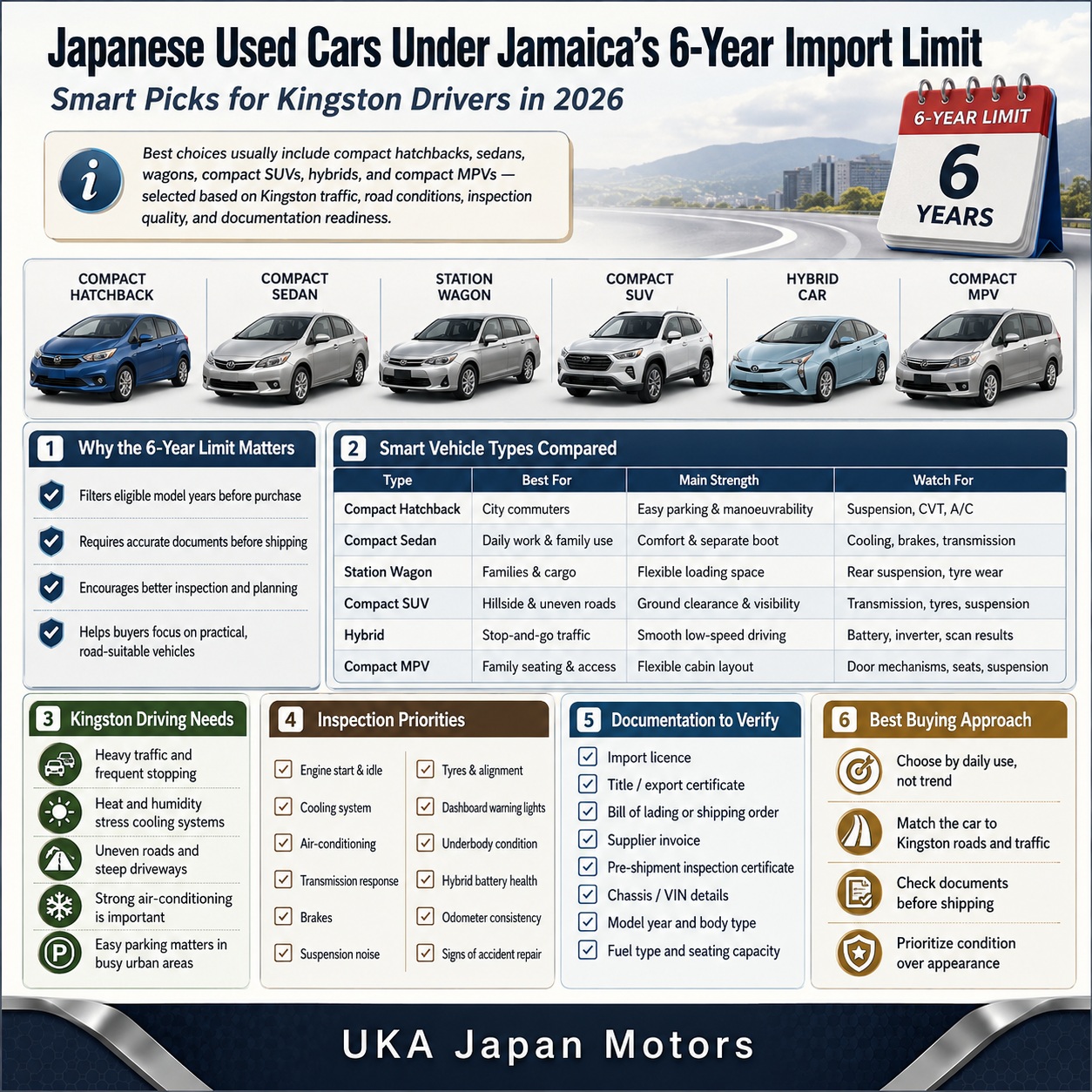
The smartest Japanese used cars under Jamaica’s six-year import limit for Kingston drivers in 2026 are usually compact hatchbacks, compact sedans, small station wagons, compact SUVs, and carefully inspected hybrids. These vehicle types suit Kingston because they handle stop-and-go traffic, tight parking, short daily trips, heat, humidity, and mixed road surfaces more comfortably than many larger or more complex vehicles.
Good categories to consider include:
Compact hatchbacks for single drivers, couples, students, and daily city commuters.
Compact sedans for drivers who want a more traditional shape, better boot separation, and comfortable daily movement around Kingston.
Station wagons for families, small business users, and drivers who need flexible luggage space without moving into a large vehicle.
Compact SUVs for drivers who frequently deal with uneven roads, steep driveways, rural family visits, or hillside areas.
Hybrids for drivers who understand battery inspection, electronic system checks, and the importance of proper documentation.
The right choice depends on how the vehicle will be used. A driver moving mainly between Half-Way Tree, New Kingston, Liguanea, Cross Roads, Portmore, and Spanish Town Road may need something very different from a driver who regularly climbs into Red Hills, Stony Hill, Jack’s Hill, or rural parish roads on weekends.
Why the 6-Year Import Limit Matters
The six-year limit matters because it narrows the selection window before the vehicle even reaches the inspection stage. A car may look suitable online or through supplier photos, but if its model year does not fit the import requirement, it can create serious problems during permit review and clearance. This is why model year, chassis details, body type, seating capacity, and supporting documents must be checked early.
For Kingston buyers, the import limit also encourages better planning. Many vehicles that meet the age requirement will still need careful assessment because Jamaica’s driving conditions can be demanding. Heat affects cooling systems, batteries, rubber seals, tyres, and interior materials. Humidity can expose weaknesses in electrical connectors, sensors, and underbody protection. City traffic keeps engines, transmissions, and hybrid systems operating at low speeds for long periods. Hillside driving places additional load on brakes, suspension, and engine cooling.
A six-year-old vehicle is not automatically a good vehicle. It is simply a vehicle that may be young enough to be considered under the import rule. The buyer still needs to ask whether the car is mechanically sound, properly documented, suited to local use, and reasonable to maintain over several years.
Understanding “Under the 6-Year Limit” in Practical Terms
For a 2026 Kingston buyer, the phrase “under the six-year import limit” should be treated as a documentation and eligibility issue first. The model year must be checked against the applicable import guidance, and the information on the export certificate, title, invoice, chassis number, and other records must match. Any uncertainty should be resolved before the vehicle is purchased or shipped.
A common mistake is to focus only on the year shown in a listing. Buyers should also check:
The model year stated on the official document.
The chassis or VIN details.
The body type and seating capacity.
The fuel type.
The engine size and engine code where available.
The odometer reading and whether it appears consistent.
The inspection certificate details.
The invoice details and supplier information.
The vehicle’s condition classification.
The import permit should not be treated as a formality. It is part of the protection process. A vehicle that seems attractive can become difficult to handle if the documentation is incomplete, inconsistent, or submitted late. Smart buying begins before the car is selected, not after it arrives.
Kingston Driving Conditions: What a Car Must Handle
Kingston is not a gentle testing ground for a used vehicle. Traffic can be slow and dense, especially around Half-Way Tree, Constant Spring Road, New Kingston, Cross Roads, Downtown Kingston, and major school or business corridors. A car may spend a lot of time idling, creeping forward, stopping suddenly, and restarting. That kind of driving places stress on cooling fans, air-conditioning systems, transmissions, brake pads, batteries, and engine mounts.
Road surfaces also vary. Some areas are smooth enough for small hatchbacks, while other routes include potholes, uneven repairs, steep ramps, open drainage edges, and rougher side roads. Coastal air can also affect exposed metal and electrical connections over time, while hillside communities require stronger braking confidence and reliable engine cooling.
This is why a smart pick for Kingston is not simply a stylish vehicle under six years old. It should have:
A reliable cooling system.
Strong air-conditioning performance.
Suspension that can cope with uneven roads.
Good ground clearance for normal Jamaican conditions.
A transmission suited to slow traffic.
Parts familiarity among local technicians.
Clear inspection and documentation history.
A cabin that remains comfortable in heat.
Reasonable tyre sizing for local availability.
Good visibility for tight parking and lane changes.
Smart Pick 1: Compact Hatchbacks
Compact hatchbacks are often among the most practical Japanese used cars for Kingston drivers. They are easy to park, simple to manoeuvre in traffic, and suitable for short daily trips. For drivers who spend most of their time between home, work, school, errands, and weekend movement within the Corporate Area, a hatchback can be a sensible choice.
Examples in this category may include Japanese-brand compact models such as Toyota Vitz/Yaris-type vehicles, Honda Fit-type vehicles, Suzuki Swift-type vehicles, Mazda Demio/Mazda2-type vehicles, and similar compact hatchbacks that fall within the eligible model-year window.
The main benefit of a compact hatchback is ease of use. In Kingston traffic, a smaller body helps with tight lanes, crowded parking areas, narrow plazas, and quick lane positioning. Hatchbacks also tend to be more flexible than they look because the rear seats can often fold to create extra loading space.
However, buyers should not assume every compact hatchback is suitable. Some have low front bumpers, delicate underbody trim, or tyre sizes that may not be ideal for rougher routes. A hatchback that works well in New Kingston may feel less comfortable on broken roads, steep driveways, or frequent hillside use.
A compact hatchback suits drivers who:
Travel mainly in Kingston and nearby urban areas.
Need easy parking and simple daily handling.
Usually carry one to three passengers.
Prefer a vehicle that feels light and manageable.
Do not regularly transport heavy loads.
It may not suit drivers who:
Frequently carry a full family with luggage.
Travel often on rougher rural routes.
Need high seating position.
Regularly use steep hillside roads with passengers and cargo.
When inspecting a compact hatchback, pay close attention to suspension noise, steering response, underbody condition, air-conditioning performance, engine mounts, and CVT behaviour if the vehicle uses a CVT transmission. Smooth low-speed movement is especially important for Kingston traffic.
Smart Pick 2: Compact Sedans
Compact sedans remain useful for Kingston drivers who want a balanced daily vehicle with a separate boot, comfortable seating, and a more settled road feel than some small hatchbacks. Japanese-brand sedans such as Toyota Corolla-type vehicles, Honda Grace-type vehicles, Mazda Axela-type vehicles, Nissan Sylphy-type vehicles, and similar models can be worth considering when they fall within the six-year window and pass inspection.
A sedan can be a smart pick for drivers who move between home, office, school, and family commitments. The separate boot keeps luggage away from the cabin, which is helpful for documents, tools, personal items, and groceries. Sedans also often feel more stable on main roads and longer parish drives than very small hatchbacks.
For Kingston use, a compact sedan should be judged by more than exterior condition. Check the cooling system, air-conditioning output, transmission response, brake feel, and suspension condition. Sedans often carry families, so rear-seat comfort and child-seat practicality may also matter.
A compact sedan suits drivers who:
Want a traditional daily vehicle.
Carry passengers regularly.
Need a separate boot.
Drive across Kingston and occasionally beyond.
Prefer a stable feel on main roads.
It may not suit drivers who:
Need maximum cargo flexibility.
Prefer a higher driving position.
Regularly use rougher roads or steep entrances.
Need very compact parking dimensions.
The main contrast between a hatchback and a sedan is flexibility versus separation. A hatchback gives more cabin-loading flexibility, while a sedan gives better boot separation and often a more mature road feel. For Kingston drivers, the choice should depend on daily routine rather than appearance alone.
Smart Pick 3: Small Station Wagons
Small station wagons can be excellent choices for Kingston drivers who need more space but do not want a large SUV. Japanese-brand wagon models such as Toyota Fielder-type vehicles and similar compact wagons can suit families, small business users, teachers, field workers, and drivers who regularly carry equipment or luggage.
The station wagon body style is useful because it provides a longer cargo area while keeping the vehicle relatively easy to drive. For Kingston, this can be helpful for school runs, supermarket trips, work materials, sports gear, and family movement. A wagon can also be more stable than a tall vehicle while offering more loading flexibility than a sedan.
The key issue is condition. Wagons are sometimes used more heavily because of their practical shape. Buyers should inspect the rear suspension, cargo area trim, tailgate condition, rear shocks, tyre wear, and signs of heavy loading. A clean-looking wagon may still have suspension fatigue if it has carried loads regularly.
A small station wagon suits drivers who:
Need flexible cargo space.
Carry family items or work materials.
Want more room than a hatchback.
Prefer a lower vehicle than an SUV.
Need a practical all-purpose daily car.
It may not suit drivers who:
Want higher ground clearance.
Rarely use extra cargo space.
Prefer the smallest possible vehicle for tight city parking.
Need a very high seating position.
For Kingston buyers, a station wagon can be one of the most sensible under-six-year choices when the inspection report is strong and the vehicle has not been overworked. The practicality is real, but the buyer must look beyond the clean exterior.
Smart Pick 4: Compact SUVs
Compact SUVs are popular because they offer a higher seating position, easier entry and exit, and better confidence on uneven roads. For Kingston drivers who frequently move through areas with rougher road surfaces, steep driveways, rainfall runoff, or hillside routes, a compact SUV can be more comfortable than a low hatchback or sedan.
Japanese-brand compact SUVs such as Toyota Raize-type vehicles, Honda Vezel-type vehicles, Nissan Juke-type vehicles, Mazda CX-3-type vehicles, Suzuki Vitara-type vehicles, and similar models may be worth considering if they meet the import age requirement and pass proper inspection.
The benefit of a compact SUV is not just appearance. A slightly higher seating position can improve visibility in traffic. The body shape can also be easier for older passengers or family members who prefer not to sit too low. Ground clearance can help on uneven entrances, rougher side roads, and areas affected by heavy rain.
However, compact SUVs should be inspected carefully. Some models use more complex transmissions, hybrid systems, or electronic controls. Larger tyres and suspension parts may also require more planning. A compact SUV is useful only when its condition and maintenance needs are understood.
A compact SUV suits drivers who:
Use hillside routes regularly.
Want easier entry and exit.
Need more confidence on uneven roads.
Carry family members often.
Prefer a higher driving position.
It may not suit drivers who:
Drive mainly short urban routes with easy parking.
Prefer the simplest possible mechanical layout.
Do not need extra ground clearance.
Want a low, compact body for tight spaces.
The contrast between a compact SUV and a station wagon is important. A wagon usually gives better cargo length and a lower loading floor, while a compact SUV gives height, visibility, and ground clearance. Kingston drivers should decide based on roads, passengers, and cargo habits.
Smart Pick 5: Carefully Inspected Hybrids
Hybrids are now a major part of the Japanese used car conversation in Jamaica. For Kingston’s stop-and-go driving, a hybrid can feel smooth and efficient because the system is designed to manage low-speed movement and frequent stopping. Models such as Toyota Aqua-type vehicles, Toyota Prius-type vehicles, Honda Fit Hybrid-type vehicles, Honda Grace Hybrid-type vehicles, Toyota Corolla Hybrid-type vehicles, and similar options may appeal to drivers who understand the importance of battery and electronic inspection.
A hybrid can be a smart pick, but only when documentation and condition are properly checked. The hybrid battery, inverter, cooling fan, warning lights, dashboard messages, scan results, and service history should be reviewed carefully. Buyers should avoid judging a hybrid only by exterior condition or mileage.
In Kingston, hybrid vehicles face a mix of benefits and stresses. Slow traffic can suit hybrid operation, but heat and poor maintenance can affect battery cooling. Dust, humidity, and neglected cabin filters can also affect hybrid battery ventilation in some vehicles. A hybrid that has been properly inspected can be suitable; one with unclear battery condition can become a concern.
A hybrid suits drivers who:
Spend long periods in city traffic.
Want smooth low-speed driving.
Understand inspection requirements.
Plan to maintain the vehicle properly.
Have access to technicians familiar with hybrid systems.
It may not suit drivers who:
Do not want battery-system checks.
Prefer very simple mechanical systems.
Ignore dashboard warning lights.
Need a vehicle for rougher usage with minimal electronic complexity.
The key comparison is hybrid versus non-hybrid. A non-hybrid may be simpler to inspect and maintain, while a hybrid can be more refined in traffic but requires more careful electronic and battery assessment. Neither is automatically better. The better choice is the one that matches the buyer’s usage and willingness to maintain the system properly.
Smart Pick 6: Compact MPVs for Family Use
Some Kingston families need more flexibility than a sedan or hatchback can provide, but they may not want a large vehicle. Compact MPV-style Japanese vehicles, such as Toyota Sienta-type models and similar small multi-purpose vehicles, can be useful where seating flexibility is more important than style.
An MPV can work well for school runs, family errands, church activities, weekend visits, and carrying children or older relatives. Sliding doors, flexible seating, and a taller cabin can make daily use easier in tight parking spaces. For Kingston households with mixed needs, this body style can be practical.
Inspection matters because MPVs often carry passengers regularly. Check door mechanisms, seat rails, rear air-conditioning if fitted, suspension, tyres, brakes, and signs of heavy family or commercial-type use. A compact MPV may look clean but still have worn interior fittings if used heavily.
A compact MPV suits drivers who:
Need flexible seating.
Carry children or relatives often.
Value easy cabin access.
Use the vehicle for family routines.
Need more cabin space than a sedan.
It may not suit drivers who:
Usually drive alone.
Prefer a sportier road feel.
Need high ground clearance.
Want the simplest cargo layout.
Compared with a compact SUV, a compact MPV often gives better passenger access and interior flexibility. The SUV gives better height and road confidence. Families should think about who enters the vehicle every day, what they carry, and where they drive most often.
Model-Year Thinking for 2026 Buyers
In 2026, buyers should treat model year as a first-stage filter. A vehicle that is outside the acceptable age range should not move forward, no matter how attractive it appears. For cars, station wagons, and SUVs under the six-year import rule, buyers should focus on vehicles whose official model-year documentation fits the import window.
The safest approach is to confirm eligibility before committing. That means checking the official document, not only the seller’s listing. The model year should match across the export certificate or title, invoice, chassis details, and permit application. Any mismatch should be resolved before shipping.
A smart 2026 buyer should also consider the vehicle’s remaining ownership life in Jamaica. A car may enter within the age limit, but it must still serve reliably after registration. A vehicle with poor maintenance history, unclear mileage, weak air-conditioning, or early transmission symptoms may create more concern than an older-looking but better-documented vehicle that still meets the rule.
Inspection Priorities Before Choosing a Vehicle
Inspection is central to smart buying. Under the six-year limit, many vehicles will appear modern and clean, but condition still varies. Buyers should look for evidence rather than assumptions.
Important inspection points include:
Engine start-up behaviour.
Idle smoothness.
Cooling fan operation.
Radiator and coolant condition.
Air-conditioning strength.
Transmission engagement.
Brake feel and brake noise.
Suspension noise over bumps.
Steering response.
Tyre condition and tyre date.
Underbody rust or repairs.
Signs of flood exposure.
Dashboard warning lights.
Odometer consistency.
Hybrid battery condition where applicable.
Electronic system scan results.
Interior wear compared with mileage.
Seatbelt, airbag, and safety-system condition.
For Kingston use, cooling and air-conditioning deserve special attention. A weak air-conditioning system can make daily commuting uncomfortable, while cooling system weakness can become serious in slow traffic. Transmission condition is also important because stop-and-go driving exposes hesitation, shuddering, slipping, or delayed engagement.
The inspection should also consider whether the car is suitable for Jamaica’s surfaces. Low-profile tyres, very low bumpers, stiff suspension, or unusual wheel sizes may look appealing but can be less practical for daily use.
Documentation: What Buyers Should Check
Documentation is not separate from vehicle quality. It is part of the buying decision. A clean, well-presented car with incomplete records should be treated carefully. In Jamaica’s import process, the documents help confirm identity, eligibility, ownership history, and clearance readiness.
Key documentation areas include:
Import licence.
Title or export certificate.
Bill of lading or shipping order.
Supplier invoice.
Tax Compliance Certificate where applicable.
Customs declaration prepared by a licensed customs broker.
Pre-shipment inspection certificate for used vehicles.
Chassis or VIN details.
Model year.
Seating capacity.
Fuel type.
Engine information.
Odometer reading.
Body type.
Colour.
Unladen weight where relevant.
The vehicle details should be consistent across documents. A mismatch in model year, chassis number, seating capacity, or body type can delay processing or raise questions. For Kingston buyers who need the vehicle for daily work or family use, delays can be frustrating, so document accuracy should be checked early.
Matching Vehicle Type to Driver Need
A smart pick is not the same for every driver. The best vehicle depends on daily routes, passengers, parking, road surface, and long-term maintenance expectations.
For a single commuter in Kingston, a compact hatchback can be ideal. It is easy to park, simple to handle, and well suited to short trips.
For a professional or small family, a compact sedan may offer a better balance of comfort, boot space, and daily road stability.
For a family that carries school bags, groceries, sports gear, or work items, a station wagon can make more sense than a sedan.
For a driver who lives in a hillside community or frequently travels on uneven roads, a compact SUV may offer better confidence.
For a driver who spends much of the day in traffic and understands electronic inspection, a hybrid may be suitable.
For a household carrying children or older relatives, a compact MPV may offer the best cabin access.
The mistake is choosing by trend rather than use. A popular model can still be the wrong vehicle if it does not match the driver’s actual life.
Ownership Considerations After Import
A vehicle’s suitability does not end at registration. The first year of ownership is important because the car adjusts from import condition to daily Jamaican use. New owners should establish a maintenance baseline early.
Useful first-stage checks include:
Engine oil and filter condition.
Transmission fluid condition where serviceable.
Coolant condition.
Brake fluid condition.
Battery health.
Tyre condition.
Wheel alignment.
Suspension inspection.
Air-conditioning service check.
Cabin filter and engine air filter.
Hybrid cooling fan cleaning where applicable.
Diagnostic scan.
Underbody review.
These checks help the owner understand the vehicle’s true starting point. Even a recent model can need attention if it was stored, shipped, or previously maintained inconsistently.
For Kingston use, owners should also monitor tyre pressure, cooling performance, brake feel, and any warning lights. Small issues can become larger when a car is used daily in traffic and heat.
Vehicles That May Look Attractive but Need Extra Caution
Some vehicles under the six-year limit may look modern but require extra caution. This does not mean they should be avoided automatically. It means the inspection should be more detailed.
Be careful with vehicles that have:
Unusual tyre sizes.
Very low ground clearance.
Complex electronic features with warning lights.
Unclear hybrid battery condition.
Inconsistent odometer records.
Heavy interior wear.
Signs of accident repair.
Weak air-conditioning.
Transmission hesitation.
Missing export or inspection details.
Water stains or musty smells.
Rust on underbody components.
Non-standard modifications.
Missing spare key or key-system issues.
A smart Kingston buyer should avoid being guided only by paint shine, screen size, or seat design. Mechanical condition, documentation, and practical fit matter more.
Comparison Table: Which Type Fits Which Kingston Driver?
| Vehicle Type | Best For | Main Strength | Inspection Focus | May Not Suit |
|---|---|---|---|---|
| Compact hatchback | City commuters and easy parking | Manoeuvrability | Suspension, CVT, air-conditioning | Heavy family use or rough routes |
| Compact sedan | Daily work and family movement | Comfort and boot separation | Cooling, brakes, transmission | Drivers needing flexible cargo space |
| Small station wagon | Families and cargo flexibility | Practical loading area | Rear suspension, tailgate, tyre wear | Drivers wanting higher ground clearance |
| Compact SUV | Hillside and uneven-road users | Visibility and clearance | Transmission, suspension, tyres | Drivers needing the smallest city car |
| Hybrid hatchback/sedan | Stop-and-go traffic | Smooth low-speed driving | Battery, inverter, scan results | Buyers avoiding electronic complexity |
| Compact MPV | Family access and flexible seating | Cabin practicality | Sliding doors, seats, suspension | Drivers usually travelling alone |
This comparison should be used as a thinking tool, not a fixed rule. The better vehicle is the one that fits the driver’s daily pattern and passes a proper inspection.
Practical Kingston Examples
A driver commuting from Portmore into New Kingston may value strong air-conditioning, smooth transmission behaviour, and comfortable seating because the vehicle may sit in slow traffic for long periods. A compact sedan, hatchback, or hybrid may work well if inspected properly.
A driver living in Stony Hill, Red Hills, or Jack’s Hill may place more value on ground clearance, braking strength, cooling performance, and low-speed hill response. A compact SUV may be more suitable than a low hatchback.
A parent managing school runs around Liguanea, Mona, Constant Spring, or Half-Way Tree may need easy parking but also useful rear-seat access. A compact hatchback, sedan, wagon, or compact MPV could all work depending on passenger needs.
A small business operator moving samples, documents, tools, or supplies around Kingston may prefer a station wagon because it gives flexible cargo space without the size of a larger vehicle.
A driver who mostly uses the car for short errands may not need a large engine, large body, or complicated feature list. A simple compact vehicle can be more practical.
Why Vehicle Condition Matters More Than Listing Appeal
Photos and descriptions can only tell part of the story. A vehicle may appear clean but still have hidden issues. Underbody condition, accident repair quality, electronic faults, and drivetrain behaviour are not always obvious from images.
For Japanese used cars under the six-year limit, buyers often assume the vehicle must be in good shape because it is relatively recent. That assumption can be risky. A six-year eligible car can still have poor maintenance history, worn tyres, weak brakes, or hybrid concerns. A proper inspection reduces uncertainty.
In Jamaica, where daily use can involve heat, traffic, hills, and uneven surfaces, small weaknesses can become noticeable quickly. That is why inspection should be treated as part of the selection process, not an afterthought.
UKA Japan Motors’ Role in the Buying Process
UKA Japan Motors’ role is to help buyers approach Japanese used car selection with documentation awareness, inspection discipline, and practical guidance. The process should not be based on excitement alone. It should include checking whether the vehicle fits Jamaica’s import requirements, whether the documents are consistent, and whether the vehicle is suitable for Kingston driving conditions.
A trust-based approach means looking beyond surface appeal. UKA Japan Motors can guide buyers through model suitability, inspection considerations, import documentation, age-limit awareness, and the practical questions that affect ownership after registration. This includes helping buyers think through vehicle type, daily use, seating needs, road conditions, hybrid inspection, and long-term maintenance expectations.
The goal is clarity. Buyers should understand why a particular vehicle suits them, what needs to be checked before import, and what ownership responsibilities come after the vehicle is registered in Jamaica.
Frequently Asked Questions
1. What does Jamaica’s six-year import limit mean for Japanese used cars?
It means the vehicle’s age must fall within the permitted import window for its category. For cars, station wagons, and SUVs, buyers should confirm model-year eligibility before purchase or shipping. The official documents should support the model year being used for the import application.
2. Does a vehicle under six years old automatically make it a good choice?
No. Age eligibility only means the vehicle may qualify under the import rule. The car still needs proper inspection, clear documentation, suitable condition, and practical fit for Jamaican roads.
3. Which body type is best for Kingston driving?
There is no single best body type. Compact hatchbacks are strong for parking and city movement. Sedans are balanced for daily comfort. Station wagons are useful for cargo. Compact SUVs help with uneven roads and hillside driving. Hybrids can suit traffic when properly inspected.
4. Are hybrids suitable for Kingston?
Hybrids can be suitable for Kingston because stop-and-go traffic is common. However, hybrid battery condition, cooling systems, warning lights, and electronic scan results must be checked carefully before selection.
5. What should I inspect first on a Japanese used car?
Start with documentation, model year, chassis details, inspection certificate, engine condition, transmission behaviour, cooling system, air-conditioning, suspension, tyres, brakes, underbody condition, and any dashboard warning lights.
6. Why is air-conditioning such an important inspection point?
Kingston’s heat and traffic make air-conditioning more than a comfort feature. Weak cooling can affect daily usability, especially during long waits in traffic. It may also point to maintenance needs within the system.
7. Is a compact SUV always better for Jamaica?
No. A compact SUV can be useful for ground clearance, visibility, and hillside routes, but it may not be necessary for every driver. A hatchback, sedan, or wagon may be more practical depending on daily use.
8. Are station wagons good choices for families?
Yes, a small station wagon can be very practical for families because it provides useful cargo space while staying manageable in Kingston. Buyers should inspect rear suspension, tyre wear, and signs of heavy use.
9. What documents should be checked before importing?
Important documents include the import licence, title or export certificate, bill of lading or order, supplier invoice, relevant tax compliance documentation, customs declaration documents, and pre-shipment inspection certificate for used vehicles.
10. Why does the chassis or VIN matter?
The chassis or VIN helps confirm the vehicle’s identity. It should match across documents and the vehicle itself. Any mismatch can create serious documentation concerns.
11. Can a clean-looking vehicle still be risky?
Yes. A vehicle can look clean but still have accident repairs, electronic faults, weak air-conditioning, worn suspension, battery issues, or inconsistent records. Inspection helps reveal issues that photos may not show.
12. How should a buyer choose between a hatchback, sedan, wagon, SUV, hybrid, or MPV?
The buyer should start with daily use. Consider routes, passengers, parking, cargo, hills, road surface, and maintenance expectations. The best vehicle is the one that fits the owner’s real driving life and passes inspection.
Conclusion
Japanese used cars under Jamaica’s six-year import limit can be strong choices for Kingston drivers in 2026 when selected carefully. The import rule helps define the eligible model-year range, but it does not replace inspection, documentation checks, or practical judgement. A smart pick is not simply the newest-looking vehicle. It is the vehicle that meets the import requirement, has consistent documents, passes condition checks, and suits the owner’s daily routine in Jamaica.
For some drivers, that will be a compact hatchback. For others, it will be a sedan, station wagon, compact SUV, hybrid, or compact MPV. Each category has strengths and limitations. The right decision comes from matching the vehicle to Kingston traffic, local roads, heat, humidity, parking needs, family use, and long-term maintenance.
A careful buyer should confirm model-year eligibility, review documentation, inspect mechanical and electronic systems, and think beyond first impressions. With the right guidance, the six-year import limit can become a useful filter rather than a source of confusion.
Contact UKA Japan Motors for availability and inspection guidance.