


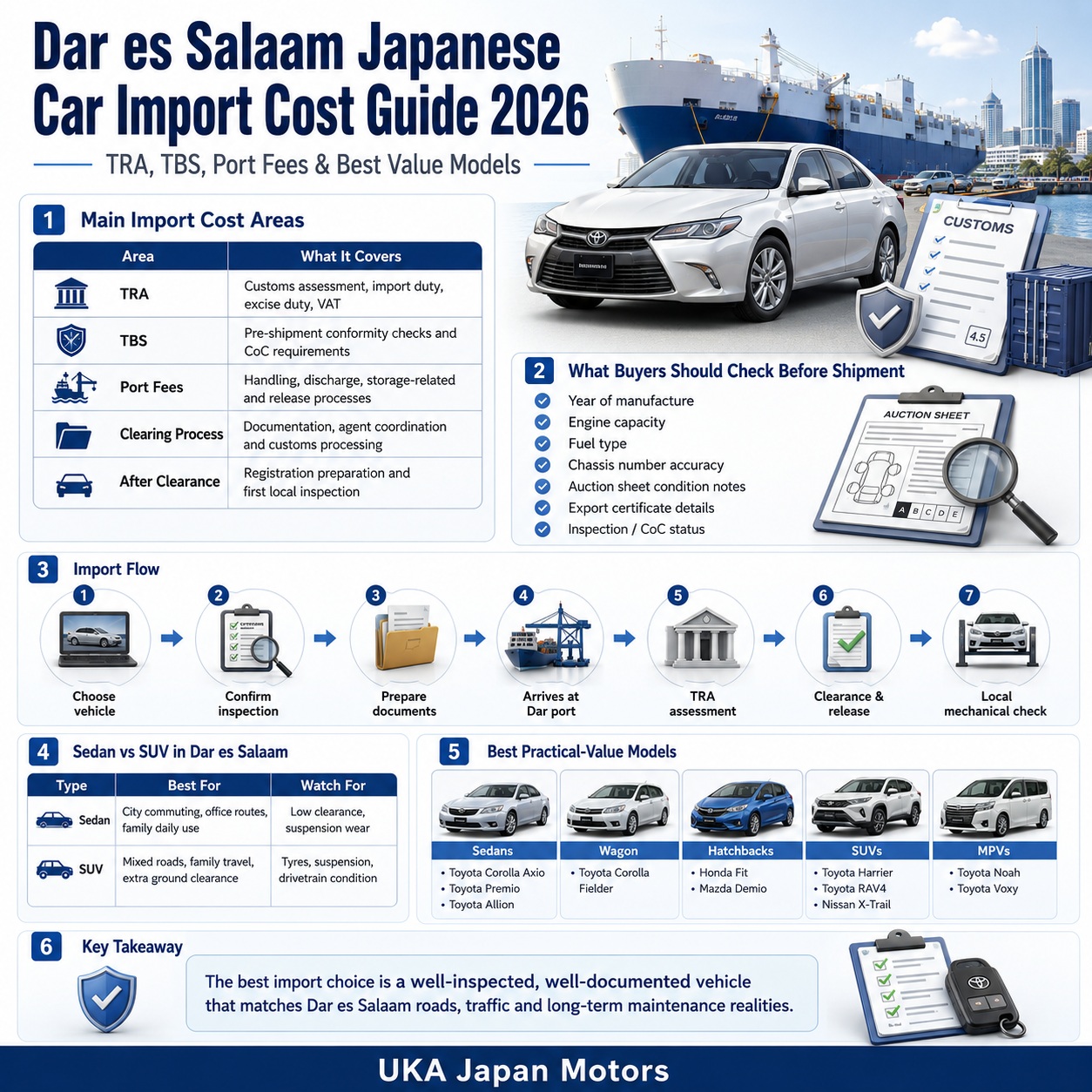
Importing a Japanese car into Dar es Salaam in 2026 is not only about selecting a clean vehicle and waiting for it to arrive at the port. The real process involves several connected stages: vehicle selection, export inspection, shipping documentation, TRA assessment, TBS conformity requirements, port handling, customs clearance, registration and final road-use preparation.
For many buyers in Dar es Salaam, the most confusing part is not the car itself. It is understanding why one vehicle clears smoothly while another vehicle faces delays, extra checks or unexpected compliance issues. A Japanese car may look attractive from photos, but its final suitability depends on its age, engine size, inspection condition, documentation accuracy, port handling status and how well it fits daily use in Tanzania.
This guide explains the main import cost drivers and compliance steps without publishing figure-based estimates. That approach is important because official assessments depend on current rules, declared vehicle details, customs valuation, inspection status and the documents submitted during clearance. Instead of relying on rough assumptions, this article focuses on what buyers in Dar es Salaam should understand before committing to a Japanese vehicle import in 2026.
Direct Answer: What Should a Dar es Salaam Buyer Know First?
A Japanese car import into Dar es Salaam is shaped by five main areas: TRA tax assessment, TBS inspection and conformity requirements, Dar es Salaam port handling, registration requirements and the long-term suitability of the model.
The most important early decision is choosing the right vehicle before shipment. A model with a clean inspection history, manageable engine size, good parts support, practical ground clearance and strong daily-use reliability will usually create a smoother ownership experience than a model chosen only because it looks attractive online.
For Dar es Salaam buyers, practical-value models usually come from categories that match local use: compact hatchbacks for city driving, sedans for daily commuting, wagons for family and business movement, SUVs for mixed road conditions, and MPVs for households that need flexible seating. The best choice is not always the biggest or most stylish vehicle. It is the one whose documentation, condition, inspection profile and ownership needs align with Tanzanian roads and regulations.
Why This Topic Matters in Dar es Salaam
Dar es Salaam is Tanzania’s main vehicle import gateway and the busiest ownership environment for many imported Japanese cars. A buyer may use the same car for office commuting, family errands, school runs, weekend travel, business movement and occasional long-distance trips to Morogoro, Dodoma, Tanga or Arusha.
This mixed use makes import planning important. A vehicle that works well on smooth urban roads may feel less suitable on rougher access roads, during rainy-season traffic or when loaded with passengers and luggage. Dar es Salaam traffic also exposes cars to heat, idling, stop-and-go movement and frequent braking. These conditions affect cooling systems, automatic transmissions, hybrid batteries, suspension components and air-conditioning systems.
The import process matters because documentation mistakes can slow clearance. Inspection gaps can cause additional checks. Poor model selection can create long-term ownership inconvenience. A buyer who understands TRA, TBS and port clearance before selecting the vehicle is better prepared than one who begins the process after the vehicle is already on the water.
How TRA Fits Into Japanese Car Importing
TRA is central to customs assessment and vehicle clearance. For imported Japanese vehicles, TRA looks at details such as vehicle description, age, engine capacity, customs value, import classification and supporting documentation. The vehicle cannot move into normal local use until the required customs process is completed.
A Dar es Salaam buyer should understand that TRA assessment is not based on a single simple item. It is built around the vehicle’s declared particulars and the rules that apply at the time of clearance. Important details include the year of manufacture, model code, engine size, fuel type, body type, seating capacity and vehicle category.
This is why accuracy matters at the buying stage. If the auction sheet, export certificate, invoice, bill of lading and inspection documents do not align, the clearance process may require clarification. Even small inconsistencies can create delays because customs and registration depend on correct identification.
TRA-Related Factors Buyers Should Review Before Shipment
A buyer should review the following before the vehicle leaves Japan:
| Factor | Why It Matters in Dar es Salaam Importing |
|---|---|
| Year of manufacture | Affects age-related assessment and suitability for long-term use |
| Engine capacity | Influences vehicle classification and ownership practicality |
| Fuel type | Matters for maintenance planning and parts familiarity |
| Seating capacity | Helps identify the correct vehicle category |
| Body type | Distinguishes hatchback, sedan, wagon, SUV, van or MPV use |
| Chassis number | Must match documents and physical vehicle identity |
| Auction grade and condition notes | Helps reveal accident history, corrosion, mechanical issues or repairs |
| Export certificate details | Supports legal export identity and local clearance |
The best time to detect a problem is before purchase. Once a vehicle is shipped, correcting mismatched information becomes more difficult.
How TBS Inspection Affects the Import Process
TBS plays an important role in confirming that regulated imports meet required standards before entering Tanzania. For used Japanese vehicles, the Pre-Shipment Verification of Conformity process is especially important. A Certificate of Conformity helps support smoother clearance because it shows that the vehicle was inspected before shipment.
For Dar es Salaam buyers, TBS compliance should not be treated as a final-stage detail. It should be part of the buying decision from the beginning. A car with uncertain inspection status, questionable repair history or incomplete export documentation may create more administrative pressure when it reaches the port.
TBS inspection is not only a formality. It helps protect buyers from vehicles with serious condition issues, missing conformity documentation or standards-related complications. In practical terms, it encourages buyers to look beyond exterior appearance and check structural condition, mileage consistency, emissions-related systems, lights, tyres, braking components and overall roadworthiness.
Why Pre-Shipment Checks Are Better Than Waiting Until Arrival
Pre-shipment checking gives the buyer time to avoid unsuitable vehicles before shipping. Once the vehicle arrives in Dar es Salaam, options become more limited. A car that fails a requirement after arrival may require further inspection, documentation follow-up or corrective steps.
Before shipment, a buyer can still choose another unit, request clearer photos, review the auction sheet more carefully or reject a vehicle with suspicious history. After arrival, the buyer is already committed to clearance steps.
A good import plan therefore starts with inspection-led selection, not appearance-led selection.
Understanding Dar es Salaam Port Fees and Handling
Dar es Salaam port is where the import process becomes physical. The vehicle is discharged, handled, stored where applicable, verified and released after the necessary clearance steps. Port-related items may vary depending on shipping method, cargo status, handling requirements, timing and the way the vehicle is processed.
Buyers should understand that port fees are not the same as TRA taxes. TRA deals with customs assessment and tax-related clearance. Port fees relate to services and handling connected to the port environment. These may include landing, handling, storage-related situations, movement within the port, documentation-linked processes or other port-service categories.
The most important practical point is timing. A vehicle that clears quickly is easier to manage than one delayed by missing documents, late agent appointment, unresolved inspection issues or unclear payment instructions. Delays can create additional administrative pressure and may affect the overall clearance experience.
What Usually Causes Port Clearance Delays?
Dar es Salaam buyers should watch for these issues:
| Delay Cause | Practical Meaning |
|---|---|
| Late appointment of clearing agent | Documents may not be lodged early enough |
| Missing or inconsistent invoice details | Clearance may require explanation |
| Bill of lading mismatch | Vehicle identity or consignee details may need correction |
| Missing conformity documents | TBS-related checks may slow movement |
| Unclear chassis number record | Physical verification may require extra attention |
| Arrival before document readiness | Vehicle reaches port while paperwork is incomplete |
| Poor communication between buyer, exporter and agent | Instructions may be delayed or duplicated |
The best way to reduce risk is to prepare documents before the vessel arrives, confirm the agent’s instructions and avoid waiting until the car is already at the port.
Import Documentation: What Buyers Should Prepare
A Japanese vehicle import into Dar es Salaam usually requires a complete and consistent document set. The buyer, exporter and clearing agent should coordinate early so that customs and port processes are not slowed by missing paperwork.
Typical document areas include:
| Document Area | Purpose |
|---|---|
| Final invoice | Supports declared purchase and vehicle details |
| Bill of lading | Confirms shipment and consignee information |
| Export certificate | Shows legal export identity from Japan |
| Inspection certificate or CoC | Supports TBS conformity requirements |
| Importer authorization | Allows the clearing agent to act on behalf of the importer |
| Packing or shipment details where applicable | Supports cargo identification |
| Identification and tax records | Supports local ownership and registration processing |
The exact document handling should be guided by the clearing agent and current official requirements. Buyers should avoid relying on informal lists shared without context because requirements may depend on the vehicle category and clearance situation.
Step-by-Step Import Flow for Dar es Salaam Buyers
The process is easier to understand when broken into stages.
Stage 1: Choose the Right Vehicle
Start with the intended use. A Dar es Salaam commuter who mostly drives between home, office and school routes may not need the same vehicle as a family travelling regularly to Morogoro or Dodoma. A buyer in areas with rough access roads may need more ground clearance than someone using mainly paved city routes.
At this stage, inspect the auction sheet, body condition, mileage consistency, service record clues, engine type and parts availability.
Stage 2: Confirm Compliance Before Shipment
Before the vehicle leaves Japan, confirm whether the required inspection and conformity process can be completed. This is where TBS-related planning becomes important. The goal is to avoid importing a vehicle that creates avoidable difficulty after arrival.
Stage 3: Prepare Documents Early
The importer should appoint a licensed clearing and forwarding agent and ensure documents are ready before vessel arrival. Waiting until the vehicle reaches Dar es Salaam can slow the process.
Stage 4: Vehicle Arrives at Dar es Salaam Port
Once the vessel arrives, the vehicle is discharged and handled according to port procedures. The agent coordinates customs declaration, document submission and related clearance steps.
Stage 5: TRA Assessment and Clearance
TRA assessment is based on vehicle details and applicable rules. Any inconsistency in age, chassis number, engine size, model code or invoice details may require clarification.
Stage 6: Release and Registration Preparation
After clearance, the vehicle moves toward registration and road-use preparation. This may include number plate processes, roadworthiness checks, insurance arrangements and mechanical inspection before daily use.
Stage 7: First Local Mechanical Check
Even after a clean import process, the vehicle should be checked locally. Dar es Salaam heat, traffic and road conditions make it wise to inspect fluids, tyres, cooling system, brakes, suspension and battery condition before regular driving.
Why Vehicle Age Matters
Vehicle age matters for both compliance and ownership. From an import perspective, age can affect the way the vehicle is assessed. From an ownership perspective, age affects wear patterns, parts replacement needs and inspection confidence.
Older vehicles may still be usable if they are well maintained, but buyers should be more careful with underbody condition, suspension wear, engine leaks, dashboard warning lights and prior accident repairs. In Dar es Salaam, where traffic heat and frequent idling are common, older cooling systems and automatic transmissions deserve particular attention.
Newer used vehicles may offer improved safety features, cleaner interiors and more modern fuel systems, but they can also include electronic systems that require proper diagnostics. The practical choice is not simply “newer is always better.” It is whether the specific vehicle is clean, well documented and suitable for local maintenance.
Why Engine Size Matters
Engine size affects both import classification and daily ownership feel. A smaller engine may suit city driving, lighter body weight and lower-speed traffic. A larger engine may feel stronger when carrying passengers, climbing steeper roads or travelling outside Dar es Salaam, but it can also require more attention to fuel planning and maintenance.
The key is matching engine size to body size and use. A compact hatchback with a small engine may be practical in dense city routes. A large SUV with a small engine may feel strained when fully loaded. A heavy MPV may need a powertrain that handles passengers and air-conditioning without constant stress.
For Dar es Salaam, the best engine is not always the smallest or largest. It is the one that gives balanced performance, service familiarity and durability for the buyer’s real route pattern.
Comparing Main Japanese Vehicle Categories for Dar es Salaam
| Category | Best Suited For | Local Strengths | Watch Carefully |
|---|---|---|---|
| Compact hatchback | City commuting and light errands | Easy to park, simple to handle in traffic | Ground clearance, rear space, hybrid battery if applicable |
| Sedan | Daily office use and family commuting | Comfortable, stable, familiar parts support | Suspension wear, low front bumper clearance |
| Wagon | Family and small business movement | Flexible cargo space, practical cabin | Rear suspension, hatch seals, load wear |
| SUV | Mixed city and rough-road use | Ground clearance, stronger road presence | Tyres, suspension, fuel system, body repairs |
| MPV | Larger families and passenger movement | Sliding doors, seating flexibility | Transmission, cooling system, rear air-conditioning |
| Hybrid | City traffic and fuel-conscious driving | Smooth stop-and-go movement | Battery health, inverter cooling, diagnostic history |
This comparison shows why the best vehicle depends on the buyer’s daily life. A buyer in central Dar es Salaam may prioritise compact handling, while a household travelling often between Dar es Salaam and Dodoma may prefer comfort, luggage space and stronger highway stability.
Best Practical-Value Japanese Models for Dar es Salaam in 2026
The following models are selected because they often align well with Tanzanian ownership realities: parts familiarity, road suitability, manageable maintenance, inspection confidence and practical daily usability. This is not a ranking by price. It is a practical ownership guide.
Toyota Corolla Axio
The Corolla Axio is a strong choice for buyers who want a simple sedan for daily commuting in Dar es Salaam. It suits office travel, family movement and regular city routes. Its size makes it easier to manage in traffic, and its mechanical layout is familiar to many local technicians.
Buyers should check suspension wear, dashboard warning lights, accident repair signs and interior condition. A clean Axio with consistent documentation can be a sensible import choice for buyers who want straightforward ownership.
Toyota Corolla Fielder
The Corolla Fielder adds cargo flexibility to the Corolla platform. It suits families, small business owners and drivers who carry luggage, supplies or work equipment. In Dar es Salaam, the wagon body is useful because it remains manageable in traffic while offering more rear space than a sedan.
Buyers should inspect the rear suspension, boot area, tailgate seals and signs of heavy loading. Hybrid versions should be checked with proper diagnostics.
Toyota Premio
The Toyota Premio remains popular because of its comfort, smooth driving feel and strong familiarity in Tanzania. It suits buyers who want a refined sedan for city driving and longer trips to places such as Morogoro or Dodoma.
The main checks are body condition, mileage consistency, suspension health and engine performance. Because many buyers like Premio models, clean documentation and inspection records are especially important.
Toyota Allion
The Allion shares many practical strengths with the Premio but feels slightly different in design and road character. It suits buyers who want a comfortable sedan with a balanced cabin and familiar service support.
As with the Premio, the buyer should look closely at accident history, underbody condition and engine performance. Dar es Salaam roads can expose worn shock absorbers and bushings, so suspension inspection is important.
Honda Fit
The Honda Fit is a compact hatchback that works well in dense city traffic. It is suitable for buyers who need easy parking, flexible interior space and daily movement within Dar es Salaam. Hybrid versions can be attractive for city use, but battery and transmission checks are essential.
Buyers should inspect gearbox behaviour, hybrid system health where applicable, dashboard warnings and underbody condition. A Fit should be chosen carefully, not casually, because condition varies widely from one unit to another.
Mazda Demio
The Mazda Demio is compact, agile and suitable for city driving. It can work well for buyers who mostly drive within Dar es Salaam and do not need large passenger or cargo capacity.
The key checks include engine condition, transmission feel, suspension noise and dashboard electronics. Buyers should also consider parts familiarity in their preferred service area.
Toyota Harrier
The Toyota Harrier suits buyers who want comfort, ground clearance and a more premium SUV feel. It can handle mixed Dar es Salaam use better than low sedans when roads are uneven or when the vehicle is used for longer trips.
The buyer should inspect suspension components, tyres, body repairs, engine condition and electronic systems. Because the Harrier has more features than simpler models, inspection quality matters.
Toyota RAV4
The Toyota RAV4 is practical for buyers who need SUV usefulness without moving into very large vehicle territory. It is suitable for mixed routes, family travel and buyers who want a stronger road stance.
Checks should include drivetrain condition, suspension, underbody, tyres and signs of previous rough use. The RAV4 is a good example of a vehicle where clean condition matters more than visual appeal.
Nissan X-Trail
The Nissan X-Trail can suit buyers who want SUV practicality and cabin flexibility. It can work for Dar es Salaam families and drivers who occasionally travel beyond the city.
Buyers should pay close attention to transmission condition, service history clues, engine performance and suspension health. A proper diagnostic scan is strongly recommended before committing to this model.
Toyota Noah and Toyota Voxy
The Toyota Noah and Voxy are practical MPVs for larger households, school runs, family activities and passenger movement. Their sliding doors are useful in tight parking areas, and the cabin layout is highly flexible.
Buyers should inspect the transmission, cooling system, rear air-conditioning, sliding door mechanisms and suspension. These vehicles are often used heavily, so a clean unit is far better than a tired one with attractive photos.
Sedan vs SUV: Which Makes More Sense in Dar es Salaam?
A sedan is usually better for buyers who drive mostly on paved city roads, prefer easy maintenance and want a comfortable daily vehicle. Models such as the Corolla Axio, Premio and Allion suit office routes, family errands and intercity travel when roads are predictable.
An SUV makes more sense for buyers who face rough access roads, carry passengers frequently, travel outside Dar es Salaam or prefer extra ground clearance. Models such as the Harrier, RAV4 and X-Trail offer more height and flexibility, but they also require careful suspension, tyre and drivetrain inspection.
The contrast is simple: sedans are often easier for routine city life, while SUVs offer more flexibility when road conditions vary. The better choice depends on the buyer’s actual use, not status or appearance.
Petrol vs Hybrid Imports
Hybrid vehicles are increasingly considered by Dar es Salaam buyers because city traffic often involves slow movement, idling and frequent stopping. A hybrid can feel smooth in these conditions, especially when the system is healthy.
However, hybrid imports require more careful inspection than simple petrol models. Battery health, inverter cooling, warning lights and diagnostic history should be checked before shipment. A hybrid that has been poorly maintained can create frustration after arrival.
Petrol models remain attractive for buyers who want simpler maintenance and wider technician familiarity. A well-kept petrol Corolla, Premio, Allion, RAV4 or Noah can serve reliably if inspected properly.
The practical comparison is this: petrol models are usually simpler to understand and service, while hybrids require better diagnostic confidence. Neither is automatically better. The right choice depends on condition, documentation and buyer readiness for proper maintenance.
Dar es Salaam Road and Climate Considerations
Dar es Salaam conditions place specific demands on imported vehicles. Heat affects cooling systems, air-conditioning, rubber parts and batteries. Traffic affects transmissions, brakes and engine cooling. Rainy-season water and rough access roads affect underbody components, wheel bearings and suspension parts.
Before importing, buyers should think about where the vehicle will actually be driven. A low sedan may be fine in many urban areas but less comfortable where road surfaces are uneven. A compact hatchback may be easy to park but less suitable for frequent long-distance family travel. An SUV may feel strong but should not be chosen without checking drivetrain and suspension condition.
Local climate makes preventive maintenance important. After clearance, the first service should include coolant condition, engine oil, transmission fluid inspection, brake check, tyre condition, battery test and air-conditioning performance.
Inspection Red Flags Before Buying From Japan
A buyer should be cautious when a vehicle shows signs such as unclear auction sheet notes, repaired structural areas, inconsistent mileage records, heavy underbody corrosion, warning lights, engine smoke, transmission hesitation or missing inspection details.
Photos alone are not enough. A clean exterior can hide poor underbody condition or mechanical neglect. Auction grade alone is also not enough; the comments and diagrams matter. For vehicles intended for Dar es Salaam, check the bumper height, radiator support area, suspension condition and tyre wear pattern.
For hybrids, battery and inverter system condition should be confirmed. For SUVs, drivetrain and suspension deserve extra attention. For MPVs, sliding doors, rear cooling and transmission behaviour should be checked.
Ownership Planning After Clearance
A Japanese import should not be treated as ready for heavy use immediately after leaving the port. Even clean vehicles need a first local inspection because they have gone through storage, shipping, port handling and climate transition.
A wise first inspection includes:
| Area | Why It Matters |
|---|---|
| Engine oil and filters | Establishes a maintenance baseline |
| Coolant and radiator | Important for Dar es Salaam heat |
| Transmission behaviour | Traffic conditions expose weak gearboxes |
| Brake pads and fluid | Essential for city stop-and-go driving |
| Tyres | Shipping and age can affect safety |
| Suspension bushings and shocks | Local roads quickly reveal wear |
| Battery and charging system | Heat can shorten battery life |
| Air-conditioning | Daily comfort and demisting depend on it |
| Diagnostic scan | Reveals hidden electronic or hybrid issues |
This first inspection should be done before long-distance trips to Dodoma, Arusha, Mwanza, Mbeya, Morogoro or Tanga.
Practical Model Selection by Buyer Type
First-Time Import Buyer in Dar es Salaam
A first-time buyer should choose a model with simple servicing, strong parts familiarity and clean documentation. Corolla Axio, Corolla Fielder, Premio and Allion are easier to understand than complex high-feature models.
Family Buyer
A family buyer should focus on cabin space, safety features, air-conditioning strength and suspension comfort. Noah, Voxy, Fielder, Harrier and RAV4 may suit different family sizes.
Business and Mixed-Use Buyer
A buyer using the car for both personal and business movement should consider load space, rear-seat comfort and durability. Fielder, Noah, Voxy and selected SUVs can fit this role.
City Commuter
A Dar es Salaam city commuter may prefer compact handling, easy parking and reliable cooling. Honda Fit, Mazda Demio, Corolla Axio and similar compact models can make sense if condition is strong.
Frequent Intercity Traveller
A buyer who often drives between Dar es Salaam and other Tanzanian cities should prioritise stability, comfort, tyre condition, cooling system strength and suspension health. Premio, Allion, Harrier, RAV4 and Noah can be considered depending on passenger and luggage needs.
Internal Linking Opportunities
This article naturally connects with several supporting topics:
- A broader guide on how to import a Japanese used car into Tanzania
- A supporting article on TBS vehicle inspection requirements
- A supporting article on TRA assessment factors for imported vehicles
- A model review of Toyota Premio for Tanzanian buyers
- A model review of Toyota Harrier for Tanzanian roads
- A comparison between Toyota Corolla Fielder and Toyota Premio
- A hybrid education article for Dar es Salaam traffic
- A guide to checking Japanese auction sheets before importing
These connections help buyers move from general import understanding to model-specific decisions.
UKA Japan Motors’ Role in the Import Process
UKA Japan Motors’ role is to help buyers approach Japanese car importing with inspection awareness, documentation clarity and practical model understanding. The focus is not on pushing one model over another. It is on helping the buyer understand whether a vehicle is suitable for Tanzania before commitment.
A trustworthy import process begins with checking the vehicle’s identity, condition, inspection status and ownership suitability. For Dar es Salaam buyers, that means looking at more than photos. It means reviewing the auction sheet, confirming export details, considering TBS requirements, understanding TRA-related assessment factors and preparing for port clearance.
UKA Japan Motors can support buyers by helping them compare models realistically, understand inspection concerns and think through long-term ownership. A buyer choosing between a Premio, Fielder, Harrier, RAV4 or Noah should understand not only how the car looks, but how it will behave in Dar es Salaam traffic, on local roads and during maintenance over time.
The most reliable import decisions are made before shipment, not after arrival.
Frequently Asked Questions
1. What is the most important thing to check before importing a Japanese car to Dar es Salaam?
The most important thing is the vehicle’s complete condition and document consistency. Check the auction sheet, year of manufacture, chassis number, engine size, export certificate details, inspection status and signs of accident repair before shipment.
2. Does TBS inspection matter for used Japanese vehicles?
Yes. TBS conformity requirements are important because regulated imports, including used motor vehicles, must meet inspection and documentation requirements. A proper pre-shipment process helps reduce clearance complications.
3. Can a car be cleared smoothly if documents are incomplete?
Incomplete documents can slow clearance. TRA and port processes depend on accurate and complete documentation. Buyers should work with a licensed clearing and forwarding agent before the vehicle arrives.
4. Why does engine size matter when importing?
Engine size affects classification and ownership practicality. It also influences how well the vehicle performs in Dar es Salaam traffic, when carrying passengers and during longer trips across Tanzania.
5. Are hybrids suitable for Dar es Salaam?
Hybrids can be suitable for Dar es Salaam traffic if the battery, inverter and electronic systems are healthy. A diagnostic check is important before buying a hybrid vehicle from Japan.
6. Which is better for Dar es Salaam, a sedan or SUV?
A sedan suits buyers who mainly drive on paved city routes and want a comfortable daily car. An SUV suits buyers who need more ground clearance, carry passengers often or travel on mixed road conditions.
7. Why do some imported cars face delays at Dar es Salaam port?
Delays may happen because of missing documents, unclear vehicle identity, late agent appointment, inspection issues, inconsistent invoice details or unresolved customs queries.
8. Is the Toyota Premio still a practical import choice?
Yes, the Toyota Premio remains practical for many Dar es Salaam buyers because of comfort, familiarity and daily usability. The buyer should still check condition carefully, especially suspension, body repairs and documentation.
9. What should be checked after the car is released from the port?
After release, the vehicle should undergo a local mechanical inspection. Check engine oil, coolant, brakes, tyres, battery, suspension, air-conditioning, transmission behaviour and electronic warning systems.
10. Should buyers choose a vehicle based only on auction grade?
No. Auction grade is useful, but it is not enough. Buyers should read the auction comments, inspect diagrams, check photos, confirm mileage consistency and consider the vehicle’s suitability for Tanzanian roads.
Conclusion
Importing a Japanese car into Dar es Salaam in 2026 requires more than choosing a model and arranging shipment. The buyer must understand how TRA assessment, TBS conformity, port handling, documentation and local ownership needs work together.
The best import decision begins before shipment. A clean auction sheet, accurate documents, suitable engine size, strong inspection status and realistic model choice can make the process smoother and ownership more predictable. For Dar es Salaam buyers, practical-value vehicles are those that fit real roads, real traffic, real maintenance conditions and real family or business use.
A sedan such as the Corolla Axio, Premio or Allion may suit daily commuting. A wagon such as the Corolla Fielder may suit flexible family and business movement. An SUV such as the Harrier, RAV4 or X-Trail may suit mixed roads. An MPV such as the Noah or Voxy may suit larger households. The right choice depends on inspection quality, compliance readiness and long-term suitability.
A careful buyer should never treat import clearance as a final detail. It is part of the vehicle selection process from the beginning.
Contact UKA Japan Motors for availability and inspection guidance.