


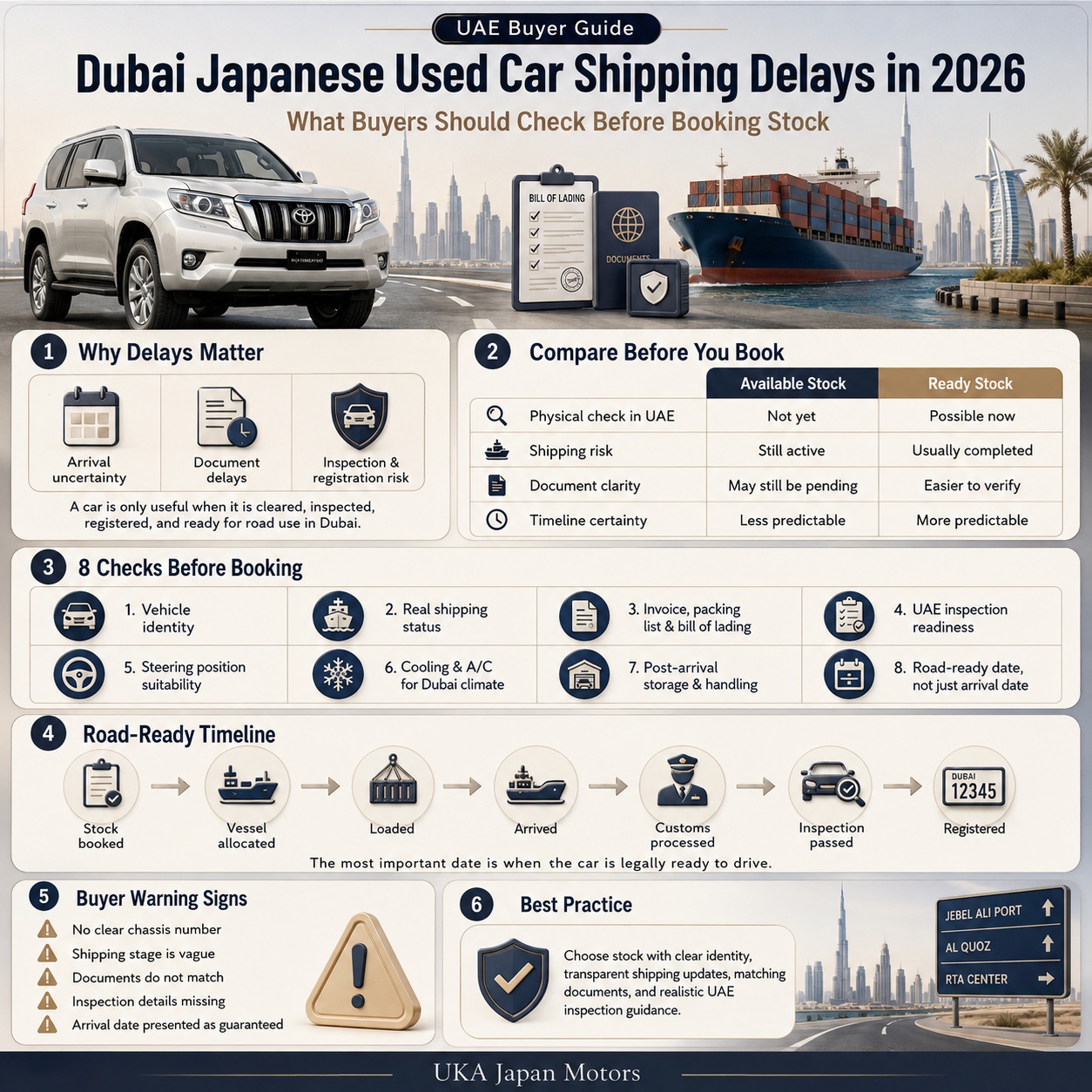
Shipping delays have become one of the most important issues for Dubai buyers considering Japanese used cars in 2026. For many buyers, the vehicle itself may look attractive on paper: the model is suitable, the mileage appears reasonable, the grade may seem acceptable, and the specification may fit daily use in Dubai, Sharjah, Abu Dhabi, Ajman, Ras Al Khaimah, Umm Al Quwain, or Fujairah. However, the buying decision should not depend only on the car. It should also depend on whether the vehicle can realistically arrive, clear, pass inspection, and be registered without avoidable uncertainty.
A Japanese used car that is not yet in Dubai is different from a vehicle already available for physical inspection inside the UAE. The buyer is not only considering the condition of the car; they are also accepting a process. That process includes stock verification, shipping booking, vessel scheduling, arrival handling, customs documentation, roadworthiness inspection, compliance review, insurance arrangement, and registration readiness. Any weak point in that chain can affect timing.
In 2026, buyers should be especially careful before booking stock that has not yet landed. Shipping dates can shift. Vessel schedules can change. Documents can be delayed. Port-side movement can slow down. Inspection or registration questions can appear after the vehicle arrives. For Dubai buyers, the practical question is not only “Is this a good car?” but also “Is this a car with a clean and realistic path to UAE use?”
This guide explains what buyers should check before booking Japanese used car stock when shipping delays are possible. It focuses on Dubai and the wider UAE ownership environment, including inspection, registration, climate suitability, documentation, and long-term usage.
Direct Answer: What Should Buyers Check First?
Before booking Japanese used car stock for Dubai in 2026, buyers should check eight things first:
- The vehicle identity must be clear, including chassis number, model code, year details, fuel type, trim, and steering position.
- The inspection information must be credible, not limited to attractive photos.
- The shipping status must be specific, including whether the car is already booked, waiting for vessel allocation, loaded, in transit, or pending documentation.
- The bill of lading and related shipping documents must match the vehicle details exactly.
- The Dubai Customs documentation path must be understood before the vehicle arrives.
- The vehicle must have a realistic chance of passing UAE technical inspection.
- The buyer must confirm that the specification suits UAE climate, roads, and driving patterns.
- The booking agreement must explain what happens if shipment, arrival, inspection, or documentation is delayed.
A buyer should avoid treating an estimated arrival date as a guaranteed handover date. In Dubai, the useful timeline is not “shipping date to arrival date.” The real timeline is “verified stock to cleared, inspected, registered, and ready for lawful road use.”
Why Shipping Delays Matter More in Dubai in 2026
Dubai buyers often have clear usage plans. Some need a vehicle for daily commuting between residential areas and business districts. Others need a family car for school runs, weekend travel, or movement between Dubai and nearby emirates. Some buyers want a hybrid for frequent city driving, while others prefer SUVs for comfort, visibility, and road presence. In all these cases, timing matters because the car is not useful until it is legally ready to drive.
Shipping delays create three types of uncertainty.
The first is arrival uncertainty. A car may be available as stock but not yet allocated to a vessel. Another vehicle may have a vessel booking but may not yet be loaded. A third may already be in transit but still subject to schedule changes. These are very different situations, and buyers should not treat them as equal.
The second is document uncertainty. A vehicle can arrive before all supporting documents are ready in the correct format. Dubai Customs, registration authorities, and inspection channels depend on accurate paperwork. If the invoice, packing list, bill of lading, customs certificate, or ownership details do not align, the vehicle can face avoidable delays after arrival.
The third is compliance uncertainty. A Japanese used car may be mechanically appealing, but Dubai registration depends on UAE requirements. The car must be suitable for inspection, roadworthiness, and ownership transfer. Issues such as steering position, modifications, warning lights, tyre condition, lighting, emissions-related systems, and chassis condition can become serious once the car is physically inspected.
For this reason, buyers should look beyond the advertised stock listing. A clean booking process requires vehicle verification, shipment clarity, document control, inspection awareness, and realistic communication.
The Difference Between “Available Stock” and “Ready Stock”
One common misunderstanding is the difference between available stock and ready stock.
Available stock means the vehicle may be available for booking. It may still be awaiting shipping allocation, document preparation, export-side handling, or movement toward Dubai. The buyer is selecting a vehicle before it has completed the full UAE arrival and registration process.
Ready stock means the vehicle is already in the UAE and can be physically checked, inspected, cleared, and prepared for registration. This does not automatically mean the vehicle is perfect, but it gives the buyer more direct control over condition verification and timing.
Comparison: Available Stock vs Ready Stock
| Checkpoint | Available Japanese Used Car Stock | Ready Stock in Dubai |
|---|---|---|
| Physical inspection in UAE | Not immediately possible | Possible before final decision |
| Shipping uncertainty | Still relevant | Usually already completed |
| Document timing | May still be developing | Can often be checked directly |
| Customs and clearance status | Usually pending | Often completed or in progress |
| UAE inspection readiness | Estimated before arrival | Can be tested locally |
| Buyer timeline clarity | Depends on shipping and paperwork | More predictable |
| Risk of specification mismatch | Must be checked carefully before booking | Easier to confirm physically |
| Suitability for UAE use | Requires expert pre-check | Can be confirmed through local inspection |
This does not mean available stock should always be avoided. Many buyers choose incoming Japanese used cars because they are looking for specific models, grades, colours, or configurations. However, available stock requires a more disciplined checklist. The buyer must understand what has been verified and what still depends on shipping, documents, and inspection.
Check 1: Confirm the Vehicle Identity Before Booking
The first step is to confirm exactly which vehicle is being booked. Photos alone are not enough. A buyer should ask for the core identity details before making any commitment.
The most important identifier is the chassis number. It should match across the stock record, inspection sheet, invoice, shipping documents, and customs paperwork. Any mismatch in digits, prefixes, or model information can create delays later.
Buyers should also check the model code, body type, engine type, fuel system, drive configuration, trim, colour, and year details. For Dubai buyers, this matters because small differences can affect parts compatibility, inspection expectations, insurance processing, and long-term maintenance.
For example, two vehicles may look similar in photos but have different engine variants, hybrid systems, lighting specifications, or safety equipment. A buyer planning daily use on Sheikh Zayed Road, Al Khail Road, Emirates Road, or between Dubai and Sharjah should know whether the vehicle has the performance, cooling, braking, and comfort features suitable for that usage.
The vehicle identity check should answer:
- Is the chassis number clear and consistent?
- Does the model code match the advertised model?
- Is the steering position suitable for Dubai registration?
- Is the fuel type correctly identified?
- Is the trim level confirmed rather than assumed?
- Do the photos match the listed vehicle?
- Are there any visible modifications?
- Does the documentation match the car being offered?
A buyer should not proceed when the listing looks attractive but the identity details are incomplete.
Check 2: Understand the Real Shipping Status
Shipping status should be explained in practical language. A vague phrase such as “shipping soon” does not tell the buyer enough. In 2026, buyers should ask for the current stage of the shipment.
There are several possible stages:
- Stock identified but not yet booked for shipping
- Vehicle reserved but waiting for vessel allocation
- Vehicle assigned to a vessel but not yet loaded
- Vehicle loaded and shipping documents pending
- Vehicle in transit
- Vehicle arrived but not yet cleared
- Vehicle cleared but awaiting inspection
- Vehicle inspected but not yet registered
Each stage carries different timing expectations. A car that is only waiting for vessel allocation has more uncertainty than a car already loaded. A car that has arrived but is waiting for documents is different from a car that has cleared and is ready for inspection.
The buyer should ask for a plain explanation of what has already happened and what remains pending. This is especially important if the buyer needs the vehicle for a planned move, work schedule, family use, or replacement of an existing car.
A professional stock booking process should not create the impression that all delays are the same. Vessel delay, customs document delay, inspection delay, and registration delay are separate issues. Each one requires a different response.
Check 3: Review the Document Trail Early
Documentation is often the difference between a smooth arrival process and a frustrating one. For Japanese used car stock entering Dubai, the buyer should understand which documents are expected, who controls them, and when they will be available.
The key document trail normally includes the invoice, packing list, bill of lading, identity details, customs-related records, and registration-supporting documents. The important point is not only whether documents exist; it is whether they match each other.
A buyer should check that:
- The chassis number is consistent across records.
- The vehicle description is not vague or contradictory.
- The buyer or importing party details are correct.
- The bill of lading reflects the correct vehicle.
- The invoice details match the booked stock.
- The customs documentation path is clear.
- Any required conformity or compliance document is considered early.
- The registration route in Dubai is understood before arrival.
Document issues are frustrating because the vehicle may physically exist in Dubai, yet still not be ready for road use. For buyers, the safest approach is to treat documentation as part of the vehicle’s condition. A clean car with unclear paperwork is not truly ready.
Check 4: Ask Whether the Vehicle Is Likely to Pass UAE Inspection
Every buyer should separate visual condition from inspection readiness. A car can look clean in photos and still raise concerns during technical inspection.
Dubai inspection focuses on roadworthiness and safety. Buyers should pay attention to tyres, lights, brakes, suspension, steering, chassis condition, fluid leaks, warning lights, emissions-related systems, and modifications. Vehicles that have been stored, transported, or handled across a long logistics chain may need a careful inspection before registration.
For Japanese used cars, buyers should be especially careful with:
- Dashboard warning lights
- Hybrid battery condition, where relevant
- Cooling system performance
- Air-conditioning strength
- Suspension noise
- Steering rack condition
- Brake feel and brake balance
- Tyre age and specification
- Headlight pattern and lighting operation
- Chassis repairs or corrosion signs
- Oil, coolant, or transmission fluid leaks
- Aftermarket modifications
- Non-standard exhaust systems
- Body repairs that may affect alignment
Dubai’s heat makes cooling and air-conditioning checks especially important. A vehicle that performs acceptably in mild conditions may show weaknesses during UAE summer driving, especially in traffic on busy urban routes or during longer drives between emirates.
A buyer should ask whether the vehicle has been reviewed from a UAE inspection perspective, not only from a stock selection perspective. This is where professional pre-booking guidance becomes valuable.
Check 5: Confirm Steering Position and Registration Suitability
Steering position is a major compliance point. Buyers should not assume that every Japanese used car is suitable for normal registration in Dubai. The steering configuration must be checked before booking.
A right-hand drive vehicle is generally not suitable for normal Dubai registration unless it falls into a specific permitted category such as a qualifying classical vehicle. For most buyers looking for daily use, school runs, work commuting, family transport, or inter-emirate driving, the vehicle should be suitable for standard registration.
This should be confirmed before booking, not after arrival. A buyer who overlooks steering position may face a situation where the vehicle exists physically but does not meet the intended use case.
The same caution applies to unusual specifications, modified body structures, special-use vehicles, and vehicles with non-standard equipment. Dubai registration is not just about ownership; it is about compliance with road use requirements.
Check 6: Check Whether the Car Suits UAE Climate
Dubai’s climate affects imported used cars in ways that buyers should not ignore. Heat, dust, humidity, and long air-conditioning usage can expose weak points in cooling systems, rubber components, batteries, tyres, and interior materials.
Before booking stock, the buyer should consider whether the vehicle is suitable for UAE daily use. The following systems deserve attention:
Cooling System
The radiator, coolant hoses, thermostat, water pump, fans, and related sensors should be treated as important. Overheating risk is not a minor issue in Dubai. A car used on congested roads, parking ramps, and long highway stretches needs stable cooling performance.
Air-Conditioning
Air-conditioning is not a comfort extra in the UAE; it is part of practical usability. A weak compressor, blocked condenser, tired blower motor, or refrigerant leak can affect daily ownership. Buyers should ask whether the air-conditioning system has been checked or can be checked after arrival before handover.
Battery and Hybrid System
For hybrid vehicles, the condition of the hybrid battery and related cooling system matters. For conventional vehicles, the starting battery and charging system should also be checked because heat can shorten battery life and expose electrical weaknesses.
Tyres and Rubber Components
Tyre age, sidewall condition, and suitability for UAE driving should be reviewed. Rubber bushes, mounts, belts, and seals can also be affected by age and heat. A low-mileage car is not automatically immune from age-related wear.
Interior and Electronics
Screens, switches, cameras, sensors, seat motors, and electronic modules should be checked carefully. Dubai drivers rely heavily on air-conditioning, navigation, parking assistance, and safety systems in dense traffic and parking environments.
The best stock decision is not simply the cleanest-looking vehicle. It is the vehicle that can handle UAE conditions with fewer surprises.
Check 7: Understand Storage and Handling After Arrival
Shipping delays do not end when the vehicle reaches Dubai. A car can arrive and still wait for processing, movement, clearance, inspection, or handover preparation. During this period, storage and handling matter.
Buyers should ask where the vehicle will be kept after arrival and how it will be handled. This includes protection from unnecessary exposure, careful movement, battery management, key control, document control, and condition checks after unloading.
A vehicle may need a post-arrival condition review because transport movement can reveal issues that were not visible in earlier photos. The buyer should expect a sensible receiving inspection, including exterior condition, interior condition, start-up check, warning lights, fluid leaks, tyre condition, and accessory operation.
A proper post-arrival check helps separate shipping-related concerns from pre-existing condition issues. It also helps the buyer understand whether any rectification is needed before technical inspection.
Check 8: Compare Estimated Arrival With Actual Registration Readiness
Many buyers ask, “When will the car arrive?” A better question is, “When can the car realistically be registered and driven?”
Arrival is only one milestone. A Japanese used car intended for Dubai road use must move through a sequence. The typical sequence includes vehicle booking, shipment, arrival, customs documentation, clearance, local movement, inspection, insurance arrangement, registration, and handover preparation.
Timeline Contrast: Arrival Date vs Road-Ready Date
| Stage | What It Means | Buyer Risk If Ignored |
|---|---|---|
| Stock booked | Vehicle is selected and reserved | Buyer may assume shipping has started when it has not |
| Vessel allocated | Vehicle has a planned shipping route | Schedule may still change |
| Vehicle loaded | The car is physically on the vessel | Documents still need to align |
| Vehicle arrived | The car has reached the UAE | It may not yet be cleared or inspected |
| Customs processed | Import documentation is moving forward | Registration may still require inspection and insurance |
| Technical inspection completed | Roadworthiness has been checked | Any failed item may require correction |
| Registration completed | Vehicle is legally ready for road use | This is the milestone that matters most to the buyer |
This distinction is important because a buyer may plan around an arrival date and then be surprised by post-arrival steps. A professional explanation should focus on the full path, not only the shipping leg.
Common Reasons Japanese Used Car Bookings Face Delays
Delays can happen for different reasons. Understanding the type of delay helps the buyer respond calmly and make better decisions.
Vessel Scheduling Delays
The vehicle may not be loaded as early as expected. Vessel space, route changes, operational adjustments, and shipping movement can affect timing.
Document Preparation Delays
The vehicle may be ready to move, but supporting documents may not be complete or aligned. A small mismatch in the chassis number, name, or vehicle description can slow the process.
Arrival Processing Delays
After arrival, the vehicle may wait for unloading, movement, customs-related procedures, or release steps. This can be affected by cargo volume and operational flow.
Inspection-Related Delays
If the vehicle needs correction before passing inspection, the handover date can shift. This is why pre-booking condition review is important.
Compliance Questions
Steering position, major modifications, special vehicle type, or missing conformity information can create registration concerns.
Communication Delays
Sometimes the issue is not the delay itself but unclear communication. Buyers should expect transparent updates that explain the current stage, what is pending, and what can be verified.
What Buyers Should Ask Before Booking Stock
Before booking, buyers should ask direct questions. These questions help identify whether the seller or importer is managing the process professionally.
Vehicle Verification Questions
- What is the chassis number?
- Does the chassis number match the stock record?
- Is the model code confirmed?
- Is the steering position suitable for Dubai registration?
- Are there any known modifications?
- Are there any warning lights or mechanical concerns?
- Are inspection details available?
- Are the photos recent and connected to this exact vehicle?
Shipping Questions
- Is the car already assigned to a vessel?
- Has the car been loaded?
- Is the shipping date confirmed or estimated?
- What stage is the bill of lading at?
- What could still change before arrival?
- How will updates be shared?
Document Questions
- Will the invoice, packing list, and bill of lading match the chassis number?
- Who is responsible for customs documentation?
- Is the registration path in Dubai clear?
- Are any conformity documents expected?
- Are buyer details recorded correctly?
- What happens if a document needs correction?
Inspection Questions
- Has the car been assessed for UAE inspection readiness?
- Are tyres, lights, brakes, suspension, and warning lights checked?
- Will a post-arrival inspection be carried out?
- What happens if the vehicle needs correction before registration?
- Is the air-conditioning system checked under UAE expectations?
- Are hybrid-related systems checked where relevant?
Handover Questions
- Is the expected date an arrival date or a road-ready date?
- What steps remain after arrival?
- Where will the vehicle be stored?
- How will the buyer be updated?
- What documents will the buyer receive?
- What condition checks will be done before handover?
A buyer who receives clear answers has a stronger basis for decision-making. A buyer who receives vague answers should slow down and request more detail.
When Booking Incoming Japanese Stock Makes Sense
Booking incoming stock can make sense when the buyer is looking for a specific Japanese used car that is not commonly available as ready stock in Dubai. It can also suit buyers who understand the process and are comfortable with a timeline that depends on shipping, documentation, and inspection.
Incoming stock may suit:
- Buyers looking for a specific model or trim
- Buyers who understand that arrival dates are estimates
- Buyers who have another vehicle available during the waiting period
- Buyers who value document transparency
- Buyers who want inspection guidance before commitment
- Buyers who accept that registration readiness matters more than shipping date alone
However, incoming stock is not suitable for every buyer.
When Buyers Should Be More Careful
A buyer should be more cautious when they need immediate vehicle use, cannot tolerate timing changes, or cannot review documents properly before booking. Extra care is also needed when the vehicle has unusual specifications, unclear history, visible modifications, unclear steering position, limited photos, or incomplete document details.
Buyers should be cautious if:
- The seller cannot provide the chassis number.
- The shipment stage is unclear.
- The vehicle is described differently across documents.
- The steering position is not suitable for normal use.
- Inspection details are missing.
- The car has non-standard modifications.
- The handover date is presented as certain before the vehicle has cleared and passed inspection.
- The buyer is not told what happens if shipping or documents are delayed.
A careful buyer is not being difficult. They are protecting the integrity of the purchase process.
UAE Inspection and Compliance Considerations
Dubai buyers should remember that imported used cars must fit UAE road use requirements. A car should not be judged only by auction appearance, exterior shine, or online listing quality. It must pass through local processes.
Key inspection and compliance considerations include:
- Vehicle identity consistency
- Customs documentation
- Technical inspection readiness
- Insurance eligibility
- Registration requirements
- Steering position suitability
- Lighting and safety system operation
- Tyre condition
- Brake and suspension condition
- Chassis integrity
- Absence of major unsafe modifications
- Air-conditioning and cooling performance for UAE use
For buyers outside Dubai but within the UAE, the same principle applies: the car must be suitable for lawful local ownership and daily use. A Dubai buyer may use the vehicle across Abu Dhabi, Sharjah, Ajman, Ras Al Khaimah, Umm Al Quwain, and Fujairah, so practical roadworthiness matters beyond one inspection centre.
Ownership Considerations After the Car Arrives
Shipping delay checks are not only about the first day of ownership. They also affect long-term confidence.
A vehicle that arrives with correct documents, verified identity, and inspection-ready condition gives the owner a stronger foundation. Maintenance planning becomes easier. Future renewal becomes more straightforward. Parts identification is clearer. Insurance and service records are easier to organise. The owner also has a better understanding of the vehicle’s real condition from the start.
By contrast, a poorly documented or poorly checked vehicle may continue to create inconvenience after registration. A mismatch in specification, hidden cooling issue, weak air-conditioning, overlooked suspension concern, or unclear modification can affect daily life in Dubai traffic.
Long-term ownership in the UAE should consider:
- Heat-resistant maintenance planning
- Cooling system monitoring
- Air-conditioning performance
- Tyre suitability
- Hybrid system care where relevant
- Regular inspection preparation
- Reliable parts identification
- Documentation storage
- Renewal readiness
- Safe use across city and highway routes
The best time to reduce ownership uncertainty is before booking, not after delivery.
Practical Buyer Checklist Before Booking Stock
Use this checklist before booking any incoming Japanese used car stock for Dubai.
Identity
- Chassis number confirmed
- Model code confirmed
- Steering position confirmed
- Fuel type confirmed
- Trim and specification confirmed
- Photos linked to the exact vehicle
- No unexplained modifications
Shipping
- Current shipping stage explained
- Vessel allocation status known
- Loading status confirmed where applicable
- Estimated arrival described as an estimate
- Post-arrival steps explained
- Update method agreed
Documents
- Invoice details consistent
- Packing list details consistent
- Bill of lading path understood
- Buyer or importer details correct
- Customs documentation route clear
- Registration-supporting documents considered
Inspection
- UAE inspection risks reviewed
- Tyres checked
- Brakes checked
- Lights checked
- Suspension checked
- Chassis condition checked
- Warning lights reviewed
- Leaks checked
- Air-conditioning considered
- Hybrid system considered where relevant
Compliance
- Registration suitability reviewed
- Steering position suitable
- Specification suitable for UAE road use
- No major unresolved modification concern
- Insurance path understood
- Handover depends on inspection and registration, not only arrival
Communication
- Clear booking terms
- Delay handling explained
- Document responsibility explained
- Inspection responsibility explained
- Handover sequence explained
- Buyer receives updates at meaningful stages
How UKA Japan Motors Helps Buyers Navigate Shipping Delays
UKA Japan Motors’ role is to guide buyers through the process with inspection awareness, documentation discipline, and realistic communication. For Japanese used car buyers in Dubai, trust is built by explaining what is known, what is still pending, and what needs to be verified before the vehicle becomes road-ready.
The focus is not only on finding stock. It is on helping buyers understand whether the stock is suitable for UAE use. This includes checking vehicle identity, reviewing available condition information, explaining shipping stage, identifying documentation requirements, considering inspection readiness, and guiding buyers through compliance concerns.
UKA Japan Motors also helps buyers think practically. A vehicle may be attractive, but if it has unclear documents, unsuitable steering position, inspection concerns, or a timeline that does not match the buyer’s real needs, those issues should be discussed early. Transparent guidance protects the buyer and supports better long-term ownership.
For incoming stock, UKA Japan Motors can help buyers separate confirmed facts from estimates. This is especially important in 2026, when shipping timelines may shift and post-arrival processing can affect handover planning. A buyer should know whether a car is merely booked, actually loaded, arrived, cleared, inspected, or ready for registration.
The goal is not pressure. The goal is clarity.
FAQ
1. Are Japanese used car shipping delays common in Dubai in 2026?
Shipping timelines can change in 2026, so buyers should treat estimated arrival dates as planning guides rather than guaranteed handover dates. The safer approach is to track the full process from stock verification to shipping, arrival, customs handling, inspection, registration, and final readiness.
2. What is the most important document to check before booking stock?
No single document is enough by itself. The buyer should check that the vehicle identity is consistent across the invoice, packing list, bill of lading, and customs-related documents. The chassis number is especially important because it connects the physical vehicle to the paperwork.
3. Is an arrival date the same as a handover date?
No. Arrival means the vehicle has reached the UAE. Handover requires additional steps, including document processing, clearance, technical inspection, insurance arrangement, registration, and preparation. Buyers should ask for the road-ready timeline, not only the arrival estimate.
4. Can a Japanese used car fail inspection after arriving in Dubai?
Yes. A vehicle can look clean in photos and still require attention before passing inspection. Tyres, lights, brakes, suspension, chassis condition, warning lights, leaks, and modifications can all affect inspection readiness.
5. Should buyers book stock that has not yet shipped?
It depends on the buyer’s timeline, the vehicle’s documentation, and the clarity of the process. Booking incoming stock may suit buyers who want a specific model and understand the waiting period. It may not suit buyers who need immediate vehicle use or cannot accept schedule changes.
6. Why is steering position important before booking?
Steering position affects registration suitability in Dubai. A buyer should confirm this before booking, because a vehicle that cannot be registered for the intended use may not meet the buyer’s practical needs.
7. What should buyers ask about the bill of lading?
Buyers should ask whether the bill of lading has been issued or is pending, and whether it matches the vehicle’s chassis number and shipment details. A mismatch or delay in this document can affect post-arrival processing.
8. How does Dubai climate affect Japanese used car selection?
Dubai heat, dust, humidity, and heavy air-conditioning use can expose weaknesses in cooling systems, batteries, hybrid components, tyres, rubber parts, and electronics. Buyers should review these areas before and after arrival.
9. Is ready stock safer than incoming stock?
Ready stock gives the buyer more direct inspection control because the vehicle is already in the UAE. Incoming stock can still be suitable, but it requires stronger document checks, shipping updates, and inspection planning.
10. What is the biggest mistake buyers make with shipping delays?
The biggest mistake is assuming that a shipping estimate equals a confirmed road-ready date. Buyers should follow each step: stock verification, shipment, arrival, customs processing, inspection, registration, and final preparation.
11. Should buyers rely only on photos?
No. Photos are useful, but they do not confirm full mechanical condition, inspection readiness, document accuracy, or registration suitability. Buyers should request identity details, condition information, document clarity, and UAE-specific checks.
12. What should happen after the car arrives in Dubai?
After arrival, the vehicle should be checked for condition, documents should be reviewed, customs-related processing should be completed, inspection should be arranged, and registration readiness should be confirmed. The buyer should receive clear updates at each meaningful stage.
Conclusion
Dubai buyers considering Japanese used cars in 2026 should approach shipping delays with patience, structure, and careful verification. The right question is not only whether the vehicle is available. The right question is whether the vehicle has a clear path from stock booking to lawful, inspected, and reliable UAE ownership.
Before booking, buyers should confirm the vehicle identity, shipping stage, document trail, inspection readiness, compliance suitability, and realistic handover sequence. A well-presented listing is only the beginning. The real value of a good buying process lies in clarity, document consistency, technical awareness, and honest communication.
For Dubai and wider UAE use, Japanese used car stock should be selected with local realities in mind: heat, traffic, inspection standards, registration requirements, and long-term ownership. When these checks are handled early, buyers are better prepared for shipping changes and less likely to face avoidable problems after arrival.
Contact UKA Japan Motors for availability and inspection guidance.