


Japanese 660cc cars have become a familiar part of daily driving in Lahore and Karachi. Their small size, easy parking manners, light steering, compact cabins, automatic transmissions, and city-friendly driving behavior make them attractive for people who spend most of their time in traffic rather than on open roads. Models such as small hatchbacks, tall wagons, and compact family runabouts are commonly considered by office commuters, students, small households, and drivers who want a manageable vehicle for congested urban routes.
After the 2026 import duty changes, many buyers naturally ask whether these cars still make sense. The question is not only about duty. A 660cc car should be judged by how it performs in real Pakistani ownership conditions: Karachi humidity, Lahore heat, traffic jams, broken road patches, dust, rainwater exposure, underbody condition, registration documentation, parts support, workshop understanding, and long-term maintenance discipline.
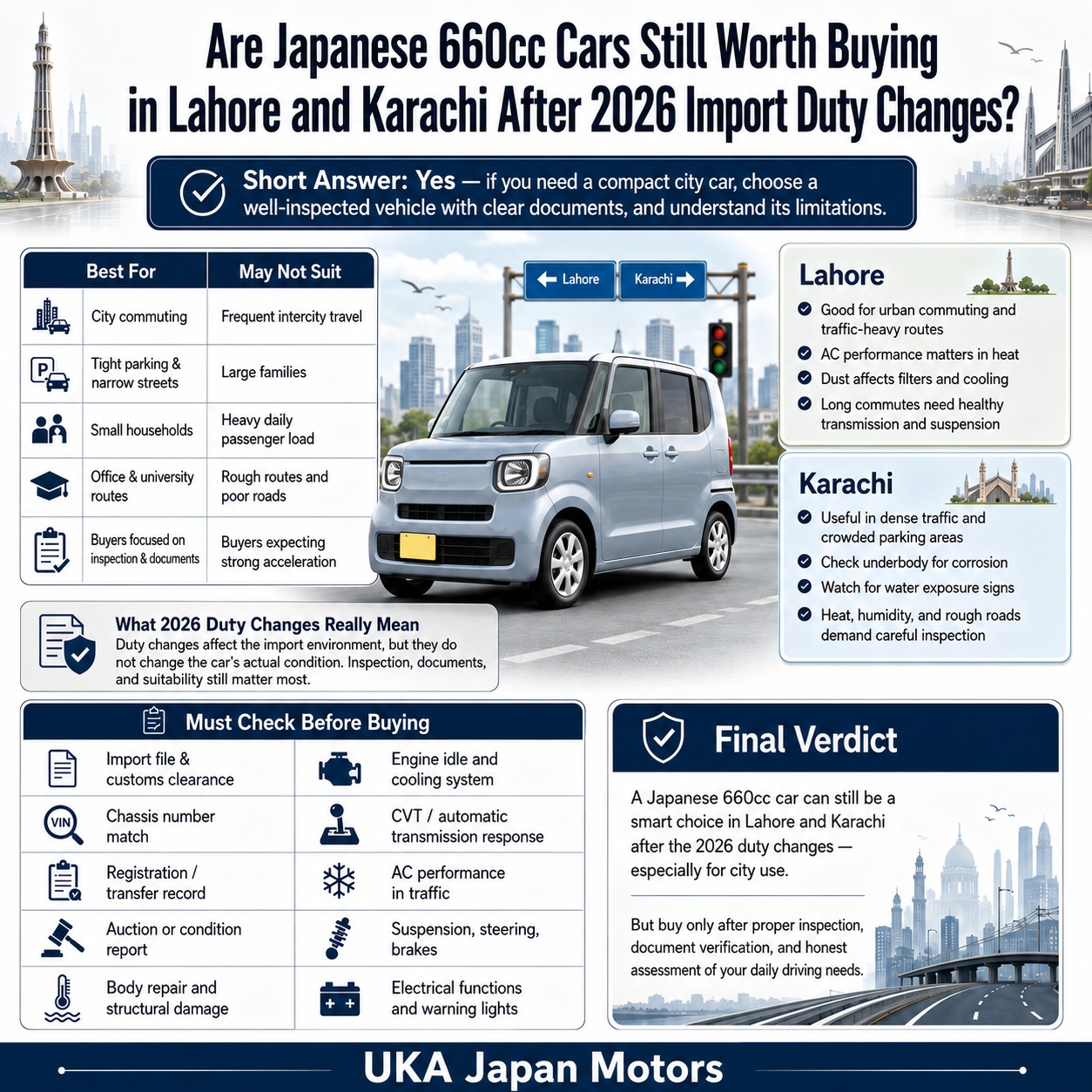
The short answer is yes, Japanese 660cc cars can still be worth buying in Lahore and Karachi after the 2026 import duty changes, but only for the right usage pattern and only when the vehicle has clear documents and a proper inspection record. They are not automatically suitable for every buyer, every route, or every household. A clean, well-inspected 660cc car can be a practical city vehicle. A poorly inspected unit, a car with hidden accident repair, weak transmission, tampered mileage, incomplete documents, or unclear import history can become a difficult ownership experience regardless of duty changes.
This guide explains the issue from a practical buyer’s perspective, not from a promotional angle. It looks at what 660cc cars are, why the 2026 duty environment matters, how these cars behave in Lahore and Karachi, what buyers should inspect, who they suit, who should avoid them, and how UKA Japan Motors approaches inspection and documentation guidance.
Direct Answer: Are 660cc Cars Still Worth Buying After 2026 Duty Changes?
Yes, Japanese 660cc cars are still worth considering after the 2026 import duty changes if the buyer needs a compact city car for Lahore or Karachi and understands the limitations of a small-engine vehicle.
They make the most sense for:
- Daily city commuting
- Short to medium urban routes
- Small families
- Solo drivers
- Office use
- University travel
- Narrow streets and dense parking areas
- Drivers who prefer automatic city driving
- Buyers who are willing to verify documents and inspection history carefully
They may not be suitable for:
- Frequent intercity travel
- Large families
- Regular fully loaded driving
- High-speed motorway use
- Rough rural routes
- Drivers expecting strong acceleration with air conditioning and passengers
- Buyers who ignore maintenance history
- Buyers choosing only by exterior appearance
The 2026 import duty changes may influence the import environment, but they do not change the mechanical nature of a 660cc car. A small-engine vehicle remains best for controlled urban use. It must still be inspected for body condition, engine health, cooling system performance, transmission behavior, suspension wear, mileage consistency, import paperwork, and registration readiness.
What Japanese 660cc Cars Are
Japanese 660cc cars are compact vehicles with engines around 660cc, usually designed around city movement, space efficiency, and easy maneuverability. Many come in tall-body designs, which makes the cabin feel roomier than the exterior size suggests. Others are lower hatchbacks with simpler layouts and lighter bodies.
Most of these cars are automatic or CVT-based. Some have turbo variants, idle-stop systems, sliding doors, safety features, digital climate controls, smart keys, and compact cabin storage. Their appeal in Pakistan comes from how easily they fit into tight streets and crowded parking areas.
In Karachi, a 660cc car can be useful around Saddar, Tariq Road, Gulshan, North Nazimabad, DHA, Clifton, Korangi, Federal B Area, and dense commercial areas where traffic flow is irregular and parking space is limited. In Lahore, they are useful around Model Town, Johar Town, Gulberg, Muslim Town, Ichhra, Wapda Town, Township, DHA, and old-city approach roads where traffic, turns, and lane changes require a compact vehicle.
However, the same compact size that makes these cars easy to handle also creates limitations. Cabin space, boot space, ground clearance, highway confidence, engine response under load, and long-distance comfort must be evaluated honestly.
Why the 2026 Import Duty Changes Matter
The 2026 import duty changes matter because imported vehicles are not assessed only by their mechanical condition. They also pass through a documentation and customs process. When import-related duties, regulatory duties, additional customs duties, or procedural handling change, the buying environment also changes.
For a 660cc buyer, the important point is not to assume that a duty change alone makes every imported small car a good choice. Duty changes may influence availability, import planning, model selection, and buyer attention, but the actual ownership quality still depends on the car itself.
A 660cc car should be evaluated in three layers:
| Layer | What It Means | Why It Matters |
|---|---|---|
| Import and document layer | Import scheme, customs clearance, file record, registration documents | Protects buyer from legal and transfer issues |
| Vehicle condition layer | Engine, transmission, body, suspension, cooling, electrical systems | Determines reliability in daily use |
| Local usage layer | Karachi or Lahore traffic, weather, road quality, route length | Determines whether the car suits the buyer’s real life |
The duty environment can change paperwork and import decisions, but it does not repair a weak transmission, reverse accident damage, improve poor cooling performance, or make a small cabin suitable for a large family. That is why inspection and documentation are still more important than the headline duty change.
Lahore and Karachi Conditions: Why Local Use Matters
A 660cc car must be judged in the environment where it will actually be driven. Lahore and Karachi create different challenges, but both require careful vehicle selection.
Lahore Driving Conditions
Lahore has long commuting routes, heavy peak-hour traffic, heat, dust, underpasses, signal-heavy roads, and mixed traffic patterns. A driver may travel from Johar Town to Gulberg, DHA to Jail Road, or Wapda Town to Canal Road and spend long periods in slow movement. During summer, air conditioning performance becomes critical. Dust affects filters, radiator fins, cabin airflow, and sensor performance. Uneven road patches and speed breakers also test the suspension.
A 660cc car in Lahore should have:
- Strong air conditioning performance
- Clean radiator and cooling system
- Healthy CVT or automatic transmission
- Good suspension response
- Proper ground clearance for daily routes
- Confirmed engine health under load
- No overheating tendency in traffic
Karachi Driving Conditions
Karachi brings humidity, sea air exposure in some areas, broken roads, rainwater accumulation, rough patches, crowded commercial districts, and long cross-city movement. A buyer driving from North Karachi to Clifton, Gulshan to Korangi, or Malir to Saddar needs a car that can tolerate heat, stop-start traffic, road vibration, and occasional water exposure.
A 660cc car in Karachi should be checked carefully for:
- Underbody corrosion
- Flood or water exposure signs
- Suspension noise
- AC cooling stability
- Electrical connectors and wiring condition
- Door seals and cabin dampness
- Steering and braking response
- Engine cooling under traffic load
A 660cc car that feels pleasant on a short drive may behave differently after long idling in Karachi traffic or repeated movement through Lahore’s hot and dusty routes. This is why a proper inspection should not be limited to exterior shine.
When a Japanese 660cc Car Makes Sense
A Japanese 660cc car makes sense when the buyer’s daily driving pattern matches the vehicle’s strengths.
It suits drivers who spend most of their time inside the city. If the route includes narrow lanes, parking challenges, office traffic, school runs, market visits, and short-to-medium commutes, a 660cc vehicle can be practical. Its compact body helps in tight areas, and its automatic transmission reduces fatigue in stop-start traffic.
It also suits households that already understand small-car limitations. A 660cc car can serve well as a primary city car for a small household or as a second household vehicle for routine daily movement. It is especially useful when the owner values ease of use, visibility, parking convenience, and gentle driving behavior.
The strongest case for a 660cc car is not engine size alone. It is the combination of compact size, efficient cabin packaging, city-friendly controls, and easier movement through crowded urban roads.
When a 660cc Car May Not Suit You
A 660cc car may not suit every buyer. It can feel limited when used outside its intended role.
A buyer should reconsider if the car will regularly carry four adults with luggage, climb bridges or underpasses with heavy load and AC running, travel frequently between cities, or cover rough outer routes with damaged road surfaces. Some 660cc cars manage occasional longer drives, but that does not mean they are ideal for repeated high-load use.
Drivers who expect strong acceleration may also feel restricted. A 660cc engine works best when driven smoothly. Sudden acceleration, hard overtaking, heavy passenger load, and continuous AC demand can make the engine feel strained.
The buyer should also avoid selecting a 660cc car only because it looks clean. Many imported vehicles appear attractive after detailing, but the real condition is found in the body panels, chassis, auction report, cooling system, engine behavior, transmission response, suspension, and electronic systems.
660cc Cars Compared With Larger Hatchbacks
A useful way to understand 660cc cars is to compare them with larger small hatchbacks commonly used in Pakistani cities. This is not a price comparison. It is a practical use comparison.
| Factor | Japanese 660cc Car | Larger Hatchback |
|---|---|---|
| City maneuverability | Very strong in tight spaces | Good, but needs more room |
| Parking ease | Excellent for dense areas | Depends on body size |
| Cabin width | Limited for three adults at the back | Usually more comfortable |
| Boot space | Often limited | Usually better |
| Engine response with full load | Can feel strained | Usually more relaxed |
| AC load impact | More noticeable | Less noticeable |
| Long-distance comfort | Limited | Better suited |
| Karachi inner-city use | Strong fit | Good but less compact |
| Lahore long commute use | Suitable if lightly loaded | Better for frequent long routes |
| Maintenance sensitivity | High; inspection matters | Also important, but engine load is different |
This comparison shows why the answer depends on use. A 660cc car is not automatically better or worse. It is more specialized. It works best when its compact nature is an advantage rather than a compromise.
The 2026 Duty Change Should Not Replace Inspection
After any import duty change, some buyers begin focusing only on availability and paperwork movement. That is risky. A car remains a mechanical machine, and its past usage, repair history, and document trail matter more in long-term ownership.
A 660cc car should be inspected in detail before buying. The inspection should include:
- Auction sheet or condition record where available
- Chassis number verification
- Engine number verification where applicable
- Import file review
- Customs clearance documentation
- Registration and excise record
- Body panel repaint and repair checks
- Pillar, apron, frame, and underbody inspection
- Engine idle, smoke, noise, and vibration check
- CVT or automatic transmission response
- AC cooling and blower function
- Radiator, coolant, fan, and hoses
- Suspension noise and steering play
- Brake condition
- Tyre condition and alignment signs
- Electrical functions, warning lights, sensors, and key system
The purpose is not to reject every used vehicle with minor wear. Used vehicles naturally have condition differences. The purpose is to separate normal wear from structural damage, unclear paperwork, flood exposure, poor repair, and hidden mechanical weakness.
Documentation: What Buyers Must Confirm
Documentation is especially important for imported cars. A buyer in Lahore or Karachi should not rely only on verbal assurance. The paper trail must be clear.
Key documents and records may include:
| Document or Record | Why It Matters |
|---|---|
| Import file | Shows the vehicle’s import trail |
| Customs clearance record | Confirms legal clearance |
| Goods declaration record | Supports import documentation |
| Duty and tax payment record | Confirms official processing |
| Registration book or smart card | Confirms local registration |
| Excise record | Helps verify registration status |
| Chassis number | Must match body and documents |
| Transfer documents | Required for legal ownership transfer |
| Auction or inspection record | Helps understand pre-import condition |
| Maintenance record, if available | Helps evaluate care history |
Incomplete documentation can create ownership issues later. In Karachi and Lahore, buyers should be especially careful with transfer status, biometric requirements, excise verification, and matching numbers. A car can look excellent but still create problems if the file is incomplete or details do not match.
Engine and Transmission Considerations
Most 660cc cars are designed for smooth, efficient city driving rather than aggressive use. The engine should start easily, idle smoothly, and respond predictably. Unusual vibration, knocking, rough idle, smoke, overheating, or weak pickup may indicate deeper issues.
Transmission condition is equally important. Many Japanese 660cc cars use CVT systems. A healthy CVT should move smoothly, without jerks, delays, whining sounds, or sudden rpm flare. Buyers should avoid judging the transmission only during a short lane drive. It should be checked during slow movement, gradual acceleration, reverse gear engagement, and warm running.
In Lahore and Karachi traffic, the transmission works constantly. Repeated start-stop movement, heat, AC load, and slow crawling can expose problems that may not appear immediately. Proper fluid condition, service history, and driving behavior matter.
Air Conditioning and Cooling System
Air conditioning is not a luxury in Lahore and Karachi; it is part of daily usability. A 660cc car with weak AC can become uncomfortable very quickly, especially in peak summer traffic.
The AC system should be tested while the car is stationary and while moving. Some cars cool acceptably on open roads but struggle when idling in traffic. The condenser, radiator, fan, compressor, cabin filter, blower, vents, and cooling cycle should be inspected.
The cooling system is equally critical. Small engines generate less displacement but still face intense heat during long traffic waits. Radiator condition, coolant quality, thermostat behavior, fan operation, hoses, and engine temperature stability should be checked. Overheating can damage the engine and reduce long-term confidence.
Ground Clearance, Suspension, and Road Quality
Many Japanese 660cc cars have compact designs and city-focused suspension. In Lahore and Karachi, road quality varies greatly. Some routes are smooth, while others include broken patches, speed breakers, uneven service roads, drainage cuts, and rough commercial lanes.
Suspension should be checked for:
- Knocking sounds
- Weak shocks
- Uneven tyre wear
- Steering vibration
- Pulling to one side
- Damaged bushings
- Underbody contact marks
Ground clearance should be judged according to the buyer’s actual route. A car used mostly in planned areas may perform well, while the same car may scrape frequently on rougher streets or steep parking ramps. Buyers should not assume all 660cc cars behave the same. Tall wagons, hatchbacks, and sportier versions can feel different on local roads.
Fuel Behavior in Real Pakistani Use
Many buyers associate 660cc cars with good fuel behavior, but the real result depends on usage, maintenance, traffic, tyre condition, AC use, engine health, and driving style.
A well-maintained 660cc car driven gently in city traffic can be efficient. However, if the car is overloaded, constantly pushed hard, driven with poor tuning, used with weak tyres, or operated with a struggling AC system, fuel behavior may not meet expectations.
In Karachi, long idling, humidity, and traffic jams affect real-world fuel behavior. In Lahore, dust, heat, and extended commutes can also change results. Buyers should treat fuel efficiency as a condition-based outcome, not a guaranteed promise.
Body Condition and Accident Repair
Body condition is one of the most important areas in imported 660cc cars. A shiny exterior can hide repaired panels, replaced parts, or structural work. Minor cosmetic repair may not always be a serious issue, but structural repair should be evaluated carefully.
Important areas include:
- Front apron
- Radiator support
- Pillars
- Roof line
- Chassis rails
- Boot floor
- Door frames
- Underbody
- Suspension mounting points
A car with structural repair may not drive, align, or protect occupants as intended. Buyers should also check paint thickness, panel gaps, sealant lines, welding marks, and inconsistent bolts. Imported vehicles should be judged by inspection evidence, not by surface polish.
Karachi-Specific Concerns
Karachi buyers should be especially careful about humidity, corrosion, and water exposure. Cars used in coastal air or exposed to standing water may show rust underneath, around suspension points, near door edges, or inside hidden cavities.
Electrical systems should also be checked thoroughly. Moisture can affect connectors, sensors, window motors, keyless entry systems, dashboard lights, and control modules. A car that starts normally may still have intermittent electrical issues.
Karachi routes also include rough patches where suspension and tyres face frequent stress. Buyers should inspect underbody scraping, wheel alignment signs, and steering response.
Lahore-Specific Concerns
Lahore buyers should focus on heat, dust, AC performance, filters, and long commute behavior. Dust can reduce cooling efficiency and cabin air quality. Long routes can expose weak suspension, poor alignment, overheating, or transmission stress.
Lahore’s traffic pattern can shift from slow urban movement to faster road sections. A 660cc car should feel stable and predictable within its intended range. It should not vibrate heavily, wander at speed, or struggle badly under normal driving with AC.
Buyers in Lahore should also consider road humps, underpass approaches, and uneven side roads. Ground clearance and suspension condition are important for daily comfort.
Which 660cc Body Style Suits Local Drivers?
Not all 660cc cars are the same. Body style matters.
| Body Style | Best For | Caution |
|---|---|---|
| Tall wagon | Family city use, easier entry, better headroom | Can feel affected by crosswinds and body roll |
| Compact hatchback | Solo commute, office use, easy parking | Limited cabin and boot space |
| Sliding-door mini wagon | School runs, elderly passengers, tight parking | Door mechanisms need inspection |
| Turbo variant | Drivers wanting stronger response | Requires stricter maintenance checks |
| Simple non-turbo variant | Routine city use | Less responsive with heavy load |
The best choice depends on daily route, passenger count, parking space, and maintenance expectations.
Should Buyers Wait or Buy After Duty Changes?
A buyer should not make the decision only around duty changes. The better approach is to buy only when the right vehicle is available with the right inspection and document record.
Waiting may bring more options, but availability does not guarantee condition. Buying quickly may secure a clean unit, but rushing can lead to missed inspection issues. The sensible approach is to define the required condition first.
A buyer should decide based on:
- Verified documents
- Clear import and registration record
- Body condition
- Engine and transmission health
- AC and cooling performance
- Suitability for daily route
- Parts and workshop familiarity
- Long-term ownership comfort
The 2026 duty change is one factor. It is not the complete decision.
Practical Buyer Checklist
Before selecting a Japanese 660cc car in Lahore or Karachi, review this checklist:
- Does the car’s size suit your household?
- Will it be used mainly inside the city?
- Does it need to carry passengers daily?
- Is your route smooth, mixed, or rough?
- Has the import file been reviewed?
- Do the chassis details match the documents?
- Is the auction or condition record available?
- Has the body been checked for structural repair?
- Does the engine idle smoothly with AC on?
- Does the transmission engage smoothly?
- Does the AC cool properly in traffic?
- Is the cooling system stable?
- Are suspension and steering free from abnormal noise?
- Are electrical systems working properly?
- Is the registration transfer process clear?
A buyer who answers these questions carefully will make a better decision than one who focuses only on model name or duty news.
UKA Japan Motors’ Role in Inspection and Guidance
UKA Japan Motors’ role is to help buyers understand the condition, documentation, and suitability of imported vehicles before making a decision. For Japanese 660cc cars, this means looking beyond the exterior and explaining what matters in daily Pakistani use.
The inspection-focused approach includes reviewing the vehicle’s documents, import trail, body condition, mechanical condition, and local usability. A 660cc car may be suitable for one buyer and unsuitable for another, even if both cars are from the same model family. The difference often comes from route, passenger needs, inspection grade, maintenance condition, and documentation clarity.
UKA Japan Motors focuses on transparency, inspection guidance, and practical explanation. The aim is not to present every 660cc car as the right option. The aim is to help buyers understand whether a particular vehicle fits Lahore or Karachi driving conditions and whether its documents and condition support long-term ownership confidence.
Final Verdict
Japanese 660cc cars are still worth buying in Lahore and Karachi after the 2026 import duty changes, but only when judged correctly. The duty environment may change how imported cars are planned and processed, but it does not remove the need for careful inspection, document verification, and honest suitability assessment.
For city-focused drivers, small families, office commuters, and people who regularly face traffic and parking challenges, a clean and well-documented 660cc car can remain a practical choice. For heavy-load driving, frequent long-distance travel, rough routes, or larger households, a bigger vehicle may be more suitable.
The best decision is not based on engine size alone. It is based on matching the car to real usage in Karachi or Lahore, checking the import and registration record, confirming mechanical health, and understanding the limitations of a compact vehicle.
A Japanese 660cc car can still be a sensible city vehicle after the 2026 duty changes, but only when the buyer treats inspection and documentation as essential parts of the decision.
FAQs
1. Are Japanese 660cc cars still suitable for Karachi traffic?
Yes, they can be suitable for Karachi traffic because their compact size helps in crowded roads, narrow lanes, and limited parking spaces. However, buyers should check AC performance, cooling system health, underbody condition, and electrical systems because Karachi heat, humidity, rough roads, and rainwater exposure can affect long-term use.
2. Are 660cc cars good for Lahore commuting?
They can work well for Lahore commuting if the route is mainly urban and the car is not heavily loaded every day. Lahore’s heat, dust, long signal waits, and extended routes make cooling system health, AC strength, air filters, transmission behavior, and suspension condition very important.
3. Did the 2026 import duty changes make every 660cc car a better choice?
No. Duty changes may affect import planning and market movement, but they do not determine the actual quality of a vehicle. A 660cc car still needs proper inspection, clear documents, verified import record, and mechanical fitness.
4. What is the biggest risk when buying a Japanese 660cc car?
The biggest risk is buying without proper inspection and document verification. Hidden accident repair, weak transmission, unclear import file, mileage inconsistency, water exposure, poor cooling, and incomplete transfer documents can create problems later.
5. Should I choose a turbo 660cc car or a non-turbo 660cc car?
A turbo 660cc car may feel more responsive, but it needs stricter maintenance and careful inspection. A non-turbo car is usually simpler for routine city use. The better choice depends on driving style, route, maintenance discipline, and vehicle condition.
6. Are 660cc cars suitable for long drives?
They can manage occasional longer drives if well maintained, but they are not ideal for frequent high-load or long-distance use. Their main strength is city driving. For regular long routes, a vehicle with more relaxed engine performance and cabin space may be more suitable.
7. What documents should be checked before buying?
Buyers should check import file, customs clearance record, registration documents, excise record, transfer documents, chassis number, and any available auction or inspection record. All details should match clearly.
8. Why is AC inspection so important in 660cc cars?
In Lahore and Karachi, AC performance directly affects daily usability. A weak AC system can also place additional load on the engine. The AC should be checked in traffic-like conditions, not only while the car is moving.
9. Are Japanese 660cc cars good for small families?
They can be good for small families using the car mainly inside the city. Buyers should check rear seat comfort, boot space, child-seat needs, entry height, door design, and passenger load requirements before deciding.
10. What should buyers avoid when choosing a 660cc car?
Buyers should avoid cars with unclear documents, structural damage, overheating signs, weak CVT response, mismatched chassis details, suspicious mileage, poor underbody condition, or electrical issues. A clean exterior alone is not enough.
Contact UKA Japan Motors for availability and inspection guidance.