


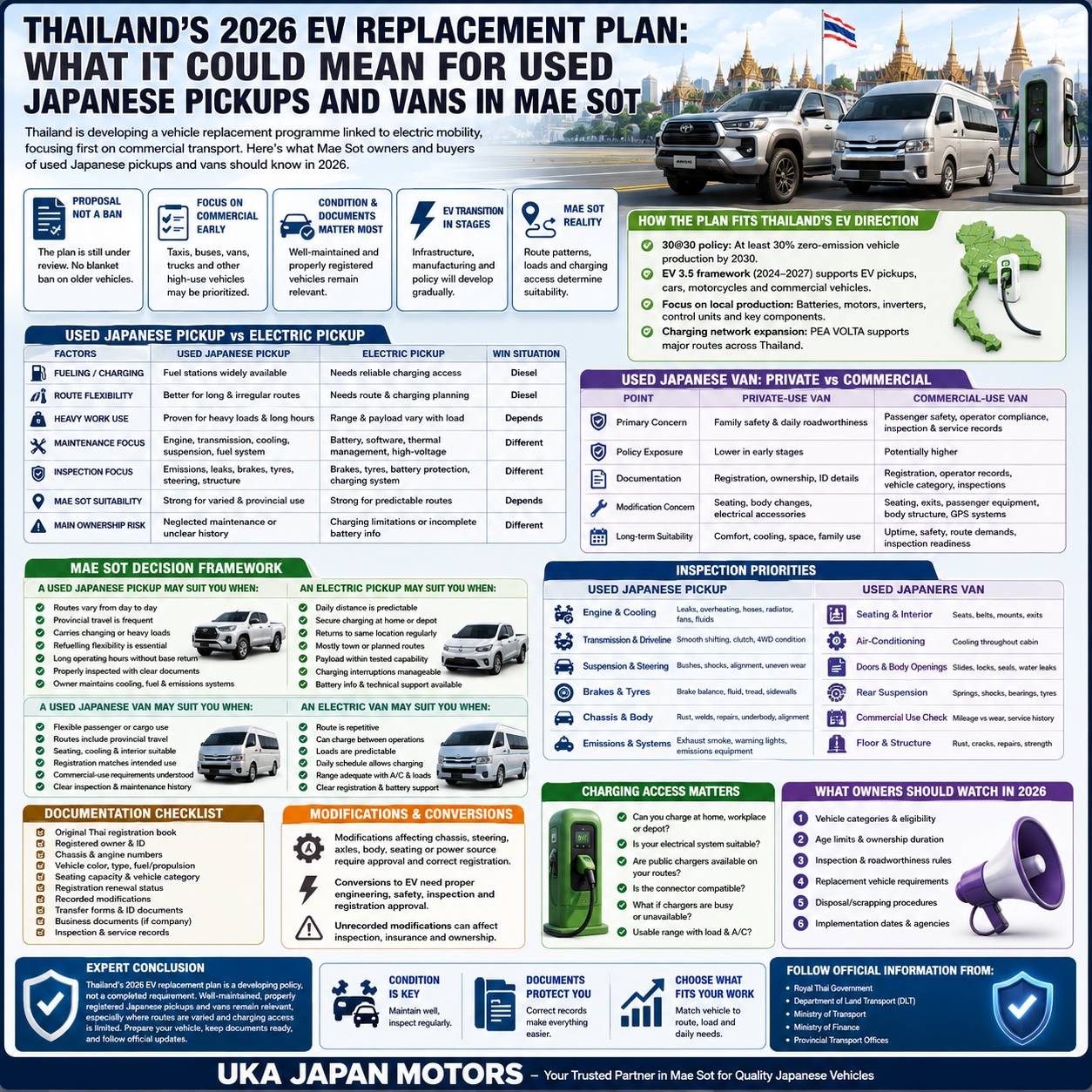
Thailand’s automotive transition entered a new stage in 2026 as the government began considering a large vehicle-replacement programme connected to electric mobility, road safety, industrial development, and reduced dependence on conventional fuels.
For vehicle owners and buyers in Mae Sot, the announcement naturally raises questions. Will older diesel pickups be removed from the road? Will Japanese vans become harder to register? Could a used vehicle lose its practical usefulness? Will businesses be expected to replace working vehicles with electric models?
As of July 27, 2026, the most important point is that Thailand’s EV replacement programme is still being developed. Public information describes a proposed assistance framework for replacing certain ageing vehicles, initially concentrating on commercial transport such as taxis, tuk-tuks, buses, vans, trucks, and other working vehicles. Authorities have also discussed whether the programme should eventually cover a wider range of vehicle categories. Final eligibility rules, vehicle-age limits, inspection requirements, disposal procedures, and implementation methods have not yet been fully confirmed.
This means the plan should not currently be interpreted as a nationwide instruction forcing Mae Sot owners to stop using properly registered Japanese pickups or vans. Instead, it signals a gradual shift in how Thailand may classify, inspect, replace, and manage older vehicles over the coming years.
For Mae Sot, where pickups and vans support daily commuting, family transport, deliveries, agricultural work, provincial travel, and local business operations, the practical effects will depend less on headlines and more on vehicle condition, registration status, documented history, road-use category, and whether a vehicle is operated privately or commercially.
Direct Answer: What Does the 2026 Plan Mean Right Now?
Thailand’s developing EV replacement plan does not currently make used Japanese pickups or vans illegal, unsuitable, or automatically subject to retirement.
Its likely short-term effects are more focused:
- Greater attention to the age and condition of commercially operated vehicles.
- More detailed eligibility rules for any future replacement programme.
- Stronger emphasis on inspection readiness and correct registration records.
- Gradual expansion of electric pickups, vans, buses, and commercial trucks.
- Increasing importance of emissions, safety, and documented maintenance.
- Possible separation between well-maintained older vehicles and poorly documented vehicles.
- More careful consideration of whether an electric vehicle suits the owner’s actual route and workload.
A roadworthy, correctly registered Japanese pickup or van can remain relevant in Mae Sot, particularly where the vehicle must travel on provincial roads, carry equipment, operate for long hours, or reach areas where charging access is less predictable.
The policy direction does, however, make one point increasingly clear: ownership records, mechanical condition, lawful modifications, and inspection preparation will matter more than simply the vehicle’s badge or model year.
The Policy Is a Proposal, Not a Blanket Vehicle Ban
Thailand’s government has been reviewing a programme intended to replace a significant number of ageing transport vehicles with electric alternatives. Early discussions focused on working vehicles, including taxis, motorcycle taxis, tuk-tuks, buses, vans, and trucks. Pickups have also become part of the discussion because they are central to Thailand’s automotive industry and are widely used for commercial and private transport.
However, an official government update published in July 2026 confirmed that the earlier “old vehicle for new vehicle” concept faced unresolved implementation problems. These included the difficulty of creating fair eligibility standards for vehicles of the same age but very different condition, as well as questions about vehicle disposal, scrapping, documentation, and programme administration.
That distinction is highly relevant in Mae Sot.
A fifteen-year-old pickup that has been maintained, inspected, correctly repaired, and used mainly for family transport is not mechanically equivalent to a vehicle of the same age that has carried excessive loads, suffered flood exposure, received structural repairs, or operated without consistent maintenance.
Similarly, a Japanese van with complete registration records and a sound cooling system is different from a visually similar van with uncertain ownership history, unrecorded body modifications, mismatched identification details, or evidence of heavy commercial use.
The difficulty of separating these vehicles is one reason the programme remains under review.
Therefore, owners should not make immediate decisions based only on a vehicle’s age. Condition, documentation, legal classification, roadworthiness, and actual suitability for daily use provide a more useful basis for planning.
How the Replacement Plan Fits Thailand’s Wider EV Direction
The proposed replacement programme is not an isolated policy. It forms part of Thailand’s wider effort to develop electric vehicle manufacturing, charging infrastructure, local component production, and lower-emission transport.
Thailand’s 30@30 policy aims for zero-emission vehicles to represent at least 30 percent of national vehicle production by 2030. The government’s broader industrial approach continues to include several powertrain types, including internal-combustion vehicles, hybrids, plug-in hybrids, and battery-electric vehicles, while expanding the domestic EV supply chain.
The EV 3.5 framework, which applies from 2024 to 2027, specifically includes electric pickups as well as passenger cars and motorcycles. For electric pickups, the policy places particular emphasis on domestic production.
The Board of Investment has also introduced measures encouraging manufacturers to use locally produced batteries, motors, battery-management systems, control units, inverters, electric compressors, and other important components. This indicates that Thailand’s EV strategy is intended to develop an industrial ecosystem rather than merely increase the number of imported electric vehicles.
For Mae Sot buyers, this wider context suggests that electric pickups and commercial vehicles should gradually become more common. It does not mean that every existing diesel pickup or petrol van will immediately become unsuitable.
The transition is more likely to happen in stages:
- Public transport and high-use commercial fleets receive early attention.
- Locally produced electric commercial vehicles become more widely available.
- Charging coverage expands along major and provincial routes.
- inspection and registration systems adapt to electric and converted vehicles.
- Buyers begin comparing vehicles according to route suitability, charging access, payload, working hours, and long-term maintenance requirements.
Used Japanese pickups and vans will continue to operate during this transition, especially where they remain mechanically sound and match local transport needs.
Why Pickups Matter So Much to Thailand’s Transition
Pickups are not a small specialist category in Thailand. They form a major part of domestic vehicle production and support a large network of manufacturers, component suppliers, service businesses, and vehicle users. The government is therefore considering electric pickups while also examining other lower-emission technologies suitable for working vehicles.
In Mae Sot, pickups have multiple roles. A single vehicle may be used for commuting during the week, transporting equipment, carrying agricultural supplies, supporting a small business, or taking family members on longer provincial journeys.
This mixed use makes replacement decisions more complicated than replacing a passenger car used only for short urban journeys.
An electric pickup may suit predictable daily routes with dependable overnight charging. A well-maintained diesel Japanese pickup may remain more practical for long operating days, remote road access, irregular journeys, heavy loads, or work that cannot pause while the vehicle charges.
The correct choice depends on the duty cycle rather than the national policy direction alone.
Used Japanese Pickup Versus Electric Pickup
| Ownership factor | Used Japanese pickup | Electric pickup |
|---|---|---|
| Refuelling or charging | Established fuel access across town and provincial routes | Requires dependable home, workplace, depot, or public charging |
| Long and irregular routes | Generally familiar and flexible | Requires route and charging planning |
| Heavy working use | Condition, cooling, suspension, transmission, and payload history are critical | Battery temperature, usable range under load, and charging time are critical |
| Maintenance focus | Engine, transmission, fuel system, cooling system, emissions equipment | Battery health, thermal management, charging system, software, high-voltage safety |
| Inspection focus | Smoke, leaks, brakes, tyres, steering, suspension, structure | Brakes, tyres, steering, structure, battery protection, charging equipment |
| Mae Sot suitability | Strong where routes are varied and provincial use is common | Strong where routes are predictable and charging is controlled |
| Main ownership risk | Neglected maintenance or unclear history | Charging limitations or incomplete battery-condition information |
Neither category is automatically superior for every Mae Sot owner. Suitability depends on how the vehicle will be used.
What the Plan Could Mean for Used Japanese Vans
Vans may be affected differently from pickups because their registration and use can vary significantly.
A van may be registered and used as:
- A private family vehicle.
- A staff transport vehicle.
- A passenger-service vehicle.
- A delivery vehicle.
- A mobile service vehicle.
- A vehicle modified with additional seating or equipment.
- A commercial transport vehicle regulated under transport law.
The proposed replacement programme has shown particular interest in commercial transport categories. Therefore, a van operated as part of a transport service may face different future requirements from a privately used family van.
Owners should not assume that all vans will be treated alike.
Vehicle classification, seating capacity, operator licensing, inspection frequency, recorded modifications, and the legal purpose of use may all influence how future rules apply.
A Japanese van used privately for family transport in Mae Sot may remain outside the first phase of a commercial replacement programme. A high-use passenger van operating under transport regulations may receive earlier attention because it carries more passengers, covers more kilometres, and has greater road-safety and emissions exposure.
Private Van Versus Commercial Van
| Question | Private-use van | Commercial-use van |
|---|---|---|
| Primary concern | Family safety and daily roadworthiness | Passenger safety, operator compliance, inspection frequency, and service records |
| Likely policy exposure | Lower in the early stages | Potentially higher |
| Documentation focus | Registration book, ownership transfer, identification details | Registration, operator records, vehicle category, inspection and transport permissions |
| Modification concern | Seating, body changes, electrical accessories | Seating, exits, passenger equipment, body structure, GPS or operational systems where required |
| Long-term suitability | Comfort, cooling, space, family use | Uptime, passenger safety, route demands, inspection readiness |
For both categories, complete documentation and correct registration remain essential.
Mae Sot Is Not a Simple Urban Driving Environment
National EV policy is often discussed in terms of broad adoption, industrial targets, and major transport fleets. Vehicle use in Mae Sot requires more local reasoning.
Many vehicles operate in a combination of conditions:
- Short journeys through town traffic.
- Repeated stopping and starting.
- Provincial roads outside the town centre.
- Rainy-season surface water and reduced visibility.
- Heat and humidity affecting cooling and electrical systems.
- Uneven road surfaces affecting tyres, suspension, and steering.
- Longer journeys toward other parts of Tak Province.
- Work routes that change according to deliveries or customer needs.
- Periods of idling with air conditioning operating.
- Loads that vary substantially from one trip to another.
These conditions influence both conventional and electric vehicles.
For a used Japanese pickup or van, owners should pay close attention to radiator condition, coolant quality, hoses, fans, transmission behaviour, suspension wear, tyre condition, brake performance, and signs of water exposure.
For an electric vehicle, the inspection focus changes but does not disappear. Battery cooling, underbody protection, high-voltage cable routing, charging-port condition, electrical isolation, water ingress, tyre condition, and software warnings become important.
An EV can perform well in town traffic because repeated low-speed driving and regenerative braking suit electric propulsion. However, range estimates may change when a vehicle is heavily loaded, operated with continuous air conditioning, driven at sustained road speeds, or used on routes with elevation changes.
A conventional Japanese pickup or van may provide greater route flexibility where charging access is uncertain, but it requires disciplined maintenance, especially as the vehicle becomes older.
Charging Access Will Determine Practical EV Suitability
Thailand’s Provincial Electricity Authority operates the PEA VOLTA network, which provides several charging connector types and power levels along routes throughout the country. The network is intended to support travel across Thailand, including northern and western routes.
The existence of a national charging network is encouraging, but a Mae Sot owner should evaluate charging at the level of actual daily use.
The most important questions are practical:
- Can the vehicle charge securely at home, at a business site, or at a fleet depot?
- Is the electrical installation suitable for regular vehicle charging?
- Can charging be completed during normal parking hours?
- Are public chargers available along the routes the vehicle actually uses?
- Is the connector compatible with the vehicle?
- What happens when a planned charger is occupied or unavailable?
- How much usable range remains when carrying passengers or cargo?
- Can the vehicle complete an unexpected additional trip?
For a family vehicle travelling mostly within Mae Sot, overnight charging may be enough. For a delivery van with a predictable return-to-base schedule, depot charging may support regular operation.
For a pickup that travels unpredictably across provincial roads, carries changing loads, or cannot return to the same location each evening, charging requires more careful planning.
The replacement plan may increase the number of electric commercial vehicles, but it does not remove the need for route-specific assessment.
Will Used Japanese Pickups and Vans Become Less Relevant?
Used Japanese pickups and vans are unlikely to disappear simply because Thailand expands EV policy.
Their continuing relevance will depend on several factors:
1. Mechanical Condition
Vehicles with reliable engines, smooth transmissions, effective cooling systems, safe brakes, stable steering, and sound suspension will remain more practical than neglected vehicles of the same age.
An older vehicle that is maintained properly can be more suitable for daily use than a newer vehicle with accident damage, uncertain repair work, or incomplete servicing.
2. Documentation Quality
A complete registration book, matching identification numbers, accurate ownership details, lawful modification records, and clear transfer documents make a used vehicle easier to inspect and manage.
The Department of Land Transport advises buyers to check the original registration book, owner information, chassis number, engine number, vehicle colour, annual registration status, and the physical vehicle itself. It also advises buyers to complete the transfer through the appropriate transport office rather than relying on an incomplete open-transfer arrangement.
3. Use Category
Private pickups, goods vehicles, passenger vans, and commercially operated transport vehicles may face different requirements.
Future replacement rules may prioritise high-use or regulated commercial vehicles rather than private vehicles used occasionally.
4. Inspection Readiness
Thailand continues to develop and update vehicle-inspection procedures for vehicles governed by both motor-vehicle and land-transport laws. Current and proposed procedures cover passenger vehicles, goods vehicles, and vehicles presented for annual or operational inspections.
A vehicle that can pass inspection without concealed defects is better positioned for continued lawful use.
5. Availability of Appropriate Replacements
A replacement vehicle must perform the same work safely and reliably.
An electric van designed for short urban passenger routes may not replace a long-distance goods van in every situation. An electric pickup used for predictable municipal duties may not match the needs of a vehicle travelling on changing provincial routes.
Policy eligibility does not automatically establish operational suitability.
Inspection Priorities for a Used Japanese Pickup
Mae Sot buyers considering a used Japanese pickup should inspect the vehicle as a working machine, not only as a body and engine.
Engine and Cooling System
Check cold-start behaviour, exhaust condition, fluid leaks, coolant level, radiator condition, fan operation, hoses, reservoir condition, and signs of repeated overheating.
Heat, long idling, heavy loads, and slow traffic can expose cooling-system weaknesses.
Transmission and Driveline
Automatic transmissions should shift consistently without delay, harsh engagement, or warning lights. Manual transmissions should be checked for clutch wear, gear engagement, and abnormal driveline vibration.
Four-wheel-drive systems should be inspected where fitted, particularly if the vehicle may have experienced heavy rural or work use.
Suspension and Steering
Look for uneven tyre wear, steering play, worn bushes, damaged shock absorbers, broken springs, and signs that the vehicle has regularly carried excessive loads.
A pickup that sits unevenly may have suspension damage or previous chassis stress.
Brakes and Tyres
Check brake balance, pedal feel, warning indicators, disc or drum condition, brake-fluid history, tyre age, tread condition, sidewall damage, and consistency across all wheels.
Rainy-season grip and water clearance matter on both town and provincial roads.
Chassis and Body
Inspect chassis rails, mounting points, cabin alignment, cargo-bed alignment, welds, corrosion, underbody impact marks, and repair signs.
Paint variation alone does not prove major damage, but structural inconsistencies require careful examination.
Emissions and Warning Systems
A vehicle should not rely on temporary warning-light resets or hidden emissions problems. Diesel smoke, engine warning indicators, modified exhaust equipment, and removed emissions components can affect inspection readiness and long-term reliability.
Inspection Priorities for a Used Japanese Van
Used vans require additional attention because body size, seating, passenger use, and previous commercial operation can hide wear.
Seating and Interior Structure
Confirm that the seating arrangement matches the registration information. Check seat mounting points, seat belts, head restraints, floor condition, doors, emergency access where applicable, and signs of unrecorded modifications.
Air-Conditioning Performance
A large van may require extended air-conditioning operation in Mae Sot’s heat. Test cooling performance throughout the cabin, not only at the front vents.
Weak rear cooling can indicate compressor wear, refrigerant leakage, electrical issues, blocked evaporators, or poorly maintained auxiliary systems.
Sliding Doors and Body Openings
Check hinges, rollers, locks, seals, handles, and electrical door systems. Water entry around doors or roof seams can damage interior panels and electrical wiring.
Rear Suspension
Passenger vans and delivery vans often carry repeated loads. Inspect rear springs, dampers, bushes, wheel bearings, tyres, and floor structure.
Previous Commercial Use
High recorded distance does not automatically make a van unsuitable, but the condition should match the record. Steering-wheel wear, pedal wear, seat wear, door wear, service stickers, and interior condition can help assess whether the vehicle’s history appears consistent.
Documentation and Registration Matter More Under a Replacement Policy
When government programmes use vehicle age, category, emissions, or registration status to determine eligibility, accurate documents become essential.
A Mae Sot buyer should verify:
- The original Thai registration book.
- The registered owner’s identity.
- Chassis and engine numbers.
- Vehicle colour and body type.
- Recorded fuel or propulsion type.
- Seating capacity.
- Vehicle-use classification.
- Registration renewal status.
- Recorded modifications.
- Transfer forms and identification documents.
- Business documents where the vehicle is owned by a company.
- Inspection records where required.
The Department of Land Transport specifically recommends verifying the vehicle and registration data through the provincial transport office or relevant branch and completing the ownership transfer correctly.
This protects the buyer in normal ownership and may also become important if a future replacement programme requires proof of continuous ownership, registration history, vehicle age, operational category, or lawful disposal.
A poorly documented vehicle may be difficult to transfer, inspect, modify, or include in any future government programme.
Modified Pickups and Vans Need Special Attention
Many pickups and vans in Thailand have been modified for specific tasks. Common changes may involve cargo bodies, passenger seating, suspension, lighting, electrical equipment, refrigerated compartments, canopies, service equipment, or alternative propulsion systems.
Modifications affecting the chassis, steering, wheel arrangement, tyre size, axles, power source, body, seating capacity, or wheelbase may require formal approval and correct registration treatment. DLT inspection procedures distinguish materially modified vehicles from standard vehicles, and Thailand maintains specific rules for approving altered vehicles.
Owners should not assume that a practical modification is automatically lawful.
Before acquiring a modified vehicle, check whether:
- The modification is recorded.
- The work appears structurally sound.
- The vehicle category remains correct.
- The number of seats matches the registration book.
- The modification affects payload or axle loading.
- Wiring has been installed safely.
- The vehicle can be inspected in its current configuration.
- Supporting engineering or approval records are available where necessary.
This is particularly important for vans converted for passenger transport and pickups fitted with specialised bodies.
Should Owners Convert Existing Pickups or Vans to Electric Power?
Electric conversion may appear to offer a way to keep a familiar vehicle body while changing the propulsion system. However, conversion should not be treated as a simple engine replacement.
Thailand has been developing specific registration and taxation procedures for vehicles converted to electric propulsion, showing that converted vehicles require a formal legal and technical framework. A DLT draft published in late 2025 addressed registration procedures for vehicles modified to use electric motors.
A proper conversion must consider:
- Battery mounting strength.
- Chassis loading.
- Weight distribution.
- Braking capacity.
- High-voltage isolation.
- Cable protection.
- Water resistance.
- Charging-system compatibility.
- Battery cooling.
- Crash protection.
- Instrument displays.
- Registration approval.
- Inspection requirements.
- Availability of technical support.
A converted vehicle may not be suitable when the original chassis is already fatigued, corroded, accident-repaired, overloaded, or difficult to document.
For most owners, a factory-engineered electric vehicle with complete technical documentation will be easier to assess than an undocumented conversion. A conversion should only be considered where the engineering, inspection, registration, and future maintenance arrangements are clear.
A Practical Mae Sot Decision Framework
Instead of asking whether EVs or used Japanese vehicles are universally better, buyers can use a route-and-duty assessment.
A Used Japanese Pickup May Still Suit You When:
- Routes vary from day to day.
- Provincial travel is frequent.
- The vehicle carries changing loads.
- Refuelling flexibility is essential.
- The vehicle must operate for long periods without returning to a base.
- Local servicing familiarity is important.
- A properly inspected example with clear documents is available.
- The owner is prepared to maintain the cooling, fuel, braking, and emissions systems.
An Electric Pickup May Suit You When:
- Daily distance is predictable.
- Secure overnight or depot charging is available.
- The vehicle returns to the same location regularly.
- Most driving occurs in town or on planned routes.
- Payload requirements fall within the vehicle’s tested capability.
- Charging interruptions can be accommodated.
- Battery-condition information and technical support are available.
A Used Japanese Van May Still Suit You When:
- Flexible passenger or cargo use is required.
- Routes include provincial travel.
- Seating, cooling, and interior condition are suitable.
- The registration category matches the intended use.
- Commercial-use requirements are understood.
- The vehicle has a clear inspection and maintenance history.
An Electric Van May Suit You When:
- The route is repetitive.
- The vehicle can charge between operating periods.
- Passenger or cargo loads are predictable.
- Daily scheduling allows for charging.
- Battery range remains adequate with air conditioning and normal loads.
- The owner has confirmed registration, servicing, and battery-support arrangements.
Long-Term Ownership Considerations
Thailand’s EV transition does not remove the normal responsibilities of vehicle ownership. It changes which systems deserve attention.
For Conventional Japanese Pickups and Vans
Long-term ownership depends on:
- Cooling-system maintenance.
- Engine-oil and fluid discipline.
- Transmission servicing.
- Fuel-system condition.
- Emissions-system integrity.
- Tyre age and alignment.
- Brake condition.
- Suspension wear.
- Air-conditioning performance.
- Rust and water-exposure checks.
- Availability of appropriate replacement components.
- Accurate maintenance records.
Older vehicles should be assessed more frequently when they carry loads, travel on uneven roads, operate in heavy rain, or idle for extended periods.
For Electric Pickups and Vans
Long-term ownership depends on:
- Battery condition.
- Battery thermal management.
- Charging habits.
- High-voltage component protection.
- Software and diagnostic support.
- Charging-port condition.
- Underbody protection.
- Tyres suited to vehicle weight.
- Brake servicing despite regenerative braking.
- Air-conditioning efficiency.
- Availability of trained technicians.
- Clear battery and repair documentation.
Battery-electric vehicles have fewer conventional engine components, but they are not maintenance-free. Their inspection requirements are different, particularly after underbody impact, water exposure, collision repair, or charging faults.
What Owners Should Monitor During the Rest of 2026
Because the replacement programme is still under review, owners should watch for official announcements covering:
- Which vehicle categories qualify.
- Whether private pickups and vans are included.
- Minimum or maximum vehicle-age requirements.
- Whether commercial registration is required.
- Required ownership duration.
- Inspection or roadworthiness conditions.
- Scrapping or de-registration procedures.
- Treatment of modified vehicles.
- Treatment of inactive or unregistered vehicles.
- Whether electric, hybrid, or other lower-emission replacements qualify.
- Required domestic production or component conditions.
- Implementation dates and responsible government agencies.
Official statements indicate that the programme’s scope and conditions are still being considered. The government has discussed expanding it beyond commercial transport, but no final nationwide rule for privately owned used pickups and vans had been published as of July 27, 2026.
Until detailed regulations are issued, owners should avoid treating unofficial summaries as final requirements.
Frequently Asked Questions
1. Does Thailand’s 2026 EV replacement plan ban old Japanese pickups?
No. Current information describes a developing replacement programme, not a blanket ban on older Japanese pickups. Properly registered and roadworthy vehicles can continue to be used unless future regulations establish specific restrictions.
2. Will every old pickup have to be replaced by an EV?
No such universal requirement has been announced. Early proposals have focused mainly on ageing commercial transport, while officials are still considering the final vehicle categories and eligibility conditions.
3. Are private vans likely to be treated the same as commercial passenger vans?
Not necessarily. Registration category, passenger use, operator status, inspection obligations, and transport licensing may lead to different treatment. Commercial vehicles are more likely to receive early policy attention because of their high utilisation and public-safety responsibilities.
4. Does vehicle age matter more than condition?
Both may matter. A future programme could use age as an initial eligibility factor, but officials have acknowledged that vehicles of the same age can have very different condition and maintenance histories.
5. Should Mae Sot owners replace working pickups immediately?
There is no current requirement to do so. Owners should first evaluate mechanical condition, documentation, intended use, route patterns, charging access, payload needs, and future official rules.
6. Can an electric pickup handle provincial-road use?
It may, provided its usable range, payload capability, battery cooling, charging access, and route conditions match the owner’s needs. Provincial operation requires more planning than predictable town use.
7. Are used Japanese vans still suitable for family use?
They can be suitable when seating, seat belts, air conditioning, tyres, brakes, suspension, doors, body structure, and registration details have been properly inspected. A history of commercial use should also be checked carefully.
8. What documents should be checked before acquiring a used pickup or van?
Check the original registration book, registered owner, chassis number, engine number, vehicle colour, body type, propulsion type, seating capacity, registration status, transfer documents, and modification records. The physical vehicle should match the registration information.
9. Is an open-transfer arrangement safe?
The Department of Land Transport recommends completing the transfer through the relevant transport office and warns against relying on an incomplete open-transfer arrangement. A formal transfer allows the vehicle and documents to be checked correctly.
10. Can a diesel pickup be converted into an EV?
Conversion is technically possible, but it requires proper engineering, high-voltage safety, structural assessment, inspection, and registration approval. It should not be treated as a simple mechanical modification. Thailand has been developing specific procedures for vehicles converted to electric propulsion.
11. Will charging availability improve in provincial Thailand?
Thailand is continuing to develop charging infrastructure through networks including PEA VOLTA, which supports several charging standards and major travel routes. Actual suitability still depends on charger location, availability, compatibility, and the owner’s daily routes.
12. What is the safest approach while the policy remains uncertain?
Keep the vehicle correctly registered, maintain it to an inspection-ready standard, preserve service and ownership records, avoid undocumented modifications, and follow announcements from the Thai government, Department of Land Transport, Ministry of Transport, Ministry of Finance, and relevant provincial transport offices.
UKA Japan Motors Thailand – Mae Sot: Inspection and Ownership Guidance
Thailand’s EV transition makes transparent vehicle assessment increasingly important. The correct response is not to assume that every older vehicle is unsuitable or that every electric vehicle is automatically appropriate.
UKA Japan Motors Thailand – Mae Sot focuses on helping buyers understand the condition, documentation, compliance position, and practical use of pickups and vans before ownership decisions are made.
This includes attention to:
- Engine and transmission behaviour.
- Cooling-system condition.
- Tyres, brakes, steering, and suspension.
- Body structure and repair signs.
- Mileage consistency.
- Water-exposure indicators.
- Commercial-use wear.
- Registration-book accuracy.
- Chassis and engine identification.
- Seating and body modifications.
- Ownership-transfer documentation.
- Inspection readiness.
- Road-use suitability in Mae Sot and Thailand.
- Long-term family or business requirements.
- Differences between conventional, hybrid, and electric operation.
The purpose of inspection guidance is not to direct every owner toward one powertrain. It is to establish whether the vehicle is safe, correctly documented, legally suitable, and appropriate for its intended work.
A conventional Japanese pickup may remain the practical choice for one owner. An electric van may suit another owner with predictable routes and controlled charging. A third owner may need to retain an existing vehicle while monitoring future policy details.
Clear communication and condition awareness allow each decision to be based on real ownership requirements rather than general assumptions.
Neutral Expert Conclusion
Thailand’s 2026 EV replacement plan represents an important policy direction, but it remains a developing programme rather than a completed nationwide requirement.
The initial focus on ageing commercial transport suggests that taxis, buses, vans, trucks, and other high-use vehicles may receive earlier attention. Pickups are also part of the discussion because of their central role in Thailand’s transport system and automotive industry. However, the government has not announced a blanket rule requiring every private owner to replace a used Japanese pickup or van.
For Mae Sot owners, the most practical response is preparation rather than urgency.
A vehicle with sound mechanical condition, correct registration, clear ownership documents, lawful modifications, safe tyres and brakes, effective cooling, and suitable road performance remains easier to operate and manage under any future system.
Electric pickups and vans will become increasingly relevant, especially for predictable town routes, return-to-base operations, and owners with dependable charging. Conventional Japanese vehicles will continue to serve many provincial, family, agricultural, and business roles where route flexibility, long operating periods, and established servicing remain important.
The eventual impact of the replacement plan will depend on final eligibility rules, vehicle categories, inspection conditions, registration requirements, and implementation procedures. Until those details are officially confirmed, decisions should be based on vehicle condition, lawful documentation, charging practicality, workload, and long-term ownership suitability in Mae Sot.
Contact UKA Japan Motors for availability and inspection guidance.