


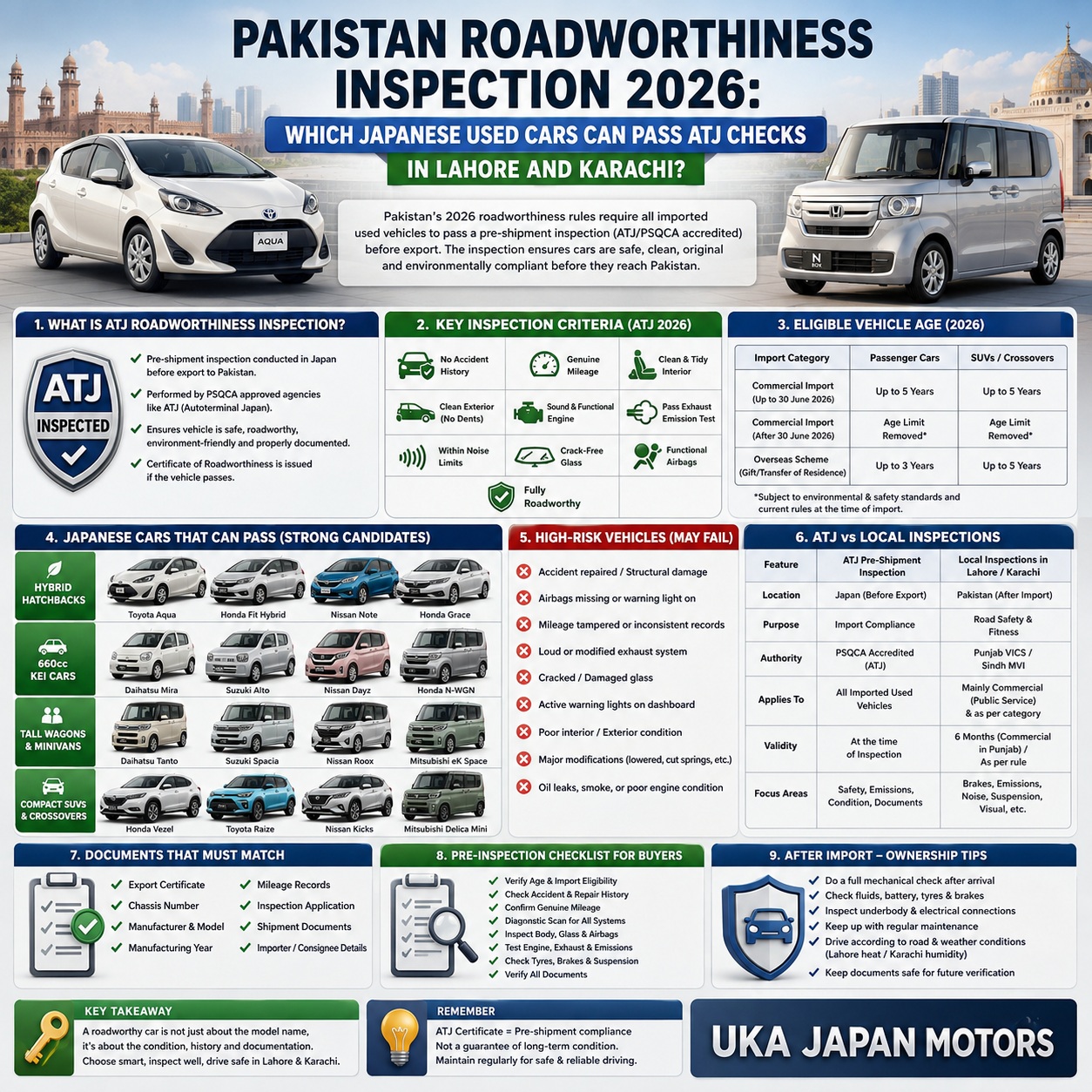
Pakistan’s roadworthiness requirements for imported used vehicles changed significantly in 2026. Japanese used cars intended for registration and daily use in Lahore or Karachi now face greater scrutiny before shipment, particularly in relation to accident history, mileage authenticity, emissions, engine condition, airbags, glass, exterior damage and general road safety.
The most important clarification is that an ATJ roadworthiness inspection is not normally carried out after the car reaches Lahore or Karachi. It is a pre-shipment inspection performed before the vehicle is exported to Pakistan. Lahore and Karachi are the eventual ownership and registration environments, while the inspection itself is intended to stop unsuitable vehicles before they enter the import process.
Pakistan’s amended import framework recognises pre-shipment inspection agencies registered with the Pakistan Standards and Quality Control Authority, or PSQCA. Autoterminal Japan, commonly known as ATJ, publishes Pakistan-specific Roadworthiness Inspection criteria, while other accredited organisations may also issue the required conformity documentation. The Ministry of Commerce lists SRO 2443 of December 2025 as the amendment dealing with pre-shipment inspection, and ATJ states that its Pakistan inspection programme began on 1 April 2026.
For buyers in Lahore and Karachi, the practical question is therefore not simply, “Is this a Toyota, Honda, Nissan, Daihatsu, Mitsubishi or Suzuki?” The real question is:
Is the individual vehicle accident-free, mechanically sound, correctly documented, unmodified, clean, emissions-compliant and equipped with functioning safety systems?
A well-kept Japanese hatchback can pass. A poorly repaired example of the same model may not.
Direct Answer: Which Japanese Used Cars Can Pass?
Recent, accident-free and mechanically original examples of commonly imported Japanese models can potentially pass an ATJ inspection. Suitable candidates may include:
- Toyota Aqua, Corolla Axio, Corolla Fielder, Yaris and Raize
- Honda Fit, Grace, Vezel and N-WGN
- Nissan Dayz, Note and Roox
- Daihatsu Mira, Move, Tanto and Cast
- Suzuki Alto, Wagon R, Hustler and Spacia
- Mitsubishi eK Wagon, eK Space and Delica Mini
This is not an official ATJ approval list. ATJ does not pass or fail a car merely because of its model name. Each unit is assessed according to its age eligibility, accident history, mileage record, mechanical condition, safety equipment, emissions, noise, glass and overall roadworthiness.
A Toyota Aqua with original body structure, verified mileage, functioning airbags, clean exhaust readings and no warning lights may be a strong inspection candidate. Another Aqua with repaired structural damage, replaced airbags, odometer inconsistencies or an illuminated hybrid-system warning may fail.
The same principle applies to every model.
What the 2026 ATJ Roadworthiness Inspection Actually Means
ATJ describes its Pakistan service as a Roadworthiness Inspection, or RWI. The inspection supports the issuance of a Certificate of Roadworthiness for vehicles being exported to Pakistan.
Its published Pakistan requirements state that a vehicle must:
- Fall within the applicable age category
- Have no accident history
- Have no evidence of mileage tampering
- Have a tidy, undamaged interior
- Have a clean exterior without bumps, dents or dimples
- Have a sound and functional engine
- Pass the applicable radiation inspection
- Pass exhaust-gas testing
- Remain within permissible noise limits
- Have crack-free and undamaged glass
- Have functioning airbags
- Be roadworthy in all respects
ATJ also states that vehicle age is determined by the year of manufacture rather than only by the first registration date. This distinction can affect vehicles manufactured near the end of one year but registered during the following year.
ATJ’s published process indicates that an export certificate should be submitted before inspection. The application records details such as the make, model, chassis number and first registration information, allowing the inspection and certificate to be associated with a particular vehicle rather than merely with a model category.
ATJ Inspection Is Not the Same as a Local Lahore or Karachi Fitness Test
The terms “roadworthiness inspection,” “vehicle fitness inspection,” “registration inspection” and “physical verification” are often used together, but they do not necessarily describe the same procedure.
ATJ pre-shipment inspection
This happens before export. It is connected with import conformity and the documentation required for a used vehicle to enter Pakistan under the applicable import procedure.
Lahore vehicle fitness inspection
Punjab’s Vehicle Inspection and Certification System, or VICS, is primarily used for public-service and commercial transport vehicles. Punjab states that commercial vehicles must receive a fitness certificate and undergo testing every six months.
The VICS system performs seven principal checks:
- Brakes
- Wheel alignment
- Noise
- Emissions
- Headlights
- Suspension
- Visual condition
Punjab also requires proper registration documents, identification and a vehicle free from visible leaks, hanging parts and loose wiring when presented for a fitness inspection. Vehicles that fail must be repaired and returned for retesting.
A privately used Japanese hatchback registered in Lahore should not automatically be treated as subject to the same six-month commercial fitness cycle. Its import inspection, registration verification and any future fitness obligation depend on its classification and use.
Karachi vehicle fitness inspection
Sindh maintains a Motor Vehicle Inspection Wing and provides fitness certification for commercial vehicles through the Motor Vehicle Inspector. The provincial transport department also issued a notification in April 2026 concerning mandatory digitisation of route permits and fitness certificates.
Sindh has been developing a more automated inspection and certification system intended to replace or strengthen manual vehicle fitness procedures. The official provincial record describes the proposed system as a way to inspect vehicles electronically and identify dilapidated vehicles presenting safety or environmental hazards.
Therefore, an ATJ certificate should not be understood as permanent protection from local enforcement. It confirms condition at the time of pre-shipment inspection. Registration authorities, traffic enforcement agencies and provincial vehicle inspection systems may still examine the vehicle according to its category and use after arrival.
The Age-Eligibility Question in 2026
Vehicle age requires careful attention because Pakistan’s commercial-import policy and the published operational inspection criteria have not always appeared in identical wording.
In September 2025, the federal government announced that commercial importation of used vehicles would initially be limited to vehicles no more than five years old until 30 June 2026. The stated policy direction was that the commercial age restriction would then be removed while environmental and safety standards remained applicable.
However, ATJ’s Pakistan page, which remained current after that date, continued to state that five-year-old vehicles are allowed under its published RWI requirements. It separately states that overseas-scheme imports permit passenger cars up to three years old and SUVs up to five years old.
This creates an important practical distinction:
- A broad government policy announcement may indicate the intended direction.
- The operational inspection agency may still publish a particular age requirement.
- Customs processing may depend on the specific import route, shipment date, documentation and instructions in force when the vehicle is presented.
- Gift and Transfer of Residence imports may retain different limits from commercial imports.
A buyer should not select an older vehicle merely because an earlier announcement said that a commercial age ceiling would eventually be removed. The manufacturing year, shipment date, import category and current inspection instructions must be confirmed together before the vehicle is committed for export.
Why Model Name Alone Does Not Determine the Result
Roadworthiness belongs to the individual car, not to the badge on its bonnet.
Two cars of the same model and manufacturing year may produce completely different inspection outcomes because of differences in:
- Accident and repair history
- Chassis alignment
- Airbag condition
- Odometer records
- Engine maintenance
- Hybrid-system condition
- Exhaust performance
- Glass damage
- Suspension modifications
- Interior care
- Warning lights
- Water or corrosion exposure
Japanese used cars are often discussed through auction grades and model reputation. These may help during initial selection, but they do not replace a Pakistan-specific pre-shipment inspection.
A vehicle may look clean in photographs while hiding repaired pillars, disconnected airbag modules, active diagnostic faults or mileage inconsistencies. Conversely, a car with ordinary cosmetic wear may remain structurally and mechanically sound, although ATJ’s published exterior rules are strict enough that dents and visible damage should still be corrected before inspection.
Strong Inspection Candidates by Vehicle Type
Japanese 660cc hatchbacks and tall wagons
Cars such as the Daihatsu Mira, Suzuki Alto, Nissan Dayz, Mitsubishi eK Wagon and Honda N-WGN can be reasonable inspection candidates when they remain close to original specification.
Their compact mechanical layout does not exempt them from any safety requirement. The inspector will still consider the vehicle’s body, airbags, exhaust, engine operation, glass and general roadworthiness.
A good candidate normally has:
- Straight structural members
- Original airbag equipment
- No persistent engine or transmission warning
- No visible smoke
- No abnormal exhaust noise
- Properly operating lamps and wipers
- Roadworthy tyres
- No fluid leakage
- Intact seat belts and interior fittings
- Accurate chassis and mileage records
These vehicles suit dense urban driving in Lahore and Karachi, but buyers should also assess ground clearance, cooling-system condition and suspension strength. A car can pass its pre-shipment check yet still require careful ownership after repeated use on uneven roads, raised lane joints, broken surfaces and waterlogged streets.
Tall models such as the Tanto, Spacia, Roox and eK Space should receive particular attention around sliding doors, door pillars and roof sections. Any evidence of a side impact, distorted aperture or poorly aligned door should be investigated before inspection.
Hybrid hatchbacks and compact sedans
Toyota Aqua, Honda Fit Hybrid, Honda Grace Hybrid, Toyota Corolla Axio Hybrid and Toyota Corolla Fielder Hybrid are common examples of vehicles that may qualify when their condition is transparent and original.
ATJ’s publicly listed requirements focus on roadworthiness, engine condition, emissions and airbags. They do not provide a simple published hybrid-battery health threshold on the Pakistan information page. Nevertheless, an active hybrid warning light, poor engine operation or an unsafe electrical repair would be inconsistent with a vehicle being fully roadworthy.
Before such a vehicle is inspected, the following should be checked:
- Hybrid control system for stored faults
- Engine starting and shutdown behaviour
- Cooling fans and battery ventilation
- Exhaust condition
- Instrument-panel warning lights
- Twelve-volt battery stability
- Wiring repairs
- Air-conditioning operation
- Evidence of water entering the cabin or battery area
For Lahore, prolonged stop-and-go operation in summer places extra importance on cooling-system efficiency and air-conditioning performance. For Karachi, heat, humidity, dust and rainwater exposure make electrical connectors, floor areas and previous water entry particularly important.
A roadworthiness certificate confirms that the vehicle met the inspection criteria when examined. It does not prove that the hybrid battery will remain in equal condition through every future ownership cycle.
Compact crossovers and SUVs
Honda Vezel, Toyota Raize and other Japanese crossovers can pass when they meet the relevant age category and condition requirements.
Potential concerns include:
- Repaired front or rear crumple zones
- Previous airbag deployment
- Radar or camera warning lights
- Uneven tyre wear caused by alignment damage
- Suspension noise
- Modified ride height
- Damaged windscreens near camera mounting areas
- Non-original exhaust components
- Underbody impact damage
Crossovers are sometimes chosen because drivers expect them to handle broken urban roads more comfortably than low hatchbacks. That ownership advantage should not encourage acceptance of a repaired or structurally questionable vehicle.
An apparently minor front impact can involve the bumper reinforcement, radiator support, sensors, cooling components and airbag system. Where the inspection rule requires no accident history, cosmetic restoration alone will not make such a vehicle a reliable candidate.
Conventional petrol sedans and wagons
Non-hybrid examples such as eligible Toyota Corolla Axio, Toyota Corolla Fielder and other compact Japanese sedans may present a comparatively straightforward inspection profile when mechanically standard and properly maintained.
Their main risks are still condition-related:
- Engine smoke
- Oil or coolant leaks
- Steering play
- Brake imbalance
- Worn suspension
- Cracked glass
- Airbag faults
- Mileage discrepancies
- Accident repairs
- Excessive exhaust noise
A conventional powertrain should not be assumed to pass automatically. A neglected petrol car with an altered exhaust or unstable engine can be less suitable than a properly maintained hybrid.
High-Risk Vehicles That May Struggle to Pass
Accident-repaired vehicles
ATJ’s published Pakistan criteria state that the vehicle must not have been involved in an accident. This is stronger than a simple requirement that repairs should look neat.
Vehicles showing repairs to pillars, chassis rails, apron areas, floor sections, roof structure or major suspension mounting points should be treated as high-risk inspection candidates. A repaired structural area can also create questions about alignment, airbag deployment and the accuracy of the vehicle’s history.
A source auction record indicating repair history should not be ignored merely because the finished car now appears clean.
Vehicles with missing or disabled airbags
A removed airbag, installed resistor, altered control module or continuously illuminated airbag warning lamp directly conflicts with the stated requirement that airbags must function.
The inspection concern is not limited to the steering-wheel airbag. Depending on the vehicle, the safety system can include passenger, side, curtain and knee airbags, seat-belt pretensioners, impact sensors and a restraint control module.
After an accident, some vehicles are repaired cosmetically while their restraint systems remain incomplete. Such cars are poor candidates for Pakistan’s 2026 roadworthiness process.
Cars with doubtful mileage
ATJ specifically disallows vehicles with tampered mileage. A low odometer reading is therefore useful only when supporting records are consistent.
Warning signs may include:
- Mileage inconsistent with previous records
- Instrument cluster replacement without documentation
- Gaps in maintenance history
- Unusual wear compared with the displayed distance
- Conflicting mileage on inspection or auction documents
- Electronic control units storing different distance information
Mileage should be verified before shipment rather than explained after an inspection identifies a conflict.
Modified exhaust systems
A loud exhaust can fail the noise requirement and may also affect emissions performance. Missing catalytic equipment, poorly repaired exhaust joints and leaks near sensors can create additional problems.
Karachi and Lahore owners sometimes encounter cars that have been modified for sound or appearance before import. Returning the vehicle to a correct and properly functioning exhaust configuration before inspection is safer than relying on a temporary silencer repair.
Cracked or damaged glass
ATJ requires the windscreen and all other glass to be free from cracks and breakage. A small windscreen crack should not be dismissed because it lies away from the driver’s immediate view.
Modern Japanese vehicles may also position cameras and sensors near the upper windscreen area. Incorrect glass replacement or poor sensor mounting can create additional warning messages even when the new glass looks acceptable.
Cars with warning lights
A warning light is evidence that a system has detected a problem. Turning off the lamp temporarily without correcting the cause does not make the vehicle roadworthy.
Particular attention should be paid to:
- Check-engine warning
- Airbag warning
- Anti-lock braking warning
- Electric power-steering warning
- Hybrid-system warning
- Charging-system warning
- Brake-system warning
- Stability-control warning
Diagnostic scanning should be combined with physical inspection. Clearing stored codes immediately before testing is not a substitute for verifying that the fault has been repaired.
Vehicles with poor exterior or interior condition
ATJ’s published rules extend beyond major mechanical defects. The interior must be tidy, clean and free from stains or damage, while the exterior should not have dents, bumps or dimples.
This means a mechanically functioning car may still require preparation if it has torn upholstery, missing trim, heavily stained fabric, damaged controls or obvious body deformation.
The requirement also discourages importation of vehicles that have been roughly stored, partially dismantled or inadequately repaired.
ATJ Criteria Compared With Daily Ownership in Lahore and Karachi
| Inspection consideration | ATJ-related concern | Lahore and Karachi ownership concern |
|---|---|---|
| Accident history | Vehicle should have no accident history | Structural repairs can worsen alignment and tyre wear on uneven roads |
| Exhaust and emissions | Exhaust-gas test must be passed | Congestion and prolonged idling expose weak engines and exhaust systems |
| Cooling system | Engine must be sound and functional | Summer heat makes radiator, fan and coolant condition critical |
| Airbags | Airbags must function | Local repair quality and parts availability should be considered after any later collision |
| Glass | No cracks or breakage | Heat, road vibration and poor replacement work can expand minor damage |
| Exterior condition | No dents, bumps or dimples | Tight parking and dense traffic can create fresh cosmetic damage after arrival |
| Mileage | Tampering is not permitted | Verified mileage supports more realistic maintenance planning |
| General roadworthiness | Vehicle must be safe in all respects | Tyres, suspension and ground clearance affect everyday urban use |
The comparison shows why “passed ATJ” and “ideal for Karachi or Lahore” are related but not identical conclusions.
A very low car may be roadworthy yet inconvenient on certain broken streets. A hybrid may be fully functional yet require a workshop familiar with its cooling and electrical systems. A 660cc car may pass every safety requirement but feel strained when repeatedly operated with heavy passenger and luggage loads.
Inspection establishes a minimum condition at a particular point in time. Ownership suitability requires a broader assessment.
Documentation That Should Match the Vehicle
Roadworthiness is partly mechanical and partly documentary.
Before inspection and shipment, the following records should be consistent:
- Export certificate
- Chassis number
- Manufacturer and model
- Manufacturing year
- First registration information
- Mileage history
- Auction or condition record
- Inspection application
- Shipment documents
- Importer and consignee details where applicable
ATJ’s application process requests vehicle-specific information and requires submission of the export certificate before inspection. This helps connect the physical car with its legal identity.
A discrepancy should be resolved before the vehicle is shipped. Chassis-number errors, inconsistent manufacturing information or unclear mileage records can create problems even where the mechanical condition appears satisfactory.
For buyers in Karachi, documentation is particularly important because the vehicle generally enters the registration process after customs handling at the port. Lahore buyers may receive a vehicle transported inland after clearance, making it important that original import and inspection documents travel with the car rather than remaining with an intermediary.
A Practical Pre-Inspection Selection Method
A dependable selection process should begin before the vehicle is booked for ATJ inspection.
First, verify eligibility
Confirm the import route, manufacturing year and shipment timing. Do not rely solely on the model year stated in an advertisement.
Second, reject doubtful accident history
Review the source inspection record, body panels, structural photographs and any repair notation. Where major repair history is disclosed, do not assume the car will be acceptable simply because it drives normally.
Third, verify mileage
Compare the odometer with available service, auction, inspection and ownership records.
Fourth, perform a diagnostic scan
Check the engine, transmission, airbags, anti-lock braking system, electric steering, stability control and hybrid control modules where fitted.
Fifth, inspect the body and safety systems
Confirm that the windscreen is intact, seat belts operate correctly, airbags are present, lights work and the exterior meets the required condition.
Sixth, test the engine and exhaust
The engine should start cleanly, idle consistently and operate without abnormal smoke, excessive noise or fluid leakage.
Seventh, inspect tyres, steering, brakes and suspension
Even when not individually described on ATJ’s short public checklist, these systems are fundamental to the requirement that the vehicle be roadworthy in all respects.
Eighth, verify the documents again
The chassis number visible on the vehicle should correspond exactly with the export and inspection records.
Does Passing ATJ Guarantee Registration?
No inspection certificate should be treated as an unconditional registration guarantee.
An ATJ certificate demonstrates that the vehicle met the applicable pre-shipment inspection requirements when examined. Customs and registration authorities may separately review:
- Import-category eligibility
- Manufacturing age
- Shipment date
- Certificate validity
- Chassis identity
- Customs documentation
- Tax and duty compliance
- Importer eligibility
- Provincial registration documents
- Physical verification requirements
The Ministry of Commerce framework allows PSQCA-registered and internationally accredited inspection agencies to carry out pre-shipment inspection under the Import Policy Order. The certificate is therefore one part of the complete import record rather than a replacement for every other requirement.
Long-Term Ownership After the Inspection
A Japanese used car should be inspected again after it reaches Pakistan, even where it arrives with a valid roadworthiness certificate.
Sea transport, port storage, inland movement and extended parking can affect:
- Battery charge
- Tyre pressure
- Brake surfaces
- Fluid levels
- Electrical connections
- Underbody condition
- Air-conditioning performance
Before regular operation in Lahore or Karachi, a sensible arrival inspection should include engine oil, coolant, brake fluid, tyres, brakes, suspension, wheel alignment, air-conditioning and electronic diagnostics.
Lahore considerations
Lahore driving commonly combines dense traffic, longer cross-city journeys, summer heat, dust and variable road surfaces. Particular attention should be given to:
- Radiator and cooling fans
- Engine and hybrid cooling passages
- Air filter condition
- Air-conditioning load
- Suspension bushes
- Wheel alignment
- Tyre sidewalls
- Ground clearance
Karachi considerations
Karachi adds coastal humidity, severe congestion, dust, intense heat, rainwater accumulation and frequent stop-and-go use. Owners should watch:
- Electrical connectors
- Underbody corrosion
- Cabin water entry
- Door and window seals
- Cooling-system condition
- Brake maintenance
- Air-conditioning efficiency
- Hybrid battery ventilation
- Tyres damaged by broken road edges
Passing the original roadworthiness inspection does not remove the need for preventive maintenance under these conditions.
UKA Japan Motors’ Inspection-Oriented Role
UKA Japan Motors’ role should be to help buyers understand the relationship between source condition, inspection certification, import documentation and local ownership.
This involves reviewing whether:
- The vehicle falls within the applicable import category
- The manufacturing year is correctly identified
- The chassis and export records match
- Accident history is clearly disclosed
- Mileage information is consistent
- Airbags and warning systems appear functional
- The condition is suitable for a pre-shipment inspection
- The inspection certificate corresponds to the imported vehicle
- The car’s design remains practical for Lahore or Karachi usage
A roadworthiness certificate should not be represented as proof that a vehicle is perfect. It is evidence that the vehicle met a defined inspection requirement at a particular time.
Transparent guidance also means advising against a vehicle when its structural history, documents or mechanical condition create an avoidable inspection risk.
Frequently Asked Questions
1. Are ATJ checks performed in Lahore or Karachi?
ATJ’s Pakistan RWI is primarily a pre-shipment inspection conducted before the used vehicle is exported. Lahore and Karachi are the intended registration and ownership locations, not normally the point at which the original pre-shipment inspection occurs. ATJ does list a Karachi representation office, but its Pakistan requirement remains a pre-export conformity process.
2. Does every Japanese used car need an ATJ certificate?
Pakistan requires the relevant pre-shipment roadworthiness or conformity certificate from an eligible PSQCA-approved inspection agency under the applicable import framework. ATJ is one such agency publishing Pakistan-specific criteria, but the governing principle is approval of the inspection agency rather than the model’s country of manufacture alone.
3. Can an accident-repaired Japanese car pass?
ATJ’s published requirement states that the vehicle must not have been involved in an accident. A vehicle with disclosed accident or structural repair history should therefore be regarded as a high-risk or unsuitable candidate for an ATJ roadworthiness certificate.
4. Can a car with a replaced bumper pass?
A replaced cosmetic component does not automatically establish the full vehicle history. The important issue is why it was replaced, whether an accident occurred, whether structural components were affected and whether the finished exterior meets ATJ’s condition requirements. The history should be verified rather than inferred from the bumper alone.
5. Can a Japanese hybrid pass the inspection?
Yes, a hybrid can potentially pass when it satisfies the same roadworthiness, safety, engine, emissions, airbag, glass, mileage and condition requirements. An active hybrid warning, unsafe wiring repair or serious powertrain fault would make the vehicle a poor candidate.
6. Does a clean auction sheet guarantee an ATJ pass?
No. An auction or condition record can support selection, but ATJ conducts its own inspection for Pakistan. Mechanical faults, damaged glass, airbag problems, emissions, noise or documentation inconsistencies can still affect the result.
7. Will a small dent cause a failure?
ATJ’s published exterior requirement says the vehicle should be clean and have no bumps, dents or dimples. Even a mechanically minor dent should therefore be corrected or reviewed before the inspection rather than assumed to be acceptable.
8. Can a car pass with an airbag warning light?
A warning light indicates that the restraint system has recorded or detected a fault. Since functioning airbags are an explicit ATJ requirement, an unresolved airbag warning should be expected to create an inspection problem.
9. Are modified wheels and lowered suspension acceptable?
ATJ’s public summary does not list every possible modification separately. However, the vehicle must be roadworthy in all respects. Tyre rubbing, unsafe wheel fitment, cut springs, poor suspension travel or altered alignment would conflict with that requirement.
10. Does ATJ check the hybrid battery capacity?
ATJ’s short published Pakistan criteria do not state a specific hybrid-battery capacity threshold. They do require the engine to be sound and the complete vehicle to be roadworthy. A diagnostic assessment remains advisable because a certificate should not be interpreted as a long-term hybrid-battery guarantee.
11. Is an ATJ certificate enough for Punjab VICS?
No. ATJ inspection and Punjab VICS serve different regulatory stages. VICS applies particularly to public-service and commercial vehicles operating in Punjab and includes local tests for brakes, alignment, noise, emissions, headlights, suspension and visual condition.
12. Is an ATJ certificate enough for Sindh commercial fitness?
No. A commercial vehicle operating in Sindh may still require a provincial fitness certificate through the Motor Vehicle Inspection system. Import roadworthiness documentation does not permanently replace provincial transport compliance.
13. How is the vehicle’s age calculated?
ATJ states that age is based on the year of manufacture rather than simply the first registration year. Import rules may also apply calculations connected with shipment timing and import category, so both the manufacturing record and shipment documents should be checked.
14. Which model is the safest choice for passing ATJ?
There is no single guaranteed model. The safest inspection candidate is a vehicle with verifiable mileage, no accident history, original safety equipment, a sound engine, compliant exhaust, undamaged glass, clean bodywork and complete documentation.
15. Can a car pass ATJ and still be unsuitable for Karachi or Lahore?
Yes. A vehicle can meet the pre-shipment criteria but still be less practical because of low ground clearance, delicate tyres, limited cooling-system maintenance, unsuitable load capacity or insufficient local technical support. Inspection compliance and ownership suitability should be assessed separately.
Conclusion
Pakistan’s 2026 roadworthiness framework changes the way Japanese used cars should be selected. The most reliable approach is to begin with the inspection standard rather than choosing a model first and investigating its history later.
Toyota Aqua, Honda Fit, Nissan Dayz, Daihatsu Mira, Suzuki Alto, Honda Vezel and many other Japanese models may pass an ATJ inspection, but only when the individual vehicle meets the required condition. The badge, auction photograph or displayed mileage cannot replace structural verification, diagnostic testing and document review.
Buyers in Lahore should consider heat, dust, long commutes, suspension wear and uneven road surfaces after the import inspection has been completed. Buyers in Karachi should give equal attention to cooling, electrical condition, humidity, water exposure, brakes and underbody protection.
Most importantly, ATJ inspection must be understood as a pre-shipment regulatory step. It is not the same as Punjab VICS, Sindh commercial fitness certification or provincial registration verification. A properly selected vehicle should be capable of satisfying the import inspection while also remaining mechanically appropriate for its intended daily use.
Contact UKA Japan Motors for availability and inspection guidance.